Under Chapter 733 of the Florida Statutes, probate administration involves private bilateral contracts like beneficiary redistribution agreements, settlement compromises, or real estate purchase contracts, alongside essential court instruments like Letters of Administration, Orders Determining Homestead, and Petitions for Exempt Property.
While contracts allow heirs, personal representatives, and creditors to voluntarily restructure rights or resolve disputes, court orders and statutory filings are strictly required to clear title, transfer legal ownership, and protect protected assets in Florida probate proceedings.
Let us be completely honest with each other for a second. Nobody wakes up on a sunny Tuesday morning in South Florida thinking, I really hope I get to read a fifty page legal breakdown of Florida probate contracts today!
If you found your way to this page, someone you cared about likely passed away, or a lawyer handed you a stack of paperwork thick enough to act as a doorstop. Now you have to make sense of it all.
When an estate enters probate under Chapter 733 of the Florida Statutes, families quickly discover that the legal world runs almost entirely on paperwork. Some of these papers are genuine, two-sided contracts where living people negotiate terms. Others are formal court orders that require a judge to stamp a seal before anyone can touch a single dollar in a bank account.
Here is an honest, straightforward guide to every contract and document you might encounter in South Florida, written in plain language without the dense legalese that usually makes people fall asleep at their desks.
PART 1: Private Contracts and Bilateral Agreements in Florida Probate
In ordinary life, a contract requires a mutual agreement, an offer, and something of value changing hands. In the probate realm, contracts serve as the legal tools that let living people fix messy situations, buy out family members, or hire experts to clean out a dusty attic.
1. Private Agreements Among Interested Persons (Fla. Stat. § 733.815)
What It Is and How It Looks
A Private Agreement Among Interested Persons looks like a standard legal contract. It starts with a caption identifying the estate, followed by a long list of “Whereas” clauses that explain the background.
The main text outlines who gets what, releases everyone from liability, and includes signature lines that require proper legal validation. It must state clearly that all parties are competent adults and that no creditor is getting cheated out of money.
Detailed Scenario
Mateo and Sofia are adult siblings who inherited their late father’s estate in Coral Springs. The father’s will leaves everything split equally between them. The estate consists of a house worth $400,000 and an investment account worth $400,000.
Mateo wants to live in the house. Sofia prefers cash so she can buy a condo in Miami.
Instead of forcing a quick sale of the home that neither of them actually wants, their lawyer drafts an agreement under Section 733.815. Mateo gets full ownership of the house, Sofia gets the investment account, and Mateo pays her an extra $25,000 to cover minor valuation differences.
Legal Mechanics
Under Florida Statutes Section 733.815, heirs can agree to trade or reallocate assets however they like. The personal representative must confirm that all estate debts, final taxes, and administrative fees are covered before handing over the keys.
2. Family Settlement Agreements and Compromises (Fla. Stat. § 733.708)
What It Is and How It Looks
A Family Settlement Agreement looks like a high stakes corporate treaty. It includes agreed facts, complete releases of liability, and a clause submitting the deal to the 17th Judicial Circuit Court in Broward County.
Crucially, it includes a paragraph requiring the executor to present the contract to the probate judge for official sign off.
Detailed Scenario
A resident of Fort Lauderdale passes away and leaves behind a brand new will that disinherits his child from a first marriage, leaving everything to a second spouse. The child hires a lawyer and claims the new spouse used undue influence when the father was sick.
Both sides realize that fighting in court for three years will only make the litigation lawyers rich.
During mediation, they draft a Family Settlement Agreement. The surviving spouse agrees to pay the child a flat cash settlement and hand over a few family heirlooms. In exchange, the child drops the lawsuit and agrees never to sue the estate again.
Legal Mechanics
Florida law loves family settlements because they keep relatives from screaming at each other in courtroom hallways. Submitting the contract under Section 733.708 turns a private agreement into a binding court order. This step is mandatory if any beneficiaries are minors, since kids cannot legally sign away their rights without a judge checking the math first.
3. Personal Representative Service and Vendor Contracts (Fla. Stat. §§ 733.612 and 733.619)
What It Is and How It Looks
A Fiduciary Service Contract looks like a typical vendor agreement for home repairs or estate sales. The key difference is tucked away in the very first paragraph and the signature block.
It must state that the person signing is acting only as the representative of the estate, not as an individual paying out of their own pocket.
Detailed Scenario
The executor of an estate in Coral Springs needs to fix a damaged roof, paint the living room, and clear out forty years of accumulated furniture before putting a home on the market. The executor hires a licensed roofing company and a professional estate sale team.
This executor signs the contracts. Because they are managing someone else’s property, they must ensure the contract text protects their personal savings account if something goes wrong on the job site.
Legal Mechanics
Florida Statutes Section 733.612 gives an executor the authority to hire workers to preserve estate property. Under Section 733.619, an executor becomes personally liable for the bill if they forget to specify their official title on the signature line. If you sign your name without adding “as Personal Representative of the Estate,” the contractor can legally demand payment directly from your personal checking account.
4. Real Estate Purchase and Sale Agreements in Probate (Fla. Stat. § 733.613)
What It Is and How It Looks
A Probate Real Estate Purchase Agreement uses standard residential contract forms alongside specific probate clauses.
The seller line must list the seller in their official representative capacity. The agreement always includes a clause making the sale contingent on court approval or proper probate filings.
Detailed Scenario
A decedent owned a house in Coral Springs, and a buyer puts in a great cash offer.
The real estate agent writes up the contract, but the closing attorney notices that the deceased person died without a valid will. That means there is no written clause granting a power of sale.
Legal Mechanics
Under Florida Statutes Section 733.613, if a will does not explicitly give the executor the power to sell real estate, the executor cannot transfer title on their own. The contract sits in limbo while the probate lawyer files a formal petition with the Broward County court. All heirs receive formal notice, and the judge must sign an order approving the sale before the closing can happen.
A Creditor Compromise Agreement is a short contract between the executor and a creditor like a credit card company or hospital.
It states the original debt amount, acknowledges that the estate has limited funds, sets a lower lump sum payment, and confirms that the debt is fully canceled once the check clears.
Detailed Scenario
A decedent leaves behind $30,000 in credit card bills, but the estate only holds $12,000 in a checking account along with a protected primary home.
Credit card companies cannot touch a protected Florida homestead. That $12,000 in the bank is the only cash available to pay off every bill. The executor calls the credit card companies and offers each one a fraction of what they are owed to settle the accounts completely.
Legal Mechanics
Section 733.708 allows an executor to negotiate and settle debts for lower amounts. However, Florida law enforces a strict priority list for paying bills under Section 733.707.
Funeral costs, court administrative fees, and final hospital bills take priority over credit cards. Paying off a low priority credit card before settling the funeral bill can make the executor personally responsible for paying the funeral home out of their own pocket.
6. Attorney and Professional Engagement Agreements (Fla. Stat. §§ 733.6171 and 733.6175)
What It Is and How It Looks
A Probate Retainer Agreement is a formal contract between the executor and the law firm. It explains the legal scope of work, hourly rates or percentage fee schedules, upfront costs, and court filing expectations.
Florida law requires specific written disclosures explaining how probate attorney fees are calculated.
Detailed Scenario
A newly appointed executor in Broward County feels completely overwhelmed by the legal paperwork and hires a local probate law firm to manage the estate.
The law firm provides an engagement agreement detailing whether they will charge an hourly rate or use the standard state fee percentage based on the total value of the estate assets.
Legal Mechanics
Florida Statutes Section 733.6171 sets statutory fee guidelines that courts consider reasonable for probate lawyers. Under Section 733.6175, any heir who thinks the lawyer is charging too much can ask the probate judge to review the bill and cut the fee down to a fair amount.
7. Contracts Concerning Succession and Agreements to Make a Will (Fla. Stat. § 732.701)
What It Is and How It Looks
A Contract to Make a Will is an agreement created while the person is still alive. It looks like a hybrid between a commercial contract and a will, explicitly stating that one person agrees to leave specific property to another in exchange for a clear action or service.
Detailed Scenario
An elderly parent tells their adult child that if the child moves to Coral Springs, quits their job, and acts as a full time caregiver, the parent will leave them the family home in their will. The child moves in and takes care of the parent for five years.
When the parent passes away, a surprise will surfaces that leaves the entire house to a local pet shelter.
The child files a claim against the estate using their written caregiver contract.
Legal Mechanics
Under Florida Statutes Section 732.701, an agreement to make a will or leave an inheritance is completely useless unless it is written down and signed in front of two attesting witnesses. Casual verbal promises made over dinner carry zero weight in a Florida courtroom, no matter how unfair the situation seems.
8. Premarital and Postmarital Elective Share or Property Waivers (Fla. Stat. § 732.702)
What It Is and How It Looks
A Waiver of Spousal Probate Rights is a specialized contract, usually included inside a prenuptial or postnuptial agreement. It contains clear clauses where a spouse gives up their rights to the elective share, homestead property, exempt assets, and family allowances.
Detailed Scenario
Two people get married later in life. Both own homes in South Florida and have adult children from previous marriages. They want their homes to pass directly to their biological kids without any surviving spouse claims getting in the way.
They sign a prenuptial agreement waiving all probate inheritance rights. When the husband passes away, the wife steps aside so the kids can inherit the house cleanly.
Legal Mechanics
Under Florida Statutes Section 732.702, a spouse can sign away their inheritance rights. The document must be in writing and signed in front of two attesting witnesses. Signing this document after the wedding requires a full, honest written disclosure of all personal assets and bank accounts.
PART II: Critical Non-Contractual Probate Documents
Contracts are voluntary agreements between people. The rest of the probate world runs on court orders, official petitions, and statutory filings. You need to know these documents just as well as any contract.
1. Letters of Administration
What It Is: The official document issued by a probate judge that appoints the executor and grants them the legal authority to handle the estate.
How It Looks: A single page court document featuring the raised seal of the Broward County Clerk of Courts, the case number, and the judge’s signature.
When It Comes Into Play: You cannot move money, close accounts, or sell property without this document. Bank managers will refuse to speak with you until you hand them a certified copy of these Letters.
2. Petition and Order Determining Homestead Property (Fla. Const. Art. X, § 4 and Fla. Stat. § 732.401)
What It Is: A formal court request and judge’s order declaring that a house was the deceased person’s primary Florida residence.
How It Looks: A legal order containing the property address, legal parcel details, and an official ruling that the house passes directly to protected family members.
When It Comes Into Play: A primary residence in Florida receives massive legal protection under the state constitution. Protected homestead property passes to heirs completely free from most creditor claims, and it sits outside the standard probate estate process.
3. Petition to Determine Exempt Property (Fla. Stat. § 732.402)
What It Is: A formal court filing asking the judge to set aside specific personal belongings for the surviving spouse or minor children.
How It Looks: A court filing listing household furniture up to $20,000, college savings accounts, and up to two personal cars.
When It Comes Into Play: When creditors come knocking, the surviving spouse files this petition to protect the family cars and living room furniture from being seized to pay off old bills.
4. Statement of Claim (Fla. Stat. § 733.703)
What It Is: The official form a creditor files with the court to demand payment for an unpaid debt.
How It Looks: A short court form detailing the amount owed, the reason for the debt, and attached proof like credit card statements or medical bills.
When It Comes Into Play: Creditors must file this form within three months of the public probate notice, or within thirty days of receiving direct notice. If a creditor misses the deadline, their claim gets wiped out forever.
5. Disclaimer of Interest (Fla. Stat. § 739.104)
What It Is: An official written statement where an heir says, No thank you, I do not want this inheritance.
How It Looks: A notarized statement filed directly with the court, detailing the exact asset or inheritance share being refused.
When It Comes Into Play: People use this document when accepting an inheritance would trigger a massive tax bill, or when they want the asset to pass directly to their own children instead.
Summary Matrix: Contracts vs. Non-Contractual Probate Instruments
Document or Instrument Type
Legal Nature
Governed By
Primary Purpose in Probate
Private Agreement (§ 733.815)
Bilateral Contract
Fla. Stat. § 733.815
Lets heirs change how assets are divided among themselves.
Family Settlement Agreement
Multilateral Contract
Fla. Stat. § 733.708
Resolves serious family disputes and stops active lawsuits.
Vendor Contract
Commercial Contract
Fla. Stat. §§ 733.612, 733.619
Hires workers while protecting the executor’s personal money.
Real Estate Purchase Agreement
Commercial Contract
Fla. Stat. § 733.613
Handles the sale of estate owned houses or land.
Creditor Compromise Agreement
Bilateral Contract
Fla. Stat. § 733.708
Settles unpaid debts for lower cash payouts.
Letters of Administration
Court Order
Fla. Stat. Chapter 733
Gives the executor official authority to manage the estate.
Order Determining Homestead
Judicial Order
Fla. Const. Art. X, § 4
Protects the family home from general debt collectors.
Frequently Asked Questions (FAQs)
1. Can siblings legally change how an inheritance is divided in Florida?
Yes. Under Florida Statutes Section 733.815, competent adult heirs can sign a private contract to divide property however they want. The deal cannot cheat creditors or leave out non signing family members.
2. What happens if an executor signs a contract without using their official title?
Under Section 733.619, an executor who signs a contract without adding “as Personal Representative of the Estate” can be held personally responsible for paying the bill out of their personal savings.
3. Can you sell a house during probate in Broward County?
Yes, but the process depends on the will. If the will explicitly grants a power of sale, the executor can complete the deal. If there is no will, the contract must state that the sale depends on getting an approval order from a Broward County judge under Section 733.613.
4. Is an oral promise to leave property to someone in a Florida will valid?
No. Section 732.701 states that any agreement to leave an inheritance is completely invalid unless it is written down and signed in front of two witnesses.
5. What is the difference between a probate contract and a court order?
A probate contract is a voluntary agreement between living people. A court order is an official decision signed by a judge that carries the full force of the law.
6. Can heirs sign a contract to skip probate court entirely?
No. Private contracts cannot transfer legal ownership of assets that require court orders, like sole name real estate or locked bank accounts. Contracts only control how assets are shared within or after the court process.
7. How long do creditors have to file a claim against a Florida estate?
Under Section 733.702, creditors must file a formal Statement of Claim within three months of the published notice, or within thirty days of receiving direct notice. Late claims are permanently barred.
Let Us Take the Stress Off Your Shoulders
Trying to make sense of probate contracts, court orders, and inheritance rules while grieving a loved one is exhausting. You do not have to figure this out by yourself late at night.
If you need to settle a family dispute, protect a primary residence, or complete a property sale in Coral Springs or Broward County, reach out to our team at Reinfeld & Cabrera. Call us directly at (954) 866-8600 or send us a message online to set up a time to talk. We will handle the heavy legal lifting so you can focus on taking care of your family.
Fast Answer: If a Florida business owner dies or becomes incapacitated, what happens to the business depends on the business structure, governing documents, estate plan, and applicable Florida law. Ownership may pass to heirs or other beneficiaries, while management authority may remain with other owners or designated decision makers. A business succession plan can establish what happens to the owner’s interest and who can manage the company when the owner can no longer do so.
Business owners spend years building companies that depend on their judgment, relationships, skills, and decisions.
Then life does what life does.
An owner dies. An illness leaves someone unable to work. A business partner suddenly has to deal with an estate. Family members inherit an ownership interest without knowing how the company operates. Employees are left wondering who can sign contracts, access accounts, or make decisions.
These situations raise two separate questions:
Who owns the business interest, and who has authority to run the business?
Those answers do not always point to the same person.
A Florida business succession plan addresses what happens to ownership and management when an owner dies, becomes incapacitated, retires, or otherwise can no longer participate in the company. Depending on the business, that plan may involve an operating agreement, shareholder agreement, buy-sell agreement, trust, power of attorney, estate plan, or several of these documents working together.
What Happens to a Business When the Owner Dies?
The answer depends heavily on the type of business and its governing documents.
If a person owns an interest in a Florida LLC, the ownership interest does not necessarily give the person’s heirs an automatic right to step into the owner’s management role.
Florida’s LLC statute distinguishes between a transferable interest and the rights of a member. A transferee generally receives the economic rights associated with the transferred interest but does not automatically acquire the right to participate in management or access company records.
Death can also cause an individual to cease being a member under Florida’s LLC statute, while the consequences of that dissociation depend on the governing law and the company’s operating agreement.
That can create a surprisingly awkward situation.
Imagine a company owned by two siblings. One dies and leaves everything to a spouse who has never worked in the business. The spouse may inherit an economic interest, while the surviving sibling continues operating the company.
Now everyone has a legitimate interest in what happens next.
The spouse wants to know what the inherited interest is worth. The surviving sibling wants to know who has authority to make business decisions. The company needs to continue operating.
An operating agreement or buy-sell arrangement can address those questions before anyone has to improvise.
What Happens If a Business Owner Becomes Incapacitated?
Death and incapacity create different legal problems.
When an owner dies, the estate and succession process becomes relevant. When an owner becomes incapacitated, the business may need someone with legal authority to act while the owner is still alive.
Florida’s Power of Attorney Act defines incapacity in part as the inability to take actions necessary to obtain, administer, and dispose of property, including business property.
A properly drafted durable power of attorney can allow an agent to continue exercising specified authority despite the principal’s later incapacity.
The document needs to grant the authority actually required. Florida law provides that an agent may exercise authority specifically granted in the power of attorney, and certain powers require specific enumeration.
That makes the details important for a business owner.
A document authorizing someone to handle personal banking does not necessarily answer every question involving ownership interests, company management, securities, contracts, or other business decisions.
A succession plan should therefore consider incapacity separately from death.
Does a Will Control My Business After I Die?
A will can determine who receives assets that pass through the estate, including an ownership interest in a business.
But the will does not automatically rewrite the company’s governing documents.
An LLC’s operating agreement governs important aspects of the company’s internal affairs. Florida law expressly provides that an LLC is bound by its operating agreement and that a person who becomes a member is generally bound by it as well.
Corporations have their own governing documents and statutory rules concerning shareholders, shares, directors, officers, and shareholder agreements. Florida’s Business Corporation Act separately addresses restrictions on share transfers and shareholder agreements.
This creates an important planning issue:
Your estate plan and your business documents need to work together.
Suppose a business owner leaves the company to three children in equal shares. The will may produce three equal ownership interests.
But what happens if one child wants to run the company, another wants to sell, and the third wants cash rather than an operating role?
The will alone may not provide a practical answer.
Can a Trust Own a Business Interest?
Yes. A trust can hold certain business interests, and trusts can be part of a broader estate and succession plan.
That does not mean putting an LLC interest into a trust automatically solves the succession problem.
The trust document has to address who controls the trust, who benefits from it, and what the trustee can do with the property. Florida law gives trustees significant powers, including powers to acquire and sell trust property, subject to the terms of the trust and the trustee’s fiduciary duties.
The business documents also have to be considered.
For example, an LLC operating agreement may contain restrictions or requirements concerning transfers, membership, voting, management, or the admission of new members.
A trust can therefore be one component of a succession plan rather than a substitute for the entire plan.
What Is a Buy-Sell Agreement?
A buy-sell agreement establishes rules for what happens to an owner’s business interest when a specified event occurs.
Depending on how it is drafted, the triggering event might include death, disability, retirement, divorce, termination of employment, or another circumstance affecting ownership.
A typical arrangement might give the company or the remaining owners the right, or sometimes the obligation, to purchase the departing owner’s interest.
The agreement can also address valuation and payment terms.
Consider the three-sibling example again.
If one sibling dies, the agreement might provide a mechanism for the surviving owners to purchase that sibling’s interest at a defined valuation methodology. The estate receives value, while the remaining owners retain control of the company.
That is a very different outcome from leaving three people to negotiate ownership after the death.
The details matter. Valuation formulas that seemed reasonable five years ago may produce strange results after the business has grown substantially. Funding also needs consideration. A purchase obligation is useful only if the parties have a realistic way to pay for it.
What Happens to a Family Business When the Owner Dies?
Family businesses create another succession problem: inheritance and management can point in different directions.
A child may inherit an ownership interest without having any experience running the company. Another child may have spent twenty years working in the business and expect to continue operating it.
Those interests can coexist, but the documents need to account for them.
A useful succession plan can address:
Who can own the business
Who can manage the business
Whether family members can transfer their interests
Whether existing owners have purchase rights
How an owner’s interest will be valued
How a purchase will be funded
What happens if an heir does not want to participate in the company
“A 50/50 split sounds wonderfully democratic until two people have a 50/50 disagreement.”
That problem becomes considerably harder when one of the two owners has died and the surviving owner is now dealing with the deceased owner’s estate.
Who Runs the Business While the Estate Is Being Settled?
This is one of the practical questions business owners often overlook.
A business does not necessarily stop operating because its owner has died. Employees still need to be paid. Customers still expect service. Contracts still need attention. Taxes and other obligations continue.
But the legal authority to make decisions can become complicated depending on the company’s structure and the owner’s role.
An LLC may be member-managed or manager-managed. Florida law provides different management structures, with management generally vested in the members of a member-managed LLC and in the managers of a manager-managed LLC.
That means the succession plan should account for management authority, not merely inheritance.
The same principle applies to corporations, partnerships, and other business structures.
The person who inherits the business and the person who runs the business do not necessarily have to be the same person.
What Documents Should a Business Owner Have in Place?
There is no universal package that works for every business.
Depending on the circumstances, a Florida business owner may need to coordinate several documents:
Operating agreement
For an LLC, the operating agreement can establish rules concerning ownership, management, voting, transfers, and other internal matters. Florida law gives operating agreements an important role in governing the company’s affairs.
Shareholder agreement
Corporations may use shareholder agreements to establish rules concerning ownership and the relationship among shareholders.
Buy-sell agreement
This can establish what happens when an owner dies, becomes disabled, retires, or experiences another specified triggering event.
Will
A will can address assets that pass through the estate, including business interests that are part of the probate estate.
Trust
A trust may hold business interests and establish rules for their administration and eventual distribution.
Durable power of attorney
A properly drafted durable power of attorney can address authority during incapacity, subject to the powers actually granted in the document.
These documents should be coordinated.
A business succession plan can become surprisingly fragile when the operating agreement says one thing, the buy-sell agreement says another, and the estate plan was drafted years earlier without considering the company.
What If the Business Has Multiple Owners?
Multiple-owner businesses need succession planning even when everyone is getting along.
Especially when everyone is getting along.
The difficult provisions are often the ones people are least interested in discussing when the company is doing well.
What happens if one owner dies?
What if an owner’s spouse inherits the interest?
What if one owner wants out?
What if an owner becomes unable to work?
What if two owners disagree about selling the company?
What if the business becomes significantly more valuable?
These are business questions, but they also become estate-planning questions when ownership changes because of death or incapacity.
“Most business partnerships start with optimism. The operating agreement is where you discuss what happens when optimism takes a day off.”
That conversation can be uncomfortable. It is also considerably easier to have while everyone is alive, healthy, and still speaking to one another.
How Do You Plan for Business Succession in Florida?
Start by identifying the business interest itself.
Is the company an LLC, corporation, partnership, or another structure? Who owns it? Who manages it? What does the governing agreement say about transfers and management?
Then consider the two events that tend to create the biggest disruption: death and incapacity.
For death, determine how ownership should transfer and whether the remaining owners should have a purchase right or obligation.
For incapacity, determine who can exercise the necessary authority while the owner is alive.
Then coordinate those decisions with the owner’s estate plan.
The goal is not necessarily to create a complicated stack of documents. It is to make sure the documents already governing the business and the documents governing the owner’s estate do not contradict one another.
Business Succession Planning in Coral Springs and Broward County
For business owners in Coral Springs, succession planning can involve both business law and estate planning.
A company may have an operating agreement, shareholder agreement, employment arrangements, commercial contracts, and financial obligations. The owner may separately have a will, trust, power of attorney, and other estate-planning documents.
Those pieces should be reviewed together when ownership of the business represents a significant part of the owner’s estate.
The same considerations apply throughout Broward County and South Florida.
A succession plan drafted when a company has two owners and $200,000 in annual revenue may need substantial revision after the company has ten employees, several million dollars in revenue, and three generations of family members involved.
Frequently Asked Questions
What happens to my LLC if I die in Florida?
The result depends on the LLC’s operating agreement, ownership structure, and applicable Florida law. Death can cause an individual member to dissociate, while the economic interest and management rights associated with the business interest can be treated differently.
Can my children inherit my business?
They may inherit a business interest depending on the business structure, estate plan, governing agreements, and applicable law. Inheriting an ownership interest does not necessarily mean inheriting the right to manage the company.
Does a will determine who runs my business?
Not necessarily. A will can address ownership passing through the estate, but management may be governed by the company’s operating agreement, corporate documents, or other applicable rules.
Can a trust own my LLC interest?
A trust can hold certain business interests, but the trust terms and the company’s governing documents need to be considered together.
What happens to my business if I become incapacitated?
The answer depends on the business structure and the authority available to someone else to act for you. A properly drafted durable power of attorney can provide authority that continues despite later incapacity, subject to its terms and Florida law.
Do I need a buy-sell agreement if I have business partners?
It can be useful when the owners need predetermined rules for what happens after death, disability, retirement, or another triggering event. Whether one is appropriate depends on the business and the owners’ objectives.
Planning for the Future of a Florida Business
A business succession plan answers a very practical question:
What happens to the company when the person who currently controls it cannot continue doing so?
For some owners, the answer may involve an operating agreement. For others, it may require a buy-sell agreement, trust, durable power of attorney, revised estate plan, or several documents working together.
The important part is making those decisions while the owner can still make them.
To properly execute a paper will in Florida, the testator must sign at the end of the will, or direct another person to sign for them in their presence. The testator’s signing or acknowledgment must occur in the presence of at least two witnesses, and those witnesses must sign in the presence of the testator and each other. Florida also permits electronic wills under separate statutory requirements.
The rules may sound straightforward. The details matter.
A will can contain exactly what someone intended to leave to their family and still create a problem if the document was not executed according to Florida law. That is why signing a will deserves more attention than simply putting a signature on the last page.
What Are the Requirements for Executing a Will in Florida?
The testator must sign at the end of the will, or direct another person to sign the testator’s name in the testator’s presence.
The testator must sign or acknowledge the will in the presence of at least two attesting witnesses.
The witnesses must sign the will in the presence of the testator and in the presence of each other.
Florida law does not require a particular set of magic words for a will to be valid. The required formalities are what matter.
Codicils, which modify an existing will, generally must be executed with the same formalities as a will.
That last point is easy to overlook. Adding a handwritten instruction to an existing estate-planning document does not automatically turn the instruction into a valid codicil.
How Many Witnesses Are Required for a Florida Will?
A Florida paper will requires at least two attesting witnesses.
The witnesses do not merely sign a document that the testator hands them.
Florida law requires the testator’s signing or acknowledgment to occur in their presence. The witnesses then sign in the presence of both the testator and each other.
The order of events can therefore matter.
A proper execution ceremony gives everyone a clear understanding that the document being signed is the testator’s will and that the required witnesses are participating in its execution.
This is one reason formal will execution is usually handled as a deliberate process rather than as an administrative afterthought.
Does a Florida Will Have to Be Notarized?
No. A notary is not a substitute for the two witnesses required to execute a traditional Florida will.
Notarization enters the picture in a different way when a will is made self proved.
Under Florida Statute §732.503, a will that has been properly executed can be made self proved through the testator’s acknowledgment and the affidavits of the witnesses before an officer authorized to administer oaths.
The self proving affidavit is therefore connected to the proof of the will. It does not replace the basic execution requirements.
That distinction is important because people sometimes assume that a notarized will is automatically valid.
A notary stamp cannot repair an execution process that failed to comply with the statutory requirements.
What Is a Self Proving Affidavit?
A self proving affidavit is a sworn statement associated with a properly executed will.
The testator acknowledges the will, and the witnesses swear to the circumstances of its execution before an authorized officer. When the statutory requirements are satisfied, the will can be admitted to probate without further proof of execution.
Florida law also provides that a self proving affidavit can establish prima facie formal execution and attestation in a will contest.
In practical terms, that can make the later probate process easier because the estate does not necessarily have to locate a witness years later simply to establish how the will was signed.
A self proving affidavit does not make an improperly executed will valid.
The underlying will still needs to satisfy the applicable execution requirements.
Can a Handwritten Will Be Valid in Florida?
This is one of the areas where Florida law can surprise people.
Florida does not generally allow a person to bypass its execution requirements merely because the person wrote the will by hand.
A document written entirely in the testator’s handwriting is commonly called a holographic will. Florida’s statute specifically excludes holographic and nuncupative wills from the ordinary out of state validity provision, while requiring wills executed in Florida to comply with the state’s formal requirements.
Writing “This is my will” on a sheet of paper and signing it is therefore not a reliable substitute for a properly executed Florida will.
There are situations involving wills executed under another state’s law, military testamentary instruments, and other special circumstances, so an individual document should be evaluated under the law applicable to it.
Can a Will Be Signed Electronically in Florida?
Yes.
Florida has a statutory framework for electronic wills. An electronic will uses an electronic signature and must be executed according to the requirements established in Part V of Chapter 732.
Florida law also permits the required presence of individuals to be satisfied through qualifying audio video communication technology in circumstances involving online notarization and the statutory requirements for electronic execution.
Electronic wills have additional requirements that do not apply in exactly the same way to an ordinary paper will.
For example, Florida law addresses qualified custodians and establishes requirements concerning the custody of an electronic will before it is offered for probate.
An electronic will should therefore not be treated as a PDF version of a paper will. It is a separate legal framework with its own execution and custody requirements.
Can a Beneficiary Witness a Will in Florida?
Florida law specifically addresses who may serve as a witness.
Florida Statute §732.504 provides that a person who is an interested witness is not disqualified from witnessing a will merely because the person has an interest under the will.
That does not mean that choosing beneficiaries as witnesses is necessarily the best practical approach.
When witnesses are available who have no personal interest in the estate, using disinterested witnesses can avoid unnecessary questions later about the circumstances surrounding the execution.
The important point is that the witness question should be considered deliberately rather than handled by asking whichever two people happen to be standing nearby.
What Happens If a Will Was Not Properly Executed?
An execution problem can become important when the will is presented for probate.
Florida law places the initial burden on the person offering a will to establish prima facie formal execution and attestation in a will contest. A self proving affidavit executed under the statute can establish that prima facie showing.
If the formal execution of the document is challenged, the circumstances surrounding the signing may therefore become part of the probate dispute.
That does not mean every mistake produces the same legal result.
A document signed in another state may be governed by rules concerning the validity of out of state wills. Military testamentary instruments have separate statutory treatment. Electronic wills are governed by their own provisions.
The circumstances surrounding the document matter.
Is an Out of State Will Valid in Florida?
Often, yes.
Florida Statute §732.502 provides that a will executed by a nonresident can be valid in Florida if it was valid under the laws of the state or country where it was executed, subject to the statutory limitations.
This can matter frequently in Florida estate planning.
Someone may have created a will in New York, New Jersey, Illinois, or another state before moving to Coral Springs. The fact that the person now lives in Florida does not automatically mean the old will is worthless.
It does mean the document deserves review.
The same applies when someone has moved between countries or has estate documents prepared under another jurisdiction’s laws.
A Florida estate-planning review can determine whether an existing will works with the person’s current circumstances and Florida law.
What If I Need to Change My Will?
Changing a will requires care.
Florida law provides several methods for revoking or modifying testamentary documents, and a codicil must be executed with the same formalities as a will.
That makes informal changes risky.
Writing a new instruction in the margin, crossing out a provision, attaching a note, or creating a separate document does not necessarily accomplish what the person intends.
If the goal is to change the estate plan, the safer approach is to use a legally recognized method of modification or replacement and execute the resulting document properly.
There is a reason lawyers tend to be suspicious of the sentence, “I just made a few changes to the old will.”
What Should You Do When Signing a Will?
The execution ceremony should be treated as part of the legal document, not as a routine signing appointment.
Before signing, make sure the document being executed is the final version.
The people participating should understand their roles.
The testator should follow the signing and acknowledgment procedure required by the applicable law. The witnesses should sign as witnesses and follow the required presence rules. If a self proving affidavit is being executed, that process should be completed at the same time when appropriate.
The original should then be stored somewhere it can actually be found.
A beautifully drafted will hidden in an unknown filing cabinet is not a particularly useful estate-planning document.
What Can Go Wrong With Poor Will Execution?
Several problems can complicate probate:
A required witness did not actually witness the testator’s signing or acknowledgment.
The witnesses did not sign in the required presence of the testator and each other.
Someone made handwritten changes without properly executing a new document or codicil.
The family cannot determine which version is the final will.
An electronic will was not created or maintained according to the statutory requirements.
A will prepared in another state has not been reviewed after the testator moved to Florida.
The original document cannot be located.
A later dispute raises questions about the circumstances surrounding execution.
Some of these problems can be addressed through evidence or other legal procedures. Others can produce genuine probate litigation.
The simplest time to discover an execution problem is while the person who made the will is still alive and able to correct it.
Does a Lawyer Have to Execute My Will?
No. Florida law does not require every will to be prepared or executed by an attorney.
A person can prepare their own estate-planning documents.
The legal requirements do not become optional because the document was prepared without a lawyer, however. A do-it-yourself will still has to comply with the applicable rules if it is going to function as intended.
Legal review can also identify issues that have nothing to do with the signature ceremony itself, including conflicts between an old will and newer estate-planning documents, beneficiary designations, trusts, business interests, or property ownership.
Execution is one part of estate planning.
It is an important part, but it is not the entire plan.
Proper Will Execution in Coral Springs and Broward County
For residents of Coral Springs and Broward County, will execution questions often arise when an older will is being updated, when someone has moved to Florida from another state, or when family circumstances have changed since the original document was signed.
The signing process should account for the applicable Florida requirements and for the rest of the person’s estate plan.
Reinfeld & Cabrera P.A. assists clients in Coral Springs, Broward County, and throughout South Florida with wills, trusts, probate, and related estate-planning matters.
Frequently Asked Questions
How many witnesses are required for a will in Florida?
A traditional Florida paper will generally requires at least two attesting witnesses. The testator must sign or acknowledge the will in their presence, and the witnesses must sign in the presence of the testator and each other.
Does a Florida will need to be notarized?
No. A notary does not replace the two required witnesses. A properly executed will can be made self proved through the statutory affidavit process.
Is a handwritten will valid in Florida?
A handwritten will does not generally avoid Florida’s execution requirements merely because it was written by the testator. The circumstances under which the document was executed matter.
What is a self proving affidavit?
It is a sworn statement by the testator and witnesses that satisfies Florida’s statutory requirements for making a properly executed will self proved. A self proved will can generally be admitted to probate without additional proof of execution.
Can a beneficiary witness a will in Florida?
Florida law does not automatically disqualify an interested person from serving as a witness. Even so, selecting appropriate witnesses should be handled carefully.
Can I make an electronic will in Florida?
Yes. Florida recognizes electronic wills under a separate statutory framework that includes requirements concerning electronic signatures, witnesses, notarization, and, for self proof, qualified custody.
Is an out of state will valid in Florida?
A will executed outside Florida can be valid in Florida when it satisfies the applicable requirements of the state or country where it was executed, subject to Florida’s statutory rules.
Do I need a lawyer to execute a will?
Florida law does not require an attorney to be present for every will execution. A lawyer can nevertheless review the document and execution process and identify issues that could affect its validity or its interaction with the rest of an estate plan.
This article provides general information about Florida law and is not a substitute for legal advice concerning a particular estate or will.
Yes. An estate plan can keep an asset out of probate while creating a different problem involving ownership, inheritance, control, or family disputes.
Joint accounts, beneficiary designations, trusts, and survivorship ownership can all be useful estate-planning tools. Problems arise when one of those arrangements is created without considering how it fits with the rest of the estate plan.
A person may add a child to a bank account because the child will receive it automatically at death. Someone else may name a beneficiary on a retirement account and never update it. A homeowner may add a child to a deed to make a future transfer easier.
Each decision can accomplish its immediate purpose. It can also produce an unintended result elsewhere.
When Probate Avoidance Changes the Intended Inheritance
The central problem is coordination.
Suppose a parent wants three children to inherit equally. The will reflects that intention, but one child is the beneficiary of a bank account, another is the beneficiary of a life insurance policy, and the house is jointly owned with the third.
The probate estate may then tell only part of the story.
Florida recognizes numerous arrangements that allow assets to pass outside probate. Some nonprobate assets can nevertheless remain relevant for other estate-planning purposes. For example, Florida’s elective-share statute includes certain payable-on-death, transfer-on-death, in-trust-for, and survivorship accounts when calculating a surviving spouse’s elective estate.
Avoiding probate and determining who should ultimately receive an estate are therefore separate questions.
Can Adding Someone to a Bank Account Cause an Inheritance Problem?
It can.
Adding a child or other person to an account may be intended to provide convenience during the owner’s lifetime or allow the account to pass automatically at death.
But joint ownership can affect both control and inheritance.
The Florida Bar warns that joint ownership can produce unintended consequences involving creditor exposure, unequal treatment of heirs, estate expenses, and other issues.
For example, a parent might add one child to an account because that child helps manage the parent’s finances. If the account carries survivorship rights, the arrangement may also determine who receives the money when the parent dies.
That result may be completely different from an intention to divide the estate equally among several children.
Can a Beneficiary Designation Conflict With a Will?
Yes.
A beneficiary designation can determine who receives certain assets without the asset passing through probate.
That can be useful until an old designation conflicts with a later estate plan.
Suppose someone signs a new will leaving the estate equally to two children. A retirement account still names one child as the sole beneficiary.
The new will does not necessarily change that beneficiary designation.
Beneficiary designations should therefore be reviewed whenever the overall estate plan changes and after major life events such as marriage, divorce, or the death of a beneficiary.
What If I Create a Trust but Forget to Transfer an Asset?
A trust document does not automatically place every asset into the trust.
If someone creates a revocable trust intending for it to hold an investment account, but the account remains solely in that person’s individual name, the trust may not control the account simply because the trust document says it should.
The same issue can arise with real estate, business interests, and other significant property.
The planning documents and ownership records need to match.
Can Putting a Child on Your House Cause Problems?
It can.
Adding a child to real estate can affect ownership and control during the parent’s lifetime as well as what happens after death.
The parent may have intended to make the eventual transfer easier. Instead, the arrangement can create a co-ownership relationship that affects decisions about selling, refinancing, or managing the property.
Florida homestead adds another layer of rules. Florida law places restrictions on the devise of homestead when a surviving spouse or minor child is involved, and separate provisions address certain lifetime transfers.
An ownership change intended to avoid probate therefore needs to be considered under the homestead rules as well.
What Happens When Estate Documents Disagree?
Consider a simple example:
The will divides the estate equally among three children.
A bank account names Child A as beneficiary.
A life insurance policy names Child B.
The house is jointly owned with Child C.
A trust was created to hold the house, but the deed was never transferred to the trust.
There is no single document explaining the entire estate.
Each asset may have its own transfer mechanism. The family may then have to determine which arrangement controls each asset and whether any of them create additional legal rights.
The underlying problem is coordination.
Should Every Asset Be Arranged to Avoid Probate?
No.
Some assets may appropriately pass through probate. Others may be better handled through a trust, beneficiary designation, survivorship arrangement, or another structure.
The useful planning exercise is to identify the major assets, determine how each is currently owned, and ask how each will pass at death.
Then compare that result with the intended distribution.
That review can reveal inconsistencies before they become disputes.
Avoiding Probate in Coral Springs and Broward County
For families in Coral Springs and Broward County, these issues can arise when an estate includes a Florida homestead, investment accounts, business interests, jointly owned property, or multiple beneficiaries.
They can also arise when someone moves to Florida with estate documents and account arrangements created years earlier in another state.
A will, trust, beneficiary designation, deed, and account title can each serve a legitimate purpose. Problems arise when they produce different results.
Frequently Asked Questions
Can avoiding probate cause problems?
Yes. Probate avoidance can create unintended ownership, inheritance, control, or family issues if the arrangement is inconsistent with the rest of the estate plan.
Can adding someone to my bank account change who inherits the money?
Yes. Depending on the account’s ownership and survivorship terms, adding another person can affect who receives the account at death.
Could a beneficiary designation conflict with my will?
Yes. Certain beneficiary designations control the transfer of assets outside probate and may produce a different result from a later will.
Can I create a trust but still have assets go through probate?
Yes. An asset that remains outside the trust and is otherwise a probate asset may still require probate administration.
Can putting my child on my house cause problems?
Yes. Adding a child as an owner can affect control and ownership during life, while Florida homestead law imposes additional rules on certain transfers and inheritance.
Should every asset be arranged to avoid probate?
No. The appropriate treatment depends on the asset, the owner’s objectives, family circumstances, and applicable Florida law.
When Probate Avoidance Becomes an Estate-Planning Problem
Keeping an asset out of probate can be useful. It can also change who owns it, who controls it, and who receives it.
The important question is whether the way an asset avoids probate produces the result the owner actually intended.
How Long Does a Landlord Have to Return a Security Deposit?
Florida Statute §83.49 creates two different timelines.
If the landlord is not making a claim against the security deposit, the deposit must be returned within 15 days after the tenancy ends.
If the landlord intends to keep some or all the deposit, the landlord has 30 days to notify the tenant. He provides a copy in writing of the intention to impose a claim and the reason for it. The notice must be sent as required by the statute. This by certified mail to the tenant’s last known mailing address or, when the parties have properly agreed to electronic notices, by email.
That difference is important. The 15-day rule is about returning a deposit when there is no claim. The 30-day rule gives the landlord time to notify the former tenant about a claim against the deposit.
What If the Landlord Wants to Keep Part of the Deposit?
A landlord cannot simply decide that the security deposit has become a convenient repair fund.
When a landlord intends to impose a claim, the required notice must state the amount claimed. It should also state the reason for the claim. The tenant then has 15 days after receiving the notice to object in writing.
If the tenant does not object within that period, things change. The landlord may deduct the claim and must send the remaining balance within the time required by the statute.
A late objection does not necessarily eliminate every possible legal claim by the tenant. Florida law says that failing to object within the 15-day period doesn’t waive the right to seek damages.
What Can a Landlord Deduct From a Security Deposit in Florida?
A security deposit exists to secure the tenant’s obligations under the rental agreement. A dispute can arise over unpaid rent, damage to the property, or other amounts the landlord claims are owed under the lease.
The recurring fight, however, is usually about damage versus ordinary wear and tear.
A tenant who has lived in an apartment for several years shouldn’t expect it to look as it did on move-in day. Normal deterioration is different from a broken fixture, a damaged door, or other physical damage caused during the tenancy.
The lease, the property’s condition, and the evidence surrounding the claimed damage all matter.
For that reason, both sides should preserve useful records:
The lease and any amendments
Move-in and move-out photographs
Inspection reports
Messages about repairs
Photographs of claimed damage
Repair invoices or estimates
Proof of rent payments
The tenant’s forwarding address
The landlord’s deposit correspondence
A photograph taken on moving day can be considerably more useful than an argument six months later about what the carpet looked like.
What Happens If the Landlord Misses the 30-Day Deadline?
This is one of the most important Florida security deposit rules.
If a landlord fails to give the required notice within the 30-day period, the landlord forfeits the right to impose a claim against the security deposit. The statute still allows the landlord to bring an action for damages after returning the deposit.
That does not mean every late notice automatically ends every dispute between the parties. It means the landlord cannot use the security deposit itself as a setoff after missing the statutory notice deadline.
For a tenant who has been waiting for a deposit, the date the tenancy ended and the date the landlord sent the notice can therefore become important evidence.
What If the Tenant Disagrees With the Deduction?
A tenant who receives a claim against the deposit has 15 days after receiving the notice to object in writing.
The objection should address the actual dispute. If the landlord claims $2,000 for repairs and the tenant believes the property suffered ordinary wear and tear, thing vary. The tenant can explain that disagreement and preserve the relevant evidence.
Photographs, inspection records, repair communications, and the condition of the property at move-in can all become useful.
If the dispute cannot be resolved, either party can bring an action to determine who is entitled to the security deposit. Florida law provides that the prevailing party is entitled to court costs and a reasonable attorney fee in an action concerning the deposit.
That can make the size and strength of the claim relevant when deciding how to proceed.
Does a Florida Security Deposit Earn Interest?
It can.
Florida law allows a landlord to hold a security deposit in a separate non-interest-bearing account, a separate interest-bearing account, or under certain circumstances through a surety bond.
When the deposit is held in an interest-bearing account, the tenant must receive interest calculated under the formula in §83.49. The statute also provides a 5% simple-interest requirement when the landlord uses the specified surety-bond option.
The landlord must also give the tenant written information about how the deposit is being held and whether the tenant is entitled to interest, subject to the statutory exceptions.
What If I Paid a Fee Instead of a Security Deposit?
Florida law now recognizes a separate arrangement in which a landlord may offer a tenant the option to pay a fee in lieu of a security deposit.
That fee is legally different from a traditional security deposit. The arrangement has its own disclosure requirements and rules concerning claims for unpaid rent, fees, and property damage. The statute applies to rental agreements entered into or renewed on or after July 1, 2023.
So if the money paid at the beginning of the tenancy was called a “deposit waiver fee,” “deposit alternative,” or something similar, the first step is to determine what agreement the tenant actually signed.
The ordinary security-deposit rules should not automatically be applied to a different arrangement.
What If the Tenant Never Gave a Forwarding Address?
Give the landlord one.
Florida’s statutory security-deposit notice specifically tells tenants to provide a new address after moving out so the landlord can send notices concerning the deposit. Section 83.49 also contains separate rules concerning a tenant who vacates or abandons a property without giving the required notice.
A forwarding address also removes one very unnecessary source of confusion.
If there is a dispute over the deposit, keep proof that the new address was provided and keep copies of the communication.
Security Deposit Disputes in Coral Springs and Broward County
A security deposit dispute in Coral Springs is governed primarily by Florida’s statewide landlord-tenant law. Florida expressly preempts local regulation of matters covered by Part II of Chapter 83, including security deposits and landlord-tenant notice requirements.
The same statutory framework applies across Broward County and South Florida, whether the rental property is in Coral Springs, Tamarac, Fort Lauderdale, Parkland, or another community.
The facts of the dispute will still be local: the rental property, the lease, the inspection records, the communications between the parties, and the evidence supporting the claimed deduction.
Landlord or tenant? Get the deposit dispute reviewed before it gets bigger.
If you are a tenant and your security deposit was withheld, bring the lease, the landlord’s notice, photographs, and your move-out records to an attorney who can evaluate whether the deduction and notice complied with Florida law.
If you are a landlord, have the lease, deposit records, photographs, invoices, and notice reviewed before assuming a deduction is enforceable. A mistake in the notice or timing can affect your ability to claim against the deposit.
How long does a landlord have to return a security deposit in Florida?
Generally, 15 days after the tenancy ends if the landlord does not intend to make a claim against the deposit. If the landlord intends to make a claim, the landlord generally has 30 days to provide the required notice.
Can a landlord keep a security deposit for damages in Florida?
A landlord may have a claim against a security deposit for amounts the tenant owes under the rental agreement, including qualifying damage. The landlord must follow Florida’s statutory notice procedure when making a claim.
What is the 30-day rule for security deposits in Florida?
If a landlord intends to impose a claim against the security deposit, the landlord generally must give the tenant written notice of the claim and its reason within 30 days after the tenancy ends.
How long does a tenant have to dispute a security deposit deduction in Florida?
A tenant generally has 15 days after receiving the landlord’s claim notice to object in writing.
What happens if a landlord does not return a security deposit in Florida?
The answer depends on whether the landlord made a claim and whether the required statutory notices were provided on time. A landlord who misses the 30-day claim-notice deadline forfeits the right to impose a claim against the deposit itself, although the statute allows a later action for damages after the deposit is returned.
This article provides general information about Florida landlord-tenant law and security deposits. It is not legal advice for a particular landlord or tenant, and the outcome of a dispute depends on the lease, the facts, and the applicable law.
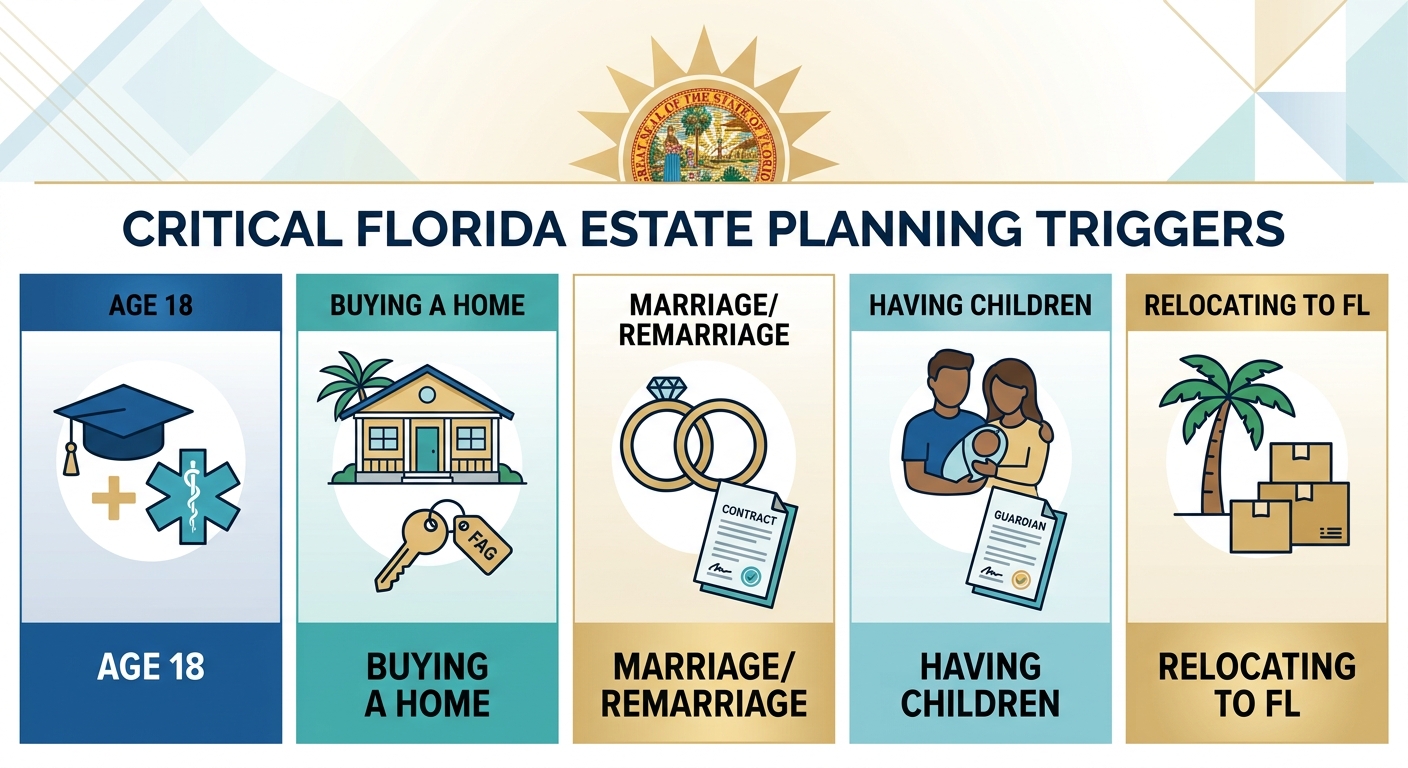
The best time to create or update an estate plan in Florida is immediately upon reaching legal adulthood (age 18) or directly following major life changes, such as acquiring real estate, getting married, having children, or relocating to Florida.
While many people assume estate planning is an end-of-life task triggered by age or net worth, Florida law operates on specific triggers—such as constitutional homestead rules, healthcare decision rights, and asset titling—that take effect regardless of your wealth.
Estate Planning Triggers Matrix: What to Secure & When
Rather than treating estate planning as a single document created at one point in time, effective planning responds to specific life milestones:
Life Trigger
Primary Focus
Critical Florida Legal Instruments
Turning 18
Medical & Financial Decision-Making
Healthcare Surrogate Designation, Living Will, Durable Power of Attorney
Buying Property / Moving to FL
Homestead Protection & Probate Avoidance
Lady Bird Deed (Enhanced Life Estate Deed), Revocable Living Trust
Business Power of Attorney, Transfer-on-Death Structures
Why Timing Matters Under Florida Law
Waiting to create or update an estate plan leaves critical decisions to default state statutes and court procedures. In Florida, three specific factors highlight why early planning is essential:
1. Healthcare Rights at Age 18
Once a child turns 18, parents no longer have automatic legal authority to view their medical records or make emergency healthcare decisions. Establishing a Healthcare Surrogate and Durable Power of Attorney ensures loved ones can act in a crisis without requiring court-ordered guardianship.
2. Florida Constitutional Homestead Rules
Florida’s constitutional homestead protections (Fla. Const. art. X, § 4) restrict how a primary residence can be transferred if a homeowner dies while survived by a spouse or minor child. Planning early prevents unintended devises that conflict with state homestead law.
3. Coordinating Assets Beyond a Will
A will alone does not avoid probate court in Florida. Assets with direct beneficiary designations (like life insurance or retirement accounts) or property titled with rights of survivorship bypass a will entirely. Coordinating asset titles and trust funding early prevents conflicting inheritance outcomes.
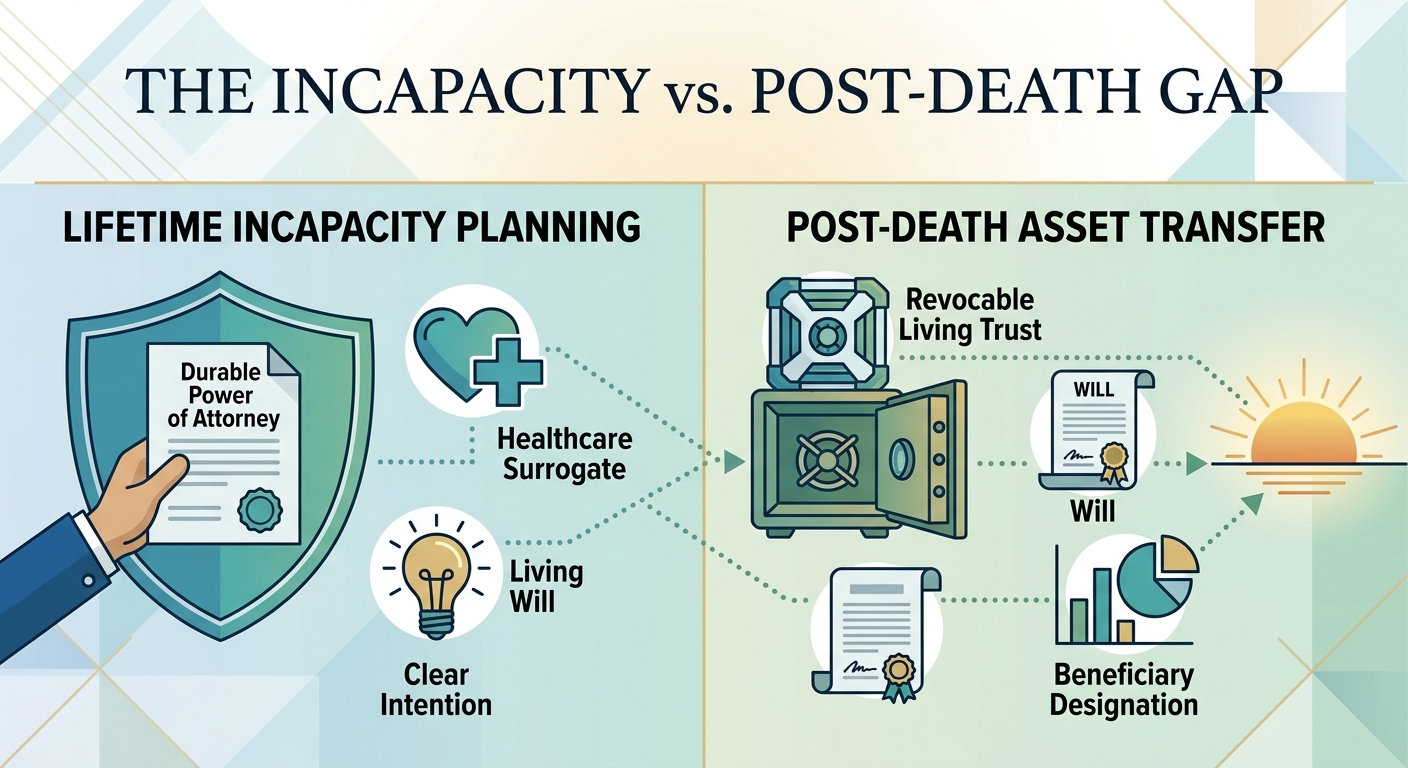
Incapacity vs. After-Death Planning: The Hidden Gap in Timing
Most people assume estate planning only dictates what happens after death. However, the most urgent reason to plan early is managing sudden incapacity during your lifetime.
In Florida, if an unexpected illness or injury leaves you unable to communicate or handle financial decisions, loved ones cannot automatically sign documents or manage accounts on your behalf—even if you are legally married.
Without proactive planning, your family must petition the court for a costly, time-consuming legal guardianship.
┌────────────────────────────────────────────────────────────────────────┐
│                        TWO PATHS OF ESTATE PLANNING                    │
├───────────────────────────────────┬────────────────────────────────────┤
│         LIFETIME INCAPACITY       │          POST-DEATH TRANSFERS      │
├───────────────────────────────────┼────────────────────────────────────┤
│ • Durable Power of Attorney       │ • Revocable Living Trust           │
│ • Healthcare Surrogate            │ • Last Will and Testament          │
│ • Living Will                     │ • Lady Bird (Life Estate) Deeds    │
│ • Pre-Need Guardian Designation   │ • Pay-on-Death (POD) Designations  │
└───────────────────────────────────┴────────────────────────────────────┘
By putting lifetime incapacity documents in place early, you ensure trusted individuals can manage your healthcare and financial affairs immediately without judicial intervention.
Take Control of Your Future Today
You do not need a massive fortune or decades of preparation to protect your family—you simply need an estate plan that aligns with Florida law and responds to your life’s milestones.
Whether you are securing your first property, starting a family, or relocating to South Florida, waiting until “someday” leaves critical decisions to courts and rigid default laws.
What happens if I move to Florida with an estate plan created in another state?
While Florida law generally recognizes out-of-state wills, specific instruments (like real estate deeds, durable powers of attorney, and healthcare directives) must strictly comply with Florida statutes to function properly. Additionally, out-of-state plans rarely account for Florida’s unique constitutional homestead restrictions.
Can I change my estate plan after it is created?
Yes. Most foundational estate plans utilize revocable living trusts and alterable wills. As long as you maintain legal capacity, you can update, amend, or completely revoke your documents whenever major family or financial life triggers occur.
How does a Revocable Living Trust help during my lifetime?
A properly funded revocable trust acts as both a lifetime management tool and an estate transfer vehicle. If you become incapacitated, your designated successor trustee can seamlessly step in to manage trust assets without needing court permission.
Is a Last Will and Testament sufficient on its own in Florida?
A will is essential for nominating personal representatives and naming legal guardians for minor children. However, a will alone does not avoid probate court or manage assets during lifetime incapacity. Complete plans combine wills with trusts and incapacity directives.
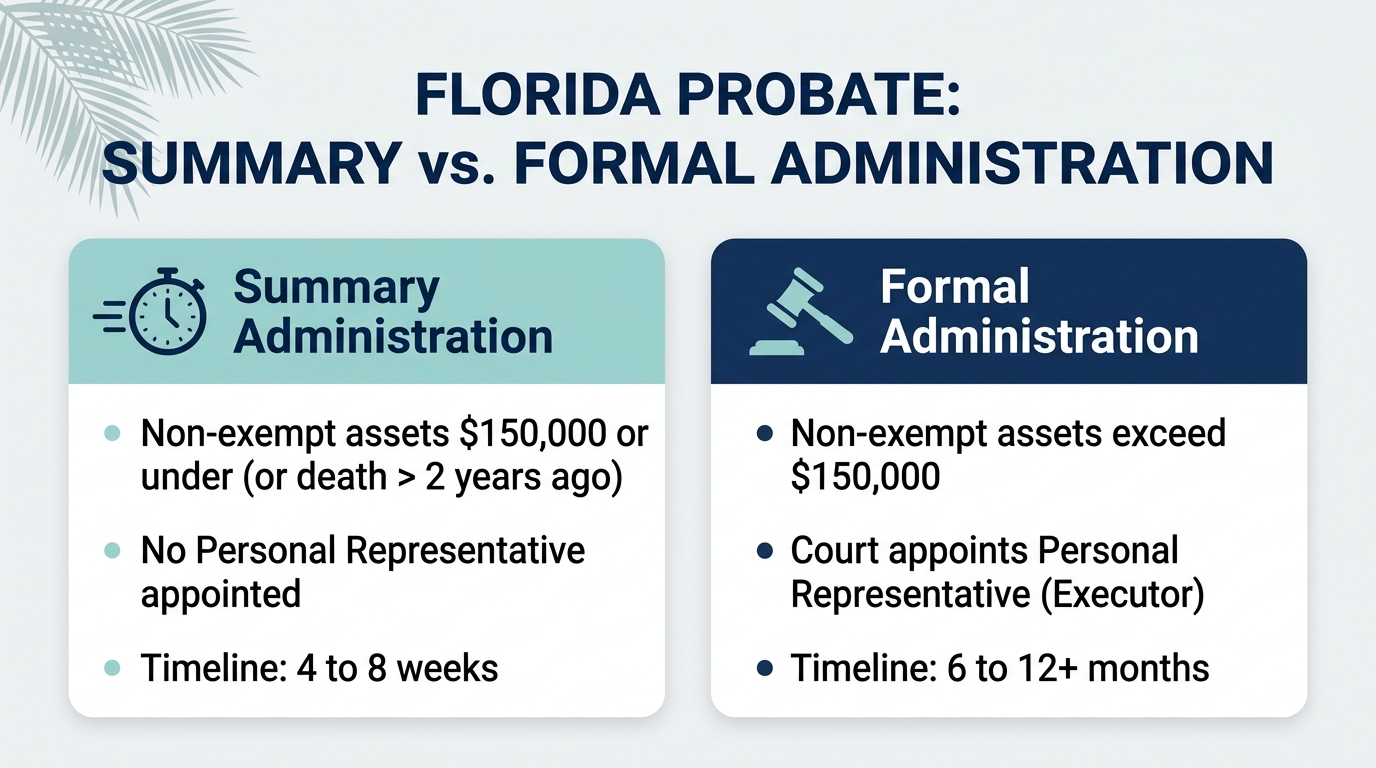
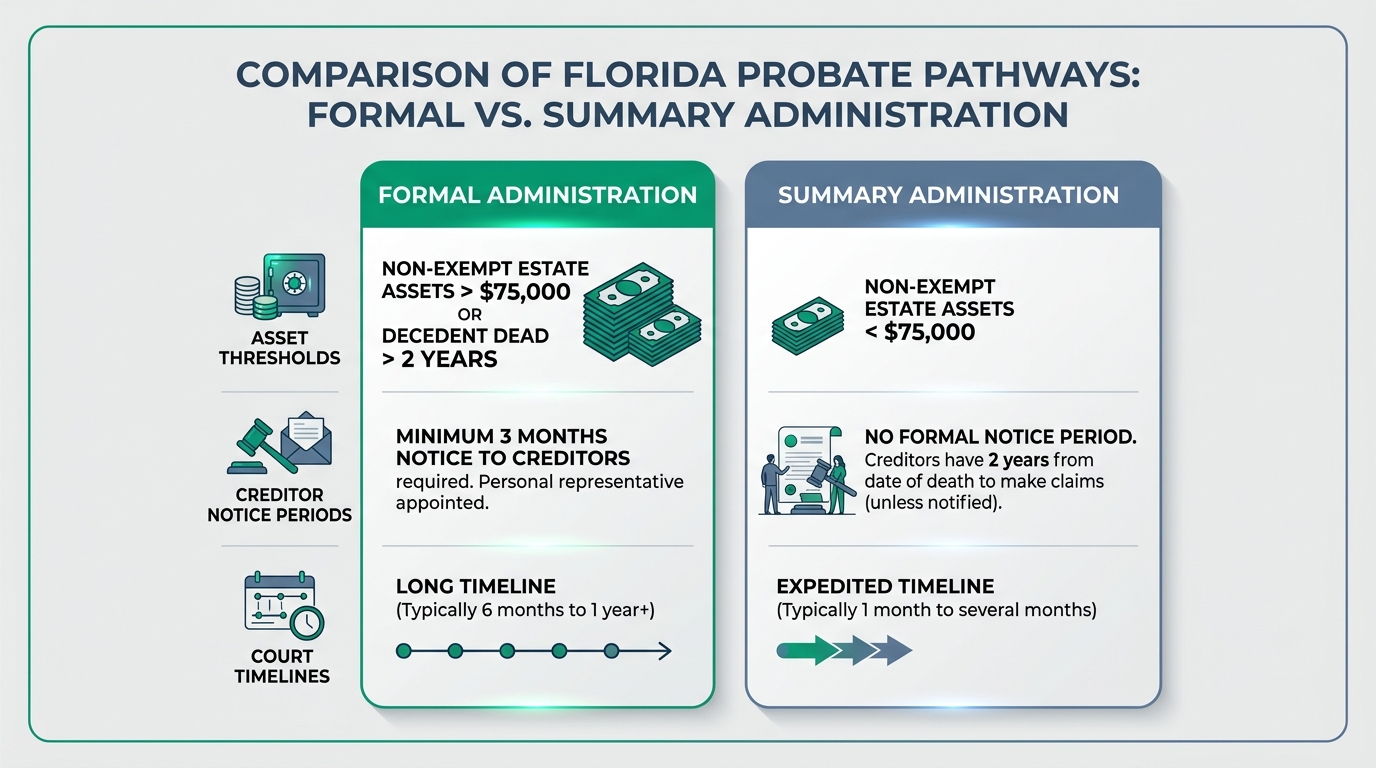
Florida law establishes two primary court-supervised probate procedures for handling an estate. Specifically, courts offer Summary Administration as an expedited process for smaller estates and Formal Administration as the traditional, fully supervised court proceeding
Whether an estate qualifies for Summary Administration depends on the total net value of non-exempt probate assets, whether the decedent has been deceased for over two years, and the complexity of outstanding creditor claims under Florida probate law (Fla. Stat. § 735.201). Understanding how these two probate paths function ensures that South Florida beneficiaries receive their inheritance as quickly and cost-effectively as possible.
Summary vs. Formal Administration at a Glance
Qualification & Process Feature
Summary Administration (Fla. Stat. § 735.201)
Formal Administration (Florida Probate Rules)
Estate Value Threshold
Non-exempt probate assets are $150,000 or less (for deaths on/after July 1, 2026), OR the decedent has been deceased for over 2 years.
Required for estates exceeding $150,000 in non-exempt probate assets (if death occurred within 2 years).
Personal Representative
Not appointed. No Letters of Administration are issued by the court.
Required. Court officially appoints a Personal Representative (Executor) with fiduciary authority.
Average Timeline
4 to 8 weeks (subject to Broward County court docket schedules).
Creditors must be resolved or served prior to distribution; or barred if death occurred over 2 years ago.
Formal 3-month Notice to Creditors published in local media to legally bar future claims.
Primary Judicial Order
Order Summary Administration directly transfers legal title of assets to beneficiaries.
Letters of Administration issued at inception; Order of Discharge issued at estate closing.
When Does Summary Administration Apply in Florida?
Furthermore, Summary Administration provides an expedited judicial procedure that transfers property title to beneficiaries without opening a full probate estate.. However – to qualify under Florida law, the estate must satisfy one of two statutory criteria:
The $150,000 Net Asset Test: Effective July 1, 2026, Florida increased the summary administration statutory limit. The total value of all assets subject to probate—excluding protected Florida Constitutional Homestead real estate and statutory exempt personal property—does not exceed $150,000 (for deaths on or after July 1, 2026; $75,000 for deaths prior to July 1, 2026).
The Two-Year Rule: In addition, petitioners can file for Summary Administration if the decedent died more than two years prior. Florida law waives the asset limit after this two-year period expires. Under Fla. Stat. § 733.710, two years establishes a non-claim statute of repose that automatically bars unfiled creditor claims.
Key Distinction: No Personal Representative Appointed
In Summary Administration, the court does not appoint a Personal Representative and does not issue Letters of Administration. Instead, the petitioner files a petition asking the judge to transfer specific assets, such as a bank account or vehicle, directly to named beneficiaries.
Some estates require active ongoing legal authority to access restricted medical records, pursue a wrongful death lawsuit, or negotiate complex business debts. Consequently, the petitioner must open Formal Administration regardless of the estate’s total value.
When Is Formal Administration Mandatory?
Formal Administration is the comprehensive, fully supervised probate process in Florida. It is mandatory when:
Non-exempt probate assets exceed $150,000 and the decedent passed away within the last two years.
The decedent’s Last Will and Testament explicitly mandates formal probate administration.
The estate involves disputed creditor claims, contested wills, or missing heirs.
In addition, the appointed Personal Representative must actively list, market, and sell real estate during probate by signing legal contracts and closing documents.
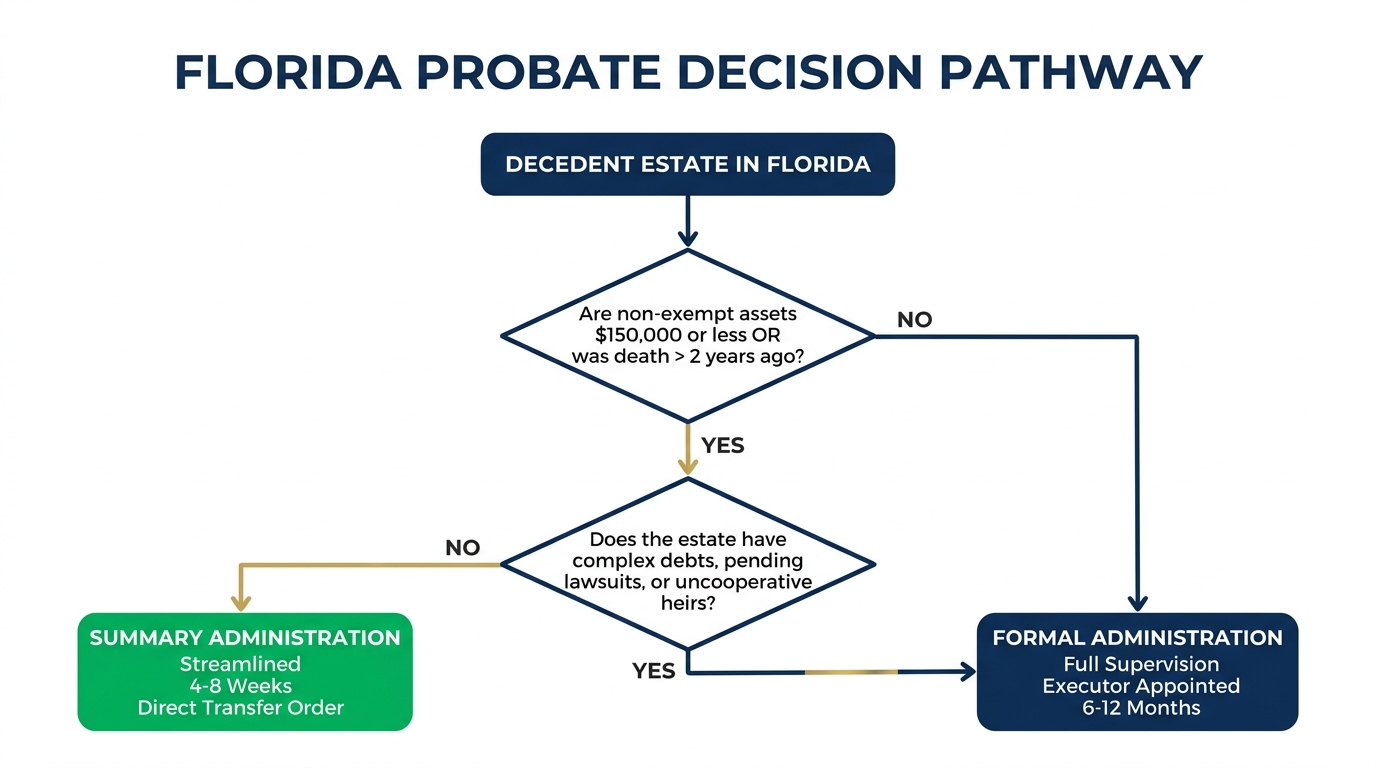
FLORIDA PROBATE DECISION PATH
↓
Is the non-exempt probate value under $150k OR has the decedent been deceased > 2 years?
▼ YES▼ NO
Are there complex debts, disputes, or land sales requiring an Executor?
YES
Requires formal oversight / Executor
NO
SUMMARY ADMINISTRATION
Expedited, 4-8 Weeks, Order Directly Transfers
FORMAL ADMINISTRATION
Full Court Process
Personal Rep Appointed, 6-12 Month Duration
What About Very Small Estates? (Disposition Without Administration)
For extremely modest estates where the decedent left no real estate, Florida offers an informal non-probate process under Fla. Stat. § 735.301 known as Disposition of Personal Property Without Administration.
This simplified filing is available only when remaining non-exempt personal property does not exceed the total sum of preferred funeral expenses and necessary medical bills incurred during the last 60 days of the decedent’s final illness.
Selecting between Summary and Formal Administration involves critical legal trade-offs beyond estate size:
1. The Post-Probate Creditor Exposure Risk
Under Fla. Stat. § 735.206, Summary Administration directly distributes assets to beneficiaries without opening a mandatory 90-day newspaper creditor publication window.
Consequently, if the petitioner files the petition before the two-year non-claim period expires, creditor claims can still affect the estate. (Fla. Stat. § 733.710). Beneficiaries remain personally liable to valid estate creditors up to the full value of the property received. If unknown debts emerge post-distribution, Formal Administration is often safer because publishing a statutory Notice to Creditors permanently cuts off future claims after 90 days.
2. Ancillary Administration for Out-of-State Residents
However, an out-of-state court order cannot transfer real estate in Broward County or anywhere in South Florida when a non-resident dies. An Ancillary Probate proceeding (Fla. Stat. § 734.102) must be opened in Florida. Depending on the non-exempt Florida land value, Ancillary proceedings can be conducted as either Summary or Formal Administration.
Frequently Asked Questions
Does Florida Homestead Property count toward the $150,000 Summary Administration limit?
No. Protected Florida Constitutional Homestead property passes to heirs outside general creditor claims. Furthermore, the court excludes this property when calculating the $150,000 Summary Administration threshold, provided the petitioner files a formal Petition to Determine Homestead Status alongside the summary petition.
What is the 10-day Will Deposit Rule in Florida?
Under Fla. Stat. § 732.901, whoever holds the decedent’s original Last Will and Testament must deposit it with the Clerk of the Circuit Court in the county where the decedent resided within 10 days of receiving notice of death, regardless of whether formal probate will be opened.
What is the current Florida Summary Administration asset threshold?
Effective July 1, 2026 (Fla. Stat. § 735.201), the Florida Legislature increased the non-exempt probate asset threshold for Summary Administration from $75,000 to $150,000 for deaths occurring on or after July 1, 2026 (or where the decedent has been deceased for more than 2 years). Protected homestead property continues to be excluded from this calculation.
How long does Formal Administration take in Broward County?
A routine, uncontested Formal Administration in Broward County typically takes between 6 and 12 months. This timeframe accommodates publishing the mandatory Notice to Creditors, observing the 90-day statutory creditor claim window, marshaling asset inventories, preparing tax accountings, and securing final court discharge.
Can the court convert a summary administration to a formal administration if a dispute arises?
Yes. Unexpected creditor claims, beneficiary disputes, or newly discovered assets can push an estate’s total value over $150,000. Consequently, any interested party or petitioner can motion the court to convert the summary proceeding into a Formal Administration.
Do I need a probate attorney for Summary Administration in Broward County?
Florida law technically permits self-representation in Summary Administration when the court does not appoint a Personal Representative. However, court clerk offices cannot provide legal advice or assist you with legal filings.. Drafting accurate petitions, verifying homestead status, and coordinating creditor searches require specialized legal guidance to avoid judicial rejection.
Don’t Let an Outdated Deed Dictate Your Family’s Future
Choosing the correct probate pathway prevents costly administrative delays, court rejections, and personal liability for estate debts. Your family may qualify for an expedited Summary Administration or require full Formal Administration in South Florida. Regardless, working with experienced legal counsel ensures that you protect every estate asset.
Schedule a Property Deed & Titling Audit
Consequently, you should structure your real estate title and probate strategy so assets pass seamlessly outside of or through probate court. Contact the attorneys at Reinfeld & Cabrera, P.A. today to review your estate and property deeds with our South Florida legal team.
Office Locations: Coral Springs | Fort Lauderdale | Plantation
Direct Telephone: (954) 334-1520
Email: Info@lawrct.com
Website: mypersonalattorneys.com
Local Practice Coverage: Coral Springs, Fort Lauderdale, Tamarac, Plantation, and Broward County
When a commercial contract breaks down, an invoice goes unpaid, or a business partner fails to deliver, rushing straight into a lawsuit is rarely the smartest first move. Litigation in South Florida courts can easily take 12 to 18 months, cost tens of thousands of dollars in legal fees, and permanently destroy valuable commercial relationships.
In many cases, a strategically drafted commercial demand letter from an experienced business attorney is all it takes to enforce your rights, recover owed funds, and force a resolution—saving your business time, capital, and unnecessary stress.
What Is a Commercial Demand Letter?
Quick Answer: A commercial demand letter is a formal legal instrument sent by an attorney outlining a breach of contract or unpaid debt, detailing the exact financial or performance remedy required under Florida law, and setting a firm deadline to comply. It transitions an informal dispute into an active legal matter, establishes an official evidentiary record, and provides maximum settlement leverage before initiating formal court proceedings.
Why Demand Letters Resolve Disputes Effectively
Informal emails, text messages, and phone calls are easy for a non-paying client or defaulting vendor to ignore. However, receiving a formal legal letter on law firm letterhead fundamentally shifts the dynamics of a dispute. It signals that your business has engaged counsel and is fully prepared to take legal action if necessary.
Specifically, a well-crafted demand letter accomplishes four critical objectives:
Establishes an Unassailable Evidentiary Record: It clearly documents the timeline of the deal, the precise contractual terms, the exact nature of the breach, and the total financial damages incurred.
Imposes a Firm Compliance Deadline: Giving the opposing party a strict window (typically 10 to 30 days) forces them to pause, consult with their own legal counsel, and evaluate their potential exposure in court.
Triggers Florida Pre-Suit Statutory Prerequisites: Certain causes of action under Florida law require written pre-suit notice. Sending a formal demand satisfies these prerequisites while preserving your right to claim statutory default interest under Fla. Stat. § 55.03.
Protects Confidentiality: Unlike court pleadings filed in public records, settlement negotiations prompted by a demand letter remain completely private between the parties.
Strategic Tone Selection: Tough vs. Tactful
Before your attorney drafts the letter, you must evaluate one essential question: Do you want to preserve a commercial relationship with this party after the dispute is resolved?
Your business objectives determine the tone and posture of the letter.
┌──────────────────────────────────────────────────────────────────────────┐
│              COMMERCIAL DEMAND LETTER STRATEGIC MATRIX                   │
├────────────────────────────────────┬─────────────────────────────────────┤
│      COLLABORATIVE SETTLEMENT      │        AGGRESSIVE ENFORCEMENT       │
├────────────────────────────────────┼─────────────────────────────────────┤
│ • Objective: Preserve an ongoing   │ • Objective: Rapid financial or     │
│   vendor, client, or partner deal  │   injunctive recovery               │
│ • Focus: Mutual contract terms     │ • Focus: Strict pre-suit notice,    │
│   and structured cure options      │   damages, and statutory remedies   │
│ • Ideal For: Minor delays or       │ • Ideal For: Severe breach, fraud,  │
│   good-faith misunderstandings     │   or persistent non-payment         │
└────────────────────────────────────┴─────────────────────────────────────┘
1. The Collaborative Settlement Approach
If the dispute stems from a temporary cash flow hiccup, operational delay, or honest miscommunication with a long-term partner, an overly aggressive letter can backfire. In such cases, the demand letter adopts a firm yet professional tone. It emphasizes the underlying agreement, specifies the performance gap, and offers workable solutions—such as a structured payment plan—without burning bridges.
2. The Direct Enforcement Approach
Conversely, if you are dealing with intentional contract evasion, fraud, or a debtor refusing to communicate, soft language will yield no results. Consequently, the letter adopts an uncompromising legal stance. It explicitly details statutory causes of action, calculates interest and penalties, attaches supporting exhibits, and gives clear notice that failure to comply will result in an immediate lawsuit filed in local courts like the 17th Judicial Circuit in Broward County.
4 Essential Elements of an Enforceable Florida Demand Letter
To ensure your demand letter commands authority and holds up if the case proceeds to trial, your attorney will structure it with four core components:
1.1. Contractual & Factual Recital: Establishing the factual timeline.
A clear, detailed chronological background outlining the original agreement, purchase orders, or scope of work executed between the parties, alongside specific evidence showing full performance on your part.
2.2. Specific Allegation of Breach: Identifying the exact legal failure.
An explicit accounting of how the opposing party failed to perform, citing specific clauses of the contract, delivery deadlines missed, or unpaid invoices.
3.3. Itemized Statement of Damages: Calculating financial exposure.
A precise breakdown of direct financial losses, incidental expenses, and accrued statutory interest under Fla. Stat. § 55.03, demonstrating exactly what the non-compliance is costing your company.
4.4. Demand for Cure & Litigation Warning: Setting the litigation threshold.
A specific date by which full payment or cure action must occur, accompanied by explicit notice that non-compliance will trigger a civil complaint seeking full damages, court costs, and attorney fees where applicable.
Comparing Dispute Resolution Options
Understanding how a pre-suit demand letter compares to traditional litigation highlights why it should almost always be your first line of defense:
Feature
Legal Demand Letter
Full Court Litigation
Time to Resolution
10 to 30 Days
6 to 18+ Months
Legal Costs
Low, Fixed & Predictable
High (Discovery, Depositions, Trial)
Privacy & Publicity
100% Private
Public Court Record
Business Relationship
Potential to Preserve
Almost Always Destroyed
Enforcement Leverage
High (Pre-suit notice & pressure)
Binding Court Judgment
Protect Your Business Interests with South Florida Counsel
Allowing unpaid invoices, breach of contract, or vendor default to linger threatens your company’s cash flow and growth. The commercial litigation team at Reinfeld & Cabrera P.A. helps business owners across South Florida resolve complex disputes swiftly through strategic demand letters and aggressive trial representation when required.
Schedule a Commercial Consultation
If your company is facing a contract dispute, unpaid account, or partnership conflict, speak directly with an attorney to evaluate your legal remedies:
Direct Line: (954) 866-4878 | Toll-Free: 954-866-HURT
Coral Springs Office: 9625 W. Sample Rd, Coral Springs, FL 33065
Fort Lauderdale Office: 2933 W. Cypress Creek Rd, Suite 201, Ft. Lauderdale, FL 33309
Website: mypersonalattorneys.com
Serving: Coral Springs, Fort Lauderdale, Parkland, Tamarac, Margate, and all of Broward, Miami-Dade, and Palm Beach Counties.
What happens if the other party completely ignores a demand letter?
If the receiving party fails to respond or cure the default within the designated deadline (typically 10 to 30 days), your attorney will move forward with filing a formal civil complaint in the appropriate court—such as the 17th Judicial Circuit Court in Broward County or the 11th Judicial Circuit Court in Miami-Dade County. Furthermore, the demand letter serves as key evidence demonstrating that you made a good-faith pre-suit effort to resolve the dispute, which can influence court decisions regarding legal costs and interest.
Can I write and send a demand letter myself without an attorney?
While a business owner can technically write their own letter, DIY demand letters rarely carry the legal weight needed to force a settlement. Specifically, letters drafted without counsel often omit necessary statutory citations, fail to properly preserve rights to pre-judgment interest under Fla. Stat. § 55.03, or reveal strategic weaknesses that the opposing party’s legal team can exploit. A formal letter on law firm letterhead demonstrates immediate litigation readiness.
Can a demand letter include a claim for statutory attorney fees in Florida?
Yes. Under Florida law, attorney fees are recoverable if explicitly authorized by the underlying contract or by specific Florida statutes, such as Fla. Stat. § 57.105 (sanctions for unsupported claims/defenses) or statutory civil theft claims under Fla. Stat. § 772.11. Consequently, including a specific statutory fee warning in the demand letter significantly increases your settlement leverage.
How much does it cost to have a South Florida lawyer send a demand letter?
Drafting and serving a commercial demand letter is typically billed as a predictable flat fee or a few hours of attorney time, making it significantly more cost-effective than initiating full-scale civil litigation. As a result, most South Florida businesses recover their investment many times over through early pre-suit settlements or full debt recovery.
When you sit down at the kitchen table to sort through a parent’s papers after they pass away, the last thing you want is a fresh wave of bureaucratic dread.
What happens to the house now? How do we pay the lingering bills? And why does everyone make probate sound like a multi year hostage negotiation with the state of Florida?
Quick Answer:
Under Florida probate law, administering an estate through the 17th Judicial Circuit in Broward County involves formal or summary court proceedings to settle debts and transfer property. Formal administration typically takes between six months and over a year due to mandatory creditor notice windows, whereas summary administration offers an expedited process for estates valued under $75,000 or where the decedent passed away more than two years ago.
If you search online for estate guidance, you will drown in dry textbook definitions. Most treat probate like an unavoidable trap or a magical cure all. Neither description captures reality. Probate is simply the legal mechanism the state uses to clear title to property. It’s how to pay legitimate creditors, and transition assets when someone passes away without proper advance planning.
So what do Florida families and property owners actually need to know about navigating the Broward County court system. What do they need to get to manage a estate, and keep your hard earned assets out of unnecessary courtrooms? Let us pull back the curtain and talk about how estate administration really works in South Florida without any legal mumbo jumbo.
Why the Internet Gets Probate Wrong (And Why Wills Do Not Avoid Court)
There is a stubborn myth floating around the internet that having a last will and testament means your family completely bypasses the probate court. People assume a will acts like a VIP backstage pass that lets your heirs walk right past the judges and walk away with your property.
Nothing could be further from the truth.
Ask yourself: If I spend my entire life building equity in a home and saving for my children, why would I hand them a legal document that explicitly instructs a judge to oversee how those assets get handed out?
A will does not avoid probate. A will is instructions for the probate court. It tells the judge who you want to inherit your belongings. But the court still has to supervise the process, validate the signature, notify creditors, and formally authorize your personal representative to act. If you want to spare your family from court supervision, you have to look beyond a basic will. You should utilize tools like revocable living trusts, payable on death designations, and properly structured joint ownership.
What Actually Goes Through Probate in Florida?
Not every asset a person owns gets sucked into the probate vortex upon death. Understanding the dividing line between probate and non probate property is the first step toward building a sensible estate plan.
Probate Assets: Solely owned real estate, bank accounts held in a single name without payable on death instructions, and personal belongings like vehicles or jewelry without designated beneficiaries must go through court administration to change legal ownership.
Non Probate Assets: Assets governed by contract or operation of law pass directly to beneficiaries without court interference. This includes living trusts, life insurance policies with named beneficiaries, retirement accounts. It also includes real estate held as tenants by the entirety or joint tenants with rights of survivorship.
If your estate consists entirely of beneficiary designated accounts and trust owned property, things change. Your family might never set foot inside a courtroom. But if a single deed or bank account was left in your individual name, the probate doors swing wide open.
Formal Administration Versus Summary Administration in Broward County
When a probate estate is opened in the 17th Judicial Circuit in Broward County, the administration generally follows one of two statutory paths. Both depend on the size of the estate and how long the decedent has been gone:
Formal Administration: This is the standard, comprehensive court process required for larger estates or complex matters involving multiple creditors and disputed claims. The court appoints a personal representative, issues letters of administration, requires formal publication of notice to creditors, and mandates a multi month inventory and accounting process.
Summary Administration: A streamlined, expedited court procedure available in Florida if the value of the entire estate subject to probate does not exceed $75,000, or if the decedent has been dead for more than two years. Summary administration bypasses the appointment of a personal representative and moves much faster, though it still requires a formal petition filed by an attorney.
Avoiding Dual Tracking and Creditor Traps During Estate Administration
When a personal representative steps up to manage an estate in South Florida, they quickly realize that administering assets is a minefield of strict statutory deadlines and creditor notification rules under Florida Probate Code.
How do you handle aggressive credit card companies or mortgage lenders demanding payment while the estate is still frozen in court?
The Creditor Notice Period: Florida law requires a diligent search for known creditors and publication of a formal notice in a local legal periodical. Creditors have a strict window (typically three months from the first publication of notice) to file formal claims against the estate.
The Priority of Claims: You cannot simply pay out inheritance money to family members while valid estate debts remain unpaid. Florida law establishes a rigid priority structure for paying funeral expenses, administrative costs, taxes, and medical bills before beneficiaries see a dime. Failing to follow this order can expose the personal representative to personal financial liability.
Real World Case Example: Untangling an Estate in Broward County
To see how these rules play out in local practice, consider a scenario our firm frequently handles across Coral Springs and Fort Lauderdale.
A client came to our office after losing a parent who owned a residential home in Broward County without a living trust. The parent had left a simple will naming our client as personal representative, but because the deed was in the parent’s individual name, the property was completely frozen. To make matters worse, a home equity line of credit was past due, and the lender was threatening default proceedings while the family was still grieving.
How Our Legal Team Resolved the Crisis
Opening Formal Administration: We immediately filed a petition for formal administration in the 17th Judicial Circuit, securing letters of administration so our client had the legal authority to deal with the bank.
Publishing Creditor Notice: We managed the statutory creditor notice period. We shield the personal representative from harassing collection calls and ensuring claims were evaluated through proper legal channels.
Resolving the Debt and Transferring Title: By coordinating with the mortgage lender and liquidating a small non probate account to cover arrears, we stabilized the property, avoided foreclosure, and ultimately transferred clear title of the home to the rightful heirs.
Frequently Asked Questions About Florida Probate
How long does the probate process take in Broward County?
An uncontested formal administration in Florida typically spans 6 to 12 months. This timeline is largely dictated by mandatory statutory creditor notice periods and court review schedules in the 17th Judicial Circuit. Complex estates involving will contests or contested creditor claims can take significantly longer.
Can I avoid probate simply by writing a last will and testament?
No. A common misconception is that having a will avoids probate. In reality, a will provides instructions for the probate court on how you want your assets distributed. To avoid probate entirely, assets must pass outside the will via living trusts, beneficiary designations, or survivorship titles.
What happens if someone dies intestate without a will in Florida?
If a person dies without a valid will, Florida intestacy statutes dictate how assets are distributed among surviving spouses, children, or extended relatives. This rigid statutory formula rarely matches what the decedent would have actually wanted. And it often forces court sales of family property to divide proceeds among heirs.
Do I need a probate attorney if I am appointed as a personal representative?
Yes. Under Florida probate rules, a personal representative representing an estate with multiple beneficiaries or outstanding creditors is generally required by law to be represented by a licensed attorney admitted to practice in Florida.
Protect Your Estate and Your Family Legacy
Planning for the future or handling the aftermath of a loved one’s passing is not something you should do alone. Whether you want to bulletproof your own estate with a comprehensive living trust or you need experienced local counsel to guide you through a Broward County probate administration, having the right advocate changes everything.
The estate planning and probate attorneys at Reinfeld Cabrera Tison help families across South Florida secure their assets. We establish durable trusts, and resolve complex court proceedings with absolute confidence.
Schedule a Confidential Consultation
Do not wait until a crisis forces your family into court. Speak directly with an experienced attorney today to review your options:
Coral Springs Office: 9625 W Sample Rd, Coral Springs, FL 33065
Fort Lauderdale Office: 2933 W Cypress Creek Rd, Suite 201, Ft Lauderdale, FL 33309
Website: mypersonalattorneys.com
Local Coverage: Coral Springs, Fort Lauderdale, Parkland, Tamarac, Margate. All surrounding communities across Broward, Miami Dade, and Palm Beach Counties.
A business can have a clear ownership structure on paper and still be poorly prepared for a change in ownership. Consider a Coral Springs company whose founder holds most of the membership interest in an LLC. The founder becomes incapacitated, and the family discovers that inheriting the financial value of the company does not necessarily give them the authority to run it. The remaining members may have their own interpretation of the operating agreement. Meanwhile, employees still expect payroll, and someone has to make decisions.
The problem is not necessarily that the owner failed to make a will. The problem may be that the estate plan and the business documents were prepared separately, without accounting for what would happen if the person in control could no longer act.
This is one reason business trusts deserve careful consideration. Depending on the company’s structure and the owner’s objectives, a trust can form part of a plan for managing business interests during incapacity or transferring them after death. But a trust is not an automatic solution to every ownership problem. Its usefulness depends on how it interacts with the company’s governing documents, the rights of other owners, and the authority granted to the trustee.
The attorney should understand how the company operates, who holds decision making authority, and what would happen to those arrangements if the owner became incapacitated or died.
For owners of small and medium sized businesses in Coral Springs and throughout Broward County, those questions deserve attention before a crisis forces the issue.
Why business succession deserves attention in Florida
Florida’s business landscape includes companies at very different stages of development. A family owned construction firm may have several generations involved in its operations. A professional services company may depend heavily on one partner’s relationships with clients. A growing distributor may have substantial inventory and contractual obligations that the company cannot simply put on hold when ownership changes.
The consequences of an owner’s death or incapacity will differ across these businesses.A plan designed for a single-owner company without employees fails to meet the needs of a medium-sized company with multiple members and a management team.
The scale of Florida’s business community helps explain why these questions matter. The U.S. Small Business Administration’s Office of Advocacy reported approximately 3.3 million small businesses in Florida in its 2024 state profile. Small businesses accounted for approximately 99.8 percent of the state’s businesses. These figures concern the SBA’s small business category, rather than the entire small and medium sized business sector, but they illustrate the extent to which Florida’s economy depends on privately operated companies.
Now consider what happens when the owner of one of those companies dies. The business does not necessarily close, and its contracts do not automatically disappear. Yet the person who understood its finances or held the authority to approve major decisions may no longer be available. Family members might inherit an economic interest without having the right to manage the company. Business partners may disagree about who should take control.
These problems often arise from a mismatch between the owner’s personal estate plan and the company’s legal structure.
How Florida LLC Law (F.S. § 605.0502) Separates Management Rights from Ownership
Florida law makes that distinction particularly relevant for limited liability companies. Under Florida Statutes §605.0502, transferring an LLC interest does not automatically transfer every right associated with membership. An assignee’s economic rights are distinct from the rights to participate in management.
An owner who wants a spouse or child to inherit a business interest should therefore examine the company’s operating agreement alongside the estate plan. A trust may be useful, but the documents need to work together.
What does a business trust attorney actually do?
A business trust attorney helps determine whether a trust fits the owner’s objectives and, if it does, designs and integrates the trust with the rest of the company’s legal arrangements.
A trust generally involves a settlor who creates it, a trustee who administers the property, and beneficiaries who receive its benefits. The exact rights and duties depend on the trust document and the applicable law. A business trust may hold an ownership interest or other assets associated with a company, although the appropriate structure depends on the nature of the business.
Suppose the owner of a Coral Springs consulting firm wants a daughter to receive the financial benefit of the company after the owner’s death, while an experienced business partner continues managing its daily operations. Those objectives may be compatible, but they raise questions about who can vote on company matters, who receives distributions, and what happens if the daughter and the partner disagree.
A trust can define how owners hold or manage their equity interest. It cannot, by itself, erase restrictions in an operating agreement or guarantee that the intended management arrangement will work.
The same distinction matters when an owner is concerned about incapacity. Who has authority to act if the owner cannot make decisions? Would the company have enough continuity to keep operating? Does the existing estate plan address the ownership interest, or does it focus primarily on personal assets?
These are the questions that should guide the legal work. The trust is one possible instrument, not the starting assumption.
Eight things to look for when choosing a business trust attorney
1. Experience with Florida trust law and business ownership
Trust law and business law overlap, but they are not interchangeable. An attorney may have experience preparing family trusts without regularly handling business ownership questions. Another may understand LLC formation but have limited experience with trust administration.
For a business owner, the relevant experience lies in understanding how these areas interact.
Ask the attorney about their experience with trusts that hold business interests. Ask how they would approach a proposed transfer of an LLC interest into a trust. The answer should account for the company’s governing documents and any restrictions that might affect the transfer.
Florida’s Trust Code, Chapter 736, establishes duties and rules that can affect the administration of a trust. A lawyer advising on business succession should understand the responsibilities the trustee may assume and the rights beneficiaries may have.
You do not need a guarantee that no dispute will ever arise.. You need an explanation of the legal issues that apply to your particular business.
2. An assessment of your existing business structure
Attorneys should never draft a trust in isolation from the company it serves.
An attorney should review the operating agreement if the company is an LLC. For a corporation, the relevant documents may include its bylaws and shareholder agreements. Existing buyout provisions or restrictions on transfers can affect what happens when an owner dies or becomes incapacitated.
Consider a company with two owners who have different levels of involvement. One manages operations while the other provides capital. If the second owner’s interest passes to a beneficiary through a trust, the business still needs to determine who can make management decisions and whether the surviving owner has any purchase rights.
The trust document cannot answer every one of those questions on its own.
Florida Statutes §605.0502 is particularly relevant because an assignment of an LLC interest does not necessarily grant the recipient management rights. The attorney should establish whether the proposed arrangement fits the operating agreement before recommending a transfer.
This review may reveal that the company must update its existing documents before our team prepares a trust.. That is useful information, even if it means the legal work becomes more involved than the owner initially expected.
3. A realistic plan for incapacity
Death is only one reason an owner may become unable to manage a company. A serious illness or accident can leave the business without its usual decision maker while the owner remains alive.
The legal plan should address what happens during that period.
A revocable trust may allow a successor trustee to manage assets held in the trust under the authority granted by its terms. However, the trust does not automatically give that person authority over every aspect of the business. The company’s governing documents and the nature of the ownership interest still matter.
You do not need a guarantee that no dispute will ever arise. If the owner expects someone to manage the company itself, the plan may need additional provisions or separate arrangements.
Florida Statutes §736.0601 addresses the capacity required to create or amend a revocable trust. This is one reason owners should review their arrangements while they can still make informed decisions about them.
If incapacity is already a concern, the attorney should explain which existing documents remain effective and whether any further steps are legally available.
4. Careful selection of a successor trustee
The person who inherits the financial benefits of a business may not be the right person to administer its ownership interest. The same applies to a family member whom the owner trusts personally, but who lacks experience handling business obligations.
A successor trustee may need to communicate with company managers, understand distributions, comply with the trust’s terms, and make decisions affecting beneficiaries. The role can become demanding when the business has several owners or the beneficiaries disagree.
Ask how the attorney approaches successor trustee selection. The discussion should address the candidate’s ability to carry out the role and the practical consequences if that person declines to serve or becomes unable to continue.
It is also worth discussing whether a professional fiduciary would be appropriate. While that option introduces additional fees, business owners should consider it when the trust holds a substantial business interest or when family relationships create strain.
The goal is to appoint someone capable of carrying out the plan, rather than selecting a trustee solely because they are the closest relative.
5. Honest advice about taxes and creditor protection
Be cautious if an attorney suggests that creating a business trust automatically eliminates estate taxes or protects every asset from creditors.
Those claims confuse separate legal questions.
Business owners commonly use a revocable trust to manage and transfer assets.. Assets in a properly funded revocable trust may avoid the ordinary probate process for those assets, depending on how they are titled and the applicable law. That does not mean the assets automatically escape federal estate tax calculations.
The IRS explains the federal estate tax framework in its Instructions for Form 706. Whether a particular estate owes tax depends on the applicable rules and the facts of the estate. Florida does not currently impose a separate state estate tax under its general estate tax framework, but federal obligations may still apply.
Creditor protection is another distinct issue. Under Florida Statutes §736.0505, property in a revocable trust is generally subject to the settlor’s creditors during the settlor’s lifetime. Creating a revocable trust should not be presented as a way to make personal debts disappear.
An attorney should explain which objective the proposed arrangement is intended to serve. Probate avoidance, tax planning, and creditor protection involve different legal rules. A strategy aimed at one may not accomplish the others.
6. Proper funding and coordination of the trust
A signed trust document does not automatically place every intended asset under the trustee’s control. The assets must be transferred or otherwise connected to the trust in the appropriate manner.
For a business owner, this may involve an LLC membership interest or shares in a corporation. The correct procedure depends on the company’s legal structure and any restrictions imposed by its governing documents.
This is where an incomplete estate plan can fail in a particularly frustrating way. The owner may have paid for a trust and named the intended beneficiaries, yet the business interest remains outside it because the necessary transfer was never completed.
The attorney should explain what must be signed, whether company approvals are needed, and what records should be updated. If other professionals are involved, the owner should know who is responsible for each step.
Funding also deserves review after the initial work is finished. A company may change its ownership structure or issue additional interests as it grows. An estate plan that once reflected the owner’s wishes can become outdated if no one checks whether the documents still match the business.
7. A plan for disagreements within the family
Business succession becomes more complicated when the people who inherit an interest have different expectations.
One beneficiary may want the company to continue operating. Another may prefer to receive cash from a sale. A trustee may be required to consider the interests of several beneficiaries while complying with the trust’s terms.
Florida law imposes duties on trustees. Under Florida Statutes §736.0813, trustees have duties concerning information and accountings for qualified beneficiaries, subject to the statute’s terms and applicable exceptions.
The details matter because beneficiaries may have legitimate questions about the business interest held in trust. They may want to understand its value or how distributions are being handled. A trustee who cannot explain the decisions being made may find it difficult to maintain confidence among beneficiaries.
Ask the attorney how the trust would address competing interests. The answer should reflect the company’s circumstances rather than assume that family members will agree simply because they share a surname.
The trust document should establish clear rules where possible. The attorney should also explain which disagreements may still require negotiation or court involvement.
8. Clear fees and a defined scope of work
Before hiring an attorney, establish what the engagement covers.
Does the fee include reviewing the company’s operating agreement? Will the attorney prepare the trust and the necessary transfer documents? If amendments to existing business documents are needed, are those included or billed separately?
These questions are especially relevant for small and medium sized companies that need to manage legal expenses alongside ordinary operating costs.
A low initial fee may cover only the trust document. That may be sufficient for a straightforward personal estate plan, but a business owner may need additional work to coordinate ownership rights and succession arrangements.
Ask for a clear explanation of the proposed work and the circumstances that could increase the cost. You should understand what the attorney intends to prepare before authorizing the engagement.
Questions to ask during your consultation
The first meeting is an opportunity to find out whether the attorney understands your actual concerns. You do not need to know every detail of Florida trust law before attending. You should, however, leave with a clearer picture of the legal work involved.
Consider asking:
Have you worked with trusts that hold interests in Florida LLCs or corporations?
What parts of my existing business documents need to be reviewed?
Would the proposed trust affect who can manage the company?
What happens if I become incapacitated and cannot make business decisions?
What steps are required to transfer the intended ownership interest into the trust?
Could the arrangement create tax consequences or leave the assets exposed to creditors?
Who would administer the trust if my first choice could not serve?
What work is included in your fee, and what might require a separate engagement?
Pay attention to whether the attorney gives specific answers or relies on broad assurances. A good consultation should identify the relevant legal issues and explain what further information is needed before a recommendation can be made.
Why local experience can matter in Coral Springs and Broward County
A business trust attorney does not need to be located in the same city as the company to provide sound legal advice. Florida trust law applies statewide. Nevertheless, an attorney familiar with the Coral Springs and Broward County business community may be well placed to understand the kinds of ownership arrangements local business owners bring to a consultation.
The City of Coral Springs Economic Development Office provides information and resources for the local business community. It can be a useful starting point for understanding the area’s business environment, although it does not certify attorneys or evaluate their legal work.
For an owner choosing counsel, local familiarity should be one consideration rather than the deciding factor. Relevant experience with trust administration and business succession matters more than an office address alone.
The right attorney should be able to explain the legal consequences of the proposed arrangement in plain language. You should understand why a particular structure is being recommended and what it will not accomplish.
When should you consider a business trust?
There is no single stage of business development at which every owner needs a trust. The question is whether your current arrangements address the circumstances you are trying to prepare for.
A review may be worth considering if you own a substantial interest in an LLC, expect a family member to inherit your ownership, or want someone else to administer that interest if you become incapacitated. It may also be useful when the business has grown and the original ownership documents no longer reflect the way the company operates.
A trust may not be the best answer in every case. Some succession concerns are better
Get Clear Answers About Your Company’s Future
Planning for ownership transitions requires careful attention, but you do not have to navigate complex Florida statutes alone. Unclear succession terms create friction, yet the right legal adjustments restore stability to your business plan.
At mypersonalattorneys.com, we review your current operating agreements to confirm that your estate plans function properly under state law. We provide the dedicated, direct guidance required to resolve your specific corporate concerns.