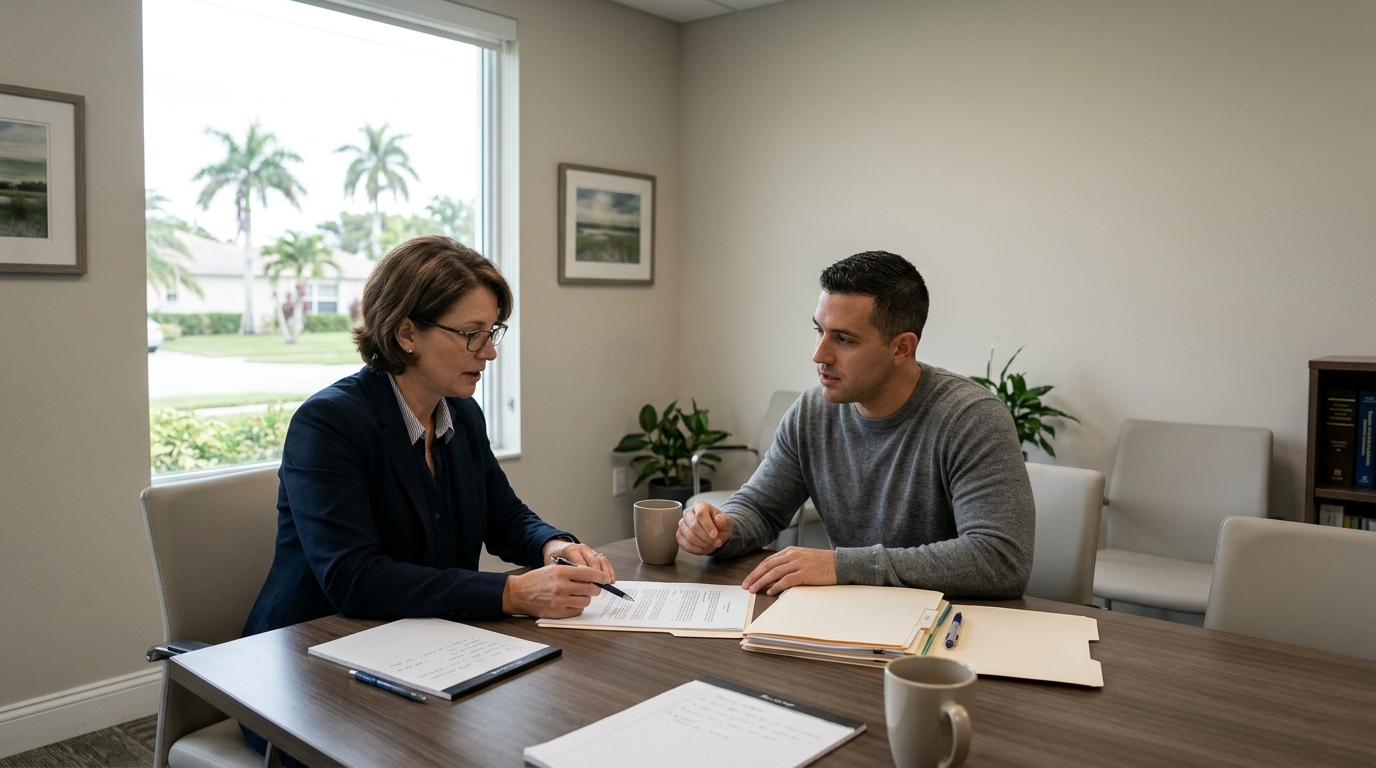
When you walk into your kitchen, grab a cup of coffee, and find a foreclosure notice sitting right next to the toaster, the panic hits you square in the chest.
How on earth did things get this far, and is there any actual, realistic way to save your home before the bank schedules a fire sale on the courthouse steps?
Quick Answer: Under Florida law, a judicial foreclosure typically takes 6 to 14 months to complete, providing homeowners with a vital legal window to pursue loss mitigation options like a Fannie Mae Flex Modification or file a formal defense. Under federal RESPA rules (12 C.F.R. § 1024.41), mortgage servicers are strictly prohibited from dual tracking a foreclosure while a complete loan modification application is under review.
If you wander onto the internet looking for mortgage relief, you will trip over old blog posts, expired federal initiatives from decades past, or blanket quick fixes that vanished years ago. Relying on outdated internet advice or waiting around for a government bailout program that no longer exists is a marvelous way to lose your property while wondering what went wrong.
So what options do Florida homeowners actually have right now when facing default, past due mortgage payments, or a looming court summons in the 17th Judicial Circuit? Let us break down how modern loan modifications, loss mitigation, and active foreclosure defenses work in today’s real estate market without any corporate mumbo jumbo.
Why Modern Loss Mitigation Replaced One Size Fits All Federal Programs
When banks initiate foreclosure proceedings in Florida, they move through a strict, formal judicial process. Older programs like HAMP dictated a rigid federal template, but today mortgage servicing relies on standardized corporate guidelines and portfolio specific workouts.
Modern foreclosure defense requires looking at your current financial snapshot and choosing an active legal path:
Standardized Lender Modifications: Major loan servicers and government backed entities like Fannie Mae and Freddie Mac utilize structured programs—such as the Flex Modification—to lower monthly payments by extending loan terms up to 40 years, capitalizing missed arrears, or adjusting interest rates.
Chapter 13 Bankruptcy Protection: For homeowners with steady income facing an imminent foreclosure auction, filing a Chapter 13 plan can halt the bank instantly, giving you a court approved safety net to catch up on mortgage arrears over three to five years.
Strategic Loss Mitigation & Short Sales: If staying in the home is no longer financially viable, a managed exit strategy protects your overall credit profile and helps avoid a predatory deficiency judgment.
How Modern Loan Modifications Work With Your Lender
Securing a permanent loan modification requires navigating a structured underwriting review with your loan servicer.
Ask yourself: Does my current monthly income realistically support a restructured payment if the bank agrees to stretch out the loan term or lower the interest rate?
To qualify for a modern in-house or agency backed loan modification, your servicer will typically look for three key criteria:
Proof of Stable Income: Verifying that you have sufficient monthly earnings through pay stubs, profit and loss statements, or tax documents to support a modified payment structure.
Primary Residence Verification: Demonstrating that the property is your primary home rather than an unmanaged investment portfolio asset.
Financial Hardship Documentation: Providing a signed hardship affidavit explaining the life event—such as a medical emergency, job change, or temporary income reduction—that caused you to fall behind.
Avoiding Dual Tracking and Protecting Your Rights Under Federal Servicing Rules
When dealing with mortgage default or foreclosure in Florida, many homeowners worry that submitting a loan modification application will cause the bank to quietly move forward with a foreclosure judgment behind their backs.
What safeguards actually prevent lenders from rushing an auction while your loss mitigation paperwork is sitting on an underwriter desk?
Under federal regulations governed by the Consumer Financial Protection Bureau (12 C.F.R. § 1024.41), mortgage servicers are strictly prohibited from engaging in dual tracking. Dual tracking occurs when a lender simultaneously processes a foreclosure lawsuit while a complete loss mitigation or modification application is actively under review.
Critical Protection Milestones for Florida Borrowers
The 120 Day Rule: Under federal rules, a mortgage servicer generally cannot officially file a judicial foreclosure complaint in court until a borrower is more than 120 days delinquent on payments. This window gives homeowners ample time to submit an initial loss mitigation package.
The Evaluation Freeze: If you submit a complete modification application before the bank makes its first official foreclosure filing or moves for a judgment, the servicer cannot move for foreclosure judgment or conduct a judicial sale until they have formally evaluated your application and provided you with written notice of their decision.
The Right to Appeal: If a servicer denies a modification, federal guidelines often provide a 14 day window to appeal the decision if the application was submitted at least 90 days before a scheduled sale date.
If a lender or bank servicer violates these federal protections or mishandles your paperwork while operating in local courts like the 17th Judicial Circuit in Broward County, an experienced foreclosure defense attorney can leverage these violations to halt the lawsuit, challenge the bank’s standing under Fla. Stat. § 702.015, and force the lender back to the negotiating table.
Real-World Case Example: Stopping Dual Tracking in Broward County
Consider a case our firm handled where a Broward County homeowner inherited a residential property after a family member passed away. The mortgage servicer quickly initiated a foreclosure action in the 17th Judicial Circuit. To make matters worse, the bank mishandled the estate transfer documents and loss mitigation paperwork, attempting to rush a foreclosure judgment while the surviving family member was trying to secure a loan modification.
How Our Legal Team Resolved the Case
Challenging Standing: We filed formal defenses requiring the bank to prove proper legal standing under Florida law.
Stopping Dual Tracking: We enforced federal rules under 12 C.F.R. § 1024.41 to halt the foreclosure sale while the modification paperwork was under review.
Securing the Result: The active defense forced the lender to stop the rushed timeline and approve a permanent solution that allowed the family to keep their home.
Frequently Asked Questions About Florida Foreclosures
Can I fight a foreclosure lawsuit while simultaneously applying for a loan modification?
Yes. Under Florida law and federal mortgage servicing rules, working with your lender on loss mitigation options does not mean you should ignore a pending lawsuit. Having a defense attorney file a formal answer in court protects you from a default judgment while your modification application is actively being reviewed.
What happens if the bank wrongfully denies my loan modification request?
If a servicer improperly denies your modification or violates federal RESPA (Real Estate Settlement Procedures Act) guidelines by dual tracking your file while a complete modification application is pending, a real estate litigation attorney can hold them accountable in court.
How long does the judicial foreclosure process take in Florida?
Because Florida is a strict judicial foreclosure state, lenders cannot seize property without filing a formal lawsuit in circuit court. On average, an uncontested or contested foreclosure timeline spans anywhere from 6 to 14 months, providing a critical window to evaluate defense options, pursue loss mitigation, or negotiate with the bank.
What is a Fannie Mae or Freddie Mac Flex Modification?
The Flex Modification is a standardized loss mitigation program used for government backed conventional loans. It is designed to achieve a target reduction in monthly principal and interest payments by capitalizing delinquent amounts, lowering interest rates, or extending the loan maturity term up to 480 months.
Does filing for bankruptcy stop a scheduled foreclosure sale in Broward County?
Yes. The moment a Chapter 13 or Chapter 7 bankruptcy petition is filed, an automatic stay goes into effect under federal law. This injunction immediately halts all collection efforts, creditor calls, and scheduled foreclosure sales governed by the 17th Judicial Circuit in Broward County, giving you breathing room to reorganize your debts.
Can a lender proceed with foreclosure if I never received a default notice?
Lenders must comply with strict contractual notice conditions precedent outlined in standard mortgage agreements, typically requiring a formal notice of default and intent to accelerate thirty days prior to filing a lawsuit. If the bank failed to provide proper statutory or contractual notice, a defense attorney can leverage this error to dismiss or delay the foreclosure action.
Protect Your Home and Your Financial Future
Facing foreclosure alone is a risk you should not take. Whether your goal is to restructure your loan, fight the bank standing in court, or execute a graceful exit strategy to preserve your credit, you need a localized game plan.
The foreclosure defense attorneys at Reinfeld & Cabrera P.A. help homeowners across South Florida navigate complex lender disputes, evaluate modification alternatives, and protect their rights.
Schedule a Confidential Foreclosure Consultation
Do not wait until a sale date is scheduled. Speak directly with an attorney today to review your options:
Coral Springs Office: 9625 W Sample Rd, Coral Springs, FL 33065
Fort Lauderdale Office: 2933 W Cypress Creek Rd, Suite 201, Ft Lauderdale, FL 33309
Website: mypersonalattorneys.com
Local Coverage: Coral Springs, Fort Lauderdale, Parkland, Tamarac, Margate, and all surrounding communities across Broward, Miami Dade, and Palm Beach Counties.
A Florida guardianship does not automatically take away a person’s gun rights. However, an incapacity adjudication can trigger a separate firearm disability under Florida law, depending on the findings made by the court.
That sounds straightforward until someone actually has to deal with it.
Dad cannot manage his bills anymore. His daughter is considering guardianship. Then somebody remembers the guns.
There is a handgun in the nightstand. Two rifles are in a locked cabinet. Dad insists he is perfectly capable of handling them. His daughter is considerably less convinced.
Now the family has a very different question:
Can Dad still legally own or possess those firearms?
Florida’s guardianship law and firearm law approach that question differently. A guardianship does not automatically erase every legal right an incapacitated person has. At the same time, Florida’s firearm statutes impose restrictions on certain people who have been adjudicated mentally defective, and that definition includes certain judicial findings of incapacity under Florida’s guardianship law.
So the answer may depend on something buried in the court record that the family did not realize mattered.
And that is where things get interesting.
Does Guardianship Automatically Take Away Gun Rights in Florida?
No. Being placed under guardianship does not, by itself, automatically remove a person’s right to own or possess firearms.
Florida’s guardianship statute, §744.3215, lists the rights a person determined incapacitated retains and the rights that a court may remove. The list includes rights involving marriage, voting, driving, contracts, property, health care, residence, and other decisions. Firearm ownership and possession are not listed as rights that §744.3215 specifically gives a guardian authority to remove.
That does not mean an incapacity finding has no effect on firearms.
Florida’s firearm statutes create a separate legal disability. Under §790.065, the statutory definition of a person “adjudicated mentally defective” includes a judicial finding of incapacity under §744.331(6)(a). A person who falls within that definition can be prohibited from purchasing a firearm.
Section 790.064 goes further. A person who has been adjudicated mentally defective, as defined by §790.065, may not own or possess a firearm until relief from the firearm disability is obtained.
So there are two different pieces of law sitting next to each other:
Chapter 744: What rights has the guardianship court removed from the ward?
Chapter 790: Does the person have a separate firearm disability?
The answer to one does not automatically answer the other.
What Does an Incapacity Adjudication Have to Do With Firearms?
This is the part families can easily miss.
A guardianship case begins with a determination of incapacity. Florida law requires the petition to identify the rights the petitioner believes the alleged incapacitated person cannot exercise. The court then determines the nature and scope of the incapacity and the rights affected by its order.
Firearm law uses its own terminology.
Under §790.065, “adjudicated mentally defective” includes certain court determinations involving mental illness, incompetency, conditions, or disease. The statute specifically includes a judicial finding of incapacity under §744.331(6)(a).
That is why the phrase “the person has a guardian” is not enough to determine whether a firearm disability exists.
You have to look at the actual incapacity adjudication and the statutory definition that applies to it.
A limited guardianship involving one set of rights can raise different questions from a broader incapacity adjudication. The court order, the findings supporting it, and the applicable firearm statutes all matter.
What Happens to Guns Someone Already Owns?
Suppose Dad already owns three firearms before the guardianship proceeding.
His daughter becomes his guardian. The guns do not suddenly become the daughter’s property because she was appointed guardian.
But if Dad has been adjudicated mentally defective within the meaning of Florida’s firearm statutes, §790.064 says he may not own or possess a firearm until the firearm disability is removed.
That creates a practical problem the family should not try to solve by improvising.
Someone needs to determine:
What exactly did the court adjudicate?
What rights were removed?
Does the adjudication fall within §790.065?
Is there an existing firearm disability?
Is there a concealed weapons or firearms license?
Does a court order address the firearms?
What legally authorized arrangement should be made for firearms the person already owns?
A guardian does not receive a free-floating power to make every decision for a ward. Florida law limits the rights a guardian may exercise to those removed from the ward and delegated to the guardian.
And if the person is legally prohibited from possessing a firearm, the family should not treat the guns as if this were simply a question of where to put Dad’s property.
Florida Lawyers Were Already Arguing About This in 2013
Then, in February 2014, attorneys Caroline S. A. Zoes and J. Marcos Martinez responded with “Wards and Guns.” Their position was that becoming a ward does not automatically erase constitutional rights.
The exchange is useful today because it identified the exact problem: guardianship law and firearm law were not using the same framework.
Florida’s statutes have since developed firearm-specific restrictions that make the analysis different from the one presented in those 2013 and 2014 articles.
The old debate is still worth reading, though. It explains why the relationship between guardianship, incapacity, and gun rights has never been as simple as “the judge appointed a guardian, so the guns are gone.”
Florida Guardianship Forms Mention Firearms
There is an unusually specific clue in Florida’s guardianship paperwork.
The Florida Supreme Court’s guardianship forms include a question asking whether the respondent may or may not have a license to carry a firearm or possess a weapon or firearm. The form appears in the court’s guardianship rules and forms governing incapacity and guardianship proceedings.
That does not mean the form itself creates a firearm disability.
It does show that firearms are something the guardianship process can require the court to address.
The same form separately identifies the rights that may be delegated to a guardian. Those include contracts, lawsuits, government benefits, property management, residence, health care, and social-environment decisions. Firearm possession does not appear in that list of delegable guardianship rights.
That distinction is worth keeping straight.
Can an Incapacitated Person Still Have a Concealed Weapons License?
Not necessarily. An incapacity-related firearm disability can also affect eligibility for or continued possession of a Florida concealed weapons or firearms license.
Florida’s firearm background-check statute requires the state to consider whether a person has been adjudicated mentally defective or committed to a mental institution. The statute also directs the Department of Law Enforcement to provide relevant information to the Department of Agriculture and Consumer Services when determining eligibility for a concealed weapons or firearms license or whether an existing license should be suspended or revoked.
So a family should not assume that the question ends with the firearms sitting in a gun safe.
There may also be a licensing issue.
Can Someone Regain Gun Rights After an Incapacity Adjudication?
Possibly, but restoration of capacity and restoration of firearm rights are separate legal processes.
Florida law allows a person to seek relief from a firearm disability arising from an adjudication or commitment. Under §790.065, the petition is presented to the appropriate court, the state attorney may object, and the court considers evidence concerning the person’s reputation, mental health record, criminal history when applicable, the circumstances surrounding the firearm disability, and other evidence.
The court must determine that the person is not likely to act in a manner dangerous to public safety and that granting relief would not be contrary to the public interest before granting relief under that statute.
Florida’s guardianship law separately provides a procedure for restoring a ward to capacity when the person can again exercise rights that were previously removed.
Those two procedures should not be treated as interchangeable.
Someone whose capacity has been restored should still determine whether a separate firearm disability remains and whether formal relief under Chapter 790 is required.
What If the Guardian and the Family Disagree About the Guns?
Imagine the Coral Springs family again.
Dad’s daughter is now his guardian. Dad’s son thinks the guns should stay in the house. Dad insists that nothing has changed and wants access to them.
Nobody agrees.
The daughter says, “I’m his guardian.”
The son says, “They’re his guns.”
Dad says, “They’re mine.”
None of those statements, by itself, resolves the legal issue.
The family needs to look at the incapacity order, the guardianship authority actually granted, and the firearm statutes that apply to the adjudication.
If a firearm disability exists under Chapter 790, the possession question becomes very different from a dispute over who owns a piece of ordinary personal property.
And if the family believes the incapacity determination itself should be changed, that is a separate guardianship issue.
This is one of those situations where pulling the actual court file is considerably more useful than arguing around the kitchen table.
What Does This Mean for Families in Coral Springs and Broward County?
For families in Coral Springs and Broward County, guardianship proceedings are handled through Florida’s court system, and the details of the incapacity order can determine what happens next.
A family dealing with an aging parent, dementia, cognitive decline, or another condition affecting decision-making may already be dealing with medical records, financial accounts, powers of attorney, and property issues.
Firearms can add another layer.
If the person owns firearms, the family should identify that issue early in the guardianship process rather than assuming the appointment of a guardian answers it.
The relevant documents may include:
The petition to determine incapacity
The examining committee reports
The order determining incapacity
The order appointing the guardian
Letters of guardianship
Any order addressing firearm possession
Records relating to a firearm or concealed weapons license
Any later order restoring capacity or granting relief from firearm disabilities
The legal analysis is fact specific. A guardianship attorney in Coral Springs or elsewhere in Broward County may need to review the actual orders before giving a definitive answer about a particular person’s firearm rights.
Frequently Asked Questions
Can guardianship take away your gun rights in Florida?
Guardianship alone does not automatically remove gun rights. However, a qualifying incapacity adjudication can trigger a separate firearm disability under Florida’s Chapter 790.
Does an incapacity adjudication prevent someone from buying a gun in Florida?
It can. Florida’s firearm purchase statute includes certain judicial findings of incapacity within the definition of “adjudicated mentally defective,” which can make a person prohibited from purchasing a firearm.
Can an incapacitated person possess a firearm in Florida?
Not if the person is subject to the firearm possession disability in §790.064. That statute prohibits a person covered by its definition from owning or possessing a firearm until relief from the disability is obtained.
Could a guardian take away a ward’s guns?
A guardian does not automatically receive authority over firearms simply because the guardian was appointed. The guardian’s authority depends on the rights removed and powers delegated by the court, while firearm possession may also be governed independently by Chapter 790.
Can someone regain firearm rights after an incapacity adjudication in Florida?
Florida law provides a procedure for seeking relief from a firearm disability. The firearm-relief process is separate from the general procedure for restoring capacity under the guardianship statutes.
Does restoring capacity automatically restore gun rights in Florida?
Do not assume that it does. Restoration of capacity and relief from a firearm disability arise under different statutory procedures. The person’s specific court orders and firearm records should be reviewed.
Can an incapacity adjudication affect a concealed weapons license?
Yes. Florida law directs relevant firearm-disability information to the state agency responsible for determining eligibility for concealed weapons or firearms licenses and for considering suspension or revocation of existing licenses.
Guardianship and Gun Rights in Coral Springs, Broward County, and South Florida
The unusual combination of guardianship and gun rights in Florida creates a legal problem that does not fit neatly into either a standard guardianship checklist or a standard firearm question.
A person can have a guardian without every legal right disappearing. At the same time, a qualifying incapacity adjudication can create a separate firearm disability under Florida law.
For families in Coral Springs, Broward County, and throughout South Florida, the starting point is the actual incapacity order and the firearm statutes that apply to it.
This article provides general information about Florida guardianship and firearm law. It is not legal advice and does not determine whether a particular person may lawfully possess, purchase, or carry a firearm.
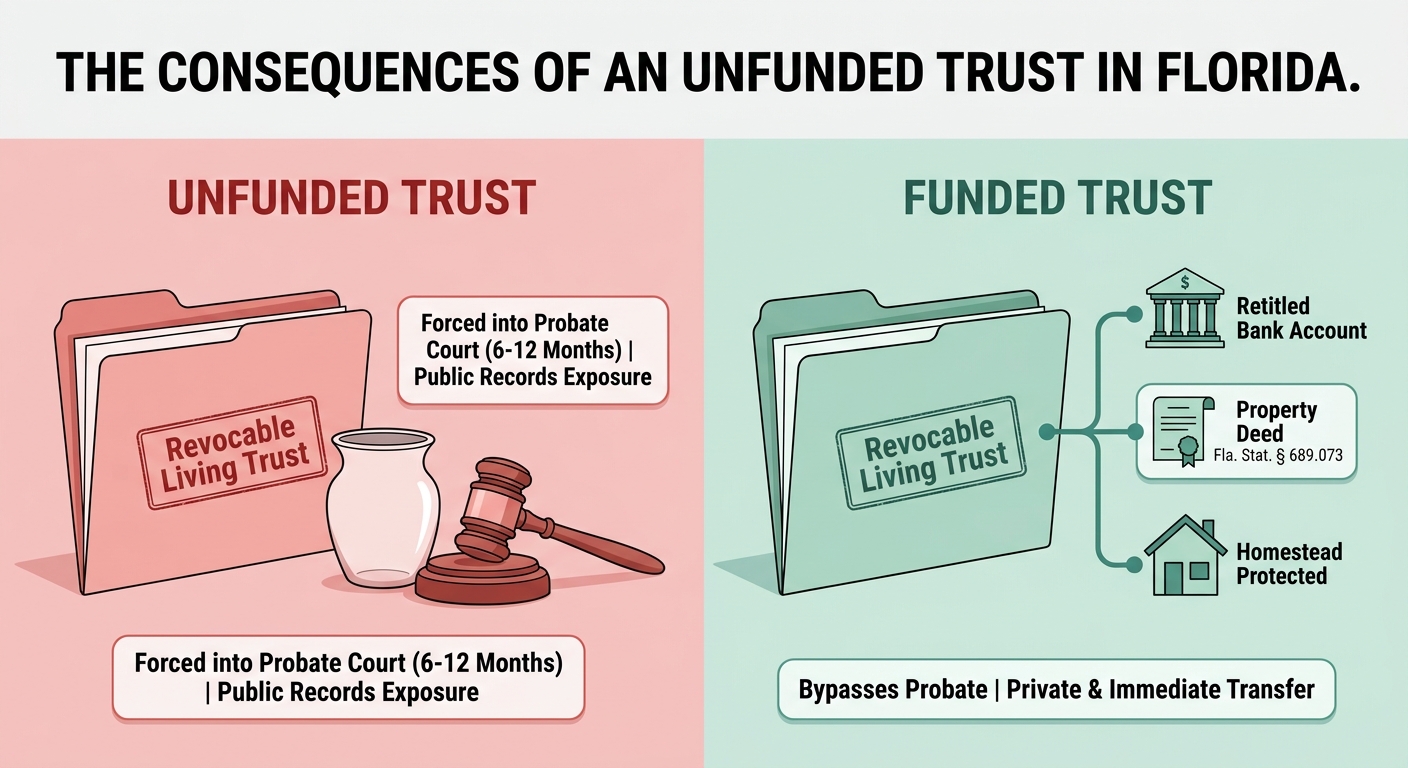
In Florida, a Revocable Living Trust is essentially an empty vessel with written instructions. Signing the trust document creates the legal framework, but if assets are not officially retitled into the name of the trust—a process known as funding—the trust cannot govern or transfer those assets upon your death or incapacity.
Here is an in-depth look at what happens in Florida when a trust remains unfunded, the legal consequences, and how Florida law resolves the gap.
1. The Core Problem: Loss of Probate Avoidance
The primary reason individuals establish revocable living trusts in Florida is to keep their assets out of probate court.
If Funded:Specifically, assets owned by ‘John Doe, as Trustee of the John Doe Revocable Trust’ pass directly to beneficiaries via the successor trustee according to the terms of the trust, bypassing probate court entirely.
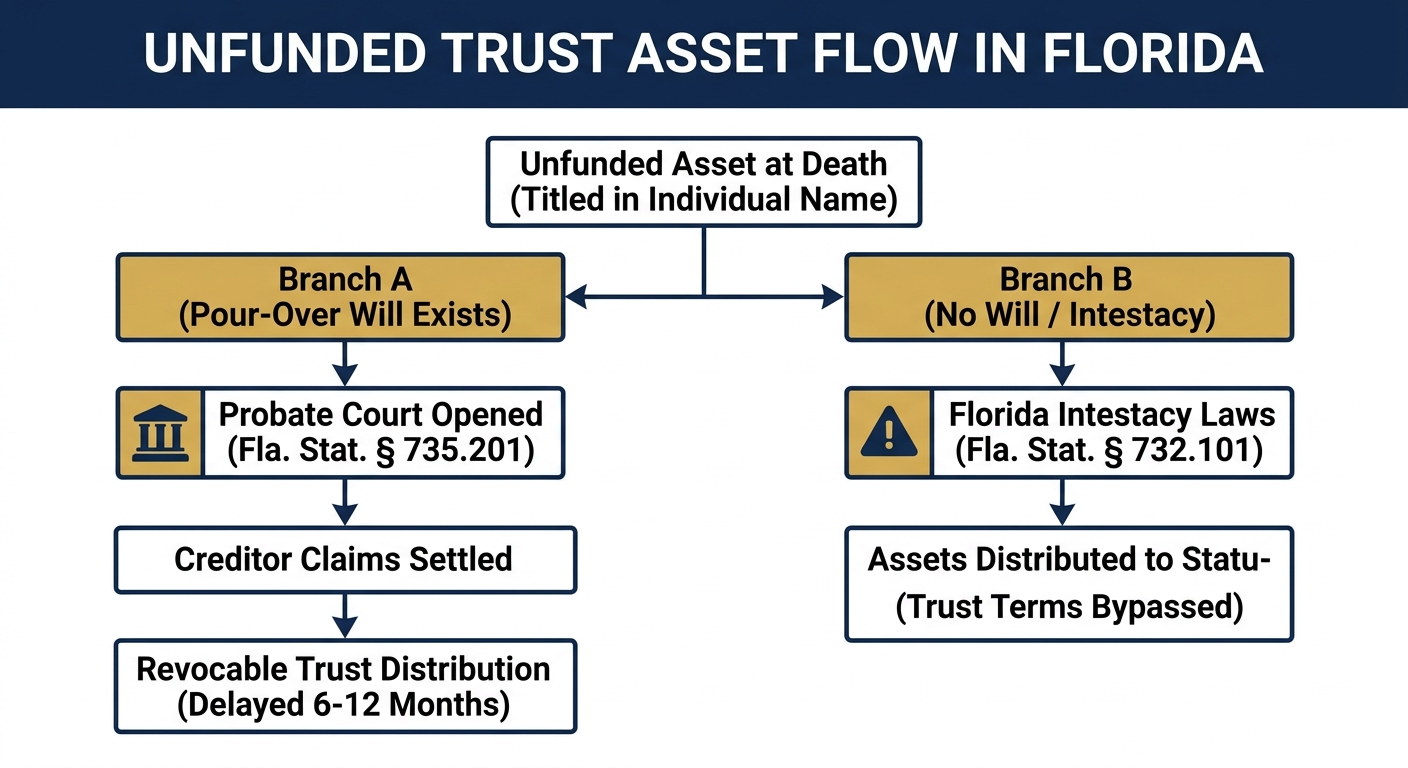
If Unfunded: Any asset that remains in an individual’s personal name at death (e.g., “John Doe”) forms part of the decedent’s probate estate. The trust document holds no legal authority over these individually titled assets.
2. The Legal Safety Net: The Florida “Pour-Over Will”
To protect against unfunded or forgotten assets, a properly executed Florida estate plan includes a Pour-Over Will.
How it works: The Pour-Over Will acts as a catch-all safety net. It states that any asset remaining in the individual’s name at death should be transferred (or “poured over”) into the trust.
The Catch:A Pour-Over Will must go through Florida Probate Court.
The Process:During this process, the court appoints a Personal Representative to collect the unfunded assets, satisfy valid creditor claims under Florida Probate Rules, and then transfer the remaining net assets to the trustee to distribute according to the trust’s instructions.
The Outcome: The wishes outline in the trust are eventually honored, but the estate experiences the exact court delays (6 to 12+ months), public record disclosures, and legal/court costs that the trust was designed to prevent.
3. What Happens If There Is No Pour-Over Will?
If a trust is unfunded and the creator (settlor) dies without executing a Pour-Over Will (or any valid Will):
Intestacy Laws Take Over: The unfunded assets pass according to Florida’s intestate succession laws (Fla. Stat. § 732.101 et seq.), which default to statutory family order (surviving spouse, adult children, parents, siblings).
Accidental Disinheritance:Furthermore, the trust’s provisions, such as leaving equal shares to children, funding charities, or holding money in trust for minors, are bypassed completely for those unfunded assets.
Key Complications Specific to Unfunded Trusts in Florida
Consequently, if real estate is not deeded to the trust using a properly drafted Quitclaim or Warranty Deed (specifying trust powers under Fla. Stat. § 689.073), the home remains individual property.
Upon death, the homestead therefore requires a court proceeding (a Petition to Determine Homestead) to pass free of claims to legal heirs, regardless of what the trust document outlines.
B. Loss of Incapacity Protection
A key function of a Florida revocable trust is managing assets if the creator becomes incapacitated (e.g., due to dementia or stroke).
Funded Trust: The successor trustee steps in smoothly to manage trust assets without court involvement.
Unfunded Trust: The successor trustee has no authority over individually owned bank accounts or real estate. Family members must instead rely on a Durable Power of Attorney or petition a Florida court for a costly Guardianship proceeding.
C. Exposure of Financial & Personal Privacy
Once probate is opened to catch unfunded assets, the estate inventory, financial balances, names of heirs, and trust references become part of the public court record in the county where the probate is filed.
Summary of Consequences
Scenario
Fully Funded Florida Trust
Unfunded Trust (with Pour-Over Will)
Unfunded Trust (NO Pour-Over Will)
Probate Required?
No (Bypasses court entirely)
Yes (Formal or Summary Administration required)
Yes (Must go through Intestate Probate)
Distribution Time
Immediate or within weeks
6 to 12+ months
6 to 12+ months
Privacy
Private (Kept out of court records)
Public (Will and asset inventories filed with court)
Public (Filed with court)
Who Inherits?
Trust Beneficiaries
Trust Beneficiaries (after probate completion)
Statutory Heirs under Florida Intestacy Laws
How Funding Is Completed in Florida
To fund a trust properly under Florida law:
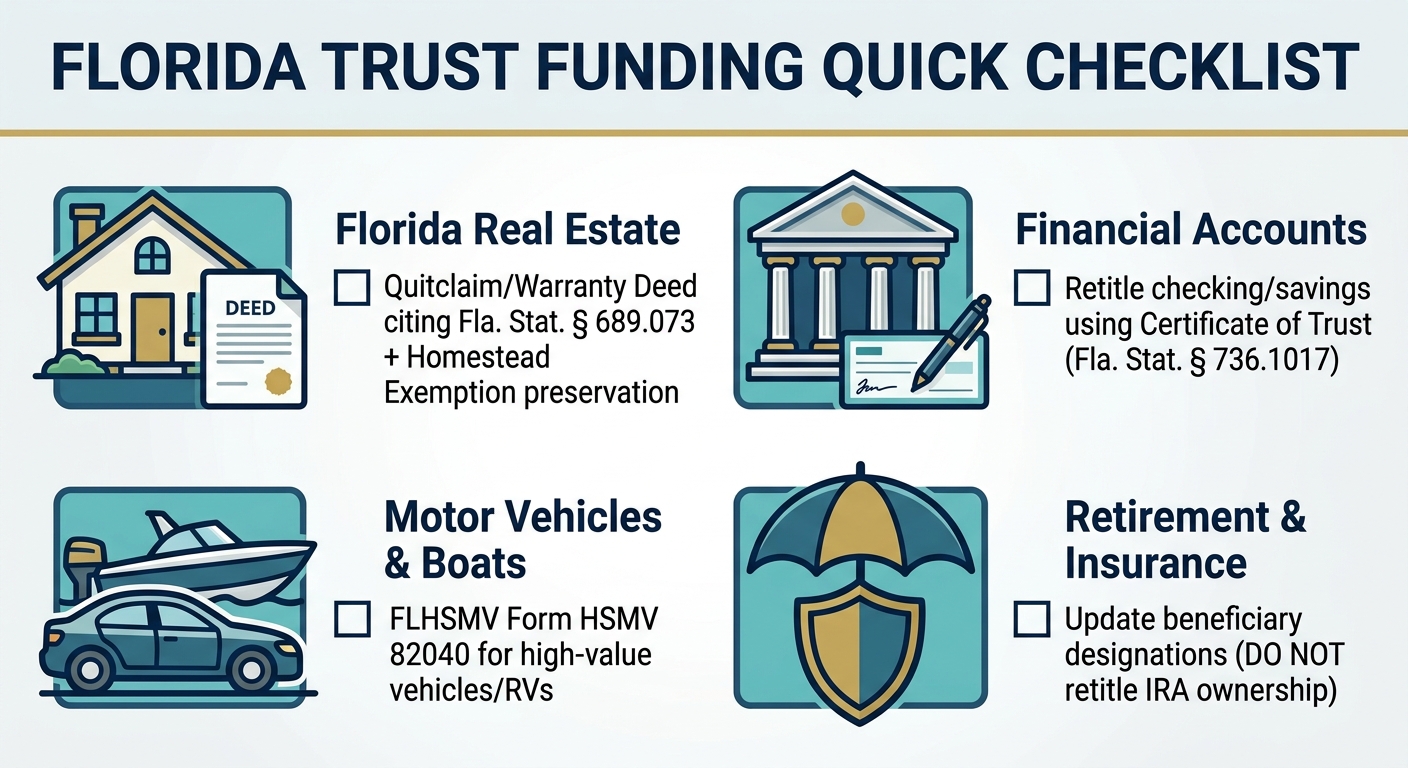
Real Estate: Draft and record a deed transferring title from the individual to the trust in the county where the property is located.
Financial Accounts: Change account ownership at banks and brokerages to the trust’s name.
Beneficiary Designations: Update primary or contingent beneficiary forms for life insurance policies, retirement accounts (IRAs/401ks), or Pay-on-Death (POD) accounts where appropriate.
Florida Revocable Living Trust Funding Checklist
A Revocable Living Trust cannot avoid probate or manage assets until those assets are retitled into the trust’s name. Follow this streamlined checklist to ensure your trust is properly funded under Florida law.
Essential Prerequisites
Certificate of Trust (Fla. Stat. § 736.1017): Provides banks, brokers, and title companies proof of trustee authority without exposing private beneficiary details.
Standard Trust Titling Format: [Trustee Name(s)], Trustee(s) of the [Trust Name], dated [Execution Date]
Quick-Action Asset Checklist
1. Bank Accounts & Cash Assets
Checking & Savings: Present your Certificate of Trust at your bank to retitle existing accounts or open new trust accounts.
Certificates of Deposit (CDs): Confirm in writing first that the bank will waive early withdrawal penalties for trust transfers before retitling.
Safe Deposit Boxes: Execute a new lease naming the trust or trustee to ensure immediate successor access.
2. Florida Real Estate
Deed Execution: Record a Quitclaim or Special Warranty Deed transferring title to the trustee.
Statutory Protection (Fla. Stat. § 689.073):To be valid under Florida law, the deed must explicitly grant the trustee full power to sell, lease, or encumber property.”
Preserve Homestead Exemptions: Include homestead occupancy rights in the deed/trust to safeguard tax caps (Fla. Admin. Code 12D-7.011) and creditor exemptions (Fla. Const. Art. X, § 4).
3. Motor Vehicles & Vessels (FLHSMV)
Selective Retitling: Under Fla. Stat. § 319.28, Florida allows heirs to transfer simple vehicle titles outside probate. We primarily recommend retitling high-value vehicles, RVs, or boats directly into the trust via FLHSMV Form HSMV 82040.
4. Investment Accounts & Non-Probate Assets
Brokerage Accounts: Submit ownership change forms to custodians (Schwab, Fidelity, Vanguard) along with your Certificate of Trust.
Life Insurance: Assign the trust as the primary or contingent beneficiary to ensure immediate, unencumbered payout administration.
Tax-Deferred Accounts (IRAs/401ks):However, do not retitle ownership, as this triggers immediate tax liabilities. Instead, update beneficiary designations carefully following SECURE Act 2.0 guidelines.
Complete Your Trust Execution with Experienced Counsel
Ensure your real estate, financial accounts, and business assets are properly structured under Florida law. Contact our South Florida estate planning team today:
Direct Telephone: (954) 866-4878 | Toll-Free: 954-866-HURT
Coral Springs Office: 9625 W. Sample Rd, Coral Springs, FL 33065
Fort Lauderdale Office: 2933 W. Cypress Creek Rd, Suite 201, Ft. Lauderdale, FL 33309
Website: mypersonalattorneys.com
Local Coverage: Coral Springs, Fort Lauderdale, Parkland, Tamarac, Margate, and all surrounding areas of Broward County
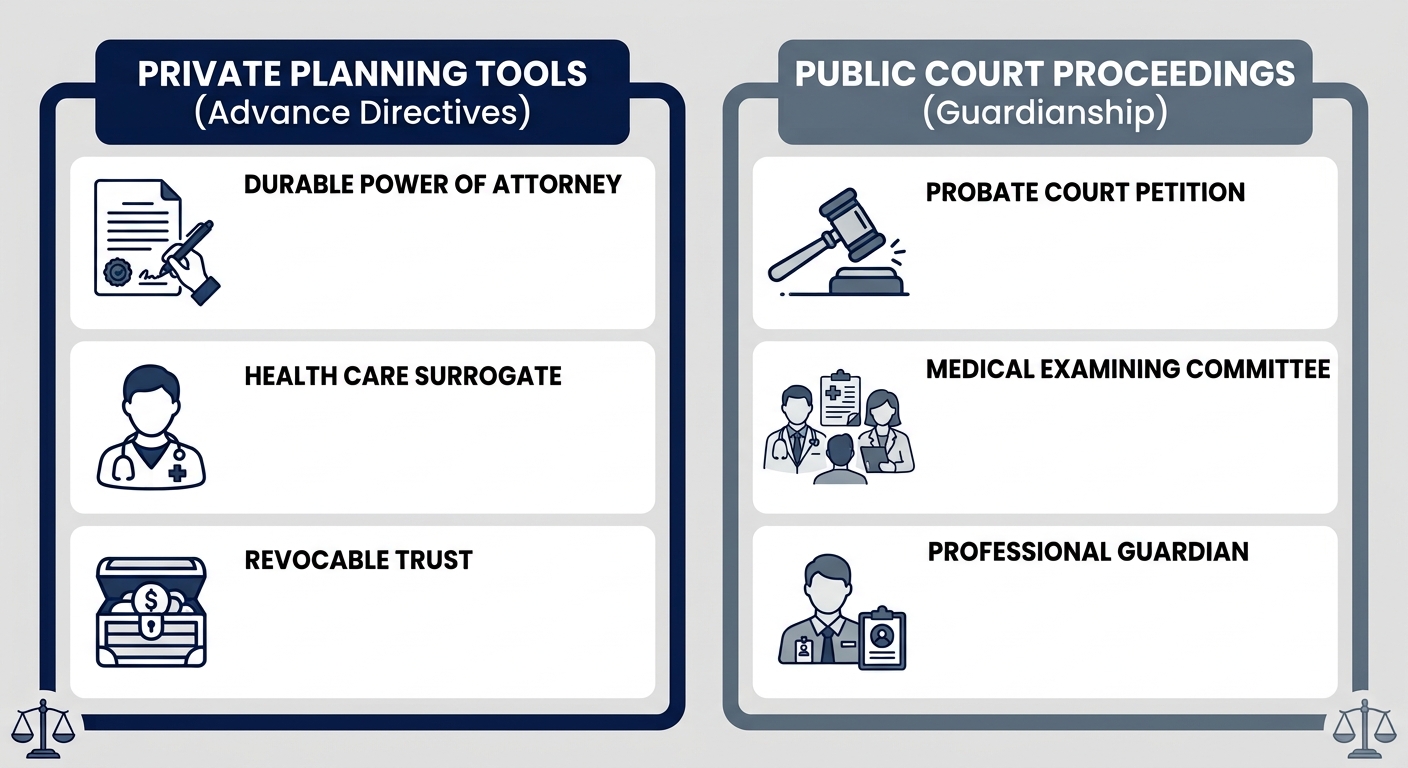
In Florida, adult guardianship is avoided by executing three proactive, legally binding instruments while mentally competent: a Durable Power of Attorney (Fla. Stat. § 709.2104), a Designation of Health Care Surrogate (Fla. Stat. § 765.202), and a Revocable Living Trust. Together, these documents grant immediate, private decision-making authority to chosen surrogates, preventing the 17th Judicial Circuit Court of Broward County from declaring incompetence or appointing a court-monitored professional guardian under Fla. Stat. Chapter 744.
Why a Florida Last Will and Testament Fails During a Lifetime Health Crisis
The most pervasive misconception among Florida property owners is the belief that a well-crafted Will protects their business, real estate, and financial accounts if they suffer a debilitating stroke, traumatic brain injury, or severe cognitive decline.
A Will is legally dormant until death. It grants zero authority during your lifetime.
If you lose legal capacity without specific lifetime governance documents, your family cannot simply present your Will to Bank of America, Chase, or a Broward County title company. Instead, your loved ones are forced into a rigid, public, and adversarial legal process known as Involuntary Adult Guardianship.
Path A: Proactive Planning (Private)
Path B: Court Intervention (Guardianship)
1. Key Legal Instruments:
Durable Power of Attorney
Health Care Surrogate
Revocable Living Trust
1. Emergency Court Petition:
Filed in the Broward County Circuit Court by family, health care providers, or interested third parties.
2. Immediate Authority:
Your designated agent or trustee steps in immediately without court permission.
2. 3-Member Examining Committee:
Court appoints a physician, medical expert, and layperson to evaluate your mental competency.
3. Privacy & Autonomy:
Financial affairs and health decisions remain strictly private within the family.
3. Public Incompetency Hearing:
Formal court hearing stripping fundamental constitutional rights and declaring legal incapacity.
Final Outcome: Seamless Family Management
Zero court fees, no public record, immediate operational continuity.
Final Outcome: Court Guardian Control
Appointed professional guardian, mandatory annual audits, assets drained by legal fees.
The Financial and Personal Realities of Florida Guardianship Proceedings
When a court petition is filed under Florida Statute Chapter 744, you become the “Alleged Incapacitated Person” (AIP). The judicial process moves quickly, privately stripping personal freedoms through public records:
1. Mandatory 3-Member Examining Committee
Under Fla. Stat. § 744.331, the court appoints an examining committee consisting of three professionals (at least one must be a medical doctor or psychiatrist). These individuals visit your home or hospital room, conduct cognitive testing, and submit written assessments directly to the Broward County judge.
2. Immediate Loss of Fundamental Civil Rights
If the court finds you incapacitated, you do not just lose access to your checking account. You lose the legal right to:
Contract, sign deeds, or manage business interests
Choose where you live or consent to medical treatment
Vote, hold a driver’s license, or marry
Retain personal legal counsel of your choice
3. The Financial Strain of Professional Guardianship
A court-appointed guardian is entitled to reasonable compensation paid directly out of your assets. Every financial move—selling a home in Coral Springs, liquidating stock, or paying for specialized memory care—requires formal court petitions, attorney appearances, and annual financial audits overseen by the clerk of court.
Real World Precedent: How Lack of Planning Triggers Systemic Vulnerability
To understand why Florida courts step in so forcefully, one needs to look no further than the notorious state guardianship cases that led to major legislative reforms across South Florida.
Consider the real life case of Jan Garwood, a Central Florida resident who suffered a sudden medical crisis without a complete, active incapacity plan in place.
┌────────────────────────────────────────────────────────┐
│               THE REALITY OF COURT CONTROL             │
├───────────────────────────┬────────────────────────────┤
│    WITHOUT A DPOA / TRUST │  WITH PROACTIVE R&C PLAN   │
├───────────────────────────┼────────────────────────────┤
│ Forced court petition     │ Private family transition  │
│ 3-person medical panel    │ Designated agent steps in  │
│ Court-appointed guardian  │ Zero court costs or fees   │
│ House sold without consent│ Assets fully protected     │
└───────────────────────────┴────────────────────────────┘
After an emergency hospital admission under the Baker Act, the hospital petitioned the court to appoint a professional guardian. Because Garwood lacked a updated Durable Power of Attorney and Revocable Living Trust specifically naming trusted family members to handle her affairs:
The Court Intervened Immediately: A judge declared her incompetent based on brief examining committee reports, bypassing her family.
Loss of Property: The court appointed professional guardian gained complete control over her finances, eventually selling her home to cover facility care costs.
Loss of Autonomy: Garwood spent three years in a locked assisted living facility before independent attorneys managed to restore her rights, by which time her personal assets had been liquidated.
Cases like Garwood’s—and the widespread Florida state investigations into court appointed guardians that followed—highlight a critical legal reality: If you do not choose your own decision makers through private estate planning documents, a Florida probate court will choose one for you.
The Incapacity Avoidance Triad: 3 Key Documents
To lock out judicial interference, an incapacity strategy must unite three precise legal instruments under Florida law:
1. Florida Financial Durable Power of Attorney (DPOA)
Governed by Fla. Stat. § 709.2104, a Florida DPOA must contain specific “superpowers” (explicit initialed clauses under Fla. Stat. § 709.2114) granting your named agent the legal right to manage real estate, conduct banking, handle tax returns, and qualify for governmental benefits without court approval.
2. Florida Designation of Health Care Surrogate
UnderFla. Stat. § 765.202, this instrument allows your named surrogate to consult with doctors, review HIPAA-protected medical records, authorise surgeries, and make end-of-life decisions if you become unable to provide informed consent.
3. Revocable Living Trust
Holding property, financial accounts, and business equity inside a revocable trust creates an unbroken chain of authority. If you face incapacity, your named Successor Trustee steps in seamlessly to manage trust assets according to your written directives, eliminating the need for court supervision.
Frequently Asked Questions
Can my spouse automatically handle my finances if I become incapacitated?
No. Spousal status alone does not grant legal authority to sign deeds, alter bank accounts, or manage individually held assets in Florida. Without a valid Durable Power of Attorney or Trust, a spouse must petition the court for guardianship just like any third party.
What is the difference between a Power of Attorney and a Guardian?
A Power of Attorney agent is chosen privately by you while you are mentally sound. A Guardian is appointed by a judge after a court determination of incompetence.
Does a Durable Power of Attorney expire upon incapacity in Florida?
No. Unlike a standard power of attorney, a Durable Power of Attorney explicitly remains effective during temporary or permanent mental incapacity under Fla. Stat. § 709.2104.
Protect Your Independence with a Coral Springs Estate Planning Attorney
Maintaining total control over your health choices, personal dignity, and financial assets requires clear legal planning before a sudden health crisis occurs.
The estate planning attorneys at Reinfeld & Cabrera, P.A. help individuals and families across Coral Springs, Fort Lauderdale, and Broward County construct airtight incapacity plans that bypass court intervention entirely.
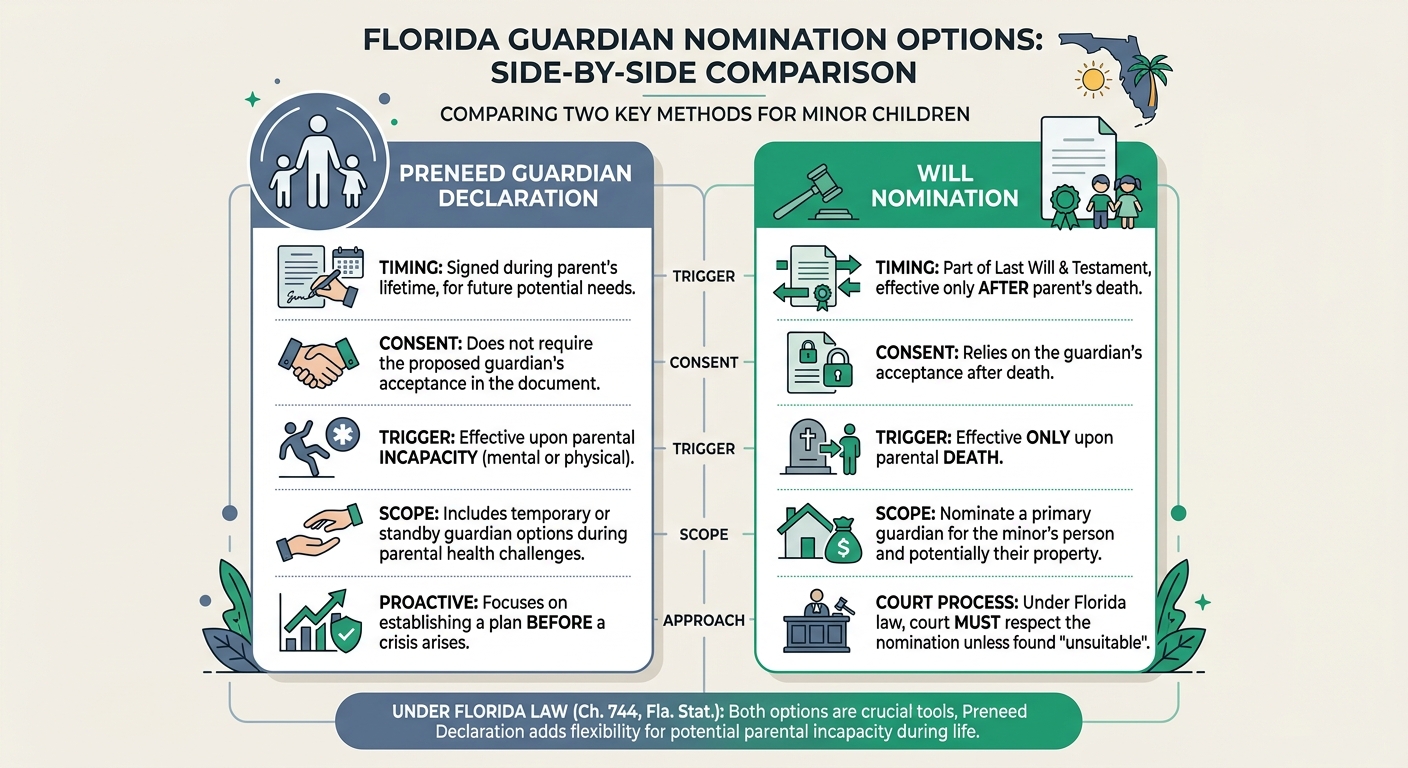
Under Florida law (Fla. Stat. § 744.3046), parents can name a guardian for minor children by executing a formal Preneed Guardian Designation signed in the presence of two simultaneous witnesses. Unlike a will, which only activates upon death, a preneed designation protects your children during parental death or medical incapacity.
The document creates a strong presumption in court favoring your chosen primary and alternate guardians, allowing you to split physical care (Guardian of the Person) from financial management (Guardian of the Property).
Let us be completely honest with each other for a moment. Nobody wakes up on a sunny Saturday, pours a mug of coffee, and cheerfully says, “You know what sounds fun today? Figuring out who raises my children if my spouse and I get eaten by a shark or crushed by a meteor.”
It is uncomfortable. It makes your stomach do little flip flops. And if you are like most parents in South Florida, your default setting is simply to kick the can down the road, assuming your sister or your mother will just step in and figure it out if the unthinkable happens.
Except Florida law does not work on gentle assumptions. If you do not formally put your wishes in writing using proper legal execution rules, a circuit court judge who has never met your family will be forced to make that choice for you.
So how do you actually name a guardian for your minor children in Florida, avoid a holiday dinner feud between the in laws, and make sure your intentions stand up in court? Let us break down how parental designations work without any dry corporate nonsense or confusing legalese.
Why the Internet Gets Child Guardianships Wrong
If you search online late at night while spiraling into panic, you will find plenty of generic advice. Telling you to just type up a short note or throw a sentence into a basic Last Will and Testament.
Nominating a guardian in your will is a very common approach. But relying solely on a will leaves a massive, gaping hole in your legal safety net.
Ask yourself: What happens if you and your spouse are in a serious car accident and end up in a coma for six months?
A will only springs to life after you pass away. If you are incapacitated rather than deceased, a judge cannot use your will to authorize someone to care for your kids or handle their day to day needs. That is why Florida estate planning relies on specialized advance designations that cover both incapacitation and death.
Preneed Guardians vs. Standby Guardians: Decoding the Legal Jargon
Florida law gives parents two primary legal mechanisms to nominate who steps in when disaster strikes. You do not need a law degree to understand them, but you do need to know which one fits your situation.
Think of this as your official written nomination letter to the local probate court. Under Florida law, parents can sign a formal declaration naming a primary guardian and an alternate guardian.
How it works: You sign the document ahead of time with two attesting witnesses present at the exact same time. If both parents pass away or become incapacitated, the document is produced in court. This creates a powerful legal presumption that the judge should honor your chosen person.
Why it matters: It covers both death and medical incapacity, seamlessly closing the gap that a standard will leaves behind.
A standby guardian is a slightly different tool designed for immediate handoffs.
How it works: This involves a pre approved court petition where a designated guardian stands in the wings. He or she is ready to act instantly upon a specific triggering event (like severe medical decline or death). The standby guardian assumes duties immediately and then has 20 days to file a formal petition for court confirmation.
The Person vs. The Property: You Do Not Have to Pick Just One Human
Here is a common dilemma that paralyzes parents: Your brother is incredible with kids, warm, patient, and living in a great school district, but he handles money like a golden retriever with a stolen credit card. Meanwhile, your accountant sister is a financial wizard, but her idea of childcare is handing a toddler a spreadsheet.
Good news: Florida law allows you to split these responsibilities down the middle.
Guardian of the Person: This person gets physical custody, decides where the kids live, manages their schooling, signs permission slips, and handles medical decisions.
Guardian of the Property: This person manages the financial inheritance, holds onto money left for the children, pays for their expenses out of a trust or court supervised account, and ensures nobody wastes their funds.
You can name the same person for both roles, or you can split them up so your kids get loving care while your financial hawk protects their inheritance.
How to Choose an Alternate (and Avoid In-Law Meltdowns)
Always, always name an alternate guardian. Life happens. Your primary choice might move across the globe, face health challenges of their own, or simply realize that taking on two active toddlers at age fifty five is more than they can physically handle.
When selecting guardians, look beyond raw emotional attachment and evaluate practical realities:
Shared Values and Lifestyle: Do they raise children with similar boundaries, educational goals, and emotional warmth?
Geographic Location: Would your children have to move across the country, switch schools, and leave their support network behind during a time of intense grief?
Financial and Physical Capacity: Do they have the health, energy, and space in their life to raise children through high school and college?
Pro Tip: Talk to the people you want to name before you sign the papers. Finding out after the fact that your prospective guardian never wanted kids in the first place makes for an extremely awkward conversation.
Frequently Asked Questions About Naming a Guardian in Florida
How do I name a guardian for my child in Florida?
You can document your intent by executing a formal Preneed Guardian Designation under Fla. Stat. § 744.3046 or by nominating a guardian within your Last Will and Testament. The document must comply strictly with Florida signing formalities, including two simultaneous attesting witnesses.
Can I name a guardian for my minor child in my will?
Yes. Florida law allows parents to nominate a guardian inside a will. However, because a will only takes effect upon death, pairing it with a Preneed Guardian Designation ensures your choices are legally documented if you become incapacitated.
What is a preneed guardian for a minor in Florida?
A preneed guardian is a person formally nominated by living parents to step in, take custody, or manage property for a minor child if the parents die or lose legal capacity.
Can I name an alternate guardian for my child?
Yes. Florida statutes explicitly encourage parents to name an alternate preneed guardian in case your primary choice is unable or unwilling to serve when the time comes.
What happens if both parents die without naming a guardian?
If no written designation exists, any interested family member or party can petition the court for guardianship. A judge in the 17th Judicial Circuit will hold hearings and choose a guardian based on what they determine is in the child’s best interests, which may not align with who you would have wanted.
Does the court have to appoint the person named by the parents?
While Florida courts give immense weight and priority to a valid preneed designation signed by the parents, the judge retains ultimate authority to verify that the nominee meets statutory qualifications and that the appointment serves the child’s best interests.
Can a guardian be named for a child’s property as well as the child?
Yes. Florida law explicitly separates guardianship of the person (physical care and custody) from guardianship of the property (financial management), allowing parents to appoint the same individual or two separate people.
What is the difference between a preneed guardian and a standby guardian?
A preneed guardian is nominated in advance on paper and awaits a potential future appointment by the court. A standby guardian is pre approved by court order prior to an emergency and can take physical custody instantly upon a triggering event, with 20 days to get final confirmation from the judge.
Can I change or revoke the guardian I have named for my child?
Yes. As long as you are competent, you can revoke, modify, or replace your preneed guardian designation at any time by executing a new written declaration that meets Florida statutory requirements.
Does naming a guardian eliminate the need for a full estate plan?
No. Naming a guardian addresses who cares for your children, but it does not manage how your home, bank accounts, or life insurance proceeds are handled. Pairing your guardian designations with a revocable living trust ensures your money is protected and managed smoothly for your kids without ongoing court oversight.
Protecting Your Children and Your Peace of Mind
At the end of the day, naming a guardian is not about dwelling on tragic worst case scenarios. It is about taking control, removing uncertainty, and giving yourself total peace of mind knowing that your kids will always be raised by people who love them and share your values.
The estate planning attorneys at Reinfeld & Cabrera P.A. help parents across South Florida establish airtight preneed guardian designations, revocable living trusts, and comprehensive family protection plans.
Schedule a Confidential Consultation
Do not leave your family’s future up to chance or a courtroom schedule. Speak directly with an attorney today to set up your parental designations:
Coral Springs Office: 9625 W Sample Rd, Coral Springs, FL 33065
Fort Lauderdale Office: 2933 W Cypress Creek Rd, Suite 201, Ft Lauderdale, FL 33309
Website: mypersonalattorneys.com
Local Coverage: Coral Springs, Fort Lauderdale, Parkland, Tamarac, Margate, and all surrounding communities across Broward, Miami Dade, and Palm Beach Counties.
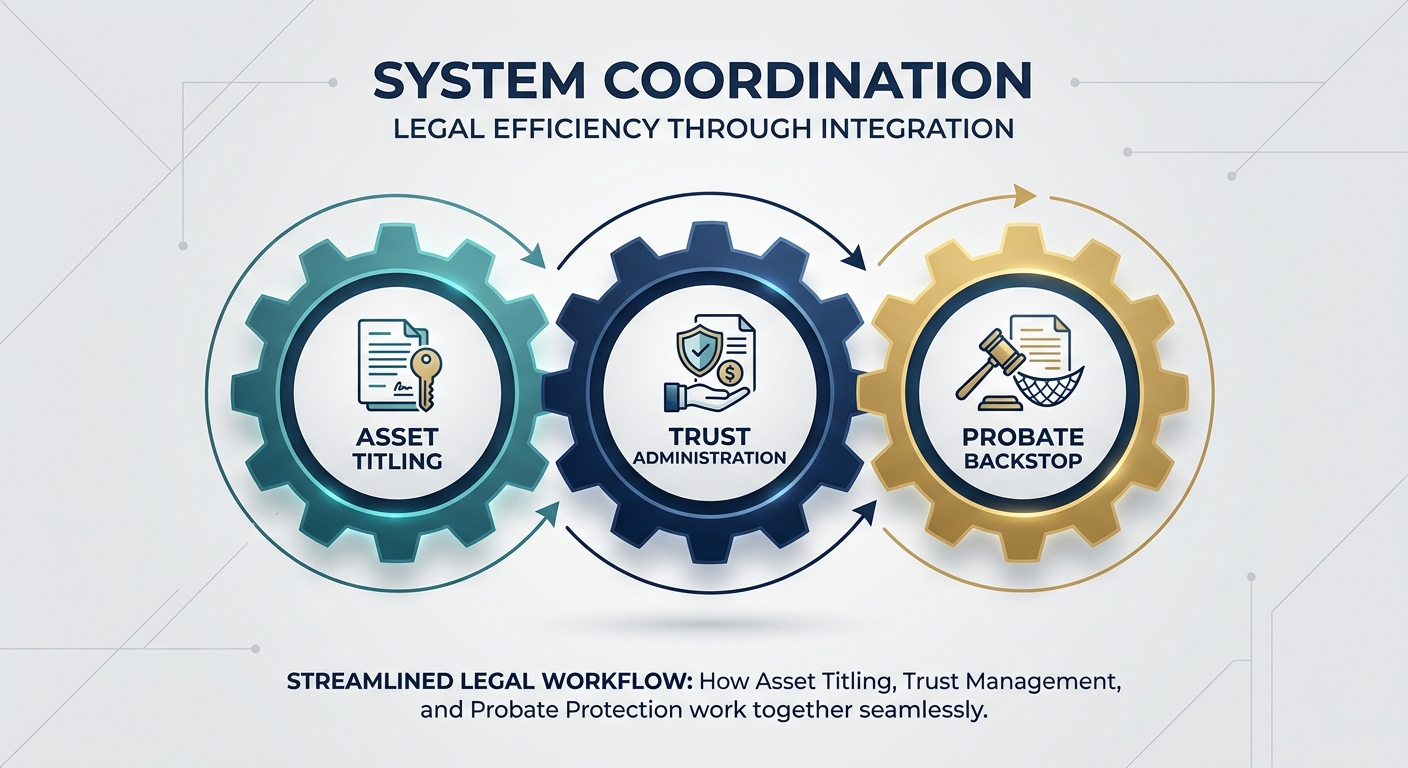
An estate plan under Florida law is not a single isolated document, but an interlocking system of distinct legal instruments.
To function effectively, it coordinates asset titling (how property is owned), contractual beneficiary designations (such as life insurance and retirement accounts that bypass probate), revocable living trusts (for private asset management), and a Last Will and Testament (which acts as an administrative backstop for stray assets and nominates guardians for minor children under the 17th Judicial Circuit probate framework).
Direct Transfer InstrumentsBeneficiary designations and trusts that bypass probate to route funds directly to intended recipients.
The Backstop AdministrationWills and probate courts acting as the administrative safety net for any leftover or stray assets.
A common misconception among clients entering an attorney’s office is that estate planning is merely a shopping exercise. People assume they need to choose between buying a will or setting up a trust. As if these documents were competing consumer products on a shelf.
In practice, a durable estate plan functions less like a single document and more like an interlocking machine. Each piece: whether it is a deed, a beneficiary designation, a trust agreement, or a last will and testament – answers a different legal question about your property, your care, and your family’s future security under Florida law.
Asset Ownership Sets the Foundation
Every legal instrument relies entirely on the underlying registration of your property.
The name on a title holds more legal authority over where property goes than almost any standard clause you can write down. Consider how differently law treats various holdings. A commercial storefront in Coral Springs tied to a corporate entity, a family home structured with survivorship rights, or an ordinary checking account carrying no payable on death instructions. Each follows its own strict statutory track.
Property registration and testamentary instruments point in opposite directions. The title or contractual beneficiary designation almost always supersedes your written documents. For instance, naming a child in a will has no legal effect on a bank account where a different individual is listed as the sole payable on death recipient. A thorough planning process evaluates these existing ownership titles first. Therefore ensuring that deeds, corporate shares, and financial accounts are adjusted or harmonized before any wills or trusts are finalized.
Different Assets Can Follow Different Paths
When an individual passes away, their property does not automatically flow down one universal river. Different asset classes utilize entirely distinct legal conduits:
Contractual Transfers: Life insurance policies, retirement accounts, and payable on death bank accounts bypass both wills and trusts entirely. Thus transferring directly to named beneficiaries by operation of contract law.
Trust Administration: Assets properly titled in the name of a revocable living trust flow privately through trustee administration without judicial interference.
Probate Administration: Assets left solely in an individual name with no beneficiary designation must be processed through the probate court system.
Understanding that these pathways operate simultaneously is the key to grasping how an estate plan actually functions.
The Operational Reality of Financial Accounts and Institutional Payables
A common blind spot in estate planning is assuming that legal documents command absolute authority over every dollar an individual owns. In practice, financial institutions, such as major banks operating in Coral Springs and regional credit unions, don’t act like this. They do not look to your will or trust first when an account holder passes away.
Instead, financial operations are strictly governed by internal institutional protocols and direct account contracts. When a bank representative reviews an account after a death certificate is presented, they execute whatever binding agreement is physically attached to that specific account file. If a bank ledger lists an individual payable on death designation, or if a brokerage account registers a transfer on death instruction, institutional compliance departments are legally bound to disburse those funds directly to the named individual, bypassing any instructions found in a trust agreement or a court supervised will.
An integrated estate plan accounts for this operational friction by auditing every institutional account agreement during the drafting phase. Therefore ensuring that corporate paperwork matches your overarching legal strategy before a financial institution ever faces a disbursement decision.
Where the Will Fits Into the Plan
Rather than acting as the absolute ruler of your entire estate, a Last Will and Testament serves a specific structural purpose within the broader system.
Within an integrated plan, a will functions primarily as a legal backstop. It catches stray assets that were never retitled into a trust. Names guardians for minor children. It also nominates the personal representative to manage the probate administration process if court intervention becomes necessary.
Where a Trust Fits Into the Plan
A revocable living trust operates as an alternative operating system for asset management and distribution.
When properly funded during your lifetime, the trust holds legal title to your major property holdings. Instead of directing asset distribution through public probate filings, the trust instrument coordinates private management rules. It establishes exact conditions for beneficiaries, and governs how assets are handled if you experience temporary or permanent incapacity.
If certain assets remain outside your trust or lack beneficiary designations, the probate court becomes the mandatory administrative mechanism required to clear title and transfer ownership. The goal of comprehensive planning is not always to eliminate every possibility of court involvement, but to ensure that probate handles only what is necessary while private mechanisms handle the bulk of your wealth.
What Happens When the Pieces Do Not Match?
The most critical test of an estate plan occurs when its individual instruments conflict with one another.
Consider a scenario where an individual executes a trust directing that their financial account be divided equally among three children, but the underlying bank account form lists only one child as a payable on death beneficiary. Under Florida law, the contractual beneficiary designation on the account typically overrides the instructions in the trust or will.
When beneficiary designations, trust agreements, and asset titles point in opposing directions, family disputes and unintended disinheritances frequently follow. Coordination prevents these friction points.
Through durable powers of attorney and healthcare surrogate designations, your plan designates trusted individuals to manage financial transactions, sign documents, and make medical decisions if you are unable to speak for yourself. These instruments integrate seamlessly with your property management framework, ensuring continuity whether you are navigating daily life or managing a medical crisis in Broward County.
Frequently Asked Questions
Does having a revocable living trust mean my estate will completely avoid probate in Florida?
Not automatically. A trust only avoids probate for assets that were properly titled in the name of the trust during your lifetime. Any remaining individually owned assets left outside the trust at the time of death will still require a probate administration unless alternative transfer mechanisms apply.
Can a beneficiary designation override the instructions written in my last will and testament?
Yes. Contractual arrangements such as life insurance policies, retirement accounts, and payable on death bank accounts operate independently of a will. The financial institution distributes funds directly to the named beneficiary on file, regardless of what your will states.
Why is asset titling just as important as drafting a will or trust?
Asset titling dictates the legal pathway property travels upon death or incapacity. If your legal documents specify one distribution plan but your deeds or account titles are registered under a conflicting ownership structure, the ownership title or beneficiary form frequently overrides your written documents.
How does local court jurisdiction in Broward County affect the administration of an estate plan?
When an estate plan requires judicial oversight, such as formal or summary administration through the 17th Judicial Circuit Court in Broward County, local procedural rules govern how property titles are cleared and distributed.
An integrated estate plan accounts for these local court requirements ahead of time, minimizing administrative delays for real estate located in Coral Springs, Parkland, or Fort Lauderdale by ensuring property deeds and trust funding are properly structured before probate ever becomes necessary.
What happens if instructions in a revocable living trust contradict a financial account beneficiary form?
If a revocable living trust states that all liquid accounts should be divided equally among beneficiaries, but an individual retirement account or bank account lists a single person as a payable on death recipient, the financial institution is legally bound to honor the beneficiary form.
A comprehensive estate audit resolves these discrepancies proactively to prevent unintended disinheritances.
Coordinate Your Estate Plan in Broward County
The goal of estate planning is not to accumulate the largest stack of legal documents. It is to ensure that your ownership titles, beneficiary forms, trusts, and wills work together as a unified system to protect your family and assets.
One of the first things families often discover after a death is that the law does not treat everything a person owned in the same way.
A house may be treated differently from a bank account. A retirement account may pass directly to a beneficiary. A jointly owned property may never become part of the probate estate. A will may control some assets but have no effect on others.
So when a loved one dies, the first legal question is not simply : “Who inherits?”
It is:
What happens to each of the things the person left behind?
That question leads into probate, but probate is only part of the picture.
The estate begins with an inventory, not a distribution
Suppose someone dies owning a house, two bank accounts, an IRA, a life insurance policy, a car, and personal belongings.
It would be easy to imagine that all of those things are gathered together into one estate and then divided among the heirs.
Florida law does not work that neatly.
An account with a valid beneficiary designation may pass directly to the named beneficiary. Certain jointly owned property may pass to the surviving owner. Life insurance and retirement accounts can also transfer according to their beneficiary designations rather than through the probate process.
Other property may become part of the probate estate and have to be administered through the court system.
21This distinction can completely change what happens after a death.
It also explains why finding the will is only one part of the initial investigation. The ownership documents, deeds, account agreements, beneficiary designations, and other estate planning documents may be just as important.
The Florida Bar describes probate as the process of identifying and gathering probate assets, paying valid obligations, and distributing what remains to the people entitled to receive it.
A will tells the court what the deceased wanted. It does not eliminate the legal process.
A valid will is important, but it does not simply cause property to change hands the moment someone dies.
The will is presented to the probate court, and the person nominated to administer the estate generally becomes the personal representative once appointed and qualified.
Florida deliberately uses “personal representative” as the general legal term rather than relying on terms such as executor or administrator.
That person then has legal authority over the probate estate and corresponding responsibilities.
This is an important distinction for families.
Someone named in a will does not simply become the owner of the estate. The personal representative may first have to identify and protect the assets, determine what the estate owes, deal with creditors, resolve claims, and determine what can ultimately be distributed.
The will provides instructions. Probate is the legal machinery through which those instructions are carried out.
And if there is no will?
The absence of a will does not mean that everything becomes uncertain.
It means Florida’s intestacy laws determine who inherits the probate estate.
The result depends on the surviving family members. A surviving spouse, children, parents, and other relatives can have different rights depending on the circumstances.
Homestead can make the analysis even more unusual.
Florida law contains special rules for a deceased person’s homestead when a spouse and descendants survive. Under the applicable statute, the surviving spouse may receive a life estate with a vested remainder for the descendants, or may elect an undivided one half interest as a tenant in common, subject to the statutory requirements.
That is one reason the simple statement “the house goes to the children” can be legally misleading.
The person handling the estate is not simply carrying out family wishes
The personal representative occupies a fiduciary position.
Florida law gives the personal representative possession or control of much of the decedent’s property and requires reasonable steps to manage, protect, and preserve estate property until distribution. Protected homestead is treated separately.
That can put the personal representative in an unusual position.
The person may be a child, spouse, sibling, or other relative of the deceased. At the same time, that person is administering property that may ultimately belong to several different beneficiaries and may have to be used to satisfy creditors or other obligations first.
Family agreement does not eliminate those duties.
A personal representative who mishandles estate property can face personal consequences. Florida’s fiduciary rules can impose liability for losses resulting from a breach of duty.
This is also why the role can become complicated even when everyone initially gets along.
The estate may owe money before anyone receives an inheritance
Death does not erase a person’s outstanding obligations.
Probate can involve mortgages, taxes, medical expenses, credit accounts, business obligations, and other legitimate claims against the estate. Florida has specific procedures governing creditor claims, including deadlines for filing them.
Generally, claims must be filed within the statutory period, subject to exceptions and special rules. The personal representative is responsible for administering the estate in accordance with those requirements.
This creates an important distinction:
The value of an estate is not necessarily the same thing as the value of the inheritance.
An estate may own substantial property while also carrying substantial obligations.
The personal representative has to determine what remains after the legally required expenses and claims are addressed.
Not every estate needs the same kind of probate
This is where Florida’s probate system becomes more interesting than the familiar idea of “going through probate.”
Florida provides different procedures depending on the circumstances of the estate. Formal administration is the more extensive process, while summary administration provides an abbreviated procedure for qualifying estates.
And Florida changed the rules in 2026.
Beginning July 1, 2026, an estate can generally qualify for summary administration when the value of the estate subject to administration in Florida, after excluding property exempt from creditors’ claims, does not exceed $150,000. Summary administration can also be available when the decedent has been dead for more than two years. The previous threshold was $75,000.
That is a significant change for Florida families.
It also means that an older article telling readers that summary administration is limited to estates worth $75,000 or less may now be giving them outdated information.
There are additional small estate procedures as well. Florida law provides a limited route for disposition without administration in certain intestate estates involving qualifying personal property and other statutory conditions.
The point is not that every family should try to avoid probate.
The point is that the appropriate procedure depends on the estate in front of you.
Then there is the house
For many families, the most important asset is also the one most likely to produce difficult legal questions.
Florida homestead law has constitutional protections and statutory rules that can affect what happens to a home after its owner dies. Those rules can interact with a will, a surviving spouse’s rights, descendants, prior ownership arrangements, and the language of deeds executed during the owner’s lifetime.
A recent Broward County case illustrates how quickly this can become complicated.
In McFarlane v. Holness, decided by Florida’s Fourth District Court of Appeal on September 23, 2026, a surviving spouse challenged the treatment of a property as homestead after her husband’s death. The case involved an enhanced life estate deed, commonly called a Lady Bird Deed.
The appellate court did not decide who ultimately had the better claim to the property. Instead, it held that the trial court had improperly resolved the deed’s legal effect at the motion to dismiss stage and sent the case back for further proceedings.
That distinction is worth noticing.
The dispute was not simply about who was named in a document. It involved the nature of the deceased person’s ownership interest, the effect of a deed, and the surviving spouse’s potential homestead rights.
In other words, “Who gets the house?” can sometimes be the beginning of the legal question rather than the end of it.
What should the family do first?
There is no universal checklist, because every estate is different. But several questions should be answered before anyone starts distributing property:
Was there a will, trust, or other estate planning document?
How was each major asset owned?
Were beneficiaries named on financial accounts, insurance policies, or retirement accounts?
Was the deceased’s home protected homestead?
What debts, taxes, or other obligations remain?
Does the estate qualify for summary administration or another simplified procedure?
Who has authority to act for the estate?
And perhaps most importantly:
Has anyone started distributing property before determining what the estate actually owes and what procedure applies?
That last question can save a family from turning a manageable probate administration into a dispute.
What happens next depends on the estate
No single event can be called “what happens after someone dies.”
There is an investigation into ownership. There may be a will to probate. Someone may need to be appointed personal representative. Creditors may have claims. Property may need to be protected or sold. A surviving spouse may have statutory rights. Beneficiaries may disagree. A house may be subject to homestead rules that make an apparently simple inheritance considerably more complicated.
And sometimes the estate qualifies for a simplified procedure instead.
That is why the first useful step is usually not trying to predict the entire probate process from the family circumstances alone. It is determining what the deceased owned, how those assets were held, and which Florida rules apply to them.
Probate in Coral Springs and Broward County
For families in Coral Springs, Broward County, and throughout South Florida, these questions are governed by Florida’s probate statutes and rules, with the appropriate proceedings handled through the local court system.
A relatively simple estate may require little more than careful administration. Another may involve a contested will, a homestead dispute, competing beneficiaries, creditor claims, or questions about the personal representative’s conduct.
The difference is often found in the details of how the deceased owned the property and what happened before and after death.
When a Florida Probate Attorney Can Help
If you are dealing with an estate after the death of a parent, spouse, relative, or other loved one, the most important legal questions may not be obvious from the will itself.
A probate attorney can help determine which assets require administration, explain the responsibilities of the personal representative, address creditor and beneficiary issues, and identify problems involving real estate, homestead, or disputed estate property before they become more difficult to resolve.
Reinfeld & Cabrera P.A. represents clients in probate and estate matters in Coral Springs, Broward County, and throughout South Florida.
Questions People Often Ask
Does everything a person owns go through probate in Florida?
No. Certain assets can pass outside probate through beneficiary designations, survivorship arrangements, or other forms of ownership. Whether an asset is subject to probate depends on how it was owned and how it was designated.
Does a will avoid probate?
Generally, no. A will provides instructions for the distribution of probate assets, but those assets may still need to pass through the applicable probate process.
What is a personal representative?
A personal representative is the person or qualified institution appointed by the court to administer a probate estate. Florida uses this term instead of executor or administrator.
Is probate always necessary in Florida?
No. Florida has formal administration, summary administration, and other procedures for qualifying estates. The facts and assets of the estate determine which procedure may apply.
What changed to Florida’s probate law in 2026?
Among other changes, Florida increased the statutory threshold for summary administration from $75,000 to $150,000, effective July 1, 2026.
Can a personal representative be held personally responsible for mishandling an estate?
Yes. A personal representative has fiduciary duties and can be liable for losses resulting from a breach of those duties. The specific consequences depend on the conduct and circumstances involved.
Related Florida Probate Topics
What Is Summary Administration in Florida? The 2026 increase to $150,000 makes this a particularly timely subject for a dedicated article explaining eligibility, procedure, and the differences from formal administration.
What Happens to a House When Someone Dies in Florida? A deeper examination of homestead, surviving spouse rights, descendants, deeds, and disputes over inherited real estate.
What Assets Avoid Probate in Florida? A focused explanation of beneficiary designations, joint ownership, survivorship rights, trusts, and other methods by which assets may pass outside probate.
What Does a Personal Representative Do in Florida? A more detailed look at fiduciary duties, control of estate property, creditor claims, distributions, conflicts, and potential liability.
What Happens to Debts When Someone Dies in Florida? A dedicated article on creditor claims, mortgages, taxes, estate expenses, and the distinction between estate debts and personal liability.
How Long Does Probate Take in Florida? A separate piece could examine formal administration, summary administration, creditor periods, contested estates, and the factors that make some probate cases considerably longer than others.
There is something different about dealing with a family business. The people answering the phone may know the people making the decisions. The person whose name is on the door may still be around when you have a question six months later. And when something goes wrong, there usually isn’t an impressive chain of departments available to explain why nobody knows who is responsible.
A family owned law firm can have some of those same characteristics.
That does not make family ownership a substitute for legal experience. If you need an attorney in Coral Springs, you still want someone who knows the relevant area of Florida law. You need someone who understands your particular problem, and can explain what your options actually are. The fact that a law firm is owned by a family does not magically accomplish any of those things.
What it can change is the relationship you have with the firm.
What Does Family Owned and Operated Actually Mean?
In a family owned and operated business, the people behind the company have a personal connection to what happens there. Their reputation is attached to the business. Their relationships with clients can continue for years. And the people who own the firm may also be involved in the day to day work.
For a law firm, that can be valuable. Legal matters are rarely as simple as handing someone a document, collecting a fee, and saying goodbye. A client may have questions later, another legal issue may come up. Perhaps a matter that seemed straightforward at the beginning may take an unexpected turn. Knowing who to call can make a real difference.
This is one reason some people prefer working with family owned businesses. They want to know who they are dealing with. People want to have a sense that the relationship matters to the people on the other side of the desk.
A Relationship That Can Continue Over Time
For clients in Coral Springs and throughout Broward County, that kind of relationship can be useful. Especially when legal needs extend over ongoing estate planning and business succession strategies with a local family in Broward County.me. Estate planning, probate, real estate transactions, business matters, and other legal issues can bring people back to the same law firm at different stages of their lives. Having attorneys who already understand the background can save everyone from starting the story from page one.
There is also a practical advantage to knowing how a firm is structured. Before hiring any attorney in Coral Springs, it is reasonable to ask who will actually handle your matter. You want to see how directly you can communicate with the attorney. There needs to be consistency – and whether the same people will remain involved as the case or transaction develops.
Those questions matter regardless of whether a firm is family owned. But they can be especially relevant when a firm’s owners are also actively involved in its work.
Managing Local Legal Matters Across Broward County
For families and business owners living in Coral Springs, Parkland, Fort Lauderdale, and surrounding South Florida communities, legal challenges rarely exist in a vacuum. An estate planning decision can directly impact a commercial real estate holding, and a family business succession plan can intersect directly with probate or guardianship administration.
Working with an established local firm means your legal team understands the specific procedural tendencies of the 17th Judicial Circuit Court and regional municipal codes. Rather than treating your matter as a routine transaction processed by an anonymous case manager in a distant corporate hub, a boutique local practice evaluates how your legal choices affect your daily life, your business balance sheet, and your long term family security in Broward County.
Family Businesses Understand Some Familiar Problems
Family ownership can also matter to people who run their own businesses. A family owned business often understands that legal decisions can affect relationships as well as balance sheets. Ownership, contracts, real estate, succession planning, and disputes can sometimes overlap with personal concerns.
For business owners in Coral Springs and the surrounding Broward County community, having a law firm that understands that overlap can be useful.
Family Owned Does Not Mean Every Firm Works the Same Way
None of this means that every family owned law firm operates in exactly the same way. Some are small. Many have several attorneys and staff. Some owners are heavily involved in client matters, while others have a more traditional management role. The label itself tells you only part of the story.
The better question is what the firm’s family ownership actually means for you as a client.
You can look at the firm’s practice areas and experience, but you can also ask how the attorneys work, who you will deal with, how communication is handled, and whether the firm is built around relationships that continue after one legal matter is finished.
You Know Who You Are Calling
One of the less glamorous advantages of a family owned law firm is also one of the easiest to appreciate: knowing who you are dealing with.
When a legal issue comes up, clients generally do not want to spend half their morning explaining the same situation to a new person. They want to reach someone who knows the matter, understands the history, and can tell them what happens next.
A family owned and operated firm can be well suited to that kind of continuity. The attorneys who own the business may remain closely involved with clients and their legal matters over time. For someone dealing with an estate, a property transaction, a business concern, or another ongoing legal issue, having a familiar point of contact can make the process considerably easier to navigate.
It also gives clients an opportunity to develop a relationship with the attorneys they rely on. You may initially contact a lawyer about one issue and return years later with another. By then, you are no longer starting with a blank page. The attorney may already understand your circumstances, your priorities, and the history behind the new question.
Direct Attorney Accountability Versus Corporate Law Factories
The modern legal landscape is increasingly dominated by large institutional law firms featuring multi tiered phone trees, layers of paralegals, and shifting case managers. When clients call with urgent questions about a probate timeline or a real estate closing, they are often forced to re-explain their entire situation to a stranger.
A family owned law firm operates on a completely different model of accountability:
Direct Communication Lines: You speak directly with the attorneys whose names are on the door and who actively manage your legal filings.
Institutional Memory: Because the firm builds multi generational relationships with local families, your historical legal context is preserved for future needs.
Aligned Interests: The firm’s local reputation in Northwest Broward County depends entirely on transparent communication, reliable case preparation, and dedicated client advocacy.
Talk With Our Attorneys
If you are considering a family owned law firm in Coral Springs, the easiest way to see whether the relationship feels right is to have a conversation.
How can you protect your finances during a divorce in Florida? Start by documenting your assets and debts, understanding which property qualifies as marital or nonmarital, and reviewing the financial consequences of any proposed settlement before signing.
To protect your interests during a Florida divorce:
Document your finances. Gather bank statements, tax returns, retirement account records, property documents, and outstanding debt information.
Understand your legal position. Identify which assets and liabilities may be marital before negotiating a settlement.
Avoid costly financial mistakes. Do not conceal assets or make questionable transfers that could damage your legal position.
Evaluate settlement terms carefully. Consider mortgage obligations, taxes, retirement benefits, and the practical consequences of your parenting plan.
Seek appropriate legal advice. Consult a qualified Florida divorce attorney before making major financial decisions or signing an agreement you do not fully understand.
The biggest divorce mistakes often begin with assumptions about what the law allows. Some spouses expect everything to be divided equally. Others believe that keeping the house automatically means keeping its full value, or that a divorce judgment removes their name from a joint mortgage.
Unfortunately, the legal system does not award compensation for misplaced confidence.
This guide explains how Florida divorce law works, which financial risks deserve attention, and what you can do to protect your interests. It also examines the decisions that should ideally happen before marriage, when financial arrangements are generally easier to negotiate and nobody has yet started arguing over who gets the dining room furniture.
1. The Most Important Advice Comes Before the Wedding
The best time to discuss financial protection during a marriage is often before the marriage begins.
That advice may arrive too late for someone already considering divorce. Still, it deserves attention because the decisions couples make before marrying can affect their finances for years.
Before getting married, discuss existing debts, income differences, property ownership, retirement savings, business interests, and expectations about future expenses. These conversations can reveal disagreements that might otherwise remain hidden until the relationship deteriorates.
Consider a prenuptial agreement
A prenuptial agreement can establish certain financial arrangements before marriage. Under Florida Statutes § 61.079, a premarital agreement must be written and signed by both parties. Florida law also establishes requirements and circumstances that can affect enforceability.
Depending on its terms and applicable law, an agreement may address the treatment of property, responsibility for certain obligations, and rights that would otherwise arise upon divorce.
It is not a magic document. An agreement may face a legal challenge if the circumstances surrounding its execution or the applicable statutory requirements create grounds for doing so. The Florida Supreme Court’s decision inCasto v. Casto, 508 So. 2d 330 (Fla. 1987), discusses circumstances in which a marital agreement may be challenged, including overreaching and issues involving financial disclosure.
A prenuptial agreement also cannot simply override every legal obligation involving children.
If you are already married, ask a Florida family law attorney whether a postnuptial agreement or another lawful arrangement could address your circumstances. Do not assume that an agreement signed after a dispute begins will have the same legal effect as one negotiated before marriage.
2. Understand What Florida Actually Divides
Florida follows an equitable distribution system. That does not mean a judge can divide everything however they please.
Under Florida Statutes § 61.075, the court must identify and set apart each spouse’s nonmarital assets and liabilities. It then determines how to distribute marital property and marital debts. Equal distribution is the starting point, although statutory factors can justify a different result.
The classification of property matters because ownership, timing, financial contributions, and other circumstances can affect how an asset is treated.
Marital property is not limited to items with both names on them
Depending on the circumstances, marital property can include assets acquired during the marriage, certain retirement benefits earned during that period, and increases in the value of particular assets.
An asset held in one spouse’s name is not automatically excluded from equitable distribution. Conversely, an asset acquired before marriage does not automatically become marital property simply because the couple later divorces.
Florida law contains specific rules for identifying marital and nonmarital assets. The details matter, particularly when one spouse owned a business before marriage or received an inheritance that was later mixed with marital funds.
Make a complete financial inventory
Start gathering records before negotiations become complicated. Keep lawful copies of relevant documents, including:
Bank and investment account statements.
Tax returns and income records.
Retirement plan statements and pension information.
Mortgage documents, property deeds, and home valuation records.
Business ownership documents and financial statements.
Credit card balances, personal loans, and other liabilities.
Records showing when property was acquired or inherited.
Florida’s Family Law Rule of Procedure 12.285 establishes financial disclosure requirements in many family law cases, subject to applicable exceptions and court orders.
Do not access accounts you are not authorized to use or obtain records through unlawful means. If important financial information is unavailable, ask your attorney about lawful discovery procedures.
Understand the difference between ownership and value
Suppose one spouse owns a business that increased in value during the marriage. The business’s original purchase price may tell only part of the story. Its current valuation, the source of the investment, the contributions made during the marriage, and the applicable legal classification may all matter.
The same principle applies to real estate and investment accounts.
A financial inventory should therefore identify both the asset and the evidence supporting its valuation. Guessing at values during settlement negotiations can leave you with a misleading picture of your actual financial position.
3. Do Not Hide Money or Drain Accounts
When a marriage breaks down, one spouse may be tempted to transfer money, withdraw large sums, sell property, or move assets into a relative’s name.
The distinction between ordinary spending and intentional dissipation matters.
InMiller v. Miller, 2016, Florida’s Fourth District Court of Appeal explained that a finding of dissipation requires evidence of intentional misconduct. Ordinary mismanagement or spending that a spouse simply dislikes does not automatically satisfy that standard.
The case is a useful reminder that suspicious spending and legally established dissipation are not the same thing.
What should you do if money appears to be disappearing?
Preserve the records you can lawfully access. Make a note of unexplained withdrawals or transfers, including dates and amounts. Keep copies of account statements and other relevant documents.
Avoid retaliatory financial decisions. Emptying an account because you suspect your spouse has done the same thing can complicate your position rather than protect it.
If you believe assets are being concealed or deliberately depleted, discuss the evidence with your attorney. Depending on the circumstances, the appropriate response may involve formal financial disclosure, discovery, or a request for court intervention.
A practical example
Imagine that a couple has joint savings of $80,000. During the breakdown of the marriage, one spouse transfers $30,000 to an undisclosed account and refuses to explain the transaction.
That transfer deserves investigation. However, the legal outcome depends on the source of the money, the purpose of the transfer, the available evidence, and the applicable law.
A transfer made to conceal marital funds is different from a documented payment for legitimate household expenses. Establishing the facts is more useful than making accusations without supporting evidence.
The decision inRabbath v. Farid, 34 So. 3d 1270 (Fla. 1st DCA 2009) illustrates how financial evidence, allegations of concealed assets, and questions about income can become significant in divorce litigation. The court also emphasized the need for adequate evidentiary support when determining income for support awards.
4. Think Carefully Before Giving Up the Marital Home
For many couples, the family home is their most valuable asset. It can also be their largest financial obligation.
The decision to keep or leave the property should not be based exclusively on emotional attachment or the desire to maintain familiar surroundings.
Before agreeing to keep the house, determine its approximate market value. Obtain the current mortgage balance and estimate the costs of ownership, including insurance, property taxes, maintenance, and any applicable association fees.
Then calculate the equity.
For example, a home valued at $500,000 with a $300,000 mortgage has approximately $200,000 in gross equity before selling costs or other adjustments. That does not mean either spouse can automatically claim $100,000. The legal classification of the property and the overall settlement affect the analysis.
Keeping the house does not necessarily mean you can afford it
A settlement might award the home to one spouse while requiring that spouse to compensate the other for an agreed share of the equity.
That arrangement may work if the spouse retaining the property can refinance the mortgage or otherwise meet the financial obligations. It can become a problem if the necessary financing is unavailable.
If both spouses remain borrowers, the lender may still pursue either borrower according to the loan agreement. A promise in a divorce settlement is not the same as a release from the lender.
Compare your options before deciding
Depending on the circumstances, the options may include selling the property and dividing the proceeds, refinancing so one spouse retains the home, or negotiating another arrangement that accounts for the property’s value and associated obligations.
Florida law also addresses credits and setoffs associated with the marital home. Florida Statutes § 61.077 identifies factors relevant to these issues, including possession of the property and certain housing expenses.
The right decision depends on the numbers and the legal circumstances. A house that looks like a valuable settlement asset can become a financial burden if the mortgage and maintenance costs exceed what the new household can reasonably afford.
5. Understand Child Support and Alimony Separately
Support payments can significantly affect both spouses’ financial futures. They should be evaluated separately from property division.
Alimony depends on the applicable legal standards
Florida law recognizes several forms of alimony, including temporary, bridge the gap, rehabilitative, and durational alimony. The applicable requirements and potential award depend on the circumstances described in Florida Statutes § 61.08.
A spouse should not assume that alimony is automatic after a long marriage. Nor should a higher earning spouse assume that support can never be awarded to someone who has an independent income.
The court considers statutory factors when determining whether an award is appropriate. Relevant considerations include the parties’ financial circumstances and the duration of the marriage.
Florida’s 2023 legislative reforms eliminated permanent alimony for new awards. Current law governs the forms of alimony available in a particular proceeding.
Before agreeing to a settlement, examine the proposed payment amount and duration. Consider how your income, housing costs, employment prospects, and other obligations may change after the divorce.
Child support follows separate rules
Child support is calculated under the guidelines in Florida Statutes § 61.30. The calculation considers factors including parental income and other legally relevant information.
Parents should not assume that the person with less time sharing will necessarily receive a particular amount. Nor should they treat support as a reward for one parent or a penalty against the other.
A parenting arrangement and a support obligation address different legal questions. Under Florida Statutes § 61.13, parenting plans and time sharing are governed by the child’s best interests and the applicable statutory framework.
Do not agree to an informal financial arrangement that leaves major questions unresolved. If a support order already exists, follow it unless it is modified through an appropriate legal process.
Account for taxes
Support and property transfers can have different federal tax consequences.
The Internal Revenue Service’s guidance on filing taxes after divorce or separation explains several issues that can arise, including the treatment of child support and certain property transfers. For divorce or separation agreements executed after 2018, alimony generally is not deductible by the payer or taxable to the recipient for federal income tax purposes.
Do not assume that a settlement’s stated dollar amounts represent their full economic value. If a proposed agreement involves substantial property or support payments, ask a qualified tax professional to evaluate the consequences.
6. Protect Your Relationship With Your Children
When children are involved, decisions made during divorce can affect family life long after the legal proceedings end.
Florida uses the term time sharing rather than relying exclusively on the older concept of custody. Parenting plans address the schedule and the responsibilities each parent will undertake.
Under Florida Statutes § 61.13, the child’s best interests are central to parenting decisions. The statute establishes a rebuttable presumption that equal time sharing is in the child’s best interests, subject to the law’s requirements and the facts of the case.
That presumption does not mean every family will receive an identical schedule. A child’s needs and the parents’ circumstances remain important.
Make the parenting plan specific
A workable plan should address ordinary practical questions. Where will the child stay during the school week? How will holidays be divided? Who will handle school decisions and medical appointments? What happens when a parent needs to change the schedule?
The more precisely an agreement addresses foreseeable situations, the less room there may be for disputes about its meaning.
A parent should also avoid making promises about a schedule that they cannot realistically maintain. Travel time, employment hours, school commitments, and the child’s needs all affect whether a proposed arrangement is workable.
Do not use the child as a negotiating tool
Withholding time sharing because support payments are late can violate an existing order. Florida law addresses the independence of these obligations in § 61.13(4).
Likewise, a parent should not stop paying court ordered support because the other parent has failed to follow the schedule. Seek legal enforcement or modification rather than attempting to resolve the dispute through retaliation.
If safety concerns exist, document them and seek appropriate legal advice. The child’s welfare must remain central to the response.
7. Do Not Sign a Settlement You Do Not Understand
A settlement can resolve disputes without requiring every issue to be decided at trial. However, signing an agreement without understanding its consequences can create problems that are difficult or expensive to correct.
Read the proposed agreement carefully. Make sure the financial terms match the parties’ intentions and that the document addresses the obligations each person will assume.
Check the details behind the headline numbers
A proposed settlement might award one spouse the house and the other spouse a retirement account. The apparent values could be similar, yet the assets may have very different tax implications, liquidity, and future costs.
Before agreeing, consider:
Whether the property valuations are reliable.
Whether the proposed division accounts for outstanding debts.
Whether retirement assets require a qualified domestic relations order.
Whether a mortgage lender must approve refinancing or another change.
Whether the agreement establishes clear deadlines and enforcement mechanisms.
Whether the support provisions reflect the parties’ actual circumstances.
The IRS guidance on retirement plans and divorce explains that many employer sponsored retirement plans require a qualified domestic relations order, commonly called a QDRO, before benefits can be paid to a former spouse.
A divorce judgment alone may not complete the administrative steps required to divide a retirement account. Ask the plan administrator and your legal adviser what documents are necessary.
Do not confuse an agreement with a completed transaction
Suppose a settlement states that one spouse will retain the home and take responsibility for the mortgage. If the loan remains in both names, the other spouse may still face financial exposure.
The agreement may create obligations between the former spouses, but it does not necessarily change the lender’s rights. Similar implementation problems can arise with vehicle loans, joint credit accounts, and retirement benefits.
A settlement should explain how these obligations will be completed. Where necessary, it should establish realistic deadlines and address what happens if a required transaction cannot be completed.
If you do not understand a provision, ask questions before signing. A short delay to clarify an obligation is usually preferable to discovering its meaning after the agreement becomes binding.
8. Common Divorce Mistakes That Can Cost You
Some financial mistakes are obvious. Others arise from seemingly reasonable decisions made without understanding their legal consequences.
Moving out without considering the practical consequences
Moving out does not automatically mean you surrender ownership of the home. However, leaving can affect household expenses, access to personal belongings, and the practical arrangements surrounding children.
Before making a major change, consider the immediate financial implications and obtain advice if ownership or parenting issues are disputed.
Do not remain in an unsafe environment merely to protect a financial position. Safety concerns require appropriate action and should take priority.
Making major purchases or taking on new debt
Large discretionary purchases during a separation can complicate the financial picture. The effect depends on the source of funds, the timing, the purpose, and the applicable legal standards.
Avoid assuming that your spouse will automatically be responsible for a debt simply because it was incurred during the marriage. Ask your attorney how the obligation may be classified and addressed.
Ignoring retirement savings
Retirement accounts can represent a substantial portion of a couple’s accumulated wealth. Focusing exclusively on the house or bank accounts may leave important assets out of settlement discussions.
Review the account balance and the legal classification of the benefits. If an employer sponsored plan is involved, confirm the process for implementing any agreed division with the plan administrator and review the IRS guidance on QDROs.
Overlooking the cost of starting over
The financial effect of divorce does not end when assets are divided. Each household may need to cover separate housing costs, utilities, insurance, transportation, and other expenses.
Prepare a realistic post divorce budget before accepting a settlement. Include recurring costs and reasonable contingency funds. A settlement that looks attractive on paper may not provide enough cash flow to support your actual needs.
Treating litigation as a contest to win at any cost
Some disputes require a judge to make a decision. Others can be resolved through negotiation or mediation.
The objective should be a legally sound outcome that protects your interests. Spending substantial sums to contest an issue with limited financial significance may be counterproductive.
That does not mean you should accept an unfair agreement simply to avoid conflict. It means evaluating the likely costs, benefits, evidence, and alternatives before choosing how to proceed.
9. How to Approach the Divorce Process
A structured approach can help you make better decisions under pressure.
Step 1: Establish your financial baseline.
List your income, regular expenses, assets, and debts. Gather records showing account balances and ownership. Identify missing information that needs to be obtained lawfully.
Step 2: Identify the urgent issues.
Consider housing, access to funds, ongoing household bills, parenting arrangements, and any immediate safety concerns. Ask a lawyer whether temporary court orders or other protective measures may be appropriate.
Step 3: Understand the applicable legal rules.
Review how equitable distribution, support, and time sharing may apply to your situation. Florida’s Chapter 61 statutes provide the statutory framework for dissolution of marriage and related matters.
One spouse must generally have resided in Florida for at least six months before the petition is filed, as provided by Florida Statutes § 61.021.
Step 4: Evaluate negotiation and mediation.
Consider whether the disputed issues can be resolved through negotiation. Mediation may help the parties explore settlement options with the assistance of a neutral mediator.
Mediation does not guarantee agreement. It also does not eliminate the need to understand the legal and financial implications of any proposed settlement.
Step 5: Review the proposed outcome in practical terms.
Calculate what you are likely to own and owe after the divorce. Consider housing expenses, support obligations, taxes, retirement benefits, and the time required to complete transactions.
Step 6: Confirm that the agreement is implemented.
After the judgment, complete any necessary transfers, refinancing, account changes, or retirement plan paperwork. Review deadlines and preserve copies of the final documents.
An agreement is only as useful as the practical arrangements that carry it out.
10. When Professional Legal Help Matters Most
Not every divorce requires the same level of legal intervention. A straightforward, uncontested case may involve fewer disputed issues than a divorce involving a business, substantial property, hidden assets, or complex parenting concerns.
Legal advice becomes particularly important when you cannot determine which assets are marital, when financial disclosures appear incomplete, or when a proposed agreement could affect your long term financial security.
A lawyer can help you understand the applicable law and identify issues that deserve closer examination. A financial professional or tax adviser may also be useful when the settlement involves complicated assets or significant tax consequences.
If you cannot afford full representation, ask whether limited scope legal services or other assistance may be available. Do not assume that the only options are full representation or handling every issue alone.
The Florida Courts’ family law resources provide information for people navigating family law matters. These resources can help you understand court procedures, although they do not replace advice about your particular circumstances.
11. The Final Checklist Before You Commit
Before filing for divorce or agreeing to settlement terms, review the following questions.
Have you gathered reliable records of your assets and debts?
Do you understand which property may be classified as marital?
Have you reviewed the mortgage and other joint financial obligations?
Have you considered retirement accounts and any required QDRO?
Do you understand the potential effect of alimony and child support?
Is the parenting plan realistic for your family’s circumstances?
Have you reviewed the tax implications of the proposed settlement?
Are there unexplained transfers or missing financial records that require investigation?
Does the agreement establish clear obligations and deadlines?
Have you obtained legal advice about provisions you do not understand?
You do not need to answer every question immediately. You do need to recognize which questions remain unresolved before making an irreversible decision.
Frequently Asked Questions About Conducting a Divorce in Florida
1. Does Florida automatically divide marital property equally?
Equal distribution is the starting point under Florida Statutes § 61.075. A court may order an unequal distribution when justified by the relevant statutory factors. The classification of property as marital or nonmarital must also be addressed.
2. Can my spouse take half of everything I own?
Not automatically. Florida law distinguishes marital property from nonmarital property. Assets acquired before marriage, inheritances, gifts, and property that has been mixed with marital assets may require closer examination. The outcome depends on the applicable legal rules and the evidence.
3. Can I keep the house if I get divorced?
Possibly. The spouses may negotiate for one person to retain the property, or a court may address the home as part of the proceedings. The arrangement must account for the property’s value and associated obligations. If the mortgage remains in both names, the other borrower may remain liable to the lender unless the loan is changed or the lender releases that borrower.
4. Can I be required to pay alimony in Florida?
Yes, when the applicable legal requirements are satisfied. Florida law permits several forms of alimony under § 61.08. Whether an award is appropriate depends on the parties’ circumstances and the statutory factors.
5. Does equal time sharing mean neither parent pays child support?
No. Parenting arrangements and child support are separate legal questions. Support is determined under the applicable guidelines in Florida Statutes § 61.30, while parenting decisions are governed by the law addressing the child’s best interests.
6. What happens if my spouse hides money during a divorce?
You can raise the issue through appropriate legal procedures and seek the relevant financial records. A court may consider intentional dissipation of marital assets when determining equitable distribution under § 61.075. The evidence must support the claim, and suspicious activity does not automatically establish wrongdoing.
7. Should I sign a divorce settlement to avoid going to court?
Only after you understand the agreement and its consequences. Settlement can reduce conflict and legal expense, but an agreement that leaves important obligations unresolved may create problems later. Obtain legal advice when the terms are unclear or the financial consequences are significant.
8. How long do I have to live in Florida before filing for divorce?
Generally, one spouse must have resided in Florida for at least six months before filing the petition for dissolution of marriage. This requirement appears in Florida Statutes § 61.021.
Considering Divorce in Coral Springs or Broward County?
If you are unsure what divorce would mean for your family, finances, or future, a consultation can help you understand your options before you file. Contact My Personal Attorneys to discuss your circumstances with a Florida family law attorney.
You cannot control every outcome of a divorce. You can take steps to understand your position before committing to a settlement.
Once you understand what is at stake, proceeding without appropriate advice is a risk you should take with your eyes open.
A Florida real estate attorney knows the rules that govern property transactions, from contract requirements and title issues to closing procedures and the remedies available when something goes wrong. A buyer or seller generally does not have that knowledge. There is no reason to expect them to.
You know the property. What you want to pay or receive. You know the circumstances that brought you to the transaction. Your attorney brings something different: a working knowledge of Florida real estate law and the experience to recognize legal problems that may not be obvious from the face of a document.
The Florida Bar recommends consulting an experienced Florida licensed real estate lawyer before signing a purchase contract. That timing gives the attorney an opportunity to examine the agreement while its terms can still be negotiated.
For someone buying or selling property in Coral Springs, Broward County, or elsewhere in South Florida, that is often the most useful place to begin.
Who Represents Your Interests?
A property transaction can involve real estate agents, brokers, lenders, title professionals, inspectors, surveyors, insurance professionals, and attorneys.
Each person has a different responsibility.
A closing agent may coordinate documents, funds, title requirements, and the mechanics of completing the transaction. That person may also be a lawyer. The Florida Bar cautions consumers that a closing agent does not necessarily represent the buyer’s personal legal interests.
Your own attorney has a different assignment. The lawyer is there to advise you about your legal position, explain what you are agreeing to, identify problems, and negotiate or respond when necessary.
“A closing can look perfectly organized from the outside while still containing terms that deserve a closer legal review. The question is whether someone is specifically looking at the transaction from your legal point of view.”
That can matter when a contract contains unusual obligations, a title commitment raises questions, a condominium has complicated restrictions, or the parties disagree about what was promised.
Start With the Contract
The purchase agreement establishes the framework for the transaction.
Price is one provision. Deadlines, deposits, financing, inspections, repairs, default provisions, closing conditions, property disclosures, and special agreements can all affect what happens after the contract is signed.
The Florida Bar advises buyers to have a lawyer review the purchase contract before signing. Its consumer guidance also notes that contractual terms may become difficult to change once the agreement has been executed.
Florida Realtors has likewise advised consumers to read contracts carefully, including the particular version being used and provisions dealing with default and disputes. Familiarity with a standard form does not answer every question raised by an individual transaction.
A lawyer reviewing the agreement may examine
Contract issue
Questions legal review can address
Deposit
Where is it held? When can it be released?
Inspection
What rights exist if defects are discovered?
Financing
What deadlines and conditions apply?
Closing date
What happens if either side cannot close on time?
Repairs
Which obligations have actually been agreed to?
Default
What remedies may become available?
Special provisions
Do unusual terms create additional obligations?
Disputes
What procedures or remedies does the agreement provide?
A provision can look harmless when read by itself and have a very different effect when considered alongside the rest of the agreement. An attorney is trained to look for those connections.
Title Problems Can Follow the Property
Title work is another central part of a real estate transaction.
A title examination can involve years of recorded documents, previous transfers, liens, easements, restrictions, and other matters affecting ownership. The title insurance commitment identifies requirements that must be satisfied before the policy is issued as well as exceptions to coverage.
Consider a buyer who discovers an easement affecting part of the property. The existence of an easement does not automatically make the transaction unacceptable. Its location, purpose, language, and effect on the buyer’s intended use of the property are the questions that need attention.
The same applies to liens, restrictions, unresolved ownership questions, and other title matters.
A title commitment may identify an exception. The attorney’s job is to explain what that exception means and whether it creates a legal problem for the client.
Florida’s Department of Financial Services recognizes Florida attorneys in good standing as professionals who may handle real estate closings involving title insurance and escrow.
Negotiating the Terms
Real estate negotiations rarely stop at the number written on the first page.
A buyer may want additional time for financing. A seller may agree to repairs in exchange for a particular closing date. The parties may negotiate responsibility for an existing lien or an issue discovered during inspection. A condominium transaction may involve documents and restrictions that require attention before the buyer proceeds.
The lawyer brings legal knowledge to those negotiations.
That knowledge can be useful when a proposed change sounds reasonable but creates an obligation elsewhere in the contract. It can also help a client understand what is worth negotiating and what may create unnecessary complications.
Florida Realtors has emphasized that contract terms can be negotiated and that parties have a right to seek legal review.
A standard contract form is a starting point. The property, the parties, and the circumstances determine whether its provisions actually work for the transaction at hand.
What Happens at Closing?
Closing is where the contractual decisions, title work, financing, and other requirements come together.
The deed must transfer the property properly. Required documents must be completed. The closing figures must correspond with the transaction. Title requirements must be satisfied or addressed. Funds need to reach the correct destination.
A lawyer handling the transaction understands the legal significance of those documents and requirements. The client does not need to become a temporary expert in Florida property law simply because they are buying a house.
There is also a distinctly modern hazard: wire fraud.
That advice deserves serious attention. Real estate transactions can involve hundreds of thousands of dollars moving electronically. A fraudulent change to wiring instructions can turn an ordinary closing into a serious financial problem.
When a Transaction Starts to Fall Apart
Some legal questions do not appear until the deal is already under pressure.
The inspection may reveal significant damage. Financing may fail. A title defect may appear shortly before closing. The seller may refuse to perform an agreed obligation. The buyer may want to withdraw. The parties may disagree about the deposit.
Once that happens, the contract becomes the starting point for determining what each party is required to do and what remedies may exist.
Florida Realtors notes that a failed closing does not cause the underlying contract to disappear. The circumstances surrounding the failure can determine whether a breach occurred and what consequences follow.
This is where knowing the details of the agreement matters. Deadlines, contingencies, default provisions, notice requirements, and other clauses can determine what a party can do next.
An attorney who has reviewed the transaction from the beginning also has the benefit of knowing how the dispute developed, rather than trying to reconstruct the deal after the parties have reached an impasse.
Florida’s Property Market
Florida’s real estate market gives these transactions considerable financial weight.
By August 2026, the statewide median price was $415,000 for single-family homes and $298,000 for condos and townhouses. Inventory stood at 4.3 months for single-family homes and 7.7 months for condos and townhouses.
Florida residential market, August 2026
Median price
Inventory
Single-family homes
$415,000
4.3 months
Condos and townhouses
$298,000
7.7 months
A transaction involving a property worth several hundred thousand dollars can turn on a few sentences in a contract or a title document. Understanding those sentences is part of the attorney’s job.
Do You Need a Real Estate Attorney in Florida?
Florida does not require an attorney for every real estate transaction.
The Florida Bar nevertheless recommends consulting an experienced Florida licensed real estate lawyer before signing a purchase contract.
There is nothing strange about that distinction. People routinely hire professionals for matters that fall within those professionals’ expertise.
You probably would not expect a title examiner to negotiate your purchase agreement or a real estate agent to give you a complete analysis of Florida contract law. An attorney occupies a different place in the transaction.
The lawyer knows the statutes, regulations, contractual principles, title rules, and legal remedies that can affect the deal. The client brings knowledge of the property and their own objectives. Good representation connects the two.
Questions to Ask a Real Estate Attorney
If you are considering legal representation for a Florida property transaction, useful questions include:
Will you review the purchase contract before I sign it?
Will you review the title commitment and exceptions?
Who will represent my interests during closing?
Can you negotiate changes to the contract?
Will you review condominium or homeowners’ association documents when relevant?
What happens if the other party refuses to close?
What should I do if a title problem appears?
How will you communicate with the title company, lender, broker, or opposing counsel?
The answers can tell you how involved the attorney expects to be and whether the representation fits the transaction.
Why Use a Real Estate Attorney?
You do not need to memorize Florida’s real estate laws to buy a house.
You do need to understand the agreement you are signing and the legal consequences of the transaction. That is where an attorney’s knowledge becomes useful.
A real estate lawyer works with the statutes, contracts, title records, closing requirements, and disputes that surround property transactions. The lawyer can recognize legal issues that an ordinary buyer or seller may never have encountered before.
As he states: “A successful closing depends on documents that accurately reflect the agreement and on careful attention to the client’s legal interests throughout the transaction.”
If you are buying or selling property, refinancing, dealing with a title issue, or facing a disagreement over a real estate contract, contact Reinfeld & Cabrera to discuss your situation.
Frequently Asked Questions
Is a real estate attorney required in Florida?
No. Florida does not require an attorney for every real estate transaction. The Florida Bar recommends consulting an experienced Florida licensed real estate lawyer before signing a purchase contract.
When should I hire a real estate attorney?
Before signing the purchase contract is generally the most useful time. Early review allows potential contractual problems to be addressed while the terms remain open to negotiation.
What does a Florida real estate attorney do?
Depending on the transaction, an attorney may review contracts, investigate title issues, explain closing documents, negotiate terms, advise on property restrictions, and represent a client when a transaction develops into a dispute.
Does the closing agent represent the buyer?
Not necessarily. A closing agent can coordinate the transaction without representing the buyer’s individual legal interests.
Can a real estate attorney resolve title problems?
An attorney can investigate the legal significance of title defects, liens, easements, restrictions, and other title issues and advise the client about available options.
What happens when a Florida real estate transaction does not close?
The answer depends on the contract and the circumstances. The parties may have rights and obligations involving deposits, default, damages, deadlines, or other remedies. The contract and the facts need to be examined before determining what follows.