Florida Guardianship and Gun Rights: Can You Keep Your Firearms?

Guardianship attorney discussing firearm rights with a family in Coral Springs, Florida

A Florida guardianship does not automatically take away a person’s gun rights. However, an incapacity adjudication can trigger a separate firearm disability under Florida law, depending on the findings made by the court.

That sounds straightforward until someone actually has to deal with it.

Dad cannot manage his bills anymore. His daughter is considering guardianship. Then somebody remembers the guns.

There is a handgun in the nightstand. Two rifles are in a locked cabinet. Dad insists he is perfectly capable of handling them. His daughter is considerably less convinced.

Now the family has a very different question:


Can Dad still legally own or possess those firearms?

Florida’s guardianship law and firearm law approach that question differently. A guardianship does not automatically erase every legal right an incapacitated person has. At the same time, Florida’s firearm statutes impose restrictions on certain people who have been adjudicated mentally defective, and that definition includes certain judicial findings of incapacity under Florida’s guardianship law.

So the answer may depend on something buried in the court record that the family did not realize mattered.

And that is where things get interesting.


Does Guardianship Automatically Take Away Gun Rights in Florida?

No. Being placed under guardianship does not, by itself, automatically remove a person’s right to own or possess firearms.

Florida’s guardianship statute, §744.3215, lists the rights a person determined incapacitated retains and the rights that a court may remove. The list includes rights involving marriage, voting, driving, contracts, property, health care, residence, and other decisions. Firearm ownership and possession are not listed as rights that §744.3215 specifically gives a guardian authority to remove.

That does not mean an incapacity finding has no effect on firearms.

Florida’s firearm statutes create a separate legal disability. Under §790.065, the statutory definition of a person “adjudicated mentally defective” includes a judicial finding of incapacity under §744.331(6)(a). A person who falls within that definition can be prohibited from purchasing a firearm.

Section 790.064 goes further. A person who has been adjudicated mentally defective, as defined by §790.065, may not own or possess a firearm until relief from the firearm disability is obtained.

So there are two different pieces of law sitting next to each other:

  • Chapter 744: What rights has the guardianship court removed from the ward?
  • Chapter 790: Does the person have a separate firearm disability?

The answer to one does not automatically answer the other.


What Does an Incapacity Adjudication Have to Do With Firearms?

This is the part families can easily miss.

A guardianship case begins with a determination of incapacity. Florida law requires the petition to identify the rights the petitioner believes the alleged incapacitated person cannot exercise. The court then determines the nature and scope of the incapacity and the rights affected by its order.

Firearm law uses its own terminology.

Under §790.065, “adjudicated mentally defective” includes certain court determinations involving mental illness, incompetency, conditions, or disease. The statute specifically includes a judicial finding of incapacity under §744.331(6)(a).

That is why the phrase “the person has a guardian” is not enough to determine whether a firearm disability exists.

You have to look at the actual incapacity adjudication and the statutory definition that applies to it.

A limited guardianship involving one set of rights can raise different questions from a broader incapacity adjudication. The court order, the findings supporting it, and the applicable firearm statutes all matter.


What Happens to Guns Someone Already Owns?

Suppose Dad already owns three firearms before the guardianship proceeding.

His daughter becomes his guardian. The guns do not suddenly become the daughter’s property because she was appointed guardian.

But if Dad has been adjudicated mentally defective within the meaning of Florida’s firearm statutes, §790.064 says he may not own or possess a firearm until the firearm disability is removed.

That creates a practical problem the family should not try to solve by improvising.

Someone needs to determine:

  • What exactly did the court adjudicate?
  • What rights were removed?
  • Does the adjudication fall within §790.065?
  • Is there an existing firearm disability?
  • Is there a concealed weapons or firearms license?
  • Does a court order address the firearms?
  • What legally authorized arrangement should be made for firearms the person already owns?

A guardian does not receive a free-floating power to make every decision for a ward. Florida law limits the rights a guardian may exercise to those removed from the ward and delegated to the guardian.

And if the person is legally prohibited from possessing a firearm, the family should not treat the guns as if this were simply a question of where to put Dad’s property.


Florida Lawyers Were Already Arguing About This in 2013

In December 2013, The Florida Bar Journal published “Grandparents, Guns, and Guardianship: Incapacity and the Right to Bear Arms” by Carla-Michelle Adams. The article argued that Florida’s guardianship statutes did not specifically address whether an incapacitated person’s right to bear arms could be removed.

Then, in February 2014, attorneys Caroline S. A. Zoes and J. Marcos Martinez responded with “Wards and Guns.” Their position was that becoming a ward does not automatically erase constitutional rights.

The exchange is useful today because it identified the exact problem: guardianship law and firearm law were not using the same framework.

Florida’s statutes have since developed firearm-specific restrictions that make the analysis different from the one presented in those 2013 and 2014 articles.

The old debate is still worth reading, though. It explains why the relationship between guardianship, incapacity, and gun rights has never been as simple as “the judge appointed a guardian, so the guns are gone.”


Florida Guardianship Forms Mention Firearms

There is an unusually specific clue in Florida’s guardianship paperwork.

The Florida Supreme Court’s guardianship forms include a question asking whether the respondent may or may not have a license to carry a firearm or possess a weapon or firearm. The form appears in the court’s guardianship rules and forms governing incapacity and guardianship proceedings.

That does not mean the form itself creates a firearm disability.

It does show that firearms are something the guardianship process can require the court to address.

The same form separately identifies the rights that may be delegated to a guardian. Those include contracts, lawsuits, government benefits, property management, residence, health care, and social-environment decisions. Firearm possession does not appear in that list of delegable guardianship rights.

That distinction is worth keeping straight.


Can an Incapacitated Person Still Have a Concealed Weapons License?

Not necessarily. An incapacity-related firearm disability can also affect eligibility for or continued possession of a Florida concealed weapons or firearms license.

Florida’s firearm background-check statute requires the state to consider whether a person has been adjudicated mentally defective or committed to a mental institution. The statute also directs the Department of Law Enforcement to provide relevant information to the Department of Agriculture and Consumer Services when determining eligibility for a concealed weapons or firearms license or whether an existing license should be suspended or revoked.

So a family should not assume that the question ends with the firearms sitting in a gun safe.

There may also be a licensing issue.
Florida guardianship and firearm rights documents on an attorney's desk.

Can Someone Regain Gun Rights After an Incapacity Adjudication?

Possibly, but restoration of capacity and restoration of firearm rights are separate legal processes.

Florida law allows a person to seek relief from a firearm disability arising from an adjudication or commitment. Under §790.065, the petition is presented to the appropriate court, the state attorney may object, and the court considers evidence concerning the person’s reputation, mental health record, criminal history when applicable, the circumstances surrounding the firearm disability, and other evidence.

The court must determine that the person is not likely to act in a manner dangerous to public safety and that granting relief would not be contrary to the public interest before granting relief under that statute.

Florida’s guardianship law separately provides a procedure for restoring a ward to capacity when the person can again exercise rights that were previously removed.

Those two procedures should not be treated as interchangeable.

Someone whose capacity has been restored should still determine whether a separate firearm disability remains and whether formal relief under Chapter 790 is required.


What If the Guardian and the Family Disagree About the Guns?

Imagine the Coral Springs family again.

Dad’s daughter is now his guardian. Dad’s son thinks the guns should stay in the house. Dad insists that nothing has changed and wants access to them.

Nobody agrees.

The daughter says, “I’m his guardian.”

The son says, “They’re his guns.”

Dad says, “They’re mine.”

None of those statements, by itself, resolves the legal issue.

The family needs to look at the incapacity order, the guardianship authority actually granted, and the firearm statutes that apply to the adjudication.

If a firearm disability exists under Chapter 790, the possession question becomes very different from a dispute over who owns a piece of ordinary personal property.

And if the family believes the incapacity determination itself should be changed, that is a separate guardianship issue.

This is one of those situations where pulling the actual court file is considerably more useful than arguing around the kitchen table.


What Does This Mean for Families in Coral Springs and Broward County?

For families in Coral Springs and Broward County, guardianship proceedings are handled through Florida’s court system, and the details of the incapacity order can determine what happens next.

A family dealing with an aging parent, dementia, cognitive decline, or another condition affecting decision-making may already be dealing with medical records, financial accounts, powers of attorney, and property issues.

Firearms can add another layer.

If the person owns firearms, the family should identify that issue early in the guardianship process rather than assuming the appointment of a guardian answers it.

The relevant documents may include:

  • The petition to determine incapacity
  • The examining committee reports
  • The order determining incapacity
  • The order appointing the guardian
  • Letters of guardianship
  • Any order addressing firearm possession
  • Records relating to a firearm or concealed weapons license
  • Any later order restoring capacity or granting relief from firearm disabilities

The legal analysis is fact specific. A guardianship attorney in Coral Springs or elsewhere in Broward County may need to review the actual orders before giving a definitive answer about a particular person’s firearm rights.
Family discussing firearm possession after a guardianship proceeding in Broward County

Frequently Asked Questions

Can guardianship take away your gun rights in Florida?

  • Guardianship alone does not automatically remove gun rights. However, a qualifying incapacity adjudication can trigger a separate firearm disability under Florida’s Chapter 790.

Does an incapacity adjudication prevent someone from buying a gun in Florida?

  • It can. Florida’s firearm purchase statute includes certain judicial findings of incapacity within the definition of “adjudicated mentally defective,” which can make a person prohibited from purchasing a firearm.

Can an incapacitated person possess a firearm in Florida?

  • Not if the person is subject to the firearm possession disability in §790.064. That statute prohibits a person covered by its definition from owning or possessing a firearm until relief from the disability is obtained.

Could a guardian take away a ward’s guns?

  • A guardian does not automatically receive authority over firearms simply because the guardian was appointed. The guardian’s authority depends on the rights removed and powers delegated by the court, while firearm possession may also be governed independently by Chapter 790.

Can someone regain firearm rights after an incapacity adjudication in Florida?

  • Florida law provides a procedure for seeking relief from a firearm disability. The firearm-relief process is separate from the general procedure for restoring capacity under the guardianship statutes.

Does restoring capacity automatically restore gun rights in Florida?

  • Do not assume that it does. Restoration of capacity and relief from a firearm disability arise under different statutory procedures. The person’s specific court orders and firearm records should be reviewed.

Can an incapacity adjudication affect a concealed weapons license?

  • Yes. Florida law directs relevant firearm-disability information to the state agency responsible for determining eligibility for concealed weapons or firearms licenses and for considering suspension or revocation of existing licenses.

Guardianship and Gun Rights in Coral Springs, Broward County, and South Florida

The unusual combination of guardianship and gun rights in Florida creates a legal problem that does not fit neatly into either a standard guardianship checklist or a standard firearm question.

A person can have a guardian without every legal right disappearing. At the same time, a qualifying incapacity adjudication can create a separate firearm disability under Florida law.

For families in Coral Springs, Broward County, and throughout South Florida, the starting point is the actual incapacity order and the firearm statutes that apply to it.

Reinfeld & Cabrera P.A. handles guardianship, probate, and related legal matters in Coral Springs and throughout Broward County. If a guardianship proceeding involves firearms or questions about an existing firearm disability, the attorneys can review the circumstances and explain the legal issues that may apply.


This article provides general information about Florida guardianship and firearm law. It is not legal advice and does not determine whether a particular person may lawfully possess, purchase, or carry a firearm.
Florida Adult Guardianship Avoidance: The Legal Architecture of Lifetime Autonomy

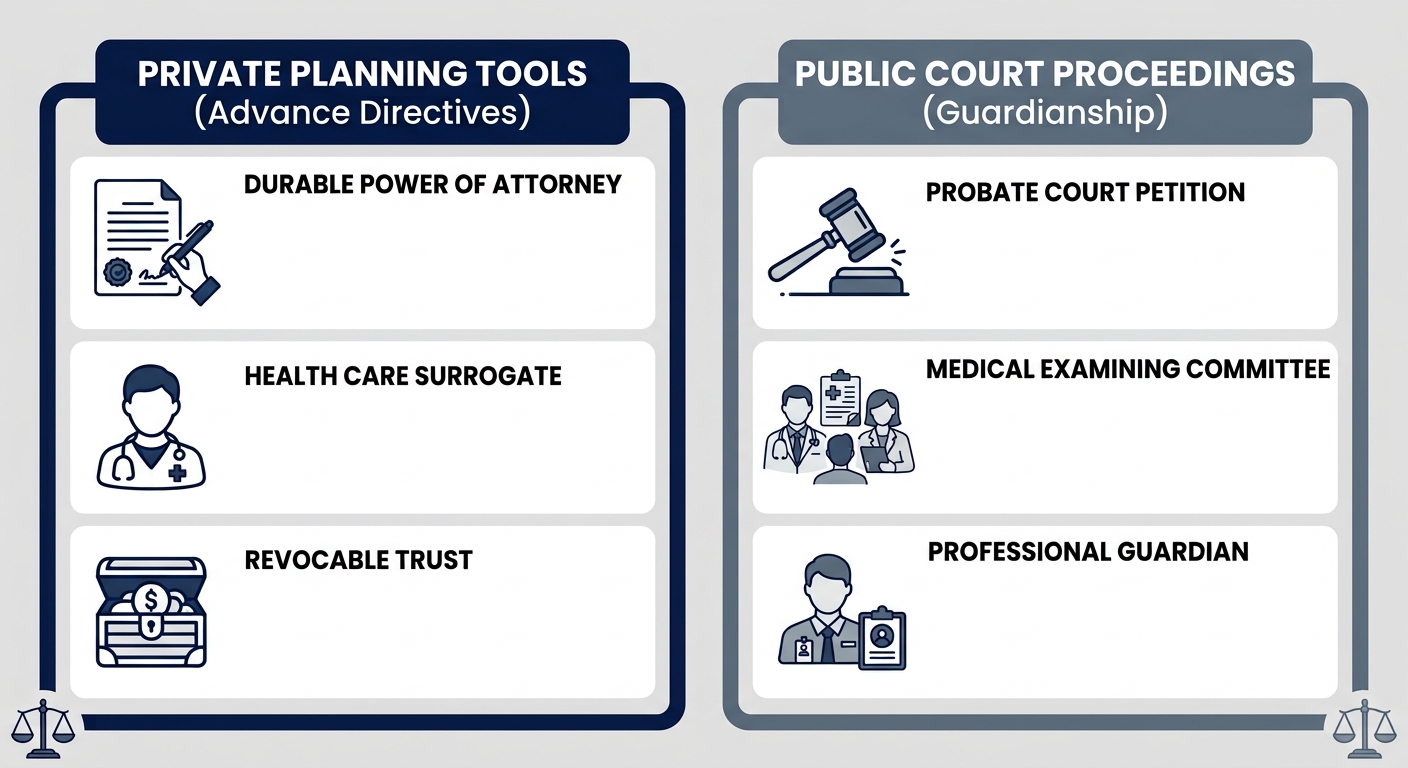
Diagram comparing private Florida incapacity planning documents with judicial probate court guardianship proceedings.

Direct Answer:

In Florida, adult guardianship is avoided by executing three proactive, legally binding instruments while mentally competent: a Durable Power of Attorney (Fla. Stat. § 709.2104), a Designation of Health Care Surrogate (Fla. Stat. § 765.202), and a Revocable Living Trust. Together, these documents grant immediate, private decision-making authority to chosen surrogates, preventing the 17th Judicial Circuit Court of Broward County from declaring incompetence or appointing a court-monitored professional guardian under Fla. Stat. Chapter 744.


Why a Florida Last Will and Testament Fails During a Lifetime Health Crisis

The most pervasive misconception among Florida property owners is the belief that a well-crafted Will protects their business, real estate, and financial accounts if they suffer a debilitating stroke, traumatic brain injury, or severe cognitive decline.

A Will is legally dormant until death. It grants zero authority during your lifetime.

If you lose legal capacity without specific lifetime governance documents, your family cannot simply present your Will to Bank of America, Chase, or a Broward County title company. Instead, your loved ones are forced into a rigid, public, and adversarial legal process known as Involuntary Adult Guardianship.


Path A: Proactive Planning (Private) Path B: Court Intervention (Guardianship)
1. Key Legal Instruments:
  • Durable Power of Attorney
  • Health Care Surrogate
  • Revocable Living Trust
1. Emergency Court Petition:

Filed in the Broward County Circuit Court by family, health care providers, or interested third parties.

2. Immediate Authority:

Your designated agent or trustee steps in immediately without court permission.

2. 3-Member Examining Committee:

Court appoints a physician, medical expert, and layperson to evaluate your mental competency.

3. Privacy & Autonomy:

Financial affairs and health decisions remain strictly private within the family.

3. Public Incompetency Hearing:

Formal court hearing stripping fundamental constitutional rights and declaring legal incapacity.

Final Outcome: Seamless Family Management

Zero court fees, no public record, immediate operational continuity.

Final Outcome: Court Guardian Control

Appointed professional guardian, mandatory annual audits, assets drained by legal fees.


The Financial and Personal Realities of Florida Guardianship Proceedings

When a court petition is filed under Florida Statute Chapter 744, you become the “Alleged Incapacitated Person” (AIP). The judicial process moves quickly, privately stripping personal freedoms through public records:

1. Mandatory 3-Member Examining Committee

Under Fla. Stat. § 744.331, the court appoints an examining committee consisting of three professionals (at least one must be a medical doctor or psychiatrist). These individuals visit your home or hospital room, conduct cognitive testing, and submit written assessments directly to the Broward County judge.

2. Immediate Loss of Fundamental Civil Rights

If the court finds you incapacitated, you do not just lose access to your checking account. You lose the legal right to:

  • Contract, sign deeds, or manage business interests
  • Choose where you live or consent to medical treatment
  • Vote, hold a driver’s license, or marry
  • Retain personal legal counsel of your choice

3. The Financial Strain of Professional Guardianship

A court-appointed guardian is entitled to reasonable compensation paid directly out of your assets. Every financial move—selling a home in Coral Springs, liquidating stock, or paying for specialized memory care—requires formal court petitions, attorney appearances, and annual financial audits overseen by the clerk of court.


Signing a Florida Durable Power of Attorney document with witness and notary signature blocks.

Real World Precedent: How Lack of Planning Triggers Systemic Vulnerability

To understand why Florida courts step in so forcefully, one needs to look no further than the notorious state guardianship cases that led to major legislative reforms across South Florida.

Consider the real life case of Jan Garwood, a Central Florida resident who suffered a sudden medical crisis without a complete, active incapacity plan in place.

┌────────────────────────────────────────────────────────┐
│               THE REALITY OF COURT CONTROL             │
├───────────────────────────┬────────────────────────────┤
│    WITHOUT A DPOA / TRUST │  WITH PROACTIVE R&C PLAN   │
├───────────────────────────┼────────────────────────────┤
│ Forced court petition     │ Private family transition  │
│ 3-person medical panel    │ Designated agent steps in  │
│ Court-appointed guardian  │ Zero court costs or fees   │
│ House sold without consent│ Assets fully protected     │
└───────────────────────────┴────────────────────────────┘

After an emergency hospital admission under the Baker Act, the hospital petitioned the court to appoint a professional guardian. Because Garwood lacked a updated Durable Power of Attorney and Revocable Living Trust specifically naming trusted family members to handle her affairs:

  1. The Court Intervened Immediately: A judge declared her incompetent based on brief examining committee reports, bypassing her family.
  2. Loss of Property: The court appointed professional guardian gained complete control over her finances, eventually selling her home to cover facility care costs.
  3. Loss of Autonomy: Garwood spent three years in a locked assisted living facility before independent attorneys managed to restore her rights, by which time her personal assets had been liquidated.

Cases like Garwood’s—and the widespread Florida state investigations into court appointed guardians that followed—highlight a critical legal reality: If you do not choose your own decision makers through private estate planning documents, a Florida probate court will choose one for you.


The Incapacity Avoidance Triad: 3 Key Documents

To lock out judicial interference, an incapacity strategy must unite three precise legal instruments under Florida law:

1. Florida Financial Durable Power of Attorney (DPOA)

  • Governed by Fla. Stat. § 709.2104, a Florida DPOA must contain specific “superpowers” (explicit initialed clauses under Fla. Stat. § 709.2114) granting your named agent the legal right to manage real estate, conduct banking, handle tax returns, and qualify for governmental benefits without court approval.

2. Florida Designation of Health Care Surrogate

  • Under Fla. Stat. § 765.202, this instrument allows your named surrogate to consult with doctors, review HIPAA-protected medical records, authorise surgeries, and make end-of-life decisions if you become unable to provide informed consent.

3. Revocable Living Trust

  • Holding property, financial accounts, and business equity inside a revocable trust creates an unbroken chain of authority. If you face incapacity, your named Successor Trustee steps in seamlessly to manage trust assets according to your written directives, eliminating the need for court supervision.

Exterior view of the Broward County Judicial Complex in Fort Lauderdale Florida housing the 17th Judicial Circuit probate court.

Frequently Asked Questions

Can my spouse automatically handle my finances if I become incapacitated?

  • No. Spousal status alone does not grant legal authority to sign deeds, alter bank accounts, or manage individually held assets in Florida. Without a valid Durable Power of Attorney or Trust, a spouse must petition the court for guardianship just like any third party.

What is the difference between a Power of Attorney and a Guardian?

  • A Power of Attorney agent is chosen privately by you while you are mentally sound. A Guardian is appointed by a judge after a court determination of incompetence.

Does a Durable Power of Attorney expire upon incapacity in Florida?

  • No. Unlike a standard power of attorney, a Durable Power of Attorney explicitly remains effective during temporary or permanent mental incapacity under Fla. Stat. § 709.2104.

Protect Your Independence with a Coral Springs Estate Planning Attorney

Maintaining total control over your health choices, personal dignity, and financial assets requires clear legal planning before a sudden health crisis occurs.

The estate planning attorneys at Reinfeld & Cabrera, P.A. help individuals and families across Coral Springs, Fort Lauderdale, and Broward County construct airtight incapacity plans that bypass court intervention entirely.


Schedule a Confidential Consultation

Ensure your autonomy remains protected under Florida law:

  • Direct Telephone: (954) 866-4878
  • Coral Springs Office: 9625 W Sample Rd, Coral Springs, FL 33065
  • Fort Lauderdale Office: 2933 W Cypress Creek Rd, Suite 201, Ft Lauderdale, FL 33309
  • Website: mypersonalattorneys.com
  • Regional Coverage: Coral Springs, Fort Lauderdale, Parkland, Tamarac, Margate, and all surrounding Broward County communities.

How to Name a Guardian for Your Child in Florida (Without Causing a Family Civil War)

Florida parents reviewing and signing a preneed guardian designation in a South Florida estate planning law office.

Quick Answer :

Under Florida law (Fla. Stat. § 744.3046), parents can name a guardian for minor children by executing a formal Preneed Guardian Designation signed in the presence of two simultaneous witnesses. Unlike a will, which only activates upon death, a preneed designation protects your children during parental death or medical incapacity.

The document creates a strong presumption in court favoring your chosen primary and alternate guardians, allowing you to split physical care (Guardian of the Person) from financial management (Guardian of the Property).


Let us be completely honest with each other for a moment. Nobody wakes up on a sunny Saturday, pours a mug of coffee, and cheerfully says, “You know what sounds fun today? Figuring out who raises my children if my spouse and I get eaten by a shark or crushed by a meteor.”

It is uncomfortable. It makes your stomach do little flip flops. And if you are like most parents in South Florida, your default setting is simply to kick the can down the road, assuming your sister or your mother will just step in and figure it out if the unthinkable happens.

Except Florida law does not work on gentle assumptions. If you do not formally put your wishes in writing using proper legal execution rules, a circuit court judge who has never met your family will be forced to make that choice for you.

So how do you actually name a guardian for your minor children in Florida, avoid a holiday dinner feud between the in laws, and make sure your intentions stand up in court? Let us break down how parental designations work without any dry corporate nonsense or confusing legalese.


Why the Internet Gets Child Guardianships Wrong

If you search online late at night while spiraling into panic, you will find plenty of generic advice. Telling you to just type up a short note or throw a sentence into a basic Last Will and Testament.

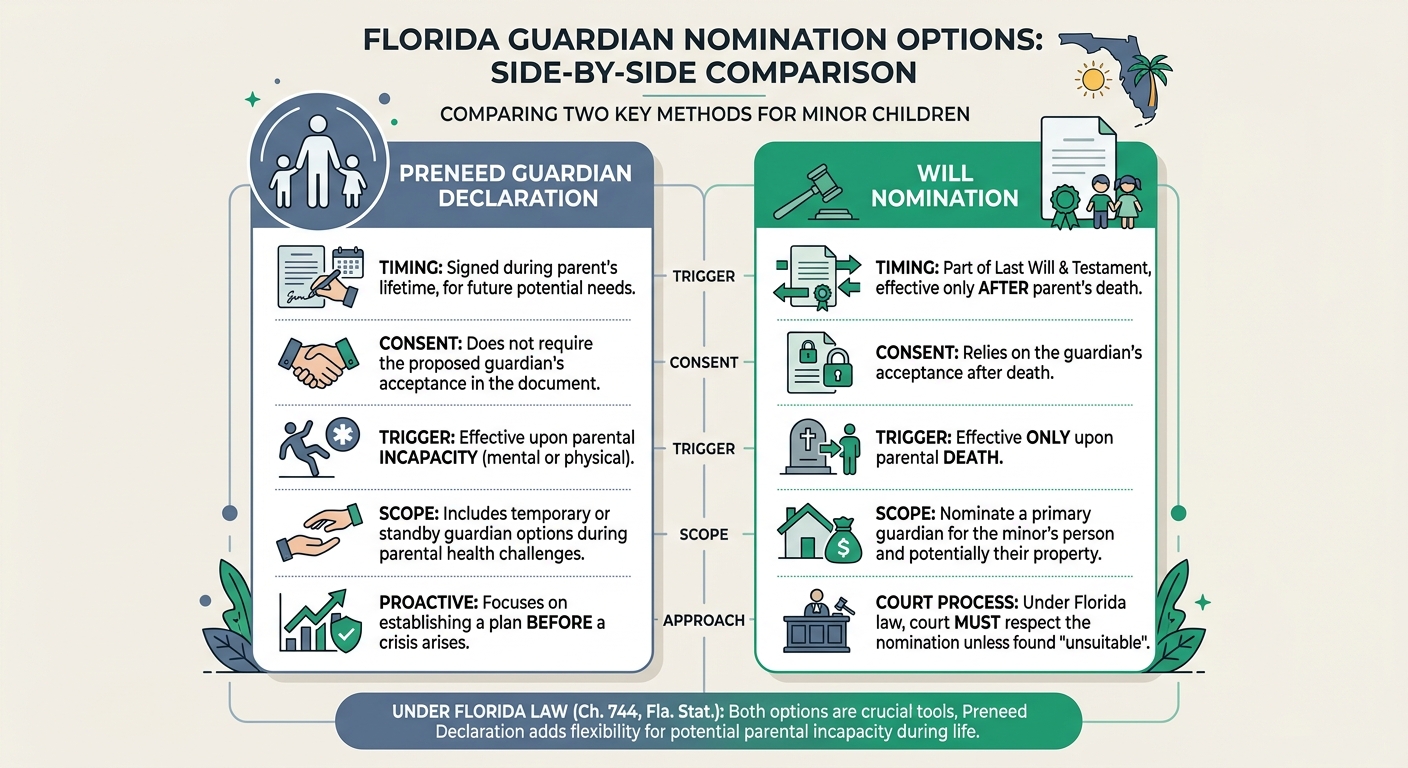
Nominating a guardian in your will is a very common approach. But relying solely on a will leaves a massive, gaping hole in your legal safety net.

Ask yourself: What happens if you and your spouse are in a serious car accident and end up in a coma for six months?

A will only springs to life after you pass away. If you are incapacitated rather than deceased, a judge cannot use your will to authorize someone to care for your kids or handle their day to day needs. That is why Florida estate planning relies on specialized advance designations that cover both incapacitation and death.


Preneed Guardians vs. Standby Guardians: Decoding the Legal Jargon

Florida law gives parents two primary legal mechanisms to nominate who steps in when disaster strikes. You do not need a law degree to understand them, but you do need to know which one fits your situation.

1. The Preneed Guardian Designation (Fla. Stat. § 744.3046)

Think of this as your official written nomination letter to the local probate court. Under Florida law, parents can sign a formal declaration naming a primary guardian and an alternate guardian.

  • How it works: You sign the document ahead of time with two attesting witnesses present at the exact same time. If both parents pass away or become incapacitated, the document is produced in court. This creates a powerful legal presumption that the judge should honor your chosen person.
  • Why it matters: It covers both death and medical incapacity, seamlessly closing the gap that a standard will leaves behind.

2. Standby Guardianship (Fla. Stat. § 744.304)

A standby guardian is a slightly different tool designed for immediate handoffs.

  • How it works: This involves a pre approved court petition where a designated guardian stands in the wings. He or she is ready to act instantly upon a specific triggering event (like severe medical decline or death). The standby guardian assumes duties immediately and then has 20 days to file a formal petition for court confirmation.


The Person vs. The Property: You Do Not Have to Pick Just One Human

Here is a common dilemma that paralyzes parents: Your brother is incredible with kids, warm, patient, and living in a great school district, but he handles money like a golden retriever with a stolen credit card. Meanwhile, your accountant sister is a financial wizard, but her idea of childcare is handing a toddler a spreadsheet.

Good news: Florida law allows you to split these responsibilities down the middle.

  • Guardian of the Person: This person gets physical custody, decides where the kids live, manages their schooling, signs permission slips, and handles medical decisions.
  • Guardian of the Property: This person manages the financial inheritance, holds onto money left for the children, pays for their expenses out of a trust or court supervised account, and ensures nobody wastes their funds.

You can name the same person for both roles, or you can split them up so your kids get loving care while your financial hawk protects their inheritance.


How to Choose an Alternate (and Avoid In-Law Meltdowns)

Always, always name an alternate guardian. Life happens. Your primary choice might move across the globe, face health challenges of their own, or simply realize that taking on two active toddlers at age fifty five is more than they can physically handle.

When selecting guardians, look beyond raw emotional attachment and evaluate practical realities:

  1. Shared Values and Lifestyle: Do they raise children with similar boundaries, educational goals, and emotional warmth?
  2. Geographic Location: Would your children have to move across the country, switch schools, and leave their support network behind during a time of intense grief?
  3. Financial and Physical Capacity: Do they have the health, energy, and space in their life to raise children through high school and college?

Pro Tip: Talk to the people you want to name before you sign the papers. Finding out after the fact that your prospective guardian never wanted kids in the first place makes for an extremely awkward conversation.


Frequently Asked Questions About Naming a Guardian in Florida

How do I name a guardian for my child in Florida?

  • You can document your intent by executing a formal Preneed Guardian Designation under Fla. Stat. § 744.3046 or by nominating a guardian within your Last Will and Testament. The document must comply strictly with Florida signing formalities, including two simultaneous attesting witnesses.

Can I name a guardian for my minor child in my will?

  • Yes. Florida law allows parents to nominate a guardian inside a will. However, because a will only takes effect upon death, pairing it with a Preneed Guardian Designation ensures your choices are legally documented if you become incapacitated.

What is a preneed guardian for a minor in Florida?

  • A preneed guardian is a person formally nominated by living parents to step in, take custody, or manage property for a minor child if the parents die or lose legal capacity.

Can I name an alternate guardian for my child?

  • Yes. Florida statutes explicitly encourage parents to name an alternate preneed guardian in case your primary choice is unable or unwilling to serve when the time comes.

What happens if both parents die without naming a guardian?

  • If no written designation exists, any interested family member or party can petition the court for guardianship. A judge in the 17th Judicial Circuit will hold hearings and choose a guardian based on what they determine is in the child’s best interests, which may not align with who you would have wanted.

Does the court have to appoint the person named by the parents?

  • While Florida courts give immense weight and priority to a valid preneed designation signed by the parents, the judge retains ultimate authority to verify that the nominee meets statutory qualifications and that the appointment serves the child’s best interests.

Can a guardian be named for a child’s property as well as the child?

  • Yes. Florida law explicitly separates guardianship of the person (physical care and custody) from guardianship of the property (financial management), allowing parents to appoint the same individual or two separate people.

What is the difference between a preneed guardian and a standby guardian?

  • A preneed guardian is nominated in advance on paper and awaits a potential future appointment by the court. A standby guardian is pre approved by court order prior to an emergency and can take physical custody instantly upon a triggering event, with 20 days to get final confirmation from the judge.

Can I change or revoke the guardian I have named for my child?

  • Yes. As long as you are competent, you can revoke, modify, or replace your preneed guardian designation at any time by executing a new written declaration that meets Florida statutory requirements.

Does naming a guardian eliminate the need for a full estate plan?

  • No. Naming a guardian addresses who cares for your children, but it does not manage how your home, bank accounts, or life insurance proceeds are handled. Pairing your guardian designations with a revocable living trust ensures your money is protected and managed smoothly for your kids without ongoing court oversight.

A peaceful Coral Springs community park with tropical palm trees representing family living in Broward County.

Protecting Your Children and Your Peace of Mind

At the end of the day, naming a guardian is not about dwelling on tragic worst case scenarios. It is about taking control, removing uncertainty, and giving yourself total peace of mind knowing that your kids will always be raised by people who love them and share your values.

The estate planning attorneys at Reinfeld & Cabrera P.A. help parents across South Florida establish airtight preneed guardian designations, revocable living trusts, and comprehensive family protection plans.

Schedule a Confidential Consultation

Do not leave your family’s future up to chance or a courtroom schedule. Speak directly with an attorney today to set up your parental designations:

  • Direct Telephone: (954) 866 4878 | Toll Free: (954) 866 HURT
  • Coral Springs Office: 9625 W Sample Rd, Coral Springs, FL 33065
  • Fort Lauderdale Office: 2933 W Cypress Creek Rd, Suite 201, Ft Lauderdale, FL 33309
  • Website: mypersonalattorneys.com
  • Local Coverage: Coral Springs, Fort Lauderdale, Parkland, Tamarac, Margate, and all surrounding communities across Broward, Miami Dade, and Palm Beach Counties.