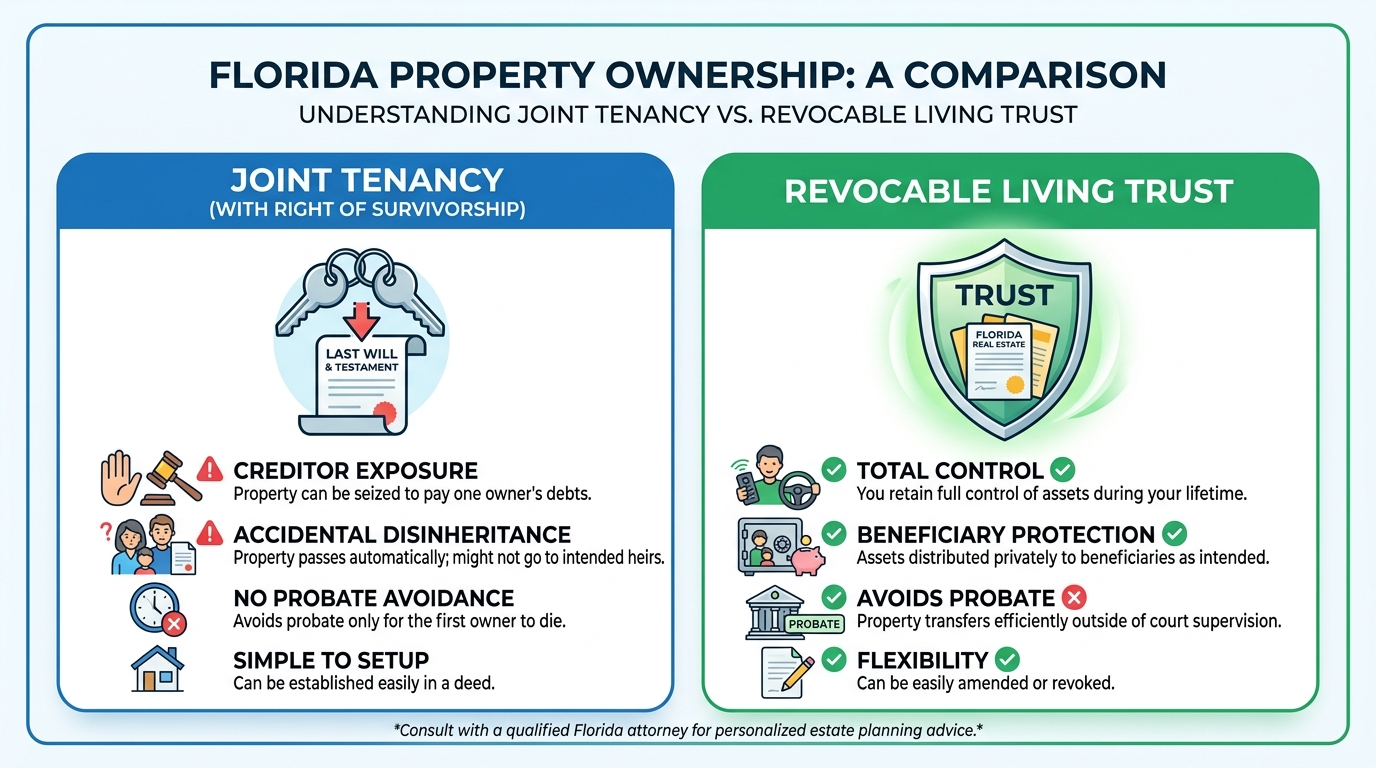
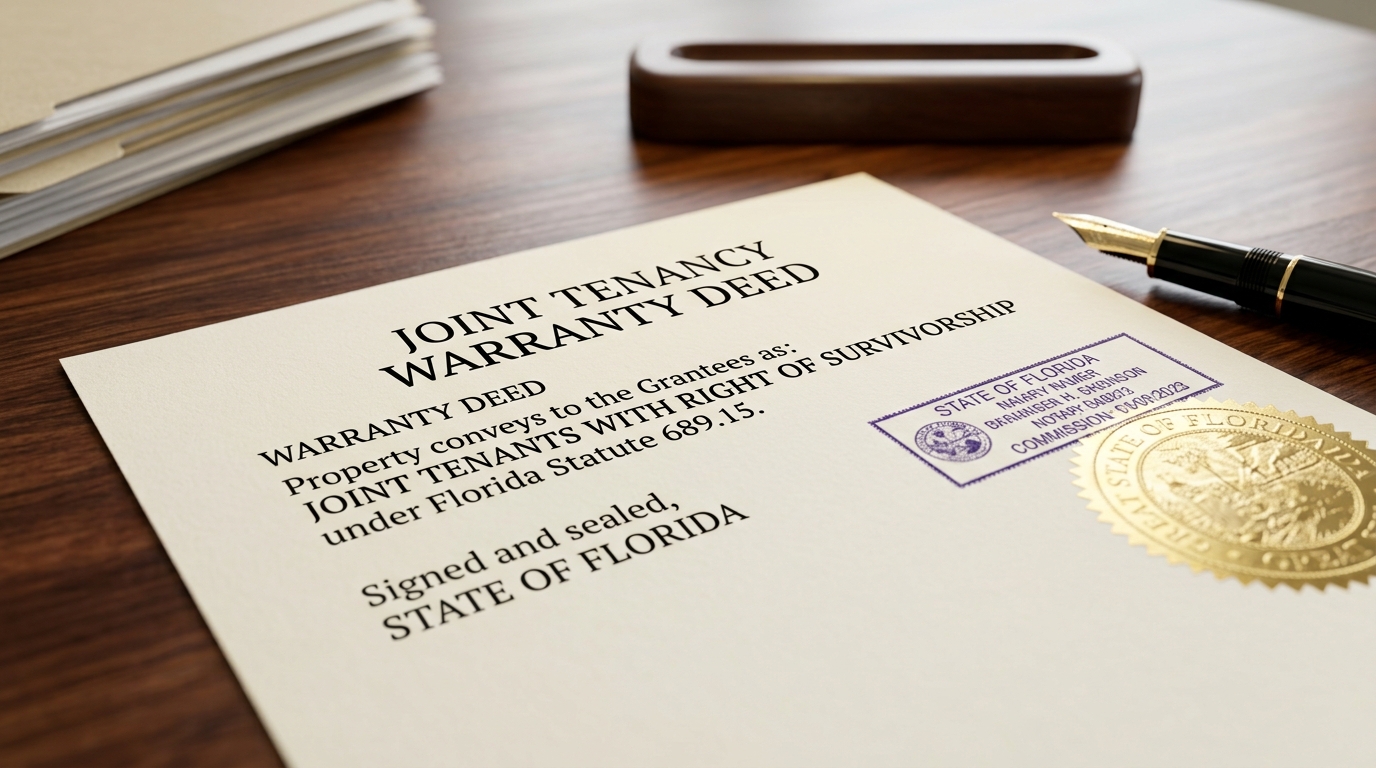
Joint Tenancy with Right of Survivorship (JTWROS) in Florida bypasses probate under Fla. Stat. § 689.15, but it completely overrides your Last Will and Testament. Upon the death of one joint owner, title vests immediately and automatically in the surviving owner. This exposes assets to the survivor’s future creditors, potential remarriage claims, and total disinheritance of biological children from prior marriages.
Governed by Will DirectivesJoint Tenancy completely overrides your Will. A Revocable Trust strictly enforces every distribution instruction in your estate plan.
Co Owner Creditor ProtectionJoint Tenancy exposes your assets to co owner debts and lawsuits. A Revocable Trust protects assets from third party beneficiary liabilities.
Many South Florida homeowners and account holders add adult children, second spouses, or relatives to bank accounts and real estate deeds as a quick shortcut to avoid formal probate court proceedings.
While adding a joint owner appears convenient on the surface, Joint Tenancy with Right of Survivorship (JTWROS) is one of the most unpredictable, blunt force mechanisms in estate planning. Under Florida property and probate law, joint titling strips away your lifetime financial control, exposes your hard earned assets to outside lawsuits, and routinely triggers accidental family disinheritance.
3 Fatal Vulnerabilities of Joint Ownership Under Florida Estate Law
1. Automatic Property Transfer Overrides Your Will and Intentions
Under Florida Statute § 689.15, when property or financial assets are held as joint tenants with right of survivorship, the deceased co owner’s interest transfers instantly to the surviving co owner upon death by operation of law.
Your Last Will and Testament, Revocable Trust instructions, or verbal promises made to family members carry zero legal weight. If a parent adds one adult child to a Coral Springs real estate deed purely for administrative convenience or convenience check writing, that child becomes the sole legal owner upon the parent’s death, completely cutting out their siblings regardless of what the parent’s Will specifies.
2. Immediate Asset Exposure to Co Owner Liabilities and Creditors
The moment you name a joint owner on a bank account or Broward County real estate deed, that individual gains immediate legal ownership rights. If your co owner faces a divorce proceeding, automobile accident lawsuit, business bankruptcy, or personal tax lien, judgment creditors can attach claims directly to your shared asset. You effectively gamble your lifelong financial security on your co owner’s personal financial discipline and legal stability.
3. The Blended Family Disinheritance Trap
In blended families with children from prior relationships, joint titling regularly causes catastrophic estate outcomes.
When a married couple holds real estate or bank accounts jointly with right of survivorship, all assets vest exclusively in the surviving spouse upon the first spouse’s death. When that surviving spouse eventually passes away, the entire estate passes to their personal biological children or designated heirs. The biological children of the spouse who passed away first receive nothing, creating permanent financial alienation between stepfamilies.
Real World Legal Case Study: In re Estate of Kester
A clear example of how joint titling destroys testamentary intent is illustrated in the official Florida legal precedent In re Estate of Kester, Fla. 4th DCA 1986), decided by the Fourth District Court of Appeal in West Palm Beach.
The Case Background
In this landmark dispute, a mother executed a formal Last Will and Testament directing that her entire estate be divided equally among her children. However, for everyday banking convenience, she established joint bank accounts and credit union shares with right of survivorship naming only one of her daughters as a co owner.
The Legal Conflict
Following the mother’s death, the siblings brought legal action in court, arguing that the funds in the joint accounts were intended for the benefit of all children under the terms of the mother’s Will, and that the joint owner held those funds merely as a fiduciary for the estate.
The Court Ruling
The Fourth District Court of Appeal ruled firmly against the other siblings. The appellate court held that under Florida statutory law governing joint accounts, titling an account as joint tenancy with right of survivorship creates a strong legal presumption of an absolute gift to the surviving joint owner.
Because the disappointed siblings could not provide clear and convincing written evidence proving the mother did not intend to create a survivorship right at the exact moment the accounts were established, the surviving joint daughter kept the entirety of the money. The clear instructions contained inside the mother’s Last Will and Testament were completely ignored and legally powerless.
Superior Florida Legal Alternatives to Joint Ownership
Rather than risking loss of control or accidental disinheritance through joint titling shortcuts, comprehensive estate plans utilize flexible legal structures designed under Florida statutory law:
1. Revocable Living Trust
Establishing a trust under Fla. Stat. Chapter 736 allows you to maintain 100 percent sole authority over your real estate and financial accounts during your lifetime. Upon death, your named successor trustee distributes property to your designated beneficiaries according to your exact written terms, achieving complete probate court avoidance without exposing your assets to co owner debts or disinheriting loved ones.
2. Florida Financial Durable Power of Attorney
If your main objective is allowing a trusted child or relative to assist with bill paying, property maintenance, or financial management during a health crisis, executing a Durable Power of Attorney (Fla. Stat. § 709.2104) grants them legal administrative authority without giving them property ownership rights or subjecting your assets to their personal creditors.
3. Enhanced Life Estate Deed (Lady Bird Deed)
For primary residential property in Coral Springs, Fort Lauderdale, or anywhere in Broward County, an Enhanced Life Estate Deed allows a property owner to retain total lifetime ownership rights, including the right to sell, lease, or mortgage the home without obtaining permission, while designating an automatic transfer on death beneficiary that completely bypasses Florida probate.
Frequently Asked Questions
Does joint ownership avoid probate in Broward County?
Yes, joint tenancy with right of survivorship avoids probate upon the death of the first co owner. However, when the surviving owner eventually passes away without establishing formal trust planning, the property must pass through formal Florida probate administration.
Can I remove a joint owner from my Florida real estate deed without their consent?
No. Once an individual is added to a deed as a joint tenant in Florida, you cannot remove them, sell the property, or execute mortgages without their formal notarized signature, even if you originally paid for the entire property yourself.
What is the legal difference between Joint Tenancy and Tenancy by the Entirety in Florida?
Tenancy by the Entirety is a specialized form of joint ownership reserved strictly for legally married couples under Florida law. It provides built in creditor protection against individual spouse liabilities that standard Joint Tenancy does not offer.
Can a Last Will override a joint bank account in Florida?
No. Under Florida law, joint accounts with right of survivorship transfer automatically upon death. A Last Will carries no legal authority to alter or redistribute funds held in a valid joint survivorship account.
Protect Your Property and Family Autonomy in Coral Springs
If you manage or own rental property in South Florida, tenant turnovers and the occasional eviction are bound to happen. But here is the catch: when a lease ends or a tenant vacates under court order, how you handle their security deposit can make or break your legal standing.
Can you simply keep the deposit to cover unpaid rent or property damage? Not without following Florida procedural rules to the letter. Missing a statutory deadline or skipping a certified letter notice can strip away your legal right to hold those funds even if the tenant destroyed your floors or walked out owing months of rent.
So how does Fla. Stat. § 83.49 actually work when you are standing inside an empty unit staring at ruined drywall? What concrete steps must you take right now to protect your bottom line, and how can you keep yourself far away from costly disputes in local South Florida courtrooms? Let us break down everything you need to navigate move outs safely.
What Are Florida Security Deposit Notice Deadlines?
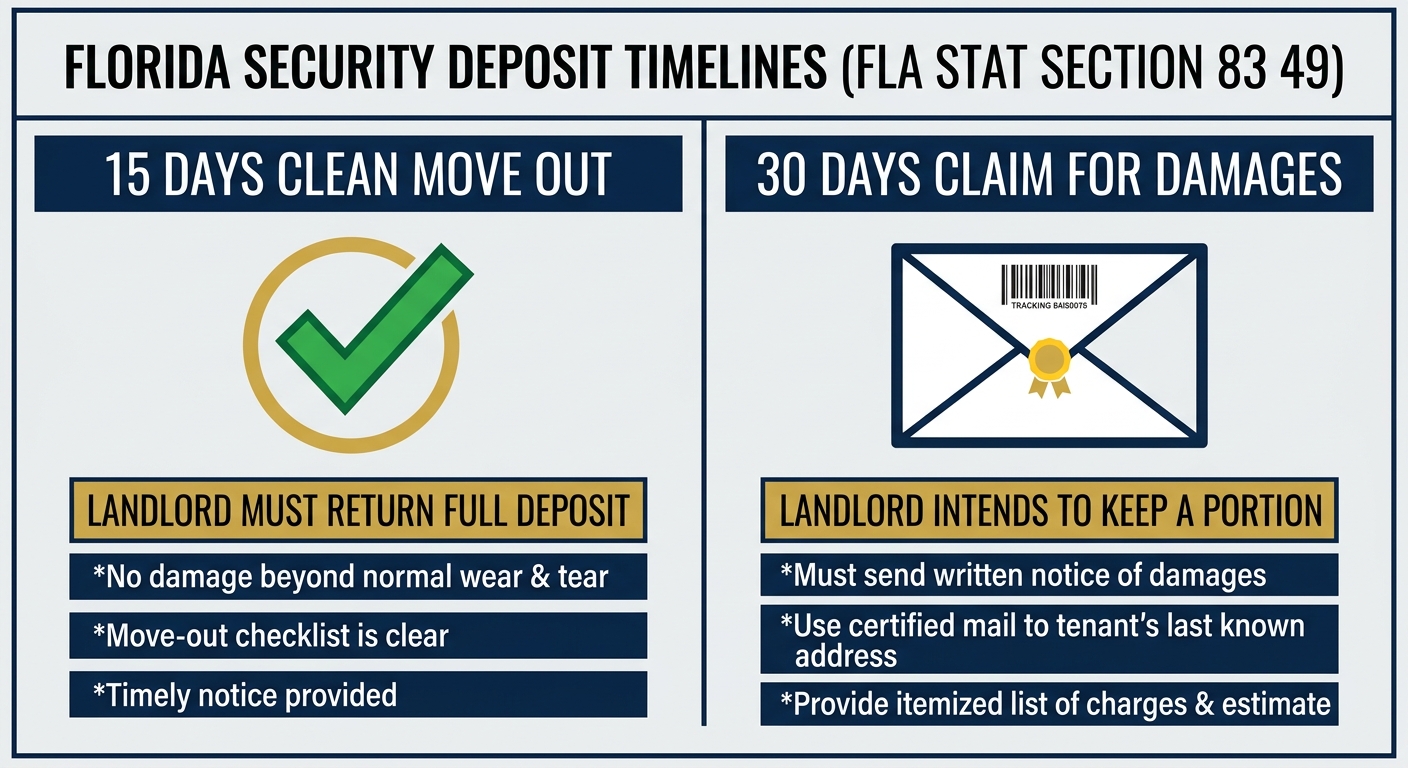
Quick Answer: Under Fla. Stat. § 83.49, Florida landlords have 15 days to return a security deposit in full if no deductions are being made. However, if you are claiming money for property damage, deep cleaning, or unpaid rent, you have 30 days to send an itemized claim via Certified Mail to the tenant last known address. If you fail to send this notice within 30 days, you legally forfeit your right to claim any part of the deposit.
The Core Rule: 15 Days vs 30 Days
Why do so many property owners get tripped up by Florida security deposit timelines? Usually, it comes down to confusing a clean turnover with a damage claim. You might ask yourself: Am I simply handing back their money, or am I preparing to fight for repair costs? The law divides move outs into two distinct paths:
No Claim on Deposit (15 Days): Timeline is 15 days from move out. Action requires a full refund plus accrued interest if held in an interest account. Target is clean turnovers.
Imposing a Claim (30 Days): Timeline is 30 days from move out. Action requires sending an itemized claim via Certified Mail containing required statutory text. Target covers physical damage, back rent, or unpaid utility fees.
1. The Clean Turnover (15 Day Window)
Suppose your tenant moves out, hands over the keys, and leaves the home in excellent shape with zero unpaid rent. Under Fla. Stat. § 83.49(3)(a), you have exactly 15 days from the date they vacate to return their full deposit along with any accrued interest if kept in an interest bearing account.
2. The Damage or Back Rent Claim (30 Day Window)
Now, what if you walk into the property and find broken drywall, ruined carpets, or an unpaid utility balance? Would a quick text message or an informal email suffice to let them know you are withholding funds? Absolutely not.
In this scenario, you have 30 days to issue a formal written notice detailing your intent to keep part or all of the deposit. Florida law strictly mandates that this notice must be sent by Certified Mail to the tenant forwarding address or last known mailing address. I often tell property owners to treat that certified mail receipt like pure gold because without it, proving you met your 30 day clock becomes nearly impossible.
What Happens if You Skip the Statutory Warning Language?
Here is a detail that continuously catches self managing landlords off guard: it is never enough to write a quick note stating, “I am keeping $500 for carpet repairs.”
Florida statute explicitly mandates that your notice include specific statutory warning language informing the tenant of their right to object within 15 days.What actually happens if you leave this mandatory wording out? Legally, the entire notice becomes invalid. That means you forfeit your right to retain the deposit and could end up paying the tenant legal fees under Fla. Stat. § 83.48 if they retain an attorney to contest your error.
I always think: Why risk losing thousands over a missed paragraph when the statute gives you the exact script to copy?
The 15 Day Tenant Objection Clock
Once the tenant receives your certified letter, the ball moves directly into their court:
If they do not object within 15 days: You are legally authorized to deduct the claimed amount from the deposit and return any remaining balance to them within 30 days of the original notice date.
If they object in writing: You now have a formal legal dispute on your hands. If that disagreement escalates into county court in Broward, Miami Dade, or Palm Beach County, a judge will review whether every single statutory notice rule was meticulously followed.
What Counts as Legitimate Deductions vs Normal Wear and Tear?
One of the most frequent friction points between landlords and departing tenants is deciding what damage justifies keeping deposit funds.
Before you start writing up your itemized bill, ask yourself: Is this issue the natural result of everyday human living, or does it represent actual property destruction and tenant negligence?
Permissible Deductions (Tenant Damage)
Unpaid rent, fees, or utility balances
Holes in drywall, broken doors, or cracked floor tiles
Pet damage such as scratched doors, carpet stains, or deep odors
Trash removal and heavy cleaning charges for abandoned personal property
Impermissible Deductions (Normal Wear and Tear)
Faded wall paint or small nail holes from picture frames
Minor carpet wear or light scuffs along high traffic hallways
Aging, worn door handles or standard cabinet hinges
Routine HVAC filter servicing or standard dust accumulation
Frequently Asked Questions for Florida Landlords
What if I completely miss the 30 day Certified Mail deadline?
If you miss the 30 day window, you automatically forfeit your right to retain the security deposit under Fla. Stat. § 83.49, meaning you must return 100 percent of the money to the tenant. Does this mean you are completely out of options if they wrecked your rental property? Not entirely. Missing the deposit deadline prevents you from holding onto their deposit money, but it does not prevent you from filing a separate lawsuit against the former tenant in court for breach of contract or physical property damage.
Does winning an eviction judgment mean I can automatically keep the deposit?
Surprisingly, no. Even if you secure a writ of possession in the 17th Judicial Circuit Court of Broward County, you remain legally bound to send the 30 day certified claim notice if you intend to apply the security deposit toward back rent or damages caused by the evicted tenant. I see landlords fall into this exact trap all the time assuming an eviction order wipes out their security deposit duties.
Can I include a clause in my lease waiving these notice rules?
No. Florida courts treat Fla. Stat. § 83.49 as a mandatory protection statute. Any clause inside a residential rental agreement that attempts to bypass, shorten, or alter these statutory notice timelines is considered legally null and void.
Protect Your Real Estate Investments with Legal Counsel
Whether you manage a single rental home in Coral Springs or an apartment complex in Fort Lauderdale, administrative slip ups during tenant move outs can cost you thousands in lost funds and legal fee awards.
The real estate litigation team at Reinfeld & Cabrera P.A.helps South Florida landlords, investors, and property managers enforce lease agreements, execute formal evictions, and navigate security deposit compliance smoothly.
Schedule a Property Law Consultation
Facing a tenant dispute or need assistance structuring legally compliant lease agreements? Speak directly with a South Florida real estate attorney today:
Coral Springs Office: 9625 W Sample Rd, Coral Springs, FL 33065
Fort Lauderdale Office: 2933 W Cypress Creek Rd, Suite 201, Ft Lauderdale, FL 33309
Website: mypersonalattorneys.com
Local Coverage: Coral Springs, Fort Lauderdale, Parkland, Tamarac, Margate, and surrounding communities across Broward, Miami Dade, and Palm Beach Counties.
Florida does not require every homebuyer to hire an attorney, but legal review can be valuable before signing a purchase contract. A real estate attorney can identify contractual, title, ownership, and closing issues that may affect your rights as a buyer.
For a home purchase in Coral Springs or elsewhere in Broward County, the legal review may involve:
Title: Examining the ownership history and identifying liens, judgments, probate issues, defective deeds, easements, or other recorded interests.
Deed and ownership: Determining how the property will be titled and whether the proposed ownership structure fits the buyer’s circumstances.
Closing: Reviewing documents and addressing unresolved legal issues before ownership transfers.
Florida homestead: Evaluating homestead considerations when the property will be the buyer’s primary residence.
Estate planning: Considering how the new property fits into the buyer’s will, trust, and broader estate plan.
Probate: Identifying potential probate issues when the property was inherited or when its future transfer may involve an estate.
The timing of the legal review matters. A lawyer who examines the transaction before the purchase contract is signed may be able to identify provisions that become difficult to change later. Title and ownership issues should also be addressed before closing, when resolving them can become more complicated.
For buyers in Coral Springs and Broward County, these questions arise under Florida real estate law, but the appropriate legal strategy depends on the specific property, contract, ownership structure, and family circumstances.
When should you hire a real estate attorney?
Many buyers think about hiring a lawyer when they reach the closing table. By that point, the most important contractual decisions may already have been made.
The purchase contract establishes the legal framework for the transaction. It can determine the buyer’s rights concerning financing, inspections, repairs, deposits, title, closing dates, and termination.
The Florida Bar recommends consulting an experienced Florida real estate lawyer before signing a purchase contract. Its consumer guidance explains that important provisions can become difficult to change once the agreement has been signed.
That timing matters whether you are buying a home in Coral Springs, Fort Lauderdale, Parkland, Coconut Creek, or another Broward County community.
Suppose an inspection later reveals substantial roof damage. The buyer may want the seller to make repairs or provide a credit. Whether the buyer can demand either remedy depends on the contract and the circumstances surrounding the transaction.
The same principle applies to financing problems, delays, title defects, and disputes about property condition.
A lawyer who reviews the agreement before signature can explain what the buyer has agreed to and identify provisions that deserve attention.
What does a real estate attorney do for a homebuyer?
The work depends on the transaction.
A real estate attorney may review the purchase agreement, examine title records, review the deed, address liens and judgments, examine closing documents, advise on ownership, and represent the buyer if a dispute develops.
Some transactions require little legal intervention after the contract and title are reviewed. Others become complicated because of the property’s history.
A house in Broward County may have changed hands several times. A previous owner may have died. A divorce may have affected ownership. An old mortgage may remain in the public record. A judgment may have attached to an owner’s interest. A deed may contain an error.
The current seller may have no knowledge of any of these issues.
That does not necessarily prevent the sale. It does mean that the issue should be identified and resolved before the buyer accepts the property.
For a buyer purchasing a home in Coral Springs, the property’s recorded history deserves the same attention as its current condition.
Why title matters when buying a house
A real estate listing tells you who is selling the property. It does not establish the entire legal history of the property.
A title examination looks at recorded documents affecting ownership. Depending on the property, those records may include deeds, mortgages, liens, judgments, probate documents, and other instruments.
Florida law governs the recording of interests in real property. Florida Statutes Section 695.01 addresses the recording of conveyances, mortgages, and other interests in land and explains when recorded instruments have priority against certain creditors and subsequent purchasers.
For a buyer, the practical issue is whether the seller can deliver the ownership interest required by the purchase contract.
Consider a property that has passed through several generations.
The owner listed on the tax record may have inherited the house from a parent. That parent may have inherited it from someone else. At some point, an estate may have been administered incorrectly or a deed may have failed to include someone whose interest mattered.
The problem can remain hidden until the property is sold.
A title examination can reveal that history.
This is particularly relevant in established Broward County neighborhoods, where some properties have changed ownership several times over many years.
What happens when the seller inherited the house?
Inherited property can create title questions that do not appear in an ordinary residential sale.
If the seller acquired the property through an estate, the circumstances surrounding that transfer may need to be examined. The buyer may need documentation showing how ownership passed from the deceased person to the current seller.
Probate can therefore become part of a real estate transaction.
This is one reason real estate law and probate law sometimes meet in the same file.
A buyer does not need to become an expert in probate procedure. The important question is whether the person selling the property has the legal authority to transfer the interest the buyer expects to receive.
If that authority is unclear, the transaction may need additional documentation or court action before closing.
A buyer should not assume that an inherited property has a clean title simply because the seller has lived there for years.
The deed deserves careful attention
The deed is the document that transfers the seller’s interest in the property.
Buyers sometimes give it little attention because the purchase agreement and mortgage receive most of the discussion. The deed deserves its own review.
The buyer should understand what interest is being conveyed and who will receive it.
That second question is particularly important.
A person buying a house alone may have a straightforward ownership arrangement. A married couple may have different estate planning concerns. Two unmarried people purchasing together may need to consider what happens if one owner dies or wants to sell.
Parents sometimes purchase property with adult children. Some buyers consider a trust or another ownership arrangement.
Each situation raises different legal questions.
The answer should be based on the buyer’s circumstances rather than a generic preference about how property should be titled.
How you take title can affect your estate
Buying a house creates an asset that may eventually become part of your estate.
The way that asset is owned can affect what happens after death.
Certain forms of ownership can affect whether an interest passes through probate. Other ownership arrangements may require the property to be addressed through the owner’s estate.
This is why the deed and the estate plan should be considered together.
A person might have a carefully prepared will but never review whether the way the person’s property is titled supports the intended estate plan.
That can create problems later.
The purchase of a home is therefore a useful point to review the larger ownership picture.
For a Coral Springs homeowner purchasing a primary residence, that conversation may also involve Florida homestead law.
Florida’s homestead laws deserve special attention when the property will be the buyer’s primary residence.
Florida provides significant legal protections for qualifying homestead property. The state also has specific rules concerning what happens to homestead property after the owner’s death.
Florida Statutes Section 732.401 addresses the descent of homestead property when an owner dies. Section 732.4015 places restrictions on the owner’s ability to devise homestead property when certain family members survive the owner.
These rules can affect surviving spouses and children.
For example, when a Florida homeowner dies while survived by a spouse and descendants, the disposition of the homestead may be governed by statutory rules rather than by whatever result the owner assumed a will would produce.
The details depend on the family and ownership circumstances.
That is why homeowners in Coral Springs and Broward County should not assume that a will alone determines what happens to their Florida homestead.
Can a will control who receives your house?
Sometimes. Florida law can limit what a homeowner may accomplish through a will when the property qualifies as homestead.
The owner’s family situation matters.
The ownership structure matters.
The type of property matters.
The timing of transfers can matter as well.
Florida Statutes Section 732.4015 contains specific restrictions concerning the devise of homestead when a spouse or minor child survives the owner. Section 732.401 also establishes rules concerning descent when a Florida resident dies without a valid disposition controlling the property.
This is one reason estate planning should be based on the actual assets a person owns.
A will should not be viewed in isolation from deeds, trusts, beneficiary arrangements, and Florida’s property laws.
Should you put your house in a trust?
A trust can be useful in some estate plans. It is not the right ownership arrangement for every homeowner.
The decision depends on what the owner wants the estate plan to accomplish.
A revocable living trust, for example, may be considered as part of an incapacity and estate administration plan. Other trusts can serve different purposes.
The important question is whether a particular trust arrangement fits the person’s property, family circumstances, and estate planning objectives.
Florida also has specific rules concerning transfers of homestead property into trusts and other lifetime transfers. Florida Statutes Section 732.4017 addresses certain transfers of homestead property and explains circumstances affecting the way the property is treated under the homestead rules.
That makes professional review useful before changing the title to a Florida home.
A homeowner should understand the consequences of the transfer before signing a new deed.
What if the inspection reveals serious damage?
A home inspection and a legal review serve different purposes.
An inspector examines the physical condition of the house. An attorney examines the legal rights and obligations created by the transaction.
Suppose an inspection reveals structural damage.
The buyer may want the seller to make repairs. A buyer may prefer a price reduction. The buyer may want a credit at closing. The buyer may decide that the property is no longer worth purchasing.
The purchase agreement determines which options are available.
An inspection report does not automatically give the buyer a right to cancel the transaction.
The contract may contain deadlines governing inspection objections. It may establish particular procedures for repairs or termination. Missing those deadlines can affect the buyer’s rights.
A lawyer can explain the relevant provisions before the buyer takes action.
What happens when a title search reveals a lien?
A lien does not always mean the buyer has to abandon the transaction.
The first step is understanding what the lien is and whose obligation created it.
A mortgage may need to be satisfied at closing. A judgment may require resolution. A construction lien may involve a contractor or subcontractor. An estate matter may require additional documentation.
The appropriate solution depends on the problem.
This is where title work becomes practical rather than abstract. The buyer needs to know whether the defect can be resolved before closing and whether the title company will insure the buyer’s intended ownership.
A buyer should also understand any exceptions listed in the title commitment.
Accepting an exception without understanding it can leave the buyer with a title issue that was visible before closing.
Is title insurance enough?
Title insurance provides protection against covered title risks under the terms of the policy.
It does not perform the same function as an attorney representing the buyer.
The Florida Bar explains that a title examination generally precedes issuance of a title insurance policy. A title commitment identifies requirements that must be satisfied before the policy can be issued and lists exceptions to coverage.
Those exceptions deserve attention.
A buyer should know what the policy covers and what it does not cover.
The buyer should also know who represents the buyer.
A closing attorney may be involved in the transaction without representing the buyer personally. The Florida Bar specifically advises consumers to determine who the closing attorney represents.
If you want independent legal advice, ask that question before closing.
When should a Broward County homebuyer consider legal representation?
Some circumstances call for particular caution.
Consider speaking with a Florida real estate attorney when:
The purchase contract contains provisions you do not understand.
The seller inherited the property.
The property has been involved in probate.
The title search identifies a lien or judgment.
A previous deed appears defective.
A divorce affected ownership.
You are buying with someone who is not your spouse.
You are considering buying the property through a trust or business entity.
The house will be a major part of your estate.
The inspection reveals serious defects.
The seller disputes a repair obligation.
The transaction involves seller financing.
The property has unusual easements or restrictions.
A dispute develops before closing.
You are unsure how the property should be titled.
These circumstances are not limited to any particular Broward County neighborhood. They can arise in a Coral Springs purchase just as they can in a transaction elsewhere in South Florida.
The common factor is uncertainty.
A buyer does not need to wait until a dispute reaches court before asking a lawyer to review the transaction.
What should you bring to the attorney?
The purchase contract is the obvious starting point.
If you have not signed it, bring the proposed agreement.
If you have already signed it, bring the complete version along with any amendments.
Other useful documents can include the title commitment, inspection report, seller disclosures, survey, mortgage documents, homeowners association documents, and written communications about repairs.
If the property was inherited, information about the estate can also be important.
If you are purchasing the property as part of an estate plan, bring the relevant estate planning documents.
The attorney also needs to know what you intend to do with the property.
Will it be your primary residence?
Will you own it alone?
Will someone else share ownership?
Do you expect to leave the property to your children?
Are you considering a trust?
Those answers can change the legal analysis.
What does this have to do with probate?
A house can become one of the largest assets handled by an estate.
When the owner dies, the legal treatment of that property depends on how it was owned and the circumstances surrounding the owner’s death.
Some properties pass through probate. Others may pass through a different legal mechanism. Homestead can create additional rules.
This is why the deed signed at the time of purchase can become relevant years later in an estate administration.
A buyer may be thinking about a mortgage and a move.
An estate planning attorney may also need to think about incapacity, death, family rights, and the eventual transfer of the property.
Both perspectives concern the same asset.
For families in Coral Springs and throughout Broward County, that connection can be particularly useful when a home is expected to remain in the family.
A house can create legal consequences long after closing
The closing date is only one point in the property’s legal history.
The deed remains part of the public record. The mortgage may remain for decades. The property may become subject to homestead protections. Ownership may change through marriage, divorce, death, or another transfer.
The house may eventually become part of a probate estate.
That is why a home purchase can be a useful time to review an estate plan.
If you live in Coral Springs or elsewhere in Broward County, the attorney reviewing your purchase should understand the Florida laws that govern the property and your ownership interest.
The goal is to understand the legal consequences before they become difficult to correct.
Questions to ask before signing a purchase contract
A buyer does not need a law degree to ask useful questions.
Start with these:
Who owns the property now?
The answer should be supported by the title records.
Can the seller deliver the title required by the contract?
A title examination can identify issues that need attention.
What happens if the inspection reveals a serious problem?
The answer should come from the purchase agreement and applicable law.
What happens if financing is delayed or denied?
The contract should establish the buyer’s rights in that situation.
Who will own the property after closing?
The deed should reflect the intended ownership arrangement.
What happens to the property if one owner dies?
That question can bring estate planning into the discussion.
Does the property qualify as homestead?
If it will be the buyer’s primary residence, Florida’s homestead laws deserve attention.
Does my estate plan account for this property?
If the house will be a significant asset, the answer should be clear.
The right legal question is often a little earlier
Homebuyers usually have plenty of practical questions.
How much will the mortgage cost?
When can we move in?
Did the inspection find anything serious?
Are the repairs finished?
Those questions matter.
There is another question worth asking before signing:
Do I understand the legal rights I am acquiring and the obligations I am accepting?
If the answer is uncertain, a Florida real estate attorney can review the transaction before the buyer becomes committed to terms that may be difficult to change.
For buyers in Coral Springs and throughout Broward County, that conversation can also include estate planning and probate considerations when the property is expected to remain a significant family asset.
A home purchase creates ownership.
The way that ownership is established can matter for years afterward.
Frequently Asked Questions
Do I need a real estate attorney to buy a house in Florida?
Florida does not require every residential buyer to hire a lawyer. The Florida Bar recommends that prospective buyers consult an experienced Florida licensed real estate attorney before signing a purchase contract. Legal advice can be particularly useful when the transaction involves title questions, unusual contract terms, probate, ownership concerns, or estate planning.
What does a real estate attorney check when buying a house?
A real estate attorney can review the purchase contract, examine title records, review the deed and closing documents, identify liens or other title problems, advise on ownership, and address disputes that arise before closing.
Should I hire an attorney before signing a purchase contract?
If you want legal advice about the agreement, reviewing it before signing gives the attorney an opportunity to identify provisions that could affect your rights. The Florida Bar specifically recommends consulting a Florida real estate lawyer before signing a purchase contract.
Can buying a house affect my estate plan?
Yes. The way a home is owned can affect what happens to the property during incapacity and after death. Florida also has special rules concerning homestead property.
Does a will determine who receives my Florida home?
A will may control some aspects of an estate, but Florida homestead law can restrict how a homestead property may be devised when a surviving spouse or minor child is involved. The ownership structure and family circumstances need to be considered.
Can a house become part of probate?
Yes. Real estate can become part of a probate estate when its owner dies, depending on the ownership structure and circumstances. Property that belonged to a deceased owner may therefore require probate administration before it can be transferred or sold.
Is a title search the same as a home inspection?
No. A home inspection examines the physical condition of the property. A title examination investigates ownership and recorded interests affecting the property.
Does title insurance replace a real estate attorney?
No. Title insurance protects against covered risks under the policy. An attorney can provide legal advice about the contract, title, ownership, closing documents, and other legal issues affecting the buyer.
Should I discuss estate planning when buying a house?
It can be useful when the property will be a significant asset or when the buyer has specific plans for its future ownership. The purchase may be a good opportunity to review the relationship between the new property, the deed, and the existing estate plan.
Can I put my Florida home into a trust?
A Florida homeowner may be able to transfer a home into a trust, but the consequences depend on the type of trust, the property, the owner’s circumstances, and Florida homestead law. Legal advice should be obtained before changing the title.
Talk with an attorney before signing
A home purchase can involve questions about contracts, title, ownership, homestead, probate, and estate planning.
In simple terms, an operating agreement governs the internal relationship between an LLC and its owners, while a franchise agreement governs the relationship between a franchisor and the business operating under its brand.
An operating agreement answers questions about who owns the LLC, who manages it, how decisions are made, how money is distributed, and what happens when an owner wants to leave.
A franchise agreement answers different questions. It establishes the conditions under which the business can use the franchisor’s trademarks and business system and may address royalties, operating standards, territory, suppliers, training, reporting, renewal, transfer, default, and termination.
A business can be subject to both agreements at the same time. The important question is therefore not which document is more important, but which relationship and legal issue the particular provision addresses.
Understanding that distinction is important before signing either document.
What Is an Operating Agreement?
An operating agreement establishes many of the rules governing a limited liability company and its owners.
Under Florida’s LLC statute, an operating agreement governs relationships among members, relationships between members and the LLC, the rights and duties of managers, the company’s activities and affairs, and the process for amending the agreement. Florida law also permits operating agreements to establish specific consequences when a member or transferee fails to comply with their terms.
An operating agreement may address:
Ownership percentages and membership interests
Capital contributions
Voting rights
Management authority
Allocation of profits and losses
Distributions
Member compensation
Restrictions on transferring ownership interests
Admission of new members
Death or incapacity of a member
Buyout procedures
Dispute resolution
Dissolution of the company
Procedures for amending the agreement
The operating agreement therefore deals primarily with how the LLC and its owners operate together.
It is also important to distinguish the operating agreement from the LLC’s liability protection. The operating agreement establishes contractual and governance rules. It is not itself what creates the legal distinction between the LLC and its members.
What Does an Operating Agreement Actually Control?
Consider two people who form an LLC to purchase and operate a restaurant.
Their operating agreement might establish that one member owns 60 percent and the other owns 40 percent. It might also determine who manages the company, which decisions require member approval, how profits are distributed, and what happens if one member wants to sell their interest.
Those are internal questions.
The agreement may become particularly important when the owners disagree.
In DiMauro v. Martin, a Florida Fourth District Court of Appeal case involving an LLC created to develop and sell a residence, the parties’ amended operating agreement established obligations involving the property, construction funding, capital contributions, membership interests, and the parties’ responsibilities. Litigation later arose over those obligations. The appellate court rejected the trial court’s conclusion that the operating agreement was unenforceable for lack of mutuality of remedy and consideration, although it ultimately affirmed the denial of specific performance on other grounds.
The practical lesson is that an operating agreement is not merely an administrative document kept in a corporate file. Its provisions can become important evidence of the parties’ rights and obligations when an LLC’s members disagree.
What Is a Franchise Agreement?
A franchise agreement addresses a different relationship.
A franchise agreement is a contract governing the relationship between a franchisor and a franchisee. It generally establishes the conditions under which the franchisee can operate a business associated with the franchisor’s brand and business system.
Federal regulations define a franchise based on three elements: the right to operate under the franchisor’s trademark or other commercial identifier, significant control or assistance concerning the franchisee’s method of operation, and a required payment to the franchisor or an affiliate.
A franchise agreement may address:
Use of trademarks and other intellectual property
Territory
Initial franchise fees
Royalties
Advertising contributions
Required products or suppliers
Training
Operating standards
Reporting requirements
Insurance
Renewal
Transfer of the franchise
Defaults and cure periods
Termination
Post termination obligations
Dispute resolution
Personal guarantees
A franchise relationship can also involve other documents. The Federal Trade Commission’s Franchise Rule requires covered franchisors to provide prospective franchisees with a Franchise Disclosure Document containing 23 specified categories of information. The FTC states that the FDD generally must be provided at least 14 days before the prospective franchisee is asked to sign a contract or pay money to the franchisor or its affiliate.
For that reason, a prospective franchisee should not evaluate the franchise agreement in isolation.
Operating Agreement vs. Franchise Agreement
The simplest distinction is the relationship each document governs.
Operating Agreement
Franchise Agreement
Governs an LLC
Governs a franchise relationship
Primarily concerns the LLC and its members or managers
Primarily concerns the franchisor and franchisee
Establishes internal ownership and governance rules
Establishes franchise rights and obligations
Addresses voting and management authority
Addresses operation under the franchisor’s brand and system
May establish capital contribution and distribution rules
May establish fees, royalties and advertising obligations
May restrict transfers of membership interests
May restrict transfers of the franchise
Addresses internal disputes among owners
Addresses disputes between franchisor and franchisee
May establish buyout and dissolution procedures
May establish renewal, default and termination procedures
The two documents can therefore apply to the same business without serving the same function.
Can a Franchise Business Have Both Agreements?
Yes.
This is one of the most important distinctions for a business owner to understand.
Imagine that Maria and David form Sunshine Coffee LLC.
Their operating agreement provides that Maria owns 60 percent of the company and David owns 40 percent. It establishes who manages the LLC, how major decisions are approved, how profits are distributed, and what happens if one member wants to sell an ownership interest.
The LLC then purchases a coffee franchise.
The franchise agreement may require Sunshine Coffee LLC to pay royalties, use the franchisor’s trademarks, follow operating standards, use approved suppliers, maintain insurance, complete required training, and comply with reporting requirements.
The two agreements answer different questions.
If Maria wants to sell her 60 percent ownership interest, the operating agreement may determine what happens inside the LLC.
If the franchisor alleges that Sunshine Coffee LLC violated its brand standards, the franchise agreement may determine the parties’ contractual rights.
A proposed transfer can involve both agreements. The operating agreement may govern the transfer of Maria’s membership interest, while the franchise agreement may require the franchisor’s approval or impose other conditions on the transfer.
The Business May Have More Than Two Important Documents
A franchisee may also have to consider a lease, financing documents, personal guarantees, equipment agreements, development agreements, confidentiality provisions, or other contracts.
In that case, franchise agreements were accompanied by personal guaranties, a $200,000 loan, and a promissory note. The franchisee’s dispute with the franchisor eventually included claims involving alleged representations about profitability, product quality, and the experience of the franchisor’s personnel. The Florida Second District Court of Appeal reversed dismissal of the franchisee’s counterclaim because the allegations were sufficient to support the claims at the pleading stage.
The court also addressed standing under the Florida Franchise Act. It explained that the person who invested in the franchise has standing under the statute, but the pleadings did not make clear whether the investment had been made by the franchisee entity, the individual, or both.
The same litigation continued into 2025, when the Second District Court of Appeal affirmed the lower court’s ruling in a subsequent appeal.
The practical lesson is important: the legal obligations surrounding a franchise may extend well beyond the basic franchise agreement.
What Happens When a Franchise Relationship Breaks Down?
The terms of a franchise agreement can become particularly important when the relationship between the parties deteriorates.
Case Study: Burger King Franchise Terminations
In Burger King Corp. v. Mason, a long running dispute between Burger King Corporation and a group of franchisees involved development agreements, at least 27 franchise agreements, financing arrangements, leases, supply accounts, royalties, and alleged defaults.
Burger King attempted to terminate all 27 franchises. After extensive litigation and multiple trials, the courts determined that some of the terminations were valid and others were not. In an earlier appeal, the Eleventh Circuit reported that the franchisees ultimately prevailed in nullifying the terminations of 14 franchises, while Burger King successfully defended the termination of 13.
The litigation also addressed what happened after properly terminated franchises continued using Burger King’s trademarks. The court held that continued use of the trademarks after valid termination could constitute trademark infringement.
This case demonstrates why provisions concerning default, termination, renewal, transfer, and trademark use after termination deserve careful attention before a franchise agreement is signed.
Does a Franchise Agreement Give the Franchisor Control Over the Entire Business?
Not necessarily.
Franchise agreements can impose substantial operating requirements while leaving the franchisee as an independently owned business.
In Ferrer v. Jewelry Repair Enterprises, Inc., the Florida Fourth District Court of Appeal considered whether a franchisor could be held responsible for an injury caused by the owner of a franchisee.
The franchise agreement required standardization of products and services and contemplated regular support from the franchisor. But the court found that the agreement did not give the franchisor substantial control over the franchisee’s day to day management. The franchisee remained an independently operated entity with authority over hiring and firing employees. The court therefore affirmed summary judgment for the franchisor.
The case illustrates an important point: franchise standards and franchisor control are not necessarily the same thing.
The specific language of the agreement can matter when a dispute later concerns responsibility for the franchisee’s conduct.
What Should You Review in an Operating Agreement?
Before signing an operating agreement, business owners should understand how it addresses situations that could create disagreements later.
Ownership
Who owns the LLC, and in what percentages?
Management
Who has authority to make ordinary business decisions? Which decisions require approval from other members?
Money
How are capital contributions, profits, losses, and distributions handled?
Transfers
Can a member sell or transfer an ownership interest freely, or must the other members or the company approve the transaction?
Death or Incapacity
What happens if a member dies or becomes unable to participate in the business?
Disputes
What happens if the owners disagree about a major business decision?
Exit and Dissolution
How can an owner leave the company, and what happens if the LLC ultimately needs to wind down?
Florida law gives operating agreements substantial flexibility, but that flexibility has statutory limits. For example, an operating agreement cannot eliminate certain duties or authorize conduct involving bad faith, willful or intentional misconduct, or knowing violations of law.
What Should You Review in a Franchise Agreement?
A prospective franchisee should approach a franchise agreement differently.
Important provisions may include:
Initial franchise fees
Continuing royalties
Advertising fees
Territory
Required suppliers
Equipment requirements
Training
Operating standards
Reporting requirements
Insurance
Renewal rights
Transfer restrictions
Default provisions
Cure periods
Termination rights
Post termination restrictions
Personal guarantees
Noncompetition provisions
Dispute resolution
The Franchise Disclosure Document should also be reviewed alongside the franchise agreement. The FTC advises prospective franchisees to review all 23 numbered items in the FDD and ask for clarification about information they do not understand before investing.
How Florida Law Applies to These Agreements
Florida law treats operating agreements and franchise agreements differently because they govern different relationships.
For LLCs, Florida Statutes section 605.0105 provides that an operating agreement governs relationships among members, between members and the LLC, the rights and duties of managers, the company’s activities and affairs, and procedures for amending the agreement. Florida law gives LLC members substantial flexibility to establish their own internal rules, subject to statutory limitations.
Franchise relationships involve both state and federal requirements. The FTC Franchise Rulerequires covered franchisors to provide a Franchise Disclosure Document containing 23 specified categories of information, generally at least 14 days before a prospective franchisee signs the agreement or makes a required payment. Florida law also addresses certain franchise related misrepresentations and provides remedies under section 817.416.
The practical distinction remains simple: the operating agreement governs the LLC’s internal affairs, while the franchise agreement governs the relationship between the franchisor and franchisee. A Florida business operating as a franchise may therefore need to comply with both.
Pay Particular Attention to the Exit Provisions
Business owners often focus on how they will open the business. The documents also need to address what happens when the relationship changes.
An operating agreement may determine what happens when an LLC member wants to leave, dies, becomes incapacitated, or wants to sell an ownership interest.
A franchise agreement may establish what happens when the franchisee wants to sell the franchise, fails to meet contractual requirements, seeks renewal, or faces termination.
These provisions can have substantial practical consequences.
A franchise agreement may also contain obligations that continue after termination, particularly concerning trademarks, confidential information, unpaid amounts, proprietary materials, and other protected aspects of the franchisor’s business system.
The Burger King litigation demonstrates why post termination provisions can matter. After certain franchises were properly terminated, continued use of Burger King’s trademarks became a separate legal issue.
“An operating agreement and a franchise agreement may govern the same business, but they answer very different questions. The operating agreement establishes how the owners and the LLC will function together. The franchise agreement establishes the rights and obligations between the business and the franchisor.”
Questions to Ask Before Signing Either Agreement
Before forming an LLC, purchasing a franchise, or doing both, a business owner should be able to answer several basic questions.
Who owns the business?
The operating agreement should make the LLC’s ownership structure clear.
Who controls the business?
The LLC’s management provisions and the franchise agreement’s operating requirements can address different aspects of control.
Who gets paid, and how?
An operating agreement may govern distributions among LLC members, while a franchise agreement may establish royalties and other payments to the franchisor.
What happens if someone wants out?
The operating agreement may govern the transfer of an ownership interest, while the franchise agreement may impose additional requirements concerning a transfer of the franchise.
What happens if the relationship breaks down?
Default, dispute resolution, buyout, renewal, and termination provisions can become extremely important once the parties disagree.
Are there personal guarantees?
An individual owner can sometimes take on obligations separately from those of the business entity. The franchise agreement and related documents should be reviewed carefully to determine whether a personal guarantee is required and what it covers.
Operating Agreements and Franchise Agreements Are Not Substitutes
An operating agreement does not replace a franchise agreement, and a franchise agreement does not replace an LLC’s operating agreement.
They solve different legal and business problems.
For an LLC, the operating agreement helps establish the rules governing ownership, management, decision making, financial arrangements, transfers, disputes, and other internal affairs.
For a franchise, the franchise agreement establishes the contractual relationship with the franchisor and addresses the conditions under which the franchisee may operate under the franchisor’s brand and business system.
A business that uses an LLC to operate a franchise may therefore need to understand both documents and how they interact.
For business owners in Coral Springs, Broward County, and throughout South Florida, reviewing these agreements before signing them can help identify provisions that may affect ownership, management, financial obligations, transfers, disputes, and the future of the business.
Commercial litigation encompasses legal disputes arising from business operations, corporate governance, and commercial transactions. In Florida, when a breach of contract or business dispute cannot be resolved through pre-suit negotiation, parties litigate through the civil court system or pursue alternative dispute resolution (ADR) under Florida Statutes and 17th Judicial Circuit local rules.
Running a business in Coral Springs and throughout South Florida involves the constant creation and execution of agreements, vendor partnerships, and financial transactions. When a business partner breaches an operating agreement, a key supplier fails to deliver, or a corporate client withholds payment on a substantial invoice, the operational and financial impact can threaten the viability of your enterprise.
For business owners facing a serious dispute, understanding how commercial litigation functions within the 17th Judicial Circuit (Broward County) is critical to protecting corporate assets and mitigating damages.
Many business owners assume commercial litigation is reserved exclusively for Fortune 500 corporations. In practice, commercial litigation covers any civil dispute arising directly from business and commercial activities.
In Broward County courts, commercial litigation typically involves several distinct categories of legal action:
Breach of Written and Oral Contracts: When a party fails to perform any material term of a commercial lease, vendor agreement, service contract, or promissory note without a lawful legal excuse.
Corporate and Partnership Governance Disputes: Internal deadlocks between shareholders, members of a Limited Liability Company (LLC), or partners regarding management control, profit distribution, breach of fiduciary duty, or involuntary dissolution.
Business Torts and Unfair Competition: Claims involving tortious interference with contractual relationships, fraudulent misrepresentation, civil theft, or violations of non-compete and trade secret agreements.
Commercial Debt Recovery and Foreclosure: Pursuing high-value unpaid business accounts receivable, enforcing security interests under the Uniform Commercial Code (UCC), or foreclosing on commercial mortgages.
2. The Statutory Framework: Governing Florida Business Disputes
Commercial litigation in Florida is governed by a combination of statutory frameworks, civil procedure rules, and common law precedent. Two critical statutory pillars govern most commercial actions in the state:
Florida Statutes Chapter 95 (Statutes of Limitations)
Timing is everything in commercial litigation. Waiting too long to address a breach can permanently bar your claim. Under Florida law:
Written Contracts: Actions for breach of a written contract generally carry a 5-year statute of limitations (F.S. 95.11(2)(b)).
Oral Agreements: Actions based on unwritten or oral contracts carry a shortened 4-year statute of limitations (F.S. 95.11(3)(k)).
Open Accounts: Actions to recover on an open account or unstated business debt also carry a 4-year limit (F.S. 95.11(3)(f)).
Florida Statutes Chapter 607 and Chapter 605
For corporate and LLC disputes in Coral Springs, litigation frequently hinges on the interpretation of Florida’s Business Corporation Act (Chapter 607) and Florida Revised Limited Liability Company Act (Chapter 605), which dictate voting rights, derivative actions, and member dissociation standards.
3. The Lifecycle of a Commercial Lawsuit in Broward County
When a business dispute escalates to formal litigation in the 17th Judicial Circuit, the case generally moves through several distinct procedural phases:
Step One: Pre-Suit Demand and Strategic Positioning
Before a complaint is filed, experienced counsel will typically issue a formal commercial demand letter. This document outlines the legal basis of the breach, details damages, and sets a strict deadline for cure or settlement. Under many Florida contracts, sending a proper demand letter is a statutory or contractual prerequisite to recovering attorney’s fees.
Phase Two: Pleadings and Motion Practice
If the dispute is not resolved pre-suit, the plaintiff files a formal Complaint in County or Circuit Civil court, depending on the amount in controversy. The defendant has 20 calendar days to respond, often filing motions to dismiss or asserting affirmative defenses (such as waiver, estoppel, or failure of consideration).
Part Three: Discovery and Expert Analysis
Commercial litigation is document-heavy. During discovery, both sides exchange emails, financial statements, ledgers, and corporate records through Requests for Production, Interrogatories, and Depositions. In complex cases, forensic accountants or industry experts are retained to calculate lost profits and business valuation.
Phase Four: Court-Mandated Mediation
Before a judge will permit a commercial case to proceed to trial in Broward County, the court will universally order the parties to attend mediation. Mediation is a confidential settlement conference overseen by a certified mediator. A high percentage of commercial disputes successfully resolve at this juncture, saving companies substantial trial expenses.
Phase Five: Trial and Judgment Enforcement
If mediation fails, the case proceeds to a bench or jury trial. Once a Final Judgment is secured, the prevailing party utilizes post-judgment discovery, writs of garnishment, or execution sales to collect the awarded funds.
4. Why Pro Se Representation is Prohibited for Florida Businesses
A common and costly mistake made by small business owners is attempting to represent their LLC or corporation pro se (without an attorney) in court.
Under established Florida law and court rules, a corporation or LLC is a distinct legal entity whose owner, member, or officer cannot represent it in court unless that individual is a licensed attorney.. Any pleading or court appearance filed by a non-attorney on behalf of an entity is subject to immediate striking and dismissal, leaving the business entirely unprotected.
5. Shareholder and Partnership Deadlock: When Internal Disputes Threaten Corporate Survival
While breach of contract actions make up a large portion of commercial litigation, they are not the only problem. Some of the most complex and emotionally charged disputes happen internally between business partners, co-founders, or corporate shareholders.
In Florida, when two 50/50 owners disagree fundamentally on corporate direction, financial management, or operational strategy, a corporate deadlock occurs. Left unresolved, deadlock can paralyze the business, drain operating capital, and expose the company to severe operational risks.
Judicial Dissolution and Involuntary Buyouts under Florida Law
When governance breaks down and dispute-resolution clauses fail, owners have to resort to court intervention under Statutes 607 (for Corporations). Or Chapter 605 (for LLCs).
Depending on the corporate structure and governing documents, litigation remedies can include:
Judicial Dissolution: Petitioning the 17th Judicial Circuit to order the formal winding down and liquidation of the company’s assets.
Involuntary Buyout Rights: Forcing a statutory buyout where one faction purchases the shares of the departing member at a court-determined fair value.
Claims for Breach of Fiduciary Duty: Pursuing damages against a managing partner who engaged in self-dealing or excluded co-owners from corporate records.
Having professionally drafted operating agreements with pre-established buyout formulas or tie-breaking mechanisms is the best defense against crippling partnership litigation. However, when those safeguards are missing, aggressive legal strategy in Broward County courts becomes essential to protect your financial investment.
Frequently Asked Questions
What is the difference between a breach of contract and a business tort?
A breach of contract involves the failure to perform a specific promise outlined in a binding agreement. Courts generally limit damages to economic losses contemplated by the contract.. A business tort (such as fraudulent misrepresentation) arises from a breach of a legal duty independent of the contract. This may allow for the recovery of punitive damages.
Can my business recover attorney’s fees if we win a contract lawsuit?
In Florida, the “American Rule” dictates that each party pays its own attorney’s fees unless a fee-shifting provision is explicitly written into the contract or authorized by a specific statute. Ensuring your business agreements contain robust attorney’s fees clauses is essential.
How are commercial disputes handled if my contract has an arbitration clause?
If your agreement includes a mandatory arbitration clause, the dispute will bypass the public court system entirely. Instead, it is submitted to an independent arbitration provider (such as the American Arbitration Association) where an appointed arbitrator hears evidence and issues a binding decision.
Schedule a Consultation with Our Coral Springs Business Attorneys
Protecting your enterprise from breach of contract, partnership deadlock, or commercial disputes requires decisive legal strategy.
There is something different about dealing with a family business. The people answering the phone may know the people making the decisions. The person whose name is on the door may still be around when you have a question six months later. And when something goes wrong, there usually isn’t an impressive chain of departments available to explain why nobody knows who is responsible.
A family owned law firm can have some of those same characteristics.
That does not make family ownership a substitute for legal experience. If you need an attorney in Coral Springs, you still want someone who knows the relevant area of Florida law. You need someone who understands your particular problem, and can explain what your options actually are. The fact that a law firm is owned by a family does not magically accomplish any of those things.
What it can change is the relationship you have with the firm.
What Does Family Owned and Operated Actually Mean?
In a family owned and operated business, the people behind the company have a personal connection to what happens there. Their reputation is attached to the business. Their relationships with clients can continue for years. And the people who own the firm may also be involved in the day to day work.
For a law firm, that can be valuable. Legal matters are rarely as simple as handing someone a document, collecting a fee, and saying goodbye. A client may have questions later, another legal issue may come up. Perhaps a matter that seemed straightforward at the beginning may take an unexpected turn. Knowing who to call can make a real difference.
This is one reason some people prefer working with family owned businesses. They want to know who they are dealing with. People want to have a sense that the relationship matters to the people on the other side of the desk.
A Relationship That Can Continue Over Time
For clients in Coral Springs and throughout Broward County, that kind of relationship can be useful. Especially when legal needs extend over ongoing estate planning and business succession strategies with a local family in Broward County.me. Estate planning, probate, real estate transactions, business matters, and other legal issues can bring people back to the same law firm at different stages of their lives. Having attorneys who already understand the background can save everyone from starting the story from page one.
There is also a practical advantage to knowing how a firm is structured. Before hiring any attorney in Coral Springs, it is reasonable to ask who will actually handle your matter. You want to see how directly you can communicate with the attorney. There needs to be consistency – and whether the same people will remain involved as the case or transaction develops.
Those questions matter regardless of whether a firm is family owned. But they can be especially relevant when a firm’s owners are also actively involved in its work.
Managing Local Legal Matters Across Broward County
For families and business owners living in Coral Springs, Parkland, Fort Lauderdale, and surrounding South Florida communities, legal challenges rarely exist in a vacuum. An estate planning decision can directly impact a commercial real estate holding, and a family business succession plan can intersect directly with probate or guardianship administration.
Working with an established local firm means your legal team understands the specific procedural tendencies of the 17th Judicial Circuit Court and regional municipal codes. Rather than treating your matter as a routine transaction processed by an anonymous case manager in a distant corporate hub, a boutique local practice evaluates how your legal choices affect your daily life, your business balance sheet, and your long term family security in Broward County.
Family Businesses Understand Some Familiar Problems
Family ownership can also matter to people who run their own businesses. A family owned business often understands that legal decisions can affect relationships as well as balance sheets. Ownership, contracts, real estate, succession planning, and disputes can sometimes overlap with personal concerns.
For business owners in Coral Springs and the surrounding Broward County community, having a law firm that understands that overlap can be useful.
Family Owned Does Not Mean Every Firm Works the Same Way
None of this means that every family owned law firm operates in exactly the same way. Some are small. Many have several attorneys and staff. Some owners are heavily involved in client matters, while others have a more traditional management role. The label itself tells you only part of the story.
The better question is what the firm’s family ownership actually means for you as a client.
You can look at the firm’s practice areas and experience, but you can also ask how the attorneys work, who you will deal with, how communication is handled, and whether the firm is built around relationships that continue after one legal matter is finished.
You Know Who You Are Calling
One of the less glamorous advantages of a family owned law firm is also one of the easiest to appreciate: knowing who you are dealing with.
When a legal issue comes up, clients generally do not want to spend half their morning explaining the same situation to a new person. They want to reach someone who knows the matter, understands the history, and can tell them what happens next.
A family owned and operated firm can be well suited to that kind of continuity. The attorneys who own the business may remain closely involved with clients and their legal matters over time. For someone dealing with an estate, a property transaction, a business concern, or another ongoing legal issue, having a familiar point of contact can make the process considerably easier to navigate.
It also gives clients an opportunity to develop a relationship with the attorneys they rely on. You may initially contact a lawyer about one issue and return years later with another. By then, you are no longer starting with a blank page. The attorney may already understand your circumstances, your priorities, and the history behind the new question.
Direct Attorney Accountability Versus Corporate Law Factories
The modern legal landscape is increasingly dominated by large institutional law firms featuring multi tiered phone trees, layers of paralegals, and shifting case managers. When clients call with urgent questions about a probate timeline or a real estate closing, they are often forced to re-explain their entire situation to a stranger.
A family owned law firm operates on a completely different model of accountability:
Direct Communication Lines: You speak directly with the attorneys whose names are on the door and who actively manage your legal filings.
Institutional Memory: Because the firm builds multi generational relationships with local families, your historical legal context is preserved for future needs.
Aligned Interests: The firm’s local reputation in Northwest Broward County depends entirely on transparent communication, reliable case preparation, and dedicated client advocacy.
Talk With Our Attorneys
If you are considering a family owned law firm in Coral Springs, the easiest way to see whether the relationship feels right is to have a conversation.
A legal guide to judicial dissolution, member deadlock, and disputes over business ownership
Yes, you can force an LLC to close in Florida without the other members’ consent, but you must prove that a legal ground for judicial dissolution exists. Under Florida Statutes § 605.0702, a court can dissolve an LLC when, for example, the members are trapped in a management deadlock that threatens irreparable injury, controlling members or managers engage in certain illegal or fraudulent conduct, or company assets are misappropriated or wasted in a way that causes the required injury.
Depending on the circumstances, the court may also allow the dispute to end through a buyout of the member seeking dissolution rather than closing the company.
How Can a Florida Court Force an LLC to Close?
The answer depends on why the LLC can no longer function properly and what the evidence shows. A disagreement between business partners is not automatically enough. A serious deadlock, financial misconduct, or an operating structure that can no longer function under the company’s governing documents may create a stronger basis for judicial dissolution.
That distinction matters when a business relationship has become impossible to manage. One owner may control the finances while the other cannot get a satisfactory explanation for missing money. Two equal owners may be unable to approve a decision the company urgently needs to make. An operating agreement that seemed perfectly adequate when everyone got along can become a rather expensive reminder that optimism is not a governance strategy.
Florida law gives members a path through these disputes, but there is no legal button marked “shut it all down.” The court looks at the statutory requirements, the evidence supporting the claim, and the remedies available under the circumstances. In some cases, the better outcome may be a buyout rather than dissolution.
This guide explains when you can force an LLC to close in Florida, what qualifies as an LLC member deadlock, how alleged misconduct can affect a dissolution claim, and what can happen when another member wants to keep the business operating.
1. When can a Florida court dissolve an LLC?
Florida’s Revised Limited Liability Company Act establishes the rules for judicial dissolution in Chapter 605. Under § 605.0702(1)(b), a member or manager can ask a circuit court to dissolve an LLC when at least one of the specified statutory grounds is established. A difficult relationship between owners is not, by itself, enough.
The statute identifies five grounds.
The company’s activities are unlawful. A court may dissolve an LLC when all or substantially all of its activities and affairs are unlawful. This concerns the company’s operations, not simply an unpopular decision or a dispute over how the business should be run.
The business cannot reasonably operate under its governing documents. Dissolution may be available when it is no longer reasonably practicable to carry on the company’s activities in conformity with its articles of organization and operating agreement. This ground can become important when the company’s governance arrangements have broken down.
Controlling members or managers have acted illegally or fraudulently. The statute covers qualifying past conduct, ongoing conduct, and conduct reasonably expected in the future. A member may therefore have grounds to seek relief without waiting for further harm if the evidence supports the statutory requirements.
Company assets are being misappropriated or wasted. The statute addresses misuse or waste that injures the LLC. In a proceeding brought by a member, it also covers qualifying injury to one or more members.
Management has reached a harmful deadlock. Managers or members must reach an unbreakable deadlock over company operations, threatening or causing irreparable injury to the business.. All these requirements matter. A stalemate alone is not enough.
These are separate legal grounds, not five ways of describing a business relationship that has deteriorated. A member alleging fraud needs evidence relevant to the alleged conduct. A member relying on deadlock must establish the particular conditions that the statute requires.
That is why the first question should not be whether a business partner has been unreasonable. It should be which statutory ground fits the facts, and what evidence supports it.
2. Can you force an LLC to close if your business partner refuses?
Yes, potentially. The other members do not have an absolute veto over judicial dissolution. If the petitioner establishes a statutory ground, a court may order dissolution despite their opposition. But a member cannot force closure merely by announcing that the partnership is over.
Consider a consulting company owned equally by two members. One wants to take out a large loan to expand the business. The other refuses. If the operating agreement requires both members to approve the loan, the company may be unable to proceed.
That is a disagreement. Whether it becomes a legally actionable deadlock depends on what happens next.
If the loan is optional and the company can continue operating, the dispute may not justify dissolution. If the members cannot approve essential expenses, the business begins missing obligations, and the impasse threatens irreparable injury, the circumstances may be materially different.
Now suppose the operating agreement gives one member authority to make the decision alone. The other member may be furious about the loan, but the company may still have a functioning decision making process. Disliking a decision is not the same as being unable to make one.
The same caution applies to ownership percentages. A member with a 50 percent interest does not automatically have the right to dissolve the LLC. Equal ownership can create a deadlock, but the court must examine the company’s actual governance arrangements and the consequences of the impasse.
The practical question is whether the business can continue operating under its existing structure, not whether its owners still enjoy each other’s company. The law does not require business partners to be friends. Instead, petitioners must establish all legal requirements for their requested remedy..
3. What counts as a management deadlock?
A management deadlock occurs when the people responsible for running an LLC cannot resolve a decision making impasse. For judicial dissolution under § 605.0702(1)(b)(5), the statute requires more than disagreement. The members must be unable to break the deadlock, and irreparable injury to the company must be threatened or already occurring.
Consider two members who cannot agree on whether to hire another employee. If the operating agreement gives one member final authority over staffing, the company may still be able to function. If both members must approve the hire, the disagreement may be harder to resolve. But the court will still need to examine the consequences.
A company that delays a discretionary hire is in a different position from one that cannot approve essential payments because neither member will authorize them. This situation supports a deadlock claim when you satisfy all other statutory requirements.
Why does irreparable injury matter?
The requirement prevents every internal disagreement from becoming a potential dissolution case. The petitioner must connect the deadlock to serious harm that cannot adequately be addressed through ordinary business decisions or other available remedies.
Evidence could show that the company cannot meet essential obligations because the members cannot authorize payments. A business might also be losing a critical contract because the owners cannot approve a decision before a deadline.
A falling company valuation alone does not necessarily establish irreparable injury. The court will want to understand why the injury is occurring and how it relates to the unresolved impasse.
What does the operating agreement change?
The operating agreement may assign decision making authority to a manager or establish a procedure for breaking a deadlock. Those provisions can determine whether a genuine impasse exists in the first place.
In Kertesz v. Spa Floral, LLC, 994 So. 2d 473 (Fla. 3d DCA 2008), the Third District Court of Appeal rejected a dissolution claim based on alleged deadlock where the majority members had authority to replace the plaintiff as managing member. The decision illustrates the distinction between a management decision made by an authorized majority and a genuine inability to resolve a company’s affairs.
The case predates the current Revised LLC Act, which took effect in 2014. Therefore, treat this case as historical guidance rather than a complete interpretation of current statutory language.
The lesson is straightforward. A member who loses a vote has not necessarily established a deadlock. The court must examine the company’s actual governance arrangements and the harm caused by the alleged impasse.
4. Can you force an LLC to close because a member is taking company money?
Potentially. Section 605.0702 addresses the misappropriation or waste of company assets when the required injury exists. It separately addresses illegal or fraudulent conduct by managers or members who control the company. Depending on the facts, both grounds may be relevant.
Imagine a managing member transferring company money into a personal account without an obvious business purpose. The other member asks for an explanation and receives nothing useful in return. The transaction is suspicious, but the legal analysis cannot end there.
The transfer might be an unauthorized withdrawal. It might instead be a documented loan repayment or a legitimate distribution. Bank records show where the money went, but supporting documents reveal whether the transaction was improper.
What evidence matters?
A member alleging misappropriation should preserve relevant financial records and communications. Bank statements may show the disputed transfers. Accounting records may reveal how they were classified. Written requests for an explanation can help establish what information was sought and how the managing member responded.
The evidence should also explain the injury. Did the company lose money it needed to operate? Was an obligation left unpaid? Did the conduct harm a member in a way covered by the statute?
These questions matter because a court needs evidence supporting the statutory ground, not simply proof that the members distrust each other.
Is dissolution the only remedy for suspected misconduct?
No. Florida law allows a court in a dissolution proceeding to consider an injunction, a receiver or custodian, and other appropriate relief.
That flexibility matters when the business itself remains viable. If the immediate problem is the risk of further unauthorized transfers, preserving the company’s assets may be more urgent than shutting it down. If the misconduct has made continued operation untenable, dissolution may be a more relevant remedy.
A member should not assume that alleging fraud guarantees closure. The court will assess the evidence and the legal basis for the relief requested.
5. Can a court dissolve an LLC that has become impossible to operate?
Yes. Section 605.0702(1)(b)(2) allows judicial dissolution when it is no longer reasonably practicable to carry on the company’s activities and affairs in conformity with its articles of organization and operating agreement. This ground is distinct from the more specific test for management deadlock.
Suppose an operating agreement requires the members to cooperate on essential company functions. Their relationship deteriorates so badly that the arrangement no longer works in practice. One member may technically retain authority over certain decisions, yet the business may still be unable to function as the governing documents contemplate.
Whether that situation justifies dissolution depends on the actual agreement and the evidence. Personal hostility alone does not establish that it is no longer reasonably practicable to operate the company.
A petitioner should identify the provisions that have become unworkable and explain why the company cannot reasonably continue under them. The court needs to understand the operational problem, not simply hear that the owners cannot stand each other.
This ground is important because business disputes do not always fit neatly into a deadlock claim. Sometimes the deeper problem is that the company’s governance structure no longer provides a workable way to conduct its affairs.
6. Can the other members buy you out instead of closing the LLC?
Yes. A member who files for judicial dissolution may find that the company or the other members elect to purchase that member’s entire interest instead. Florida Statutes § 605.0706 establishes this procedure. This process results in a court-supervised ownership transfer rather than business dissolution..
This is one of the most important consequences to understand before filing. A member may enter the case seeking to close the company and leave it after a purchase order that allows the business to continue without them.
How does the statutory buyout work?
Under § 605.0706, the company generally has 90 days after the petition is filed to elect to purchase the petitioner’s interest, unless the court permits a later election. If the company does not elect to purchase, one or more other members may elect to do so. The company must notify other members within 10 days of a filed election. Members who wish to participate generally have 30 days after the notice takes effect to file their intention to join.
If the parties agree on fair value and the purchase terms within 60 days after the first election, the court can enter an order reflecting their agreement, subject to the statute. If they cannot agree, the court can determine fair value. The court may also establish payment terms, including installments where appropriate.
These deadlines are consequential. After filing an election, the petitioner generally cannot discontinue the proceeding or sell their interest without court approval. The statute sets conditions for that approval.
How is the member’s interest valued?
However, fair value does not automatically match a member’s original investment. Furthermore, courts do not calculate this figure by multiplying ownership percentage by gross assets.
The court determines fair value under the statutory framework, generally using the day before the petition was filed as the valuation date unless another date is appropriate under the circumstances. The purchase terms may also require attention to the company’s financial position and the rights attached to the interest.
Valuation can become a substantial dispute in its own right. A company may have valuable intellectual property or recurring revenue even if its tangible assets are modest. Another business may have significant debts that affect what the ownership interest is worth.
The important point is that a buyout is not merely an informal offer that the petitioner can ignore while the dissolution case continues unchanged. It is a statutory process with deadlines and consequences.
Before filing, a member should consider what they actually want. If the main objective is to leave the business at a fair price, a negotiated exit may be preferable to a fight over whether the entire company should close. When facing ongoing misconduct, parties must prioritize protecting company assets while resolving the dispute.
7. Can an operating agreement prevent judicial dissolution?
An operating agreement can significantly affect an LLC dispute, but it cannot simply remove the statutory grounds for judicial dissolution. Section 605.0105(3)(i) prohibits an operating agreement from varying the grounds specified in § 605.0702.
The agreement may still provide a way to resolve a deadlock before the court orders dissolution.
Deadlock sale provisions
Section 605.0702(2) addresses an operating agreement that contains a qualifying deadlock sale provision. Such a provision may provide for the purchase of a member’s interest, a change in governance, or the sale of the company or substantially all its assets. If the statutory conditions are met and the mechanism is initiated before the court determines that the deadlock grounds exist, the provision can apply instead of a judicial dissolution order or a statutory purchase order.
Timing is important. Filing a dissolution petition does not automatically eliminate the right to initiate an available deadlock mechanism. Therefore, attorneys must examine the provision carefully to understand how it operates and whether the case meets all requirements.
What if the agreement requires arbitration?
Therefore, an arbitration clause dictates where parties must resolve a dispute. Its scope and wording matter, and it should not be assumed that every dissolution claim is automatically subject to arbitration.
In Pro Play Games, LLC v. Roger, No. 3D23 1458 (Fla. 3d DCA 2024), the Third District held that a dispute concerning a member’s removal fell within the operating agreement’s arbitration provision. The appellate court reversed the denial of a motion to compel arbitration. Instead, the court reached no final decision on dissolving the LLC.
The case illustrates why the operating agreement should be reviewed before a member chooses a litigation strategy. A party who files in court without considering a binding arbitration clause may face a motion that changes the forum for the dispute.
8. How do you file for judicial dissolution in Florida?
Litigants must file judicial dissolution claims directly in circuit court.. The petition should identify the applicable statutory ground and explain the facts supporting it. General accusations that a partner is dishonest or impossible to work with will not substitute for the legal requirements.
Under § 605.0703, venue generally lies in the circuit court of the county where the LLC’s principal office is or was last located, as shown in the Department of State’s records. If the company has no principal office in Florida, the statute provides for venue in the county where its registered office is or was last located.
Before filing, a member should review the articles of organization and the operating agreement, including any amendments. Those documents help establish who has authority to make decisions and whether a contractual dispute resolution process applies.
Counsel must then align the available evidence with each specific claim.. A deadlock case needs proof of the impasse and the threatened or actual irreparable injury. A claim involving misappropriation needs records showing what happened to the assets and why the conduct caused the injury required by the statute.
What if the company needs protection before the case is decided?
A member might worry that insiders will siphoning off company assets or inflict further damage on the business during the lawsuit.. Section 605.0703 authorizes the court to issue injunctions or appoint a receiver or custodian while the case proceeds. The court can also step in to preserve company assets and keep the business operating until the full hearing.
This relief is not automatic. The requested intervention must be supported by the circumstances. A member seeking emergency relief should be prepared to explain the immediate risk and why waiting for a final hearing may be inadequate.
Can the court choose a different remedy?
Yes. Florida law does not limit the court to either dissolving the LLC or dismissing the case. Where the statutory requirements are met, the court may appoint a receiver or custodian, order a purchase of the petitioner’s interest, or grant another appropriate remedy upon a showing of good cause.
This makes it important to identify the real objective before filing. Someone seeking to stop ongoing asset transfers may need immediate protection. A member seeking an exit may be primarily concerned with valuation. A petitioner who believes the business cannot lawfully continue may need dissolution itself.
There is also a litigation risk. Section 605.0703 provides that § 57.105 applies to a dissolution proceeding. That does not mean attorney fees or sanctions automatically follow whenever a petitioner loses. The petitioner must fulfill every statutory requirement.
Judicial dissolution is therefore a serious step, not a harmless way to get a reluctant business partner to negotiate. As the Florida Bar Journal’s discussion of LLC disputes explains, seeking dissolution can put substantial control of the business in the court’s hands.
9. What happens after an LLC is dissolved?
A court order for dissolution does not make the company disappear overnight. The LLC generally enters a winding up process under Chapter 605, during which its remaining affairs must be concluded.
The company may need to collect money owed to it and address its outstanding obligations.The company must manage its remaining assets under statutory rules before distributing anything to members.
This is where an important misconception arises. Dissolution does not erase company debts. Creditors may still have claims, and the winding up process must account for the company’s liabilities. If the business owes more than it owns, members may receive little or nothing from the remaining assets.
Members should also distinguish the court’s dissolution order from the administrative steps required to update the company’s status with the Florida Department of State. The legal process for winding up and the records maintained by the state serve different purposes.
The details depend on the company’s financial position and the applicable provisions of Chapter 605. A business with significant assets and few liabilities presents different practical questions from one facing insolvency.
10. Common mistakes in LLC dissolution disputes
Assuming equal ownership guarantees dissolution. A 50 percent interest may contribute to deadlock, but it does not establish every element required by the statute.
Treating a bad business decision as fraud. A decision that loses money is not automatically fraudulent or unlawful. The claimant must support each allegation with evidence directly tied to the legal ground.
Ignoring the operating agreement. The agreement may allocate decision making authority or establish a process for resolving deadlock. It may also contain an arbitration clause that affects the proper forum.
Assuming dissolution is the only remedy. The court may consider a buyout or other relief where the statutory requirements are met.
Using dissolution as a negotiating threat. A petition can bring the court into the company’s affairs and create statutory buyout rights. That can change the dispute in ways the petitioner did not anticipate.
Failing to preserve evidence. Financial records and written communications may become harder to obtain as the conflict escalates. Relevant records should be preserved lawfully, especially when a member suspects that assets are being misused.
11. Evidence to gather before seeking dissolution
The documents needed will depend on the legal ground, but a member should start by identifying what the evidence must prove.
Issue
Potentially relevant evidence
Governance and authority
Articles of organization, operating agreement, amendments, voting records
Deadlock
Written communications about unresolved decisions, records of votes, evidence of business harm
Misappropriation
Bank statements, accounting records, invoices, records of disputed transfers
Records of missed obligations, lost contracts, or other consequences of the dispute
This is not a complete list of everything a case may require. Some disputes need expert valuation evidence or testimony about company operations. A lawyer can help determine which documents matter and how to obtain them without violating legal obligations.
12. Frequently asked questions
Could one LLC member dissolve a Florida LLC without the others agreeing?
A member can petition for judicial dissolution without the other members’ consent. The court must still find that a statutory ground has been established.
Can a 50 percent owner force an LLC to close?
Not automatically. Equal ownership may create a deadlock, but the petitioner must establish the additional statutory requirements. For a deadlock claim, the members must be unable to break the impasse, and irreparable injury to the company must be threatened or occurring.
Can I force my business partner out instead of closing the LLC?
Possibly. The operating agreement may provide a way to remove or buy out a member, depending on its terms and the circumstances. Florida’s statutory purchase process may also apply when a member seeks judicial dissolution. The available routes have different legal requirements.
What if my partner is taking money from the LLC?
Misappropriation or waste of company assets may support dissolution if the statutory injury requirement is met. Illegal or fraudulent conduct by controlling members or managers may provide another ground. The evidence must establish the applicable legal requirements rather than merely raise suspicion.
Can an operating agreement prevent a judge from dissolving an LLC?
It cannot simply eliminate the statutory grounds for judicial dissolution. It may establish a deadlock resolution mechanism that affects how a particular dispute is resolved. Arbitration provisions may also affect where related claims must be heard.
How long does judicial dissolution take in Florida?
There is no single timeline for every case. The duration depends on the complexity of the dispute and whether the parties contest the evidence or seek interim relief. A statutory buyout election may introduce additional deadlines and valuation proceedings. The 90 day election period is not a guarantee that the entire case will end within 90 days.
Will I receive my ownership share after dissolution?
Not necessarily in the amount you expect. The company must address its obligations during winding up before remaining assets can be distributed as permitted by law. If the company has substantial liabilities, the amount available to members may be reduced or eliminated.
Can I recover attorney fees if I win?
Section 605.0706 permits the court to award certain expenses to a petitioner who had probable grounds for relief in a qualifying purchase proceeding. Section 57.105 also applies to dissolution proceedings. Neither provision makes attorney fees automatic in every successful case.
Can I seek dissolution if the LLC is profitable?
Potentially. Profitability does not rule out every statutory ground. A profitable company may still face qualifying unlawful conduct or misappropriation. A deadlock may also threaten irreparable injury even if the company remains profitable at the time the petition is filed.
What if the court refuses to dissolve the LLC?
The company may continue operating, depending on the court’s ruling and any other relief granted. A member may still have other claims or remedies if the facts support them. The available options depend on the claims raised and the terms of the decision.
13. The real question is what Florida law allows you to accomplish
A member who wants to force an LLC to close in Florida needs more than proof that the business relationship has failed. The member must establish a statutory ground for judicial dissolution and should understand that the court may consider a different remedy.
The operating agreement is often the best place to begin. It can clarify who has authority to make decisions and whether the members agreed on a way to resolve deadlock. Financial records become particularly important when the dispute involves alleged misuse of company assets. The legal strategy should follow the evidence rather than the other way around.
For business owners in Coral Springs and across Broward County, these distinctions can matter before a dispute reaches court. The same principles apply elsewhere in South Florida, subject to the governing law and the facts of each case.
The goal is not necessarily to win the argument over who was the worse business partner. It is to identify a remedy that Florida law permits and that addresses the actual problem.
Discuss Your Florida LLC Dispute with an Attorney
When an LLC reaches a point where its owners can no longer agree on how the business should operate, deciding what to do next requires a clear understanding of the company’s governing documents and the remedies available under Florida law. Judicial dissolution may be appropriate in some circumstances, but a buyout or another form of court ordered relief may better address the underlying dispute.
If a dispute is putting your business or ownership interest at risk, seek legal advice before taking steps that could affect your rights or the company’s future.
Buying an existing business in Florida can save you years of work. You may inherit an established customer base, trained employees, valuable equipment, and a reputation that took the previous owner decades to build. There is one thing you probably do not want to inherit: the previous owner’s unpaid tax bill.
Quick Overview
Yes, a buyer can be held responsible for certain unpaid taxes owed by a previous business owner under Florida Statute § 213.758. The law applies to qualifying transfers involving more than 50% of a business, its assets, or its inventory. It can expose a buyer to tax liabilities arising from the seller’s business operations, even when the buyer did not personally incur those liabilities.
Florida law also provides exceptions and procedures that can protect qualifying buyers. Obtaining the appropriate documentation from the Florida Department of Revenue before closing is one of the most important steps.
For anyone considering a business acquisition in Coral Springs, Broward County, or elsewhere in Florida, understanding these rules can prevent an expensive surprise after the purchase agreement has been signed.
Key points to know:
Florida generally requires a conventional will to be in writing and signed under specific witness formalities.
Notarization alone does not replace the required witnesses.
A valid will does not necessarily control every asset or avoid probate.
Florida recognizes electronic wills, but they must follow a separate statutory framework.
A will that is legally valid can still be unsuitable for the person’s family or financial circumstances.
What Is Florida’s Law on Unpaid Taxes When Buying a Business?
Florida Statute § 213.758, titled Transfer of Tax Liabilities, establishes when a qualifying buyer can become liable for unpaid taxes arising from the previous owner’s operation of a business.
Under the statute, a transferee who acquires more than 50% of a business, its assets, or its stock of goods can become jointly and severally liable with the seller for covered unpaid taxes. The buyer’s liability is subject to the statutory maximum and the exceptions established by the law.
The statute covers certain taxes administered by the Florida Department of Revenue. These can include sales and use taxes, reemployment assistance taxes, and other covered taxes, together with applicable interest, penalties, surcharges, and fees. The statute’s definition of tax expressly excludes corporate income tax under Chapter 220.
The exact exposure depends on the transaction, the taxes involved, and whether a statutory exception applies.
The central point is straightforward. Buying a business does not automatically make you responsible for every debt the previous owner accumulated. However, Florida’s transfer of tax liabilities statute creates a specific risk that buyers should investigate before completing an acquisition.
When Can a Buyer Become Responsible for the Seller’s Unpaid Taxes?
Section 213.758 defines a business transfer using a threshold of more than 50% of any one of three categories.
1. Acquiring more than 50% of a business
A buyer who acquires more than half of a business may fall within the statute. The definition of business is broad. It covers activities regularly conducted for private or public gain, benefit, or advantage.
The transaction does not necessarily have to involve purchasing every part of the seller’s operation.
2. Acquiring more than 50% of the business’s assets
Buying the assets of a business instead of acquiring the entire operating entity does not automatically eliminate the risk.
For example, imagine that a buyer purchases most of a Florida company’s equipment, operating assets, and other property. The seller retains the original legal entity and intends to use it for a different purpose.
The transaction may still meet the statutory threshold because the law expressly covers transfers of business assets.
This is an important distinction when evaluating an asset purchase. The parties must analyze the assets being transferred rather than relying on transaction structure to resolve the tax issue
3. Acquiring more than 50% of the business’s inventory
Florida law also addresses the transfer of a business’s stock of goods. The statute defines this as inventory held for sale to customers in the ordinary course of business.
Suppose a retailer sells nearly all its inventory to another retailer before shutting down. The buyer may have acquired more than 50% of the seller’s stock of goods, even though the buyer never purchased the seller’s company.
The inventory transaction therefore deserves its own tax review.
What if the transaction is divided into separate purchases?
Section 213.758 covers direct and indirect transfers. It also addresses groups of transferees acting in concert.
A transaction should not be assumed to fall outside the statute merely because the assets are divided among different buyers or transferred through separate agreements.
The statute also requires considering certain business divisions together when they are not separate legal entities.
Practical takeaway: Before closing, identify precisely what is being transferred and determine whether the transaction satisfies the statutory threshold. The purchase agreement’s title alone does not settle the question.
Which Unpaid Taxes Can Affect a Florida Business Purchase?
Sales tax is an important concern because businesses may collect tax from customers and then fail to remit the required amounts to the state.
However, § 213.758 is not limited to sales tax.
Its definition of tax incorporates Chapter 443 and the chapters identified in Florida Statute § 213.05, subject to the express exclusion for corporate income tax under Chapter 220.
Depending on the business and its activities, relevant tax obligations may include:
Sales and use taxes. A business may have collected sales tax without properly reporting or remitting the required amounts.
Reemployment assistance taxes. Outstanding obligations under Chapter 443 may be relevant to a qualifying transfer.
Communications services taxes. These may matter when the business provides services subject to the applicable tax provisions.
Fuel taxes and other industry specific obligations. Businesses operating in regulated or specialized industries may have additional tax exposure under the covered chapters.
This list is illustrative. The statute’s precise definition controls whether a particular obligation falls within its scope.
Corporate income tax is expressly excluded from the definition used in § 213.758. That does not mean every other tax associated with a corporation is excluded. The underlying tax provision must be examined.
Federal tax liabilities and certain local tax obligations may raise separate legal questions.You should not automatically treat them as liabilities imposed under this Florida statute.
How Much Can You Owe for a Previous Owner’s Tax Debt?
Florida law establishes a maximum amount of liability for a qualifying transferee.
Under § 213.758(6), the maximum liability is the greater of the fair market value of the transferred business, assets, or inventory and the total purchase price paid for the transferred property. The statute provides specific adjustments for liens and liabilities.
This calculation can have significant consequences when an owner sells a business at a discount or when the transaction involves substantial assets.
Example: The business has an unpaid tax bill of $80,000
Imagine that you purchase a business for $400,000. The adjusted fair market value of the transferred property is $500,000.
The previous owner has $80,000 in unpaid taxes covered by the statute.
The statutory maximum would be $500,000 because that is the greater of the two valuation measures. This does not mean that you automatically owe $500,000. The amount of qualifying unpaid tax liability remains central to determining what the state can collect.
Example: The purchase price exceeds fair market value
Now imagine that the purchase price is $700,000, while the adjusted fair market value is $600,000. The seller has $120,000 in qualifying unpaid taxes.
The statutory maximum would be $700,000. The buyer would not automatically owe that entire amount simply because it represents the statutory ceiling.
These examples illustrate the valuation rule. Actual calculations depend on the transaction documents, the assets involved, and the statutory adjustments.
Why liens and assumed liabilities matter
Florida law requires adjustments when calculating fair market value and purchase price.
The statute excludes certain insider liabilities from the adjustments. It also differentiates liabilities the buyer assumes based on whether the buyer owes them to insiders
This means buyers should not simply subtract every outstanding debt from the purchase price and assume the resulting number is the correct statutory maximum.
A careful review of the transaction’s financial structure is necessary.
How Can You Check Whether the Seller Owes Florida Taxes?
One of the most useful steps is to request appropriate documentation from the Florida Department of Revenue before closing.
The Department publishes guidance specifically for buyers and sellers of existing businesses. It recommends that buyers request documentation of taxes, penalties, and interest owed in connection with the business.
Two documents deserve particular attention.
Certificate of Compliance
A Certificate of Compliance provides evidence of the seller’s tax account status for a business sale.
Under § 213.758(4)(a)(1), one statutory exception requires the transferor to provide a Department receipt or certificate of compliance showing that the transferor has not received a notice of audit and has filed all required tax returns and paid the taxes arising from the business that are identified on those returns.
The exception also requires that no insiders be in common between the transferor and transferee at the time of the transfer.
Both requirements matter. Obtaining a certificate does not eliminate the need to examine the parties’ relationships.
A Tax Clearance Letter provides information about a taxpayer’s account status for certain purposes, including applications for federal grants or loans.
Taxpayers should not treat it as an automatic substitute for the certificate contemplated by § 213.758.
The Department also explains that its clearance documents reflect the account status at a particular point in time. A document issued well before closing may not reflect subsequent developments.
For that reason, buyers should coordinate the timing of their request with the anticipated closing date.
How long does the process take?
The Department gives a standard processing estimate of approximately seven to ten business days for a certificate of compliance or tax clearance request.
That estimate is not a guarantee. Buyers should allow additional time if the seller’s tax position requires further investigation.
The process also involves confidentiality restrictions. The person requesting documentation must satisfy the Department’s identification and authorization requirements. A buyer may need the seller’s cooperation to obtain the necessary information.
Addressing this issue while parties negotiate the transaction works better than discovering it while everyone waits to close.
What Is a Transferee Liability Audit?
A transferee liability audit allows the Florida Department of Revenue to examine the seller’s books and records to determine whether the seller owes covered taxes, interest, or penalties.
Section 213.758(4)(a)(2) establishes an exception when the Department determines after an audit that the transferor owes no such amounts.
Either the buyer or the seller can request the audit.
A purchaser applying through Form DR 843 must include documentation verifying the sale or proposed sale. The Department’s instructions identify a signed sales agreement as a required attachment.
How long does the audit take?
For an audit outside the certified audit program, § 213.758 requires the Department to complete the audit within 90 days after the records are made available to it.
The starting point matters. The period does not automatically begin on the day the buyer submits the application.
The statute also allows the Department to charge an audit fee when it had not issued a notice of intent to audit by the time the request was received.
For sales tax, a qualified certified public accountant may conduct an audit through the Department’s Certified Audit Program. The Department states that sales tax is the only tax for which this certified audit option is available.
Will the buyer receive the audit results?
Not necessarily.
The Department explains that tax information is confidential and that it generally provides the audit results and transferee liability certificate to the seller. Its guidance describes an exception when it asserts liability against the buyer or another responsible person based on the certificate’s contents.
Buyers should therefore address cooperation and disclosure in the purchase agreement. Submitting an application does not guarantee unrestricted access to the seller’s confidential tax information.
Can You Protect Yourself Through the Purchase Agreement?
Yes. Contractual protections can help allocate the financial risk between buyer and seller.
However, a private agreement does not automatically prevent the state from pursuing a buyer who is liable under § 213.758.
Several provisions deserve attention during negotiations.
Tax representations
The seller can represent that required returns have been filed, taxes have been paid, and known tax assessments or disputes have been disclosed.
These representations give the buyer a contractual basis for addressing inaccurate statements.
Tax indemnification
An indemnification provision can require the seller to reimburse the buyer for specified losses arising from pre closing tax obligations.
Its value depends on the wording, the seller’s financial resources, and the circumstances in which the provision can be enforced.
An indemnification clause is less comforting when the seller has already distributed the purchase proceeds and has no remaining assets.
Escrow arrangements
The parties can arrange for a portion of the purchase price to remain in escrow while an identified tax issue is resolved.
The agreement should specify who controls the funds, which events permit payment to the state, and when any remaining balance may be released.
The Florida Department of Revenue recommends considering an escrow arrangement equal to the potential liability while the sale is pending.
Withholding purchase consideration
Section 213.758(4)(b) expressly allows a transferee to withhold part of the purchase consideration to pay qualifying taxes owed by the seller.
The withheld consideration must be paid to the state within 30 days after the transfer. If the amount withheld is insufficient, the seller remains liable for the deficiency.
This is a statutory payment mechanism, not simply an informal agreement to retain money indefinitely.
Closing conditions
The buyer can negotiate a requirement that the seller provide specified tax documentation before the transaction closes.
The agreement can also address what happens if the documentation reveals an unpaid assessment or the Department cannot complete the necessary review within the expected timeframe.
The essential distinction is between allocating responsibility and eliminating liability. A seller’s promise to pay a tax debt may give the buyer a contractual remedy. It does not necessarily prevent the state from asserting a claim against the buyer.
What Happens If You Discover the Tax Debt After Closing?
Discovering an unpaid tax assessment after acquiring a business can complicate both the financial and operational side of the transaction.
Under § 213.758(5), qualifying transferees are jointly and severally liable with the transferor for covered taxes, subject to the transferee’s statutory maximum liability.
Joint and several liability means that the buyer cannot assume the Department must exhaust every collection option against the seller before pursuing the buyer.
Can Florida prevent the business from operating?
Section 213.758(4)(c) authorizes the Department to seek an injunction preventing further business activity by a transferee who is liable for the seller’s unpaid taxes and fails to pay the applicable maximum liability.
The statute establishes conditions for a temporary injunction. The assessment must be final, the applicable challenge period must have expired or a challenge must have resulted in a final, nonappealable judgment sustaining some part of the assessment, and the Department must provide at least 20 days’ prior written notice of its intention to seek the injunction.
This is not an automatic consequence of discovering a potential tax debt. The statutory requirements must be satisfied.
Nevertheless, it illustrates why the issue deserves attention before an acquisition is completed. A dispute over a predecessor’s tax obligations can threaten the operation of the business that the buyer paid to acquire.
How long do you have to challenge a transferee liability assessment?
Section 213.758(7) gives a transferee 60 days after notice of transferee liability to file an action under Chapter 72.
That statute contains additional requirements concerning jurisdiction, payment of uncontested amounts, and the deposit or security of contested assessments, subject to its provisions.
A buyer who receives a notice asserting transferee liability should seek legal advice promptly. Waiting until negotiations with the former owner are finished can jeopardize the opportunity to challenge the assessment.
Practical Examples of Florida Business Purchase Tax Liability
The following examples illustrate how the rules may apply in different transactions.
Buying a restaurant with unpaid sales taxes
A buyer acquires a restaurant, including its equipment, inventory, and operating assets. The previous owner failed to remit sales taxes collected from customers.
The buyer should determine whether the transaction meets the statutory threshold. It should also investigate the seller’s account status and consider whether a transferee liability audit is appropriate.
The purchase agreement should address the tax issue before the purchase price is released.
Purchasing another company’s inventory
A retailer buys most of a competitor’s inventory while leaving the competitor’s legal entity intact.
Because Florida law expressly addresses transfers of more than 50% of a business’s stock of goods, the buyer should not assume that the transaction is exempt simply because it involves inventory rather than the entire business.
Acquiring a business through a related entity
An owner arranges for a related company to acquire an existing business. The seller provides a certificate of compliance.
The buyer should investigate the common insider requirement before relying on the certificate exception. The relationship between the parties can affect whether that protection is available.
Buying a business when the seller has an outstanding assessment
The seller discloses an unpaid tax assessment during negotiations.
The buyer may still want to proceed with the acquisition. Before doing so, the parties should determine the status and amount of the assessment and establish how it will be resolved.
Depending on the circumstances, withholding purchase consideration or establishing an escrow arrangement may help protect the buyer’s position.
Buying commercial real estate without acquiring the business
A buyer purchases an owner occupied commercial property but does not acquire the seller’s inventory or other business assets.
Section 213.758(8)(b) contains a specific exception for certain transfers of owner occupied commercial real property, subject to its conditions. The exception may be relevant when the property is transferred without other business assets and the transferee is not an insider.
A buyer should not assume that the exception applies when the transaction also includes equipment, inventory, or other assets of the operating business.
Frequently Asked Questions About Buying a Florida Business With Unpaid Taxes
Can I be responsible for the previous owner’s sales tax debt?
Yes. Florida Statute § 213.758 can make a qualifying transferee liable for unpaid sales taxes arising from the previous owner’s business operations. The applicable exceptions and statutory maximum must be considered.
Does buying a business through an asset purchase protect me from unpaid taxes?
No. An asset purchase does not automatically eliminate the risk. The statute expressly covers qualifying transfers of business assets and inventory.
Is a Certificate of Compliance enough to protect a buyer?
Not in every situation. The statutory certificate exception also requires that no insiders be in common between the seller and buyer at the time of the transfer. The certificate reflects the seller’s account status at a particular point in time.
Can I ask the Florida Department of Revenue to audit the seller before closing?
Yes. Either the buyer or seller can request a transferee liability audit. A purchaser generally submits Form DR 843 with a signed sales agreement. The Department’s confidentiality rules affect how the results are disclosed.
Does the buyer have to pay every tax debt owed by the seller?
No. Liability under § 213.758 concerns qualifying unpaid taxes arising from the seller’s business operations. The buyer’s liability is subject to the statute’s maximum and its exceptions. Other kinds of debt require separate analysis.
Can the seller agree to pay all unpaid taxes after closing?
The parties can allocate responsibility through the purchase agreement. However, a contractual promise does not automatically prevent the state from asserting a statutory claim against the buyer.
What if the seller has no money left to pay the taxes?
The seller’s financial condition can affect the practical value of indemnification. A buyer should consider whether an escrow arrangement or withholding purchase consideration is appropriate while the tax position is unresolved.
How long does a Florida transferee liability audit take?
For an audit outside the certified audit program, § 213.758 establishes a 90 day completion period beginning when the Department has the records available. The actual acquisition timeline may be longer because other steps and documentation may be required.
What should I do if Florida asserts liability after closing?
Obtain the notice, review the assessment, and seek legal advice promptly. Section 213.758 provides a 60 day period after notice of transferee liability for filing an action under Chapter 72. Additional statutory requirements may apply.
Why Legal Review Before Closing Matters
Buying a business involves evaluating much more than revenue, equipment, and customer relationships. A transaction can also raise questions about tax compliance, outstanding assessments, and liabilities that arose before the buyer took ownership.
Florida Statute § 213.758 gives the state a specific route to pursue qualifying transferees for certain unpaid taxes. The same statute establishes exceptions and procedures that can help buyers investigate and address the risk.
A careful review before closing can help identify unresolved liabilities while the parties still have an opportunity to negotiate protections. That is generally a better position than discovering a tax dispute after the purchase funds have changed hands.
“Before you sign, make sure the numbers tell the whole story. A purchase price is only part of the financial picture if the business comes with unresolved tax obligations.”
This article provides general legal information about Florida law. It does not constitute legal advice for a particular transaction. The application of Florida Statute § 213.758 depends on the facts of the transfer and the relevant tax obligations.
Under Chapter 733 of the Florida Statutes, probate administration involves private bilateral contracts like beneficiary redistribution agreements, settlement compromises, or real estate purchase contracts, alongside essential court instruments like Letters of Administration, Orders Determining Homestead, and Petitions for Exempt Property.
While contracts allow heirs, personal representatives, and creditors to voluntarily restructure rights or resolve disputes, court orders and statutory filings are strictly required to clear title, transfer legal ownership, and protect protected assets in Florida probate proceedings.
Let us be completely honest with each other for a second. Nobody wakes up on a sunny Tuesday morning in South Florida thinking, I really hope I get to read a fifty page legal breakdown of Florida probate contracts today!
If you found your way to this page, someone you cared about likely passed away, or a lawyer handed you a stack of paperwork thick enough to act as a doorstop. Now you have to make sense of it all.
When an estate enters probate under Chapter 733 of the Florida Statutes, families quickly discover that the legal world runs almost entirely on paperwork. Some of these papers are genuine, two-sided contracts where living people negotiate terms. Others are formal court orders that require a judge to stamp a seal before anyone can touch a single dollar in a bank account.
Here is an honest, straightforward guide to every contract and document you might encounter in South Florida, written in plain language without the dense legalese that usually makes people fall asleep at their desks.
PART 1: Private Contracts and Bilateral Agreements in Florida Probate
In ordinary life, a contract requires a mutual agreement, an offer, and something of value changing hands. In the probate realm, contracts serve as the legal tools that let living people fix messy situations, buy out family members, or hire experts to clean out a dusty attic.
1. Private Agreements Among Interested Persons (Fla. Stat. § 733.815)
What It Is and How It Looks
A Private Agreement Among Interested Persons looks like a standard legal contract. It starts with a caption identifying the estate, followed by a long list of “Whereas” clauses that explain the background.
The main text outlines who gets what, releases everyone from liability, and includes signature lines that require proper legal validation. It must state clearly that all parties are competent adults and that no creditor is getting cheated out of money.
Detailed Scenario
Mateo and Sofia are adult siblings who inherited their late father’s estate in Coral Springs. The father’s will leaves everything split equally between them. The estate consists of a house worth $400,000 and an investment account worth $400,000.
Mateo wants to live in the house. Sofia prefers cash so she can buy a condo in Miami.
Instead of forcing a quick sale of the home that neither of them actually wants, their lawyer drafts an agreement under Section 733.815. Mateo gets full ownership of the house, Sofia gets the investment account, and Mateo pays her an extra $25,000 to cover minor valuation differences.
Legal Mechanics
Under Florida Statutes Section 733.815, heirs can agree to trade or reallocate assets however they like. The personal representative must confirm that all estate debts, final taxes, and administrative fees are covered before handing over the keys.
2. Family Settlement Agreements and Compromises (Fla. Stat. § 733.708)
What It Is and How It Looks
A Family Settlement Agreement looks like a high stakes corporate treaty. It includes agreed facts, complete releases of liability, and a clause submitting the deal to the 17th Judicial Circuit Court in Broward County.
Crucially, it includes a paragraph requiring the executor to present the contract to the probate judge for official sign off.
Detailed Scenario
A resident of Fort Lauderdale passes away and leaves behind a brand new will that disinherits his child from a first marriage, leaving everything to a second spouse. The child hires a lawyer and claims the new spouse used undue influence when the father was sick.
Both sides realize that fighting in court for three years will only make the litigation lawyers rich.
During mediation, they draft a Family Settlement Agreement. The surviving spouse agrees to pay the child a flat cash settlement and hand over a few family heirlooms. In exchange, the child drops the lawsuit and agrees never to sue the estate again.
Legal Mechanics
Florida law loves family settlements because they keep relatives from screaming at each other in courtroom hallways. Submitting the contract under Section 733.708 turns a private agreement into a binding court order. This step is mandatory if any beneficiaries are minors, since kids cannot legally sign away their rights without a judge checking the math first.
3. Personal Representative Service and Vendor Contracts (Fla. Stat. §§ 733.612 and 733.619)
What It Is and How It Looks
A Fiduciary Service Contract looks like a typical vendor agreement for home repairs or estate sales. The key difference is tucked away in the very first paragraph and the signature block.
It must state that the person signing is acting only as the representative of the estate, not as an individual paying out of their own pocket.
Detailed Scenario
The executor of an estate in Coral Springs needs to fix a damaged roof, paint the living room, and clear out forty years of accumulated furniture before putting a home on the market. The executor hires a licensed roofing company and a professional estate sale team.
This executor signs the contracts. Because they are managing someone else’s property, they must ensure the contract text protects their personal savings account if something goes wrong on the job site.
Legal Mechanics
Florida Statutes Section 733.612 gives an executor the authority to hire workers to preserve estate property. Under Section 733.619, an executor becomes personally liable for the bill if they forget to specify their official title on the signature line. If you sign your name without adding “as Personal Representative of the Estate,” the contractor can legally demand payment directly from your personal checking account.
4. Real Estate Purchase and Sale Agreements in Probate (Fla. Stat. § 733.613)
What It Is and How It Looks
A Probate Real Estate Purchase Agreement uses standard residential contract forms alongside specific probate clauses.
The seller line must list the seller in their official representative capacity. The agreement always includes a clause making the sale contingent on court approval or proper probate filings.
Detailed Scenario
A decedent owned a house in Coral Springs, and a buyer puts in a great cash offer.
The real estate agent writes up the contract, but the closing attorney notices that the deceased person died without a valid will. That means there is no written clause granting a power of sale.
Legal Mechanics
Under Florida Statutes Section 733.613, if a will does not explicitly give the executor the power to sell real estate, the executor cannot transfer title on their own. The contract sits in limbo while the probate lawyer files a formal petition with the Broward County court. All heirs receive formal notice, and the judge must sign an order approving the sale before the closing can happen.
A Creditor Compromise Agreement is a short contract between the executor and a creditor like a credit card company or hospital.
It states the original debt amount, acknowledges that the estate has limited funds, sets a lower lump sum payment, and confirms that the debt is fully canceled once the check clears.
Detailed Scenario
A decedent leaves behind $30,000 in credit card bills, but the estate only holds $12,000 in a checking account along with a protected primary home.
Credit card companies cannot touch a protected Florida homestead. That $12,000 in the bank is the only cash available to pay off every bill. The executor calls the credit card companies and offers each one a fraction of what they are owed to settle the accounts completely.
Legal Mechanics
Section 733.708 allows an executor to negotiate and settle debts for lower amounts. However, Florida law enforces a strict priority list for paying bills under Section 733.707.
Funeral costs, court administrative fees, and final hospital bills take priority over credit cards. Paying off a low priority credit card before settling the funeral bill can make the executor personally responsible for paying the funeral home out of their own pocket.
6. Attorney and Professional Engagement Agreements (Fla. Stat. §§ 733.6171 and 733.6175)
What It Is and How It Looks
A Probate Retainer Agreement is a formal contract between the executor and the law firm. It explains the legal scope of work, hourly rates or percentage fee schedules, upfront costs, and court filing expectations.
Florida law requires specific written disclosures explaining how probate attorney fees are calculated.
Detailed Scenario
A newly appointed executor in Broward County feels completely overwhelmed by the legal paperwork and hires a local probate law firm to manage the estate.
The law firm provides an engagement agreement detailing whether they will charge an hourly rate or use the standard state fee percentage based on the total value of the estate assets.
Legal Mechanics
Florida Statutes Section 733.6171 sets statutory fee guidelines that courts consider reasonable for probate lawyers. Under Section 733.6175, any heir who thinks the lawyer is charging too much can ask the probate judge to review the bill and cut the fee down to a fair amount.
7. Contracts Concerning Succession and Agreements to Make a Will (Fla. Stat. § 732.701)
What It Is and How It Looks
A Contract to Make a Will is an agreement created while the person is still alive. It looks like a hybrid between a commercial contract and a will, explicitly stating that one person agrees to leave specific property to another in exchange for a clear action or service.
Detailed Scenario
An elderly parent tells their adult child that if the child moves to Coral Springs, quits their job, and acts as a full time caregiver, the parent will leave them the family home in their will. The child moves in and takes care of the parent for five years.
When the parent passes away, a surprise will surfaces that leaves the entire house to a local pet shelter.
The child files a claim against the estate using their written caregiver contract.
Legal Mechanics
Under Florida Statutes Section 732.701, an agreement to make a will or leave an inheritance is completely useless unless it is written down and signed in front of two attesting witnesses. Casual verbal promises made over dinner carry zero weight in a Florida courtroom, no matter how unfair the situation seems.
8. Premarital and Postmarital Elective Share or Property Waivers (Fla. Stat. § 732.702)
What It Is and How It Looks
A Waiver of Spousal Probate Rights is a specialized contract, usually included inside a prenuptial or postnuptial agreement. It contains clear clauses where a spouse gives up their rights to the elective share, homestead property, exempt assets, and family allowances.
Detailed Scenario
Two people get married later in life. Both own homes in South Florida and have adult children from previous marriages. They want their homes to pass directly to their biological kids without any surviving spouse claims getting in the way.
They sign a prenuptial agreement waiving all probate inheritance rights. When the husband passes away, the wife steps aside so the kids can inherit the house cleanly.
Legal Mechanics
Under Florida Statutes Section 732.702, a spouse can sign away their inheritance rights. The document must be in writing and signed in front of two attesting witnesses. Signing this document after the wedding requires a full, honest written disclosure of all personal assets and bank accounts.
PART II: Critical Non-Contractual Probate Documents
Contracts are voluntary agreements between people. The rest of the probate world runs on court orders, official petitions, and statutory filings. You need to know these documents just as well as any contract.
1. Letters of Administration
What It Is: The official document issued by a probate judge that appoints the executor and grants them the legal authority to handle the estate.
How It Looks: A single page court document featuring the raised seal of the Broward County Clerk of Courts, the case number, and the judge’s signature.
When It Comes Into Play: You cannot move money, close accounts, or sell property without this document. Bank managers will refuse to speak with you until you hand them a certified copy of these Letters.
2. Petition and Order Determining Homestead Property (Fla. Const. Art. X, § 4 and Fla. Stat. § 732.401)
What It Is: A formal court request and judge’s order declaring that a house was the deceased person’s primary Florida residence.
How It Looks: A legal order containing the property address, legal parcel details, and an official ruling that the house passes directly to protected family members.
When It Comes Into Play: A primary residence in Florida receives massive legal protection under the state constitution. Protected homestead property passes to heirs completely free from most creditor claims, and it sits outside the standard probate estate process.
3. Petition to Determine Exempt Property (Fla. Stat. § 732.402)
What It Is: A formal court filing asking the judge to set aside specific personal belongings for the surviving spouse or minor children.
How It Looks: A court filing listing household furniture up to $20,000, college savings accounts, and up to two personal cars.
When It Comes Into Play: When creditors come knocking, the surviving spouse files this petition to protect the family cars and living room furniture from being seized to pay off old bills.
4. Statement of Claim (Fla. Stat. § 733.703)
What It Is: The official form a creditor files with the court to demand payment for an unpaid debt.
How It Looks: A short court form detailing the amount owed, the reason for the debt, and attached proof like credit card statements or medical bills.
When It Comes Into Play: Creditors must file this form within three months of the public probate notice, or within thirty days of receiving direct notice. If a creditor misses the deadline, their claim gets wiped out forever.
5. Disclaimer of Interest (Fla. Stat. § 739.104)
What It Is: An official written statement where an heir says, No thank you, I do not want this inheritance.
How It Looks: A notarized statement filed directly with the court, detailing the exact asset or inheritance share being refused.
When It Comes Into Play: People use this document when accepting an inheritance would trigger a massive tax bill, or when they want the asset to pass directly to their own children instead.
Summary Matrix: Contracts vs. Non-Contractual Probate Instruments
Document or Instrument Type
Legal Nature
Governed By
Primary Purpose in Probate
Private Agreement (§ 733.815)
Bilateral Contract
Fla. Stat. § 733.815
Lets heirs change how assets are divided among themselves.
Family Settlement Agreement
Multilateral Contract
Fla. Stat. § 733.708
Resolves serious family disputes and stops active lawsuits.
Vendor Contract
Commercial Contract
Fla. Stat. §§ 733.612, 733.619
Hires workers while protecting the executor’s personal money.
Real Estate Purchase Agreement
Commercial Contract
Fla. Stat. § 733.613
Handles the sale of estate owned houses or land.
Creditor Compromise Agreement
Bilateral Contract
Fla. Stat. § 733.708
Settles unpaid debts for lower cash payouts.
Letters of Administration
Court Order
Fla. Stat. Chapter 733
Gives the executor official authority to manage the estate.
Order Determining Homestead
Judicial Order
Fla. Const. Art. X, § 4
Protects the family home from general debt collectors.
Frequently Asked Questions (FAQs)
1. Can siblings legally change how an inheritance is divided in Florida?
Yes. Under Florida Statutes Section 733.815, competent adult heirs can sign a private contract to divide property however they want. The deal cannot cheat creditors or leave out non signing family members.
2. What happens if an executor signs a contract without using their official title?
Under Section 733.619, an executor who signs a contract without adding “as Personal Representative of the Estate” can be held personally responsible for paying the bill out of their personal savings.
3. Can you sell a house during probate in Broward County?
Yes, but the process depends on the will. If the will explicitly grants a power of sale, the executor can complete the deal. If there is no will, the contract must state that the sale depends on getting an approval order from a Broward County judge under Section 733.613.
4. Is an oral promise to leave property to someone in a Florida will valid?
No. Section 732.701 states that any agreement to leave an inheritance is completely invalid unless it is written down and signed in front of two witnesses.
5. What is the difference between a probate contract and a court order?
A probate contract is a voluntary agreement between living people. A court order is an official decision signed by a judge that carries the full force of the law.
6. Can heirs sign a contract to skip probate court entirely?
No. Private contracts cannot transfer legal ownership of assets that require court orders, like sole name real estate or locked bank accounts. Contracts only control how assets are shared within or after the court process.
7. How long do creditors have to file a claim against a Florida estate?
Under Section 733.702, creditors must file a formal Statement of Claim within three months of the published notice, or within thirty days of receiving direct notice. Late claims are permanently barred.
Let Us Take the Stress Off Your Shoulders
Trying to make sense of probate contracts, court orders, and inheritance rules while grieving a loved one is exhausting. You do not have to figure this out by yourself late at night.
If you need to settle a family dispute, protect a primary residence, or complete a property sale in Coral Springs or Broward County, reach out to our team at Reinfeld & Cabrera. Call us directly at (954) 866-8600 or send us a message online to set up a time to talk. We will handle the heavy legal lifting so you can focus on taking care of your family.
Two people can have the same business idea and end up with very different legal problems.
Imagine two friends opening a design company in Coral Springs. They agree to split everything 50/50 and decide to form an LLC. The filing takes care of the immediate problem: the company now exists.
It does not answer what happens if one of them puts in more money. Or stops working. Or wants to sell his share. Perhaps he dies. Or decides that the company should be sold while the other wants to keep it.
Those are business formation questions too.
The Florida Department of State recorded 561,143 new domestic LLC filings in 2025, and its most recent quarterly figures show more than 3 million active Florida LLCs. There are more than 4.1 million active business entities of all types in the state.
There is nothing unusual about forming an LLC in Florida.
The filing itself is usually straightforward. Deciding what the company should look like, who should own it, how it should operate, and what happens when circumstances change can require considerably more thought.
What Do You Need to Decide Before Forming a Business in Florida?
Start with the people involved.
If you are forming a business by yourself, many of the ownership questions are relatively simple. If there are two, three, or ten owners, they become part of the legal structure.
Who owns the company?
Who makes decisions?
Where does the money come from?
Who contributes equipment, intellectual property, or work?
Can one owner sell an interest without the others agreeing?
What happens if an owner wants to leave?
What happens if the business loses money?
Those questions do not appear on a basic Sunbiz filing form.
They still need answers.
The choice of entity comes after some of those questions, not before them.
Florida recognizes several forms of business organization, including corporations, limited liability companies, partnerships, limited partnerships, and limited liability partnerships.
For many small businesses, the main discussion will be whether an LLC or corporation makes sense. That is a legal and tax decision, not a matter of choosing whichever form happens to be most popular.
Should You Form an LLC or a Corporation?
There is no universal answer.
An LLC and a corporation have different rules governing ownership, management, transfers, and other aspects of the business. Their federal tax treatment can also differ.
An LLC with one member is generally treated by the IRS as a disregarded entity for federal income tax purposes unless it elects corporate treatment. A domestic LLC with two or more members is generally treated as a partnership unless it elects to be treated as a corporation.
A corporation is a different legal structure, with shares, directors and officers forming part of its statutory framework.
That does not mean a corporation is inherently more sophisticated or an LLC is inherently better for a small business. The appropriate structure depends on what the owners are trying to accomplish.
An attorney and accountant may also need to look at the same proposed business from different angles. The attorney is concerned with the legal structure and documents. The accountant is concerned with tax treatment and financial consequences. Those questions overlap, but they are not the same question.
What about a partnership?
Partnership structures can also be appropriate in some circumstances. Florida has statutes governing general partnerships, limited partnerships, and limited liability partnerships.
The point is not that every entrepreneur needs a tour through every entity available under Florida law.
It is that “LLC or corporation?” is sometimes too early a question.
First figure out what the ownership and business arrangement actually looks like.
“I like to know what the owners expect the business to look like before we start talking about forms. A company with one owner and a company with four owners may both be called an LLC, but the legal questions can be completely different.”
How Do You Choose a Name for a Florida Business?
The name has to work legally as well as commercially.
For a Florida LLC, the name must be distinguishable on the records of the Department of State and must contain an appropriate designation such as “LLC.” A Florida profit corporation has its own naming requirements and must likewise use a distinguishable name. The state recommends searching its records before filing.
There is an important qualification to the old idea that another business simply cannot have “the exact same name.”
The state’s naming rules concern whether a proposed name is distinguishable on its records. That is a narrower question than whether nobody anywhere has rights in the name.
A Sunbiz search is not a trademark search.
That distinction becomes important if the business will spend substantial money on a brand, website, signs, advertising, packaging, or other intellectual property.
What if the business uses another name?
Florida also allows registration of a fictitious name, commonly called a DBA, when a person or business operates under a name different from its legal name. The registration is intended to tell the public who is conducting business under that name. It does not give the registrant ownership of the name or prevent someone else from registering or using it.
So there are several different concepts that people often lump together:
The legal name of the entity.
A fictitious or DBA name.
Trademark rights.
They are not interchangeable.
How Do You Form an LLC in Florida?
A Florida LLC is formed by filing Articles of Organization with the Division of Corporations.
The filing identifies the LLC and its registered agent and provides other information required by Florida law. The registered agent must have a physical street address in Florida.
The current filing instructions also make something important clear: the Division of Corporations is an administrative filing agency. It does not provide legal, accounting, or tax advice, and it recommends that legal counsel review formation documents when appropriate.
That tells you something about the limits of the filing process.
The state can process your Articles of Organization. It does not decide whether the ownership arrangement between you and your business partner is sensible.
How Do You Form a Corporation in Florida?
A Florida profit corporation is formed by filing Articles of Incorporation.
The document includes the corporation’s name, principal office, registered agent and other required information. A corporation must also identify the number of shares it is authorized to issue.
Again, the terminology matters.
LLC: Articles of Organization.
Corporation: Articles of Incorporation.
The two entities also operate under different statutory frameworks after formation.
The Florida Department of State specifically recommends legal review of Articles of Incorporation when the circumstances call for it.
That can be particularly relevant when the corporation will have several shareholders, unusual ownership arrangements, outside investors, or other provisions that go beyond the minimum filing requirements.
Do You Need an EIN for a Florida Business?
The answer depends on the business.
The IRS treats a single member LLC differently from a multi member LLC for federal income tax purposes. A single member LLC that has not elected corporate treatment is generally disregarded for federal income tax purposes. A multi member domestic LLC is generally treated as a partnership unless it elects otherwise.
That does not mean a single member LLC can simply ignore EINs.
The IRS says an LLC will need an EIN if it has employees or certain excise tax obligations. A single member disregarded LLC that does not have those obligations may not need an EIN for federal income tax purposes, although it may still obtain one for purposes such as opening a bank account or satisfying another requirement.
The old rule that a corporation “definitely” needs an EIN while an LLC simply gets to choose is therefore too crude.
The entity, its tax classification, its employees, and its activities all matter.
What Licenses and Tax Registrations Does a Florida Business Need?
There is no single Florida business license that covers every company.
The requirements depend on what the business actually does.
A business selling taxable goods or services may have to register with the Florida Department of Revenue before beginning those activities. The Department provides an online registration system that determines applicable tax registrations based on information about the business.
Other businesses may have professional licensing requirements, industry specific permits, local requirements, or regulations tied to their location.
A restaurant and a software consultant can both be Florida LLCs. Their regulatory obligations can be very different.
That is why “get your business license” is not much of a checklist.
The useful questions are:
What does the business sell?
Where does it operate?
Does the industry require a professional or occupational license?
Can the business collect a tax that requires registration?
Does the local government impose additional requirements?
Those questions produce a much more accurate answer.
What Documents Should Business Owners Have?
The state filing establishes the entity. It does not necessarily establish the relationship between its owners.
This becomes especially important with a multi member LLC.
Florida law expressly recognizes operating agreements and allows people who intend to become LLC members to make an agreement that will become the company’s operating agreement when the LLC is formed. The operating agreement governs important aspects of the company’s internal relationship.
An operating agreement can address issues such as:
Ownership percentages
Management
Voting
Contributions
Distributions
Transfers of ownership
Admission of new members
Withdrawal of a member
Events affecting the business when a member dies or becomes unable to participate
Procedures for resolving disagreements
Not every LLC needs the same document.
A one person consulting business does not present the same problems as a four person company whose owners are contributing different amounts of money and labor.
A Florida LLC Dispute Shows Why the Agreement Matters
In Dinuro Investments, LLC v. Camacho, a dispute among members of an LLC reached the Third District Court of Appeal. The case concerned when an individual LLC member could bring claims against other members in an individual capacity rather than bringing a derivative action on behalf of the company. The court adopted a framework distinguishing direct injuries from injuries belonging to the LLC itself and also recognized the importance of contractual or statutory duties owed directly to a member.
The case involved a real estate development company, not a hypothetical neighborhood startup.
That is useful precisely because disputes between owners do not stay theoretical for long once money and contractual rights are involved.
The operating agreement can become one of the documents the lawyers have to examine when trying to determine what the members agreed to and what rights they have.
Proposed quote — Stuart Reinfeld: “Two people can be completely comfortable with a 50/50 arrangement when the business is making its first dollar. The harder conversation is what happens when they disagree about the hundred thousandth dollar.”
What Happens After the Business Is Formed?
This is where the old six step checklist stopped too early.
Once the entity exists, the owners still have to run it.
Depending on the business, that can include:
Obtaining an EIN
Opening business banking and accounting systems
Establishing ownership and management records
Adopting an operating agreement or corporate governance documents
Obtaining licenses and permits
Registering for applicable Florida taxes
Preparing contracts
Hiring employees and addressing employment requirements
Maintaining the registered agent
Filing annual reports
Florida LLCs must file annual reports to maintain active status. The filing period runs from January 1 through May 1 of the applicable year, and failure to file can result in administrative dissolution. Corporations have the same basic annual reporting requirement.
The annual report is not a financial statement. It updates the state’s records about the entity.
That is a small administrative obligation with a very concrete consequence if it is ignored.
The company can disappear from the state’s active records even though the owners are still thinking about it as an operating business.
Why Should Business and Personal Finances Be Kept Separate?
Someone forming an LLC or corporation is creating a separate legal entity. The way the business is actually operated should reflect that.
That includes maintaining appropriate financial records and avoiding the casual mixing of company and personal money.
Florida courts have recognized the separate nature of business entities while also addressing circumstances in which members or shareholders seek to impose liability on individuals behind the entity.
In Dinuro, for example, the Third District discussed the limited liability associated with an LLC and the distinction between claims belonging to the company and claims belonging directly to an individual member.
There is no magic bank account that makes an owner immune from personal liability.
There is also no good reason to make the company’s records harder to understand than they need to be.
If the business buys equipment, the records should show who bought it.
Perhaps an owner puts money into the company, the transaction should be documented appropriately.
If the company signs a contract, the correct legal entity should be identified.
These are ordinary business practices. They also become very important when an owner later has to explain what happened to the company’s money or property.
What Can Go Wrong When Business Partners Do Not Plan Ahead?
Consider a common situation.
Two friends form an LLC. One contributes $100,000. The other contributes less money but works full time in the business. They decide to own the company equally because, at the time, that feels fair.
Three years later, the business is profitable.
The working owner believes his contribution should give him greater control. The other owner believes the original 50/50 agreement is still the agreement.
Neither is necessarily behaving irrationally.
They simply reached the point where the assumptions they made at the beginning no longer answer the questions they now have.
That is the sort of problem an operating agreement can address before the dispute exists.
Florida’s appellate courts have dealt with similar questions in actual LLC disputes. In Demir v. Schollmeier, the Third District considered an agreement between LLC members and concluded that the agreement governed their relationship even though it was not titled an “operating agreement” and was not executed at the time the LLC was originally formed.
The case involved a particular dispute and particular contractual language. It does not mean that every informal agreement between business partners will produce the same result.
It does illustrate why the arrangements between owners deserve attention when the company is being created.
When Should You Talk to a Business Attorney?
You can form a Florida business through the state’s online filing system without hiring a lawyer to click the buttons for you.
The harder question is whether the business has legal decisions that deserve advice before those buttons are clicked.
That is particularly true when:
There are multiple owners
Owners are contributing different amounts of money or labor
The business will have investors
Ownership may change
The business involves intellectual property
The company will own significant property
The owners are family members
The business is buying another company
The company will enter substantial contracts
A professional license is involved
The owners want restrictions on transfers
The business may eventually be sold
The owners have different ideas about management or control
In those circumstances, the formation documents are only part of the legal work.
The attorney may need to look at the proposed ownership structure, operating agreement, contracts, licensing requirements, intellectual property, real estate, or other issues before the business begins operating.
“The state filing tells you that the entity exists. It does not tell you whether the arrangement between the people who own it will work. That is usually where the more interesting legal questions begin.”
Frequently Asked Questions
How do I form a business in Florida?
You generally begin by choosing an appropriate legal structure, selecting a name, designating a registered agent, and filing the required formation documents with the Florida Department of State. The business may also need tax registrations, licenses, permits, and internal ownership or governance documents.
Is an LLC or corporation better for a Florida business?
Neither is automatically better. The appropriate structure depends on ownership, management, taxation, financing, liability considerations, and the way the owners expect the business to operate.
What is the difference between Articles of Organization and Articles of Incorporation?
Articles of Organization are used to form a Florida LLC. Articles of Incorporation are used to form a Florida profit corporation.
Do I need an EIN for a Florida LLC?
It depends on the LLC’s circumstances and federal tax classification. A single member LLC that is disregarded for federal income tax purposes may not need an EIN solely for federal income tax reporting if it has no employees and no applicable excise tax obligations, although an EIN may still be needed or useful for other purposes.
Do I need a business license in Florida?
There is no single license required for every Florida business. Requirements depend on the business activity, industry, location, and applicable state or local rules.
What happens after I form an LLC in Florida?
The owners may need to obtain an EIN, establish business banking and accounting procedures, prepare an operating agreement, obtain licenses and permits, register for applicable taxes, and maintain the entity’s state records and annual filings.
Does a Florida LLC need an operating agreement?
Florida law recognizes operating agreements as governing documents for LLCs. Whether a particular business needs a detailed agreement depends on its circumstances, but an operating agreement can establish important rules concerning ownership, management, transfers, and the relationship among members.
Can I use a different name from my company’s legal name?
Yes. A Florida business can generally register a fictitious name, commonly called a DBA, when it operates under a name different from its legal name. The registration does not give the business exclusive ownership of that name.
Starting a Business in Coral Springs or Broward County
Someone opening a business in Coral Springs deals with the same Florida entity laws as someone forming a company elsewhere in the state.
The local details can still matter.
A business may have a physical location, employees, professional licensing requirements, local regulatory issues, or tax and registration obligations connected to where it operates. A company working from a home office can have a different set of practical issues from a restaurant, medical practice, construction company, or retail store.
For business owners in Coral Springs and throughout Broward County, the formation decision should therefore account for the business that actually exists rather than an imaginary generic “Florida business.”
That is also why two businesses that both file as LLCs can need very different legal documents.
Talk With a Florida Business Attorney
If you are forming a business in Coral Springs, Broward County, or elsewhere in Florida, Reinfeld & Cabrera, P.A. can review the proposed structure, ownership arrangement, formation documents, and other legal issues involved in setting up the company.
A consultation can also be useful when the basic filing is straightforward but the relationship between the owners, the company’s contracts, its property, or its future plans raises questions that a state filing form cannot answer.
This article provides general information about Florida business formation and is not a substitute for legal, tax, or accounting advice concerning a particular business.