
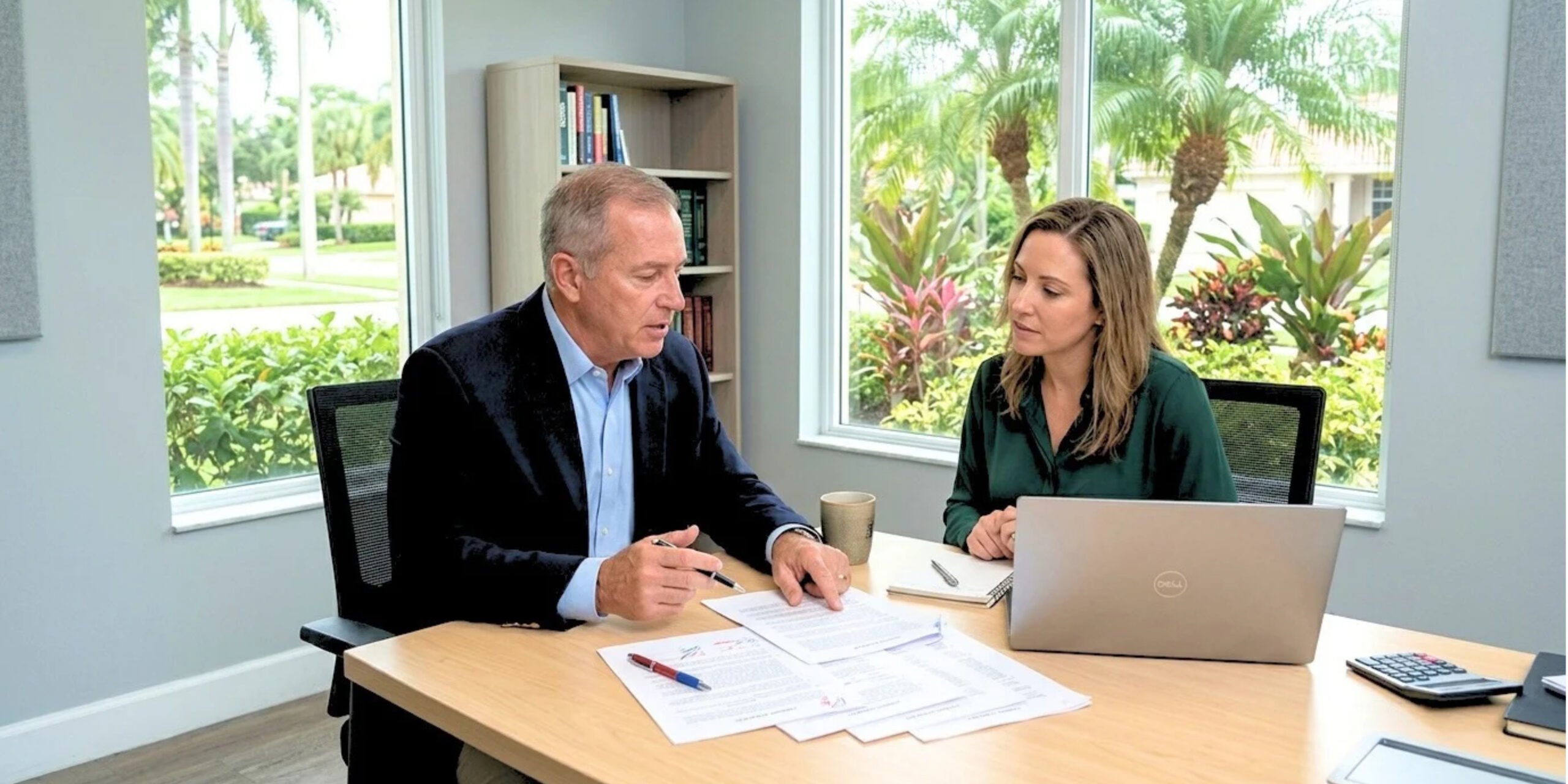
A business contract can be 20 pages long, professionally formatted, signed by everyone involved, and still create a serious problem when the parties disagree.
Sometimes the problem is obvious. Someone never signed the agreement. A required term was left blank. The person who signed it did not have authority to bind the company.
Other times, the contract exists and everyone agrees that they signed it. The fight is over what they actually agreed to.
Florida courts deal with these questions regularly. A valid contract generally requires offer, acceptance, consideration, and sufficiently definite essential terms. Courts also look at whether the parties objectively agreed to the terms that matter to the transaction.
That makes contract preparation less about producing an impressive document and more about making sure the agreement actually says what the business intends to do.
What Makes a Contract Enforceable in Florida?
A Florida business contract generally needs several basic ingredients.
There must be an agreement between the parties. There must be consideration, meaning something of legal value exchanged between them. The parties must agree on the essential terms of the transaction, and the agreement must be sufficiently definite for a court to determine what each party was supposed to do.
That last part causes plenty of trouble.
Imagine that two business owners agree that one will provide consulting services to the other for “a reasonable fee.”
They sign a document.
Six months later, they disagree about whether the fee was supposed to be $5,000, $15,000, or a percentage of the company’s revenue.
The signatures do not magically solve the problem.
Florida courts have held that a valid contract requires sufficiently definite essential terms. When the parties leave an essential provision open for future negotiation, a court generally cannot invent that missing term for them.
Does a Business Contract Have to Be in Writing?
Not every contract has to be written in the same way.
The law governing the particular transaction matters.
For example, Florida’s Uniform Commercial Code contains specific requirements for certain sales of goods. A contract for the sale of goods priced at $500 or more generally requires a sufficient record indicating that a contract was made and signed by the party against whom enforcement is sought or that party’s authorized agent, subject to statutory exceptions.
Other transactions can have their own writing requirements.
This is one reason the phrase “we had a verbal agreement” does not answer the legal question by itself.
A conversation can establish an agreement in some circumstances. In others, the law may require a writing, or the absence of a written agreement may make it considerably harder to establish what the parties actually agreed to.
And even when an oral agreement is potentially enforceable, proving its terms can become a miserable exercise in reconstructing conversations from months or years earlier.
What Happens When the Contract Leaves Something Important Out?
This is one of the most common ways a business agreement becomes difficult to enforce.
The parties may agree on the general idea while leaving the details for later.
“We’ll work out the pricing.”
“We’ll decide the delivery schedule later.”
“The parties will agree on a fair renewal rate.”
Those phrases can sound harmless when everyone is getting along.
They become considerably less charming when the parties are no longer getting along.
Florida courts have repeatedly emphasized that essential terms must be sufficiently definite. In Certified Motors, LLC v. Aventine Hill, LLC, the Second District explained that courts do not exist to supply material terms that the parties themselves failed to agree upon.
A 2026 Fourth District decision, McDowell v. Moore, similarly summarized Florida law as requiring offer, acceptance, consideration, and sufficiently definite essential terms for a valid contract.
The lesson for a business owner is fairly practical:
If a term could materially change what either side is supposed to receive, pay, provide, or tolerate, leaving it for later can create a legal problem now.
What Does “Meeting of the Minds” Mean?
You will sometimes hear lawyers talk about a “meeting of the minds.”
The phrase sounds philosophical. The underlying problem is quite ordinary.
Did the parties actually agree on the essential terms of the deal?
Florida’s Supreme Court has explained that mutual assent is necessary for contract formation, although the parties do not have to agree on every incidental detail. The essential terms must be sufficiently agreed upon for an enforceable contract to exist.
Florida courts generally use an objective approach. What the parties communicated and did matters more than what one person privately says they intended.
That can become important when a business owner says:
“That’s obviously not what I meant.”
Maybe it wasn’t.
But if the signed agreement objectively says something else, the dispute may become considerably harder to resolve.
Can an Ambiguous Contract Still Be Enforced?
Yes. Ambiguity does not automatically mean that a contract disappears.
A contract can contain language that requires interpretation without being completely unenforceable.
Florida courts distinguish between genuine ambiguity and language that is simply inconvenient for one party after the deal has gone badly.
When contractual language is clear, courts generally apply the language of the agreement. When language is genuinely ambiguous, surrounding circumstances and other evidence may become relevant to determining its meaning.
That distinction matters for business contracts because ambiguity can turn a relatively straightforward disagreement into a factual dispute.
Consider a simple example.
A contract says a business must deliver equipment “within 30 days.”
Thirty days from what?
The signing date?
The date of the first payment?
The date the buyer provides specifications?
If the rest of the agreement does not answer the question, the parties may end up arguing about something that should have taken one sentence to define.
Good drafting anticipates these ordinary questions.
Who Actually Signed the Contract?
A contract may contain excellent language and still raise a basic question:
Who agreed to it?
Businesses act through people.
An owner, officer, manager, employee, or other representative may sign a document on behalf of a company. The authority of that person can become important if the transaction is later challenged.
The contract should identify the actual parties correctly and make clear, where appropriate, the capacity in which the people are signing.
That becomes particularly important when a business has multiple owners, affiliated companies, subsidiaries, or individuals performing different roles.
A contract between John Smith and ABC Holdings, LLC is not necessarily the same thing as a contract between John Smith personally and ABC Holdings, LLC.
Getting the names and capacities right at the beginning is considerably easier than explaining them after a dispute has started.
Do Electronic Signatures Count in Florida?
Yes.
Florida’s Uniform Electronic Transaction Act provides that an electronic signature may be used to sign a writing and generally has the same force and effect as a written signature. Florida law also provides that a contract or record cannot be denied legal effect solely because it was created or signed electronically.
That means a business does not generally need to print every agreement, sign it with a pen, scan it, and email it back simply to make the signature legally meaningful.
The more important questions are whether the electronic record accurately reflects the agreement and whether the person who signed had authority to do so.

What Contract Terms Deserve Particular Attention?
There is no universal checklist that makes every business contract enforceable. Different transactions require different provisions.
Still, several subjects deserve deliberate treatment.
Payment
State the amount or method for calculating it, when payment is due, and what happens if payment is late.
Performance
Define what each party is actually required to provide.
Deadlines
If timing matters, identify the relevant dates or provide an objective method for determining them.
Termination
Explain how the relationship can end and what happens to outstanding obligations afterward.
Breach
The agreement can establish consequences for failing to perform, subject to applicable law.
Dispute resolution
Some contracts contain mediation or arbitration provisions. Florida law recognizes written agreements to arbitrate and provides mechanisms for enforcing them.
Attorney’s fees
A contract may address attorney’s fees, but the enforceability and scope of such provisions depend on the agreement and applicable law. An attorney should review the provision rather than assuming that a sentence saying “loser pays” automatically settles the issue.
Governing law and venue
Businesses sometimes want the agreement to specify which state’s law applies or where disputes will be handled. Florida has specific statutory rules governing contractual choice-of-law provisions in qualifying transactions.
These provisions deserve attention before signing, when the parties still have an opportunity to negotiate them.
Can a Contract Be Enforceable Even If It Is Not Perfect?
Yes.
A business contract does not need to predict every possible event for a court to enforce it.
Business relationships are messy. People change plans. Deliveries arrive late. Customers cancel orders. Employees leave. Markets move. Someone misunderstands an email.
The goal is not to create a document that eliminates uncertainty from commercial life.
The goal is to establish enough clear agreement that the parties and, if necessary, a court can determine what the parties actually promised to do.
Florida courts have recognized that not every detail must be fixed in advance. The critical issue is whether the parties agreed on the essential terms with enough certainty to create an enforceable obligation.
What If the Contract Is Already Signed?
Signing does not necessarily end the legal analysis.
If a dispute has already developed, the first step is usually to examine the agreement itself alongside the surrounding documents and communications.
That may include:
- The original contract
- Amendments and addenda
- Invoices
- Emails
- Text messages
- Purchase orders
- Delivery records
- Payment records
- Corporate records
- Documents showing who had authority to sign
- Evidence of how the parties actually performed under the agreement
A contract dispute rarely exists in isolation from the business relationship that produced it.
The written agreement is usually the starting point. The surrounding evidence can become important when the parties disagree about formation, meaning, performance, or modification.
A Contract Does Not Have to Be Long to Be Good
There is a temptation in business to treat contract length as a measure of seriousness.
It isn’t.
A 40-page agreement can contain an enormous amount of unnecessary language while leaving one critical commercial term unclear.
A five-page agreement can sometimes describe a transaction perfectly well.
The useful question is whether the contract clearly addresses the transaction the parties are actually entering into.
If a company is paying $50,000 for a defined service, the agreement should make clear what the company receives, what the other party must provide, when performance occurs, when payment is due, and what happens if either side fails to perform.
That is contract drafting with a purpose.

Business Contracts in Coral Springs and Broward County
For businesses in Coral Springs, contracts can govern relationships with customers, vendors, contractors, partners, landlords, employees, and other businesses.
The same principles apply throughout Broward County and South Florida, although the legal issues can vary considerably depending on the transaction.
A small Coral Springs company negotiating a vendor agreement does not necessarily face the same issues as a business acquiring another company or entering into a long-term commercial lease.
The agreement should reflect the transaction that actually exists.
That sounds obvious.
It is also something that becomes surprisingly easy to forget when a business starts with an old template, changes a few names and numbers, and assumes the rest will take care of itself.
Frequently Asked Questions
What makes a business contract enforceable in Florida?
- A valid contract generally requires offer, acceptance, consideration, and sufficiently definite essential terms. The parties must objectively agree to the essential elements of the transaction, and other legal requirements may apply depending on the type of agreement.
Does a business contract have to be in writing in Florida?
- Not every contract has the same writing requirement. Certain transactions are subject to specific statutes requiring a written record. For example, Florida’s UCC generally requires a sufficient signed record for covered sales of goods priced at $500 or more, subject to statutory exceptions.
Can an electronic signature make a business contract enforceable in Florida?
- Generally, yes. Florida law gives qualifying electronic signatures the same force and effect as written signatures and recognizes electronic contracts and records.
What happens if a business contract leaves out an important term?
- If the missing term is essential to the agreement and the parties never agreed on it, the contract may be unenforceable or a particular provision may fail. Florida courts generally will not create a material term that the parties themselves never agreed upon.
Can an ambiguous business contract still be enforced?
- Sometimes. Ambiguity does not automatically invalidate a contract. Courts may interpret genuinely ambiguous language using applicable rules of contract construction and, in appropriate circumstances, evidence concerning the surrounding circumstances.
Can a contract include an arbitration requirement?
- Yes. Florida law recognizes written agreements to arbitrate and provides procedures for enforcing arbitration agreements. The precise effect of an arbitration clause depends on its language and the circumstances of the dispute.
Talk With a Florida Business Attorney Before a Contract Becomes a Dispute
A business contract should give the parties a clear understanding of what they have agreed to do.
If the agreement leaves essential terms unresolved, identifies the wrong parties, creates conflicting obligations, or uses language that can reasonably be interpreted in different ways, the problem may not become visible until someone wants to enforce the contract.
Reinfeld & Cabrera, P.A. represents businesses in Coral Springs, Broward County, and throughout South Florida in contract matters and business disputes.
If you are negotiating a significant business agreement or dealing with a contract that is already creating problems, an attorney can review the agreement and explain the legal issues that may affect its enforcement.
This article provides general information about Florida contract law and is not legal advice concerning a particular agreement or business dispute.