The Hidden Dangers of Joint Ownership with Right of Survivorship in Florida

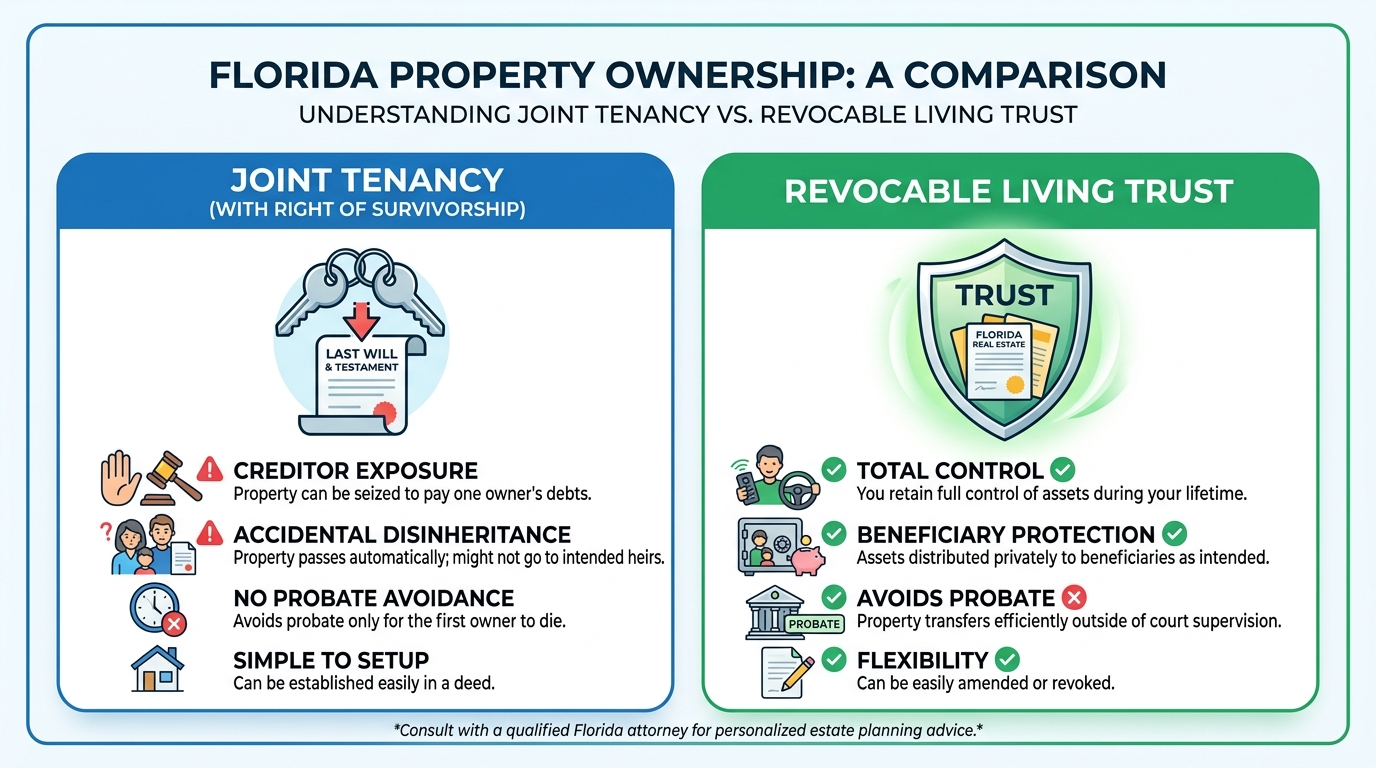
Diagram comparing Joint Tenancy with Right of Survivorship against a Revocable Living Trust under Florida law.

Direct Answer:

Joint Tenancy with Right of Survivorship (JTWROS) in Florida bypasses probate under Fla. Stat. § 689.15, but it completely overrides your Last Will and Testament. Upon the death of one joint owner, title vests immediately and automatically in the surviving owner. This exposes assets to the survivor’s future creditors, potential remarriage claims, and total disinheritance of biological children from prior marriages.


Governed by Will Directives Joint Tenancy completely overrides your Will. A Revocable Trust strictly enforces every distribution instruction in your estate plan.
Co Owner Creditor Protection Joint Tenancy exposes your assets to co owner debts and lawsuits. A Revocable Trust protects assets from third party beneficiary liabilities.

Many South Florida homeowners and account holders add adult children, second spouses, or relatives to bank accounts and real estate deeds as a quick shortcut to avoid formal probate court proceedings.

While adding a joint owner appears convenient on the surface, Joint Tenancy with Right of Survivorship (JTWROS) is one of the most unpredictable, blunt force mechanisms in estate planning. Under Florida property and probate law, joint titling strips away your lifetime financial control, exposes your hard earned assets to outside lawsuits, and routinely triggers accidental family disinheritance.


3 Fatal Vulnerabilities of Joint Ownership Under Florida Estate Law


1. Automatic Property Transfer Overrides Your Will and Intentions

Under Florida Statute § 689.15, when property or financial assets are held as joint tenants with right of survivorship, the deceased co owner’s interest transfers instantly to the surviving co owner upon death by operation of law.

Your Last Will and Testament, Revocable Trust instructions, or verbal promises made to family members carry zero legal weight. If a parent adds one adult child to a Coral Springs real estate deed purely for administrative convenience or convenience check writing, that child becomes the sole legal owner upon the parent’s death, completely cutting out their siblings regardless of what the parent’s Will specifies.

2. Immediate Asset Exposure to Co Owner Liabilities and Creditors

The moment you name a joint owner on a bank account or Broward County real estate deed, that individual gains immediate legal ownership rights. If your co owner faces a divorce proceeding, automobile accident lawsuit, business bankruptcy, or personal tax lien, judgment creditors can attach claims directly to your shared asset. You effectively gamble your lifelong financial security on your co owner’s personal financial discipline and legal stability.

3. The Blended Family Disinheritance Trap

In blended families with children from prior relationships, joint titling regularly causes catastrophic estate outcomes.

When a married couple holds real estate or bank accounts jointly with right of survivorship, all assets vest exclusively in the surviving spouse upon the first spouse’s death. When that surviving spouse eventually passes away, the entire estate passes to their personal biological children or designated heirs. The biological children of the spouse who passed away first receive nothing, creating permanent financial alienation between stepfamilies.
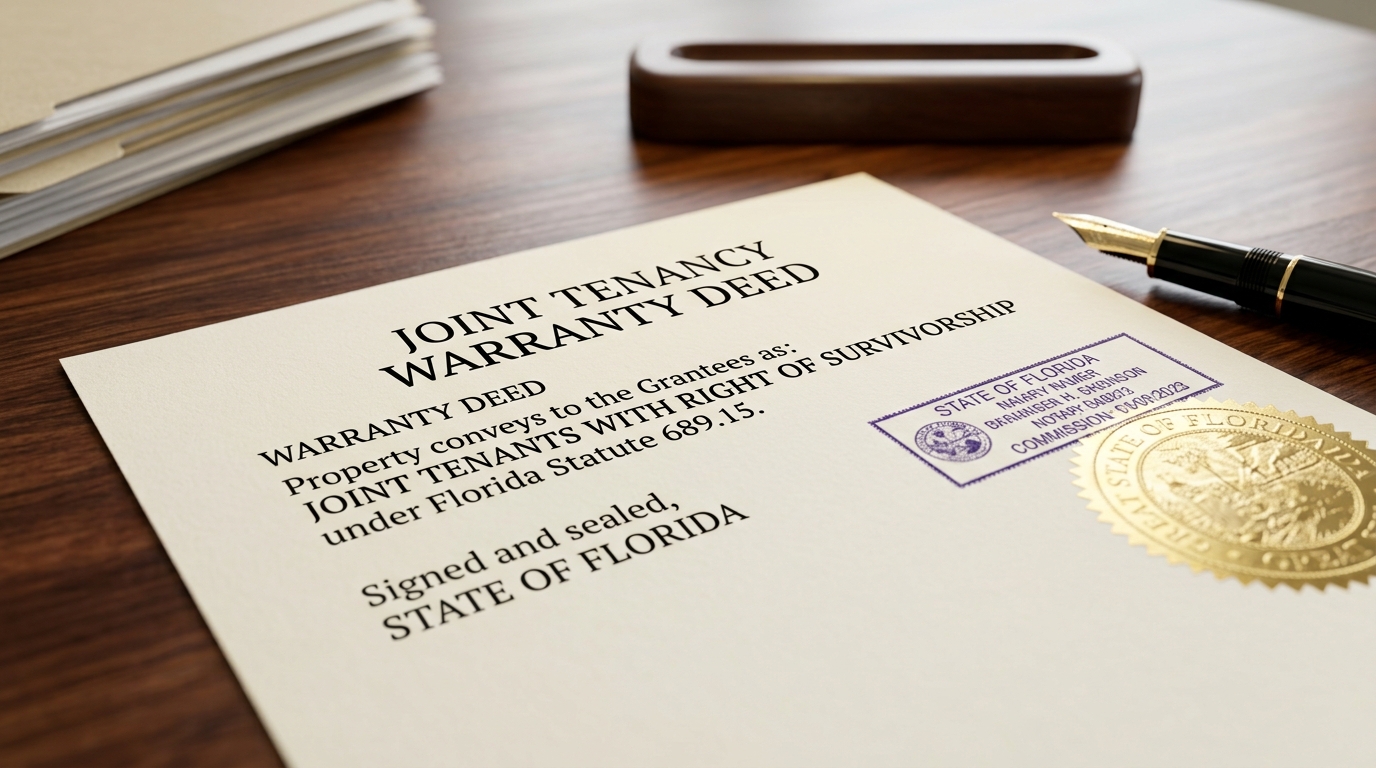

Official Florida real estate deed document highlighting joint tenancy with right of survivorship legal language.

Real World Legal Case Study: In re Estate of Kester

A clear example of how joint titling destroys testamentary intent is illustrated in the official Florida legal precedent In re Estate of Kester, Fla. 4th DCA 1986), decided by the Fourth District Court of Appeal in West Palm Beach.

The Case Background

In this landmark dispute, a mother executed a formal Last Will and Testament directing that her entire estate be divided equally among her children. However, for everyday banking convenience, she established joint bank accounts and credit union shares with right of survivorship naming only one of her daughters as a co owner.

The Legal Conflict

Following the mother’s death, the siblings brought legal action in court, arguing that the funds in the joint accounts were intended for the benefit of all children under the terms of the mother’s Will, and that the joint owner held those funds merely as a fiduciary for the estate.

The Court Ruling

The Fourth District Court of Appeal ruled firmly against the other siblings. The appellate court held that under Florida statutory law governing joint accounts, titling an account as joint tenancy with right of survivorship creates a strong legal presumption of an absolute gift to the surviving joint owner.

Because the disappointed siblings could not provide clear and convincing written evidence proving the mother did not intend to create a survivorship right at the exact moment the accounts were established, the surviving joint daughter kept the entirety of the money. The clear instructions contained inside the mother’s Last Will and Testament were completely ignored and legally powerless.


Superior Florida Legal Alternatives to Joint Ownership

Rather than risking loss of control or accidental disinheritance through joint titling shortcuts, comprehensive estate plans utilize flexible legal structures designed under Florida statutory law:

1. Revocable Living Trust

Establishing a trust under Fla. Stat. Chapter 736 allows you to maintain 100 percent sole authority over your real estate and financial accounts during your lifetime. Upon death, your named successor trustee distributes property to your designated beneficiaries according to your exact written terms, achieving complete probate court avoidance without exposing your assets to co owner debts or disinheriting loved ones.

2. Florida Financial Durable Power of Attorney

If your main objective is allowing a trusted child or relative to assist with bill paying, property maintenance, or financial management during a health crisis, executing a Durable Power of Attorney (Fla. Stat. § 709.2104) grants them legal administrative authority without giving them property ownership rights or subjecting your assets to their personal creditors.

3. Enhanced Life Estate Deed (Lady Bird Deed)

For primary residential property in Coral Springs, Fort Lauderdale, or anywhere in Broward County, an Enhanced Life Estate Deed allows a property owner to retain total lifetime ownership rights, including the right to sell, lease, or mortgage the home without obtaining permission, while designating an automatic transfer on death beneficiary that completely bypasses Florida probate.


Aerial view of residential homes in Coral Springs Broward County Florida illustrating real estate property ownership.

Frequently Asked Questions

Does joint ownership avoid probate in Broward County?

  • Yes, joint tenancy with right of survivorship avoids probate upon the death of the first co owner. However, when the surviving owner eventually passes away without establishing formal trust planning, the property must pass through formal Florida probate administration.

Can I remove a joint owner from my Florida real estate deed without their consent?

  • No. Once an individual is added to a deed as a joint tenant in Florida, you cannot remove them, sell the property, or execute mortgages without their formal notarized signature, even if you originally paid for the entire property yourself.

What is the legal difference between Joint Tenancy and Tenancy by the Entirety in Florida?

  • Tenancy by the Entirety is a specialized form of joint ownership reserved strictly for legally married couples under Florida law. It provides built in creditor protection against individual spouse liabilities that standard Joint Tenancy does not offer.

Can a Last Will override a joint bank account in Florida?

  • No. Under Florida law, joint accounts with right of survivorship transfer automatically upon death. A Last Will carries no legal authority to alter or redistribute funds held in a valid joint survivorship account.

Protect Your Property and Family Autonomy in Coral Springs

Shortcuts like joint ownership frequently create expensive courtroom battles and ruined family relationships later on. The legal team at Reinfeld & Cabrera, P.A. helps South Florida property owners evaluate titles, structure revocable living trusts, and secure family legacies across Broward County.


Schedule a Free Confidential Legal Evaluation

Ensure your assets and real estate remain completely protected under Florida law:

  • Direct Phone: (954) 866-4878 | (954) 334-1520
  • Coral Springs Main Office: 9625 W Sample Rd, Coral Springs, FL 33065
  • Fort Lauderdale Office: 2933 W Cypress Creek Rd, Suite 201, Ft Lauderdale, FL 33309
  • Online Scheduling: mypersonalattorneys.com
  • Regional Coverage: Coral Springs, Fort Lauderdale, Parkland, Tamarac, Margate, Coconut Creek, and surrounding Broward County communities.


Voted Favorite Real Estate Attorney in Coral Springs by Readers Choice

The best real estate attorney in Coral Springs is not necessarily the lawyer with the most reviews, the longest list of services, or the strongest advertising. The right attorney depends on the type of property matter you need to resolve, the attorney’s experience with that type of matter, and whether you need transactional advice, dispute resolution, or litigation. For homeowners, buyers, sellers, landlords, tenants, and businesses in Coral Springs and throughout Broward County, identifying those factors can make it easier to find appropriate legal representation.

Choosing a real estate attorney starts with understanding what kind of legal problem you actually have. A lawyer who regularly handles residential purchases may have a different focus from one who handles title disputes, commercial transactions, foreclosure matters, or real estate litigation.

That makes the right question less about finding the attorney with the biggest advertisement and more about finding an attorney whose experience fits your situation.

For property owners, buyers, sellers, landlords, and businesses in Coral Springs and throughout Broward County, a few practical considerations can help narrow that choice.


Start With the Real Estate Problem

Real estate law covers a wide range of matters. Before choosing an attorney, identify what you need help with.

A person buying a home may need contract review or help addressing a title problem. A property owner facing a dispute may need representation in litigation. A landlord and tenant may need advice about their respective rights and obligations. A business purchasing or leasing commercial property may face substantially different legal and financial issues.

Some common matters include:

  • Residential and commercial real estate transactions
  • Purchase and sale agreements
  • Contract review and disputes
  • Title and ownership disputes
  • Foreclosure matters
  • Landlord and tenant disputes
  • Property damage claims
  • Short sales and distressed property
  • Real estate litigation
  • Commercial leases and other property agreements

The important point is that real estate experience is not one-size-fits-all. The nature of the problem should help determine what kind of attorney you need.


Ask What Experience Actually Applies to Your Matter

A long legal career can be valuable, but years of practice alone do not tell you whether an attorney is a good fit for a particular property issue.

Consider whether the attorney regularly handles matters similar to yours. Someone experienced in negotiating residential purchase agreements may approach a title dispute differently from an attorney whose practice includes real estate litigation.

The same applies to commercial property. A transaction involving a business, commercial lease, development project, or other substantial investment can involve issues that do not arise in a typical residential purchase.

The more closely an attorney’s experience matches the problem, the easier it may be to identify the relevant risks and available options.


Ask Who Will Actually Handle the Matter

It is reasonable to ask who will be responsible for your case or transaction after the initial consultation.

Will the attorney you meet personally review the important documents? Who will communicate with you if a dispute develops? If litigation becomes necessary, does the firm have experience handling that type of proceeding?

These questions can matter because a real estate matter may begin as a transaction and later become a dispute. Understanding who will be handling the legal work can help you make a more informed decision before retaining counsel.


Know When a Real Estate Problem Needs Legal Attention

Not every property question requires an attorney immediately. Some situations, however, can become considerably harder to resolve if important documents are signed, deadlines pass, or a dispute escalates before the legal issues are understood.

A consultation may be particularly useful when:

  • A purchase or sale agreement contains language you do not understand.
  • The parties disagree about the meaning or performance of a contract.
  • A title search reveals a lien, ownership issue, or other unexpected problem.
  • Someone challenges your ownership or right to use a property.
  • A landlord and tenant dispute has escalated beyond an ordinary disagreement.
  • You have received legal papers involving a property.
  • A foreclosure or other serious action may affect your property rights.
  • A transaction has stalled because the parties cannot resolve a legal issue.
  • Property damage has created a disagreement about responsibility or compensation.

The point is not that every disagreement will lead to litigation. Early legal advice can sometimes clarify the parties’ rights, identify documents that need attention, or reveal an issue that should be addressed before the transaction or dispute progresses further.


What Should You Bring to a Real Estate Attorney?

The usefulness of an initial consultation often depends on how much relevant information is available. You do not need to organize every document perfectly, but bringing the important records can help an attorney understand the situation more quickly.

Depending on the matter, useful documents may include:

  • Purchase or sale contracts
  • Deeds and other property records
  • Lease agreements
  • Closing documents
  • Title or lien information
  • Mortgage or foreclosure documents
  • Property management records
  • Written communications between the parties
  • Notices, demands, or court documents
  • Photographs or records relating to property damage
  • Previous agreements concerning the property

A lawyer may need additional information after reviewing these materials. Still, having the relevant documents available can make it easier to identify the central issue and determine what should happen next.


Understand What the First Consultation Should Accomplish

A useful consultation should give you a clearer understanding of the legal issue, even if the matter cannot be resolved during the first meeting.

Depending on the circumstances, you should expect to discuss:

  • The property and the people or businesses involved
  • The documents relevant to the matter
  • Important deadlines or upcoming transactions
  • Potential legal problems or areas of uncertainty
  • Possible ways to address the issue
  • Whether additional documents or investigation are needed
  • What the next stage of the legal process may involve
  • How the attorney’s fees and representation would be structured

You do not necessarily need a definitive answer to every question during an initial consultation. Real estate disputes can depend on documents, ownership records, contracts, communications, and other facts that require careful review.

What matters is leaving the consultation with a better understanding of what the problem is and what needs to happen next.


Consider Whether You Need a Transactional Attorney or a Litigator

One distinction can be especially important when choosing a real estate attorney: Will the matter involve a transaction, a dispute, or potentially both?

Transactional work can involve reviewing and negotiating contracts, addressing closing issues, examining title concerns, and helping clients complete property transactions.

Litigation involves a different set of considerations. If the parties are already in a dispute over ownership, a contract, property damage, a landlord and tenant relationship, or another real estate issue, the matter may require representation in a legal proceeding.

Some situations can also move from one category to the other. A disagreement that begins during a transaction can become a formal dispute.

Understanding where your matter falls can help you find an attorney whose experience matches the stage and nature of the problem.


Local Experience Can Matter

Real estate law is governed by Florida law, but local circumstances can still matter when dealing with property in Coral Springs and elsewhere in Broward County.

A local attorney may be familiar with the types of residential, commercial, ownership, and property disputes that commonly arise in the area. More importantly, the attorney should understand the Florida laws governing the particular issue rather than relying solely on general real estate experience.

For property owners and businesses in Coral Springs, the goal should be to find counsel who understands both the legal issue and the circumstances surrounding the property.


Look Beyond Marketing Claims

Searching for the “best” real estate attorney can produce plenty of advertisements, awards, testimonials, and claims of experience.

Those things can be useful information, but they should not be the only basis for choosing counsel.

A better evaluation asks:

  • Does the attorney handle matters like mine?
  • Does the attorney understand the relevant Florida law?
  • Will I know who is responsible for my matter?
  • Can the attorney explain the risks and options clearly?
  • Do I understand how the representation will work?
  • Does the firm’s experience fit the problem I am trying to solve?

The attorney with the longest list of services is not necessarily the right attorney for every situation. The best fit depends on the legal problem, the property involved, and the type of representation required.


Choosing the Right Real Estate Attorney

Finding a real estate attorney in Coral Springs should begin with the problem you need to solve, not simply with a search for the most prominent name.

Whether you are buying or selling property, dealing with a title or ownership dispute, facing a foreclosure issue, managing a landlord and tenant matter, or dealing with another real estate concern, the attorney’s relevant experience should be one of the first things you evaluate.

For residents and businesses in Coral Springs and throughout Broward County, a consultation can help determine what legal issues are involved, what information needs to be reviewed, and what options may be available.

The best attorney is ultimately the one whose experience and approach fit your particular real estate matter.


Frequently Asked Questions

When should I contact a real estate attorney in Coral Springs?

  • You should consider contacting a real estate attorney when a property matter involves a contract, dispute, significant financial risk, or legal obligation you do not fully understand. This can include reviewing a purchase or sale agreement, addressing a title problem, dealing with a landlord tenant dispute, or responding to a property related lawsuit. Getting legal advice early can help identify problems before they become harder or more expensive to resolve.

Do I need a real estate attorney for a standard property transaction?

  • Not every transaction requires the same level of legal assistance. Some matters may be relatively straightforward, while others involve unusual contract terms, title issues, financing concerns, ownership disputes, or other complications. A consultation can help determine whether your particular transaction would benefit from legal review and what issues should be addressed before you sign.

How do I choose the right real estate attorney for my situation?

  • Start by identifying the specific property issue you need help with and then look for an attorney with relevant experience. Ask who will handle your matter, whether the attorney regularly handles similar cases, and what the initial consultation will cover. Local experience in Coral Springs and Broward County can also be useful when your matter involves local property, courts, or other parties in the area.

How does local court jurisdiction in Broward County affect the administration of an estate plan?

  • When an estate plan requires judicial oversight, such as formal or summary administration through the 17th Judicial Circuit Court in Broward County, local procedural rules govern how property titles are cleared and distributed. An integrated estate plan accounts for these local court requirements ahead of time, minimizing administrative delays for real estate located in Coral Springs, Parkland, or Fort Lauderdale by ensuring property deeds and trust funding are properly structured before probate ever becomes necessary.

What happens if instructions in a revocable living trust contradict a financial account beneficiary form?

  • Under Florida law, contractual arrangements and direct asset titling rules generally supersede instructions written inside a will or a trust. If a revocable living trust states that all liquid accounts should be divided equally among beneficiaries, but an individual retirement account or bank account lists a single person as a payable on death recipient, the financial institution is legally bound to honor the beneficiary form. A comprehensive estate audit resolves these discrepancies proactively to prevent unintended disinheritances.

Need Help With a Real Estate Matter?

If you are dealing with a property transaction, contract issue, landlord tenant dispute, title problem, or real estate litigation in Coral Springs or Broward County, the right legal advice can help you understand your options before you make an important decision.

MyPersonalAttorneys has been recognized by local readers and community organizations for its legal services, including recognition as a Readers’ Choice favorite in Coral Springs. If you need assistance with a real estate matter, contact our firm to discuss your situation with an experienced real estate attorney.

What is Commercial Litigation?

Commercial-litigation-attorney

You may know someone who is a commercial litigation attorney, but have you ever found yourself wondering “what is commercial litigation?” As experienced commercial litigation lawyers ourselves, we at Reinfeld & Cabrera, P.A. are here to answer your questions on commercial litigation.

What is commercial litigation?
Let’s start with commercial law: commercial law, also known as a part of business law, applies to the rights, relations, and conduct of persons and businesses engaged in commerce, merchandising, trade, and sales. Therefore, commercial litigation is any dispute which may arise in any business activities and which most often results in court proceedings to settle the issue. Usually these disputes are focussed on property or finances with some examples being corporate governance, banking transactions, mergers and acquisitions.

Why is commercial litigation necessary?
During the day-to-day events of any business, many legal matters may arise and need to be dealt with. Because commercial industries fall under both private and public law, these legal matters are of utmost importance to the smooth running and wellbeing of your business. As any business owner, large or small, will know, you cannot run a business without finances and paperwork. Things like taxes, employee contracts and property rental agreements are all legal matters and any number of issues may arise in these areas when running a business. So it is important for any issue either to be avoided through well drawn-up contracts and negotiations or to be dealt with quickly and efficiently in court to avoid growing expenses and wasting business hours on the problem.

What does a commercial litigation lawyer do?
The aim of a commercial litigation attorney is primarily to represent you and your business in a court of law during a commercial litigation case. However, a commercial litigation attorney can be tremendously useful when consulted beforehand to try to avoid ever having to go to court (as this may turn into a costly experience). They are extremely knowledgeable and skilful in all aspects of commercial law. A good commercial litigation attorney will be able to guide you through any and all aspects of your business which may fall under the wing of commercial law.

Do I need a commercial litigation attorney?
The short answer is: if you have a business or partake in any business dealings, yes. The long answer: a commercial litigation attorney can help you in all legal business matters in or out of court. These may include a breach of contract, sales disputes, contract negotiation and preparation. And whether your business is a brand new small start-up business or a massive multi-national corporation, chances are you will eventually need a good commercial litigation attorney.

So now that you know a bit more about commercial litigation, you can see the importance of knowing a good commercial litigation attorney. If you don’t already know one, let Reinfeld & Cabrera give you a free consultation and never worry about commercial litigation again.

What Does a Real Estate Attorney Do at a Florida Closing?

Real estate attorney reviewing a property closing with clients in Coral Springs, Florida

A real estate closing can look deceptively simple. The buyer signs documents, the seller signs documents, money changes hands, and the property changes ownership.

The legal work behind that moment is considerably less simple.

A Florida real estate attorney can review the purchase contract, examine title issues, address liens and other encumbrances, review the closing documents, and advise a buyer or seller when the transaction does not proceed exactly as expected. That work may begin weeks before the closing date.

For someone who already has a real estate agent, lender, title company, or closing agent, it is reasonable to ask what a separate attorney actually does. The answer depends on the transaction, but the attorney’s role is generally to provide legal advice to the client whose interests the attorney represents.

The Florida Bar recommends consulting a Florida licensed real estate lawyer before signing a purchase contract. It also points out that the closing agent may be an attorney without representing the individual buyer’s or seller’s interests.


The Lawyer’s Work Often Starts Before the Closing

The closing is the final stage of a transaction that began with a contract.

That contract determines the purchase price, deposit, financing arrangements, inspection rights, title requirements, closing date, possession, closing costs, and the obligations of both parties. It can also establish what happens when one side fails to perform.

Those provisions matter when the transaction develops a problem.

Suppose the seller discovers that an old mortgage was never properly released. Or the buyer learns that a title objection has not been resolved. Perhaps the parties disagree about whether a repair was required under the contract, or whether a closing deadline can be extended.

Those questions cannot be answered by looking only at the documents being signed on closing day. The purchase agreement, amendments, correspondence, title documents, and applicable Florida law may all matter.

That is one reason the Florida Bar recommends having a lawyer review the purchase contract before it is signed. Standard forms contain many provisions, but the parties can negotiate terms and add provisions that change their rights and obligations.


What Does a Real Estate Attorney Review?

The attorney may review the purchase agreement and the documents generated during the transaction. Depending on the property and the circumstances, that can include:

  • The purchase and sale agreement
  • Addenda and amendments
  • Title commitments and title evidence
  • Deeds
  • Mortgages and other recorded instruments
  • Liens and judgments
  • Easements and restrictions
  • Survey issues and possible encroachments
  • Closing statements
  • Tax and other prorations
  • Repair credits and other concessions
  • Financing documents
  • Possession provisions
  • Documents prepared for signing at closing

The attorney is also looking at how these documents fit together.

For example, a closing statement might contain a credit that was negotiated in an amendment to the purchase contract. A title commitment might identify an exception that needs to be addressed before the buyer can receive the title insurance coverage expected under the transaction. A survey might reveal an encroachment that was not apparent when the contract was signed.

The point is not to read every document in isolation. The documents have to be consistent with the transaction the parties actually agreed to.


Why Title Problems Can Delay a Closing

Title is one of the biggest legal issues in a real estate transaction because ownership is not established simply by the seller saying that the property belongs to them.

A title examination can reveal mortgages, tax liens, judgments, easements, restrictions, probate issues, prior conveyances, or other matters affecting the property. The Florida Bar notes that a title examination may involve records going back many years and that problems can originate in areas such as probate, divorce, foreclosure, inheritance, and previous financing.

Some problems are relatively easy to correct. Others require additional documents, negotiations, or legal proceedings.

The purchase contract also matters because it may give the buyer a specific period to examine the title and notify the seller of objections.

Florida courts have enforced those contractual deadlines. In Davis v. Ivey, 984 So. 2d 571 (Fla. 5th DCA 2008), the buyers had 15 days after receiving title evidence to examine the title and notify the seller of defects. The seller provided the title evidence only one day before the scheduled closing. The appellate court held that the contractual examination period still applied.

That kind of dispute illustrates why a closing date does not tell the entire story. The contract may give the parties rights that continue to operate as the closing approaches.


Is the Closing Agent Your Attorney?

Not necessarily.

A title company or settlement agent may handle many of the practical steps required to complete the transaction. That can include preparing or coordinating documents, receiving and disbursing funds, recording documents, satisfying title requirements, and communicating with the parties.

The closing agent’s role does not automatically create an attorney-client relationship with the buyer or seller.

The Florida Bar specifically warns consumers that a closing agent may be a lawyer but may not represent their individual interests.

This distinction becomes important when the parties have competing interests. If the buyer and seller disagree about a contractual provision, for example, the buyer may need independent legal advice rather than assuming that the person conducting the closing is there to advise the buyer.


What Happens When the Closing Statement Changes?

The money being exchanged at closing has to match the transaction.

The settlement statement can include the purchase price, deposit, loan proceeds, taxes, insurance, title charges, recording fees, commissions, credits, prorations, payoff amounts, and other expenses.

Some of these figures are routine. Others may require explanation.

A repair credit negotiated after the original contract was signed should appear consistently in the closing documents. A mortgage payoff should correspond with the amount required to satisfy the seller’s loan. Property taxes may need to be prorated according to the terms of the transaction and the relevant tax period.

A lawyer reviewing the closing documents can compare them with the contract and identify discrepancies that need to be resolved before signing.


Be Careful With Wire Instructions

Wire fraud deserves particular attention during a real estate transaction because large sums of money are commonly transferred shortly before or at closing.

The Florida Bar advises consumers to independently and personally verify wire instructions rather than relying on an email containing payment information.

That advice is worth taking literally. If someone sends new instructions shortly before closing, call the intended recipient using a telephone number you already know to be legitimate. Do not assume that an email is genuine because it contains familiar names, logos, or details from the transaction.


Florida Homestead Law Can Affect the Documents

Florida’s homestead rules create additional legal considerations for qualifying homestead property.

Section 196.031 of the Florida Statutes addresses the homestead exemption for qualifying permanent residences. Florida law also contains specific rules concerning the conveyance and mortgaging of homestead property. Section 689.111 addresses circumstances involving a married owner’s spouse.

These rules can affect the documents required for a transaction and whether a deed or mortgage has been properly executed.

Homestead status can also intersect with estate planning, ownership, and family circumstances. An attorney therefore needs to look at the property and the people involved rather than assuming that every Florida residential closing follows the same set of rules.


What If Something Goes Wrong at Closing?

A closing does not automatically become a lawsuit because a problem appears.

The parties may be able to correct a document, obtain a lien release, resolve a title objection, amend the contract, adjust the closing figures, or agree on another solution. The appropriate response depends on the nature of the problem and the rights established by the contract.

The legal question may become more serious when one party refuses to perform.

If a seller cannot deliver the title required by the agreement, a buyer may have contractual remedies. Maybe a buyer fails to provide required funds or financing, the seller may have rights under the contract. If the parties disagree about whether a condition has been satisfied, the language of the agreement can become central to the dispute.

This is why the purchase contract deserves attention before closing rather than being treated as paperwork that has already served its purpose.

Real estate attorney reviewing a property with clients in Coral Springs, Florida

Do You Need a Real Estate Attorney for a Florida Closing?

There is no single answer for every transaction.

A straightforward residential purchase may involve relatively few legal complications. Other transactions can involve title defects, probate issues, divorces, liens, boundary disputes, unusual financing arrangements, commercial property, seller financing, significant contract amendments, or disagreements between the parties.

Those circumstances can change the legal work required.

The Florida Bar recommends having a qualified Florida real estate lawyer review a purchase contract before it is signed, particularly because standard contracts can be modified and because the consequences of contractual language can be significant.

If you are considering hiring an attorney, ask what the attorney will actually review and what representation includes. You should know whether the lawyer will examine the purchase agreement, communicate with the title company, review title issues, examine the closing documents, and advise you about disputes that arise before closing.


Real Estate Closings in Coral Springs and Broward County

A Coral Springs real estate transaction follows Florida law, but the property itself has its own history.

The relevant records can include prior deeds, mortgages, liens, easements, tax information, surveys, condominium or homeowners’ association documents, and other records affecting the property.

That history matters because two properties in the same neighborhood can have completely different title issues.

For buyers and sellers in Coral Springs and Broward County, a real estate attorney can review the particular property and transaction rather than relying on assumptions about how a typical closing should proceed.


Questions to Ask a Real Estate Attorney

Before hiring a Florida real estate attorney, ask specific questions about the work you need:

  1. Will you review my purchase contract before I sign it?
  2. Will you review the title commitment and identify title problems?
  3. Who will communicate with the title company or closing agent?
  4. Will you review the final closing statement?
  5. What happens if a lien or other title defect appears?
  6. What happens if the other party misses a contractual deadline?
  7. Will you review the documents before I sign them?
  8. Who will handle my matter?
  9. How will the legal fees be calculated?

The answers should give you a clear idea of what the attorney will actually do during the transaction.


Talk With a Coral Springs Real Estate Attorney

Reinfeld & Cabrera, P.A. represents clients in Coral Springs and throughout Broward County in real estate matters.

If you are buying or selling property and want legal advice about the contract, title, closing documents, or another issue affecting the transaction, contact the firm to discuss your circumstances with an attorney.