Florida Guardianship and Gun Rights: Can You Keep Your Firearms?

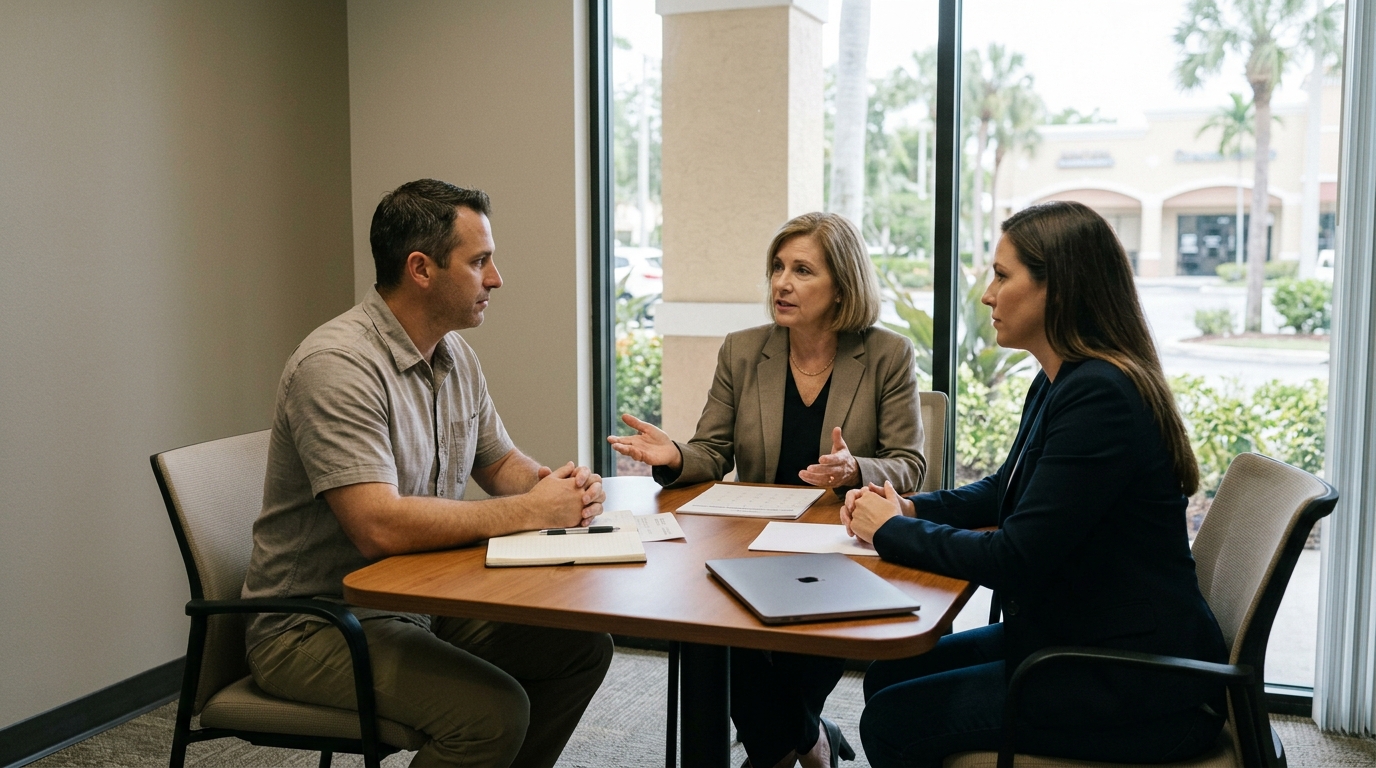
Guardianship attorney discussing firearm rights with a family in Coral Springs, Florida

A Florida guardianship does not automatically take away a person’s gun rights. However, an incapacity adjudication can trigger a separate firearm disability under Florida law, depending on the findings made by the court.

That sounds straightforward until someone actually has to deal with it.

Dad cannot manage his bills anymore. His daughter is considering guardianship. Then somebody remembers the guns.

There is a handgun in the nightstand. Two rifles are in a locked cabinet. Dad insists he is perfectly capable of handling them. His daughter is considerably less convinced.

Now the family has a very different question:


Can Dad still legally own or possess those firearms?

Florida’s guardianship law and firearm law approach that question differently. A guardianship does not automatically erase every legal right an incapacitated person has. At the same time, Florida’s firearm statutes impose restrictions on certain people who have been adjudicated mentally defective, and that definition includes certain judicial findings of incapacity under Florida’s guardianship law.

So the answer may depend on something buried in the court record that the family did not realize mattered.

And that is where things get interesting.


Does Guardianship Automatically Take Away Gun Rights in Florida?

No. Being placed under guardianship does not, by itself, automatically remove a person’s right to own or possess firearms.

Florida’s guardianship statute, §744.3215, lists the rights a person determined incapacitated retains and the rights that a court may remove. The list includes rights involving marriage, voting, driving, contracts, property, health care, residence, and other decisions. Firearm ownership and possession are not listed as rights that §744.3215 specifically gives a guardian authority to remove.

That does not mean an incapacity finding has no effect on firearms.

Florida’s firearm statutes create a separate legal disability. Under §790.065, the statutory definition of a person “adjudicated mentally defective” includes a judicial finding of incapacity under §744.331(6)(a). A person who falls within that definition can be prohibited from purchasing a firearm.

Section 790.064 goes further. A person who has been adjudicated mentally defective, as defined by §790.065, may not own or possess a firearm until relief from the firearm disability is obtained.

So there are two different pieces of law sitting next to each other:

  • Chapter 744: What rights has the guardianship court removed from the ward?
  • Chapter 790: Does the person have a separate firearm disability?

The answer to one does not automatically answer the other.


What Does an Incapacity Adjudication Have to Do With Firearms?

This is the part families can easily miss.

A guardianship case begins with a determination of incapacity. Florida law requires the petition to identify the rights the petitioner believes the alleged incapacitated person cannot exercise. The court then determines the nature and scope of the incapacity and the rights affected by its order.

Firearm law uses its own terminology.

Under §790.065, “adjudicated mentally defective” includes certain court determinations involving mental illness, incompetency, conditions, or disease. The statute specifically includes a judicial finding of incapacity under §744.331(6)(a).

That is why the phrase “the person has a guardian” is not enough to determine whether a firearm disability exists.

You have to look at the actual incapacity adjudication and the statutory definition that applies to it.

A limited guardianship involving one set of rights can raise different questions from a broader incapacity adjudication. The court order, the findings supporting it, and the applicable firearm statutes all matter.


What Happens to Guns Someone Already Owns?

Suppose Dad already owns three firearms before the guardianship proceeding.

His daughter becomes his guardian. The guns do not suddenly become the daughter’s property because she was appointed guardian.

But if Dad has been adjudicated mentally defective within the meaning of Florida’s firearm statutes, §790.064 says he may not own or possess a firearm until the firearm disability is removed.

That creates a practical problem the family should not try to solve by improvising.

Someone needs to determine:

  • What exactly did the court adjudicate?
  • What rights were removed?
  • Does the adjudication fall within §790.065?
  • Is there an existing firearm disability?
  • Is there a concealed weapons or firearms license?
  • Does a court order address the firearms?
  • What legally authorized arrangement should be made for firearms the person already owns?

A guardian does not receive a free-floating power to make every decision for a ward. Florida law limits the rights a guardian may exercise to those removed from the ward and delegated to the guardian.

And if the person is legally prohibited from possessing a firearm, the family should not treat the guns as if this were simply a question of where to put Dad’s property.


Florida Lawyers Were Already Arguing About This in 2013

In December 2013, The Florida Bar Journal published “Grandparents, Guns, and Guardianship: Incapacity and the Right to Bear Arms” by Carla-Michelle Adams. The article argued that Florida’s guardianship statutes did not specifically address whether an incapacitated person’s right to bear arms could be removed.

Then, in February 2014, attorneys Caroline S. A. Zoes and J. Marcos Martinez responded with “Wards and Guns.” Their position was that becoming a ward does not automatically erase constitutional rights.

The exchange is useful today because it identified the exact problem: guardianship law and firearm law were not using the same framework.

Florida’s statutes have since developed firearm-specific restrictions that make the analysis different from the one presented in those 2013 and 2014 articles.

The old debate is still worth reading, though. It explains why the relationship between guardianship, incapacity, and gun rights has never been as simple as “the judge appointed a guardian, so the guns are gone.”


Florida Guardianship Forms Mention Firearms

There is an unusually specific clue in Florida’s guardianship paperwork.

The Florida Supreme Court’s guardianship forms include a question asking whether the respondent may or may not have a license to carry a firearm or possess a weapon or firearm. The form appears in the court’s guardianship rules and forms governing incapacity and guardianship proceedings.

That does not mean the form itself creates a firearm disability.

It does show that firearms are something the guardianship process can require the court to address.

The same form separately identifies the rights that may be delegated to a guardian. Those include contracts, lawsuits, government benefits, property management, residence, health care, and social-environment decisions. Firearm possession does not appear in that list of delegable guardianship rights.

That distinction is worth keeping straight.


Can an Incapacitated Person Still Have a Concealed Weapons License?

Not necessarily. An incapacity-related firearm disability can also affect eligibility for or continued possession of a Florida concealed weapons or firearms license.

Florida’s firearm background-check statute requires the state to consider whether a person has been adjudicated mentally defective or committed to a mental institution. The statute also directs the Department of Law Enforcement to provide relevant information to the Department of Agriculture and Consumer Services when determining eligibility for a concealed weapons or firearms license or whether an existing license should be suspended or revoked.

So a family should not assume that the question ends with the firearms sitting in a gun safe.

There may also be a licensing issue.

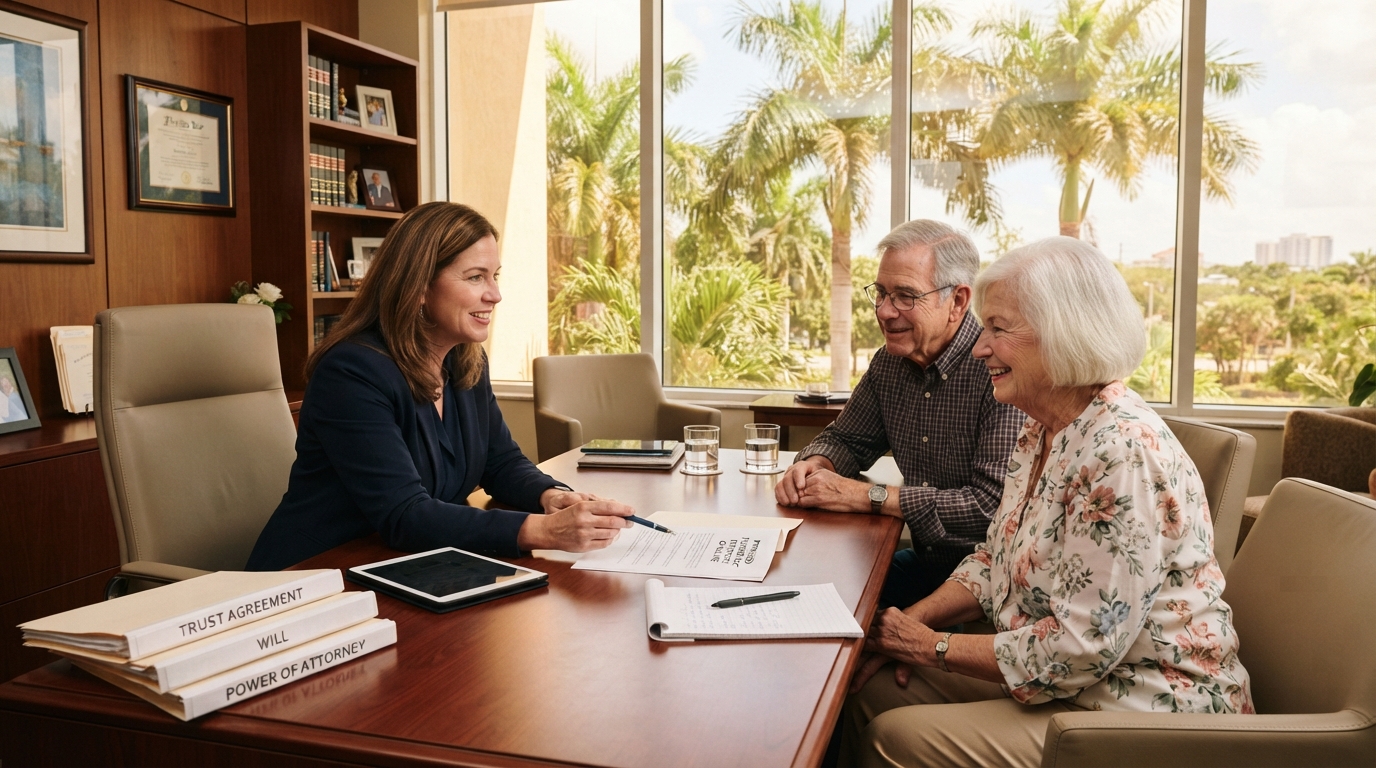
Florida guardianship and firearm rights documents on an attorney's desk.

Can Someone Regain Gun Rights After an Incapacity Adjudication?

Possibly, but restoration of capacity and restoration of firearm rights are separate legal processes.

Florida law allows a person to seek relief from a firearm disability arising from an adjudication or commitment. Under §790.065, the petition is presented to the appropriate court, the state attorney may object, and the court considers evidence concerning the person’s reputation, mental health record, criminal history when applicable, the circumstances surrounding the firearm disability, and other evidence.

The court must determine that the person is not likely to act in a manner dangerous to public safety and that granting relief would not be contrary to the public interest before granting relief under that statute.

Florida’s guardianship law separately provides a procedure for restoring a ward to capacity when the person can again exercise rights that were previously removed.

Those two procedures should not be treated as interchangeable.

Someone whose capacity has been restored should still determine whether a separate firearm disability remains and whether formal relief under Chapter 790 is required.


What If the Guardian and the Family Disagree About the Guns?

Imagine the Coral Springs family again.

Dad’s daughter is now his guardian. Dad’s son thinks the guns should stay in the house. Dad insists that nothing has changed and wants access to them.

Nobody agrees.

The daughter says, “I’m his guardian.”

The son says, “They’re his guns.”

Dad says, “They’re mine.”

None of those statements, by itself, resolves the legal issue.

The family needs to look at the incapacity order, the guardianship authority actually granted, and the firearm statutes that apply to the adjudication.

If a firearm disability exists under Chapter 790, the possession question becomes very different from a dispute over who owns a piece of ordinary personal property.

And if the family believes the incapacity determination itself should be changed, that is a separate guardianship issue.

This is one of those situations where pulling the actual court file is considerably more useful than arguing around the kitchen table.


What Does This Mean for Families in Coral Springs and Broward County?

For families in Coral Springs and Broward County, guardianship proceedings are handled through Florida’s court system, and the details of the incapacity order can determine what happens next.

A family dealing with an aging parent, dementia, cognitive decline, or another condition affecting decision-making may already be dealing with medical records, financial accounts, powers of attorney, and property issues.

Firearms can add another layer.

If the person owns firearms, the family should identify that issue early in the guardianship process rather than assuming the appointment of a guardian answers it.

The relevant documents may include:

  • The petition to determine incapacity
  • The examining committee reports
  • The order determining incapacity
  • The order appointing the guardian
  • Letters of guardianship
  • Any order addressing firearm possession
  • Records relating to a firearm or concealed weapons license
  • Any later order restoring capacity or granting relief from firearm disabilities

The legal analysis is fact specific. A guardianship attorney in Coral Springs or elsewhere in Broward County may need to review the actual orders before giving a definitive answer about a particular person’s firearm rights.
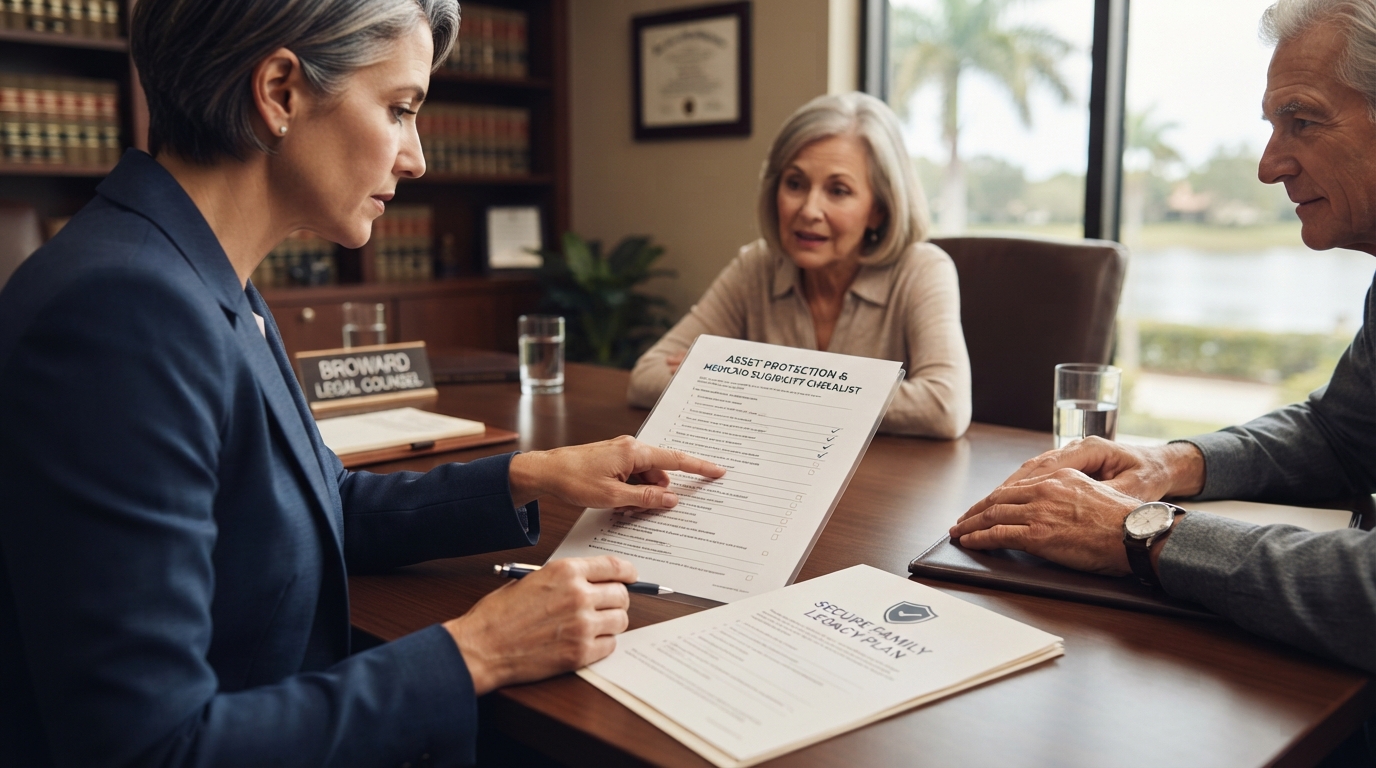
Family discussing firearm possession after a guardianship proceeding in Broward County

Frequently Asked Questions

Can guardianship take away your gun rights in Florida?

  • Guardianship alone does not automatically remove gun rights. However, a qualifying incapacity adjudication can trigger a separate firearm disability under Florida’s Chapter 790.

Does an incapacity adjudication prevent someone from buying a gun in Florida?

  • It can. Florida’s firearm purchase statute includes certain judicial findings of incapacity within the definition of “adjudicated mentally defective,” which can make a person prohibited from purchasing a firearm.

Can an incapacitated person possess a firearm in Florida?

  • Not if the person is subject to the firearm possession disability in §790.064. That statute prohibits a person covered by its definition from owning or possessing a firearm until relief from the disability is obtained.

Could a guardian take away a ward’s guns?

  • A guardian does not automatically receive authority over firearms simply because the guardian was appointed. The guardian’s authority depends on the rights removed and powers delegated by the court, while firearm possession may also be governed independently by Chapter 790.

Can someone regain firearm rights after an incapacity adjudication in Florida?

  • Florida law provides a procedure for seeking relief from a firearm disability. The firearm-relief process is separate from the general procedure for restoring capacity under the guardianship statutes.

Does restoring capacity automatically restore gun rights in Florida?

  • Do not assume that it does. Restoration of capacity and relief from a firearm disability arise under different statutory procedures. The person’s specific court orders and firearm records should be reviewed.

Can an incapacity adjudication affect a concealed weapons license?

  • Yes. Florida law directs relevant firearm-disability information to the state agency responsible for determining eligibility for concealed weapons or firearms licenses and for considering suspension or revocation of existing licenses.

Guardianship and Gun Rights in Coral Springs, Broward County, and South Florida

The unusual combination of guardianship and gun rights in Florida creates a legal problem that does not fit neatly into either a standard guardianship checklist or a standard firearm question.

A person can have a guardian without every legal right disappearing. At the same time, a qualifying incapacity adjudication can create a separate firearm disability under Florida law.

For families in Coral Springs, Broward County, and throughout South Florida, the starting point is the actual incapacity order and the firearm statutes that apply to it.

Reinfeld & Cabrera P.A. handles guardianship, probate, and related legal matters in Coral Springs and throughout Broward County. If a guardianship proceeding involves firearms or questions about an existing firearm disability, the attorneys can review the circumstances and explain the legal issues that may apply.


This article provides general information about Florida guardianship and firearm law. It is not legal advice and does not determine whether a particular person may lawfully possess, purchase, or carry a firearm.
How to Name a Guardian for Your Child in Florida (Without Causing a Family Civil War)

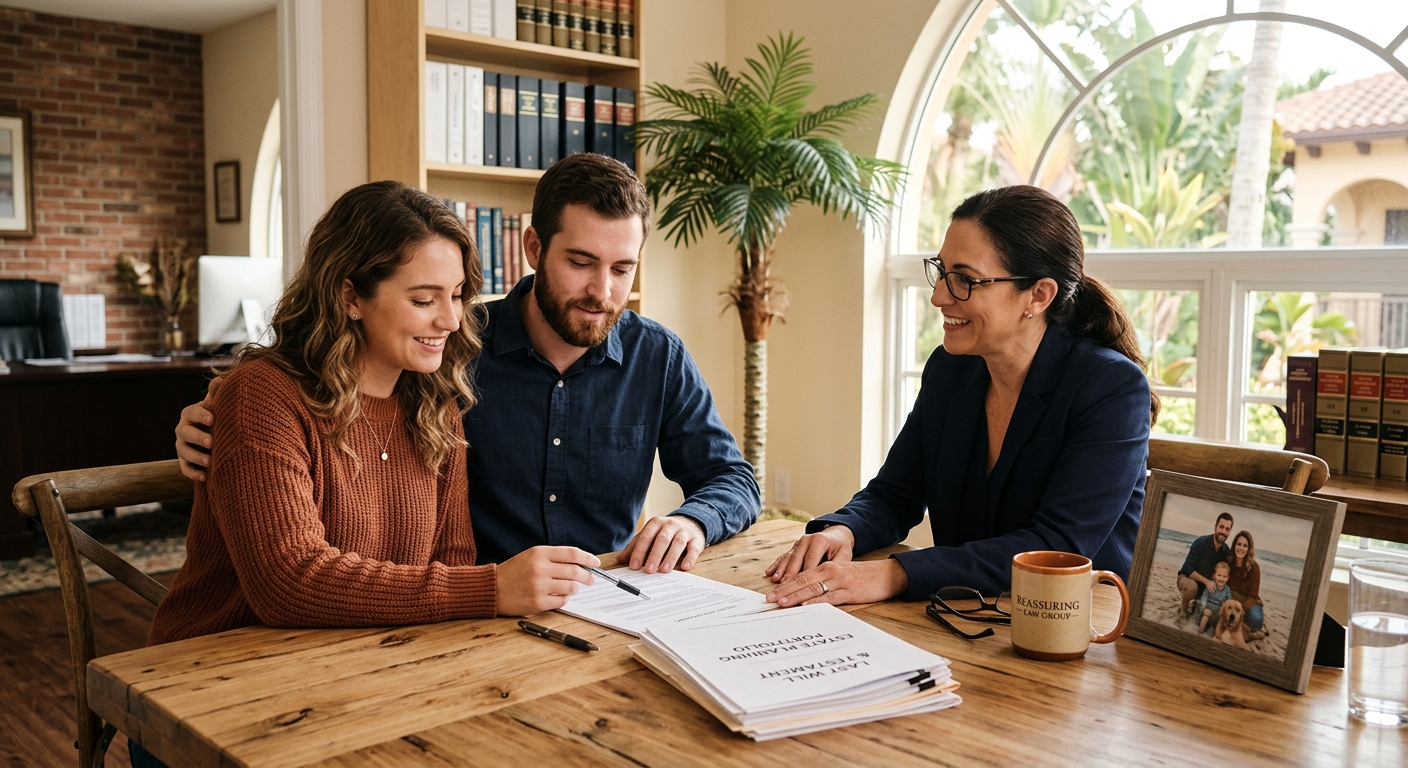
Florida parents reviewing and signing a preneed guardian designation in a South Florida estate planning law office.

Quick Answer :

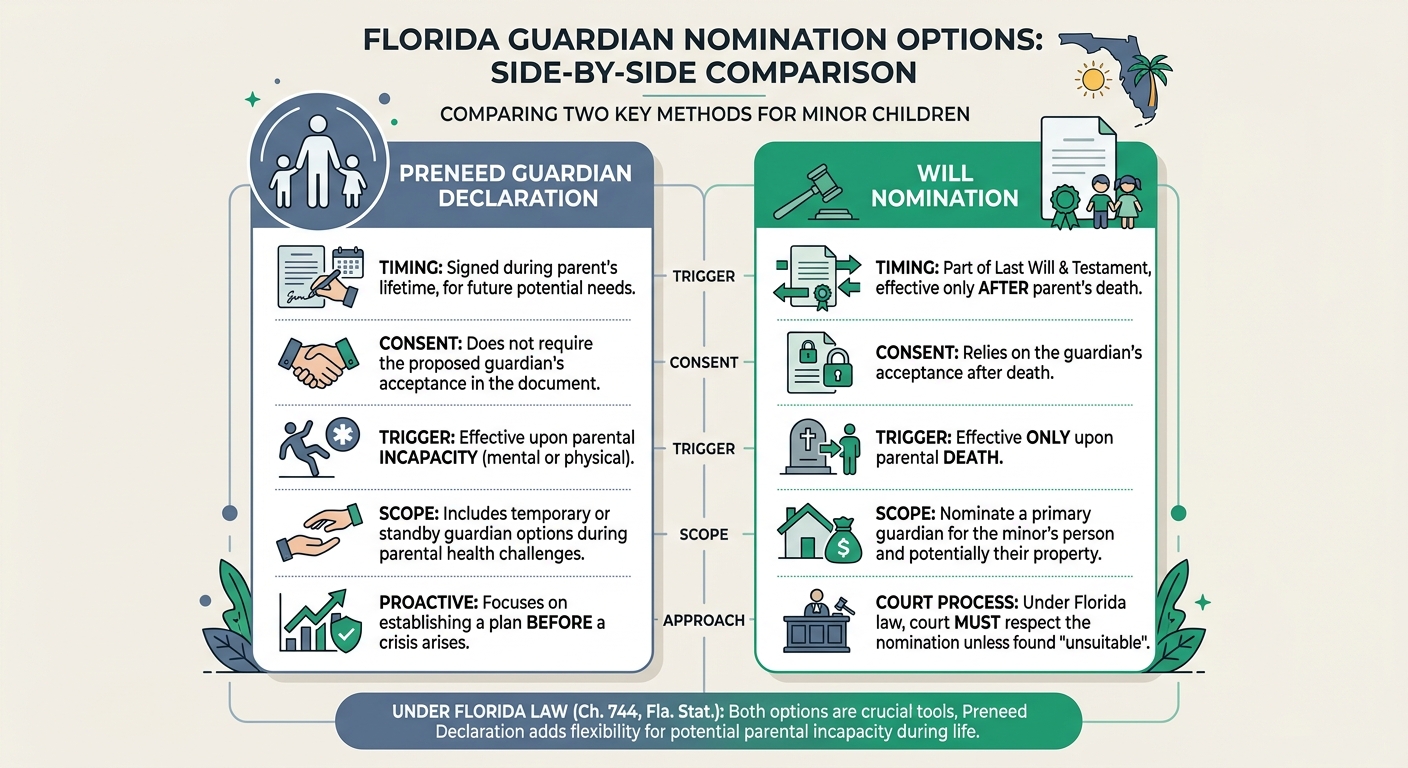
Under Florida law (Fla. Stat. § 744.3046), parents can name a guardian for minor children by executing a formal Preneed Guardian Designation signed in the presence of two simultaneous witnesses. Unlike a will, which only activates upon death, a preneed designation protects your children during parental death or medical incapacity.

The document creates a strong presumption in court favoring your chosen primary and alternate guardians, allowing you to split physical care (Guardian of the Person) from financial management (Guardian of the Property).


Let us be completely honest with each other for a moment. Nobody wakes up on a sunny Saturday, pours a mug of coffee, and cheerfully says, “You know what sounds fun today? Figuring out who raises my children if my spouse and I get eaten by a shark or crushed by a meteor.”

It is uncomfortable. It makes your stomach do little flip flops. And if you are like most parents in South Florida, your default setting is simply to kick the can down the road, assuming your sister or your mother will just step in and figure it out if the unthinkable happens.

Except Florida law does not work on gentle assumptions. If you do not formally put your wishes in writing using proper legal execution rules, a circuit court judge who has never met your family will be forced to make that choice for you.

So how do you actually name a guardian for your minor children in Florida, avoid a holiday dinner feud between the in laws, and make sure your intentions stand up in court? Let us break down how parental designations work without any dry corporate nonsense or confusing legalese.


Why the Internet Gets Child Guardianships Wrong

If you search online late at night while spiraling into panic, you will find plenty of generic advice. Telling you to just type up a short note or throw a sentence into a basic Last Will and Testament.

Nominating a guardian in your will is a very common approach. But relying solely on a will leaves a massive, gaping hole in your legal safety net.

Ask yourself: What happens if you and your spouse are in a serious car accident and end up in a coma for six months?

A will only springs to life after you pass away. If you are incapacitated rather than deceased, a judge cannot use your will to authorize someone to care for your kids or handle their day to day needs. That is why Florida estate planning relies on specialized advance designations that cover both incapacitation and death.


Preneed Guardians vs. Standby Guardians: Decoding the Legal Jargon

Florida law gives parents two primary legal mechanisms to nominate who steps in when disaster strikes. You do not need a law degree to understand them, but you do need to know which one fits your situation.

1. The Preneed Guardian Designation (Fla. Stat. § 744.3046)

Think of this as your official written nomination letter to the local probate court. Under Florida law, parents can sign a formal declaration naming a primary guardian and an alternate guardian.

  • How it works: You sign the document ahead of time with two attesting witnesses present at the exact same time. If both parents pass away or become incapacitated, the document is produced in court. This creates a powerful legal presumption that the judge should honor your chosen person.
  • Why it matters: It covers both death and medical incapacity, seamlessly closing the gap that a standard will leaves behind.

2. Standby Guardianship (Fla. Stat. § 744.304)

A standby guardian is a slightly different tool designed for immediate handoffs.

  • How it works: This involves a pre approved court petition where a designated guardian stands in the wings. He or she is ready to act instantly upon a specific triggering event (like severe medical decline or death). The standby guardian assumes duties immediately and then has 20 days to file a formal petition for court confirmation.


The Person vs. The Property: You Do Not Have to Pick Just One Human

Here is a common dilemma that paralyzes parents: Your brother is incredible with kids, warm, patient, and living in a great school district, but he handles money like a golden retriever with a stolen credit card. Meanwhile, your accountant sister is a financial wizard, but her idea of childcare is handing a toddler a spreadsheet.

Good news: Florida law allows you to split these responsibilities down the middle.

  • Guardian of the Person: This person gets physical custody, decides where the kids live, manages their schooling, signs permission slips, and handles medical decisions.
  • Guardian of the Property: This person manages the financial inheritance, holds onto money left for the children, pays for their expenses out of a trust or court supervised account, and ensures nobody wastes their funds.

You can name the same person for both roles, or you can split them up so your kids get loving care while your financial hawk protects their inheritance.


How to Choose an Alternate (and Avoid In-Law Meltdowns)

Always, always name an alternate guardian. Life happens. Your primary choice might move across the globe, face health challenges of their own, or simply realize that taking on two active toddlers at age fifty five is more than they can physically handle.

When selecting guardians, look beyond raw emotional attachment and evaluate practical realities:

  1. Shared Values and Lifestyle: Do they raise children with similar boundaries, educational goals, and emotional warmth?
  2. Geographic Location: Would your children have to move across the country, switch schools, and leave their support network behind during a time of intense grief?
  3. Financial and Physical Capacity: Do they have the health, energy, and space in their life to raise children through high school and college?

Pro Tip: Talk to the people you want to name before you sign the papers. Finding out after the fact that your prospective guardian never wanted kids in the first place makes for an extremely awkward conversation.


Frequently Asked Questions About Naming a Guardian in Florida

How do I name a guardian for my child in Florida?

  • You can document your intent by executing a formal Preneed Guardian Designation under Fla. Stat. § 744.3046 or by nominating a guardian within your Last Will and Testament. The document must comply strictly with Florida signing formalities, including two simultaneous attesting witnesses.

Can I name a guardian for my minor child in my will?

  • Yes. Florida law allows parents to nominate a guardian inside a will. However, because a will only takes effect upon death, pairing it with a Preneed Guardian Designation ensures your choices are legally documented if you become incapacitated.

What is a preneed guardian for a minor in Florida?

  • A preneed guardian is a person formally nominated by living parents to step in, take custody, or manage property for a minor child if the parents die or lose legal capacity.

Can I name an alternate guardian for my child?

  • Yes. Florida statutes explicitly encourage parents to name an alternate preneed guardian in case your primary choice is unable or unwilling to serve when the time comes.

What happens if both parents die without naming a guardian?

  • If no written designation exists, any interested family member or party can petition the court for guardianship. A judge in the 17th Judicial Circuit will hold hearings and choose a guardian based on what they determine is in the child’s best interests, which may not align with who you would have wanted.

Does the court have to appoint the person named by the parents?

  • While Florida courts give immense weight and priority to a valid preneed designation signed by the parents, the judge retains ultimate authority to verify that the nominee meets statutory qualifications and that the appointment serves the child’s best interests.

Can a guardian be named for a child’s property as well as the child?

  • Yes. Florida law explicitly separates guardianship of the person (physical care and custody) from guardianship of the property (financial management), allowing parents to appoint the same individual or two separate people.

What is the difference between a preneed guardian and a standby guardian?

  • A preneed guardian is nominated in advance on paper and awaits a potential future appointment by the court. A standby guardian is pre approved by court order prior to an emergency and can take physical custody instantly upon a triggering event, with 20 days to get final confirmation from the judge.

Can I change or revoke the guardian I have named for my child?

  • Yes. As long as you are competent, you can revoke, modify, or replace your preneed guardian designation at any time by executing a new written declaration that meets Florida statutory requirements.

Does naming a guardian eliminate the need for a full estate plan?

  • No. Naming a guardian addresses who cares for your children, but it does not manage how your home, bank accounts, or life insurance proceeds are handled. Pairing your guardian designations with a revocable living trust ensures your money is protected and managed smoothly for your kids without ongoing court oversight.

A peaceful Coral Springs community park with tropical palm trees representing family living in Broward County.

Protecting Your Children and Your Peace of Mind

At the end of the day, naming a guardian is not about dwelling on tragic worst case scenarios. It is about taking control, removing uncertainty, and giving yourself total peace of mind knowing that your kids will always be raised by people who love them and share your values.

The estate planning attorneys at Reinfeld & Cabrera P.A. help parents across South Florida establish airtight preneed guardian designations, revocable living trusts, and comprehensive family protection plans.

Schedule a Confidential Consultation

Do not leave your family’s future up to chance or a courtroom schedule. Speak directly with an attorney today to set up your parental designations:

  • Direct Telephone: (954) 866 4878 | Toll Free: (954) 866 HURT
  • Coral Springs Office: 9625 W Sample Rd, Coral Springs, FL 33065
  • Fort Lauderdale Office: 2933 W Cypress Creek Rd, Suite 201, Ft Lauderdale, FL 33309
  • Website: mypersonalattorneys.com
  • Local Coverage: Coral Springs, Fort Lauderdale, Parkland, Tamarac, Margate, and all surrounding communities across Broward, Miami Dade, and Palm Beach Counties.

What Is a Lady Bird Deed?

Florida home and legal deed representing Lady Bird Deed estate planning

A Lady Bird Deed in Florida is an enhanced life estate deed that allows a property owner to name someone who will receive the property after the owner’s death while retaining broad control over the property during life.

Unlike a traditional life estate, a properly drafted Lady Bird Deed can allow the owner to sell, mortgage, or otherwise convey the property without the future beneficiary’s permission. It can also allow the property to pass outside the ordinary probate process.

Because Florida does not have a statutory form called a “Lady Bird Deed,” the language used in the deed is especially important.


How Does It Work?

The property owner transfers the property through a deed that reserves an enhanced life estate and identifies one or more people who are intended to receive the property after the owner’s death.

During the owner’s lifetime, the owner generally retains the right to:

  • Live in and use the property
  • Sell the property
  • Mortgage the property
  • Convey the property to someone else
  • Change or defeat the beneficiary’s future interest, depending on the deed’s language

If the owner dies while the deed remains effective, the property can pass to the designated beneficiary without becoming part of the owner’s probate estate.

The exact result depends on the language of the deed and the circumstances surrounding the property.


Lady Bird Deed vs. a Regular Life Estate

The most important difference is the amount of control retained by the original owner.

With a traditional life estate, the owner keeps the right to possess and use the property for life but gives another person a present remainder interest. Selling or mortgaging the entire property can therefore require the remainderman’s participation.

An enhanced life estate, by contrast, can reserve the owner’s power to sell, mortgage, or convey the property without the beneficiary joining the transaction.

Florida courts have recognized this distinction. In Hirschenson v. Compu-Link Corp. of MI, the Third District Court of Appeal discussed an enhanced life estate as allowing the holder to sell, convey, mortgage, and otherwise manage the property without the remainderman’s joinder.


Does It Avoid Probate?

One reason Florida property owners consider this type of deed is probate avoidance.

If the deed is properly executed and remains effective when the owner dies, the designated beneficiary can receive the property without the real estate passing through the owner’s ordinary probate estate.

That does not mean every Lady Bird Deed will accomplish the same result. The deed must be legally effective, the property’s ownership must be correctly identified, and other Florida property laws may affect the transfer.


Why the Deed’s Language Matters

The enhanced powers need to be clearly established in the deed.

A Florida appellate case illustrates what can happen when the language is unclear. In Hirschenson, the deed contained inconsistent language concerning the power to mortgage the property. The resulting dispute required the court to determine what the deed actually meant, and the trial court ultimately reformed the deed. The appellate court affirmed that decision.

This is why a Lady Bird Deed should not simply be copied from an unidentified online form.


Can You Sell or Mortgage the Property?

A properly drafted enhanced life estate deed can preserve the owner’s ability to sell or mortgage the property without obtaining the future beneficiary’s consent.

That retained control is one of the defining characteristics of the arrangement.

However, the specific deed should be reviewed before a sale or mortgage. The deed’s wording, the property’s current title, and the requirements of the lender or title company can all matter.


What If the Beneficiary Dies First?

This depends on how the deed was drafted.

If the named beneficiary dies before the property owner, the deed should be reviewed to determine what happens to that person’s future interest. The owner may want to name alternate beneficiaries or include other provisions addressing this possibility.

This is one reason the beneficiary provisions should be considered carefully when the deed is prepared.


What If the Property Is Florida Homestead?

Homestead property requires additional care.

Florida law places special restrictions on the disposition of homestead, particularly when the owner has a spouse or minor children. Sections 732.4015 and 732.4017 of the Florida Statutes address important rules concerning homestead and lifetime transfers.

A Lady Bird Deed involving a Florida homestead therefore should not be evaluated solely on whether it can avoid probate. The owner’s family situation, title, and homestead status should all be considered before the deed is prepared.

Florida attorney reviewing Lady Bird Deed with client during estate planning consultation

Who Actually Owns the Property?

Before preparing the deed, it is important to determine how the property is currently titled.

For example, the property may be owned individually, jointly, through a trust, or subject to an existing interest.

In Johnson v. Johnson, Florida’s First District Court of Appeal considered enhanced life estate deeds that had been prepared in an individual’s name even though the properties were actually held by a living trust. The court affirmed reformation of the deeds based on the evidence concerning the mistake.

The practical lesson is simple: the current deed and ownership records should be checked before preparing a new conveyance.


When Might a Lady Bird Deed Be Useful?

A Florida property owner may consider an enhanced life estate deed when the goal is to:

  • Retain control of the property during life
  • Continue living in the property
  • Designate who should receive it after death
  • Preserve the ability to sell or mortgage the property
  • Potentially transfer the property outside probate

It may not be appropriate for every estate plan. More complicated family circumstances, multiple properties, trusts, creditor issues, or other planning concerns may call for a different approach.

For a detailed comparison between this type of deed and a revocable living trust, see Florida Lady Bird Deed vs. Revocable Living Trust for Real Estate.


Florida Lady Bird Deed FAQs


What is a Lady Bird Deed in Florida?

  • It is an enhanced life estate deed that allows a property owner to retain substantial control over real estate while designating who should receive the property after the owner’s death.

Does a Lady Bird Deed avoid probate?

  • A properly drafted and effective deed can allow the property to pass to the designated beneficiary outside the ordinary probate process.

Is a Lady Bird Deed the same as a life estate?

  • No. A Lady Bird Deed is an enhanced form of life estate that can reserve significantly greater powers for the original owner.

Can I sell my house after signing a Lady Bird Deed?

  • Generally, an enhanced life estate can preserve the owner’s power to sell or convey the property without the beneficiary’s consent. The specific deed should be reviewed to confirm the powers it reserves.

Can I mortgage property with a Lady Bird Deed?

  • A properly drafted deed can reserve the owner’s power to mortgage the property. The exact language matters.

What happens when the owner dies?

  • If the deed remains effective and the property has not otherwise been conveyed, the designated beneficiary can receive the property according to the deed’s terms, potentially without probate.

Does a Lady Bird Deed work for Florida homestead?

  • It can, but Florida’s homestead rules create additional considerations involving spouses, minor children, and the owner’s particular circumstances.

Florida Estate Planning Attorneys Serving South Florida

A Lady Bird Deed can be a useful way to plan for the future of Florida real estate while retaining control during life. But the deed needs to match the property’s title and the owner’s circumstances.

My Personal Attorneys assists clients with estate planning and probate matters in Coral Springs, Fort Lauderdale, Broward County, and throughout South Florida.

Call 954-334-1520 to discuss your estate planning needs and determine whether an enhanced life estate deed is appropriate for your situation.

Estate Planning in Florida: A Guide to Wills, Trusts, and More

Estate planning for a family in Coral Springs and Broward County

Estate planning is the process of deciding how your property, financial affairs, and health care decisions should be handled during your lifetime, during periods of incapacity, and after your death.

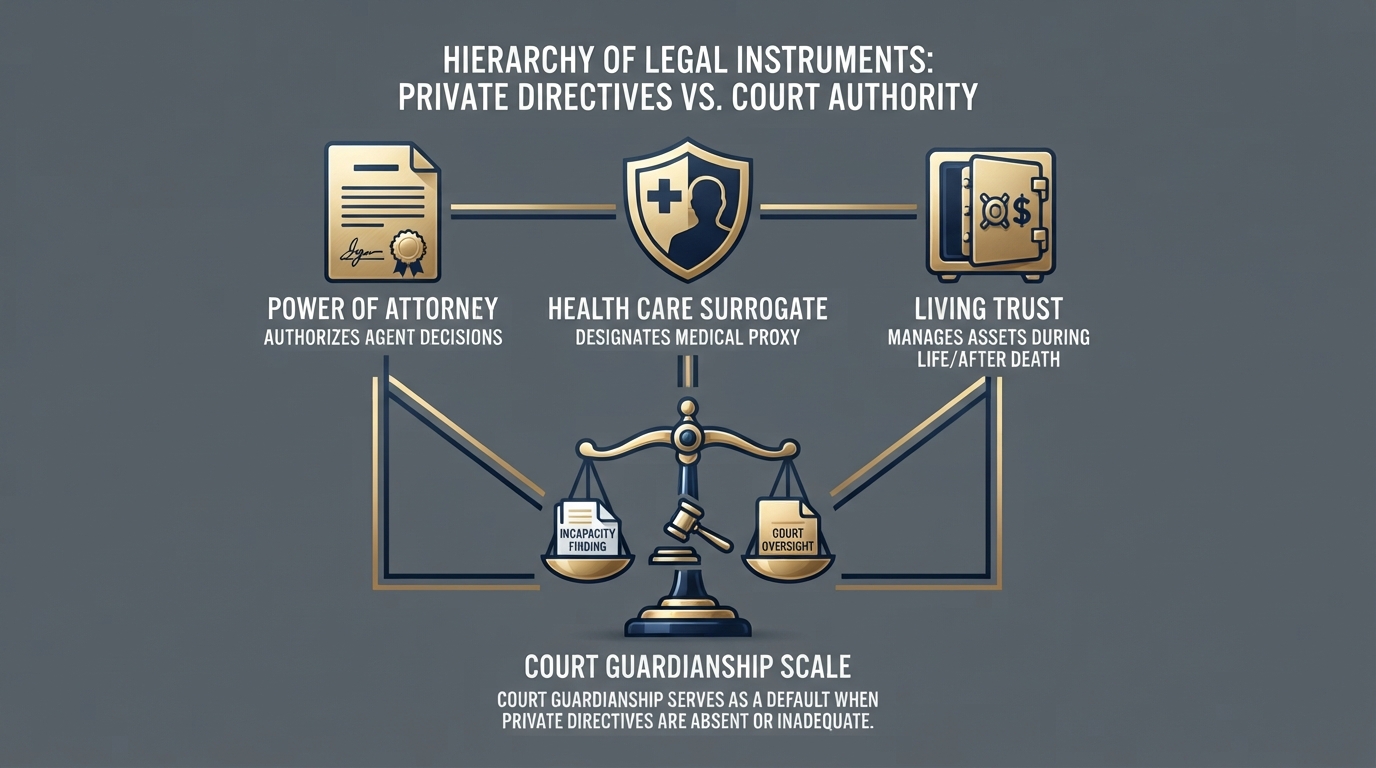
For families in Coral Springs and throughout Broward County, an estate plan may include a will, revocable trust, durable power of attorney, health care surrogate designation, living will, preneed guardian designation, or other documents depending on the person’s circumstances.

There is no single set of documents that every person needs. The important question is whether the plan addresses the situations that could actually affect you and your family.


What Does an Estate Plan Actually Do?

A basic estate plan addresses two different periods of life.

  • During your lifetime, it can establish who may manage financial matters or make health care decisions if you become unable to make those decisions yourself.
  • After your death, it can determine who receives your property, who administers your estate, who manages assets held in trust, and how certain property should be transferred.

Those functions are handled by different documents. A will, for example, does not give someone authority to manage your finances while you are alive. A health care surrogate designation does not determine who inherits your house. A durable power of attorney does not replace a will.

Understanding those distinctions is one of the foundations of effective estate planning.


1. Last Will and Testament

A last will and testament allows you to state how certain property should be distributed after your death and nominate a personal representative to administer your estate.

A will can also address other matters, including the nomination of a guardian for minor children.

But there is an important misconception to avoid:

Having a will does not automatically avoid probate.

A will generally becomes effective through the probate process when it governs probate assets. Property may instead pass outside probate through mechanisms such as joint ownership, beneficiary designations, or a properly funded trust.

Recent Florida litigation illustrates how specific the probate process can become. In Property Solutions Powerhouse, LLC v. Nelson, decided by Florida’s Second District Court of Appeal in 2025, the court addressed a dispute involving a lost will, probate, notice to interested persons, and Florida homestead. The court ultimately upheld the administration and concluded that the decedent, who had no surviving spouse or children, could devise her homestead to the named beneficiary.

The case is a useful reminder that having a will does not mean every question about an estate is automatically settled. The validity of the will, the identity of interested persons, the nature of the property, and Florida’s homestead rules can all matter.


2. Revocable Living Trust

A revocable living trust allows a person to place assets into a trust during life and establish instructions for how those assets should be managed during incapacity and distributed after death.

The person creating the trust can generally retain control while capable and can name a successor trustee to take over management if necessary.

A revocable trust can also help keep properly funded trust assets outside ordinary probate administration. But the trust has to be properly funded. Simply signing a trust agreement does not automatically transfer every asset into it.

The trust is therefore only one part of an estate plan. Its effectiveness depends on how the document is structured, which assets are transferred to it, and how the rest of the estate plan is coordinated.

For a more detailed explanation, see What Is a Revocable Living Trust in Florida?


3. Durable Power of Attorney

A durable power of attorney allows you to authorize another person, called an agent, to act on your behalf within the authority granted by the document.

In Florida, a power of attorney is durable when it contains language showing that the authority continues despite the principal’s subsequent incapacity. Florida law also establishes specific execution requirements, including signing by the principal and two subscribing witnesses and acknowledgment before a notary in the circumstances specified by statute.

The scope of an agent’s authority depends on the powers granted in the document and Florida law.

This is why simply assuming that a spouse or adult child can handle everything for you can create problems. Ownership of a bank account or property does not automatically give another person authority to act on your behalf concerning assets or legal matters that belong to you individually.

A properly prepared power of attorney can be particularly important when someone becomes incapacitated and needs another person to handle financial or legal matters without waiting for a guardianship proceeding.


4. Health Care Surrogate Designation

A health care surrogate designation allows you to name someone to make health care decisions for you if you become unable to make those decisions yourself.

Florida law provides that a designated surrogate may have authority to make health care decisions during the principal’s incapacity, subject to the principal’s instructions and any limitations placed on the surrogate’s authority.

The designation is different from a living will.

  • A health care surrogate designation identifies who may make health care decisions.
  • A living will communicates your wishes concerning life prolonging procedures in specified medical circumstances.

Those documents can work together.

Florida law also provides a mechanism for judicial review when an interested person believes, among other things, that a surrogate’s decision conflicts with the patient’s known wishes, that the advance directive is ambiguous, or that the surrogate has abused their authority.


5. Living Will

A Florida living will allows a competent adult to state preferences concerning life prolonging procedures if the person later has a terminal condition, end stage condition, or is in a persistent vegetative state.

Florida law establishes specific execution requirements and provides that a properly executed living will creates a rebuttable presumption of clear and convincing evidence of the person’s wishes.

A living will therefore serves a different purpose from a health care surrogate designation.

The surrogate is the person who may make health care decisions within the authority granted.

The living will communicates your own instructions about life prolonging treatment in the circumstances covered by the document.

Family discussing future planning and care in Coral Springs

6. Preneed Guardian Designation

Florida law also allows a competent adult to name a preferred guardian in advance.

A preneed guardian designation is a written declaration naming the person the individual wants to serve as guardian if a court later determines that the individual is incapacitated. Florida law requires the declaration to be signed in the presence of at least two witnesses. If an incapacity proceeding is later filed, the declaration creates a rebuttable presumption that the designated person should serve, although the court is not required to appoint someone who is unqualified.

The distinction is important: a preneed guardian designation does not eliminate the possibility of a guardianship proceeding. Instead, it allows the individual to express a preference before incapacity occurs.


When Estate Planning Documents Have to Work Together

Estate planning documents are most useful when they form a coordinated plan rather than a collection of unrelated forms.

For example:

  • A will can address probate assets and nominate a personal representative.
  • A revocable trust can govern assets properly transferred to the trust.
  • A durable power of attorney can authorize an agent to handle financial and legal matters during incapacity.
  • A health care surrogate designation can identify someone to make health care decisions.
  • A living will can communicate wishes concerning life prolonging procedures.
  • A preneed guardian designation can identify a preferred guardian if a guardianship proceeding becomes necessary.

The documents can also interact with beneficiary designations, jointly owned property, retirement accounts, insurance policies, business interests, and real estate.

That is why changing one document without reviewing the rest of the plan can create unintended results.


A Florida Case Shows Why Advance Planning Matters

A recent Florida appellate decision provides an unusually clear example of how these documents can operate together.

In Frank v. Frank, decided by Florida’s Fourth District Court of Appeal in 2026, a woman had executed a durable power of attorney, health care surrogate designation, trust, and will before a guardianship dispute arose. The documents named her daughter, Alicia, to manage her affairs and established her intentions concerning the family home and estate.

The trial court later appointed a different person despite those prior designations. The Fourth District Court of Appeal reversed because the lower court had failed to make the specific findings required to overcome the statutory presumption supporting the woman’s previously expressed choice. The appellate court emphasized that the record showed she had repeatedly confirmed her estate planning decisions before the guardianship dispute.


The case does not mean that a person’s chosen agent or guardian can never be replaced. It demonstrates something more practical: advance planning can provide evidence of a person’s wishes before a family dispute reaches court.

An older Florida Fourth District case, Martinez v. The Guardianship of J. Alan Smith, similarly involved a person who had executed a health care surrogate designation, preneed guardian designation, and durable power of attorney before suffering a serious injury.

The appellate court reversed because the trial court had not made the required finding that the person’s chosen representative was contrary to the ward’s best interests.


What Happens If You Do Nothing?

If you die without a valid will, Florida’s intestacy laws determine who inherits property subject to those laws.

If you become incapacitated without appropriate planning, family members may have to rely on whatever legal mechanisms are available under the circumstances. A guardianship proceeding may become necessary for some decisions, although Florida law recognizes advance directives and other planning tools that can sometimes provide alternatives or affect the scope of a guardianship.

The important point is not that everyone needs every available document.

It is that leaving the decisions entirely to default legal rules may produce a result different from the one you would have chosen yourself.


Estate Planning After Marriage, Divorce, or Other Major Changes

An estate plan should not necessarily remain unchanged for decades.

A major life event may require a review of:

  • Your will
  • Revocable trust
  • Beneficiary designations
  • Durable power of attorney
  • Health care surrogate
  • Living will
  • Preneed guardian designation
  • Ownership of real estate
  • Retirement accounts
  • Life insurance
  • Business interests

Divorce is a particularly important example. Florida law contains rules affecting fiduciary appointments and certain estate planning documents after dissolution proceedings begin or a final judgment is entered. The Florida Bar has noted that durable powers of attorney and health care surrogate designations require particular attention during divorce planning.

A plan should also be reviewed when a beneficiary or fiduciary dies, a child reaches adulthood, substantial assets are acquired or sold, or the person’s family circumstances change.

Estate planning attorney meeting with a family in Coral Springs

A Word From Stuart G. Reinfeld

“The best estate plan is one that makes the owner’s intentions clear before the family is forced to interpret them under pressure. A trust can provide that structure, but the document and the ownership of the assets need to work together.”

That principle applies beyond trusts. Estate planning works best when the documents, property ownership, beneficiary designations, and the person’s actual wishes are coordinated.


Common Estate Planning Questions

Do I need a will if I have a revocable living trust?

  • Often, yes. A will can serve purposes that a revocable trust does not, including addressing assets that were never transferred to the trust and nominating a personal representative or guardian where appropriate. The specific documents needed depend on the estate plan.

Does a will avoid probate in Florida?

  • No. A will generally directs the distribution of probate assets through the probate process. Some property may pass outside probate through trusts, beneficiary designations, joint ownership, or other mechanisms.

What is the difference between a living will and a health care surrogate?

  • A health care surrogate designation identifies someone who can make health care decisions within the authority granted when you cannot make them yourself. A living will communicates your wishes concerning life prolonging procedures in the circumstances covered by Florida law.

Does my spouse automatically have authority to manage everything if I become incapacitated?

  • Not necessarily. Marriage and joint ownership do not automatically give one spouse every legal authority that a properly executed power of attorney or health care designation can provide.

Can I choose who I want as my guardian?

  • Florida allows a competent adult to designate a preferred preneed guardian. The designation creates a rebuttable presumption in favor of the named person, but the court can decline to appoint someone who is unqualified or whose appointment is otherwise contrary to the applicable legal standard.

When should I review my estate plan?

  • Reviewing an estate plan after marriage, divorce, a death in the family, the birth or maturation of children, a major change in assets, a change in beneficiaries, or a significant change in your circumstances can help keep the plan consistent with your current wishes.

Estate Planning for Families in Coral Springs and Broward County

Estate planning is not limited to deciding who receives your property after death. For families in Coral Springs, Broward County, and surrounding South Florida communities, an effective plan can also address incapacity, health care decisions, financial management, real estate, beneficiary designations, trusts, and the administration of an estate.

The appropriate documents depend on the person’s family circumstances, property, financial affairs, and wishes.

A review of an existing plan can also be useful when the documents were prepared years ago or when major changes have occurred in the family or the assets involved.

If you are creating or reviewing an estate plan in Coral Springs or Broward County, an attorney can help evaluate how the different documents and ownership arrangements fit together under Florida law.

What Happens When a Parent Violates a Parenting Plan in Florida?

Parents involved in a parenting plan dispute in Coral Springs, Florida

A Florida parenting plan is a court ordered set of rules governing how separated or divorced parents share responsibility for their children. It can address where a child stays, when each parent has time sharing, how exchanges take place, how parents communicate, school related decisions, holidays, travel, and other matters affecting the child.

Problems arise when one parent does not follow those terms.

A missed exchange may be an isolated mistake. Repeatedly refusing scheduled time sharing is a different situation. So is taking a child on a trip without complying with the parenting plan, refusing to provide required information, or interfering with the other parent’s communication with the child.

Florida law provides several ways to address these disputes. But a parent who believes a violation occurred still has to establish what the parenting plan required and what actually happened.


What Counts as a Parenting Plan Violation?

The answer depends on the language of the particular parenting plan.

Florida parenting plans can contain detailed provisions concerning time sharing, transportation, holidays, school breaks, extracurricular activities, communication, travel, and parental decision making. A parent may violate the plan by failing to follow one of those provisions.

Examples can include:

  • Refusing to release a child for scheduled time sharing.
  • Returning a child late without a legitimate reason.
  • Failing to follow the agreed exchange location or transportation arrangements.
  • Preventing scheduled telephone or electronic communication between the child and the other parent.
  • Failure to provide information or notice required by the parenting plan.
  • Interfering with the child’s scheduled activities when the plan requires participation.
  • Denying holiday or vacation time that belongs to the other parent.
  • Taking a child somewhere in violation of travel restrictions contained in the order.
  • Repeatedly disregarding other specific requirements of the court ordered plan.

The details matter. A parent who arrives thirty minutes late once is not necessarily in the same legal position as a parent who repeatedly refuses to make the child available for scheduled time sharing.

How the wording of the actual order is done matters too.


Does Every Violation Amount to Contempt?

No.

A violation of a parenting plan does not automatically mean that a parent is in contempt of court. Florida courts generally require more than proof that something went wrong.

In Merlihan v. Skinner, the Fourth District Court of Appeal addressed a contempt finding involving a parenting plan. The appellate court explained that a contempt finding requires evidence that the parent had the ability to comply with the order and willfully refused to do so. The court also emphasized that the underlying order must be sufficiently clear and precise for a person to know what compliance requires.

That distinction is important in practical terms.

Suppose a parenting plan says that a child will be exchanged at a particular location at a particular time. If a parent repeatedly refuses to make the exchange despite being able to do so, the evidence may support an enforcement or contempt proceeding.

But if the order itself is ambiguous, or circumstances made compliance impossible, the analysis can be different.

A court therefore has to look at the order, the circumstances surrounding the alleged violation, and the evidence presented by both parents.


What Can a Florida Court Do When Time Sharing Is Improperly Denied?

Florida Statutes section 61.13 provides specific remedies when a parent fails to honor the time sharing schedule established in a parenting plan.

Depending on the circumstances, the court may order:

  • Makeup time sharing for the parent who was improperly denied time.
  • Reasonable court costs and attorney’s fees.
  • A parenting course.
  • Community service in circumstances authorized by the statute.
  • Certain transportation related expenses.
  • Other reasonable sanctions.
  • Contempt proceedings.

Makeup time sharing can be particularly significant because the remedy can address the time that was actually lost.

For example, in Varner v. Varner, a parent was held in contempt after failing to comply with provisions governing exchanges. The court awarded the other parent 17 overnight visits as makeup time sharing.

That illustrates an important point about enforcement. The remedy does not necessarily stop at telling the offending parent to follow the order in the future. Depending on the circumstances, the court can attempt to restore parenting time that was improperly denied.


Attorney’s Fees Can Be Part of the Enforcement Remedy

Parenting plan disputes can also create substantial legal expenses.

Florida law allows a court to award reasonable attorney’s fees and costs in certain enforcement proceedings. The purpose is not simply to punish a parent for causing a dispute. The court considers the statutory requirements and the circumstances of the case.

A particularly concrete example appears in Lett v. Lett, a 2025 decision from Florida’s Fifth District Court of Appeal.

That case involved a long running dispute over compliance with a 50/50 parenting schedule. The record included multiple contempt proceedings concerning alleged violations of the parenting plan. The trial court ultimately found the mother in willful contempt and awarded the father makeup time sharing. It also awarded him $19,693.46 in attorney’s fees.

The appellate court affirmed the fee award.

This figure demonstrates how quickly repeated parenting plan litigation can become financially significant. It also shows why documenting individual incidents can matter when a dispute develops into a larger enforcement proceeding.


Child Support and Time Sharing Are Separate Obligations

One of the most common misconceptions in parenting disputes is that child support and time sharing can be used as bargaining tools against each other.

Generally, they cannot.

A parent who has not received child support does not ordinarily acquire the right to withhold the other parent’s court ordered time sharing. Likewise, a parent who has been denied time sharing does not ordinarily acquire the right to stop paying court ordered child support.

Florida law treats these obligations separately.

That means a parent dealing with unpaid child support should use the appropriate child support enforcement procedures rather than withholding the child’s scheduled time with the other parent.

The same principle applies in reverse. A parent whose time sharing is being denied should pursue the appropriate enforcement remedy rather than simply stopping child support payments.


A Parenting Plan Dispute in Broward County

Florida appellate decisions provide useful examples of what these disputes can look like in practice.

In Merlihan v. Skinner, the underlying case came from Broward County and the Seventeenth Judicial Circuit. The Fourth District Court of Appeal ultimately reversed a contempt ruling because the trial court had not made the necessary findings concerning the parent’s ability to comply and willful refusal to do so.

This case is useful because it shows why a parenting plan enforcement case is not simply a matter of one parent saying, “The other parent broke the rules.”

The court has to determine what the order required and whether the evidence establishes the legal requirements for contempt.

Other cases show different patterns.

Parent documenting parenting plan violations and time sharing dates in Broward County

For Thornton v. Thornton, the Fourth District addressed allegations involving several aspects of a parenting arrangement, including extracurricular activities, travel information, birthday time sharing, and communication between a parent and children. The case demonstrates how enforcement disputes can involve considerably more than missed weekend visits.

In Erlinger v. Federico, the First District reviewed a record involving approximately ten months without visitation and seven enforcement motions over a two year period. The record also stated that 84 days of visitation had been denied during 2016.

These numbers come from the particular court record. They are not statistics showing how frequently parenting plan violations occur throughout Florida. Florida does not appear to maintain a reliable statewide statistic measuring all parenting plan violations.

What the cases do show is that repeated interference can produce a substantial litigation record when the problem continues.


A Parenting Plan Can Be Too Vague to Enforce

Sometimes the problem is not simply that a parent refuses to follow the plan.

The plan itself may not say enough.

Florida law requires parenting plans to establish a time sharing schedule. If important provisions are too vague, parents can end up disagreeing about what the court actually ordered.

The Fifth District addressed this issue in Kiswani v. Hafza in 2025. The appellate court reversed because the parenting plan did not establish a sufficiently specific time sharing schedule as required by Florida law.

This creates an important distinction.

A parent cannot necessarily be held in contempt for violating an obligation that the order never clearly established.


As Stuart G. Reinfeld explains:

“A parenting plan should give both parents a workable understanding of what they are expected to do. When the language is vague or contradictory, disputes can become much harder to resolve because the parents may disagree about what the court actually ordered.”

For that reason, reviewing the exact wording of a parenting plan should usually be one of the first steps in an enforcement dispute.


What About Moving Away With a Child?

Relocation presents a separate legal issue.

Florida law contains specific procedures governing the relocation of a child. A parent generally cannot simply move the child a substantial distance and deal with the consequences afterward.

Florida’s relocation statute, section 61.13001, establishes requirements concerning proposed relocations and gives the other parent an opportunity to object. Depending on the circumstances, court approval may be required.

A parenting plan may also contain specific restrictions concerning travel outside Florida or outside the United States.

This is why “moving without notice” should not be treated as merely another ordinary parenting plan violation. Relocation can trigger its own statutory procedures and remedies.


In Fuentes Neira v. Cardona Acosta, the Third District considered an arrangement involving relocation between Miami and Colombia. The court concluded that the agreement did not satisfy Florida’s statutory requirements for a relocation agreement because it did not adequately establish the required time sharing schedule and transportation arrangements.

For families in South Florida, international travel and relocation can create particularly complicated questions because the practical consequences may extend beyond the ordinary exchange schedule.


What Evidence Matters in a Parenting Plan Dispute?

A parenting plan enforcement case often turns on details.

The strongest evidence is usually evidence that allows the court to compare the written order with what actually happened.

Depending on the dispute, useful records may include:

  • The current parenting plan and any later court orders modifying it.
  • Text messages, emails, or other communications between the parents.
  • Records showing scheduled and actual exchanges.
  • School or extracurricular records.
  • Travel information and notices.
  • Calendars documenting missed or changed time sharing.
  • Receipts or other records showing transportation expenses.
  • Records concerning repeated requests to exercise scheduled time sharing.
  • Evidence concerning attempts to resolve the problem before filing a motion.
  • Documentation showing why compliance was impossible, if that is the position of the parent accused of violating the order.

A chronological record can be particularly useful.

Instead of simply stating that the other parent “always violates the parenting plan,” it is usually more informative to identify the date, the provision involved, what was supposed to happen, what actually happened, and what communications followed.

That gives the court something concrete to evaluate.


What If the Violations Keep Happening?

Repeated violations can change the nature of the dispute.

A single incident may be resolved without extensive litigation. A continuing pattern can require formal enforcement.

Florida courts have several possible remedies available under section 61.13, including makeup time sharing, fees and costs, sanctions, and contempt where the legal requirements are satisfied.

But repeated violations do not automatically mean that the existing parenting plan should be replaced.

Sometimes enforcement is the appropriate issue.

Other times, circumstances have changed so substantially that the existing schedule no longer works for the child or the parents. In that situation, a modification proceeding may be more appropriate.

Those are different legal questions.

A parent should not simply stop following the existing order because they believe a different arrangement would be better. Until a court changes the order, the existing order generally remains the governing requirement.


What Should You Do After a Parenting Plan Violation?

The first step is to identify exactly what happened.

Review the current parenting plan and determine which provision applies. Then preserve the communications and other records relating to the incident.

It can also help to separate an isolated problem from a continuing pattern.

Consider documenting:

  1. What the parenting plan required.
  2. So – what happened instead.
  3. When it happened.
  4. Whether the other parent provided an explanation.
  5. Did the problem affected scheduled time sharing or another specific obligation.
  6. Whether similar incidents happened before.
  7. What steps were taken to resolve the issue.

Not every disagreement requires a court filing. Parents sometimes resolve individual scheduling problems through communication or an agreed temporary change.

But repeated violations, denied time sharing, interference with commnication, relocation disputes, or conduct that continues despite attempts to resolve the problem may require legal enforcement.

Before taking action, it is also important to determine whether the existing order is clear enough to enforce and whether the facts support enforcement, contempt, modification, or another legal remedy.


A Word From Alan J. Reinfeld

“When a parenting plan dispute reaches the point where a court may become involved, the details matter. The question is not simply whether one parent believes the other acted unfairly. The court needs to know what the order required, what actually happened, and whether the circumstances support enforcement or a change to the existing plan.”

broward-county-parenting-plan-violation-evidence

Frequently Asked Questions

Can I withhold visitation because the other parent is not paying child support?

  • Generally, no. Child support and time sharing are separate obligations. A parent should use the appropriate legal process to enforce unpaid child support rather than withholding court ordered parenting time.

Could I stop paying child support because the other parent is denying visitation?

  • Mostly, no. A denied parenting schedule does not ordinarily eliminate a separate child support obligation.

A parent can be held in contempt for violating a parenting plan?

  • Potentially, yes. But a violation does not automatically establish contempt. The court must consider the requirements for contempt, including whether the order was sufficiently clear and whether the parent had the ability to comply and willfully refused to do so.

Can I get makeup time if the other parent denied my scheduled time?

  • Florida law allows courts to award makeup time sharing in appropriate circumstances when a parent fails to honor the established time sharing schedule.

Can I recover attorney’s fees?

  • Maybe. Florida law allows attorney’s fees and costs in certain parenting plan enforcement proceedings. The amount and whether an award is appropriate depend on the circumstances and applicable statutory requirements.

What if the parenting plan is unclear?

  • An unclear parenting plan can make enforcement more difficult. Florida courts have emphasized the need for sufficiently specific parenting plans and court orders, particularly when contempt is being considered.

What if the other parent repeatedly violates the parenting plan?

  • Repeated violations may support a request for enforcement and, when the legal requirements are met, contempt or other remedies. If circumstances have changed, a modification proceeding may also need to be considered.

So if the other parent wants to move with our child?

  • Relocation is governed by specific Florida statutes. The legal process can depend on the proposed distance, the existing parenting arrangement, the other parent’s position, and whether an agreement can be reached.

Parenting Plan Enforcement in Coral Springs and Broward County

For parents in Coral Springs, Broward County, and the surrounding South Florida area, a parenting plan dispute can involve much more than a disagreement over a particular weekend.

The appropriate response depends on the language of the existing order, the history of the dispute, the evidence available, and the legal remedy being sought.

At My Personal Attorneys, parenting and family law matters can be evaluated in the context of the specific court orders and circumstances involved. If a parenting plan is being repeatedly ignored, time sharing is being denied, or circumstances have changed and the existing arrangement may no longer work, reviewing the situation with a Florida family law attorney can help determine what legal options are available.

Should I Get a Divorce? Questions to Consider Before Filing in Florida

Adult considering divorce while reviewing personal documents at home in Coral Springs, Florida

Deciding whether to get a divorce is rarely a simple decision.

There may be children involved. Maybe a house, retirement accounts, debt, or a business. There may also be years of shared finances and family decisions that cannot be untangled overnight.

The legal question is somewhat simpler.

If you decide to end your marriage, what would the process actually involve?

For people in Coral Springs and Broward County, Florida law provides the framework. But the practical consequences depend on the circumstances of each family.

Before filing, it can help to look at a few basic questions.


Does Florida Allow Me to File for Divorce?


Florida calls divorce a dissolution of marriage.

To file for dissolution in Florida, at least one spouse must have lived in Florida for at least six months before filing. Florida law generally allows a dissolution when the marriage is irretrievably broken.

That means you generally do not have to prove that your spouse cheated, abandoned you, or otherwise caused the marriage to fail.

You do, however, have to meet the legal requirements for filing.

The six month residency requirement is one of them.


What Should I Think About Before Filing?

You do not need to have your entire post divorce life planned before speaking with an attorney.

It is still useful to understand what could change.

Ask yourself:

  • Where will each spouse live?
  • What happens to the marital home?
  • How will the children spend time with each parent?
  • What happens to bank and investment accounts?
  • How will marital debts be divided?
  • Could alimony be an issue?
  • How will child support be calculated?
  • Are there retirement accounts or business interests?
  • Can you and your spouse realistically negotiate an agreement?
  • Are there safety, financial control, or other circumstances that make direct negotiations difficult?

These questions can expose issues that are easy to overlook.

Divorce has a peculiar talent for turning ordinary household questions into legal questions. “Who keeps the house?” can become a discussion about valuation, equity, mortgage obligations, taxes, and equitable distribution.

The couch is usually easier.


What Happens to Property and Debt?

Florida uses equitable distribution when dividing marital assets and liabilities.

That does not simply mean dividing everything down the middle.

Florida law begins with the premise that marital assets and liabilities should be distributed equally. But the court can order an unequal distribution when the circumstances justify it. The statute lists factors including each spouse’s contributions, economic circumstances, the length of the marriage, career interruptions, business interests, the marital home, and certain forms of dissipation or depletion of marital assets.

That distinction can matter considerably.

A couple may believe they have a simple 50/50 division. Then someone asks what the house was worth when the case began. Or how a retirement account should be divided. Or whether a business interest is marital. Suddenly the arithmetic has become considerably less friendly.

A Broward County Example

In Kranci v. Kranci, the Fourth District Court of Appeal reviewed a dissolution case from Broward County involving the value of the marital home, equitable distribution, attorney’s fees, and alimony.

The wife had challenged the valuation used for the marital home. The appellate court reversed portions of the judgment and sent the case back for further proceedings concerning equitable distribution, attorney’s fees, and alimony.

The case illustrates why financial assumptions made during a divorce can have lasting consequences.

A house is not simply “the house.”

Its value, mortgage, ownership, timing, and treatment within the overall distribution can all matter.


What If We Have Children?

Divorce does not end either parent’s responsibilities to the children.

Florida uses parental responsibility, parenting plans, and time sharing to address these issues. A parenting plan can establish how parents share decision making, where children spend their time, transportation arrangements, school matters, health care, communication, holidays, and other practical details.

The questions can be very specific:

  • Who handles school pickups?
  • Where does the child spend holidays?
  • How are medical decisions made?
  • When are extracurricular activities handled?
  • Who provides transportation?
  • How do parents communicate with the child when the child is with the other parent?

If the parents agree, they can propose a parenting plan.

If they do not, the court may have to establish one.

For parents considering divorce, this is often one of the areas worth thinking through before filing. A schedule that looks fine on paper may be difficult to live with once school, work, transportation, and holidays enter the picture.


Could Alimony Be Part of the Case?

Alimony can be another major issue.

Whether alimony is appropriate depends on the circumstances of the spouses and Florida’s statutory requirements. Factors can include the requesting spouse’s need, the other spouse’s ability to pay, the length of the marriage, and other circumstances recognized by law.

A recent Broward County case illustrates how fact specific this can become.

In Loconto v. Loconto, the Fourth District considered a 50 year marriage. The trial court had awarded only limited alimony, and the appellate court reversed that portion of the judgment after concluding that the former wife had demonstrated additional need and that the former husband had the ability to pay under the applicable statute.

That does not mean that a long marriage automatically produces a particular alimony result.

It shows something more useful: the financial circumstances of the spouses matter, and the details of a case can change the analysis.

Spouse reviewing household finances and property documents during divorce planning in Broward County, Florida

Do I Need a Divorce Attorney?

Not necessarily.

Florida provides procedures and forms for people who represent themselves. It also has a simplified dissolution procedure for couples who meet specific requirements.

A simplified dissolution is limited, however. Among other requirements, the spouses must agree that the marriage cannot be saved, have no qualifying minor or dependent children together, agree on their assets and liabilities, not seek alimony, sign the petition, and meet other procedural requirements.

If those requirements are not met, the couple must use the regular dissolution process.

The important distinction is between filing paperwork and understanding what the paperwork means.

A relatively simple uncontested divorce may not require the same level of legal involvement as a case involving a business, substantial assets, contested parenting issues, retirement accounts, significant debt, or alimony.


What About Mediation?

Mediation can be another way to resolve disagreements.

A mediator is neutral. This figure does not represent either spouse.

The goal is to help the parties reach an agreement rather than having a judge decide every disputed issue.

Mediation can work well when both spouses are willing to negotiate in good faith and have enough information to understand the issues.

It is not a substitute for understanding the agreement.

If a proposed settlement divides a house, retirement account, business interest, debt, or future support obligations, those terms deserve careful attention before anyone signs.


What Should I Know About a Marital Settlement Agreement?

A Marital Settlement Agreement, or MSA, is the written agreement that can resolve some or all of the issues in a divorce.

There is no universal five item checklist that fits every marriage.

Depending on the circumstances, an MSA may address:

  • Property and debt.
  • The marital home.
  • Retirement accounts.
  • Business interests.
  • Alimony.
  • Child support.
  • Parenting responsibility.
  • Time sharing.
  • Insurance.
  • Other financial obligations.

Once an agreement is incorporated into a final judgment, changing it may not be as simple as changing your mind.

That is why the agreement deserves attention before it is signed.


What Should I Do Before Filing?

You do not need to secretly prepare for war.

But you do need to understand your financial and family situation.

Gathering basic information can help:

  • Recent bank and investment statements.
  • Mortgage information.
  • Tax returns.
  • Retirement account statements.
  • Insurance information.
  • Business records, if applicable.
  • Major household debts.
  • Information about the marital home and other real estate.
  • Records concerning the children’s expenses.

This is especially important if you do not have a clear picture of the family’s finances.

Understanding the finances is not the same thing as hiding assets or moving money around. It is preparation for an accurate discussion of what exists and what may need to be divided.

If there are concerns about domestic violence, threats, coercive financial control, or immediate safety, the situation may require a different approach.


What If I Am Still Unsure?

You do not have to decide whether divorce is personally right for you based on a legal checklist.

That is a personal decision.

A lawyer can, however, help answer a different question:


What would divorce mean in my particular circumstances?

As Alan J. Reinfeld explains:

“Before deciding whether to file, it is important to understand what the divorce would actually involve. The legal issues can be very different from one family to another, particularly when children, significant assets, or financial support are involved.”

That information can be useful even if you ultimately decide not to file.

Stuart G. Reinfeld similarly emphasizes the importance of looking at the practical consequences before an agreement is reached:

“People sometimes focus on getting the divorce finished before they have considered how the agreement will work six months or a year later. A settlement needs to make sense in real life, not only on the day it is signed.”


Questions to Ask Before Filing for Divorce

Before taking the next step, consider whether you understand:

  • Whether you meet Florida’s residency requirement.
  • You have children whose schedules and expenses will need to be addressed.
  • What property and debts may be marital.
  • Can alimony could be an issue.
  • Could you and your spouse can negotiate.
  • Maybe mediation might help.
  • Perhaps your situation is simple enough for self representation.
  • Whether there are financial or safety concerns that require legal advice.

You do not need to answer every question yourself.

Sometimes the most useful first step is simply finding out which questions actually apply to your situation.

Divorce mediation discussion about parenting and family arrangements in Coral Springs, Broward County

Divorce in Coral Springs and Broward County

For couples in Coral Springs and throughout Broward County, Florida’s divorce laws provide the legal framework. The facts of the individual marriage determine how those laws apply.

Some divorces can be resolved through an agreement.

Others involve disputes over property, finances, children, or support that require substantially more work.

The important thing is to understand the difference before making decisions that may be difficult to undo.

If you are considering divorce in Coral Springs or elsewhere in Broward County, a Florida family law attorney can review your circumstances and explain the legal issues that may need to be addressed before you decide how to proceed.


Frequently Asked Questions

Do I have to prove that my spouse did something wrong to get a divorce in Florida?

  • Generally, no. Florida law provides for dissolution when the marriage is irretrievably broken, subject to the statutory requirements.

How long do I have to live in Florida before filing?

  • At least one spouse must have resided in Florida for at least six months before filing.

Can I get divorced without an attorney?

  • Florida provides procedures for people who represent themselves. Whether that makes sense depends on the complexity of the case.

Could we get divorced without going to trial?

  • Yes. If spouses reach an agreement and satisfy the applicable requirements, a divorce may proceed without requiring a judge to decide every disputed issue.

Is everything divided 50/50?

  • Not necessarily. Florida begins with equal distribution of marital assets and liabilities but permits an unequal distribution when justified by the statutory factors.

What happens to our children?

  • The divorce process addresses parental responsibility, time sharing, and other issues through a parenting plan. The court considers the child’s best interests when these issues are disputed.

Is mediation the same as having a lawyer?

  • No. A mediator is neutral. An attorney represents one spouse and provides that spouse with legal advice.

What if I am not sure I want a divorce?

  • You can seek legal information without immediately filing. Understanding the financial and legal consequences may help you make a more informed personal decision.

Contact My Personal Attorneys to discuss your circumstances with a Florida family law attorney.

Do I Hire a Paralegal or An Attorney for My Divorce?

divorce-attorneys

Divorce can involve major decisions about your property, finances, children, and future. One of the first questions many people ask is whether they should hire a paralegal or a divorce attorney.

The answer depends largely on how complicated your divorce is and whether you and your spouse agree on the major issues.

A paralegal may be able to provide administrative or document-related assistance under the supervision of a Florida attorney. However, a paralegal cannot provide independent legal advice or represent you in court. A Florida divorce attorney can explain your legal rights, advise you about your options, negotiate with your spouse or their attorney, prepare legal documents, and represent you in court when necessary.

For a simple, uncontested divorce, limited assistance with paperwork may be appropriate in some circumstances. If your divorce involves disagreements about children, property, alimony, child support, retirement accounts, or other significant issues, speaking with a divorce attorney is generally much more important.


What Is the Difference Between a Paralegal and a Divorce Attorney?

The most important difference is legal judgment and representation.

Under the Rules Regulating The Florida Bar, a paralegal is a person with appropriate education, training, or work experience who performs specifically delegated legal work under the supervision of an attorney who is responsible for that work.

A paralegal can assist an attorney with tasks such as:

  • Preparing and organizing documents
  • Conducting legal research under attorney supervision
  • Organizing information and records
  • Assisting with forms and administrative tasks
  • Supporting an attorney during a divorce case

A paralegal cannot independently provide legal advice, determine what legal strategy you should pursue, or represent you in court.

A divorce attorney, by contrast, is licensed to practice law in Florida and can provide legal advice, exercise professional legal judgment, negotiate on your behalf, and represent you in court.


Does Florida License Paralegals?

The Florida Bar does not license paralegals in the same way it licenses attorneys.

Florida does have a voluntary Florida Registered Paralegal program, but registration is not the same thing as a Florida law license. Paralegals working for attorneys are also subject to attorney supervision and responsibility.

This distinction matters when someone is considering hiring an independent person to help with a divorce.

A nonlawyer cannot simply provide legal advice because they have experience preparing divorce documents. Florida’s rules place significant limits on what nonlawyers can do for members of the public.

If you need someone to explain your legal rights, recommend a legal strategy, or advise you about what you should agree to in your divorce, those are questions for a licensed Florida attorney.


When Might a Paralegal Be Enough for a Divorce?

Some divorces are relatively straightforward.

For example, you and your spouse may:

  • Agree that the marriage should end
  • Agree about how to divide your property and debts
  • Have no minor children
  • Agree about financial issues
  • Have no significant dispute over alimony
  • Be willing to sign the necessary documents
  • Have no major disagreement requiring a court to intervene

In a situation like this, the amount of legal conflict may be limited.

However, even an uncontested divorce involves legal documents and decisions with long-term consequences. A person helping with paperwork cannot replace an attorney’s legal judgment.

Filling out a form and determining what you should agree to are two very different things.


When Should I Hire a Divorce Attorney?

An attorney becomes particularly important when you and your spouse disagree about significant issues.

You should strongly consider speaking with a divorce attorney if your case involves:

Children

If you and your spouse have children, your divorce may involve decisions about:

  • Parenting time
  • Parental responsibility
  • A parenting plan
  • Child support
  • Health insurance
  • Education
  • Travel and relocation
  • Other child-related expenses

These decisions can affect your family long after the divorce is finalized.

Property and Debts

Dividing marital assets can become complicated when a couple owns:

  • A home or other real estate
  • Businesses
  • Investment accounts
  • Retirement accounts
  • Vehicles
  • Significant personal property
  • Joint debts
  • Separate property that may have become commingled

Determining what is marital property and how it should be divided may require careful legal and financial analysis.

Alimony

Alimony can become one of the most significant financial issues in a Florida divorce.

If either spouse is requesting alimony, disputing an alimony claim, or concerned about long-term financial obligations, legal advice can help clarify the issues before an agreement is signed.

A Contested Divorce

If your spouse has hired an attorney, refuses to cooperate, or disagrees with you about major issues, a paralegal cannot represent your interests in the dispute.

A contested divorce may involve negotiations, motions, hearings, discovery, mediation, and potentially a trial. These are situations in which professional legal representation can become particularly important.

Domestic Violence or Serious Conflict

If there are allegations of domestic violence, threats, coercion, or other serious conflict between spouses, obtaining legal advice promptly can be especially important.

These circumstances may affect issues involving safety, communication, parenting, temporary orders, and other aspects of the divorce.


Can a Paralegal Give Me Legal Advice About My Divorce?

No. A paralegal cannot independently provide legal advice in Florida.

This is one of the clearest differences between hiring a paralegal for administrative assistance and hiring a divorce attorney for legal representation.

A paralegal working for a law firm can perform substantive legal work as part of the attorney’s representation of a client, but the supervising attorney remains responsible for the legal matter.

If you need advice about what your rights are, what you should agree to, what strategy makes sense, or what could happen if you go to court, you should speak with a licensed attorney.


Is a Paralegal Cheaper Than a Divorce Attorney?

A paralegal may charge less for certain administrative or document-related services, but the lowest upfront cost is not necessarily the lowest overall cost.

A mistake in a divorce agreement can have consequences involving property, support, taxes, retirement accounts, or parenting arrangements. Once a final judgment or agreement is entered, correcting a problem may be significantly more difficult than addressing the issue before the divorce is finalized.

For that reason, the better question is not simply:

“How much does a paralegal cost?”

It is:

“What level of legal assistance does my divorce actually require?”

A relatively simple uncontested divorce and a contested divorce involving children, substantial assets, or alimony present very different legal issues.


Can I Use a Paralegal for an Uncontested Divorce?

Possibly, but it is important to understand what the paralegal can and cannot do.

If you and your spouse have already reached an agreement, a nonlawyer may be able to provide limited assistance with certain forms under Florida’s rules. However, that person cannot substitute for an attorney when you need individualized legal advice or legal judgment.

If you are unsure whether your agreement protects your interests, having a Florida divorce attorney review the situation before you sign or finalize anything may be worth considering.


What If My Divorce Starts Out Uncontested but Becomes Contested?

This happens.

A couple may initially agree on the major issues and begin the divorce expecting a simple process. Disagreements can emerge later over property, parenting time, support, debts, or the wording of the final agreement.

Once a disagreement becomes significant, the need for legal advice can change quickly.

For example, an apparently simple dispute over a house may raise questions about equity, marital and nonmarital interests, mortgage obligations, or how the property should be handled in the final settlement.

Likewise, an agreement about parenting time may become more complicated when one parent wants to relocate or the parents disagree about major decisions concerning their children.

Getting legal advice early can help you understand these issues before a disagreement becomes more difficult to resolve.


Paralegal or Divorce Attorney: Which Do You Need?

The answer depends on your circumstances.

Your situationConsider
You and your spouse agree on essentially everythingLimited document assistance or an attorney consultation
You have no significant assets or debtsA simpler process may be possible
You have minor childrenConsider consulting a divorce attorney
You disagree about parentingDivorce attorney
You disagree about child supportDivorce attorney
Alimony is an issueDivorce attorney
You own a home or substantial assetsDivorce attorney
Retirement accounts or business interests are involvedDivorce attorney
Your spouse has hired an attorneyDivorce attorney
Your spouse refuses to cooperateDivorce attorney
Your divorce is becoming contestedDivorce attorney
You need advice about your legal rightsDivorce attorney

The more issues that require legal judgment, negotiation, or court intervention, the more important it becomes to have an attorney representing you.


Speak With a South Florida Divorce Attorney

Divorce does not have to become a courtroom battle, and not every divorce requires the same level of legal representation. But deciding whether you need an attorney should depend on the facts of your case rather than simply on the desire to reduce upfront costs.

If your divorce involves children, substantial property, alimony, disagreements with your spouse, or any issue you do not fully understand, a consultation with a Florida divorce attorney can help you understand your options before you make decisions that may be difficult to change later.

Reinfeld & Cabrera, P.A. represents clients in divorce and family-law matters throughout South Florida, including Coral Springs, Fort Lauderdale, and Broward County.


Coral Springs Office

Reinfeld & Cabrera, P.A.
10235 W. Sample Rd., Suite 209
Coral Springs, FL 33065

Phone: (954) 866-HURT
(954) 866-4878

Fort Lauderdale Office

Reinfeld & Cabrera, P.A.
2933 W. Cypress Creek Rd., Suite 201
Fort Lauderdale, FL 33309

Phone: (954) 371-0499

If you are considering divorce in Coral Springs, Fort Lauderdale, Broward County, or elsewhere in South Florida, contact Reinfeld & Cabrera, P.A. to discuss your circumstances and learn what type of legal assistance may be appropriate for your case.


Frequently Asked Questions

Is it better to hire a paralegal or an attorney for divorce?

  • It depends on the circumstances. A paralegal working under an attorney can assist with delegated legal work, but cannot independently provide legal advice or represent you in court. If you need advice about your rights, legal strategy, property, support, children, or contested issues, you should speak with a Florida divorce attorney.

Can a paralegal represent me in divorce court in Florida?

  • No. A paralegal is not licensed to practice law and cannot independently represent you in a Florida divorce proceeding.

Can a paralegal give me advice about what I should agree to in my divorce?

  • No. Florida rules prohibit nonlawyers from independently providing legal advice or advising a person about legal remedies or courses of action.

Does Florida require paralegals to have a license?

  • No. The Florida Bar does not license paralegals. Florida has a voluntary Florida Registered Paralegal program, while paralegals working for attorneys are subject to attorney supervision and responsibility.

Do I need a divorce attorney if my divorce is uncontested?

  • Not necessarily. Some uncontested divorces may involve relatively limited legal assistance. However, an uncontested divorce can still involve important decisions about property, debts, support, and children. If you are unsure about your rights or the consequences of an agreement, consulting a divorce attorney can help you make an informed decision.

What if my spouse already has a divorce lawyer?

  • You should consider obtaining your own legal advice. Your spouse’s attorney represents your spouse, not you. A paralegal cannot serve as your independent legal representative in a contested divorce.

Can I start my divorce without an attorney and hire one later?

  • Depending on your circumstances, you may be able to represent yourself initially and obtain an attorney later. However, waiting can create problems if important agreements are signed or legal deadlines are missed. If your case involves significant assets, children, support, or a dispute with your spouse, obtaining legal advice early can help you understand the process before those issues become more difficult to resolve.

Preplanning Arrangements – Funeral and Estate Planning

Elder-law-attorney

Elder law attorney Alan J. Reinfeld from Reinfeld & Cabrera, PA. is experienced when it comes to helping you with your preplanning arrangements. While preplanning is a highly recommended practice when it comes to your funeral arrangements and estate planning it also comes with its pitfalls. The knowledgeable elder law attorneys at Reinfeld & Cabrera will be able to help you with all considerations to ease you and your family through this difficult process.

Preplanning arrangements are fantastic when it comes to making sure that your family does not have to worry about your funeral or estate after you are gone. It also ensures that your wishes are carried out and that there are sufficient funds left to finance your funeral and cover any other costs that may occur. However, you will need to consult a good elder law attorney to make sure that all of your bases are properly covered and that your preplanning arrangements are legally and financially sound. It is an unfortunate reality that many people try to take advantage of the elderly and the emotional stresses of preplanning by offering unsound legal advice or general preplanning documents which are not tailored to suit your specific needs. It would be a shame for all your preplanning arrangements to go to waste for an issue which could have easily been avoided by referring to a qualified elder law attorney.

A massive pitfall of the preplanning process is the prepaying of services. Recently, some services offering preplanning and prepaying programs have been found to misuse and misspend the money entrusted to them. To prevent this potentially devastating event from occurring, it is prudent that you seek advice from a trusted elder law attorney concerning finding a preplanning and prepaying option which will save you and your family unnecessary costs.

Whatever your decision or wishes are when it comes to preplanning arrangements for your funeral and estate, the attorneys at Reinfeld & Cabrera always have your best interests at heart and will help you through this immensely emotional process.

What is Guardianship?

Guardianship-Attorney

If you have found yourself wondering “what is guardianship?” then you need the help of a guardianship attorney from Reinfeld & Cabrera P.A. Guardianship is an extremely important legal aspect of life that requires deep thought. With the assistance of a guardianship attorney you will be ensuring that the guardianship over you and your loved ones will be in the best of hands. Without a guardianship attorney by your side you could run the risk of leaving this significant legal aspect up to the courts, who essentially are strangers to you and your loved ones.

Firstly it is important to understand what a guardian is. As per the Florida State Court a guardian is a “replacement decision-maker appointed by the court to make either personal and/or financial decisions for a minor or for an adult with mental or physical disabilities”. In understanding what a guardian is, you should now realize that there are two types of guardianship roles that need to be considered.

1. Guardianship over a minor:
As your child’s parents you will be your child’s natural guardian. As natural guardian you may, in general, act for your child. However, in the unfortunate event of you and your child’s other natural parent dying or becoming incapacitated, the law in Florida will call for a court appointed guardian for your child. Furthermore if your child receives an inheritance or proceeds of a lawsuit or insurance policy exceeding the amount allowed by statute, Florida law requires the court to appoint a guardian for your child. It is good to know that you can designate a guardian for your child in your will. Having a guardianship attorney assist you will ensure that the future of your children is left in the hands of your chosen guardian rather than left up to the courts.

2. Guardianship over an adult:
Should you or an adult loved one lose the ability to make decisions adult guardianship may be appointed. If the Florida court finds a person is so impaired that they are considered incapacitated the court will give the decision making rights of the incapacitated person to someone else. Adult guardianship is only necessary when there are no other less restrictive alternatives (such as durable power of attorney, trust, health care surrogate or proxy, or other form of pre-need directive) available. Interestingly the family can choose a guardian. If the family is able to agree on who should be the guardian, the court will most often accept that choice.

Once minor or adult guardianship has been appointed there are a number of things to consider such as what does a guardian do; is a guardian accountable; is a guardian liable for debts; and, is guardianship permanent? With the help of an experienced guardianship attorney from Rienfeld & Cabrera P.A. all these concerns will melt away and become an easier legal aspect to navigate.

What Happens When a Loved One Dies in Florida?

Family reviewing estate documents after a loved one dies in Coral Springs, Florida

One of the first things families often discover after a death is that the law does not treat everything a person owned in the same way.

A house may be treated differently from a bank account. A retirement account may pass directly to a beneficiary. A jointly owned property may never become part of the probate estate. A will may control some assets but have no effect on others.

So when a loved one dies, the first legal question is not simply : “Who inherits?”

It is:

What happens to each of the things the person left behind?

That question leads into probate, but probate is only part of the picture.


The estate begins with an inventory, not a distribution

Suppose someone dies owning a house, two bank accounts, an IRA, a life insurance policy, a car, and personal belongings.

It would be easy to imagine that all of those things are gathered together into one estate and then divided among the heirs.

Florida law does not work that neatly.

An account with a valid beneficiary designation may pass directly to the named beneficiary. Certain jointly owned property may pass to the surviving owner. Life insurance and retirement accounts can also transfer according to their beneficiary designations rather than through the probate process.

Other property may become part of the probate estate and have to be administered through the court system.

21This distinction can completely change what happens after a death.

It also explains why finding the will is only one part of the initial investigation. The ownership documents, deeds, account agreements, beneficiary designations, and other estate planning documents may be just as important.

The Florida Bar describes probate as the process of identifying and gathering probate assets, paying valid obligations, and distributing what remains to the people entitled to receive it.


A will tells the court what the deceased wanted. It does not eliminate the legal process.

A valid will is important, but it does not simply cause property to change hands the moment someone dies.

The will is presented to the probate court, and the person nominated to administer the estate generally becomes the personal representative once appointed and qualified.

Florida deliberately uses “personal representative” as the general legal term rather than relying on terms such as executor or administrator.

That person then has legal authority over the probate estate and corresponding responsibilities.

This is an important distinction for families.

Someone named in a will does not simply become the owner of the estate. The personal representative may first have to identify and protect the assets, determine what the estate owes, deal with creditors, resolve claims, and determine what can ultimately be distributed.

The will provides instructions. Probate is the legal machinery through which those instructions are carried out.

what-happens-when-a-loved-one-dies-florida-probate

And if there is no will?

The absence of a will does not mean that everything becomes uncertain.

It means Florida’s intestacy laws determine who inherits the probate estate.

The result depends on the surviving family members. A surviving spouse, children, parents, and other relatives can have different rights depending on the circumstances.

Homestead can make the analysis even more unusual.

Florida law contains special rules for a deceased person’s homestead when a spouse and descendants survive. Under the applicable statute, the surviving spouse may receive a life estate with a vested remainder for the descendants, or may elect an undivided one half interest as a tenant in common, subject to the statutory requirements.

That is one reason the simple statement “the house goes to the children” can be legally misleading.


The person handling the estate is not simply carrying out family wishes

The personal representative occupies a fiduciary position.

Florida law gives the personal representative possession or control of much of the decedent’s property and requires reasonable steps to manage, protect, and preserve estate property until distribution. Protected homestead is treated separately.

That can put the personal representative in an unusual position.

The person may be a child, spouse, sibling, or other relative of the deceased. At the same time, that person is administering property that may ultimately belong to several different beneficiaries and may have to be used to satisfy creditors or other obligations first.

Family agreement does not eliminate those duties.

A personal representative who mishandles estate property can face personal consequences. Florida’s fiduciary rules can impose liability for losses resulting from a breach of duty.

This is also why the role can become complicated even when everyone initially gets along.


The estate may owe money before anyone receives an inheritance

Death does not erase a person’s outstanding obligations.

Probate can involve mortgages, taxes, medical expenses, credit accounts, business obligations, and other legitimate claims against the estate. Florida has specific procedures governing creditor claims, including deadlines for filing them.

Generally, claims must be filed within the statutory period, subject to exceptions and special rules. The personal representative is responsible for administering the estate in accordance with those requirements.

This creates an important distinction:

The value of an estate is not necessarily the same thing as the value of the inheritance.

An estate may own substantial property while also carrying substantial obligations.

The personal representative has to determine what remains after the legally required expenses and claims are addressed.


Not every estate needs the same kind of probate

This is where Florida’s probate system becomes more interesting than the familiar idea of “going through probate.”

Florida provides different procedures depending on the circumstances of the estate. Formal administration is the more extensive process, while summary administration provides an abbreviated procedure for qualifying estates.

And Florida changed the rules in 2026.

Beginning July 1, 2026, an estate can generally qualify for summary administration when the value of the estate subject to administration in Florida, after excluding property exempt from creditors’ claims, does not exceed $150,000. Summary administration can also be available when the decedent has been dead for more than two years. The previous threshold was $75,000.

That is a significant change for Florida families.

It also means that an older article telling readers that summary administration is limited to estates worth $75,000 or less may now be giving them outdated information.

There are additional small estate procedures as well. Florida law provides a limited route for disposition without administration in certain intestate estates involving qualifying personal property and other statutory conditions.

The point is not that every family should try to avoid probate.

The point is that the appropriate procedure depends on the estate in front of you.


Then there is the house

For many families, the most important asset is also the one most likely to produce difficult legal questions.

Florida homestead law has constitutional protections and statutory rules that can affect what happens to a home after its owner dies. Those rules can interact with a will, a surviving spouse’s rights, descendants, prior ownership arrangements, and the language of deeds executed during the owner’s lifetime.


A recent Broward County case illustrates how quickly this can become complicated.

In McFarlane v. Holness, decided by Florida’s Fourth District Court of Appeal on September 23, 2026, a surviving spouse challenged the treatment of a property as homestead after her husband’s death. The case involved an enhanced life estate deed, commonly called a Lady Bird Deed.

The appellate court did not decide who ultimately had the better claim to the property. Instead, it held that the trial court had improperly resolved the deed’s legal effect at the motion to dismiss stage and sent the case back for further proceedings.

That distinction is worth noticing.

The dispute was not simply about who was named in a document. It involved the nature of the deceased person’s ownership interest, the effect of a deed, and the surviving spouse’s potential homestead rights.

In other words, “Who gets the house?” can sometimes be the beginning of the legal question rather than the end of it.


What should the family do first?

There is no universal checklist, because every estate is different. But several questions should be answered before anyone starts distributing property:

  • Was there a will, trust, or other estate planning document?
  • How was each major asset owned?
  • Were beneficiaries named on financial accounts, insurance policies, or retirement accounts?
  • Was the deceased’s home protected homestead?
  • What debts, taxes, or other obligations remain?
  • Does the estate qualify for summary administration or another simplified procedure?
  • Who has authority to act for the estate?

And perhaps most importantly:

Has anyone started distributing property before determining what the estate actually owes and what procedure applies?

That last question can save a family from turning a manageable probate administration into a dispute.


What happens next depends on the estate

No single event can be called “what happens after someone dies.”

There is an investigation into ownership. There may be a will to probate. Someone may need to be appointed personal representative. Creditors may have claims. Property may need to be protected or sold. A surviving spouse may have statutory rights. Beneficiaries may disagree. A house may be subject to homestead rules that make an apparently simple inheritance considerably more complicated.

And sometimes the estate qualifies for a simplified procedure instead.

That is why the first useful step is usually not trying to predict the entire probate process from the family circumstances alone. It is determining what the deceased owned, how those assets were held, and which Florida rules apply to them.


Probate in Coral Springs and Broward County

For families in Coral Springs, Broward County, and throughout South Florida, these questions are governed by Florida’s probate statutes and rules, with the appropriate proceedings handled through the local court system.

A relatively simple estate may require little more than careful administration. Another may involve a contested will, a homestead dispute, competing beneficiaries, creditor claims, or questions about the personal representative’s conduct.

The difference is often found in the details of how the deceased owned the property and what happened before and after death.

Florida homestead property involved in probate after a loved one's death in Coral Springs

When a Florida Probate Attorney Can Help

If you are dealing with an estate after the death of a parent, spouse, relative, or other loved one, the most important legal questions may not be obvious from the will itself.

A probate attorney can help determine which assets require administration, explain the responsibilities of the personal representative, address creditor and beneficiary issues, and identify problems involving real estate, homestead, or disputed estate property before they become more difficult to resolve.

Reinfeld & Cabrera P.A. represents clients in probate and estate matters in Coral Springs, Broward County, and throughout South Florida.


Questions People Often Ask

Does everything a person owns go through probate in Florida?

  • No. Certain assets can pass outside probate through beneficiary designations, survivorship arrangements, or other forms of ownership. Whether an asset is subject to probate depends on how it was owned and how it was designated.

Does a will avoid probate?

  • Generally, no. A will provides instructions for the distribution of probate assets, but those assets may still need to pass through the applicable probate process.

What is a personal representative?

  • A personal representative is the person or qualified institution appointed by the court to administer a probate estate. Florida uses this term instead of executor or administrator.

Is probate always necessary in Florida?

  • No. Florida has formal administration, summary administration, and other procedures for qualifying estates. The facts and assets of the estate determine which procedure may apply.

What changed to Florida’s probate law in 2026?

  • Among other changes, Florida increased the statutory threshold for summary administration from $75,000 to $150,000, effective July 1, 2026.

Can a personal representative be held personally responsible for mishandling an estate?

  • Yes. A personal representative has fiduciary duties and can be liable for losses resulting from a breach of those duties. The specific consequences depend on the conduct and circumstances involved.

Related Florida Probate Topics

What Is Summary Administration in Florida?
The 2026 increase to $150,000 makes this a particularly timely subject for a dedicated article explaining eligibility, procedure, and the differences from formal administration.

What Happens to a House When Someone Dies in Florida?
A deeper examination of homestead, surviving spouse rights, descendants, deeds, and disputes over inherited real estate.

What Assets Avoid Probate in Florida?
A focused explanation of beneficiary designations, joint ownership, survivorship rights, trusts, and other methods by which assets may pass outside probate.

What Does a Personal Representative Do in Florida?
A more detailed look at fiduciary duties, control of estate property, creditor claims, distributions, conflicts, and potential liability.

What Happens to Debts When Someone Dies in Florida?
A dedicated article on creditor claims, mortgages, taxes, estate expenses, and the distinction between estate debts and personal liability.

How Long Does Probate Take in Florida?
A separate piece could examine formal administration, summary administration, creditor periods, contested estates, and the factors that make some probate cases considerably longer than others.