
Can a Personal Representative Sell Florida Real Estate Below Market Value?

Can a Personal Representative Sell Florida Real Estate Below Market Value?

Quick Summary: 

No. Under Fla. Stat. § 733.610 (Probate) and Fla. Stat. § 736.0802 (Trusts), a fiduciary must administer real estate solely in the best interests of the beneficiaries. Any transaction affected by a conflict of interest, including off market sales below fair market value, sales to relatives or business partners, or self purchases, is voidable by the court unless specifically authorized by the underlying documents or approved in advance by the court after full notice to beneficiaries.


What Constitutes Self Dealing in Florida Estate Real Estate?

Self dealing occurs whenever a Personal Representative or Trustee places personal financial interests, or the interests of family, friends, or business associates, above the duty owed to estate beneficiaries.

In South Florida real estate litigation, self dealing and fiduciary misconduct typically take several distinct forms:

  • Direct Self Purchases: A Personal Representative buys estate property directly from the estate without court approval or written consent from all qualified beneficiaries.
  • Kickbacks and Dual Agency: Accepting unapproved commissions, finder fees, or under the table financial benefits from a buyer or real estate agent in exchange for accepting a lower purchase offer.
  • Failure to Expose Property to the Open Market: Refusing to list property on the MLS (Multiple Listing Service) or hire a licensed real estate broker, opting instead for a hasty cash buyer sale at a fraction of true property value.

The Legal Framework: Fla. Stat. § 733.610 and § 736.0802

Florida statutory law treats conflicts of interest in real estate transfers with severe scrutiny:

  • Fla. Stat. § 733.610 (Probate Estates): Any real estate sale or transaction affected by a conflict of interest is voidable by any interested person. The sale can only stand if expressly authorized by the will or approved by the probate judge after notice.
  • Fla. Stat. § 736.0802 (Express Trusts): Establishes the duty of loyalty. A sale of trust property by a trustee for personal account or involving family or associates is presumed affected by a conflict and is voidable by affected beneficiaries.
  • Fla. Stat. § 733.609 (Fiduciary Liability): Holds Personal Representatives personally liable for monetary damages resulting from improper exercise of power or breach of fiduciary duty.

How Beneficiaries Can Stop or Void Unlawful Real Estate Sales

If you suspect a Personal Representative or Trustee is preparing to sell, or has already sold, estate real estate in violation of their duties, immediate legal action is required before the property transfers to a third party.

  1. Emergency Injunctions and Temporary Restraining Orders
    If the property is under contract but has not closed, your attorney can file an emergency motion in the Probate Division of the Circuit Court, such as the 17th Judicial Circuit in Broward County, seeking an injunction to freeze the pending transaction.
  2. Recording a Notice of Lis Pendens (Fla. Stat. § 48.23)
    Filing a Notice of Lis Pendens in the public land records where the real estate is located alerts title companies, buyers, and lenders that ownership of the property is subject to ongoing litigation. This effectively clouds the title and halts any pending sale or refinancing.
  3. Action to Void the Deed and Quiet Title
    If an unauthorized transaction has already closed, beneficiaries can petition the circuit court to declare the deed void under Fla. Stat. § 733.610 or § 736.0802 and return property title to the estate.
  4. Surcharge Claims Against the Fiduciary
    When real estate has been transferred to a bona fide purchaser and cannot be recovered, the court can enter a surcharge order against the Personal Representative or Trustee personally. A surcharge forces the fiduciary to pay out of pocket for the difference between the actual sale price and the true fair market value of the property.

Frequently Asked Questions


Can a Personal Representative sell real estate without all beneficiaries agreeing in Florida?

Yes, if the decedent will grants the Personal Representative a broad power of sale or if the probate court grants an order authorizing the sale under Fla. Stat. § 733.613. However, even with authority to sell, the PR remains legally obligated to obtain fair market value and cannot engage in self dealing.

What happens if a Trustee sells trust real estate to a family member?

Under Fla. Stat. § 736.0802(3), a transaction entered into by a trustee with a spouse, sibling, parent, descendant, or agent is legally presumed to be affected by a conflict of interest. Affected beneficiaries can petition the court to void the sale and recover attorney fees from the trustee.


Protect Estate Real Estate with South Florida Counsel

Challenging an improper real estate transaction requires a rapid combination of probate litigation expertise and real estate title knowledge. Reinfeld Cabrera Tison represents beneficiaries, heirs, and interested parties in estate litigation and property disputes across Broward, Miami Dade, Palm Beach, and Monroe counties.

  • Office Address: 9625 W Sample Rd, Coral Springs, FL 33065
  • Contact Phone: (954) 866.4878 or 954.866.HURT
  • Court Venues Served: 17th Judicial Circuit Court (Broward County Courthouse), 11th Judicial Circuit (Miami Dade), and 15th Judicial Circuit (Palm Beach).

Navigating the Medicaid 5-Year Lookback Rule Without Losing the Family Home

Executive desk displaying a Florida Elder Law book, estate plan folder, scale model home, and senior couple photo representing Medicaid asset protection.

Quick Answer: The Florida Medicaid 5-Year Lookback Rule allows the Department of Children and Families (DCF) to review all financial transactions and asset transfers made within 60 months prior to applying for Nursing Home Medicaid. Gifting real estate or transferring home ownership below fair market value triggers severe penalty periods of Medicaid ineligibility.

However, homeowners can legally shield their residence from long-term care costs and Medicaid Estate Recovery (MERP) through statutory exceptions—such as the Caregiver Child Exemption, spousal transfers, Medicaid Asset Protection Trusts (MAPTs) created outside the 5-year window, or Lady Bird Deeds that bypass probate without violating lookback rules.


1. How the Florida Medicaid 5-Year Lookback Rule Operates

When an individual applies for Institutional Care Program (ICP) Medicaid in Florida, the state evaluates both income and countable assets. To prevent applicants from gifting away assets to qualify for state benefits, Florida enforces a strict 60-month “lookback” period.

  • Month 60 to Application Date: The window of scrutiny evaluated by the state.
  • Uncompensated Asset Transfer: Any transfer of property, cash, or real estate for less than fair market value during this 60-month window.
  • Penalty Period Enforcement: DCF calculates a period of Medicaid ineligibility based on the total value of the uncompensated transfer.

The Penalty Period Calculation

If the Florida Department of Children and Families (DCF) discovers an uncompensated transfer within the 60 months preceding the application date, DCF imposes a penalty period during which the applicant is disqualified from Medicaid coverage.

During this penalty period, the applicant must pay for nursing home care entirely out-of-pocket—often exceeding $10,000 to $12,000 per month in South Florida facilities—before Medicaid coverage can begin.

Is the Primary Residence a Countable Asset?

In Florida, a primary residence homestead is generally considered an exempt asset for initial Medicaid eligibility if the applicant’s equity interest does not exceed the state’s maximum equity limit and the applicant indicates an “intent to return home” on the application.

However, holding a primary residence as an exempt asset during life does not protect it after death. Without proactive legal structuring, the home remains vulnerable to post-death creditor claims by the state.


2. The Threat of Medicaid Estate Recovery (MERP)

Qualifying for Medicaid during life is only half the battle. Under Fla. Stat. § 409.9101, Florida operates the Medicaid Estate Recovery Program (MERP). Upon the Medicaid recipient’s death, the state becomes a creditor against their probate estate to recoup every dollar paid out for long-term care services.

  • Property Titled in Deceased’s Name Alone: Passes through formal probate administration, allowing MERP to execute claims and attach liens to force a sale.
  • Property Structured Outside Probate: Passes directly to designated heirs via deed or trust, completely avoiding probate administration and blocking MERP claims.

If the home passes through formal probate administration, the state can attach a lien to the real estate, forcing heirs to sell the property to satisfy the Medicaid debt. Protecting the family home requires strategies that insulate the residence during the lookback analysis while simultaneously ensuring the home bypasses probate court at death.


3. Statutory Exceptions and Exemption Strategies

Florida Medicaid rules contain explicit statutory safe harbors that permit home transfers within the 5-year window without triggering a penalty period.

Transfer Strategy / ExemptionLookback Penalty StatusPrimary Legal Advantage
Transfer to Surviving SpouseFully ExemptPreserves full ownership for the well spouse (Community Spouse) without penalty.
Caregiver Child ExemptionFully ExemptTransfers home title directly to an adult child who provided in-home care.
Transfer to Disabled ChildFully ExemptProtects property for a child verified as permanently disabled under SSI/SSDI rules.
Lady Bird Deed (Enhanced Life Estate)Fully ExemptRetains lifetime control, avoids probate, and blocks MERP claims.
Medicaid Asset Protection Trust (MAPT)Subject to 5-Year LookbackMust be executed >60 months prior to application; provides total asset protection.

The Caregiver Child Exemption

Under Florida Medicaid guidelines, an applicant can transfer full title of the homestead to their adult child without incurring a transfer penalty if specific conditions are met:

  • The adult child lived in the parent’s primary residence for at least two consecutive years immediately prior to the parent’s admission to a nursing home or long-term care facility.
  • The child provided documented care that permitted the parent to reside safely at home rather than in a medical care facility during those two years.
  • The care provided is verified through medical records, physician attestations, and detailed care logs.

Spousal Transfers and Community Spouse Resource Allowance (CSRA)

Transferring the primary residence to a Community Spouse (the spouse who remains living in the community) is completely exempt from the 5-year lookback rule. The well spouse can receive full title to the home without impacting the institutionalized spouse’s Medicaid application.

Lady Bird Deeds (Enhanced Life Estate Deeds)

A Florida Lady Bird Deed allows a property owner to retain an enhanced life estate (including full rights to sell, mortgage, or revoke the deed) while designating remainder beneficiaries who inherit the property automatically at death.

  • Why it passes lookback scrutiny: Because the owner retains full control to revoke the deed during life, recording a Lady Bird Deed is not classified as a completed uncompensated gift by Florida DCF.
  • Why it blocks MERP: The property transfers automatically upon death outside of probate administration, effectively shielding the homestead from state estate recovery claims under Fla. Stat. § 409.9101.

4. Real-World Execution Scenarios

Scenario A: Proactive Planning (7 Years Before Long-Term Care Needs)

  • Profile: A 70-year-old homeowner in Broward County with early-stage health concerns wants to protect her home valued at $500,000 for her two adult children.
  • Strategy: The homeowner executes a Medicaid Asset Protection Trust (MAPT) and deeds her home into the irrevocable trust.
  • Outcome: Because the transfer occurred more than 60 months before she ever required nursing care, the 5-year lookback window expires cleanly. The home is completely sheltered from long-term care costs, and she retains the right to live in the home for life.

Scenario B: Emergency Crisis Planning (Immediate Nursing Home Admission)

  • Profile: An 82-year-old widower suffers a severe stroke and requires immediate, permanent placement in a Coral Springs skilled nursing facility. He has lived with his adult daughter for the past three years, during which she managed his daily medical needs.
  • Strategy: His legal team gathers medical documentation and physician certifications establishing the Caregiver Child Exemption, while simultaneously executing a Lady Bird Deed as a secondary safeguard.
  • Outcome: The home is transferred directly to the daughter without triggering a Medicaid penalty period, preserving the home from immediate spend-down and future Medicaid estate recovery.

Frequently Asked Questions


Can Medicaid take my home while I am still alive in Florida?

No. Florida law does not allow Medicaid to place a lien on or seize your primary residence while you are alive, provided your equity remains under the state limit and you state an intent to return home. Threat of home loss occurs after death through the Medicaid Estate Recovery Program (MERP) during probate administration.

Does executing a Lady Bird Deed trigger a 5-year lookback penalty?

No. Because a Florida Lady Bird Deed allows you to retain total unilateral control to sell, refinance, or revoke the conveyance during your lifetime, Florida DCF does not treat it as a completed gift or uncompensated transfer. It does not trigger a Medicaid penalty period.

What evidence is required for the Caregiver Child Exemption in Florida?

Florida DCF requires clear written proof, including:

  • Proof of joint residency (such as tax returns, driver’s licenses, or utility bills) covering the two years prior to facility admission.
  • A signed written statement from the treating physician confirming that the care provided by the adult child allowed the parent to remain safely at home instead of entering a nursing facility.

Protect Your Family Home and Assets Before a Crisis Strikes

Navigating Florida Medicaid rules and protecting your real estate from long-term care costs requires proactive, highly technical legal planning. A single misstep with uncompensated asset transfers or failing to structure your property outside of probate can expose your family home to devastating out-of-pocket nursing home expenses and Medicaid Estate Recovery liens.

Do not leave your family’s legacy vulnerable to the uncertainties of the 5-year lookback window. Connect directly with our estate planning and elder law team to build a secure, customized asset protection strategy tailored to your circumstances.

Serving families throughout Coral Springs, Fort Lauderdale, Boca Raton, and across Broward County.

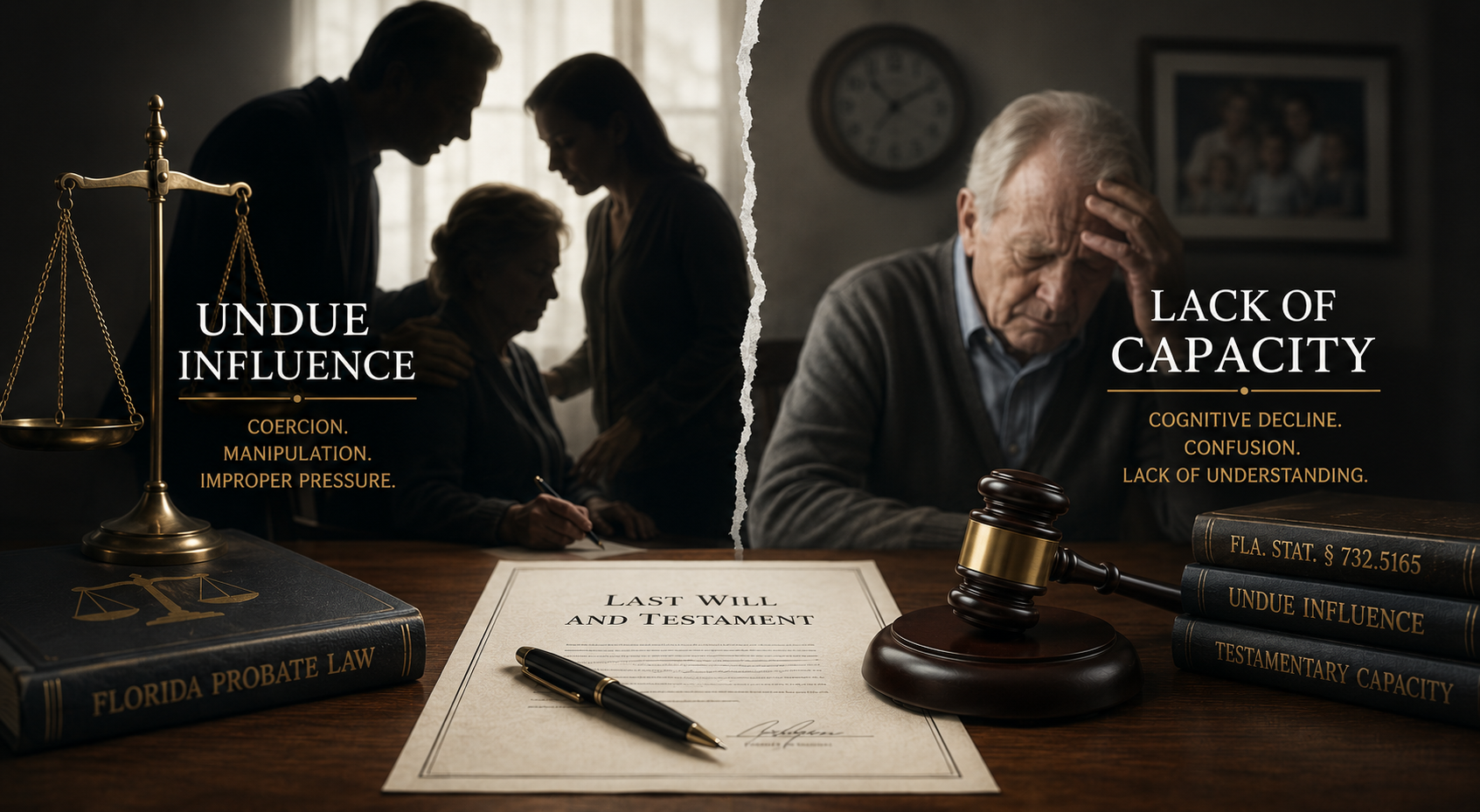
Grounds for Contesting a Will in South Florida: Undue Influence vs. Lack of Capacity

Contesting a Will in South Florida

Under Florida probate law, contesting a will means filing a formal legal petition in court to declare a deceased person’s last will and testament void. Under Fla. Stat. § 732.5165, a court can invalidate an entire will,or specific clauses within it,if the document does not represent the free and uncoerced intent of a mentally sound person.

To understand how Florida probate courts evaluate these challenges, it helps to define key legal concepts:

  • Testator: The individual who created and signed the will.
  • Probate: The court-monitored legal process used to settle debts and distribute a deceased person’s property.
  • Interested Person: An individual with a financial or legal stake in the estate (such as an heir, disinherited child, or surviving spouse) who holds the legal right to challenge the document.

The two most frequent legal grounds for challenging a Florida will are undue influence and lack of testamentary capacity.

  • Undue Influence applies when the testator had mental capacity, but a third party used pressure, manipulation, or coercion to replace the testator’s true wishes with their own.
  • Lack of Capacity applies when the testator suffered from cognitive decline (such as advanced dementia or severe intoxication) and lacked the mental sharpness required to understand what they were signing.

Key Differences: Undue Influence vs. Lack of Capacity in Florida Probate

Legal ElementUndue InfluenceLack of Testamentary Capacity
Primary Statutory BasisFla. Stat. § 732.5165 (Void if execution is procured by undue influence)Fla. Stat. § 732.502 (Execution standards requiring sound mind)
Core Legal FocusDid a third party manipulate or coerce the testator’s decision-making?Did the testator lack the basic mental understanding to execute a legal document?
Key Controlling CaseIn re Estate of Carpenter, 253 So. 2d 697 (Fla. 1971)In re Estate of Dunson, 141 So. 2d 601 (Fla. 2d DCA 1962)
Burden of Proof ShiftPresumption arises if the influencer held a confidential relationship, gained a substantial benefit, and actively procured the will (Fla. Stat. § 733.107(2))The law presumes sanity; the burden remains on the contestant throughout the case.
Relevant TimelineCourt examines the period of coercion leading up to and during execution.Court examines mental state strictly at the exact moment of execution.
Effect of “Lucid Intervals”Irrelevant if the influencer controlled or coerced the testator’s mind.A will signed during a temporary window of clarity is valid, even with a dementia diagnosis.

Proving Undue Influence in a Florida Will Contest (The Carpenter Rule)

Undue influence occurs when a third party exercises persuasion that overpowers the testator’s free agency, effectively forcing them to sign an estate document they otherwise would not have created.

Burden Shifting Under Fla. Stat. § 733.107(2): When a contestant proves that a primary beneficiary shared a confidential relationship with the testator and actively procured the contested will, a legal presumption of undue influence applies. The burden of proof then shifts to the beneficiary to prove the will was not the result of undue influence.

In In re Estate of Carpenter, the Florida Supreme Court established seven non-exclusive criteria to determine if a beneficiary “actively procured” a will:

  • Presence at Execution: The beneficiary was in the room when the will was signed.
  • Presence During Expressions of Intent: The beneficiary was present when the testator voiced desires to make or change a will.
  • Attorney Recommendation: The beneficiary selected, hired, or recommended the lawyer who drafted the document.
  • Prior Knowledge of Terms: The beneficiary knew the specific terms of the will before execution.
  • Procuring Witnesses: The beneficiary chose or brought in the attesting witnesses.
  • Holding Document Custody: The beneficiary kept possession of the signed original document after execution.

Subsequent Florida decisions also recognize isolation of the testator from family members, mental inequality between parties, and sudden, unexpected changes to long-standing estate plans as supporting indicators of active procurement.


Proving Lack of Testamentary Capacity in Florida Probate Courts

Testamentary capacity requires that a testator possess a “sound mind” at the specific moment of executing a will. Under Florida case law (Skelton v. Davis, 133 So. 2d 432), courts evaluate three distinct requirements to determine if capacity existed:

  1. Understanding Property Extent: The testator generally understood the nature and approximate value of their assets.
  2. Recognizing Natural Heirs: The testator understood their family structure and recognized individuals who naturally expect to inherit (Hendershaw v. Estate of Hendershaw, 763 So. 2d 482).
  3. Understanding the Act’s Practical Effect: The testator understood that signing the document would permanently transfer property upon death.

The legal bar for testamentary capacity in Florida is relatively low. Medical records showing diagnoses of vascular dementia, Alzheimer’s, or memory loss do not automatically prove lack of capacity. If the testator signed the will during a temporary period of mental clarity—known legally as a “lucid interval”—the document remains valid (Scott v. Young, 2024 WL 4395136).


Florida Will Contest Deadlines and Circuit Court Jurisdiction

Will contests are litigated within the Probate Division of the Florida Circuit Court holding local jurisdiction, such as the 11th Judicial Circuit (Miami-Dade County), the 15th Judicial Circuit (Palm Beach County), or the 17th Judicial Circuit (Broward County).

Florida probate rules enforce strict, short deadlines for filing a challenge:

  • 3-Month Notice of Administration Deadline: Under Fla. Stat. § 733.212(3), once a Personal Representative serves an interested person with a formal Notice of Administration, any claim contesting the validity of the will must be filed within 3 months. Failure to file within this window permanently waives the right to contest.
  • 20-Day Formal Notice Deadline: If a petition for administration is served via Formal Notice under Fla. Prob. R. 5.040 prior to the will being admitted to probate, the recipient has only 20 days from the date of receipt to file formal objections.

What Happens When a Florida Will is Invalidated?

When a circuit court judge rules that a will is void due to undue influence or lack of testamentary capacity under Fla. Stat. § 732.5165, Florida law dictates specific outcomes for property distribution:

  • Reinstatement of a Prior Valid Will: If the decedent executed an earlier, legally valid will before the contested document was signed, the court may reinstate the prior document under the doctrine of Dependent Relative Revocation (In re Estate of Pratt, 88 So. 2d 499).
  • Distribution Under Florida Intestacy Laws: If no prior valid will exists, the decedent’s estate is administered under Florida intestacy statutes (Fla. Stat. § 732.101). Assets pass to statutory heirs according to family hierarchy, starting with surviving spouses and lineal descendants.
  • Partial Invalidation: Under Fla. Stat. § 732.5165, if undue influence affected only a specific clause or devise within the will (such as an isolated bequest to an influencer), the court can invalidate that specific section while upholding the remainder of the document.
  • Award of Attorney Fees and Costs: Under Fla. Stat. § 733.106(3), an attorney who renders legal services that result in a tangible benefit to an estate—including successfully contesting an invalid will to restore legal distribution—may petition the court to receive reasonable attorney fees and court costs paid directly from estate assets.

Retaining South Florida Probate Litigation Counsel

Initiating or defending a will contest requires immediate action to secure medical evidence, subpoena financial records, collect witness depositions, and meet strict filing deadlines enforced by local probate courts. Reinfeld Cabrera Tison represents beneficiaries, disinherited heirs, and fiduciaries in estate litigation across South Florida.

  • Office Address: 9625 W Sample Rd, Coral Springs, FL 33065
  • Contact Phone: (954) 866-4878 or 954-866-HURT
  • Circuit Court Venues Served: 17th Judicial Circuit Court (Broward County Courthouse, Fort Lauderdale), 11th Judicial Circuit (Miami-Dade County), 15th Judicial Circuit (Palm Beach County), and 16th Judicial Circuit (Monroe County).

Who Inherits the Family Home in Florida? Homestead Rights for Spouses & Heirs

Real estate house keys resting on estate documents representing Florida homestead property transfers after death.

Under Article X, Section 4 of the Florida Constitution, a primary residence (homestead) is subject to strict constitutional inheritance laws that override standard terms written in a Will or Trust. If a Florida homestead owner dies while survived by a spouse or minor child, state law dictates who receives the home, preventing the owner from freely disinheriting their immediate family.


Direct Answer: When a married Florida homestead owner dies with surviving descendants, Florida Statute § 732.401 gives the surviving spouse two choices: a Life Estate (the right to live in the home for life with a vested remainder to descendants) OR an election to take an undivided 50% ownership share as Tenants in Common. The spouse must file this 50% election within 6 months of the owner’s date of death.


Can You Disinherit a Spouse or Child from a Florida Homestead in Your Will?

Florida’s constitutional restrictions prevent homeowners from leaving their primary residence to outside parties if they have a legal spouse or minor children at the time of death.

  • If you have minor children: You cannot leave the home entirely to your spouse or anyone else in a Will. Any attempt to do so is legally void under Florida law.
  • If you have a spouse (and no minor children): You can only leave the home outright to your surviving spouse. Leaving it to a friend, charity, or adult child from a previous marriage without spousal waiver is invalid.
  • If you have no spouse and no minor children: You are free to leave the property to whomever you choose.

If a Will attempts to convey homestead property in violation of these rules, Florida probate courts treat the gift as an invalid devise. The property automatically passes according to Florida’s statutory rules under Fla. Stat. § 732.401.


Life Estate vs. 50% Election: What Are a Surviving Spouse’s Rights Under Fla. Stat. § 732.401?

When a homestead owner dies survived by a spouse and children (adult or minor), Florida Statute § 732.401 governs how ownership splits between them.

Option 1: Default Life Estate

By default, the surviving spouse receives a Life Estate.

  • Spouse’s Rights: The right to live in, use, and occupy the residence for the remainder of their lifetime.
  • Children’s Rights: The decedent’s children receive a vested remainder, automatically assuming 100% ownership after the surviving spouse passes away.
  • Limitations: The surviving spouse cannot sell, mortgage, or transfer the home without the full consent of all children holding the remainder interest.

Option 2: The 50% Tenant-in-Common Election

To prevent friction between surviving spouses and adult stepchildren, Florida law permits the surviving spouse to opt out of the Life Estate.

  • Spouse’s Rights: The spouse takes an undivided 50% ownership interest as a Tenant in Common.
  • Children’s Rights: The decedent’s children collectively share the remaining 50% ownership interest.
  • Benefits: Either side can file a court action to force a sale (partition action) if both sides cannot agree on maintaining or selling the home.

Comparison Table: Florida Homestead Life Estate vs. 50% Tenant-in-Common Election (Fla. Stat. § 732.401)

Ownership FeatureOption 1: Default Life EstateOption 2: 50% Tenant-in-Common Election
Spousal ControlExclusive right to live in property for life50% legal ownership share
Heir ControlFuture ownership after spouse diesImmediate 50% collective ownership share
Routine Costs (Taxes, Insurance)Spouse pays 100% of property taxes & maintenanceSplit 50/50 between spouse and heirs
Mortgage PrincipalSplit according to statutory interest formulasSplit 50/50 between spouse and heirs
Forced Sale (Partition)Cannot be forced by heirs or spouseEither party can initiate partition to sell property
Strict DeadlineNone (automatic default)6 months from owner’s date of death

Is a Florida Homestead Protected From Estate Creditors After Death?

Beyond inheritance rules, Article X, Section 4(b) of the Florida Constitution provides strong creditor protections that pass directly to heirs.

If the primary home passes to an exempt heir (a surviving spouse, child, sibling, niece, or nephew), the home transfers free and clear of most estate debts. Unsecured creditors; such as credit card companies, medical providers, or personal loan lenders, cannot force the sale of a Florida homestead to satisfy the decedent’s unpaid debts during probate.

(Note: Under Florida’s probate framework, homestead property is entirely excluded when calculating eligibility for summary administration.)

Only three specific debt types can attach to a Florida homestead:

  1. Mortgages signed on the property.
  2. Unpaid real estate property taxes or special assessments.
  3. Mechanics’ and contractors’ liens for work performed directly on the home.

How Do You Establish Legal Homestead Status in Florida Probate Court?

Homestead protections do not apply automatically on paper; they must be formally recognized by a probate judge in the local circuit court (such as the 17th Judicial Circuit in Broward County, 15th Circuit in Palm Beach, or 11th Circuit in Miami-Dade).

  1. File a Petition for Order Determining Homestead Status: A probate attorney files an official petition asking the court to confirm that the property meets constitutional homestead qualifications.
  2. Obtain the Judicial Order: Once signed by the probate judge, the Order Determining Homestead removes the residence from the general probate estate, transfers title to the legal heirs, and shields it from general creditors.
  3. Record the Notice of Election (If Applicable): If taking the 50% Tenant-in-Common election, an official Notice of Election containing the property’s legal description must be signed and recorded in county land records within the strict 6-month statutory window.

Resolving Florida Homestead Disputes and Protecting Estate Rights

Florida’s constitutional homestead protections exist to protect families from displacement and unmanageable creditor claims following a loved one’s passing.

However, the strict constitutional mandates surrounding testamentary freedom, paired with the mandatory 6-month statutory window under Fla. Stat. § 732.401, mean that minor procedural errors can result in forfeited spousal rights, clouded property titles, or unexpected co-ownership disputes between spouses and stepchildren.

Navigating a homestead determination requires swift action in the local probate court to secure clear legal title, enforce statutory elections, and shield the home from unauthorized creditor claims.


Consult South Florida Probate Attorneys at Reinfeld Cabrera Tison

Whether you are a surviving spouse evaluating a Life Estate vs. 50% Tenant-in-Common Election, an heir seeking to establish homestead creditor protections, or a personal representative executing an estate, the probate team at Reinfeld Cabrera Tison provides experienced guidance throughout the entire judicial process.

  • Office Address: 9625 W Sample Rd, Coral Springs, FL 33065
  • Contact Phone: (954) 866-4878 | 954-866-HURT
  • Local Probate Venues Served: 17th Judicial Circuit (Broward County Courthouse, Fort Lauderdale), 15th Judicial Circuit (Palm Beach County), 11th Judicial Circuit (Miami-Dade County), and 16th Judicial Circuit (Monroe County).

How to Transfer Florida Property to Your Children Without Tax Penalties

Florida property transfer to children legal documents on a desk with an estate planning book, house keys, miniature home model, and checklist to avoid probate and minimize tax penalties

f you sign your Florida home over to your children while you are alive, such as through a standard quitclaim deed, the Internal Revenue Service (IRS) treats the transfer as a lifetime gift. Under federal tax law (IRC § 1015), this forces your kids to inherit your original purchase price as their tax baseline, known as a carryover basis, exposing them to heavy capital gains taxes when they eventually sell.

  • At the state level, the Florida Department of Revenue enforces property tax rules (Fla. Stat. § 193.155) that treat that same deed transfer as an official change of ownership. This automatically erases your Save Our Homes property tax cap, causing your annual property taxes to jump up to full current market rates.
  • As estate tax attorney Stuart Reinfeld (LL.M. in Taxation) cautions: “Well meaning parents routinely sign a lifetime deed to keep their children out of probate court, unaware that they are swapping a minor administrative process for an immediate property tax spike and a heavy tax bill down the road.”

To keep your family out of probate while preserving your property tax savings and tax free inheritance benefits, real estate transfers must be structured so you retain legal control during your lifetime, most effectively through an Enhanced Life Estate (Lady Bird) Deed or a R


Can You Transfer a House to Your Child in Florida Without Paying Taxes?

Passing down a family home is one of the most meaningful ways to build generational security. When planning for the future, your primary goal is likely straightforward: ensuring your children inherit your property smoothly, without the delays, stress, or public costs of Florida probate court.

However, informal methods, such as executing a quick quitclaim deed or adding an adult child as a co owner, frequently trigger unintended tax consequences under both federal IRS regulations and Florida state statutes. Preserving your real estate assets requires aligning federal capital gains rules with Florida statutory homestead tax protections.


1. Capital Gains Tax Rules: Why Adding a Child to Your Deed Forfeits the Stepped Up Basis (IRC § 1014)

A common misconception is that gifting property during your lifetime saves your children money. In reality, the legal method chosen dictates how the IRS calculates capital gains taxes when your heirs eventually sell the home.

  • Lifetime Gifts (Carryover Basis under IRC § 1015): Gifting real estate during your lifetime forces your child to inherit your original purchase price as their tax basis. If you bought your home decades ago for $150,000 and it is worth $900,000 today, your child inherits your original $150,000 basis. When they sell, they owe federal capital gains tax on the full $750,000 appreciation.
  • Inheritance at Death (Stepped Up Basis under IRC § 1014): Property passing to heirs upon your death receives a stepped up basis equal to the property fair market value on your date of death. The accumulated $750,000 gain is legally eliminated for income tax purposes, allowing your children to sell the home with minimal or zero capital gains exposure.

2. Florida Property Tax Reassessment: How Deeding Property Triggers the Save Our Homes (SOH) Uncapping

The Florida Save Our Homes cap under Fla. Stat. § 193.155 limits annual increases in your homestead assessed value to 3% or the Consumer Price Index, saving long term Florida homeowners thousands of dollars annually in property taxes.

Executing a lifetime deed transfer to a non spouse relative alters this protection:

  • Statutory Change of Ownership: Florida Law treats adding a child to the deed as a formal ownership change under Fla. Stat. § 193.155(3).
  • Reassessment to Full Market Value: On January 1 following the transfer, the county property appraiser resets the property assessed value to current market value.
  • Loss of Tax Cap: Accumulated Save Our Homes tax savings are permanently erased, resulting in an immediate spike in annual property taxes.

Preserving your Save Our Homes cap requires specific transfer instruments that maintain your equitable title and primary residency rights throughout your lifetime.


3. Florida Documentary Stamp Tax: Calculating Taxes on Encumbered Real Estate Transfers

Even when no cash changes hands between family members, Florida assesses a Documentary Stamp Tax under Fla. Stat. § 201.02 on real estate conveyances.

If the property carries an active mortgage, adding a child to the deed constitutes an assumption of debt under Florida Administrative Code rules. Florida assesses a tax rate of $0.70 per $100 of the remaining mortgage balance ($0.60 per $100 in Miami Dade County).

For example, adding an heir to a property with an active $400,000 mortgage creates an immediate $2,800 tax obligation payable directly to the Florida Department of Revenue.


Comparing Florida Property Transfer Strategies

Understanding how each transfer method performs across key tax and legal requirements helps determine the right approach for your estate plan:

  • Lifetime Quitclaim Deed: Forfeits capital gains tax protection by forcing a carryover basis under IRC § 1015. Resets your Save Our Homes property tax cap to full market value under Fla. Stat. § 193.155. Triggers Florida documentary stamp tax if a mortgage exists. Successfully bypasses Florida probate court.
  • Enhanced Life Estate (Lady Bird) Deed: Preserves capital gains tax protection with a full stepped up basis at death under IRC § 1014. Retains your Save Our Homes property tax cap for life. Avoids documentary stamp tax on unencumbered transfers. Successfully bypasses Florida probate court.
  • Properly Structured Revocable Trust: Preserves capital gains tax protection with a full stepped up basis at death under IRC § 1014. Retains your Save Our Homes property tax cap through explicit homestead terms. Exempt from documentary stamp tax on unencumbered property. Successfully bypasses Florida probate court while providing management during incapacity.

How Lady Bird Deeds and Revocable Living Trusts Protect Your Florida Homestead

Protecting your property and your family requires structured instruments designed specifically for Florida real estate and federal tax codes:

  • Enhanced Life Estate (Lady Bird) Deed: Retains your complete control, ownership, and right to live in, sell, or mortgage the home during your lifetime, while automatically designating your children as remainder beneficiaries upon death. It avoids probate, preserves your Save Our Homes property tax cap, and secures the federal stepped up tax basis for your children.
  • Revocable Living Trust: Offers administrative control during your lifetime and seamless management if you become incapacitated. When drafted with explicit Florida homestead terms under Fla. Stat. § 196.041, a trust maintains your homestead protections and passes the property to your heirs free of probate and capital gains penalties.

Florida Case Law: Why Precision Drafting and Specialized Counsel Matter

Real estate and estate planning instruments are strict legal mechanisms. Small oversights in execution, cross referencing, or statutory language can lead to costly probate contests, disinherited heirs, or title defects. Florida case law highlights the dramatic difference between flawed document drafting and expert legal execution:


1. The Cost of Procedural Oversights: Espinosa v. Sparber, Shevin, Shapo, Rosen & Heilbronner (612 So. 2d 1378)

In Espinosa, a parent hired counsel to update his estate plan to include his newly born fourth child, intending to give all children equal shares. However, the attorney had the parent execute a secondary codicil that altered trustee designations without properly incorporating or referencing the new child.

Under Florida probate law, executing a codicil republished the original will as written, legally cutting off the child inheritance rights. Because courts cannot look beyond unambiguous written text to guess intent, the child lost her direct inheritance share, forcing the family into years of expensive legal malpractice litigation. This precedent underscores why property deeds and estate instruments must be executed with strict statutory accuracy.


2. The Value of Statutory Mastery: Reid v. Temple Judea (994 So. 2d 1146)

In contrast, Reid v. Temple Judea illustrates how expert legal counsel uses Florida statutes to correct document ambiguities and uphold family intent. Following a settlor death, conflicting language in a trust instrument threatened to force the liquidation of key estate assets.

Rather than allowing the property to be sold under rigid administrative rules, expert legal counsel petitioned for judicial reformation under the Florida Trust Code (Fla. Stat. § 736.0415). The legal team successfully established appellate precedent proving that fiduciaries can rectify technical drafting mistakes using extrinsic evidence when backed by precise statutory advocacy, ultimately preserving the settlor true wishes and protecting the underlying property.


Frequently Asked Questions: Florida Property Transfers & Estate Tax Planning


Can I just add my child to my deed as a Joint Tenant with Right of Survivorship?

While this bypasses probate, it exposes your property to your child personal financial liabilities, lawsuits, or potential divorce settlements during your lifetime. Additionally, it forfeits a full step up in tax basis under IRC § 1015 for their fractional share.

Does a Lady Bird Deed prevent Medicaid estate recovery in Florida?

Yes. Because the property passes automatically to remainder beneficiaries upon death without entering probate court, it is shielded from Florida Medicaid estate recovery claims.

What is the first step in structuring a safe real estate transfer in Florida?

Estate tax laws and real property statutes require combined analysis. Working with legal counsel specializing in both Florida property jurisprudence and federal taxation ensures your family home is protected against unnecessary state and federal tax lia


Protect Your Legacy From Avoidable Drafting Errors

Legal precedents like Espinosa demonstrate that a single statutory technicality in a deed or trust can invalidate your true intentions and force your heirs into costly litigation. Ensuring your real estate transfers smoothly requires combined expertise in Florida property jurisprudence and federal tax law.

[Schedule a Confidential Real Estate & Tax Strategy Consultation]


Author Bio

Written by Spencer Lasday, Esq.

Spencer Lasday, Esq. is an Associate Attorney at Reinfeld Cabrera Tison. He focuses his legal practice on real estate law, civil litigation, regulatory compliance, and personal injury matters, leveraging a strong background in economics, municipal policy, and real estate transactions to guide clients through complex property conveyances and legal disputes.

Florida Homestead Estate Planning Rules: Passing Your Home to Heirs

Miniature model house, house keys, and a judge's gavel sitting next to an Estate Plan document and a Florida Estate Law book on a wooden desk.

Quick Answer: How do Florida homestead rules impact property inheritance?

Mastering florida homestead estate planning rules ensures your primary residence passes to your intended heirs without court delays or voided devises. Under Article X, Section 4 of the Florida Constitution and Fla. Stat. § 732.4015, an owner survived by a spouse or minor child cannot freely devise their homestead through a standard will or standard trust.

Violating these legal restrictions invalidates the transfer, forcing the property into statutory default distribution under Fla. Stat. § 732.401, granting the surviving spouse a life estate (or a 50% tenant-in-common election) and lineal descendants the remainder interest.

Many Florida homeowners mistakenly assume that a executed last will and testament or standard revocable trust gives them complete authority to leave their primary residence to whomever they choose. In Florida, primary residential real estate is subject to constitutional mandates that override standard estate planning instructions.

When estate plans fail to account for mandatory state restrictions, property transfers can instantly fail. This leads to unintended co-ownership arrangements, costly probate disputes among family members, and severe tax consequences.


1. The Three-Pronged Legal Reality of Florida Homestead

To properly navigate florida homestead estate planning rules, real estate owners must distinguish between the three separate components of state homestead law:

  • Ad Valorem Tax Exemptions: Provides up to $50,000 in property tax valuation deductions and caps annual property tax assessment increases at 3% or the Consumer Price Index through the “Save Our Homes” cap.
  • Creditor Asset Shield: Shields primary residential property from forced sale to satisfy unsecured civil judgments, personal loan obligations, or medical bills under Article X, Section 4(a) of the Florida Constitution.
  • Restricted Devise & Inheritance Controls: Governs who can legally inherit the property upon the owner’s death under Article X, Section 4(c) of the Florida Constitution and state probate code.

While property tax reductions and creditor protection benefit homeowners during life, inheritance restrictions strictly dictate property rights at death. These restrictions are designed to protect surviving spouses and minor children from sudden loss of shelter or disinheritance.


2. The Devise Trap: Who Can (and Cannot) Inherit Under Fla. Stat. § 732.4015

Your legal ability to leave primary real estate to specific beneficiaries depends entirely on your marital status and surviving dependents at the exact moment of your passing:

Scenario A: Survived by a Minor Child

If you pass away leaving a minor child (under age 18), state law imposes an absolute ban on devising the homestead. You cannot leave the residence to your spouse, an adult child, a relative, or a trust. Any attempt to do so in a will or trust document is legally void.

Scenario B: Survived by a Spouse (No Minor Children)

If you have a legal spouse but no minor children, Florida law allows you to leave your primary home to only one party: your surviving spouse. The devise must convey complete fee simple ownership. You cannot leave a lifetime occupancy right to your spouse while granting the remaining equity to adult children from a prior marriage unless your spouse signs an enforceable waiver of homestead rights.

Scenario C: No Surviving Spouse and No Minor Children

If you are unmarried (or widowed) and have no minor children, constitutional restrictions on homestead transfers do not apply. You retain complete autonomy to leave the property to adult children, extended family, charitable institutions, or a living trust.


3. Statutory Gridlock: Life Estates vs. 50/50 Tenant-in-Common Elections

When a homeowner attempts an improper transfer, Florida probate courts declare the devise invalid and apply statutory succession rules under Fla. Stat. § 732.401:

  • The 50/50 Tenant-in-Common Election: To prevent ongoing disputes between step-parents and adult children over property expenses, Fla. Stat. § 732.401(2) permits the surviving spouse to make a formal election within 6 months of the decedent’s death. The spouse can elect to receive an undivided 50% interest as tenants-in-common with the descendants, allowing all parties to sell the home and divide the net equity equally.
  • Vested Remainder Interest: The deceased owner’s children (lineal descendants) receive a vested remainder interest, gaining full fee simple ownership only after the surviving spouse passes away.
  • The 50/50 Tenant-in-Common Election: To prevent ongoing disputes between step-parents and adult children over property expenses, Fla. Stat. § 732.401(2) permits the surviving spouse to make a formal election within 6 months of the decedent’s death. The spouse can elect to receive an undivided 50% interest as tenants-in-common with the descendants, allowing all parties to sell the home and divide the net equity equally.

Family Circumstance at DeathPermissible Will/Trust Distribution OptionsStatutory Default Outcome (Fla. Stat. § 732.401)
Surviving Spouse + Minor ChildProhibited (Devise is constitutionally void)Spouse receives Life Estate (or 50% TIC); Children get Remainder
Surviving Spouse (No Minor Children)Outright fee simple transfer to Spouse ONLY (unless waived)Spouse receives Life Estate (or 50% TIC); Children get Remainder
No Spouse & No Minor ChildrenUnrestricted (Can pass to any designated beneficiary)Property transfers per Will terms or Intestate Law

4. Strategic Tools to Maintain Control and Avoid Probate

Homeowners can utilize recognized legal mechanisms within florida homestead estate planning rules to pass property smoothly without triggering statutory default gridlock:

Enhanced Life Estate Deeds (Lady Bird Deeds)

An Enhanced Life Estate Deed allows an owner to keep total control over the property during their lifetime—including the right to sell, lease, or refinance without beneficiary consent. Upon death, legal title transfers automatically to named beneficiaries outside of probate court, preserving lifetime tax exemptions when structured properly.

Custom Homestead Living Trusts

Holding title through a Revocable Living Trust avoids probate, but the trust agreement must feature precise language that complies with Fla. Stat. § 732.4015(2). The instrument must explicitly maintain the grantor’s homestead status and satisfy constitutional rights owed to a surviving spouse.

Marital Homestead Waivers

In blended family structures, a property owner wishing to leave real estate to children from a previous relationship must secure a formal waiver. Under Fla. Stat. § 732.702, a spouse can execute a valid prenuptial, postnuptial, or deed-based waiver relinquishing homestead rights, enabling the owner to devise the residence freely.


Frequently Asked Questions (FAQ)


Can I leave my Florida home to my adult children if I am remarried?

Not without a formal waiver. If you are married at death, Florida law restricts you from leaving the primary home to anyone other than your spouse unless your spouse executes a valid homestead rights waiver under Fla. Stat. § 732.702.

Does putting my homestead in a trust avoid spousal inheritance rules?

No. Placing real estate in a revocable living trust does not defeat constitutional restrictions under Fla. Stat. § 732.4015. If the trust provisions conflict with statutory spousal rights, the trust transfer fails.

What happens to property taxes when heirs inherit a Florida home?

Inheriting a primary residence triggers a property tax reassessment to full market value, removing the prior owner’s “Save Our Homes” cap. Heirs who make the residence their permanent home must apply for a new homestead exemption by March 1 to establish a new assessment cap.


Protect Your Primary Residence and Family Legacy Today

Proactive legal planning prevents property transfers from breaking down under statutory default rules. The attorneys at Reinfeld Cabrera Tison provide personalized title reviews, living trust drafting, and homestead waiver strategies to ensure your home passes seamlessly to your heirs.

  • Schedule a Free Case Evaluation: Contact Reinfeld Cabrera Tison at 954-866-HURT (954-866-4878) to consult with an experienced estate attorney.
  • Ensure Asset Protection: Preserve your homestead tax benefits and creditor protections across generations.

Author Bio

Written by Alan Reinfeld, Esq.

Alan Reinfeld, Esq. is a Founding Partner at Reinfeld Cabrera Tison. Leveraging extensive probate administration, personal injury litigation, and estate planning experience, he assists South Florida clients in protecting high-value assets, structuring compliant real estate transfers, and navigating complex Florida property laws.

Florida Lady Bird Deed vs. Revocable Living Trust for Real Estate

Split view comparing a Lady Bird Deed document with house keys and a model home on the left with a Revocable Living Trust Agreement and scale of justice on the right.

Quick Answer: A Florida Lady Bird Deed (Enhanced Life Estate Deed) is a streamlined legal instrument designed to transfer a single parcel of real estate to designated beneficiaries outside of probate while allowing the owner to retain absolute lifetime control.

A Revocable Living Trust is a comprehensive, multi-asset estate planning framework that manages property during lifetime incapacity, protects minor or vulnerable heirs, and coordinates complex inheritance distributions.

While a Lady Bird Deed offers an economical probate bypass for a primary residence, a Living Trust delivers complete estate management, beneficiary protection, and seamless incapacity coverage.


1. Comparing Florida Property Transfer Mechanics

Determining whether to use an Enhanced Life Estate Deed or a Revocable Living Trust requires evaluating how each instrument operates under Florida property and probate law.

Florida Lady Bird Deed (Enhanced Life Estate)

Florida does not have a transfer-on-death (TOD) deed statute. Instead, Florida common law recognizes the Lady Bird Deed, which splits property title into two legal components: an enhanced life estate retained by the property owner and a remainder interest granted to designated beneficiaries.

The defining element is the reserved-powers clause. This specific provision grants the owner unrestricted authority to sell, mortgage, lease, gift, or revoke the deed without notifying or obtaining consent from the remainder beneficiaries. Upon the owner’s death, legal ownership passes directly to the named beneficiaries outside of probate upon recording a certified death certificate.

Revocable Living Trust

A Revocable Living Trust is a separate legal entity established to hold title to real estate, financial portfolios, and personal assets. The grantor serves as trustee during their lifetime, maintaining full authority over all trust assets.

Upon the grantor’s death or incapacity, a named successor trustee steps in to manage or distribute the trust property according to the explicit terms set forth in the trust agreement. Assets properly titled in the name of the trust bypass probate court entirely.


2. Head-to-Head Comparison: Lady Bird Deed vs. Living Trust

Features & Legal ProtectionsFlorida Lady Bird DeedRevocable Living Trust
Primary ScopeSingle piece of Florida real property.All real estate (in state & out of state), accounts, and personal property.
Probate AvoidanceBypasses probate for the deeded parcel.Bypasses probate for all funded trust assets.
Incapacity ManagementNone; requires a separate Durable Power of Attorney or court guardianship.Successor trustee manages real estate and funds without court intervention.
Beneficiary RestrictionsOutright transfer only; cannot restrict or delay distributions.Holds property in trust for minor, special needs, or spendthrift beneficiaries.
Predeceased BeneficiariesRisk of title defect; requires executing corrective deeds prior to death.Built-in contingent beneficiary designations and generational distribution rules.
Homestead Tax PreservationPreserves $50k homestead exemption and 3% Save Our Homes cap automatically.Preserves homestead tax exemptions under Fla. Stat. § 196.041(2).
Medicaid Estate RecoveryAvoids MERP claims (Fla. Stat. § 409.9101) by bypassing probate.Avoids MERP claims when properly structured outside the probate estate.
PrivacyPublic record (deed recorded in county official records).Private instrument (trust terms remain confidential).
Implementation CostLower upfront legal cost ($400 – $1,000).Moderate upfront legal cost ($2,000 – $5,000).

3. Critical Structural Differences

Incapacity Coverage vs. Death-Only Activation

  • Lady Bird Deed Gap: A Lady Bird Deed activates solely upon death. If an owner becomes incapacitated due to cognitive decline or illness, the deed provides zero management authority over the property. The family cannot sell, mortgage, or manage the property without a robust Durable Power of Attorney or formal court guardianship.
  • Living Trust Advantage: One Living Trust covers both incapacity and death. The successor trustee steps in smoothly to manage property operations, pay property taxes, or execute sales for the grantor’s medical care without court oversight.

Outright Distribution vs. Multi-Generational Asset Control

  • Lady Bird Deed Limitations: Title transfers outright to remainder beneficiaries upon death. Under Florida law, minor children (under 18) cannot hold real estate title without court guardianship. Additionally, an outright transfer exposes the home immediately to a beneficiary’s judgment creditors, divorcing spouses, or personal bankruptcy.
  • Living Trust Controls: A trust permits the grantor to stagger asset distributions (e.g., ages 25, 30, and 35), establish discretionary spendthrift trusts, protect government benefits for special needs beneficiaries, and keep family real estate insulated from beneficiary creditors.

Title Standard Compliance and Spousal Restrictions

Because Florida lacks a formal Lady Bird deed statute, validity depends strictly on uniform title standards established by the Florida Bar.

  • Homestead Restrictions: Article X, Section 4 of the Florida Constitution restricts the devise of primary residence homestead property if survived by a spouse or minor child. A Lady Bird deed executed by a married individual without a formal spousal joinder or written waiver under Fla. Stat. § 732.702 is legally void.
  • Drafting Defects: Ambiguous reserved-powers wording or minor legal description discrepancies frequently lead title insurance underwriters to refuse coverage when beneficiaries attempt to sell or refinance.

4. Real-World Execution Strategies

Scenario A: Streamlined Transfer for Single-Property Estates

  • Profile: A widowed property owner whose primary asset is a single homestead residence in Broward County. Financial accounts already utilize pay-on-death (POD) beneficiary designations.
  • Target Heir: One adult child with no debt or legal complications.
  • Strategy: A custom-drafted Lady Bird Deed avoids probate efficiently and preserves the home’s $50,000 homestead exemption and Save Our Homes assessment cap during the owner’s life.

Scenario B: Multi-State Property & Vulnerable Beneficiaries

  • Profile: A married couple owning a primary home in Palm Beach County, a rental condo in Georgia, and stock accounts. They have two minor children.
  • Target Heir: Minor children requiring financial stewardship.
  • Strategy: A Revocable Living Trust consolidates ownership of both properties, eliminates ancillary probate in Georgia, and holds title in trust for the children until they reach mature adulthood.

Scenario C: The Hybrid Strategy (Lady Bird Deed Funding a Trust)

Property owners can unite both tools. An owner executes a Revocable Living Trust and records a Lady Bird Deed that designates the Revocable Living Trust as the remainder beneficiary.

  • Why Use This Method? This strategy guarantees lifetime homestead tax benefits while directing the real estate into the trust upon death. It avoids intermediate trust-titling title questions during life while applying the trust’s protective distribution rules upon death.

Frequently Asked Questions


Does a Lady Bird Deed protect my Florida home from Medicaid estate recovery?

Yes. Under Fla. Stat. § 409.9101, the Florida Medicaid Estate Recovery Program (MERP) can only collect against probate assets. Because a Lady Bird Deed transfers ownership outside of probate at death, the property is shielded from MERP claims.

What happens if a named remainder beneficiary dies before me?

If a remainder beneficiary predeceases the grantor and no contingent heir is named in the deed, that share may be forced into the deceased beneficiary’s probate estate. Fixing this requires a two-step deed process during the grantor’s life: executing a deed conveying title back to the grantor, followed by a new Lady Bird Deed naming updated beneficiaries.

Can I sell or refinance my home after recording a Lady Bird Deed?

Yes. The retained enhanced life estate gives you the unilateral right to sell, mortgage, lease, or convey the property without seeking permission or signatures from the remainder beneficiaries.


Safeguard Your Florida Real Estate Legacy

Choosing between an Enhanced Life Estate Deed and a Revocable Living Trust depends on your total asset landscape, family dynamics, and long-term asset protection goals.

  • Schedule a Consultation: Contact the Florida estate planning attorneys at Reinfeld Cabrera Tison at 954-866-HURT (954-866-4878) to analyze your title and structure an optimal property transfer plan.
  • Protect Your Homestead: Ensure your real estate documents satisfy Florida constitutional homestead standards, title insurance guidelines, and tax exemption statutes.
  • Learn More: Visit the Reinfeld Cabrera Tison Estate Planning Resource Center for insights on probate avoidance, deed drafting, and trust administration.

Author Bio

Written by Alan Reinfeld, Esq.

Alan Reinfeld, Esq. is a Founding Partner at Reinfeld Cabrera Tison. Specializing in Florida probate administration, trust drafting, and real estate asset preservation, he guides South Florida homeowners through legal strategies that eliminate probate delay and preserve generational wealth.

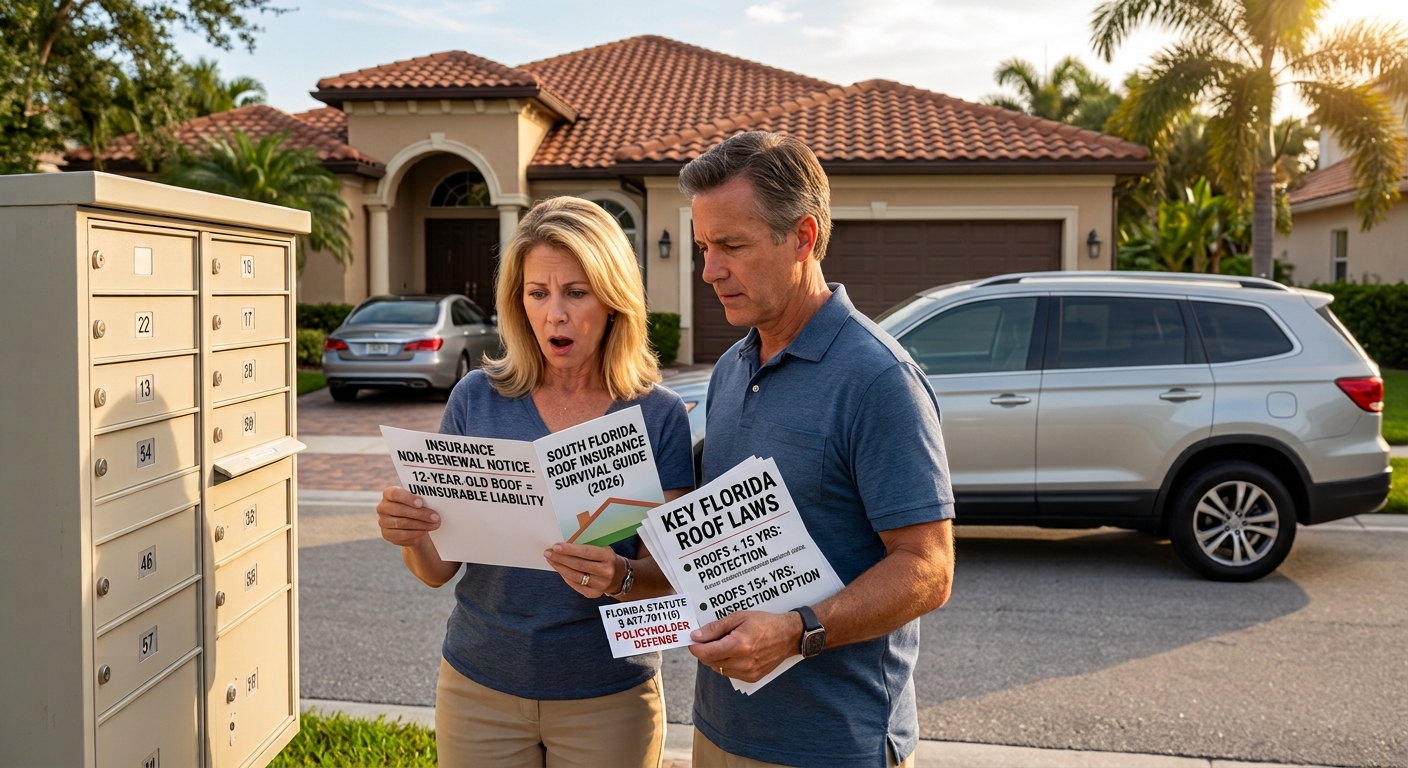
A concerned couple at a South Florida mailbox reads an insurance non-renewal notice stating their 12-year-old roof is an uninsurable liability. They are holding a 2026 survival guide and a summary of new Florida roof laws protection.

The South Florida Homeowner’s 2026 Roof Insurance Survival Guide

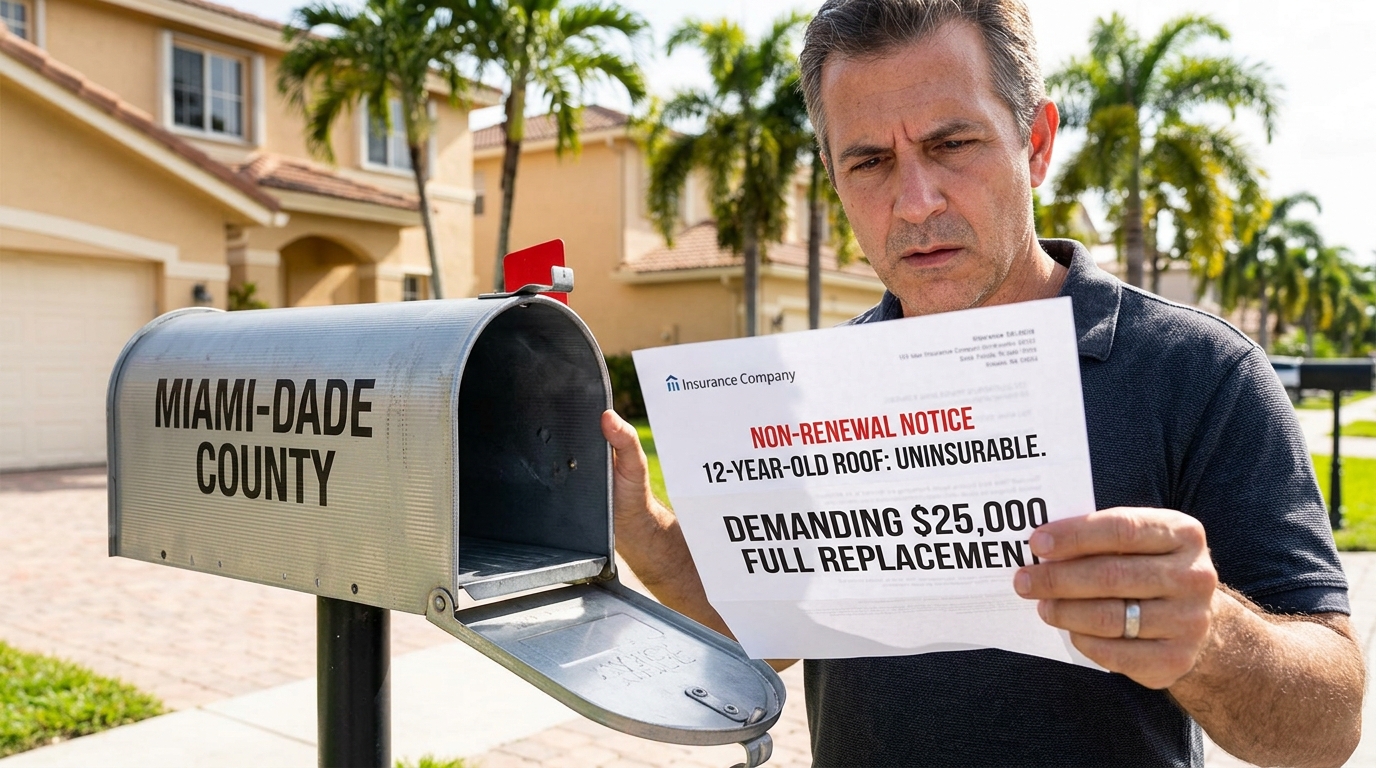
Opening your mailbox in Broward, Miami-Dade, or Palm Beach County often feels like an unpredictable gamble. One afternoon you are enjoying South Florida weather, and the next you are holding a notice from your insurance carrier stating that your 12-year-old roof is suddenly an uninsurable liability—demanding a $25,000 full replacement under threat of immediate non-renewal.

Before panicking or signing a contract with a door-to-door roofer, understand the ground rules. Florida property insurance regulations give homeowners explicit statutory protections that many carriers conveniently omit in their automated non-renewal letters.


Executive Legal Summary: Florida’s Roof Age Laws at a Glance

  • Roofs Under 15 Years Old: Under Florida Statute § 627.7011(5), property insurance carriers cannot deny coverage or refuse to renew a policy solely based on the age of your roof.
  • Roofs 15 Years or Older: Insurers can require a roof inspection, but they cannot deny coverage or force a replacement if an authorized inspector certifies that the roof has at least 5 years of remaining useful life.
  • Authorized Inspector Qualifications: Inspections must be completed by a licensed general contractor, building contractor, residential contractor, professional engineer, professional architect, or certified building code inspector.
  • Citizens Property Insurance Thresholds: Citizens requires roofs over 25 years old (for shingle) or 50 years old (for tile/metal) to submit a 4-Point or Roof Inspection Form proving 5+ years of useful life.
A distressed South Florida homeowner holds up an insurance non-renewal notice demanding $25,000 for a 12-year-old roof.

1. The Legal Reality: Florida’s 15-Year Roof Rule (Fla. Stat. § 627.7011)

Many homeowners mistakenly believe that reaching the 10- or 12-year mark on an asphalt shingle roof gives an insurer automatic legal authorization to cancel their policy. That is false.


                    FLORIDA ROOF AGE STATUTORY TIMELINE

 [0 to 14 Years Old]  ================================> CANNOT NON-RENEW SOLELY ON AGE

                                                       (Fla. Stat. § 627.7011(5))

 [15+ Years Old]      ================================> INSPECTION REQUIRED

                                                         │

                                                         ├─> 5+ Years Useful Life = COVERAGE MANDATED

                                                         └─> <5 Years Useful Life = Replacement/Repair


Protection for Roofs Under 15 Years

Florida Statute § 627.7011(5) explicitly states that an insurance company issuing or renewing a homeowners policy cannot refuse coverage solely because of roof age if the roof surface is less than 15 years old. If your carrier sends a non-renewal notice citing only a 12-year or 14-year roof age, they are violating state insurance guidelines.

The “5-Year Useful Life” Rule for Older Roofs

Once your roof hits or exceeds 15 years of age, the insurer gains the right to demand a professional roof inspection prior to policy renewal. However, the law still protects you: if the inspection proves your roof has at least 5 years of remaining useful life, the insurance company cannot reject your renewal application or force a complete replacement based on age alone.


2. Insurance Company Scare Tactics vs. Florida Statutory Law

Claim Made by Insurance CarrierActual Florida Legal & Statutory StandardImpact on Property Owner
“Your shingle roof is 12 years old, so you must replace it within 30 days to keep your policy.”Violates Fla. Stat. § 627.7011(5). Insurers cannot drop policies solely for roof age under 15 years.You do not have to replace a functional 12-year-old roof just because the carrier requests it.
“Your 16-year-old roof failed our satellite image review, so we are non-renewing.”Insurers must allow you to hire an authorized inspector to perform an in-person evaluation.Aerial satellite photos cannot override a physical inspection certifying 5+ years of useful life.
“Only our internal adjusters can determine if your roof is acceptable.”Inspections can be completed by any licensed Florida contractor, engineer, or home inspector.You have the right to hire your own independent inspector to document your roof’s actual condition.
“You must switch to an Actual Cash Value (ACV) endorsement or face immediate cancellation.”Policy changes must comply with OIR filings, and insurers must give advance written notice of endorsement alterations.ACV reduces payouts by factoring in heavy depreciation; understand what rights you give up before signing.

3. RCV vs. ACV: The Hidden Policy Trap

Understanding how your insurance carrier calculates roof damage payouts is essential when navigating renewals and storm damage claims.

  • Replacement Cost Value (RCV): The insurer covers the actual cost to repair or replace the damaged roof with similar materials at current market prices, without deducting money for age or wear and tear.
  • Actual Cash Value (ACV): The insurer deducts depreciation based on the age and condition of the roof before issuing a payment.

If a 15-year-old roof with a 20-year lifespan suffers severe storm damage under an ACV policy, the insurer may only pay 25% of the replacement cost, leaving the homeowner responsible for the remaining 75% out-of-pocket. Pay close attention to policy renewal documents—carriers frequently attempt to slip ACV roof endorsements onto older homes during annual renewals.

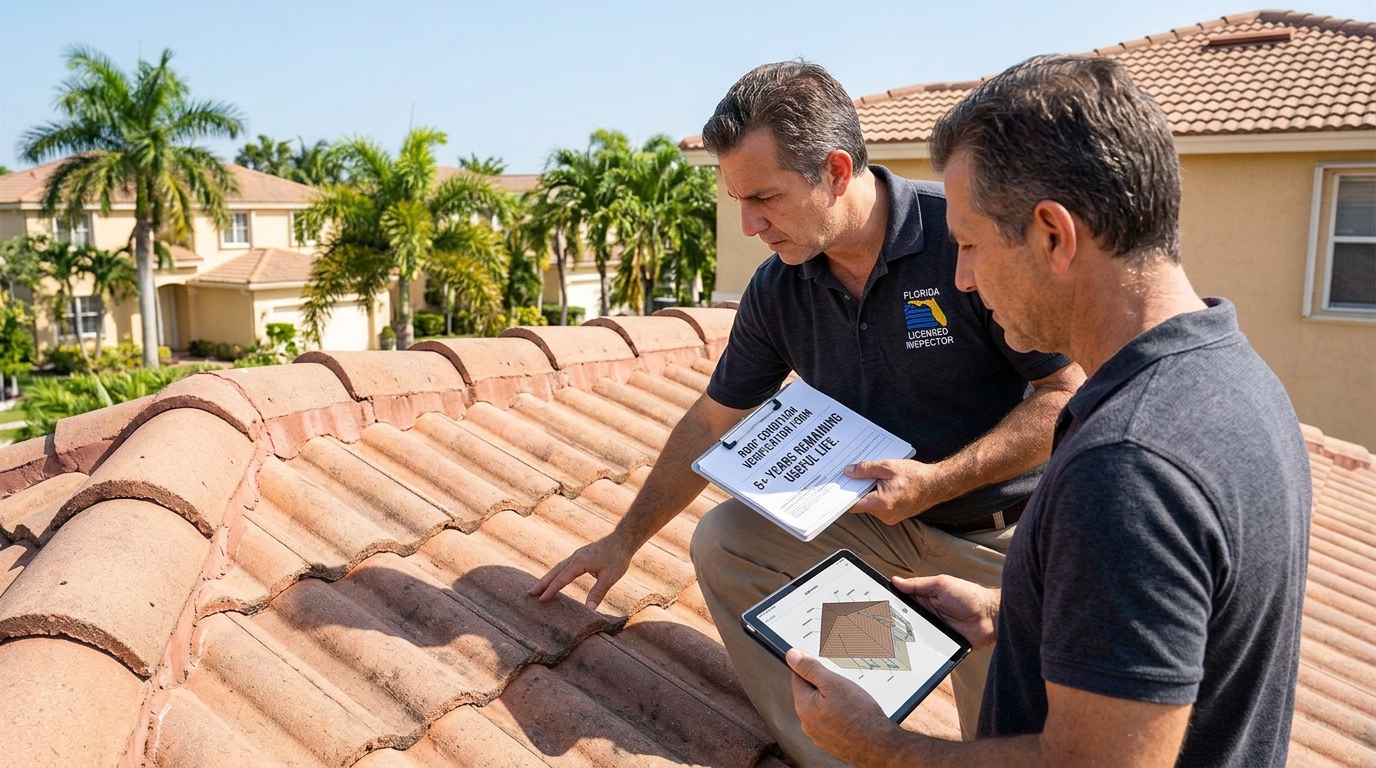
A proactive South Florida homeowner examines a roof with a licensed inspector who holds a 'ROOF CONDITION VERIFICATION FORM' certifying '5+ YEARS REMAINING USEFUL LIFE'

4. Roof Materials & Expected Insurable Lifespans

The material covering your home dramatically influences underwriting guidelines across private carriers and state-backed insurers like Citizens Property Insurance Corporation.


┌─────────────────────────┬─────────────────────────┬─────────────────────────┐

│ Roof Material Type      │ Typical Industry Life   │ Citizens Inspection Limit│

├─────────────────────────┼─────────────────────────┼─────────────────────────┤

│ Architectural Shingle   │ 15 to 25 Years          │ Inspection at 25 Years  │

│ Concrete / Clay Tile    │ 25 to 50 Years          │ Inspection at 50 Years  │

│ Standing Seam Metal     │ 30 to 50+ Years         │ Inspection at 50 Years  │

│ Flat / Low-Slope Membrane│ 10 to 15 Years          │ Inspection at 15 Years  │

└─────────────────────────┴─────────────────────────┴─────────────────────────┘


  • Asphalt Shingle Roofs: Private carriers scrutinize shingle roofs most heavily starting at year 15. However, high-grade architectural shingles often maintain structural integrity well beyond 15 years if properly maintained.
  • Tile & Metal Roofs: Concrete tiles, clay tiles, and standing-seam metal roofs regularly handle South Florida wind loads for decades. Citizens Property Insurance allows tile and metal roofs to reach up to 50 years before mandatory age-based useful life documentation is triggered.

5. Step-by-Step Defense Action Plan: Responding to a Non-Renewal Notice

If an insurance company delivers a notice demanding roof replacement or threatening non-renewal in Broward, Miami-Dade, or Palm Beach County, follow this structured response plan:


[Step 1: Audit Notice] ──> [Step 2: Hire Inspector] ──> [Step 3: Submit Form] ──> [Step 4: Legal Review]

  Check stated reasons       Independent 4-Point        Provide 5-year cert       Enforce statutory

  and roof age dates.        Roof Inspection.           to insurance carrier.     rights if denied.


  1. Audit the Non-Renewal Letter: Check the exact reason cited by the carrier. If the only reason listed is that your roof is between 1 and 14 years old, the notice violates Fla. Stat. § 627.7011(5).
  2. Order an Independent Roof Inspection: Contact a licensed Florida general contractor, building inspector, or engineer. Ask specifically for a Florida 4-Point Inspection or Roof Condition Verification Form.
  3. Secure the 5-Year Useful Life Certification: Ensure the inspector documents that the roof has at least 5 years of remaining useful life. This written verification serves as your primary protection under state law.
  4. Submit Formal Documentation via Certified Mail: Send the completed inspection report directly to your insurance agent and carrier. Request formal written confirmation that the non-renewal notice has been rescinded.
  5. Consult Legal Counsel if the Carrier Refuses: If an insurer ignores state statute and refuses to accept a valid 5-year useful life certification, legal intervention may be required to protect your property rights and coverage.

6. Frequently Asked Questions


Can my insurance company drop me if my shingle roof is only 12 years old?

No. Under Florida Statute § 627.7011(5), insurance companies cannot refuse to issue or renew a homeowners insurance policy solely because of roof age if the roof is less than 15 years old.

Who qualifies as an “authorized inspector” in Florida?

Under state law, authorized inspectors include licensed general contractors, building contractors, residential contractors, professional engineers, professional architects, and certified building code inspectors.

What happens if my roof is over 15 years old but in great condition?

If an authorized inspector certifies that your 15+ year old roof has at least 5 years of remaining useful life, Florida law prevents the insurer from denying or non-renewing your coverage solely based on roof age.

Does Citizens Property Insurance follow the same roof rules?

Yes, Citizens Property Insurance must comply with Florida statutory requirements. Citizens requires documentation verifying at least 5 years of remaining useful life for shingle roofs older than 25 years and tile/metal roofs older than 50 years.


Protecting Your Property Rights Across South Florida

When insurance carriers issue arbitrary non-renewal demands, knowing the statutory rules keeps you in control. If your insurance company is threatening improper non-renewal, forcing unnecessary roof replacements, or mishandling a property damage claim, our team can help you enforce your statutory protections.

Reinfeld Cabrera

Property Law & Real Estate Legal Services

Serving Broward County, Miami-Dade County, and Palm Beach County

Contact Our Office:

Disclaimer: The information provided in this guide is for general informational and educational purposes only and does not constitute formal legal advice. Property insurance laws and underwriting rules change frequently. Consult a qualified Florida legal professional regarding your specific situation.

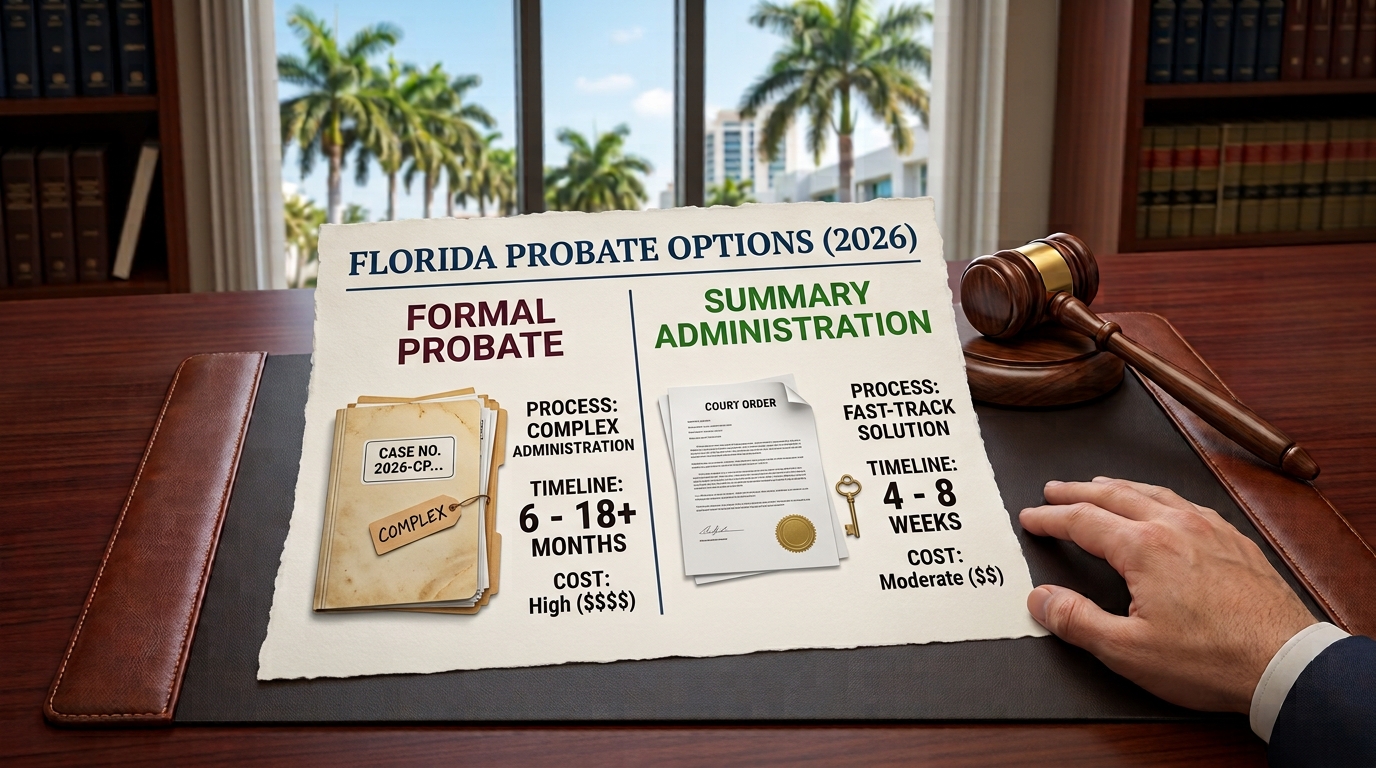
A detailed comparison chart of Formal Probate and Summary Administration on a legal desk with a gavel and hand, detailing process types, timelines (6-18+ months vs. 4-8 weeks), and relative costs for 2026 Florida probate cases.

Florida Summary Administration Requirements: How to Avoid Formal Probate in 2026


When a loved one passes away in Florida, families often assume they are facing a year-long legal battle filled with court dates, stacks of paperwork, and exorbitant administrative costs. However, under Chapter 735 of the Florida Probate Code, many families qualify for a fast-track judicial process known as Summary Administration.

Effective July 1, 2026, Florida doubled the statutory limit for small estate probate under Fla. Stat. § 735.201 from $75,000 to $150,000. This critical update allows significantly more families to distribute estate assets in a matter of weeks rather than months.


Direct Answer

What are the requirements for Summary Administration in Florida?

To qualify for Summary Administration in Florida under Fla. Stat. § 735.201, an estate must satisfy either of the following two criteria:

  1. The $150,000 Asset Cap: The total value of non-exempt Florida probate assets is $150,000 or less (for deaths on or after July 1, 2026).
  2. The 2-Year Rule: The decedent has been deceased for more than two years, regardless of total estate value.

Additionally, the decedent’s Last Will and Testament must not explicitly mandate Formal Estate Administration.


The Two Pathways to Qualifying for Summary Probate

Unlike Formal Administration—which requires the court to appoint a Personal Representative (Executor) and oversee a lengthy administration period—Summary Administration acts as a direct judicial order transferring assets straight to beneficiaries.

┌─────────────────────────────────────────────────────────┐

│           Summary Administration Qualification           │

└────────────────────────────┬────────────────────────────┘

                             │

              Does the Estate meet EITHER rule?

                             │

         ┌───────────────────┴───────────────────┐

         ▼                                       ▼

┌─────────────────────────┐             ┌─────────────────┐

│     The $150,000 Cap    │             │   2-Year Rule   │

│ Non-Exempt Assets ≤150k │     OR      │ Deceased >2 Yrs │

│  (Deaths Post-July 2026)│             │ (No Limit Cap)  │

└─────────────────────────┘             └─────────────────┘

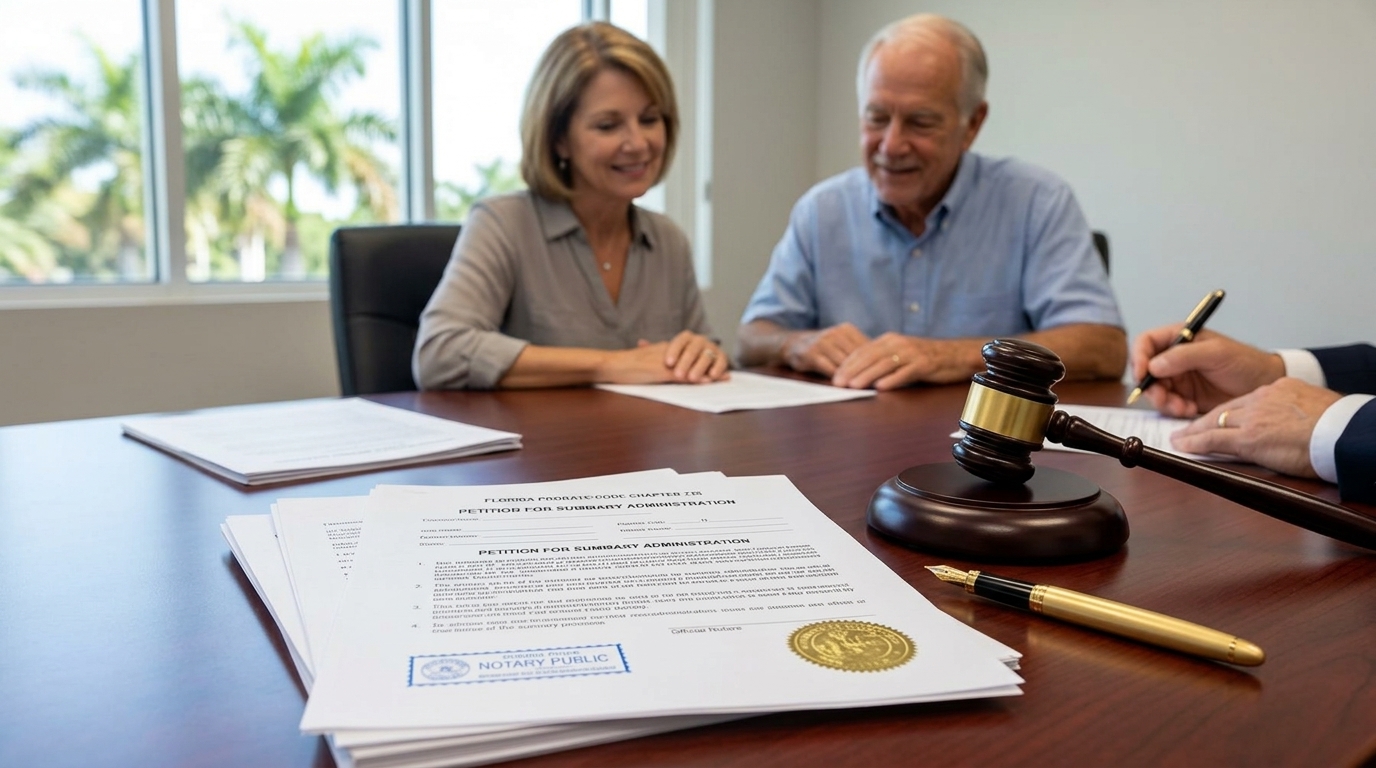
Clients meeting with their Florida summary administration probate lawyer in Coral Springs to finalize court petitions and avoid formal probate.

1. The $150,000 Asset Limit (Non-Exempt Property)

For decedents passing on or after July 1, 2026, the estate’s total non-exempt probate assets must not exceed $150,000. (For deaths occurring prior to July 1, 2026, the statutory limit remains $75,000).

2. The Two-Year Statute of Repose Rule

If the decedent passed away more than two years ago, the estate automatically qualifies for Summary Administration, regardless of how millions of dollars the estate is worth. Under Fla. Stat. § 733.710, Florida enforces a strict two-year statute of repose that permanently bars unfiled creditor claims, removing the necessity for a formal personal representative to manage debts.


Why “On-Paper” Net Worth Misleads Most Heirs

One of the most frequent misconceptions beneficiaries encounter is assuming that if a relative owned a high-value home in South Florida, they are automatically forced into Formal Probate.

Florida law only evaluates probate assets subject to court distribution. The following major asset categories are entirely excluded from the $150,000 threshold calculation:

  • Florida Protected Homestead Real Estate: Under Article X, Section 4 of the Florida Constitution, a primary residence passing to a surviving spouse or lineal heirs is constitutionally protected from general creditors. Because homestead rights vest immediately upon death, the home’s value (whether $400,000 or $2,000,000) does not count toward the $150,000 limit when petitions are properly structured.
  • Statutory Exempt Personal Property: Under Fla. Stat. § 732.402, up to $20,000 in household furniture/furnishings and two personal motor vehicles used by the decedent are exempt from creditor claims and excluded from the asset tally.
  • Non-Probate Financial Transfers: Bank accounts with Payable-on-Death (POD) or Transfer-on-Death (TOD) designations, life insurance policies with named beneficiaries, jointly owned property with rights of survivorship, and assets held inside a Revocable Living Trust bypass probate entirely.
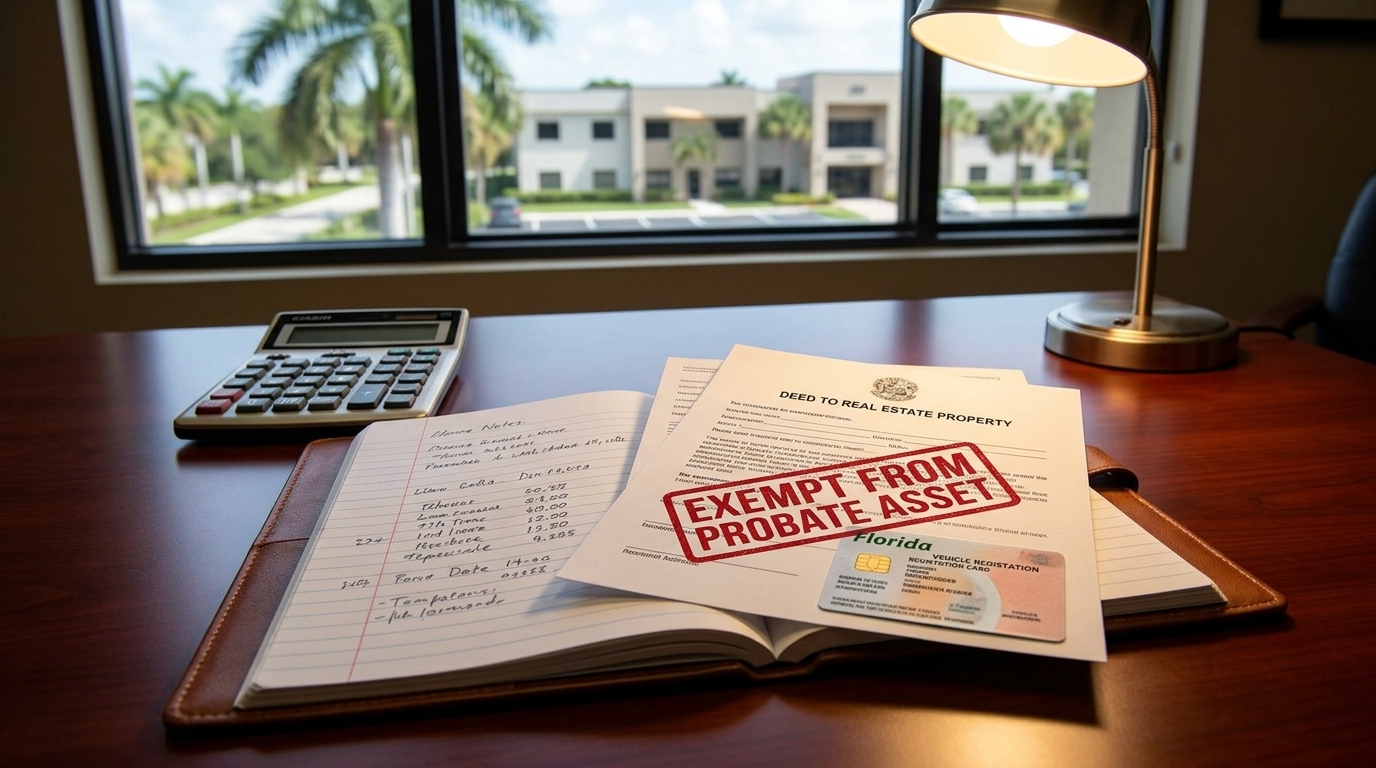
Calculating non-exempt probate assets in Florida: Real estate deed and vehicle documents marked exempt from probate to qualify for summary administration.

“Many families walk into our office believing they owe thousands in court fees because their parent owned a $700,000 house in Coral Springs. Once we isolate the constitutional homestead and exempt vehicles, the actual probate asset is just a $40,000 checking account—qualifying them for fast-track Summary Administration instantly.”

— Devin P. Tison, Esq., Lead Partner at Reinfeld Cabrera Tison


Real-World Case Studies: How Summary Administration Works in Practice

Case Study 1: Bypassing Formal Probate for a Broward County Home & Bank Account

  • Scenario: A widow in Fort Lauderdale passed away, leaving a home valued at $550,000 and a sole-name savings account containing $65,000. Her two adult children were named as equal beneficiaries in her Will.
  • The Legal Challenge: A traditional law firm informed the siblings they needed Formal Administration due to the $615,000 gross estate value, quoting an estimated 9-month process and thousands in hourly fees.
  • The RCT Solution: Our probate team filed a Petition for Determination of Homestead Property alongside a Petition for Summary Administration. Because the $550,000 home was protected homestead, its value dropped to $0 for qualification purposes. The only remaining asset was the $65,000 account—well under the statutory limit.
  • Outcome: The Broward County Probate Court issued an Order of Summary Administration in 5 weeks. The bank released the funds directly to the siblings, and the homestead order cleared title for them to sell the home without appointing a Personal Representative.

Case Study 2: Settling an Estate Decades Later for Out-of-State Heirs

  • Scenario: A father passed away in Miami-Dade County in 2018 owning an unlinked parcel of land. His heirs, living in New York, never probated the estate because they believed the process was too complex from out-of-state.
  • The Legal Challenge: The land grew in value to $220,000. The heirs wanted to sell the land but could not clear title without court authorization.
  • The RCT Solution: Because the decedent had been deceased for over two years, the estate qualified under the 2-Year Rule regardless of the $220,000 property value. We managed the entire filing remotely via Florida’s electronic court portal without requiring the heirs to travel to Florida.
  • Outcome: The court signed the distribution order within 4 weeks, enabling the title company to execute a seamless sale.

Detailed Comparison: Summary vs. Formal Administration


Key FeatureSummary Administration (Fla. Stat. § 735.201)Formal Administration (Fla. Stat. Ch. 733)
Statutory EligibilityNon-exempt assets $\le \$150,000$ OR death > 2 years agoEstates over $\$150,000$ or complex litigation cases
Average Timeline4 to 8 weeks6 to 12+ months
Personal RepresentativeNone appointed by the courtCourt appoints an Executor/PR
Letters of AdministrationNot issuedIssued (gives PR power to act for estate)
Primary Court OrderOrder of Summary AdministrationOrder of Discharge
Legal CostsSignificantly lower; often structured as a Flat FeeHigher court fees, inventory costs, and hourly rates

Frequently Asked Questions (FAQ)


Does Florida have a Small Estate Affidavit to avoid probate?

No. Florida does not recognize a standalone “Small Estate Affidavit” for transferring real estate or bank accounts like some other states do. Florida’s equivalent for small estates is Summary Administration or, for extremely small asset values under funeral costs, Disposition Without Administration (Fla. Stat. § 735.301).

What happens to outstanding creditor debts in Summary Administration?

Because no Personal Representative is appointed to manage estate claims, beneficiaries who receive assets through Summary Administration remain personally liable for valid debts of the decedent up to the dollar value of what they inherited. To eliminate this risk, a probate attorney can publish an optional Notice to Creditors in a local South Florida newspaper, initiating a 30-day window that permanently bars unfiled claims.

Can an out-of-state beneficiary file for Summary Administration in Florida?

Yes. Florida probate courts utilize 100% digital filing systems. Out-of-state heirs in New York, New Jersey, or anywhere across the country can hire a local Florida probate lawyer to execute the entire proceeding remotely without ever stepping foot inside a courtroom.

How long does it take to get an Order of Summary Administration?

In South Florida courts (Broward, Miami-Dade, and Palm Beach counties), an uncontested Petition for Summary Administration typically takes 4 to 8 weeks from initial filing to final judge signature, depending on judicial caseloads.


Why Choose Reinfeld & Cabrera, P.A. for South Florida Probate?

Navigating court petitions while grieving a family member can feel overwhelming. At Reinfeld & Cabrera, P.A. (mypersonalattorneys.com), we simplify the Florida probate process with transparency and local courtroom experience:

  • Transparent Flat-Fee Pricing: We eliminate financial anxiety by offering predictable flat legal fees for uncontested Summary Administration—no hidden hourly bills.
  • Bilingual Legal Representation: Our attorneys and staff speak fluent English and Spanish, ensuring clear communication for non-English speaking beneficiaries.
  • Full-Service Local Filings: We handle all court communication across Broward (17th Judicial Circuit), Miami-Dade (11th Judicial Circuit), and Palm Beach (15th Judicial Circuit) counties.

Take Action: Streamline Your Florida Probate Today

If you need to transfer real estate, recover frozen bank accounts, or resolve an estate in South Florida, contact Reinfeld & Cabrera, P.A. today for a free case evaluation.

  • Direct Phone: (954) 334-1520 / (855) 529-7123
  • Coral Springs Office: 9625 W. Sample Rd, Coral Springs, FL 33065
  • Online Consultation: Request a review at mypersonalattorneys.com