
Navigating the Medicaid 5-Year Lookback Rule Without Losing the Family Home

Executive desk displaying a Florida Elder Law book, estate plan folder, scale model home, and senior couple photo representing Medicaid asset protection.

Quick Answer: The Florida Medicaid 5-Year Lookback Rule allows the Department of Children and Families (DCF) to review all financial transactions and asset transfers made within 60 months prior to applying for Nursing Home Medicaid. Gifting real estate or transferring home ownership below fair market value triggers severe penalty periods of Medicaid ineligibility.

However, homeowners can legally shield their residence from long-term care costs and Medicaid Estate Recovery (MERP) through statutory exceptions—such as the Caregiver Child Exemption, spousal transfers, Medicaid Asset Protection Trusts (MAPTs) created outside the 5-year window, or Lady Bird Deeds that bypass probate without violating lookback rules.


1. How the Florida Medicaid 5-Year Lookback Rule Operates

When an individual applies for Institutional Care Program (ICP) Medicaid in Florida, the state evaluates both income and countable assets. To prevent applicants from gifting away assets to qualify for state benefits, Florida enforces a strict 60-month “lookback” period.

  • Month 60 to Application Date: The window of scrutiny evaluated by the state.
  • Uncompensated Asset Transfer: Any transfer of property, cash, or real estate for less than fair market value during this 60-month window.
  • Penalty Period Enforcement: DCF calculates a period of Medicaid ineligibility based on the total value of the uncompensated transfer.

The Penalty Period Calculation

If the Florida Department of Children and Families (DCF) discovers an uncompensated transfer within the 60 months preceding the application date, DCF imposes a penalty period during which the applicant is disqualified from Medicaid coverage.

During this penalty period, the applicant must pay for nursing home care entirely out-of-pocket—often exceeding $10,000 to $12,000 per month in South Florida facilities—before Medicaid coverage can begin.

Is the Primary Residence a Countable Asset?

In Florida, a primary residence homestead is generally considered an exempt asset for initial Medicaid eligibility if the applicant’s equity interest does not exceed the state’s maximum equity limit and the applicant indicates an “intent to return home” on the application.

However, holding a primary residence as an exempt asset during life does not protect it after death. Without proactive legal structuring, the home remains vulnerable to post-death creditor claims by the state.


2. The Threat of Medicaid Estate Recovery (MERP)

Qualifying for Medicaid during life is only half the battle. Under Fla. Stat. § 409.9101, Florida operates the Medicaid Estate Recovery Program (MERP). Upon the Medicaid recipient’s death, the state becomes a creditor against their probate estate to recoup every dollar paid out for long-term care services.

  • Property Titled in Deceased’s Name Alone: Passes through formal probate administration, allowing MERP to execute claims and attach liens to force a sale.
  • Property Structured Outside Probate: Passes directly to designated heirs via deed or trust, completely avoiding probate administration and blocking MERP claims.

If the home passes through formal probate administration, the state can attach a lien to the real estate, forcing heirs to sell the property to satisfy the Medicaid debt. Protecting the family home requires strategies that insulate the residence during the lookback analysis while simultaneously ensuring the home bypasses probate court at death.


3. Statutory Exceptions and Exemption Strategies

Florida Medicaid rules contain explicit statutory safe harbors that permit home transfers within the 5-year window without triggering a penalty period.

Transfer Strategy / ExemptionLookback Penalty StatusPrimary Legal Advantage
Transfer to Surviving SpouseFully ExemptPreserves full ownership for the well spouse (Community Spouse) without penalty.
Caregiver Child ExemptionFully ExemptTransfers home title directly to an adult child who provided in-home care.
Transfer to Disabled ChildFully ExemptProtects property for a child verified as permanently disabled under SSI/SSDI rules.
Lady Bird Deed (Enhanced Life Estate)Fully ExemptRetains lifetime control, avoids probate, and blocks MERP claims.
Medicaid Asset Protection Trust (MAPT)Subject to 5-Year LookbackMust be executed >60 months prior to application; provides total asset protection.

The Caregiver Child Exemption

Under Florida Medicaid guidelines, an applicant can transfer full title of the homestead to their adult child without incurring a transfer penalty if specific conditions are met:

  • The adult child lived in the parent’s primary residence for at least two consecutive years immediately prior to the parent’s admission to a nursing home or long-term care facility.
  • The child provided documented care that permitted the parent to reside safely at home rather than in a medical care facility during those two years.
  • The care provided is verified through medical records, physician attestations, and detailed care logs.

Spousal Transfers and Community Spouse Resource Allowance (CSRA)

Transferring the primary residence to a Community Spouse (the spouse who remains living in the community) is completely exempt from the 5-year lookback rule. The well spouse can receive full title to the home without impacting the institutionalized spouse’s Medicaid application.

Lady Bird Deeds (Enhanced Life Estate Deeds)

A Florida Lady Bird Deed allows a property owner to retain an enhanced life estate (including full rights to sell, mortgage, or revoke the deed) while designating remainder beneficiaries who inherit the property automatically at death.

  • Why it passes lookback scrutiny: Because the owner retains full control to revoke the deed during life, recording a Lady Bird Deed is not classified as a completed uncompensated gift by Florida DCF.
  • Why it blocks MERP: The property transfers automatically upon death outside of probate administration, effectively shielding the homestead from state estate recovery claims under Fla. Stat. § 409.9101.

4. Real-World Execution Scenarios

Scenario A: Proactive Planning (7 Years Before Long-Term Care Needs)

  • Profile: A 70-year-old homeowner in Broward County with early-stage health concerns wants to protect her home valued at $500,000 for her two adult children.
  • Strategy: The homeowner executes a Medicaid Asset Protection Trust (MAPT) and deeds her home into the irrevocable trust.
  • Outcome: Because the transfer occurred more than 60 months before she ever required nursing care, the 5-year lookback window expires cleanly. The home is completely sheltered from long-term care costs, and she retains the right to live in the home for life.

Scenario B: Emergency Crisis Planning (Immediate Nursing Home Admission)

  • Profile: An 82-year-old widower suffers a severe stroke and requires immediate, permanent placement in a Coral Springs skilled nursing facility. He has lived with his adult daughter for the past three years, during which she managed his daily medical needs.
  • Strategy: His legal team gathers medical documentation and physician certifications establishing the Caregiver Child Exemption, while simultaneously executing a Lady Bird Deed as a secondary safeguard.
  • Outcome: The home is transferred directly to the daughter without triggering a Medicaid penalty period, preserving the home from immediate spend-down and future Medicaid estate recovery.

Frequently Asked Questions


Can Medicaid take my home while I am still alive in Florida?

No. Florida law does not allow Medicaid to place a lien on or seize your primary residence while you are alive, provided your equity remains under the state limit and you state an intent to return home. Threat of home loss occurs after death through the Medicaid Estate Recovery Program (MERP) during probate administration.

Does executing a Lady Bird Deed trigger a 5-year lookback penalty?

No. Because a Florida Lady Bird Deed allows you to retain total unilateral control to sell, refinance, or revoke the conveyance during your lifetime, Florida DCF does not treat it as a completed gift or uncompensated transfer. It does not trigger a Medicaid penalty period.

What evidence is required for the Caregiver Child Exemption in Florida?

Florida DCF requires clear written proof, including:

  • Proof of joint residency (such as tax returns, driver’s licenses, or utility bills) covering the two years prior to facility admission.
  • A signed written statement from the treating physician confirming that the care provided by the adult child allowed the parent to remain safely at home instead of entering a nursing facility.

Protect Your Family Home and Assets Before a Crisis Strikes

Navigating Florida Medicaid rules and protecting your real estate from long-term care costs requires proactive, highly technical legal planning. A single misstep with uncompensated asset transfers or failing to structure your property outside of probate can expose your family home to devastating out-of-pocket nursing home expenses and Medicaid Estate Recovery liens.

Do not leave your family’s legacy vulnerable to the uncertainties of the 5-year lookback window. Connect directly with our estate planning and elder law team to build a secure, customized asset protection strategy tailored to your circumstances.

Serving families throughout Coral Springs, Fort Lauderdale, Boca Raton, and across Broward County.

Who Inherits the Family Home in Florida? Homestead Rights for Spouses & Heirs

Real estate house keys resting on estate documents representing Florida homestead property transfers after death.

Under Article X, Section 4 of the Florida Constitution, a primary residence (homestead) is subject to strict constitutional inheritance laws that override standard terms written in a Will or Trust. If a Florida homestead owner dies while survived by a spouse or minor child, state law dictates who receives the home, preventing the owner from freely disinheriting their immediate family.


Direct Answer: When a married Florida homestead owner dies with surviving descendants, Florida Statute § 732.401 gives the surviving spouse two choices: a Life Estate (the right to live in the home for life with a vested remainder to descendants) OR an election to take an undivided 50% ownership share as Tenants in Common. The spouse must file this 50% election within 6 months of the owner’s date of death.


Can You Disinherit a Spouse or Child from a Florida Homestead in Your Will?

Florida’s constitutional restrictions prevent homeowners from leaving their primary residence to outside parties if they have a legal spouse or minor children at the time of death.

  • If you have minor children: You cannot leave the home entirely to your spouse or anyone else in a Will. Any attempt to do so is legally void under Florida law.
  • If you have a spouse (and no minor children): You can only leave the home outright to your surviving spouse. Leaving it to a friend, charity, or adult child from a previous marriage without spousal waiver is invalid.
  • If you have no spouse and no minor children: You are free to leave the property to whomever you choose.

If a Will attempts to convey homestead property in violation of these rules, Florida probate courts treat the gift as an invalid devise. The property automatically passes according to Florida’s statutory rules under Fla. Stat. § 732.401.


Life Estate vs. 50% Election: What Are a Surviving Spouse’s Rights Under Fla. Stat. § 732.401?

When a homestead owner dies survived by a spouse and children (adult or minor), Florida Statute § 732.401 governs how ownership splits between them.

Option 1: Default Life Estate

By default, the surviving spouse receives a Life Estate.

  • Spouse’s Rights: The right to live in, use, and occupy the residence for the remainder of their lifetime.
  • Children’s Rights: The decedent’s children receive a vested remainder, automatically assuming 100% ownership after the surviving spouse passes away.
  • Limitations: The surviving spouse cannot sell, mortgage, or transfer the home without the full consent of all children holding the remainder interest.

Option 2: The 50% Tenant-in-Common Election

To prevent friction between surviving spouses and adult stepchildren, Florida law permits the surviving spouse to opt out of the Life Estate.

  • Spouse’s Rights: The spouse takes an undivided 50% ownership interest as a Tenant in Common.
  • Children’s Rights: The decedent’s children collectively share the remaining 50% ownership interest.
  • Benefits: Either side can file a court action to force a sale (partition action) if both sides cannot agree on maintaining or selling the home.

Comparison Table: Florida Homestead Life Estate vs. 50% Tenant-in-Common Election (Fla. Stat. § 732.401)

Ownership FeatureOption 1: Default Life EstateOption 2: 50% Tenant-in-Common Election
Spousal ControlExclusive right to live in property for life50% legal ownership share
Heir ControlFuture ownership after spouse diesImmediate 50% collective ownership share
Routine Costs (Taxes, Insurance)Spouse pays 100% of property taxes & maintenanceSplit 50/50 between spouse and heirs
Mortgage PrincipalSplit according to statutory interest formulasSplit 50/50 between spouse and heirs
Forced Sale (Partition)Cannot be forced by heirs or spouseEither party can initiate partition to sell property
Strict DeadlineNone (automatic default)6 months from owner’s date of death

Is a Florida Homestead Protected From Estate Creditors After Death?

Beyond inheritance rules, Article X, Section 4(b) of the Florida Constitution provides strong creditor protections that pass directly to heirs.

If the primary home passes to an exempt heir (a surviving spouse, child, sibling, niece, or nephew), the home transfers free and clear of most estate debts. Unsecured creditors; such as credit card companies, medical providers, or personal loan lenders, cannot force the sale of a Florida homestead to satisfy the decedent’s unpaid debts during probate.

(Note: Under Florida’s probate framework, homestead property is entirely excluded when calculating eligibility for summary administration.)

Only three specific debt types can attach to a Florida homestead:

  1. Mortgages signed on the property.
  2. Unpaid real estate property taxes or special assessments.
  3. Mechanics’ and contractors’ liens for work performed directly on the home.

How Do You Establish Legal Homestead Status in Florida Probate Court?

Homestead protections do not apply automatically on paper; they must be formally recognized by a probate judge in the local circuit court (such as the 17th Judicial Circuit in Broward County, 15th Circuit in Palm Beach, or 11th Circuit in Miami-Dade).

  1. File a Petition for Order Determining Homestead Status: A probate attorney files an official petition asking the court to confirm that the property meets constitutional homestead qualifications.
  2. Obtain the Judicial Order: Once signed by the probate judge, the Order Determining Homestead removes the residence from the general probate estate, transfers title to the legal heirs, and shields it from general creditors.
  3. Record the Notice of Election (If Applicable): If taking the 50% Tenant-in-Common election, an official Notice of Election containing the property’s legal description must be signed and recorded in county land records within the strict 6-month statutory window.

Resolving Florida Homestead Disputes and Protecting Estate Rights

Florida’s constitutional homestead protections exist to protect families from displacement and unmanageable creditor claims following a loved one’s passing.

However, the strict constitutional mandates surrounding testamentary freedom, paired with the mandatory 6-month statutory window under Fla. Stat. § 732.401, mean that minor procedural errors can result in forfeited spousal rights, clouded property titles, or unexpected co-ownership disputes between spouses and stepchildren.

Navigating a homestead determination requires swift action in the local probate court to secure clear legal title, enforce statutory elections, and shield the home from unauthorized creditor claims.


Consult South Florida Probate Attorneys at Reinfeld Cabrera Tison

Whether you are a surviving spouse evaluating a Life Estate vs. 50% Tenant-in-Common Election, an heir seeking to establish homestead creditor protections, or a personal representative executing an estate, the probate team at Reinfeld Cabrera Tison provides experienced guidance throughout the entire judicial process.

  • Office Address: 9625 W Sample Rd, Coral Springs, FL 33065
  • Contact Phone: (954) 866-4878 | 954-866-HURT
  • Local Probate Venues Served: 17th Judicial Circuit (Broward County Courthouse, Fort Lauderdale), 15th Judicial Circuit (Palm Beach County), 11th Judicial Circuit (Miami-Dade County), and 16th Judicial Circuit (Monroe County).

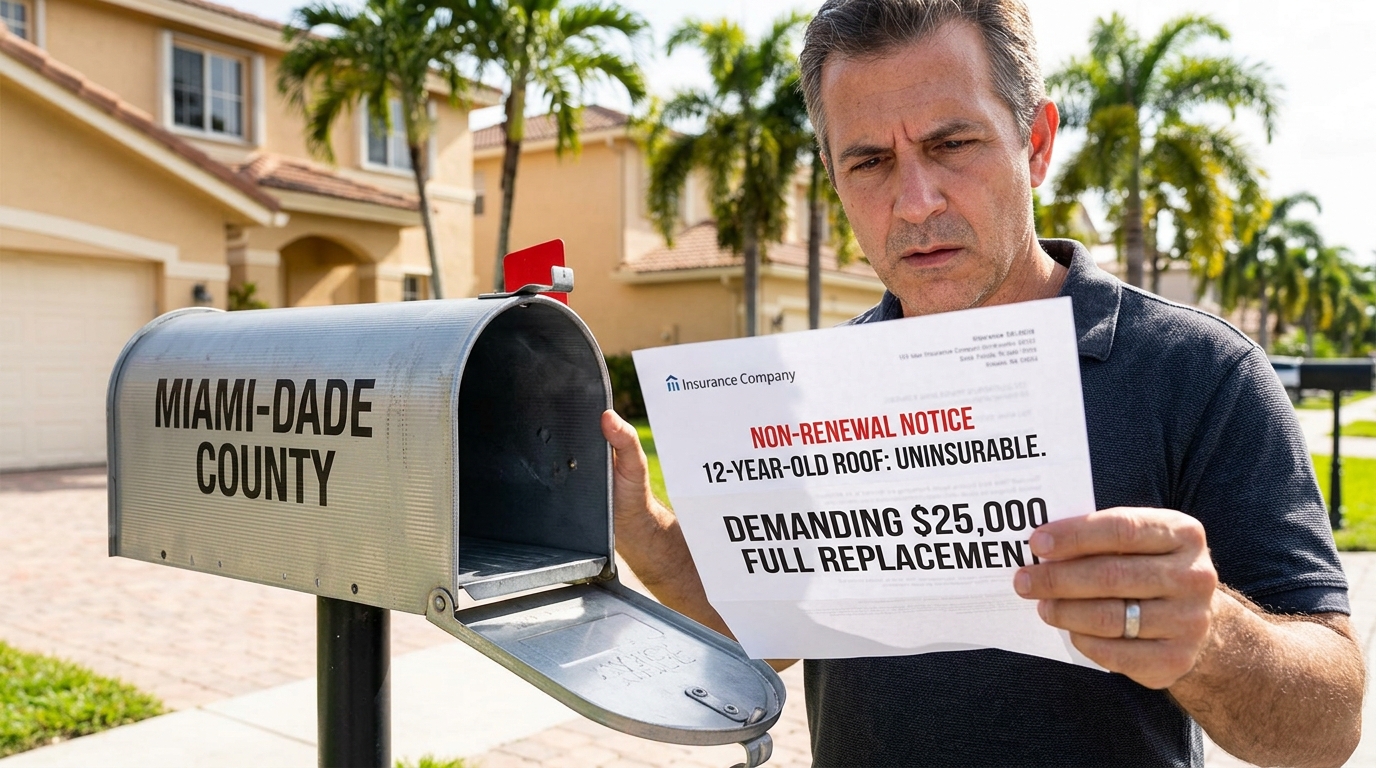
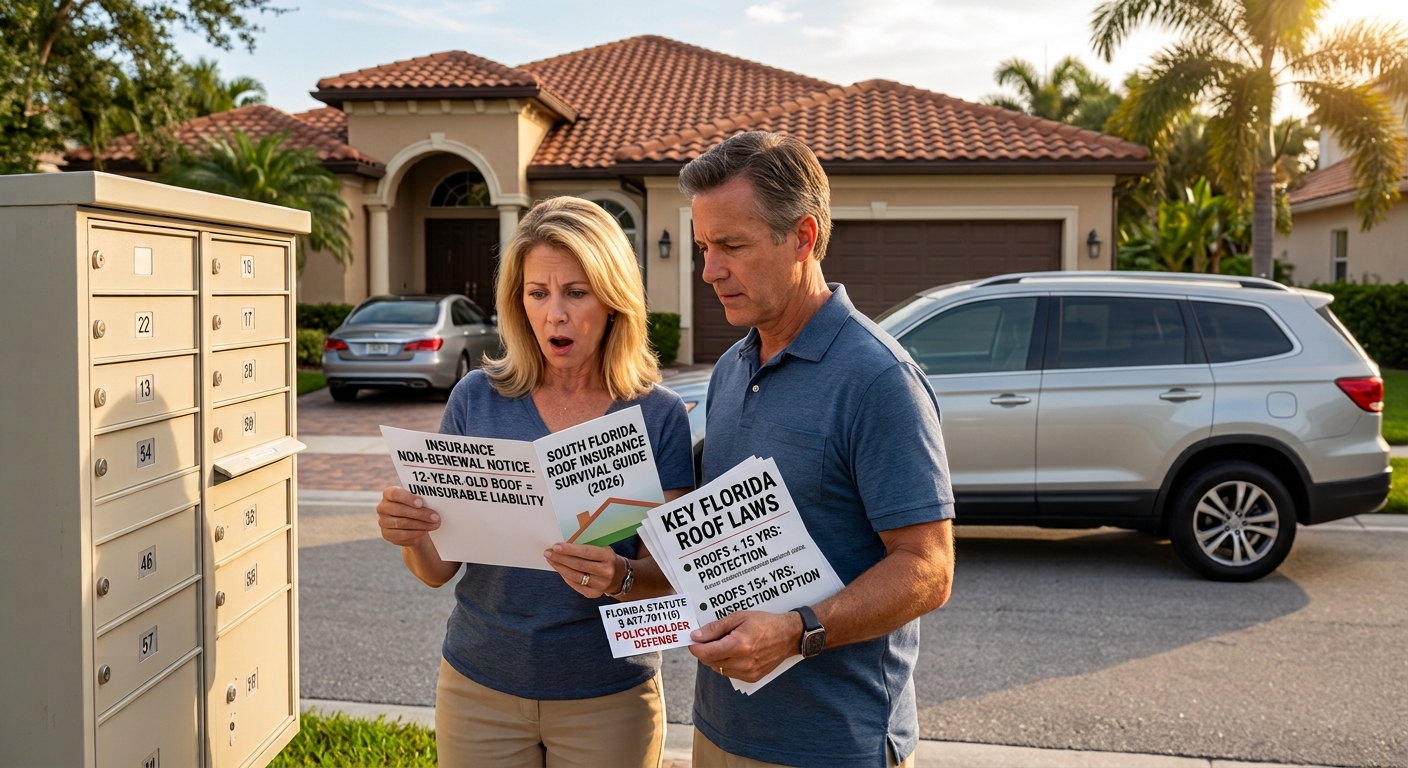
A concerned couple at a South Florida mailbox reads an insurance non-renewal notice stating their 12-year-old roof is an uninsurable liability. They are holding a 2026 survival guide and a summary of new Florida roof laws protection.

The South Florida Homeowner’s 2026 Roof Insurance Survival Guide

Opening your mailbox in Broward, Miami-Dade, or Palm Beach County often feels like an unpredictable gamble. One afternoon you are enjoying South Florida weather, and the next you are holding a notice from your insurance carrier stating that your 12-year-old roof is suddenly an uninsurable liability—demanding a $25,000 full replacement under threat of immediate non-renewal.

Before panicking or signing a contract with a door-to-door roofer, understand the ground rules. Florida property insurance regulations give homeowners explicit statutory protections that many carriers conveniently omit in their automated non-renewal letters.


Executive Legal Summary: Florida’s Roof Age Laws at a Glance

  • Roofs Under 15 Years Old: Under Florida Statute § 627.7011(5), property insurance carriers cannot deny coverage or refuse to renew a policy solely based on the age of your roof.
  • Roofs 15 Years or Older: Insurers can require a roof inspection, but they cannot deny coverage or force a replacement if an authorized inspector certifies that the roof has at least 5 years of remaining useful life.
  • Authorized Inspector Qualifications: Inspections must be completed by a licensed general contractor, building contractor, residential contractor, professional engineer, professional architect, or certified building code inspector.
  • Citizens Property Insurance Thresholds: Citizens requires roofs over 25 years old (for shingle) or 50 years old (for tile/metal) to submit a 4-Point or Roof Inspection Form proving 5+ years of useful life.
A distressed South Florida homeowner holds up an insurance non-renewal notice demanding $25,000 for a 12-year-old roof.

1. The Legal Reality: Florida’s 15-Year Roof Rule (Fla. Stat. § 627.7011)

Many homeowners mistakenly believe that reaching the 10- or 12-year mark on an asphalt shingle roof gives an insurer automatic legal authorization to cancel their policy. That is false.


                    FLORIDA ROOF AGE STATUTORY TIMELINE

 [0 to 14 Years Old]  ================================> CANNOT NON-RENEW SOLELY ON AGE

                                                       (Fla. Stat. § 627.7011(5))

 [15+ Years Old]      ================================> INSPECTION REQUIRED

                                                         │

                                                         ├─> 5+ Years Useful Life = COVERAGE MANDATED

                                                         └─> <5 Years Useful Life = Replacement/Repair


Protection for Roofs Under 15 Years

Florida Statute § 627.7011(5) explicitly states that an insurance company issuing or renewing a homeowners policy cannot refuse coverage solely because of roof age if the roof surface is less than 15 years old. If your carrier sends a non-renewal notice citing only a 12-year or 14-year roof age, they are violating state insurance guidelines.

The “5-Year Useful Life” Rule for Older Roofs

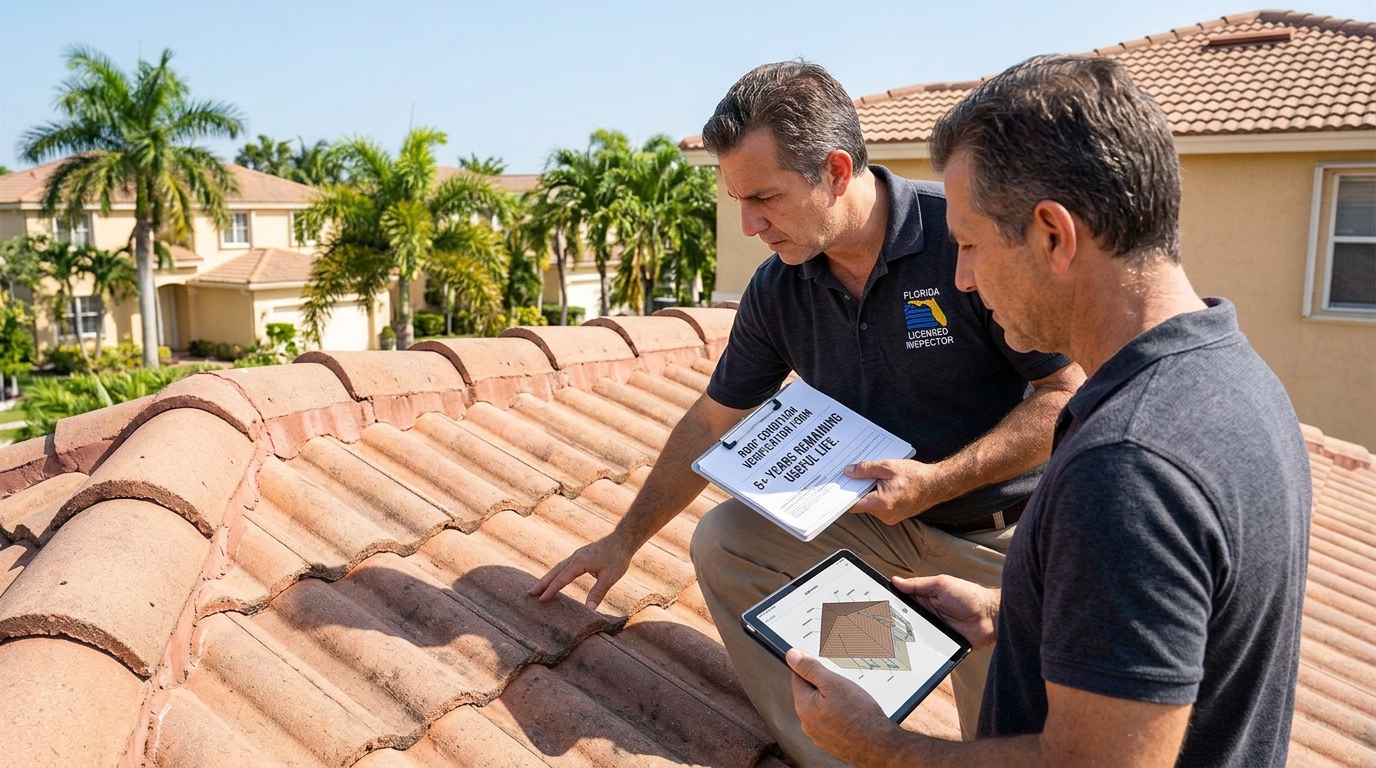
Once your roof hits or exceeds 15 years of age, the insurer gains the right to demand a professional roof inspection prior to policy renewal. However, the law still protects you: if the inspection proves your roof has at least 5 years of remaining useful life, the insurance company cannot reject your renewal application or force a complete replacement based on age alone.


2. Insurance Company Scare Tactics vs. Florida Statutory Law

Claim Made by Insurance CarrierActual Florida Legal & Statutory StandardImpact on Property Owner
“Your shingle roof is 12 years old, so you must replace it within 30 days to keep your policy.”Violates Fla. Stat. § 627.7011(5). Insurers cannot drop policies solely for roof age under 15 years.You do not have to replace a functional 12-year-old roof just because the carrier requests it.
“Your 16-year-old roof failed our satellite image review, so we are non-renewing.”Insurers must allow you to hire an authorized inspector to perform an in-person evaluation.Aerial satellite photos cannot override a physical inspection certifying 5+ years of useful life.
“Only our internal adjusters can determine if your roof is acceptable.”Inspections can be completed by any licensed Florida contractor, engineer, or home inspector.You have the right to hire your own independent inspector to document your roof’s actual condition.
“You must switch to an Actual Cash Value (ACV) endorsement or face immediate cancellation.”Policy changes must comply with OIR filings, and insurers must give advance written notice of endorsement alterations.ACV reduces payouts by factoring in heavy depreciation; understand what rights you give up before signing.

3. RCV vs. ACV: The Hidden Policy Trap

Understanding how your insurance carrier calculates roof damage payouts is essential when navigating renewals and storm damage claims.

  • Replacement Cost Value (RCV): The insurer covers the actual cost to repair or replace the damaged roof with similar materials at current market prices, without deducting money for age or wear and tear.
  • Actual Cash Value (ACV): The insurer deducts depreciation based on the age and condition of the roof before issuing a payment.

If a 15-year-old roof with a 20-year lifespan suffers severe storm damage under an ACV policy, the insurer may only pay 25% of the replacement cost, leaving the homeowner responsible for the remaining 75% out-of-pocket. Pay close attention to policy renewal documents—carriers frequently attempt to slip ACV roof endorsements onto older homes during annual renewals.

A proactive South Florida homeowner examines a roof with a licensed inspector who holds a 'ROOF CONDITION VERIFICATION FORM' certifying '5+ YEARS REMAINING USEFUL LIFE'

4. Roof Materials & Expected Insurable Lifespans

The material covering your home dramatically influences underwriting guidelines across private carriers and state-backed insurers like Citizens Property Insurance Corporation.


┌─────────────────────────┬─────────────────────────┬─────────────────────────┐

│ Roof Material Type      │ Typical Industry Life   │ Citizens Inspection Limit│

├─────────────────────────┼─────────────────────────┼─────────────────────────┤

│ Architectural Shingle   │ 15 to 25 Years          │ Inspection at 25 Years  │

│ Concrete / Clay Tile    │ 25 to 50 Years          │ Inspection at 50 Years  │

│ Standing Seam Metal     │ 30 to 50+ Years         │ Inspection at 50 Years  │

│ Flat / Low-Slope Membrane│ 10 to 15 Years          │ Inspection at 15 Years  │

└─────────────────────────┴─────────────────────────┴─────────────────────────┘


  • Asphalt Shingle Roofs: Private carriers scrutinize shingle roofs most heavily starting at year 15. However, high-grade architectural shingles often maintain structural integrity well beyond 15 years if properly maintained.
  • Tile & Metal Roofs: Concrete tiles, clay tiles, and standing-seam metal roofs regularly handle South Florida wind loads for decades. Citizens Property Insurance allows tile and metal roofs to reach up to 50 years before mandatory age-based useful life documentation is triggered.

5. Step-by-Step Defense Action Plan: Responding to a Non-Renewal Notice

If an insurance company delivers a notice demanding roof replacement or threatening non-renewal in Broward, Miami-Dade, or Palm Beach County, follow this structured response plan:


[Step 1: Audit Notice] ──> [Step 2: Hire Inspector] ──> [Step 3: Submit Form] ──> [Step 4: Legal Review]

  Check stated reasons       Independent 4-Point        Provide 5-year cert       Enforce statutory

  and roof age dates.        Roof Inspection.           to insurance carrier.     rights if denied.


  1. Audit the Non-Renewal Letter: Check the exact reason cited by the carrier. If the only reason listed is that your roof is between 1 and 14 years old, the notice violates Fla. Stat. § 627.7011(5).
  2. Order an Independent Roof Inspection: Contact a licensed Florida general contractor, building inspector, or engineer. Ask specifically for a Florida 4-Point Inspection or Roof Condition Verification Form.
  3. Secure the 5-Year Useful Life Certification: Ensure the inspector documents that the roof has at least 5 years of remaining useful life. This written verification serves as your primary protection under state law.
  4. Submit Formal Documentation via Certified Mail: Send the completed inspection report directly to your insurance agent and carrier. Request formal written confirmation that the non-renewal notice has been rescinded.
  5. Consult Legal Counsel if the Carrier Refuses: If an insurer ignores state statute and refuses to accept a valid 5-year useful life certification, legal intervention may be required to protect your property rights and coverage.

6. Frequently Asked Questions


Can my insurance company drop me if my shingle roof is only 12 years old?

No. Under Florida Statute § 627.7011(5), insurance companies cannot refuse to issue or renew a homeowners insurance policy solely because of roof age if the roof is less than 15 years old.

Who qualifies as an “authorized inspector” in Florida?

Under state law, authorized inspectors include licensed general contractors, building contractors, residential contractors, professional engineers, professional architects, and certified building code inspectors.

What happens if my roof is over 15 years old but in great condition?

If an authorized inspector certifies that your 15+ year old roof has at least 5 years of remaining useful life, Florida law prevents the insurer from denying or non-renewing your coverage solely based on roof age.

Does Citizens Property Insurance follow the same roof rules?

Yes, Citizens Property Insurance must comply with Florida statutory requirements. Citizens requires documentation verifying at least 5 years of remaining useful life for shingle roofs older than 25 years and tile/metal roofs older than 50 years.


Protecting Your Property Rights Across South Florida

When insurance carriers issue arbitrary non-renewal demands, knowing the statutory rules keeps you in control. If your insurance company is threatening improper non-renewal, forcing unnecessary roof replacements, or mishandling a property damage claim, our team can help you enforce your statutory protections.

Reinfeld Cabrera

Property Law & Real Estate Legal Services

Serving Broward County, Miami-Dade County, and Palm Beach County

Contact Our Office:

Disclaimer: The information provided in this guide is for general informational and educational purposes only and does not constitute formal legal advice. Property insurance laws and underwriting rules change frequently. Consult a qualified Florida legal professional regarding your specific situation.