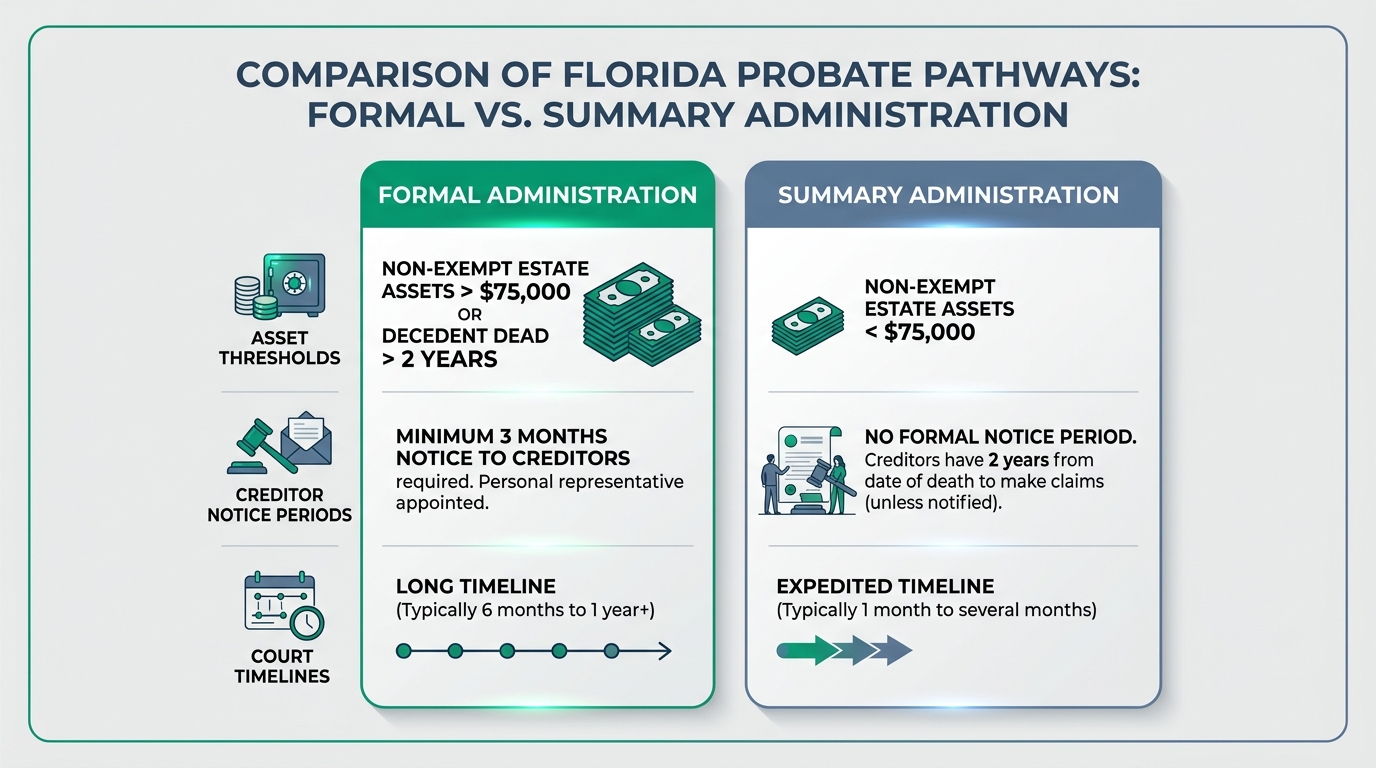
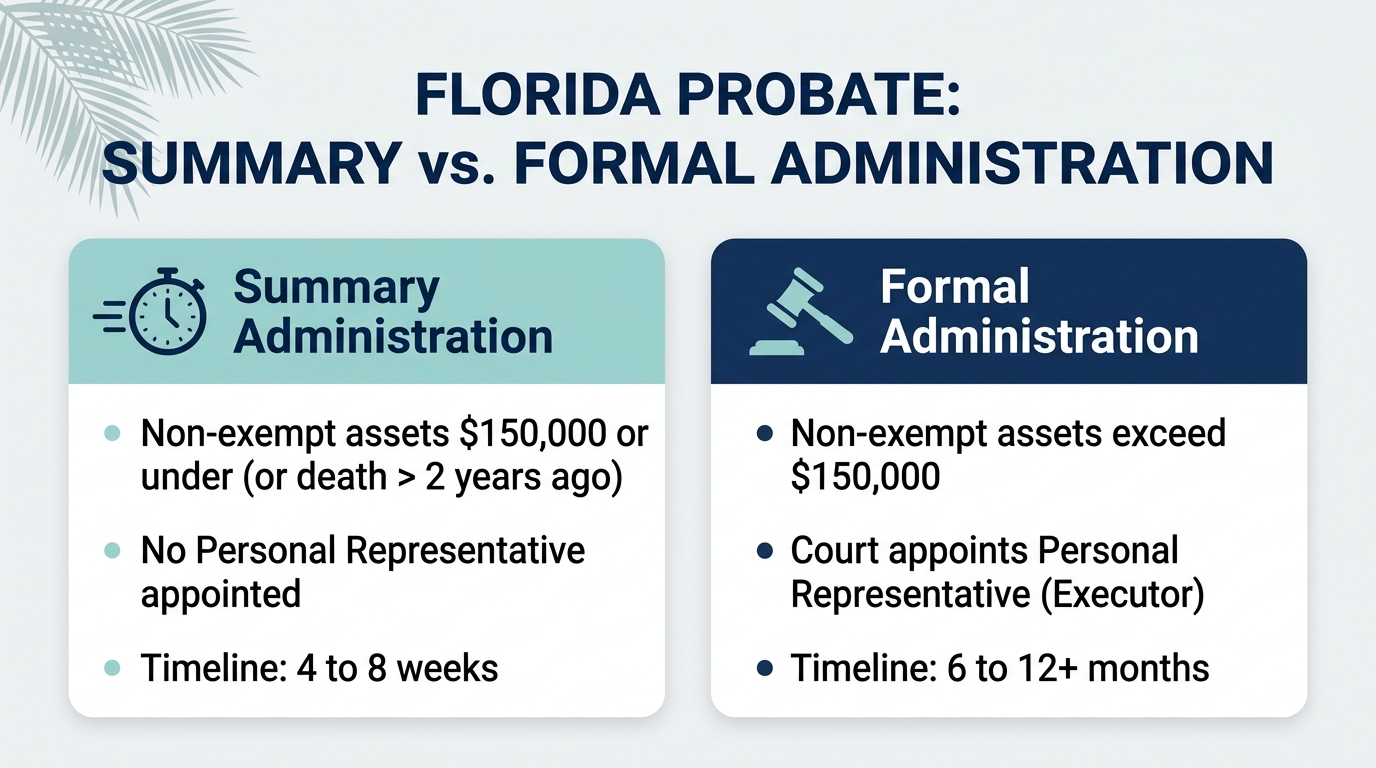
In Florida, court-supervised probate is divided into two primary procedures: Summary Administration (an expedited process for smaller or older estates) and Formal Administration (the traditional, fully supervised court process).
Whether an estate qualifies for Summary Administration depends on the total net value of non-exempt probate assets, whether the decedent has been deceased for over two years, and the complexity of outstanding creditor claims under Florida probate law (Fla. Stat. § 735.201). Understanding how these two probate paths function ensures that South Florida beneficiaries receive their inheritance as quickly and cost-effectively as possible.
Summary vs. Formal Administration at a Glance
Qualification & Process Feature
Summary Administration (Fla. Stat. § 735.201)
Formal Administration (Florida Probate Rules)
Estate Value Threshold
Non-exempt probate assets are $150,000 or less (for deaths on/after July 1, 2026), OR the decedent has been deceased for over 2 years.
Required for estates exceeding $150,000 in non-exempt probate assets (if death occurred within 2 years).
Personal Representative
Not appointed. No Letters of Administration are issued by the court.
Required. Court officially appoints a Personal Representative (Executor) with fiduciary authority.
Average Timeline
4 to 8 weeks (subject to Broward County court docket schedules).
Creditors must be resolved or served prior to distribution; or barred if death occurred over 2 years ago.
Formal 3-month Notice to Creditors published in local media to legally bar future claims.
Primary Judicial Order
Order Summary Administration directly transfers legal title of assets to beneficiaries.
Letters of Administration issued at inception; Order of Discharge issued at estate closing.
When Does Summary Administration Apply in Florida?
Summary Administration is an expedited judicial procedure designed to transfer title to beneficiaries without opening a full probate estate. However – to qualify under Florida law, the estate must satisfy one of two statutory criteria:
The $150,000 Net Asset Test: Effective July 1, 2026, Florida increased the summary administration statutory limit. The total value of all assets subject to probate—excluding protected Florida Constitutional Homestead real estate and statutory exempt personal property—does not exceed $150,000 (for deaths on or after July 1, 2026; $75,000 for deaths prior to July 1, 2026).
The Two-Year Rule: The decedent has been deceased for more than two years, regardless of the overall financial value of the estate. Under Fla. Stat. § 733.710, two years establishes a non-claim statute of repose that automatically bars unfiled creditor claims.
Key Distinction: No Personal Representative Appointed
In Summary Administration, the court does not appoint a Personal Representative and does not issue Letters of Administration. Instead, a petition is submitted asking the judge to issue a direct order transferring specific assets (such as a bank account or vehicle) directly to named beneficiaries.
If an estate requires active ongoing legal authority—such as accessing restricted medical records, pursuing a wrongful death lawsuit, or negotiating complex business debts—Formal Administration must be opened regardless of total asset value.
When Is Formal Administration Mandatory?
Formal Administration is the comprehensive, fully supervised probate process in Florida. It is mandatory when:
Non-exempt probate assets exceed $150,000 and the decedent passed away within the last two years.
The decedent’s Last Will and Testament explicitly mandates formal probate administration.
The estate involves disputed creditor claims, contested wills, or missing heirs.
Real estate must be actively listed, marketed, and sold during probate, requiring an appointed Personal Representative to sign legal contracts and closing documents.
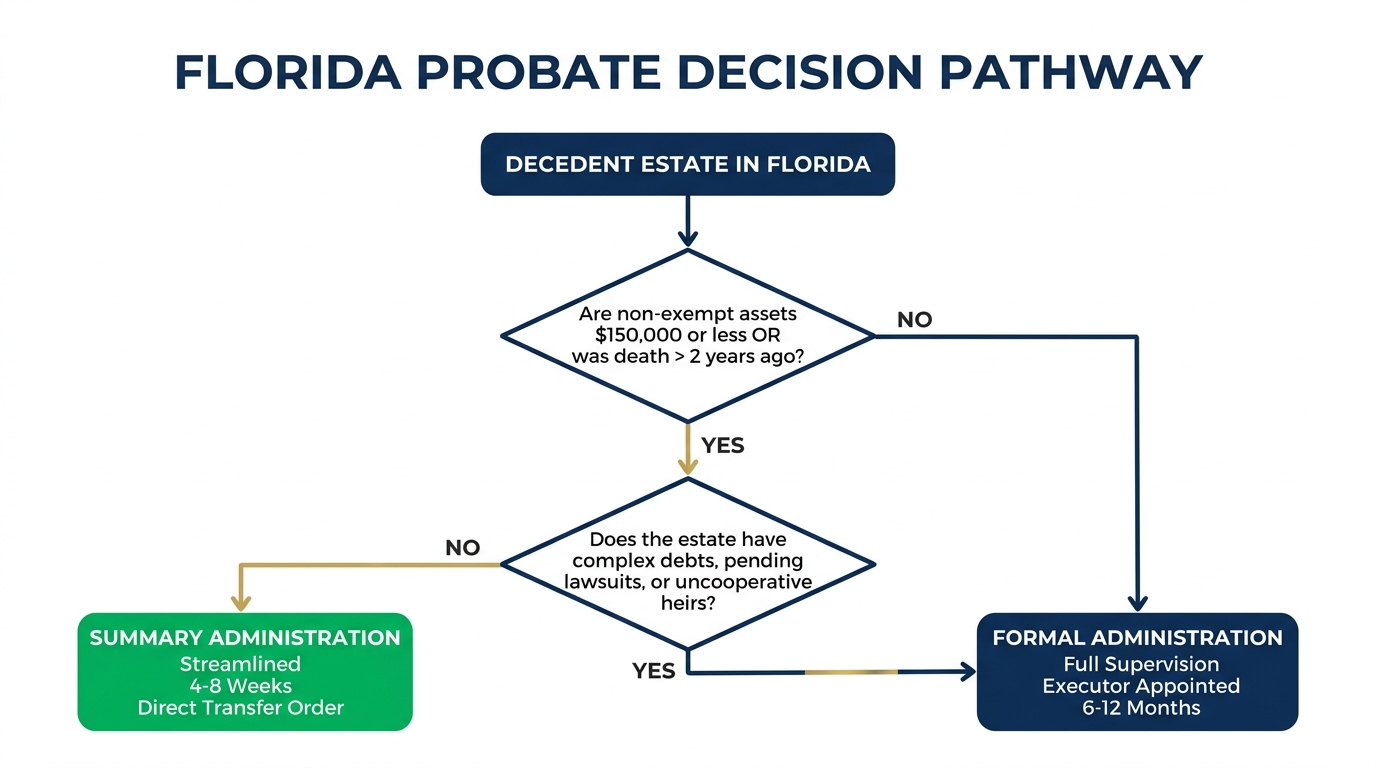
                           FLORIDA PROBATE DECISION PATH
                                         │
                    Is the non-exempt probate value under $150k
                    OR has the decedent been deceased > 2 years?
                                         │
                   ┌─────────────────────┴─────────────────────┐
                   ▼                                           ▼
                 YES                                           NO
                   │                                           │
         Are there complex debts,                              │
        disputes, or land sales                                │
         requiring an Executor?                                │
           ┌───────┴───────┐                                   │
           ▼               ▼                                   ▼
          YES              NO                        FORMAL ADMINISTRATION
           │               │                        (Full Court Process,
           │               ▼                        Personal Rep Appointed,
           │     SUMMARY ADMINISTRATION             6-12 Month Duration)
           │    (Expedited, 4-8 Weeks,
           │    Order Directly Transfers)
           └───────────────────────────────────────────────────┘
What About Very Small Estates? (Disposition Without Administration)
For extremely modest estates where the decedent left no real estate, Florida offers an informal non-probate process under Fla. Stat. § 735.301 known as Disposition of Personal Property Without Administration.
This simplified filing is available only when remaining non-exempt personal property does not exceed the total sum of preferred funeral expenses and necessary medical bills incurred during the last 60 days of the decedent’s final illness.
Selecting between Summary and Formal Administration involves critical legal trade-offs beyond estate size:
1. The Post-Probate Creditor Exposure Risk
Under Fla. Stat. § 735.206, Summary Administration directly distributes assets to beneficiaries without opening a mandatory 90-day newspaper creditor publication window.
If a petition is filed before the two-year non-claim period expires (Fla. Stat. § 733.710), beneficiaries remain personally liable to valid estate creditors up to the full value of the property received. If unknown debts emerge post-distribution, Formal Administration is often safer because publishing a statutory Notice to Creditors permanently cuts off future claims after 90 days.
┌─────────────────────────────────────────────────────────────────────────┐
│                    CREDITOR PROTECTION COMPARISON                       │
├───────────────────────────────────┬─────────────────────────────────────┤
│      SUMMARY ADMINISTRATION       │        FORMAL ADMINISTRATION        │
├───────────────────────────────────┼─────────────────────────────────────┤
│ • No mandatory newspaper notice   │ • Formal 90-day Notice published    │
│ • Beneficiaries personally liable │ • Unfiled claims permanently barred │
│   to creditors (up to asset value)│ • Clean liability shield for heirs  │
│ • Exposure lasts up to 2 years    │ • Full judicial closure of claims   │
└───────────────────────────────────┴─────────────────────────────────────┘
2. Ancillary Administration for Out-of-State Residents
When a non-Florida resident dies owning real estate in Broward County or anywhere in South Florida, the home cannot be transferred by an out-of-state court order. An Ancillary Probate proceeding (Fla. Stat. § 734.102) must be opened in Florida. Depending on the non-exempt Florida land value, Ancillary proceedings can be conducted as either Summary or Formal Administration.
Frequently Asked Questions
Does Florida Homestead Property count toward the $150,000 Summary Administration limit?
No. Protected Florida Constitutional Homestead property passes outside the general claims of creditors and is excluded when calculating the $150,000 threshold for Summary Administration, provided a formal Petition to Determine Homestead Status is filed alongside the summary petition.
What is the 10-day Will Deposit Rule in Florida?
Under Fla. Stat. § 732.901, whoever holds the decedent’s original Last Will and Testament must deposit it with the Clerk of the Circuit Court in the county where the decedent resided within 10 days of receiving notice of death, regardless of whether formal probate will be opened.
What is the current Florida Summary Administration asset threshold?
Effective July 1, 2026 (Fla. Stat. § 735.201), the Florida Legislature increased the non-exempt probate asset threshold for Summary Administration from $75,000 to $150,000 for deaths occurring on or after July 1, 2026 (or where the decedent has been deceased for more than 2 years). Protected homestead property continues to be excluded from this calculation.
How long does Formal Administration take in Broward County?
A routine, uncontested Formal Administration in Broward County typically takes between 6 and 12 months. This timeframe accommodates publishing the mandatory Notice to Creditors, observing the 90-day statutory creditor claim window, marshaling asset inventories, preparing tax accountings, and securing final court discharge.
Can a summary administration be converted to a formal administration if a dispute arises?
Yes. If unexpected creditor claims emerge, beneficiaries dispute asset distribution, or unknown assets are uncovered that push the estate over $150,000, any interested party or petitioner can motion the court to convert the summary proceeding into a Formal Administration.
Do I need a probate attorney for Summary Administration in Broward County?
While Florida law technically permits self-representation in Summary Administration when no Personal Representative is appointed, court clerk offices cannot provide legal advice. Drafting accurate petitions, verifying homestead status, and coordinating creditor searches require specialized legal guidance to avoid judicial rejection.
Don’t Let an Outdated Deed Dictate Your Family’s Future
Choosing the correct probate pathway prevents costly administrative delays, court rejections, and personal liability for estate debts. Whether your family qualifies for an expedited Summary Administration or requires full Formal Administration in South Florida, taking action with experienced legal counsel guarantees that every asset is protected.
Schedule a Property Deed & Titling Audit
Ensure your real estate title and probate strategy are structured to pass seamlessly outside of or through probate court. Contact the attorneys at Reinfeld & Cabrera, P.A. today to review your estate and property deeds with our South Florida legal team.
Office Locations: Coral Springs | Fort Lauderdale | Plantation
Direct Telephone: (954) 334-1520
Email: Info@lawrct.com
Website: mypersonalattorneys.com
Local Practice Coverage: Coral Springs, Fort Lauderdale, Tamarac, Plantation, and Broward County
A Florida homeowners association (HOA) or condominium association should consult a community association attorney when a legal question could affect its governing documents, board decisions, enforcement actions, or financial obligations. Early legal guidance can help the board understand its authority and avoid mistakes that lead to disputes or litigation.
A Florida community association should consider hiring an attorney when it needs to:
Interpret governing documents: Determine whether the declaration, bylaws, or community rules authorize a proposed action.
Enforce restrictions: Address violations consistently and assess the legal risks of disputes with residents.
Review contracts: Evaluate vendor agreements, construction contracts, or potential conflicts of interest.
Handle financial disputes: Address unpaid assessments, collection proceedings, or disagreements over association funds.
Respond to legal claims: Manage threatened lawsuits, formal demands, or allegations of improper board conduct.
Protect board decisions: Confirm that proposed actions comply with applicable Florida law and the association’s governing documents.
Florida law distinguishes between homeowners associations, generally governed by Chapter 720, and condominium associations, generally governed by Chapter 718. The rules applicable to a particular association depend on its legal structure and the issue involved.
For associations in Coral Springs and across Broward County, a community association attorney can assess the relevant documents, explain the board’s legal options, and help determine the appropriate response before a disagreement escalates.
What Does a Community Association Attorney Actually Do?
A community association attorney advises homeowners associations and condominium associations on their legal rights and responsibilities. The work may involve reviewing governing documents, assessing enforcement decisions, advising on proposed amendments, or representing the association in a dispute.
Florida law distinguishes between homeowners associations governed primarily by Chapter 720 of the Florida Statutes and condominium associations governed by Chapter 718. Although these organizations share some concerns, their legal obligations are not identical. The correct advice depends on the type of association and the documents that govern the particular community.
An attorney may help an association with:
Governing documents: Interpreting declarations, bylaws, and rules to determine whether a proposed board action is authorized.
Rule enforcement: Assessing whether an enforcement decision complies with applicable law and the association’s governing documents.
Contracts: Reviewing construction agreements or management contracts before the association commits substantial funds.
Assessments and collections: Advising on legally compliant procedures for collecting unpaid assessments.
Disputes: Representing the association in mediation, litigation, or other proceedings when appropriate.
These services are related, but they do not all require the same response. A routine maintenance question may be resolved through the management process. A proposed amendment that changes property rights presents a different legal problem.
When Should a Florida HOA Hire an Attorney?
There is no universal rule requiring an HOA to consult a lawyer before every board decision. The need for legal advice depends on the decision’s consequences and the applicable law. Several situations deserve particular attention.
1. When the board is unsure whether it has the authority to act
An association’s authority comes from applicable statutes and its governing documents. A board cannot necessarily create a new restriction simply because its members believe the restriction would benefit the community.
Consider an HOA in Coral Springs that wants to prohibit a particular type of exterior modification. The declaration contains architectural standards, but it does not clearly authorize the proposed prohibition. The board could adopt the rule and begin issuing violation notices, only to discover that its authority to impose the restriction is disputed.
An attorney can examine the declaration, applicable statutes, and relevant court decisions before the board commits to a potentially unenforceable policy.
This review is especially important when a proposed decision could affect owners’ property rights or require an amendment to recorded documents.
2. When an association plans to amend its governing documents
Amending an HOA declaration or condominium declaration is not simply a matter of changing a few sentences. The association may need to comply with specific voting requirements, notice procedures, approval thresholds, and recording requirements.
The Florida Supreme Court’s guidance on community association managers addresses this distinction. In The Florida Bar Re: Advisory Opinion—Activities of Community Association Managers, 681 So. 2d 1119 (Fla. 1996), as clarified in a 2015 opinion, the Court explained that certain tasks requiring legal interpretation or the preparation of documents affecting legal rights constitute the practice of law.
The Court-approved guidance states:
“Although CAMs may be able to draft the documents, they cannot advise the association as to the legal consequences of taking a certain course of action.”
The distinction is practical. A community association manager may handle many administrative tasks, but deciding how a statute applies to a proposed amendment is a different responsibility.
An attorney can help determine which approvals are necessary before the association circulates a proposal or schedules a vote. That can prevent a costly do-over if the amendment process is defective.
3. When the board needs to enforce a community rule
Enforcement disputes can arise over architectural modifications, property maintenance, parking restrictions, or other community rules. Before taking action against an owner, the association should confirm that the restriction is legally valid and that its enforcement process is consistent with applicable requirements.
A rule that appears straightforward on paper can become complicated when the declaration is ambiguous or the association has treated similar violations differently.
In White Egret Condominium, Inc. v. Franklin, 379 So. 2d 346 (Fla. 1979), the Florida Supreme Court considered a condominium’s restriction on children under twelve. The Court concluded that the restriction could be enforceable if reasonably related to a lawful objective and applied reasonably. However, the association had applied the restriction arbitrarily and selectively in the circumstances before the Court.
The lesson is not that every inconsistent enforcement decision invalidates a rule. Rather, the association’s authority and its actual enforcement practices can both matter.
Imagine that a board has permitted several homeowners to maintain similar exterior structures for years. It then threatens one owner with legal action over a comparable structure. The owner challenges the decision, arguing that the association has singled out the property.
The outcome would depend on the governing documents and the evidence. Legal advice can help the board determine whether it has a defensible basis for enforcement before the dispute escalates.
4. When an owner challenges assessments or requests association records
Disagreements over assessments and access to records can create legal problems if an association responds incorrectly. Florida statutes establish rules governing association records and the obligations of owners.
For homeowners associations, Section 720.303 addresses association powers, official records, meetings, and financial reporting. Condominium associations have separate requirements under Chapter 718, including Section 718.111.
An owner who questions an assessment does not automatically have the right to withhold payment. In Ocean Trail Unit Owners Association v. Mead, 650 So. 2d 4 (Fla. 1994), the Florida Supreme Court addressed the distinction between challenging association conduct and refusing to pay assessments to protect against a judgment lawfully entered against the association.
The same need for care applies to records requests. An association should identify which documents must be made available under the applicable statute and respond within the required time. If a request involves disputed records or potentially privileged communications, the board should obtain appropriate guidance rather than assume that every document is either public or confidential.
5. When a contract or potential conflict of interest raises concerns
An HOA or condominium association may enter contracts for maintenance, construction, management, and other services. The board should understand the association’s obligations before approving an agreement that could affect its finances for years.
Suppose a director recommends a contractor who is a close relative. The proposed price appears reasonable, and the board wants to approve the contract quickly.
The association should determine whether disclosure or other conflict-of-interest procedures apply. Florida’s condominium statute, Section 718.3027, addresses certain transactions involving conflicts of interest. The applicable requirements depend on the type of association and the circumstances.
An attorney can help the board assess the proposed transaction before it commits association funds. This is not an accusation of wrongdoing whenever a director knows a contractor. It is a way to identify the applicable rules and protect the integrity of the decision.
Who Does an HOA Attorney Represent?
An HOA attorney generally represents the association as a legal entity. The attorney’s client is not automatically every homeowner, every member of the board, or the property manager.
This distinction becomes particularly important when an individual director’s interests diverge from those of the association.
For example, an owner may accuse a director of misconduct and demand that the association investigate. The association’s attorney may need to advise the association about its obligations and response. If the director faces personal allegations, that director may need independent legal representation.
The same principle applies when homeowners disagree with a board decision. The association’s attorney is not automatically their personal attorney, even though the decision affects their homes.
An owner who believes the board has violated the governing documents may need independent legal advice about the owner’s own rights and available remedies.
Can an HOA Manager Provide Legal Advice?
Community association managers perform valuable administrative and operational work. They may coordinate maintenance, prepare budgets, assist with meetings, and help the board carry out its responsibilities. Florida law nevertheless draws a boundary between management functions and activities that constitute the practice of law.
The Florida Supreme Court’s advisory opinion identifies legal tasks that may require an attorney, including certain interpretations of statutes and governing documents. It also distinguishes those tasks from routine administrative work that does not require legal analysis.
This distinction protects the association as well as the manager. A manager may know the community’s operations extremely well but still need an attorney to determine whether a proposed action is legally authorized.
The practical approach is to let the manager handle operational matters within the manager’s role and involve counsel when the decision requires legal judgment.
What Can Happen When an Association Handles a Dispute Incorrectly?
The consequences of a poorly handled association dispute depend on the facts. Some disagreements can be resolved through discussion or mediation. Others result in litigation, court orders, or awards of attorney fees and costs.
A recent example illustrates why covenant enforcement deserves careful attention.
In Mooney v. Color Le Palais of Boynton Beach Homeowners Association, Inc., decided by Florida’s Fourth District Court of Appeal on August 27, 2025, the court considered whether an HOA seeking an injunction to enforce a restrictive covenant had to plead and prove irreparable harm and the absence of an adequate remedy at law. The court held that those requirements did not apply under the Florida law governing that dispute.
The homeowners had brought their property into compliance during the litigation, yet the case continued to involve a judgment and an award of prevailing-party attorney fees and costs.
The decision does not mean that an association automatically wins every covenant-enforcement case. It does show why a dispute over a seemingly minor property condition can have financial consequences beyond the original correction.
An attorney can help the board evaluate the legal basis for enforcement and the potential consequences before proceeding.
Does Attorney-Client Privilege Protect an HOA’s Legal Communications?
Attorney-client privilege can protect confidential communications made for the purpose of obtaining or providing legal services. However, not every email involving a lawyer is automatically privileged.
In Las Olas River House Condominium Association, Inc. v. Lorh, LLC, No. 4D15-2289 (Fla. 4th DCA Dec. 9, 2015), a dispute arose over communications involving a condominium association, its management company, and association representatives. The trial court had ordered the production of documents over a claim of privilege without first conducting an in-camera inspection. The appellate court granted relief.
The case illustrates a subtle but important point. A manager’s involvement in communications with counsel does not automatically destroy privilege, nor does it guarantee that every communication is protected. The purpose of the communication and the manager’s role in the legal consultation matter.
Boards should establish sensible procedures for communicating with counsel and distributing legal advice. Forwarding sensitive legal analysis to a broad group of residents can create unnecessary complications.
How Can Legal Counsel Help Prevent Conflicts Within an Association?
Disagreements between homeowners and boards are not always caused by bad faith. Sometimes the parties interpret the same governing document differently. In other cases, an owner believes a rule has been applied unfairly, while the board believes it is carrying out its responsibilities.
An attorney can help the association distinguish a legal disagreement from a routine management issue. Counsel may identify a defensible interpretation of the governing documents or recommend a procedure for addressing the dispute before litigation becomes necessary.
Legal advice can also help boards recognize when a decision requires additional review. A director who has a personal interest in a transaction may need to follow specific disclosure procedures. A board considering a new restriction may need to confirm that it has the authority to adopt it.
In Cinco v. Coquina Palms Homeowners Association, Inc., 325 So. 3d 137 (Fla. 5th DCA 2020), the appellate court addressed claims arising from a board member’s breach of fiduciary duty and a conspiracy to defraud the association. The court also ruled that a particular award of attorney fees as damages could not stand because the required special damage had not been pleaded.
The case demonstrates that association disputes can involve both substantive wrongdoing and procedural requirements. Even when an association establishes misconduct, the legal basis for each requested remedy matters.
When Is Hiring a Community Association Attorney Worth the Cost?
Legal counsel is an expense, and associations have a responsibility to manage their funds carefully. The question is not whether a lawyer should review every routine decision. It is whether the potential cost of proceeding without legal advice justifies obtaining it before acting.
Consider an association preparing to sign a substantial construction contract. A legal review may identify unclear payment terms or inadequate protections before the agreement is signed. Correcting those provisions at the outset may be easier than disputing them after work has begun.
The same reasoning applies to a proposed amendment. If the association invests time and money in an invalid voting process, it may need to repeat the process or defend a challenge.
Legal counsel also provides continuity when board membership changes. Governing documents and contractual obligations can remain in force long after the directors who approved them leave office. Clear records and sound legal guidance help a new board understand existing obligations.
No attorney can guarantee that litigation will be avoided. The value lies in making informed decisions and identifying legal problems while the association still has options.
What Should a Coral Springs HOA Look for When Choosing an Association Attorney?
A homeowners association in Coral Springs should look for an attorney who understands Florida community association law and has experience interpreting governing documents, advising boards, and resolving disputes involving homeowners. Local familiarity can also help when a matter involves Broward County courts or established procedures for handling property-related litigation.
Before retaining counsel, an association should consider the nature of its legal needs. A community facing a disputed covenant amendment may require different expertise from one negotiating a major construction contract or defending an enforcement action.
The board should also clarify how the attorney will communicate with directors, what work falls within the engagement, and how fees will be handled. For recurring legal needs, a clear arrangement can help the association obtain advice before a decision becomes urgent.
Associations should not choose counsel solely on the basis of price. The least expensive initial consultation may not provide the most useful guidance if the attorney lacks experience with the legal issue at hand. Conversely, not every routine management question requires a lengthy legal opinion.
For HOAs and condominium associations in Coral Springs, Broward County, and South Florida, the objective is to find counsel who can explain the applicable law in practical terms and help the board make informed decisions.
What Documents Should an HOA Board Gather Before Consulting an Attorney?
Preparing the relevant records before a legal consultation can help an association obtain more focused advice and avoid spending time reconstructing the history of a dispute.
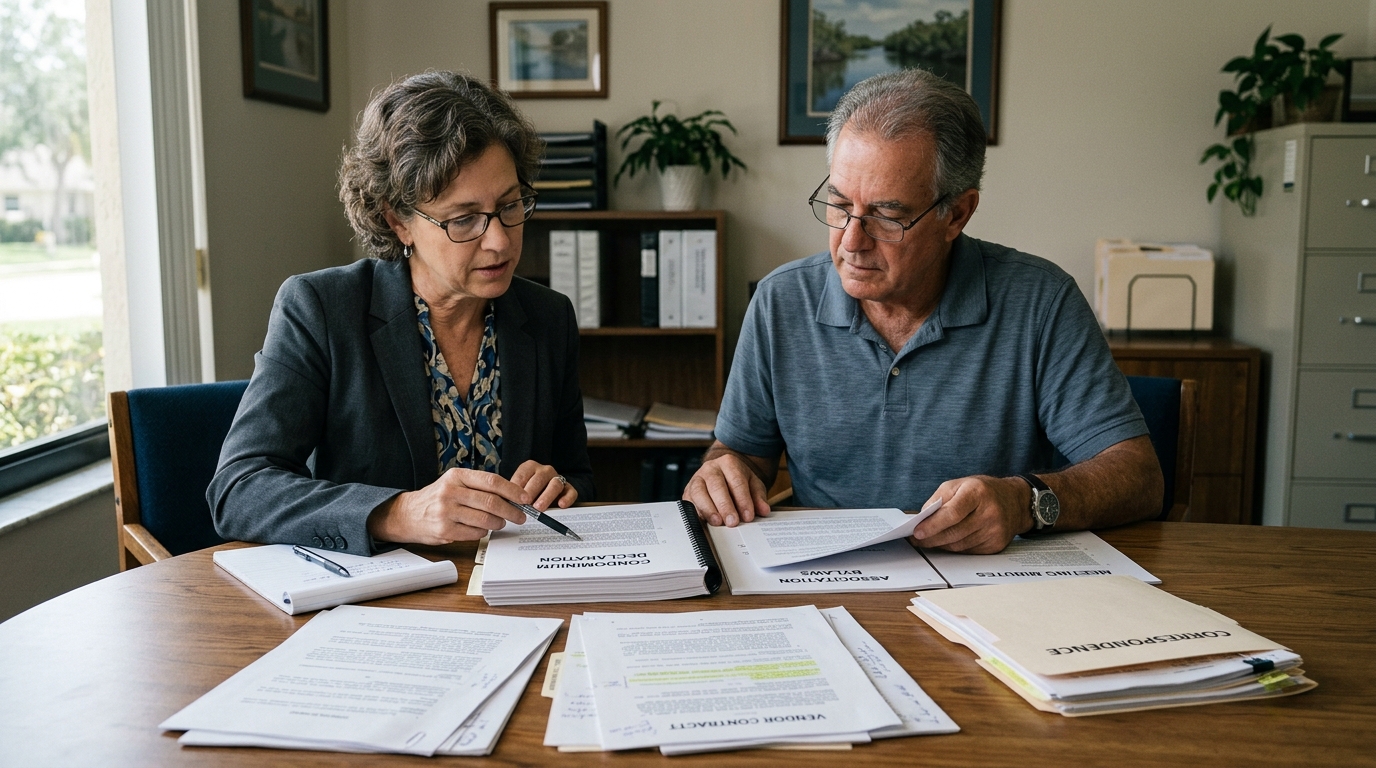
The documents needed will depend on the issue, but an HOA or condominium board should consider gathering the following:
Governing documents: The declaration, bylaws, current rules, and any amendments relevant to the dispute.
Board records: Meeting minutes, resolutions, notices, and records showing how the decision was approved.
Correspondence: Relevant communications with the homeowner, contractor, property manager, or other parties.
Contracts and financial records: The agreement at issue, invoices, payment records, or assessment statements, where applicable.
Enforcement history: Previous violation notices and records of how comparable situations were handled.
Deadlines and pending proceedings: Any demand letters, court filings, hearing notices, or statutory response deadlines.
The association should preserve relevant records and avoid altering documents once a dispute is anticipated. It should also identify any approaching deadlines when contacting counsel. Waiting until a hearing or response date is imminent may limit the available options.
Providing complete, organized records helps an attorney assess the association’s position more efficiently. It does not guarantee a particular outcome, but it gives counsel a clearer basis for explaining the available options and potential risks.
Frequently Asked Questions About Florida HOA and Condo Association Lawyers
Does a Florida HOA have to hire an attorney?
Not every HOA decision requires an attorney, and the need for counsel depends on the issue and applicable law. An association should seek legal advice when a proposed action requires legal interpretation or presents a significant risk of a dispute. Specific statutory requirements may apply to particular matters.
Can an HOA manager interpret Florida law for the board?
A manager can handle many administrative tasks, but certain activities involving legal interpretation constitute the practice of law under Florida Supreme Court guidance. The distinction depends on the task and whether it requires legal analysis rather than routine administration.
Does an HOA attorney represent individual homeowners?
Generally, no. The association’s attorney represents the association as the client. A homeowner involved in an individual dispute with the board may need independent counsel to assess personal rights and remedies.
Can an HOA enforce a rule without consulting an attorney?
An association may handle routine enforcement under established procedures. Legal review becomes particularly useful when the rule’s validity is uncertain, the governing documents are ambiguous, or the owner challenges the association’s authority.
Can an HOA board member be personally liable for a decision?
Potential liability depends on the applicable law, the governing documents, and the director’s conduct. Florida law imposes duties on association directors and officers, but it does not make every mistaken decision a basis for personal liability. Conflicts of interest or conduct that violates applicable duties may raise different concerns.
Are HOA attorney communications confidential?
Some communications may be protected by attorney-client privilege when they meet the applicable legal requirements. The presence of an attorney does not automatically make every email or document privileged. The purpose of the communication and the circumstances of disclosure matter.
When should a condominium association consult a lawyer?
A condominium association should consider legal advice when it proposes changes to governing documents, faces a significant enforcement dispute, negotiates a substantial contract, or needs to interpret its statutory obligations. The appropriate response depends on the particular issue.
Community Association Legal Guidance in Broward County
Community associations must make decisions that affect shared property, community finances, and individual owners’ rights. Understanding the association’s legal authority can help its board act responsibly and address disputes before they become more difficult to resolve.
For an HOA or condominium association in Coral Springs, Broward County, or elsewhere in South Florida, legal counsel can help clarify governing-document requirements and assess proposed actions under Florida law.
Reinfeld, Cabrera & Tison can advise on community association legal matters and related property-law issues. If your association is facing a dispute over rule enforcement, a proposed amendment, or a significant contract, obtaining legal guidance early can help the board understand its options before deciding how to proceed.
When a commercial contract breaks down, an invoice goes unpaid, or a business partner fails to deliver, rushing straight into a lawsuit is rarely the smartest first move. Litigation in South Florida courts can easily take 12 to 18 months, cost tens of thousands of dollars in legal fees, and permanently destroy valuable commercial relationships.
In many cases, a strategically drafted commercial demand letter from an experienced business attorney is all it takes to enforce your rights, recover owed funds, and force a resolution—saving your business time, capital, and unnecessary stress.
What Is a Commercial Demand Letter?
Quick Answer: A commercial demand letter is a formal legal instrument sent by an attorney outlining a breach of contract or unpaid debt, detailing the exact financial or performance remedy required under Florida law, and setting a firm deadline to comply. It transitions an informal dispute into an active legal matter, establishes an official evidentiary record, and provides maximum settlement leverage before initiating formal court proceedings.
Why Demand Letters Resolve Disputes Effectively
Informal emails, text messages, and phone calls are easy for a non-paying client or defaulting vendor to ignore. However, receiving a formal legal letter on law firm letterhead fundamentally shifts the dynamics of a dispute. It signals that your business has engaged counsel and is fully prepared to take legal action if necessary.
Specifically, a well-crafted demand letter accomplishes four critical objectives:
Establishes an Unassailable Evidentiary Record: It clearly documents the timeline of the deal, the precise contractual terms, the exact nature of the breach, and the total financial damages incurred.
Imposes a Firm Compliance Deadline: Giving the opposing party a strict window (typically 10 to 30 days) forces them to pause, consult with their own legal counsel, and evaluate their potential exposure in court.
Triggers Florida Pre-Suit Statutory Prerequisites: Certain causes of action under Florida law require written pre-suit notice. Sending a formal demand satisfies these prerequisites while preserving your right to claim statutory default interest under Fla. Stat. § 55.03.
Protects Confidentiality: Unlike court pleadings filed in public records, settlement negotiations prompted by a demand letter remain completely private between the parties.
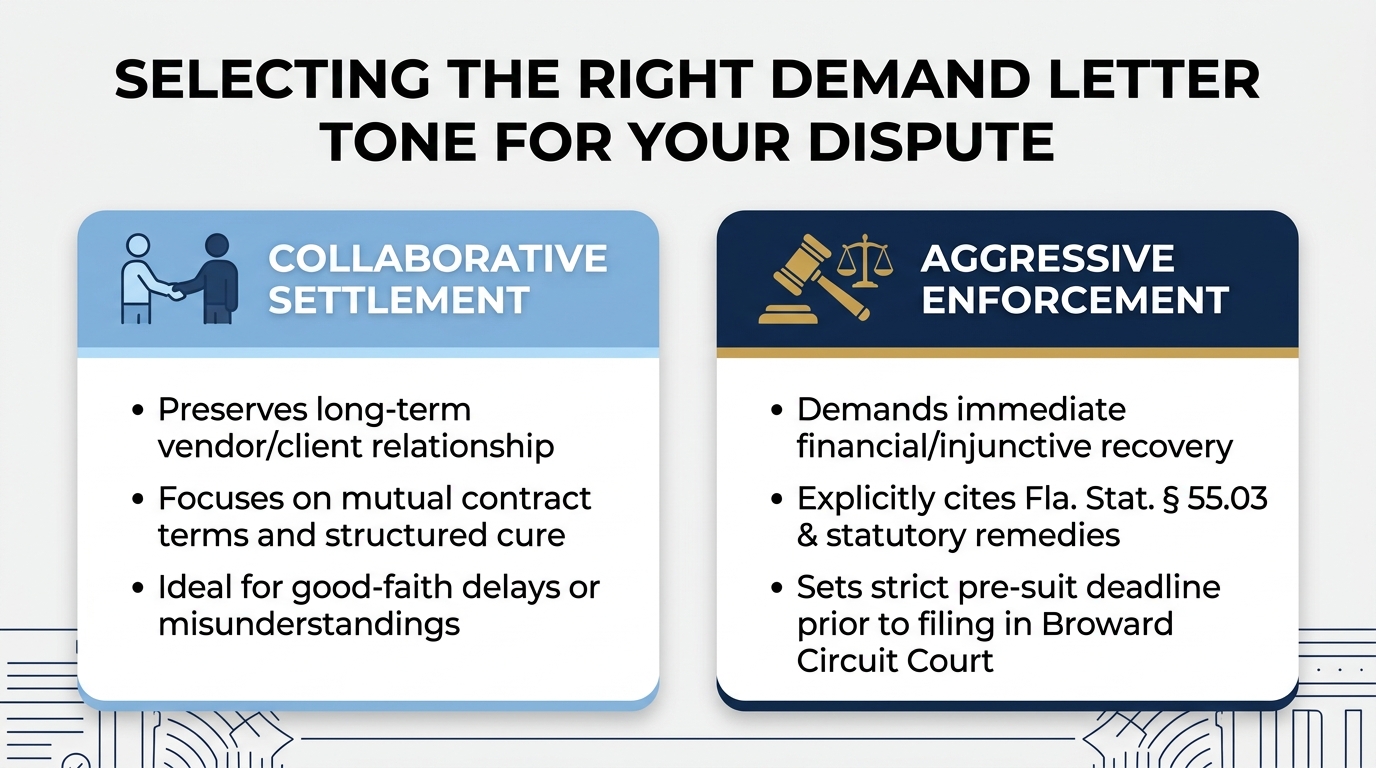
Strategic Tone Selection: Tough vs. Tactful
Before your attorney drafts the letter, you must evaluate one essential question: Do you want to preserve a commercial relationship with this party after the dispute is resolved?
Your business objectives determine the tone and posture of the letter.
┌──────────────────────────────────────────────────────────────────────────┐
│              COMMERCIAL DEMAND LETTER STRATEGIC MATRIX                   │
├────────────────────────────────────┬─────────────────────────────────────┤
│      COLLABORATIVE SETTLEMENT      │        AGGRESSIVE ENFORCEMENT       │
├────────────────────────────────────┼─────────────────────────────────────┤
│ • Objective: Preserve an ongoing   │ • Objective: Rapid financial or     │
│   vendor, client, or partner deal  │   injunctive recovery               │
│ • Focus: Mutual contract terms     │ • Focus: Strict pre-suit notice,    │
│   and structured cure options      │   damages, and statutory remedies   │
│ • Ideal For: Minor delays or       │ • Ideal For: Severe breach, fraud,  │
│   good-faith misunderstandings     │   or persistent non-payment         │
└────────────────────────────────────┴─────────────────────────────────────┘
1. The Collaborative Settlement Approach
If the dispute stems from a temporary cash flow hiccup, operational delay, or honest miscommunication with a long-term partner, an overly aggressive letter can backfire. In such cases, the demand letter adopts a firm yet professional tone. It emphasizes the underlying agreement, specifies the performance gap, and offers workable solutions—such as a structured payment plan—without burning bridges.
2. The Direct Enforcement Approach
Conversely, if you are dealing with intentional contract evasion, fraud, or a debtor refusing to communicate, soft language will yield no results. Consequently, the letter adopts an uncompromising legal stance. It explicitly details statutory causes of action, calculates interest and penalties, attaches supporting exhibits, and gives clear notice that failure to comply will result in an immediate lawsuit filed in local courts like the 17th Judicial Circuit in Broward County.
4 Essential Elements of an Enforceable Florida Demand Letter
To ensure your demand letter commands authority and holds up if the case proceeds to trial, your attorney will structure it with four core components:
1.1. Contractual & Factual Recital: Establishing the factual timeline.
A clear, detailed chronological background outlining the original agreement, purchase orders, or scope of work executed between the parties, alongside specific evidence showing full performance on your part.
2.2. Specific Allegation of Breach: Identifying the exact legal failure.
An explicit accounting of how the opposing party failed to perform, citing specific clauses of the contract, delivery deadlines missed, or unpaid invoices.
3.3. Itemized Statement of Damages: Calculating financial exposure.
A precise breakdown of direct financial losses, incidental expenses, and accrued statutory interest under Fla. Stat. § 55.03, demonstrating exactly what the non-compliance is costing your company.
4.4. Demand for Cure & Litigation Warning: Setting the litigation threshold.
A specific date by which full payment or cure action must occur, accompanied by explicit notice that non-compliance will trigger a civil complaint seeking full damages, court costs, and attorney fees where applicable.
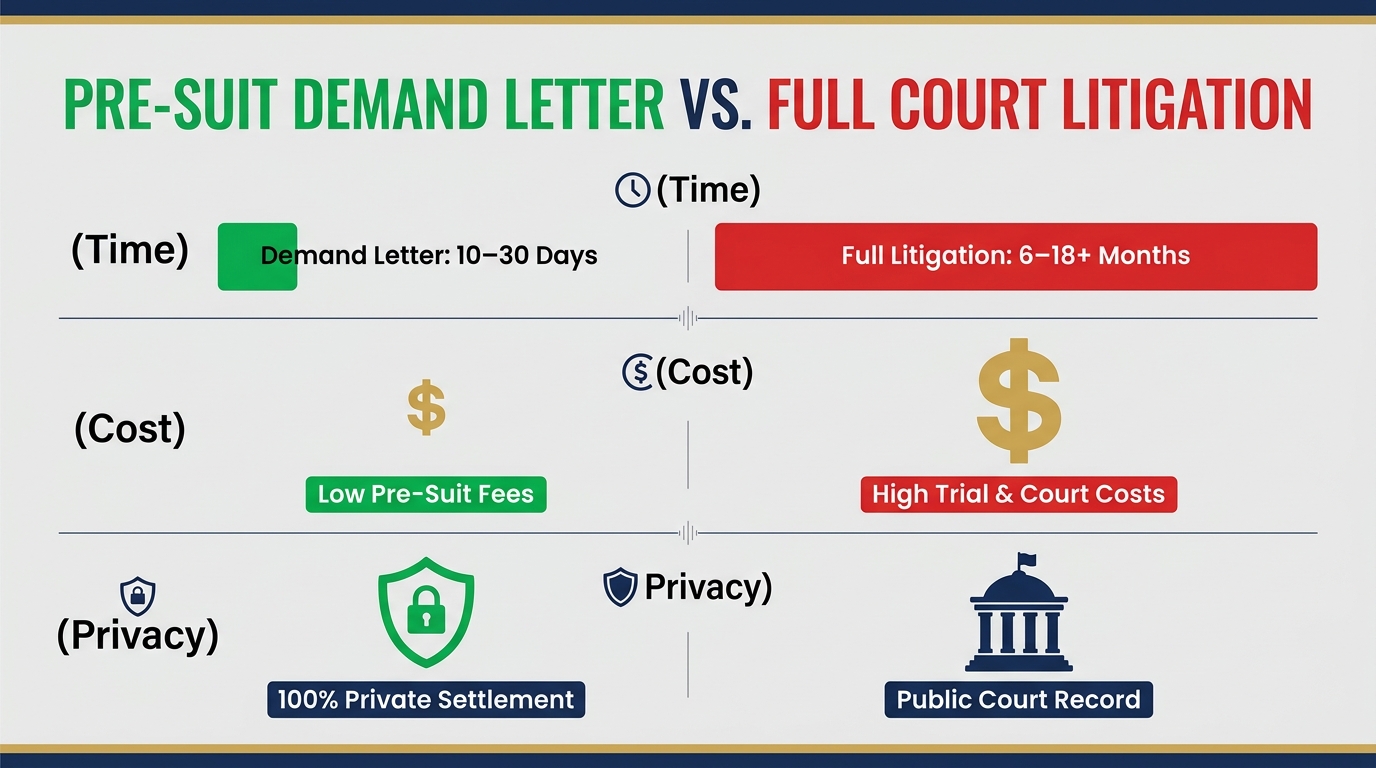
Comparing Dispute Resolution Options
Understanding how a pre-suit demand letter compares to traditional litigation highlights why it should almost always be your first line of defense:
Feature
Legal Demand Letter
Full Court Litigation
Time to Resolution
10 to 30 Days
6 to 18+ Months
Legal Costs
Low, Fixed & Predictable
High (Discovery, Depositions, Trial)
Privacy & Publicity
100% Private
Public Court Record
Business Relationship
Potential to Preserve
Almost Always Destroyed
Enforcement Leverage
High (Pre-suit notice & pressure)
Binding Court Judgment
Protect Your Business Interests with South Florida Counsel
Allowing unpaid invoices, breach of contract, or vendor default to linger threatens your company’s cash flow and growth. The commercial litigation team at Reinfeld & Cabrera P.A. helps business owners across South Florida resolve complex disputes swiftly through strategic demand letters and aggressive trial representation when required.
Schedule a Commercial Consultation
If your company is facing a contract dispute, unpaid account, or partnership conflict, speak directly with an attorney to evaluate your legal remedies:
Direct Line: (954) 866-4878 | Toll-Free: 954-866-HURT
Coral Springs Office: 9625 W. Sample Rd, Coral Springs, FL 33065
Fort Lauderdale Office: 2933 W. Cypress Creek Rd, Suite 201, Ft. Lauderdale, FL 33309
Website: mypersonalattorneys.com
Serving: Coral Springs, Fort Lauderdale, Parkland, Tamarac, Margate, and all of Broward, Miami-Dade, and Palm Beach Counties.
What happens if the other party completely ignores a demand letter?
If the receiving party fails to respond or cure the default within the designated deadline (typically 10 to 30 days), your attorney will move forward with filing a formal civil complaint in the appropriate court—such as the 17th Judicial Circuit Court in Broward County or the 11th Judicial Circuit Court in Miami-Dade County. Furthermore, the demand letter serves as key evidence demonstrating that you made a good-faith pre-suit effort to resolve the dispute, which can influence court decisions regarding legal costs and interest.
Can I write and send a demand letter myself without an attorney?
While a business owner can technically write their own letter, DIY demand letters rarely carry the legal weight needed to force a settlement. Specifically, letters drafted without counsel often omit necessary statutory citations, fail to properly preserve rights to pre-judgment interest under Fla. Stat. § 55.03, or reveal strategic weaknesses that the opposing party’s legal team can exploit. A formal letter on law firm letterhead demonstrates immediate litigation readiness.
Can a demand letter include a claim for statutory attorney fees in Florida?
Yes. Under Florida law, attorney fees are recoverable if explicitly authorized by the underlying contract or by specific Florida statutes, such as Fla. Stat. § 57.105 (sanctions for unsupported claims/defenses) or statutory civil theft claims under Fla. Stat. § 772.11. Consequently, including a specific statutory fee warning in the demand letter significantly increases your settlement leverage.
How much does it cost to have a South Florida lawyer send a demand letter?
Drafting and serving a commercial demand letter is typically billed as a predictable flat fee or a few hours of attorney time, making it significantly more cost-effective than initiating full-scale civil litigation. As a result, most South Florida businesses recover their investment many times over through early pre-suit settlements or full debt recovery.
While securing a real estate attorney when buying a home can add thousands of dollars to your transaction, it is always money well spent to make sure your interests are being represented during the closing.
One area where a real estate attorney is necessary is when drawing up the contract, as the buying and selling of the house transaction must be documented in a legally binding contract. Your attorney will review the contract, making sure there are no issues that will impact the client and also ensure the transaction follows all state laws.
A real estate attorney can also help you negotiate repairs with the sellers based on the outcome of the home inspection report. What if you find out the air conditioner is no longer working? Or the washing machine? Or the roof has some serious issues? Your attorney will make sure the repairs are done by the seller, or that the asking price is adjusted to compensate for the results of the inspection.
You also need your real estate attorney to do a title search to make sure the property in question has no liens or judgments again it. This is extremely important because this search determines whether or not the person trying to sell the house has the legal right to do so.
There are often other requirements for a real estate attorney, such as filing deeds, among other things. Having a professional, knowledgeable real estate attorney to represent you when buying a home can reassure you that there is someone looking out for your best interests during the complex process of house buying.
While you always hope the real estate transaction of buying your home will be standard and problem free, when something does come up you will be glad to have an experienced attorney’s guidance. What if during the transaction you find out the in-law suite in the home you are buying was added illegally? What if you discover you are buying a property that could potentially have structural issues? Are you buying a short sale property and have questions about the process?
These questions and other issues should only be answered by a knowledgeable attorney in the state you are buying the home. Our goal, at Reinfeld & Cabrera, P.A., is to represent our client through an uneventful transaction.
A business contract can be 20 pages long, professionally formatted, signed by everyone involved, and still create a serious problem when the parties disagree.
Sometimes the problem is obvious. Someone never signed the agreement. A required term was left blank. The person who signed it did not have authority to bind the company.
Other times, the contract exists and everyone agrees that they signed it. The fight is over what they actually agreed to.
Florida courts deal with these questions regularly. A valid contract generally requires offer, acceptance, consideration, and sufficiently definite essential terms. Courts also look at whether the parties objectively agreed to the terms that matter to the transaction.
That makes contract preparation less about producing an impressive document and more about making sure the agreement actually says what the business intends to do.
What Makes a Contract Enforceable in Florida?
A Florida business contract generally needs several basic ingredients.
There must be an agreement between the parties. There must be consideration, meaning something of legal value exchanged between them. The parties must agree on the essential terms of the transaction, and the agreement must be sufficiently definite for a court to determine what each party was supposed to do.
That last part causes plenty of trouble.
Imagine that two business owners agree that one will provide consulting services to the other for “a reasonable fee.”
They sign a document.
Six months later, they disagree about whether the fee was supposed to be $5,000, $15,000, or a percentage of the company’s revenue.
The signatures do not magically solve the problem.
Florida courts have held that a valid contract requires sufficiently definite essential terms. When the parties leave an essential provision open for future negotiation, a court generally cannot invent that missing term for them.
Does a Business Contract Have to Be in Writing?
Not every contract has to be written in the same way.
The law governing the particular transaction matters.
For example, Florida’s Uniform Commercial Code contains specific requirements for certain sales of goods. A contract for the sale of goods priced at $500 or more generally requires a sufficient record indicating that a contract was made and signed by the party against whom enforcement is sought or that party’s authorized agent, subject to statutory exceptions.
Other transactions can have their own writing requirements.
This is one reason the phrase “we had a verbal agreement” does not answer the legal question by itself.
A conversation can establish an agreement in some circumstances. In others, the law may require a writing, or the absence of a written agreement may make it considerably harder to establish what the parties actually agreed to.
And even when an oral agreement is potentially enforceable, proving its terms can become a miserable exercise in reconstructing conversations from months or years earlier.
What Happens When the Contract Leaves Something Important Out?
This is one of the most common ways a business agreement becomes difficult to enforce.
The parties may agree on the general idea while leaving the details for later.
“We’ll work out the pricing.”
“We’ll decide the delivery schedule later.”
“The parties will agree on a fair renewal rate.”
Those phrases can sound harmless when everyone is getting along.
They become considerably less charming when the parties are no longer getting along.
Florida courts have repeatedly emphasized that essential terms must be sufficiently definite. In Certified Motors, LLC v. Aventine Hill, LLC, the Second District explained that courts do not exist to supply material terms that the parties themselves failed to agree upon.
A 2026 Fourth District decision, McDowell v. Moore, similarly summarized Florida law as requiring offer, acceptance, consideration, and sufficiently definite essential terms for a valid contract.
The lesson for a business owner is fairly practical:
If a term could materially change what either side is supposed to receive, pay, provide, or tolerate, leaving it for later can create a legal problem now.
What Does “Meeting of the Minds” Mean?
You will sometimes hear lawyers talk about a “meeting of the minds.”
The phrase sounds philosophical. The underlying problem is quite ordinary.
Did the parties actually agree on the essential terms of the deal?
Florida’s Supreme Court has explained that mutual assent is necessary for contract formation, although the parties do not have to agree on every incidental detail. The essential terms must be sufficiently agreed upon for an enforceable contract to exist.
Florida courts generally use an objective approach. What the parties communicated and did matters more than what one person privately says they intended.
That can become important when a business owner says:
“That’s obviously not what I meant.”
Maybe it wasn’t.
But if the signed agreement objectively says something else, the dispute may become considerably harder to resolve.
Can an Ambiguous Contract Still Be Enforced?
Yes. Ambiguity does not automatically mean that a contract disappears.
A contract can contain language that requires interpretation without being completely unenforceable.
Florida courts distinguish between genuine ambiguity and language that is simply inconvenient for one party after the deal has gone badly.
When contractual language is clear, courts generally apply the language of the agreement. When language is genuinely ambiguous, surrounding circumstances and other evidence may become relevant to determining its meaning.
That distinction matters for business contracts because ambiguity can turn a relatively straightforward disagreement into a factual dispute.
Consider a simple example.
A contract says a business must deliver equipment “within 30 days.”
Thirty days from what?
The signing date?
The date of the first payment?
The date the buyer provides specifications?
If the rest of the agreement does not answer the question, the parties may end up arguing about something that should have taken one sentence to define.
Good drafting anticipates these ordinary questions.
Who Actually Signed the Contract?
A contract may contain excellent language and still raise a basic question:
Who agreed to it?
Businesses act through people.
An owner, officer, manager, employee, or other representative may sign a document on behalf of a company. The authority of that person can become important if the transaction is later challenged.
The contract should identify the actual parties correctly and make clear, where appropriate, the capacity in which the people are signing.
That becomes particularly important when a business has multiple owners, affiliated companies, subsidiaries, or individuals performing different roles.
A contract between John Smith and ABC Holdings, LLC is not necessarily the same thing as a contract between John Smith personally and ABC Holdings, LLC.
Getting the names and capacities right at the beginning is considerably easier than explaining them after a dispute has started.
Do Electronic Signatures Count in Florida?
Yes.
Florida’s Uniform Electronic Transaction Act provides that an electronic signature may be used to sign a writing and generally has the same force and effect as a written signature. Florida law also provides that a contract or record cannot be denied legal effect solely because it was created or signed electronically.
That means a business does not generally need to print every agreement, sign it with a pen, scan it, and email it back simply to make the signature legally meaningful.
The more important questions are whether the electronic record accurately reflects the agreement and whether the person who signed had authority to do so.
What Contract Terms Deserve Particular Attention?
There is no universal checklist that makes every business contract enforceable. Different transactions require different provisions.
Still, several subjects deserve deliberate treatment.
Payment
State the amount or method for calculating it, when payment is due, and what happens if payment is late.
Performance
Define what each party is actually required to provide.
Deadlines
If timing matters, identify the relevant dates or provide an objective method for determining them.
Termination
Explain how the relationship can end and what happens to outstanding obligations afterward.
Breach
The agreement can establish consequences for failing to perform, subject to applicable law.
Dispute resolution
Some contracts contain mediation or arbitration provisions. Florida law recognizes written agreements to arbitrate and provides mechanisms for enforcing them.
Attorney’s fees
A contract may address attorney’s fees, but the enforceability and scope of such provisions depend on the agreement and applicable law. An attorney should review the provision rather than assuming that a sentence saying “loser pays” automatically settles the issue.
Governing law and venue
Businesses sometimes want the agreement to specify which state’s law applies or where disputes will be handled. Florida has specific statutory rules governing contractual choice-of-law provisions in qualifying transactions.
These provisions deserve attention before signing, when the parties still have an opportunity to negotiate them.
Can a Contract Be Enforceable Even If It Is Not Perfect?
Yes.
A business contract does not need to predict every possible event for a court to enforce it.
Business relationships are messy. People change plans. Deliveries arrive late. Customers cancel orders. Employees leave. Markets move. Someone misunderstands an email.
The goal is not to create a document that eliminates uncertainty from commercial life.
The goal is to establish enough clear agreement that the parties and, if necessary, a court can determine what the parties actually promised to do.
Florida courts have recognized that not every detail must be fixed in advance. The critical issue is whether the parties agreed on the essential terms with enough certainty to create an enforceable obligation.
What If the Contract Is Already Signed?
Signing does not necessarily end the legal analysis.
If a dispute has already developed, the first step is usually to examine the agreement itself alongside the surrounding documents and communications.
That may include:
The original contract
Amendments and addenda
Invoices
Emails
Text messages
Purchase orders
Delivery records
Payment records
Corporate records
Documents showing who had authority to sign
Evidence of how the parties actually performed under the agreement
A contract dispute rarely exists in isolation from the business relationship that produced it.
The written agreement is usually the starting point. The surrounding evidence can become important when the parties disagree about formation, meaning, performance, or modification.
A Contract Does Not Have to Be Long to Be Good
There is a temptation in business to treat contract length as a measure of seriousness.
It isn’t.
A 40-page agreement can contain an enormous amount of unnecessary language while leaving one critical commercial term unclear.
A five-page agreement can sometimes describe a transaction perfectly well.
The useful question is whether the contract clearly addresses the transaction the parties are actually entering into.
If a company is paying $50,000 for a defined service, the agreement should make clear what the company receives, what the other party must provide, when performance occurs, when payment is due, and what happens if either side fails to perform.
That is contract drafting with a purpose.
Business Contracts in Coral Springs and Broward County
For businesses in Coral Springs, contracts can govern relationships with customers, vendors, contractors, partners, landlords, employees, and other businesses.
The same principles apply throughout Broward County and South Florida, although the legal issues can vary considerably depending on the transaction.
A small Coral Springs company negotiating a vendor agreement does not necessarily face the same issues as a business acquiring another company or entering into a long-term commercial lease.
The agreement should reflect the transaction that actually exists.
That sounds obvious.
It is also something that becomes surprisingly easy to forget when a business starts with an old template, changes a few names and numbers, and assumes the rest will take care of itself.
Frequently Asked Questions
What makes a business contract enforceable in Florida?
A valid contract generally requires offer, acceptance, consideration, and sufficiently definite essential terms. The parties must objectively agree to the essential elements of the transaction, and other legal requirements may apply depending on the type of agreement.
Does a business contract have to be in writing in Florida?
Not every contract has the same writing requirement. Certain transactions are subject to specific statutes requiring a written record. For example, Florida’s UCC generally requires a sufficient signed record for covered sales of goods priced at $500 or more, subject to statutory exceptions.
Can an electronic signature make a business contract enforceable in Florida?
Generally, yes. Florida law gives qualifying electronic signatures the same force and effect as written signatures and recognizes electronic contracts and records.
What happens if a business contract leaves out an important term?
If the missing term is essential to the agreement and the parties never agreed on it, the contract may be unenforceable or a particular provision may fail. Florida courts generally will not create a material term that the parties themselves never agreed upon.
Can an ambiguous business contract still be enforced?
Sometimes. Ambiguity does not automatically invalidate a contract. Courts may interpret genuinely ambiguous language using applicable rules of contract construction and, in appropriate circumstances, evidence concerning the surrounding circumstances.
Can a contract include an arbitration requirement?
Yes. Florida law recognizes written agreements to arbitrate and provides procedures for enforcing arbitration agreements. The precise effect of an arbitration clause depends on its language and the circumstances of the dispute.
Talk With a Florida Business Attorney Before a Contract Becomes a Dispute
A business contract should give the parties a clear understanding of what they have agreed to do.
If the agreement leaves essential terms unresolved, identifies the wrong parties, creates conflicting obligations, or uses language that can reasonably be interpreted in different ways, the problem may not become visible until someone wants to enforce the contract.
Reinfeld & Cabrera, P.A. represents businesses in Coral Springs, Broward County, and throughout South Florida in contract matters and business disputes.
If you are negotiating a significant business agreement or dealing with a contract that is already creating problems, an attorney can review the agreement and explain the legal issues that may affect its enforcement.
This article provides general information about Florida contract law and is not legal advice concerning a particular agreement or business dispute.
When you sit down at the kitchen table to sort through a parent’s papers after they pass away, the last thing you want is a fresh wave of bureaucratic dread.
What happens to the house now? How do we pay the lingering bills? And why does everyone make probate sound like a multi year hostage negotiation with the state of Florida?
Quick Answer:
Under Florida probate law, administering an estate through the 17th Judicial Circuit in Broward County involves formal or summary court proceedings to settle debts and transfer property. Formal administration typically takes between six months and over a year due to mandatory creditor notice windows, whereas summary administration offers an expedited process for estates valued under $75,000 or where the decedent passed away more than two years ago.
If you search online for estate guidance, you will drown in dry textbook definitions. Most treat probate like an unavoidable trap or a magical cure all. Neither description captures reality. Probate is simply the legal mechanism the state uses to clear title to property. It’s how to pay legitimate creditors, and transition assets when someone passes away without proper advance planning.
So what do Florida families and property owners actually need to know about navigating the Broward County court system. What do they need to get to manage a estate, and keep your hard earned assets out of unnecessary courtrooms? Let us pull back the curtain and talk about how estate administration really works in South Florida without any legal mumbo jumbo.
Why the Internet Gets Probate Wrong (And Why Wills Do Not Avoid Court)
There is a stubborn myth floating around the internet that having a last will and testament means your family completely bypasses the probate court. People assume a will acts like a VIP backstage pass that lets your heirs walk right past the judges and walk away with your property.
Nothing could be further from the truth.
Ask yourself: If I spend my entire life building equity in a home and saving for my children, why would I hand them a legal document that explicitly instructs a judge to oversee how those assets get handed out?
A will does not avoid probate. A will is instructions for the probate court. It tells the judge who you want to inherit your belongings. But the court still has to supervise the process, validate the signature, notify creditors, and formally authorize your personal representative to act. If you want to spare your family from court supervision, you have to look beyond a basic will. You should utilize tools like revocable living trusts, payable on death designations, and properly structured joint ownership.
What Actually Goes Through Probate in Florida?
Not every asset a person owns gets sucked into the probate vortex upon death. Understanding the dividing line between probate and non probate property is the first step toward building a sensible estate plan.
Probate Assets: Solely owned real estate, bank accounts held in a single name without payable on death instructions, and personal belongings like vehicles or jewelry without designated beneficiaries must go through court administration to change legal ownership.
Non Probate Assets: Assets governed by contract or operation of law pass directly to beneficiaries without court interference. This includes living trusts, life insurance policies with named beneficiaries, retirement accounts. It also includes real estate held as tenants by the entirety or joint tenants with rights of survivorship.
If your estate consists entirely of beneficiary designated accounts and trust owned property, things change. Your family might never set foot inside a courtroom. But if a single deed or bank account was left in your individual name, the probate doors swing wide open.
Formal Administration Versus Summary Administration in Broward County
When a probate estate is opened in the 17th Judicial Circuit in Broward County, the administration generally follows one of two statutory paths. Both depend on the size of the estate and how long the decedent has been gone:
Formal Administration: This is the standard, comprehensive court process required for larger estates or complex matters involving multiple creditors and disputed claims. The court appoints a personal representative, issues letters of administration, requires formal publication of notice to creditors, and mandates a multi month inventory and accounting process.
Summary Administration: A streamlined, expedited court procedure available in Florida if the value of the entire estate subject to probate does not exceed $75,000, or if the decedent has been dead for more than two years. Summary administration bypasses the appointment of a personal representative and moves much faster, though it still requires a formal petition filed by an attorney.
Avoiding Dual Tracking and Creditor Traps During Estate Administration
When a personal representative steps up to manage an estate in South Florida, they quickly realize that administering assets is a minefield of strict statutory deadlines and creditor notification rules under Florida Probate Code.
How do you handle aggressive credit card companies or mortgage lenders demanding payment while the estate is still frozen in court?
The Creditor Notice Period: Florida law requires a diligent search for known creditors and publication of a formal notice in a local legal periodical. Creditors have a strict window (typically three months from the first publication of notice) to file formal claims against the estate.
The Priority of Claims: You cannot simply pay out inheritance money to family members while valid estate debts remain unpaid. Florida law establishes a rigid priority structure for paying funeral expenses, administrative costs, taxes, and medical bills before beneficiaries see a dime. Failing to follow this order can expose the personal representative to personal financial liability.
Real World Case Example: Untangling an Estate in Broward County
To see how these rules play out in local practice, consider a scenario our firm frequently handles across Coral Springs and Fort Lauderdale.
A client came to our office after losing a parent who owned a residential home in Broward County without a living trust. The parent had left a simple will naming our client as personal representative, but because the deed was in the parent’s individual name, the property was completely frozen. To make matters worse, a home equity line of credit was past due, and the lender was threatening default proceedings while the family was still grieving.
How Our Legal Team Resolved the Crisis
Opening Formal Administration: We immediately filed a petition for formal administration in the 17th Judicial Circuit, securing letters of administration so our client had the legal authority to deal with the bank.
Publishing Creditor Notice: We managed the statutory creditor notice period. We shield the personal representative from harassing collection calls and ensuring claims were evaluated through proper legal channels.
Resolving the Debt and Transferring Title: By coordinating with the mortgage lender and liquidating a small non probate account to cover arrears, we stabilized the property, avoided foreclosure, and ultimately transferred clear title of the home to the rightful heirs.
Frequently Asked Questions About Florida Probate
How long does the probate process take in Broward County?
An uncontested formal administration in Florida typically spans 6 to 12 months. This timeline is largely dictated by mandatory statutory creditor notice periods and court review schedules in the 17th Judicial Circuit. Complex estates involving will contests or contested creditor claims can take significantly longer.
Can I avoid probate simply by writing a last will and testament?
No. A common misconception is that having a will avoids probate. In reality, a will provides instructions for the probate court on how you want your assets distributed. To avoid probate entirely, assets must pass outside the will via living trusts, beneficiary designations, or survivorship titles.
What happens if someone dies intestate without a will in Florida?
If a person dies without a valid will, Florida intestacy statutes dictate how assets are distributed among surviving spouses, children, or extended relatives. This rigid statutory formula rarely matches what the decedent would have actually wanted. And it often forces court sales of family property to divide proceeds among heirs.
Do I need a probate attorney if I am appointed as a personal representative?
Yes. Under Florida probate rules, a personal representative representing an estate with multiple beneficiaries or outstanding creditors is generally required by law to be represented by a licensed attorney admitted to practice in Florida.
Protect Your Estate and Your Family Legacy
Planning for the future or handling the aftermath of a loved one’s passing is not something you should do alone. Whether you want to bulletproof your own estate with a comprehensive living trust or you need experienced local counsel to guide you through a Broward County probate administration, having the right advocate changes everything.
The estate planning and probate attorneys at Reinfeld Cabrera Tison help families across South Florida secure their assets. We establish durable trusts, and resolve complex court proceedings with absolute confidence.
Schedule a Confidential Consultation
Do not wait until a crisis forces your family into court. Speak directly with an experienced attorney today to review your options:
Coral Springs Office: 9625 W Sample Rd, Coral Springs, FL 33065
Fort Lauderdale Office: 2933 W Cypress Creek Rd, Suite 201, Ft Lauderdale, FL 33309
Website: mypersonalattorneys.com
Local Coverage: Coral Springs, Fort Lauderdale, Parkland, Tamarac, Margate. All surrounding communities across Broward, Miami Dade, and Palm Beach Counties.



 While securing a