
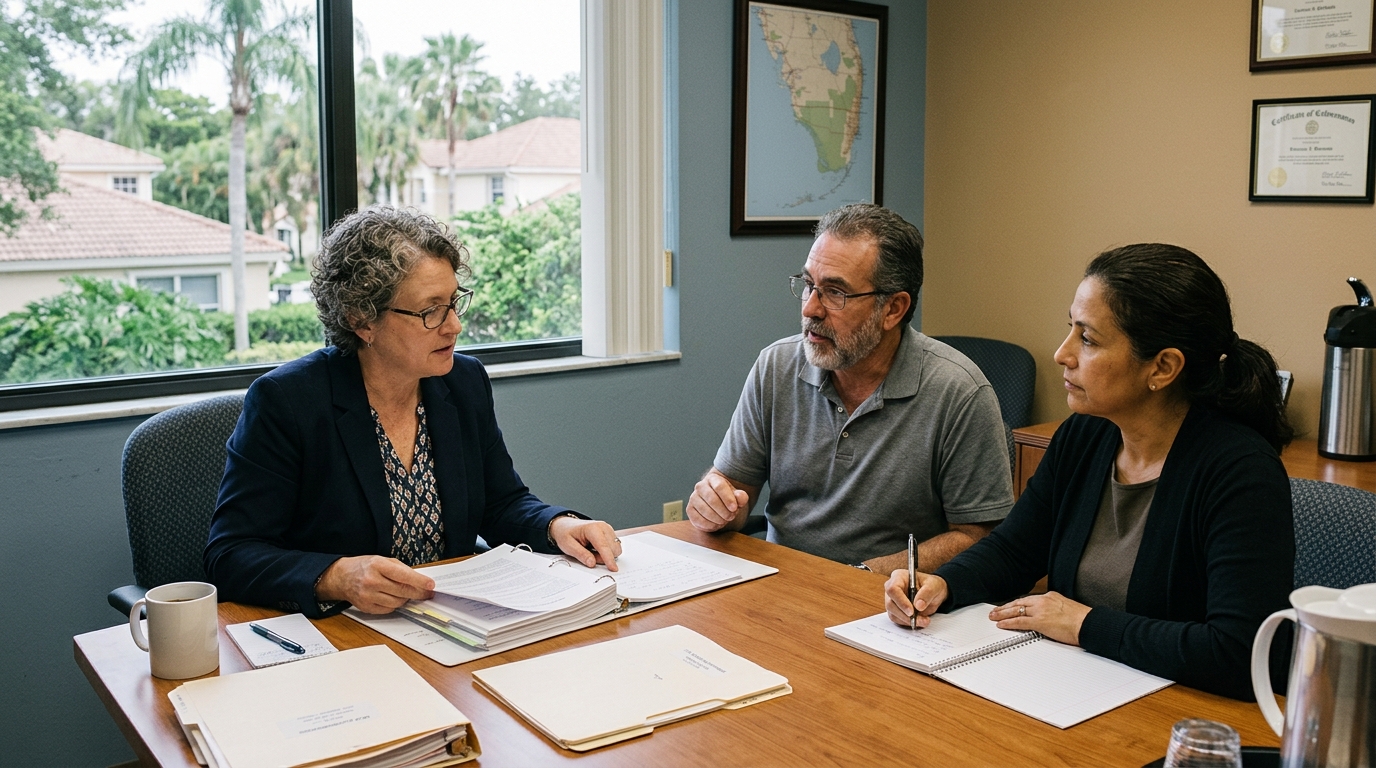
A Florida homeowners association (HOA) or condominium association should consult a community association attorney when a legal question could affect its governing documents, board decisions, enforcement actions, or financial obligations. Early legal guidance can help the board understand its authority and avoid mistakes that lead to disputes or litigation.
A Florida community association should consider hiring an attorney when it needs to:
- Interpret governing documents: Determine whether the declaration, bylaws, or community rules authorize a proposed action.
- Enforce restrictions: Address violations consistently and assess the legal risks of disputes with residents.
- Review contracts: Evaluate vendor agreements, construction contracts, or potential conflicts of interest.
- Handle financial disputes: Address unpaid assessments, collection proceedings, or disagreements over association funds.
- Respond to legal claims: Manage threatened lawsuits, formal demands, or allegations of improper board conduct.
- Protect board decisions: Confirm that proposed actions comply with applicable Florida law and the association’s governing documents.
Florida law distinguishes between homeowners associations, generally governed by Chapter 720, and condominium associations, generally governed by Chapter 718. The rules applicable to a particular association depend on its legal structure and the issue involved.
For associations in Coral Springs and across Broward County, a community association attorney can assess the relevant documents, explain the board’s legal options, and help determine the appropriate response before a disagreement escalates.
What Does a Community Association Attorney Actually Do?
A community association attorney advises homeowners associations and condominium associations on their legal rights and responsibilities. The work may involve reviewing governing documents, assessing enforcement decisions, advising on proposed amendments, or representing the association in a dispute.
Florida law distinguishes between homeowners associations governed primarily by Chapter 720 of the Florida Statutes and condominium associations governed by Chapter 718. Although these organizations share some concerns, their legal obligations are not identical. The correct advice depends on the type of association and the documents that govern the particular community.
An attorney may help an association with:
- Governing documents: Interpreting declarations, bylaws, and rules to determine whether a proposed board action is authorized.
- Rule enforcement: Assessing whether an enforcement decision complies with applicable law and the association’s governing documents.
- Contracts: Reviewing construction agreements or management contracts before the association commits substantial funds.
- Assessments and collections: Advising on legally compliant procedures for collecting unpaid assessments.
- Disputes: Representing the association in mediation, litigation, or other proceedings when appropriate.
These services are related, but they do not all require the same response. A routine maintenance question may be resolved through the management process. A proposed amendment that changes property rights presents a different legal problem.
When Should a Florida HOA Hire an Attorney?
There is no universal rule requiring an HOA to consult a lawyer before every board decision. The need for legal advice depends on the decision’s consequences and the applicable law. Several situations deserve particular attention.
1. When the board is unsure whether it has the authority to act
An association’s authority comes from applicable statutes and its governing documents. A board cannot necessarily create a new restriction simply because its members believe the restriction would benefit the community.
Consider an HOA in Coral Springs that wants to prohibit a particular type of exterior modification. The declaration contains architectural standards, but it does not clearly authorize the proposed prohibition. The board could adopt the rule and begin issuing violation notices, only to discover that its authority to impose the restriction is disputed.
An attorney can examine the declaration, applicable statutes, and relevant court decisions before the board commits to a potentially unenforceable policy.
This review is especially important when a proposed decision could affect owners’ property rights or require an amendment to recorded documents.
2. When an association plans to amend its governing documents
Amending an HOA declaration or condominium declaration is not simply a matter of changing a few sentences. The association may need to comply with specific voting requirements, notice procedures, approval thresholds, and recording requirements.
The Florida Supreme Court’s guidance on community association managers addresses this distinction. In The Florida Bar Re: Advisory Opinion—Activities of Community Association Managers, 681 So. 2d 1119 (Fla. 1996), as clarified in a 2015 opinion, the Court explained that certain tasks requiring legal interpretation or the preparation of documents affecting legal rights constitute the practice of law.
The Court-approved guidance states:
“Although CAMs may be able to draft the documents, they cannot advise the association as to the legal consequences of taking a certain course of action.”
Read the Florida Supreme Court’s 2015 opinion.
The distinction is practical. A community association manager may handle many administrative tasks, but deciding how a statute applies to a proposed amendment is a different responsibility.
An attorney can help determine which approvals are necessary before the association circulates a proposal or schedules a vote. That can prevent a costly do-over if the amendment process is defective.
3. When the board needs to enforce a community rule
Enforcement disputes can arise over architectural modifications, property maintenance, parking restrictions, or other community rules. Before taking action against an owner, the association should confirm that the restriction is legally valid and that its enforcement process is consistent with applicable requirements.
A rule that appears straightforward on paper can become complicated when the declaration is ambiguous or the association has treated similar violations differently.
In White Egret Condominium, Inc. v. Franklin, 379 So. 2d 346 (Fla. 1979), the Florida Supreme Court considered a condominium’s restriction on children under twelve. The Court concluded that the restriction could be enforceable if reasonably related to a lawful objective and applied reasonably. However, the association had applied the restriction arbitrarily and selectively in the circumstances before the Court.
Read the White Egret decision.
The lesson is not that every inconsistent enforcement decision invalidates a rule. Rather, the association’s authority and its actual enforcement practices can both matter.
Imagine that a board has permitted several homeowners to maintain similar exterior structures for years. It then threatens one owner with legal action over a comparable structure. The owner challenges the decision, arguing that the association has singled out the property.
The outcome would depend on the governing documents and the evidence. Legal advice can help the board determine whether it has a defensible basis for enforcement before the dispute escalates.
4. When an owner challenges assessments or requests association records
Disagreements over assessments and access to records can create legal problems if an association responds incorrectly. Florida statutes establish rules governing association records and the obligations of owners.
For homeowners associations, Section 720.303 addresses association powers, official records, meetings, and financial reporting. Condominium associations have separate requirements under Chapter 718, including Section 718.111.
An owner who questions an assessment does not automatically have the right to withhold payment. In Ocean Trail Unit Owners Association v. Mead, 650 So. 2d 4 (Fla. 1994), the Florida Supreme Court addressed the distinction between challenging association conduct and refusing to pay assessments to protect against a judgment lawfully entered against the association.
Read the Ocean Trail decision.
The same need for care applies to records requests. An association should identify which documents must be made available under the applicable statute and respond within the required time. If a request involves disputed records or potentially privileged communications, the board should obtain appropriate guidance rather than assume that every document is either public or confidential.
5. When a contract or potential conflict of interest raises concerns
An HOA or condominium association may enter contracts for maintenance, construction, management, and other services. The board should understand the association’s obligations before approving an agreement that could affect its finances for years.
Suppose a director recommends a contractor who is a close relative. The proposed price appears reasonable, and the board wants to approve the contract quickly.
The association should determine whether disclosure or other conflict-of-interest procedures apply. Florida’s condominium statute, Section 718.3027, addresses certain transactions involving conflicts of interest. The applicable requirements depend on the type of association and the circumstances.
An attorney can help the board assess the proposed transaction before it commits association funds. This is not an accusation of wrongdoing whenever a director knows a contractor. It is a way to identify the applicable rules and protect the integrity of the decision.
Who Does an HOA Attorney Represent?
An HOA attorney generally represents the association as a legal entity. The attorney’s client is not automatically every homeowner, every member of the board, or the property manager.
This distinction becomes particularly important when an individual director’s interests diverge from those of the association.
For example, an owner may accuse a director of misconduct and demand that the association investigate. The association’s attorney may need to advise the association about its obligations and response. If the director faces personal allegations, that director may need independent legal representation.
The same principle applies when homeowners disagree with a board decision. The association’s attorney is not automatically their personal attorney, even though the decision affects their homes.
An owner who believes the board has violated the governing documents may need independent legal advice about the owner’s own rights and available remedies.
Can an HOA Manager Provide Legal Advice?
Community association managers perform valuable administrative and operational work. They may coordinate maintenance, prepare budgets, assist with meetings, and help the board carry out its responsibilities. Florida law nevertheless draws a boundary between management functions and activities that constitute the practice of law.
The Florida Supreme Court’s advisory opinion identifies legal tasks that may require an attorney, including certain interpretations of statutes and governing documents. It also distinguishes those tasks from routine administrative work that does not require legal analysis.
Read the Florida Bar’s explanation of the Court’s guidance.
This distinction protects the association as well as the manager. A manager may know the community’s operations extremely well but still need an attorney to determine whether a proposed action is legally authorized.
The practical approach is to let the manager handle operational matters within the manager’s role and involve counsel when the decision requires legal judgment.
What Can Happen When an Association Handles a Dispute Incorrectly?
The consequences of a poorly handled association dispute depend on the facts. Some disagreements can be resolved through discussion or mediation. Others result in litigation, court orders, or awards of attorney fees and costs.
A recent example illustrates why covenant enforcement deserves careful attention.
In Mooney v. Color Le Palais of Boynton Beach Homeowners Association, Inc., decided by Florida’s Fourth District Court of Appeal on August 27, 2025, the court considered whether an HOA seeking an injunction to enforce a restrictive covenant had to plead and prove irreparable harm and the absence of an adequate remedy at law. The court held that those requirements did not apply under the Florida law governing that dispute.
The homeowners had brought their property into compliance during the litigation, yet the case continued to involve a judgment and an award of prevailing-party attorney fees and costs.
Read the 2025 appellate opinion.
The decision does not mean that an association automatically wins every covenant-enforcement case. It does show why a dispute over a seemingly minor property condition can have financial consequences beyond the original correction.
An attorney can help the board evaluate the legal basis for enforcement and the potential consequences before proceeding.
Does Attorney-Client Privilege Protect an HOA’s Legal Communications?
Attorney-client privilege can protect confidential communications made for the purpose of obtaining or providing legal services. However, not every email involving a lawyer is automatically privileged.
In Las Olas River House Condominium Association, Inc. v. Lorh, LLC, No. 4D15-2289 (Fla. 4th DCA Dec. 9, 2015), a dispute arose over communications involving a condominium association, its management company, and association representatives. The trial court had ordered the production of documents over a claim of privilege without first conducting an in-camera inspection. The appellate court granted relief.
Read the Las Olas River House decision.
The case illustrates a subtle but important point. A manager’s involvement in communications with counsel does not automatically destroy privilege, nor does it guarantee that every communication is protected. The purpose of the communication and the manager’s role in the legal consultation matter.
Boards should establish sensible procedures for communicating with counsel and distributing legal advice. Forwarding sensitive legal analysis to a broad group of residents can create unnecessary complications.

How Can Legal Counsel Help Prevent Conflicts Within an Association?
Disagreements between homeowners and boards are not always caused by bad faith. Sometimes the parties interpret the same governing document differently. In other cases, an owner believes a rule has been applied unfairly, while the board believes it is carrying out its responsibilities.
An attorney can help the association distinguish a legal disagreement from a routine management issue. Counsel may identify a defensible interpretation of the governing documents or recommend a procedure for addressing the dispute before litigation becomes necessary.
Legal advice can also help boards recognize when a decision requires additional review. A director who has a personal interest in a transaction may need to follow specific disclosure procedures. A board considering a new restriction may need to confirm that it has the authority to adopt it.
In Cinco v. Coquina Palms Homeowners Association, Inc., 325 So. 3d 137 (Fla. 5th DCA 2020), the appellate court addressed claims arising from a board member’s breach of fiduciary duty and a conspiracy to defraud the association. The court also ruled that a particular award of attorney fees as damages could not stand because the required special damage had not been pleaded.
The case demonstrates that association disputes can involve both substantive wrongdoing and procedural requirements. Even when an association establishes misconduct, the legal basis for each requested remedy matters.
When Is Hiring a Community Association Attorney Worth the Cost?
Legal counsel is an expense, and associations have a responsibility to manage their funds carefully. The question is not whether a lawyer should review every routine decision. It is whether the potential cost of proceeding without legal advice justifies obtaining it before acting.
Consider an association preparing to sign a substantial construction contract. A legal review may identify unclear payment terms or inadequate protections before the agreement is signed. Correcting those provisions at the outset may be easier than disputing them after work has begun.
The same reasoning applies to a proposed amendment. If the association invests time and money in an invalid voting process, it may need to repeat the process or defend a challenge.
Legal counsel also provides continuity when board membership changes. Governing documents and contractual obligations can remain in force long after the directors who approved them leave office. Clear records and sound legal guidance help a new board understand existing obligations.
No attorney can guarantee that litigation will be avoided. The value lies in making informed decisions and identifying legal problems while the association still has options.
What Should a Coral Springs HOA Look for When Choosing an Association Attorney?
A homeowners association in Coral Springs should look for an attorney who understands Florida community association law and has experience interpreting governing documents, advising boards, and resolving disputes involving homeowners. Local familiarity can also help when a matter involves Broward County courts or established procedures for handling property-related litigation.
Before retaining counsel, an association should consider the nature of its legal needs. A community facing a disputed covenant amendment may require different expertise from one negotiating a major construction contract or defending an enforcement action.
The board should also clarify how the attorney will communicate with directors, what work falls within the engagement, and how fees will be handled. For recurring legal needs, a clear arrangement can help the association obtain advice before a decision becomes urgent.
Associations should not choose counsel solely on the basis of price. The least expensive initial consultation may not provide the most useful guidance if the attorney lacks experience with the legal issue at hand. Conversely, not every routine management question requires a lengthy legal opinion.
For HOAs and condominium associations in Coral Springs, Broward County, and South Florida, the objective is to find counsel who can explain the applicable law in practical terms and help the board make informed decisions.
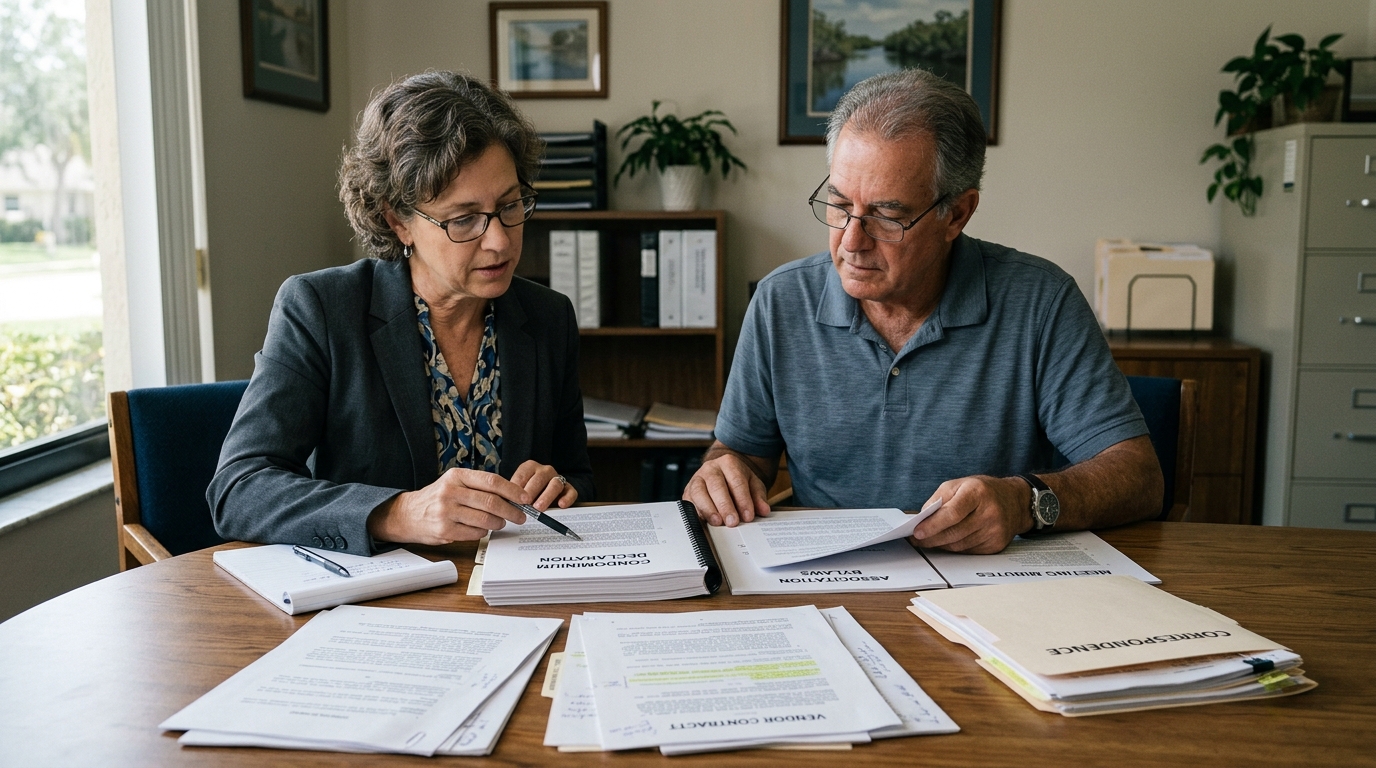
What Documents Should an HOA Board Gather Before Consulting an Attorney?
Preparing the relevant records before a legal consultation can help an association obtain more focused advice and avoid spending time reconstructing the history of a dispute.
The documents needed will depend on the issue, but an HOA or condominium board should consider gathering the following:
- Governing documents: The declaration, bylaws, current rules, and any amendments relevant to the dispute.
- Board records: Meeting minutes, resolutions, notices, and records showing how the decision was approved.
- Correspondence: Relevant communications with the homeowner, contractor, property manager, or other parties.
- Contracts and financial records: The agreement at issue, invoices, payment records, or assessment statements, where applicable.
- Enforcement history: Previous violation notices and records of how comparable situations were handled.
- Deadlines and pending proceedings: Any demand letters, court filings, hearing notices, or statutory response deadlines.
The association should preserve relevant records and avoid altering documents once a dispute is anticipated. It should also identify any approaching deadlines when contacting counsel. Waiting until a hearing or response date is imminent may limit the available options.
Providing complete, organized records helps an attorney assess the association’s position more efficiently. It does not guarantee a particular outcome, but it gives counsel a clearer basis for explaining the available options and potential risks.

Frequently Asked Questions About Florida HOA and Condo Association Lawyers
Does a Florida HOA have to hire an attorney?
- Not every HOA decision requires an attorney, and the need for counsel depends on the issue and applicable law. An association should seek legal advice when a proposed action requires legal interpretation or presents a significant risk of a dispute. Specific statutory requirements may apply to particular matters.
Can an HOA manager interpret Florida law for the board?
- A manager can handle many administrative tasks, but certain activities involving legal interpretation constitute the practice of law under Florida Supreme Court guidance. The distinction depends on the task and whether it requires legal analysis rather than routine administration.
Does an HOA attorney represent individual homeowners?
- Generally, no. The association’s attorney represents the association as the client. A homeowner involved in an individual dispute with the board may need independent counsel to assess personal rights and remedies.
Can an HOA enforce a rule without consulting an attorney?
- An association may handle routine enforcement under established procedures. Legal review becomes particularly useful when the rule’s validity is uncertain, the governing documents are ambiguous, or the owner challenges the association’s authority.
Can an HOA board member be personally liable for a decision?
- Potential liability depends on the applicable law, the governing documents, and the director’s conduct. Florida law imposes duties on association directors and officers, but it does not make every mistaken decision a basis for personal liability. Conflicts of interest or conduct that violates applicable duties may raise different concerns.
Are HOA attorney communications confidential?
- Some communications may be protected by attorney-client privilege when they meet the applicable legal requirements. The presence of an attorney does not automatically make every email or document privileged. The purpose of the communication and the circumstances of disclosure matter.
When should a condominium association consult a lawyer?
- A condominium association should consider legal advice when it proposes changes to governing documents, faces a significant enforcement dispute, negotiates a substantial contract, or needs to interpret its statutory obligations. The appropriate response depends on the particular issue.
Community Association Legal Guidance in Broward County
Community associations must make decisions that affect shared property, community finances, and individual owners’ rights. Understanding the association’s legal authority can help its board act responsibly and address disputes before they become more difficult to resolve.
For an HOA or condominium association in Coral Springs, Broward County, or elsewhere in South Florida, legal counsel can help clarify governing-document requirements and assess proposed actions under Florida law.
Reinfeld, Cabrera & Tison can advise on community association legal matters and related property-law issues. If your association is facing a dispute over rule enforcement, a proposed amendment, or a significant contract, obtaining legal guidance early can help the board understand its options before deciding how to proceed.
This article provides general information about Florida community association law. It is not legal advice for a particular association or dispute.