
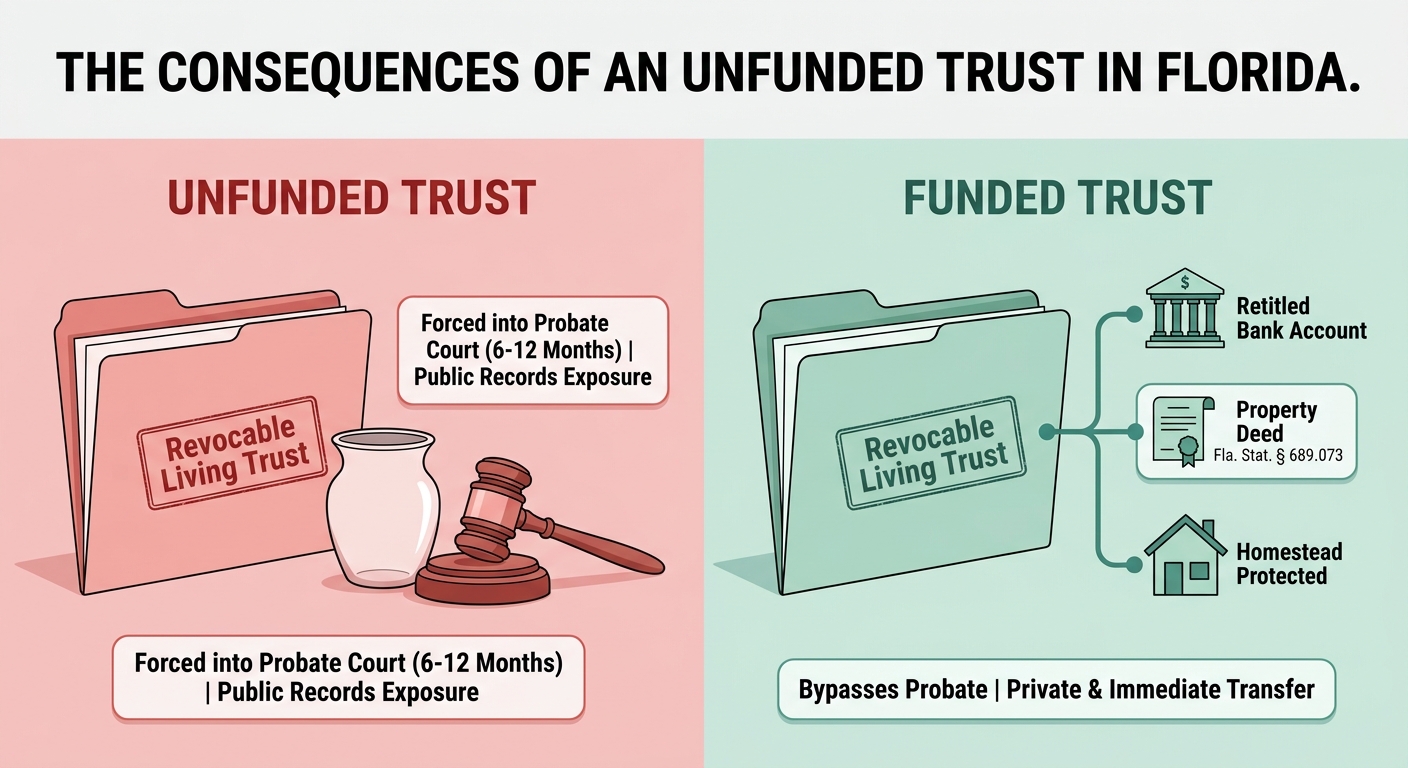
In Florida, a Revocable Living Trust is essentially an empty vessel with written instructions. Signing the trust document creates the legal framework, but if assets are not officially retitled into the name of the trust—a process known as funding—the trust cannot govern or transfer those assets upon your death or incapacity.
Here is an in-depth look at what happens in Florida when a trust remains unfunded, the legal consequences, and how Florida law resolves the gap.
1. The Core Problem: Loss of Probate Avoidance
The primary reason individuals establish revocable living trusts in Florida is to keep their assets out of probate court.
- If Funded: Specifically, assets owned by ‘John Doe, as Trustee of the John Doe Revocable Trust’ pass directly to beneficiaries via the successor trustee according to the terms of the trust, bypassing probate court entirely.
- If Unfunded: Any asset that remains in an individual’s personal name at death (e.g., “John Doe”) forms part of the decedent’s probate estate. The trust document holds no legal authority over these individually titled assets.
2. The Legal Safety Net: The Florida “Pour-Over Will”
To protect against unfunded or forgotten assets, a properly executed Florida estate plan includes a Pour-Over Will.
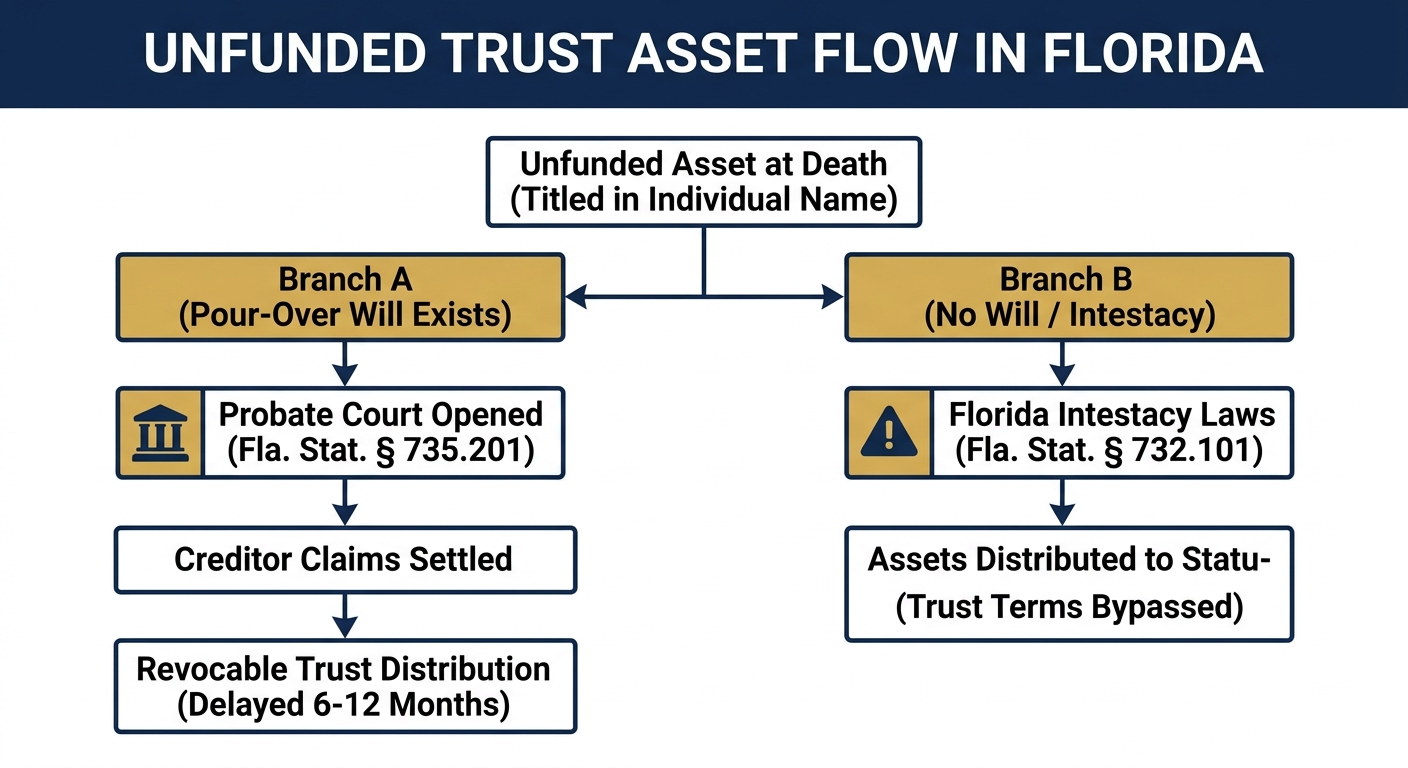
- How it works: The Pour-Over Will acts as a catch-all safety net. It states that any asset remaining in the individual’s name at death should be transferred (or “poured over”) into the trust.
- The Catch: A Pour-Over Will must go through Florida Probate Court.
- The Process: During this process, the court appoints a Personal Representative to collect the unfunded assets, satisfy valid creditor claims under Florida Probate Rules, and then transfer the remaining net assets to the trustee to distribute according to the trust’s instructions.
- The Outcome: The wishes outline in the trust are eventually honored, but the estate experiences the exact court delays (6 to 12+ months), public record disclosures, and legal/court costs that the trust was designed to prevent.
3. What Happens If There Is No Pour-Over Will?
If a trust is unfunded and the creator (settlor) dies without executing a Pour-Over Will (or any valid Will):
- Intestacy Laws Take Over: The unfunded assets pass according to Florida’s intestate succession laws (Fla. Stat. § 732.101 et seq.), which default to statutory family order (surviving spouse, adult children, parents, siblings).
- Accidental Disinheritance: Furthermore, the trust’s provisions, such as leaving equal shares to children, funding charities, or holding money in trust for minors, are bypassed completely for those unfunded assets.
Key Complications Specific to Unfunded Trusts in Florida
A. Florida Constitutional Homestead Property
Florida’s homestead laws (Fla. Const. Art. X, § 4) govern primary residences.
- Consequently, if real estate is not deeded to the trust using a properly drafted Quitclaim or Warranty Deed (specifying trust powers under Fla. Stat. § 689.073), the home remains individual property.
- Upon death, the homestead therefore requires a court proceeding (a Petition to Determine Homestead) to pass free of claims to legal heirs, regardless of what the trust document outlines.
B. Loss of Incapacity Protection
A key function of a Florida revocable trust is managing assets if the creator becomes incapacitated (e.g., due to dementia or stroke).
- Funded Trust: The successor trustee steps in smoothly to manage trust assets without court involvement.
- Unfunded Trust: The successor trustee has no authority over individually owned bank accounts or real estate. Family members must instead rely on a Durable Power of Attorney or petition a Florida court for a costly Guardianship proceeding.
C. Exposure of Financial & Personal Privacy
Once probate is opened to catch unfunded assets, the estate inventory, financial balances, names of heirs, and trust references become part of the public court record in the county where the probate is filed.
Summary of Consequences
| Scenario | Fully Funded Florida Trust | Unfunded Trust (with Pour-Over Will) | Unfunded Trust (NO Pour-Over Will) |
| Probate Required? | No (Bypasses court entirely) | Yes (Formal or Summary Administration required) | Yes (Must go through Intestate Probate) |
| Distribution Time | Immediate or within weeks | 6 to 12+ months | 6 to 12+ months |
| Privacy | Private (Kept out of court records) | Public (Will and asset inventories filed with court) | Public (Filed with court) |
| Who Inherits? | Trust Beneficiaries | Trust Beneficiaries (after probate completion) | Statutory Heirs under Florida Intestacy Laws |
How Funding Is Completed in Florida
To fund a trust properly under Florida law:
- Real Estate: Draft and record a deed transferring title from the individual to the trust in the county where the property is located.
- Financial Accounts: Change account ownership at banks and brokerages to the trust’s name.
- Beneficiary Designations: Update primary or contingent beneficiary forms for life insurance policies, retirement accounts (IRAs/401ks), or Pay-on-Death (POD) accounts where appropriate.
Florida Revocable Living Trust Funding Checklist
A Revocable Living Trust cannot avoid probate or manage assets until those assets are retitled into the trust’s name. Follow this streamlined checklist to ensure your trust is properly funded under Florida law.
Essential Prerequisites
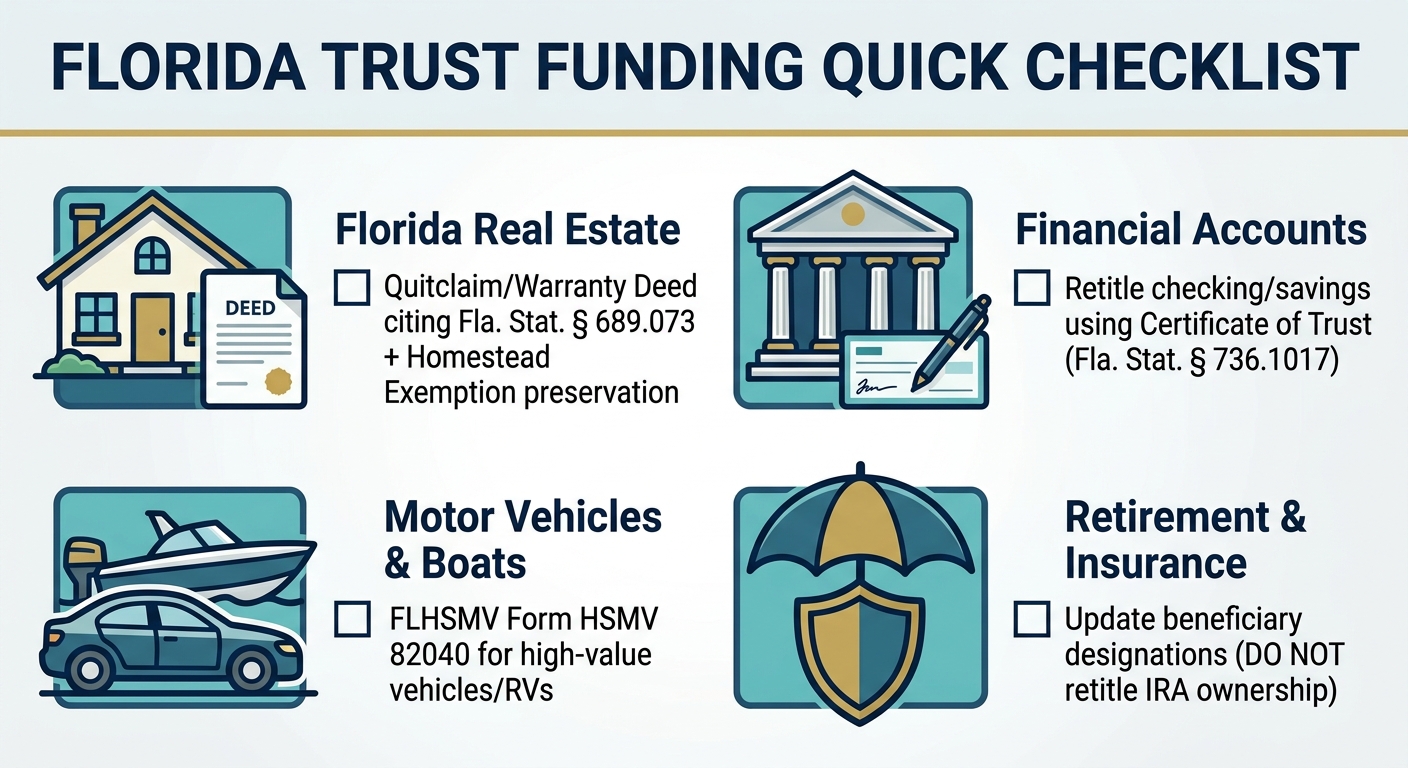
- Certificate of Trust (Fla. Stat. § 736.1017): Provides banks, brokers, and title companies proof of trustee authority without exposing private beneficiary details.
- Standard Trust Titling Format:
[Trustee Name(s)], Trustee(s) of the [Trust Name], dated [Execution Date]
Quick-Action Asset Checklist
1. Bank Accounts & Cash Assets
- Checking & Savings: Present your Certificate of Trust at your bank to retitle existing accounts or open new trust accounts.
- Certificates of Deposit (CDs): Confirm in writing first that the bank will waive early withdrawal penalties for trust transfers before retitling.
- Safe Deposit Boxes: Execute a new lease naming the trust or trustee to ensure immediate successor access.
2. Florida Real Estate
- Deed Execution: Record a Quitclaim or Special Warranty Deed transferring title to the trustee.
- Statutory Protection (Fla. Stat. § 689.073): To be valid under Florida law, the deed must explicitly grant the trustee full power to sell, lease, or encumber property.”
- Preserve Homestead Exemptions: Include homestead occupancy rights in the deed/trust to safeguard tax caps (Fla. Admin. Code 12D-7.011) and creditor exemptions (Fla. Const. Art. X, § 4).
3. Motor Vehicles & Vessels (FLHSMV)
- Selective Retitling: Under Fla. Stat. § 319.28, Florida allows heirs to transfer simple vehicle titles outside probate. We primarily recommend retitling high-value vehicles, RVs, or boats directly into the trust via FLHSMV Form HSMV 82040.
4. Investment Accounts & Non-Probate Assets
- Brokerage Accounts: Submit ownership change forms to custodians (Schwab, Fidelity, Vanguard) along with your Certificate of Trust.
- Life Insurance: Assign the trust as the primary or contingent beneficiary to ensure immediate, unencumbered payout administration.
- Tax-Deferred Accounts (IRAs/401ks): However, do not retitle ownership, as this triggers immediate tax liabilities. Instead, update beneficiary designations carefully following SECURE Act 2.0 guidelines.
Complete Your Trust Execution with Experienced Counsel
An unfunded or improperly titled trust leaves your estate exposed to unnecessary probate delays, court costs, and title defects. The attorneys at MyPersonalAttorneys assist families across South Florida in drafting, executing, and fully funding estate plans that protect family assets and ensure seamless administration.
Schedule a Trust & Estate Funding Audit
Ensure your real estate, financial accounts, and business assets are properly structured under Florida law. Contact our South Florida estate planning team today:
- Direct Telephone: (954) 866-4878 | Toll-Free: 954-866-HURT
- Coral Springs Office: 9625 W. Sample Rd, Coral Springs, FL 33065
- Fort Lauderdale Office: 2933 W. Cypress Creek Rd, Suite 201, Ft. Lauderdale, FL 33309
- Website: mypersonalattorneys.com
- Local Coverage: Coral Springs, Fort Lauderdale, Parkland, Tamarac, Margate, and all surrounding areas of Broward County