
Most people think of an estate plan as a set of documents: a will, perhaps a trust, powers of attorney, and other papers kept somewhere safe.
But there is another part of estate planning that matters just as much: how each asset is actually owned and what happens to it when you die.
A bank account can pass directly to a named beneficiary. A retirement account can do the same. Property owned with rights of survivorship may pass to the surviving owner. Assets properly transferred to a revocable trust can pass through the trust rather than through probate.
Other property may still become part of the probate estate.
So avoiding probate is not usually about finding one document or legal trick that makes the entire estate disappear from court supervision. It is about deciding, asset by asset, how ownership should change when you die.
Probate Is Not One Destination for Everything You Own
Imagine someone dies owning a house, a checking account, a retirement account, an investment account, and a life insurance policy.
It would be easy to think of all of these as “the estate” and assume they follow the same process.
They do not.
The legal mechanism attached to each asset can determine what happens next.
| Asset or arrangement | Possible transfer mechanism | May avoid probate? | Main consideration |
| Life insurance with beneficiary | Beneficiary designation | Yes | Keep the designation current |
| Retirement account | Beneficiary designation | Yes | The account designation matters |
| Bank account with POD designation | Pay on death designation | Yes | Florida law governs the transfer |
| Securities registered in beneficiary form | Transfer on death registration | Yes | Registration must comply with applicable requirements |
| Joint property with survivorship | Survivorship rights | Yes | The form of ownership matters |
| Properly funded revocable trust | Trust administration | Yes | Assets must actually be transferred to the trust |
| Solely owned property without another mechanism | Probate administration | Generally no | Probate may be required |
| Florida homestead | Special rules | Depends | Family and ownership circumstances matter |
Florida law specifically provides for pay on death accounts and allows qualifying securities registered in beneficiary form to pass to surviving beneficiaries rather than becoming part of the deceased owner’s estate.
That is why estate planning is better understood as a system of ownership and transfer than simply a collection of documents.
Start With the Asset, Not the Will
A will is important, but it does not necessarily control every asset you own.
If a retirement account names a beneficiary, that designation can determine who receives it. A valid pay on death designation can cause funds in a qualifying account to pass directly to the surviving beneficiary. Securities registered in beneficiary form can likewise pass according to that registration.
The more useful question is therefore:
Does the way this asset is titled or designated actually match the estate plan?
A will can say one thing while an outdated beneficiary designation says another.
Marriage, divorce, the birth of children, the death of a beneficiary, remarriage, or a major change in financial circumstances can all be reasons to review these arrangements.
Beneficiary Designations: Simple, but Worth Reviewing
Beneficiary designations are among the most straightforward ways to arrange for certain assets to pass outside probate.
Florida’s pay on death statute covers deposit accounts including checking accounts, savings accounts, certificates of deposit, and similar accounts. When the relevant account owner dies, the funds generally pass according to the valid designation.
Florida also has a separate statutory system for securities registered in beneficiary form. Under §711.507, ownership passes to beneficiaries who survive the owner or owners, subject to the statutory requirements.

Similar arrangements are common with:
- Life insurance
- Retirement accounts
- Annuities
- Certain investment accounts
- Pay on death bank accounts
The important word is designation.
An estate plan may have been carefully prepared years ago, but the financial institution generally follows the designation governing the account or policy.
That makes beneficiary review an important part of estate planning.
A Revocable Trust Can Avoid Probate, but It Has to Be Funded
A revocable living trust is one of the best-known probate avoidance tools.
During the owner’s lifetime, assets are transferred to the trust and managed by the trustee. After death, the successor trustee can administer trust property without requiring a probate appointment for those particular assets.
But signing the trust is only part of the process.
The Florida Bar puts it plainly: “The ‘funding’ of a revocable trust is critical to successfully avoid probate.”
A trust document does not automatically place every asset you own into the trust.
If assets remain titled solely in the deceased person’s name, those assets may still require probate. The Florida Bar notes that an incompletely funded trust can result in both probate administration for assets outside the trust and trust administration for assets held by the trust.
The documents and the ownership records therefore need to agree.
Joint Ownership Can Avoid Probate. It Can Also Change Your Rights Now.
Joint ownership with survivorship rights can allow property to pass automatically to the surviving owner.
That can be useful. It is also more consequential than simply naming someone as a beneficiary.
Adding another person as a joint owner can give that person legal rights during your lifetime. Depending on the asset and ownership arrangement, joint ownership can also create complications involving creditors, taxes, estate expenses, simultaneous deaths, or unequal treatment among heirs.
The Florida Bar warns that joint ownership can sometimes “cause more problems than it solves.”
The point is not that joint ownership is inherently problematic. It is that avoiding probate should not be the only consideration when deciding who should own an asset.
“People often think avoiding probate requires something complicated. In many cases, it starts with a few simple decisions about how your property is owned and who should receive it. A little planning can make things much easier for the people you leave behind.”
Florida Homestead Is Different
A Florida home deserves special attention because homestead does not always follow the same rules as an ordinary investment account.
Florida law establishes specific rules governing the descent of homestead. When a decedent is survived by a spouse and descendants, for example, §732.401 provides for a life estate in the surviving spouse with a vested remainder in the descendants, while also giving the spouse an option to elect an undivided one-half interest instead. That election generally must be made within six months and is irrevocable.
The statute also expressly excludes certain property owned as tenancy by the entireties or joint tenancy with rights of survivorship from its operation.
Florida also has separate rules governing lifetime transfers of homestead, including transfers involving trusts.
In other words, the family home should not simply be treated as another asset on a generic probate avoidance checklist.
Giving Property Away Is Not the Same as Avoiding Probate
The simplest version of this strategy is also the most misleading: give property away before you die and it cannot enter your probate estate.
Technically, transferring ownership during life can accomplish that.
But it also means giving up ownership during life.
That can affect control over the property, creditors, taxes, family relationships, eligibility for certain benefits, and what happens if the recipient later dies, divorces, becomes incapacitated, or experiences financial problems.
Sometimes a lifetime gift makes sense. Sometimes another estate planning mechanism accomplishes the intended result without transferring ownership immediately.
“Avoids probate” is therefore not enough reason, by itself, to give something away.
The Real Problem: When the Plan and the Assets Disagree
Consider an estate with:
- A house titled individually
- A retirement account naming a former spouse
- A bank account with a current beneficiary
- An investment account owned jointly with one child
- A revocable trust that was signed but never funded
- A will dividing the estate equally among three children
The documents may all look reasonable in isolation.
Together, they could produce a very different result.
The former spouse may still receive the retirement account. The joint account may pass to one child. The bank account may pass to another beneficiary. The unfunded trust may not control the assets its creator expected it to control. The house may require a separate analysis because of Florida’s homestead rules.
The will may ultimately govern only the property that remains subject to probate.
This is why estate planning is not simply a question of:
“Do I have a will?”
It is also:
“Do my assets actually pass the way I think they will?”
A Practical Probate Avoidance Review
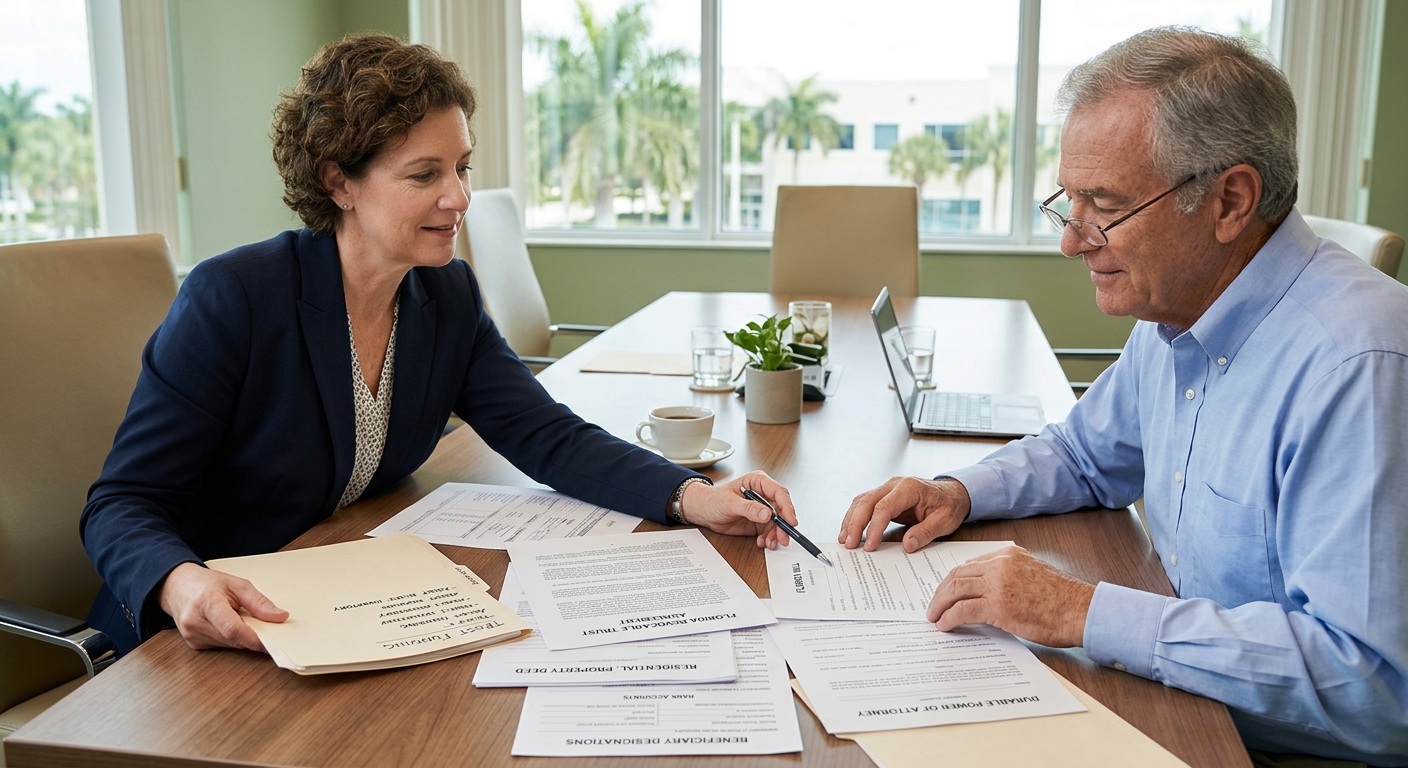
A useful review begins with the assets themselves.
For each significant asset, ask:
- Who owns it now?
- How is it titled?
- Does it have a beneficiary designation?
- Does it have survivorship rights?
- Is it owned by a trust?
- What happens if the named beneficiary dies first?
- Does the arrangement conflict with the will or trust?
- Are there special Florida rules governing the asset?
That review can reveal that an estate plan needs only a few updates.
It can also reveal several different transfer mechanisms working against one another.
Avoiding Probate Does Not Mean Avoiding Every Legal Process
Probate is not inherently a failure of estate planning. It is a legal mechanism for administering property that falls within the probate estate.
Avoiding probate can reduce court involvement for particular assets, and trust planning can sometimes prevent additional probate proceedings in another state when someone owns property outside Florida.
But a trust does not make administration disappear.
A successor trustee still has responsibilities involving assets, debts, beneficiaries, and distribution. The Florida Bar notes that many of the practical tasks performed by a personal representative must also be performed by a trustee administering a revocable trust.
The goal, then, is not simply less paperwork.
It is a transfer plan that matches the person’s wishes, family circumstances, assets, and Florida law.
Probate Avoidance in Coral Springs and Broward County
For families in Coral Springs and Broward County, probate planning ultimately comes down to the relationship between Florida law and the way the family’s assets are actually owned.
A homeowner may have very different planning considerations from someone whose estate consists primarily of retirement and investment accounts. A married couple may face different issues from an unmarried person. Someone with children from a previous relationship may need to coordinate beneficiary designations and ownership structures particularly carefully.
There is no single “avoid probate” document that produces the same result for every Florida estate.
The better question is which legal mechanism should govern each significant asset and whether those mechanisms work together.
When an Estate Planning Attorney Can Help
If you are planning your estate in Coral Springs, Broward County, or elsewhere in South Florida, an estate planning attorney can review more than whether you have a will.
The review can include how assets are titled, whether beneficiary designations match your wishes, whether a revocable trust is appropriate and properly funded, and whether Florida’s homestead rules affect the plan.
The objective is not to avoid probate at all costs.
It is to understand which assets will pass through probate, which can pass outside it, and whether the overall plan produces the result you actually intend.
Reinfeld & Cabrera P.A. assists clients with estate planning, trusts, probate, and related matters in Coral Springs, Broward County, and throughout South Florida.
If you are reviewing an existing estate plan or creating one for the first time, contact Reinfeld & Cabrera P.A. to discuss how your assets are owned and how Florida law may affect their transfer after death.
Questions People Often Ask
Can I avoid probate completely in Florida?
- Some estates can be structured so that significant assets pass outside probate. Whether that is appropriate depends on the assets, ownership structures, beneficiary designations, family circumstances, and Florida law.
Does having a will avoid probate?
- No. A will generally directs the distribution of property that remains subject to probate. It does not, by itself, remove those assets from the probate process.
Does a revocable trust avoid probate in Florida?
- It can, but the relevant assets must be properly transferred to the trust or otherwise coordinated with it. An unfunded trust may leave assets subject to probate.
Can a beneficiary designation avoid probate?
- A valid beneficiary designation can allow certain assets to pass outside probate. Florida law specifically recognizes pay on death accounts and beneficiary registrations for qualifying securities.
Can I put my Florida home in a trust to avoid probate?
- Florida homestead is subject to special constitutional and statutory rules. A trust may be appropriate in some circumstances, but homestead should not be treated like an ordinary investment asset.
Is avoiding probate always the best option?
- Not necessarily. Probate serves legitimate purposes, including administration of assets that fall within the probate estate. The appropriate estate plan depends on the circumstances rather than on avoiding court involvement as an end in itself.