Putting a Florida LLC into a revocable living trust is done by executing a formal Assignment of Membership Interest. This transfers your legal ownership equity from you as an individual to you as the trustee. It does not disrupt daily operations, trigger new federal income taxes, or force you to change your tax classification. Instead, it bypasses Broward County probate court, secures immediate business continuity if you face medical incapacity, and keeps your company running without court interference.
Let us paint a familiar picture. You worked tirelessly to build your Florida limited liability company. You handled the state filings, set up bank accounts, landed clients, and dealt with supply chain headaches.
Then, during a quiet moment over coffee, a terrifying thought creeps into your head: What actually happens to my business if I get hit by a distracted driver on I 95 tomorrow afternoon?
If your LLC membership units remain in your personal name, your business stops abruptly. Bank accounts freeze, contracts stall, and payroll grinds to a sudden halt while your family waits for a Broward County probate judge to appoint a personal representative.
Putting your LLC in a trust solves this problem. Let us walk through how Florida business owners transfer their companies into a living trust smoothly, legally, and without unnecessary headaches.
Why Florida Business Owners Assign LLC Interests to a Revocable Trust
Many business owners falsely assume that a standard Last Will and Testament protects their company. A will is essentially a formal letter to a probate judge asking them to distribute your assets after you pass away. It does not avoid probate, and it provides zero protection if you become medically incapacitated.
1. Bypassing Broward County Probate Court
When you own an LLC in your individual name, your ownership interest is personal property that must pass through probate administration upon death. Probate is slow, public, and expensive. By transferring your membership units to a trust, your trust becomes the legal owner of the business. Upon your death, your designated successor trustee steps in instantly according to your written terms, completely bypassing the court system.
2. Seamless Management Continuity During Medical Incapacity
What happens if you face a sudden health crisis or medical emergency that leaves you unable to manage your business for six months?
A personal power of attorney can work, but financial institutions routinely scrutinize or outright reject old powers of attorney for business accounts. When your LLC is owned by a trust, your successor trustee can step in immediately to approve payroll, sign client contracts, and keep operational doors open without court oversight or administrative delays.
4 Steps to Transfer Your Florida LLC Membership Into a Trust
Moving a company into a living trust sounds complex, but the execution follows four defined steps under Florida law.
Step 1: Review Your Existing Florida LLC Operating Agreement
Before signing any transfer documents, open your company operating agreement. If you are the sole owner of a single member LLC, transferring ownership is straightforward.
If your business has multiple owners, your operating agreement likely contains transfer restrictions, rights of first refusal, or specific consent requirements. You must follow these internal rules so your transfer remains valid and compliant.
Step 2: Execute an Assignment of Membership Interest
This is the core legal transfer document. You do not deed your company over like real estate; instead, you execute an Assignment of LLC Membership Interest.
This document formally states that you, as an individual, assign your equity percentage and voting rights to yourself as the trustee of your living trust.
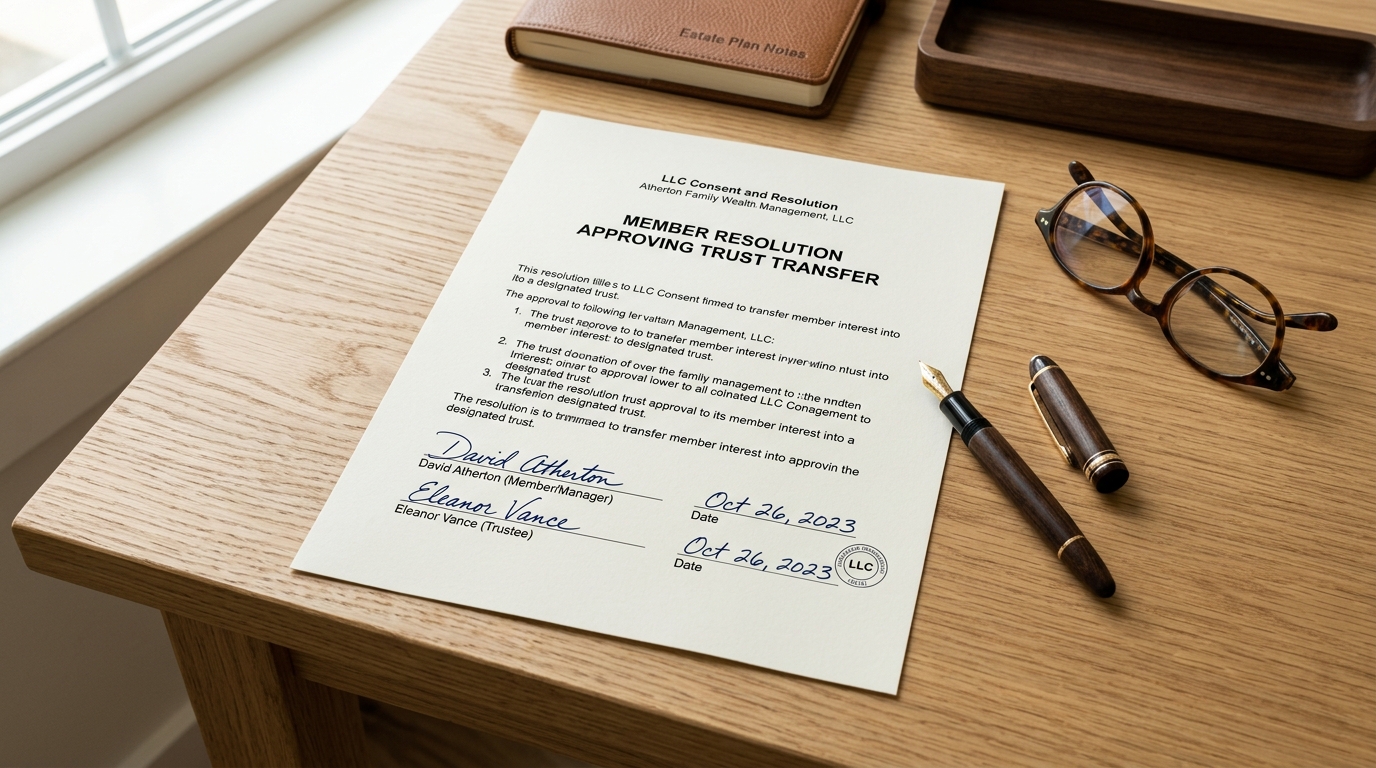
Step 3: Formalize Member Resolutions & Update Internal Schedules
Once the assignment is signed, document the transfer within your corporate records:
Draft a brief member resolution approving the assignment.
Update your LLC membership ledger to reflect your trust as the record owner.
Attach the assignment to Schedule A of your revocable trust agreement, listing your LLC equity as a funded trust asset.
Step 4: Verify Sunbiz Filings & Bank Account Signatory Rights
A common point of confusion for Florida business owners is whether Sunbiz (the Florida Division of Corporations) needs an immediate update.
Sunbiz tracks the managers or authorized persons who run the company, not necessarily every equity owner. If you remain the manager of your manager managed LLC, your Sunbiz listing stays the same.
However, you should bring your trust documents and signed assignment to your bank so your business accounts accurately recognize your trustee authority.
Common Pitfalls When Moving Florida Businesses Into a Trust
Will Putting My LLC in a Trust Change My Taxes?
For the vast majority of business owners, no. A standard revocable living trust is a disregarded grantor trust for federal tax purposes. Your single member LLC continues to report income on Schedule C of your personal Form 1040. You do not need a new Employer Identification Number (EIN) for your LLC simply because your trust now holds the membership units.
What Happens If My LLC Has Multiple Owners?
In multi member LLCs, co owners often panic when you mention putting your share into a trust. They worry your family members will show up on Monday morning trying to make operational decisions.
Clear up this confusion early. Transferring your economic rights to a trust protects your family financially while your operating agreement ensures that voting control or management decisions remain with qualified surviving partners or designated trustees.
Frequently Asked Questions About Florida LLCs and Living Trusts
How do I put an LLC in a trust in Florida?
You transfer ownership by executing an Assignment of Membership Interest from yourself as an individual to yourself as trustee, updating your internal corporate records, and listing the LLC units on your trust asset schedule.
Do I need to notify Sunbiz when I put my LLC in a trust?
Not necessarily. Sunbiz tracks managers and authorized officers, not underlying equity owners. If your managerial role remains unchanged, you generally do not need to update Sunbiz until your standard annual report filing.
Does transferring an LLC to a trust protect it from personal creditors?
A revocable living trust provides asset organization, probate avoidance, and operational continuity, but it does not shield personal assets from personal creditors during your lifetime. Irrevocable trust structures or specific charging order protection rules under Florida LLC law are required for advanced asset protection.
Can a trust hold an S Corp tax election LLC in Florida?
Yes. Federal tax law permits standard revocable grantor trusts to hold shares or membership units in S Corporations without invalidating your tax election.
Can I name my trust as the manager of my LLC?
While a trust can serve as the member (owner) of an LLC, individuals or corporate entities typically serve as managers to keep daily signing authority straightforward for contracts and banking.
Secure Your Business Continuity with a Coral Springs Estate Planning Attorney
Building a successful business takes years of dedication. Protecting it from administrative freezes, court delays, and probate confusion takes proper legal planning.
The estate planning and business attorneys at Reinfeld & Cabrera, P.A. help South Florida entrepreneurs structure their living trusts, assign business equity, and safeguard company continuity.
Schedule a Confidential Business Consultation
Protect your business and give your family total peace of mind. Speak directly with an attorney today to review your business assets and trust options:
The will attorneys in Reinfeld & Cabrera’s Coral Springs office want to remind you how important it is to keep your will up-to-date. You may have done the majority of your estate planning years ago, but now there are some changes you need to make to your will.
Your will is one of the most important documents you will ever establish and it is important to keep it up-to-date, reflecting your current plans for your estate. While the plans you made in your will years ago reflect your life at that time, you may want your current will to reflect changes in your life. The will attorneys in Coral Springs will help you update your will and make sure your estate plans are in order.
There are a lot of reasons why you might want to update your will. Marriage, divorce, and death are all reasons why wills need to be updated to reflect you current life status. A new child is also a reason to make changes to your will, as it will now reflect a new heir to your estate. Other potential reasons to update a will would be if you have seen a significant decrease or increase to your estate. For example, if you have won the lottery since your last will update, you will want to change your documents with the will attorneys in Coral Springs, to reflect your current worth.
If you have recently moved to the South Florida area from out of state, then you should also have a will attorney from Reinfeld & Cabrera’s Coral Springs office review your will to make sure it will be current and up to date according to Florida law. Tax laws change on a regular basis as well. It is always good to have your will reviewed and updated to take advantage of any new tax law changes that may be reflected in your estate planning.
Of course, the will attorneys in Coral Springs know that sometimes you just might change your mind about something in your will. Whether it be about the person you have named as the guardian of your children, or someone who was named to receive an inheritance from your estate, it is okay to change your mind and want your will to reflect this latest decision.
Don’t hesitate. Make those changes to your will today before it is too late.
The answer depends on when the beneficiary died, the language of the will, the beneficiary’s relationship to the person who died, and whether the beneficiary had already acquired a legal interest in the inheritance.
This situation can become complicated during Florida probate. A beneficiary may die while the estate is still being administered, leaving the personal representative and the surviving beneficiaries with an important question: Who is now entitled to receive that beneficiary’s share?
The answer is not always the beneficiary’s children, and the inheritance does not automatically return to the estate of the person who originally died.
What Happens When a Beneficiary Dies During Probate?
The first question is when the beneficiary died in relation to the person whose estate is being administered.
There is an important legal difference between a beneficiary who dies before the decedent and one who survives the decedent but dies before receiving an inheritance.
Those situations can produce different results under Florida law.
If the beneficiary survived the decedent, the beneficiary may have acquired an interest in the estate even though the probate case had not yet been completed. If that happens, the beneficiary’s own estate may become involved in receiving and administering that interest.
By contrast, if the beneficiary died before the decedent, Florida’s anti-lapse rules may determine whether the gift passes to certain descendants or otherwise fails under the terms of the will.
What If a Beneficiary Dies Before Receiving an Inheritance?
A common misconception is that an inheritance does not belong to a beneficiary until the personal representative actually writes the check or transfers the property.
That is not necessarily how probate works.
When a beneficiary survives the person who created the will, the legal treatment of that beneficiary’s interest can be different from the situation in which the beneficiary predeceases the decedent. The fact that distribution has not yet occurred does not by itself answer who ultimately receives the property.
The personal representative may therefore need to determine whether the deceased beneficiary’s interest must be distributed to the beneficiary’s estate.
This is one reason the question “what happens if a beneficiary dies before probate is complete?” cannot be answered with a single rule.
What If the Beneficiary Survived the Decedent?
This is one of the most important distinctions.
Suppose Maria leaves $100,000 to her son David in her will. Maria dies, and her probate estate is opened. David is alive when Maria dies, but he dies several months later while the probate case is still pending.
The fact that David died before receiving the $100,000 does not necessarily mean the gift disappears.
Depending on the circumstances and the terms of Maria’s will, David’s interest may become part of his own estate. His personal representative may then have to address that inheritance as part of David’s estate administration.
That can introduce a second probate or estate administration process.
The personal representative of Maria’s estate may therefore need to coordinate with the representative of David’s estate before the inheritance can be distributed.
What If the Beneficiary Died Before the Person Who Made the Will?
The situation can be different when a beneficiary dies before the testator.
For example, imagine that Maria’s will leaves her estate to her son David, but David dies before Maria. Maria later dies without changing her will.
Florida’s anti-lapse statute can sometimes preserve a gift to a deceased beneficiary’s descendants rather than allowing the gift to lapse. Florida Statutes section 732.603 applies to certain devisees who are relatives of the testator and who leave descendants who survive the testator. The statute also contains exceptions and conditions that can affect whether the rule applies.
This means that a beneficiary’s children do not automatically inherit every time a named beneficiary dies first.
The relationship between the deceased beneficiary and the testator matters. So does the language of the will.
How Does Florida’s Anti-Lapse Law Work?
Florida’s anti-lapse statute is designed to address certain situations in which a person named to receive property under a will dies before the testator.
Under section 732.603, a devise to certain relatives of the testator does not necessarily lapse merely because the named beneficiary dies before the testator. When the statutory requirements are satisfied, the deceased beneficiary’s descendants may take the property in the manner provided by the statute.
But anti-lapse rules should not be treated as a universal substitute-beneficiary provision.
The statute has specific requirements concerning the relationship between the testator and beneficiary, the beneficiary’s descendants, and survival. The will itself can also contain language that affects the outcome.
For that reason, determining whether Florida’s anti-lapse law applies requires examining the actual estate planning documents and the family relationships involved.
Does the Inheritance Go to the Beneficiary’s Children?
Not automatically.
Whether a deceased beneficiary’s children receive the inheritance depends on the circumstances.
If the beneficiary died before the testator, Florida’s anti-lapse statute may allow certain descendants to receive the gift.
If the beneficiary survived the testator and then died during probate, the analysis can be different. The beneficiary’s interest may instead become part of the beneficiary’s own estate, depending on the nature of the property interest and the governing documents.
The distinction is critical.
Simply knowing that “the beneficiary died” is not enough to determine what happens next.
What Happens to the Deceased Beneficiary’s Estate?
When a beneficiary survives the original decedent but dies before receiving the inheritance, the beneficiary’s own estate may become relevant.
The inheritance may need to be administered alongside the beneficiary’s other assets. The beneficiary’s will, if there is one, may affect who ultimately receives the property. If there is no valid will, the beneficiary’s estate may instead be distributed under the applicable intestacy rules.
This can create a situation in which one estate is effectively waiting for another estate to be administered.
For example, the personal representative of the first estate may need documentation establishing who has authority to act for the deceased beneficiary’s estate before completing distribution.
What If the Will Names a Backup Beneficiary?
Some wills specifically address what happens if a beneficiary dies.
A will might provide that if a named beneficiary does not survive the testator, the property goes to another person or group of people. Other wills may contain language creating a substitute gift or otherwise addressing descendants.
These provisions can change the analysis significantly.
This is why the will should be reviewed before relying on a general rule about a beneficiary who dies before receiving an inheritance.
A specific provision in the will may provide a different result from what would happen under the default statutory rules.
What Does the Personal Representative Need to Do?
The personal representative is responsible for administering the estate according to the will and Florida law.
When a beneficiary dies during administration, the personal representative may need to determine:
When the beneficiary died
Whether the beneficiary survived the decedent
Whether the will contains a substitute beneficiary provision
Whether Florida’s anti-lapse statute applies
Whether the beneficiary had already acquired an interest in the estate
Whether the beneficiary left a will
Who has authority to represent the beneficiary’s estate
Whether additional court filings are necessary
Whether the distribution should be delayed until the issue is resolved
The personal representative should not simply assume that the deceased beneficiary’s share goes to the beneficiary’s children or surviving relatives.
The correct result depends on the facts and governing documents.
Can a Beneficiary’s Death Delay Probate?
Yes.
A beneficiary’s death can complicate or delay an estate administration, particularly when the deceased beneficiary’s estate must become involved.
The personal representative may need additional documentation, court orders, or information about the beneficiary’s heirs or estate. If family members disagree about who should receive the deceased beneficiary’s share, the issue can become contested.
This is one reason a probate case can remain open even after the major assets and beneficiaries initially appear to have been identified.
What If Family Members Disagree About the Inheritance?
Disputes can arise when different family members interpret a will differently or disagree about whether an anti-lapse provision applies.
For example, one relative might argue that the deceased beneficiary’s children should receive the inheritance, while another argues that the property should pass under a different provision of the will.
The personal representative may need to seek legal guidance or court involvement rather than making the distribution based on an informal family agreement.
A disputed inheritance can also become more complicated when the deceased beneficiary had creditors, a separate probate estate, or competing heirs.
What Happens When a Beneficiary Dies Before the Estate Is Distributed in Florida?
There is no single answer for every Florida probate case.
If the beneficiary died before the decedent, Florida’s anti-lapse statute may apply in certain circumstances.
If the beneficiary survived the decedent but died before receiving the inheritance, the beneficiary’s interest may instead become part of the beneficiary’s own estate.
The will, the timing of the deaths, the relationship between the people involved, and the nature of the property all matter.
That is why a personal representative should determine the legal status of the beneficiary’s interest before distributing the estate.
Frequently Asked Questions
What happens if a beneficiary dies before probate is complete?
It depends on whether the beneficiary survived the person whose estate is being administered. If the beneficiary survived the decedent and later died during probate, the beneficiary’s interest may need to be handled through the beneficiary’s own estate. If the beneficiary died first, Florida’s anti-lapse rules may apply in certain circumstances.
Are heirs responsible for a deceased beneficiary’s inheritance?
Not necessarily. An inheritance may become part of the deceased beneficiary’s estate, and the people ultimately entitled to receive it can depend on the beneficiary’s will or Florida intestacy law.
Does a deceased beneficiary’s estate receive the inheritance?
When a beneficiary survives the original decedent but dies before distribution, the beneficiary’s estate may have a claim to the beneficiary’s share. The specific result depends on the nature of the interest, the will, and the circumstances of the estate.
Does Florida’s anti-lapse statute apply whenever a beneficiary dies?
No. Florida’s anti-lapse statute contains specific requirements and applies to certain circumstances involving beneficiaries who die before the testator. The statute should be reviewed together with the will and the family relationships involved.
Do the beneficiary’s children automatically inherit?
No. The beneficiary’s children do not automatically inherit simply because their parent died. They may receive property under Florida’s anti-lapse statute in qualifying circumstances, or they may inherit through their parent’s estate under different circumstances.
Can a beneficiary’s death create another probate case?
It can. If a beneficiary survives the original decedent and later dies while entitled to receive property, the beneficiary’s estate may need to administer that interest.
What should a personal representative do when a beneficiary dies?
The personal representative should establish when the beneficiary died. He needs to review the will, determine whether the beneficiary survived the decedent, identify any applicable substitute-beneficiary or anti-lapse provisions. He then needs to determine who has legal authority to receive or administer the beneficiary’s interest.
Facing home foreclosure in South Florida is extremely difficult and it is important to have a foreclosure defense attorney in Coral Springs representing you, in order to make sure you have exhausted all of your options. You don’t want your case to be negatively impacted because you don’t have the right attorney working with you.
At Reinfeld & Cabrera, we are foreclosure defense attorney specialists in Coral Springs who serve the entire South Florida area. We will work hard to assess your specific situation and come up with a realistic solution for your financial and legal issues. Not every foreclosure case is the same. We will respond to your specific needs and walk you through the process, so that you do not need to face the foreclosure issues on your own.
One of our first objectives will be to analyze your financial situation. After this, we can come up with the goals you want to achieve. For some clients, remaining in their home is what they want to have happen. For others, they want to unburden themselves from high mortgage payments and attempt to preserve their credit.
After meeting with you, our foreclosure defense attorneys in Coral Springs will work hard to come up with the goals that best suit your needs, and your situation. We will then determine the best strategic plan and work toward making it a viable solution.
At Reinfeld & Cabrera, we offer a free consultation with one of our foreclosure defense attorneys in Coral Springs to determine what action is right for your specific situation. You don’t need to face home foreclosure on your own. Have the right attorney on your side and we will help you work through the situation.