In Florida, adult guardianship is avoided by executing three proactive, legally binding instruments while mentally competent: a Durable Power of Attorney (Fla. Stat. § 709.2104), a Designation of Health Care Surrogate (Fla. Stat. § 765.202), and a Revocable Living Trust. Together, these documents grant immediate, private decision-making authority to chosen surrogates, preventing the 17th Judicial Circuit Court of Broward County from declaring incompetence or appointing a court-monitored professional guardian under Fla. Stat. Chapter 744.
Why a Florida Last Will and Testament Fails During a Lifetime Health Crisis
The most pervasive misconception among Florida property owners is the belief that a well-crafted Will protects their business, real estate, and financial accounts if they suffer a debilitating stroke, traumatic brain injury, or severe cognitive decline.
A Will is legally dormant until death. It grants zero authority during your lifetime.
If you lose legal capacity without specific lifetime governance documents, your family cannot simply present your Will to Bank of America, Chase, or a Broward County title company. Instead, your loved ones are forced into a rigid, public, and adversarial legal process known as Involuntary Adult Guardianship.
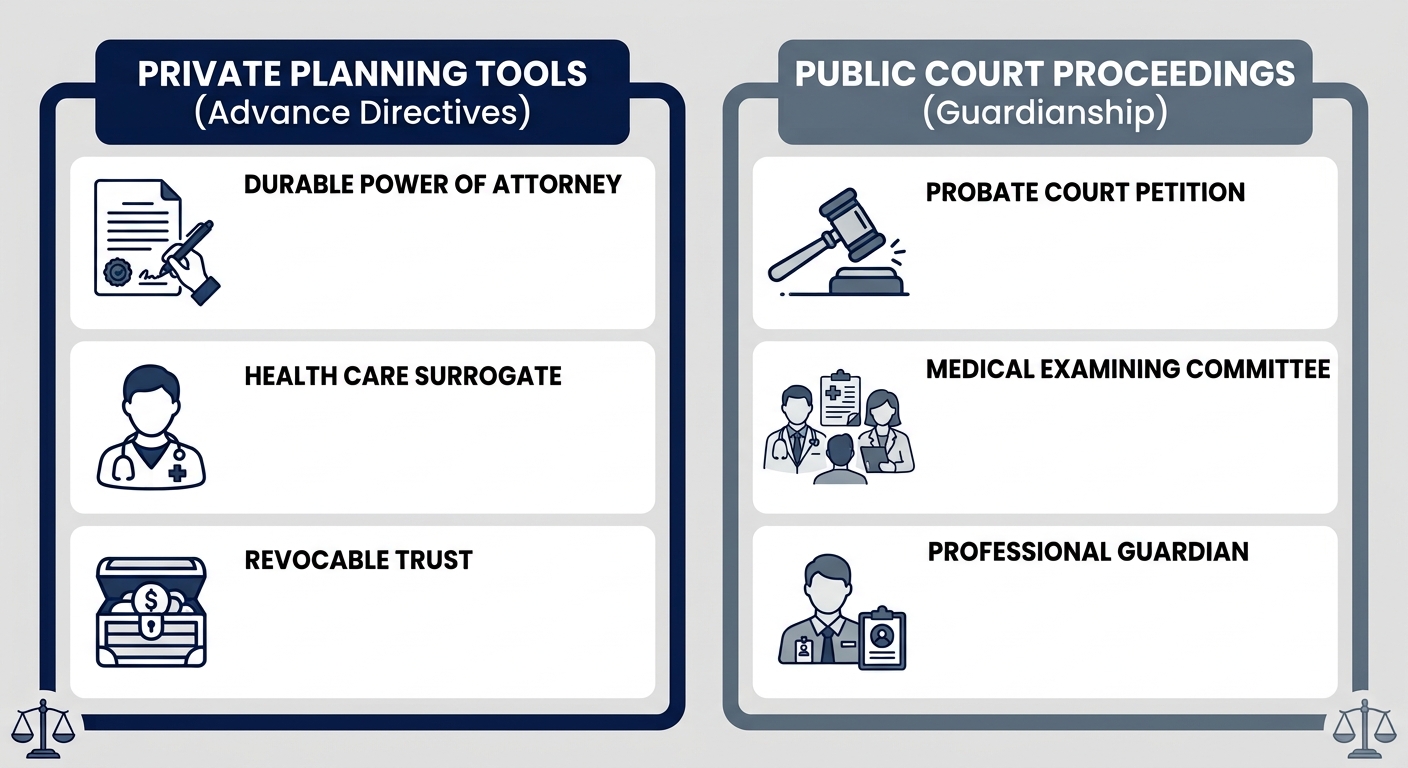
Path A: Proactive Planning (Private)
Path B: Court Intervention (Guardianship)
1. Key Legal Instruments:
Durable Power of Attorney
Health Care Surrogate
Revocable Living Trust
1. Emergency Court Petition:
Filed in the Broward County Circuit Court by family, health care providers, or interested third parties.
2. Immediate Authority:
Your designated agent or trustee steps in immediately without court permission.
2. 3-Member Examining Committee:
Court appoints a physician, medical expert, and layperson to evaluate your mental competency.
3. Privacy & Autonomy:
Financial affairs and health decisions remain strictly private within the family.
3. Public Incompetency Hearing:
Formal court hearing stripping fundamental constitutional rights and declaring legal incapacity.
Final Outcome: Seamless Family Management
Zero court fees, no public record, immediate operational continuity.
Final Outcome: Court Guardian Control
Appointed professional guardian, mandatory annual audits, assets drained by legal fees.
The Financial and Personal Realities of Florida Guardianship Proceedings
When a court petition is filed under Florida Statute Chapter 744, you become the “Alleged Incapacitated Person” (AIP). The judicial process moves quickly, privately stripping personal freedoms through public records:
1. Mandatory 3-Member Examining Committee
Under Fla. Stat. § 744.331, the court appoints an examining committee consisting of three professionals (at least one must be a medical doctor or psychiatrist). These individuals visit your home or hospital room, conduct cognitive testing, and submit written assessments directly to the Broward County judge.
2. Immediate Loss of Fundamental Civil Rights
If the court finds you incapacitated, you do not just lose access to your checking account. You lose the legal right to:
Contract, sign deeds, or manage business interests
Choose where you live or consent to medical treatment
Vote, hold a driver’s license, or marry
Retain personal legal counsel of your choice
3. The Financial Strain of Professional Guardianship
A court-appointed guardian is entitled to reasonable compensation paid directly out of your assets. Every financial move—selling a home in Coral Springs, liquidating stock, or paying for specialized memory care—requires formal court petitions, attorney appearances, and annual financial audits overseen by the clerk of court.
Real World Precedent: How Lack of Planning Triggers Systemic Vulnerability
To understand why Florida courts step in so forcefully, one needs to look no further than the notorious state guardianship cases that led to major legislative reforms across South Florida.
Consider the real life case of Jan Garwood, a Central Florida resident who suffered a sudden medical crisis without a complete, active incapacity plan in place.
┌────────────────────────────────────────────────────────┐
│               THE REALITY OF COURT CONTROL             │
├───────────────────────────┬────────────────────────────┤
│    WITHOUT A DPOA / TRUST │  WITH PROACTIVE R&C PLAN   │
├───────────────────────────┼────────────────────────────┤
│ Forced court petition     │ Private family transition  │
│ 3-person medical panel    │ Designated agent steps in  │
│ Court-appointed guardian  │ Zero court costs or fees   │
│ House sold without consent│ Assets fully protected     │
└───────────────────────────┴────────────────────────────┘
After an emergency hospital admission under the Baker Act, the hospital petitioned the court to appoint a professional guardian. Because Garwood lacked a updated Durable Power of Attorney and Revocable Living Trust specifically naming trusted family members to handle her affairs:
The Court Intervened Immediately: A judge declared her incompetent based on brief examining committee reports, bypassing her family.
Loss of Property: The court appointed professional guardian gained complete control over her finances, eventually selling her home to cover facility care costs.
Loss of Autonomy: Garwood spent three years in a locked assisted living facility before independent attorneys managed to restore her rights, by which time her personal assets had been liquidated.
Cases like Garwood’s—and the widespread Florida state investigations into court appointed guardians that followed—highlight a critical legal reality: If you do not choose your own decision makers through private estate planning documents, a Florida probate court will choose one for you.
The Incapacity Avoidance Triad: 3 Key Documents
To lock out judicial interference, an incapacity strategy must unite three precise legal instruments under Florida law:
1. Florida Financial Durable Power of Attorney (DPOA)
Governed by Fla. Stat. § 709.2104, a Florida DPOA must contain specific “superpowers” (explicit initialed clauses under Fla. Stat. § 709.2114) granting your named agent the legal right to manage real estate, conduct banking, handle tax returns, and qualify for governmental benefits without court approval.
2. Florida Designation of Health Care Surrogate
UnderFla. Stat. § 765.202, this instrument allows your named surrogate to consult with doctors, review HIPAA-protected medical records, authorise surgeries, and make end-of-life decisions if you become unable to provide informed consent.
3. Revocable Living Trust
Holding property, financial accounts, and business equity inside a revocable trust creates an unbroken chain of authority. If you face incapacity, your named Successor Trustee steps in seamlessly to manage trust assets according to your written directives, eliminating the need for court supervision.
Frequently Asked Questions
Can my spouse automatically handle my finances if I become incapacitated?
No. Spousal status alone does not grant legal authority to sign deeds, alter bank accounts, or manage individually held assets in Florida. Without a valid Durable Power of Attorney or Trust, a spouse must petition the court for guardianship just like any third party.
What is the difference between a Power of Attorney and a Guardian?
A Power of Attorney agent is chosen privately by you while you are mentally sound. A Guardian is appointed by a judge after a court determination of incompetence.
Does a Durable Power of Attorney expire upon incapacity in Florida?
No. Unlike a standard power of attorney, a Durable Power of Attorney explicitly remains effective during temporary or permanent mental incapacity under Fla. Stat. § 709.2104.
Protect Your Independence with a Coral Springs Estate Planning Attorney
Maintaining total control over your health choices, personal dignity, and financial assets requires clear legal planning before a sudden health crisis occurs.
The estate planning attorneys at Reinfeld & Cabrera, P.A. help individuals and families across Coral Springs, Fort Lauderdale, and Broward County construct airtight incapacity plans that bypass court intervention entirely.