A Florida guardianship does not automatically take away a person’s gun rights. However, an incapacity adjudication can trigger a separate firearm disability under Florida law, depending on the findings made by the court.
That sounds straightforward until someone actually has to deal with it.
Dad cannot manage his bills anymore. His daughter is considering guardianship. Then somebody remembers the guns.
There is a handgun in the nightstand. Two rifles are in a locked cabinet. Dad insists he is perfectly capable of handling them. His daughter is considerably less convinced.
Now the family has a very different question:
Can Dad still legally own or possess those firearms?
Florida’s guardianship law and firearm law approach that question differently. A guardianship does not automatically erase every legal right an incapacitated person has. At the same time, Florida’s firearm statutes impose restrictions on certain people who have been adjudicated mentally defective, and that definition includes certain judicial findings of incapacity under Florida’s guardianship law.
So the answer may depend on something buried in the court record that the family did not realize mattered.
And that is where things get interesting.
Does Guardianship Automatically Take Away Gun Rights in Florida?
No. Being placed under guardianship does not, by itself, automatically remove a person’s right to own or possess firearms.
Florida’s guardianship statute, §744.3215, lists the rights a person determined incapacitated retains and the rights that a court may remove. The list includes rights involving marriage, voting, driving, contracts, property, health care, residence, and other decisions. Firearm ownership and possession are not listed as rights that §744.3215 specifically gives a guardian authority to remove.
That does not mean an incapacity finding has no effect on firearms.
Florida’s firearm statutes create a separate legal disability. Under §790.065, the statutory definition of a person “adjudicated mentally defective” includes a judicial finding of incapacity under §744.331(6)(a). A person who falls within that definition can be prohibited from purchasing a firearm.
Section 790.064 goes further. A person who has been adjudicated mentally defective, as defined by §790.065, may not own or possess a firearm until relief from the firearm disability is obtained.
So there are two different pieces of law sitting next to each other:
- Chapter 744: What rights has the guardianship court removed from the ward?
- Chapter 790: Does the person have a separate firearm disability?
The answer to one does not automatically answer the other.
What Does an Incapacity Adjudication Have to Do With Firearms?
This is the part families can easily miss.
A guardianship case begins with a determination of incapacity. Florida law requires the petition to identify the rights the petitioner believes the alleged incapacitated person cannot exercise. The court then determines the nature and scope of the incapacity and the rights affected by its order.
Firearm law uses its own terminology.
Under §790.065, “adjudicated mentally defective” includes certain court determinations involving mental illness, incompetency, conditions, or disease. The statute specifically includes a judicial finding of incapacity under §744.331(6)(a).
That is why the phrase “the person has a guardian” is not enough to determine whether a firearm disability exists.
You have to look at the actual incapacity adjudication and the statutory definition that applies to it.
A limited guardianship involving one set of rights can raise different questions from a broader incapacity adjudication. The court order, the findings supporting it, and the applicable firearm statutes all matter.
What Happens to Guns Someone Already Owns?
Suppose Dad already owns three firearms before the guardianship proceeding.
His daughter becomes his guardian. The guns do not suddenly become the daughter’s property because she was appointed guardian.
But if Dad has been adjudicated mentally defective within the meaning of Florida’s firearm statutes, §790.064 says he may not own or possess a firearm until the firearm disability is removed.
That creates a practical problem the family should not try to solve by improvising.
Someone needs to determine:
- What exactly did the court adjudicate?
- What rights were removed?
- Does the adjudication fall within §790.065?
- Is there an existing firearm disability?
- Is there a concealed weapons or firearms license?
- Does a court order address the firearms?
- What legally authorized arrangement should be made for firearms the person already owns?
A guardian does not receive a free-floating power to make every decision for a ward. Florida law limits the rights a guardian may exercise to those removed from the ward and delegated to the guardian.
And if the person is legally prohibited from possessing a firearm, the family should not treat the guns as if this were simply a question of where to put Dad’s property.
Florida Lawyers Were Already Arguing About This in 2013
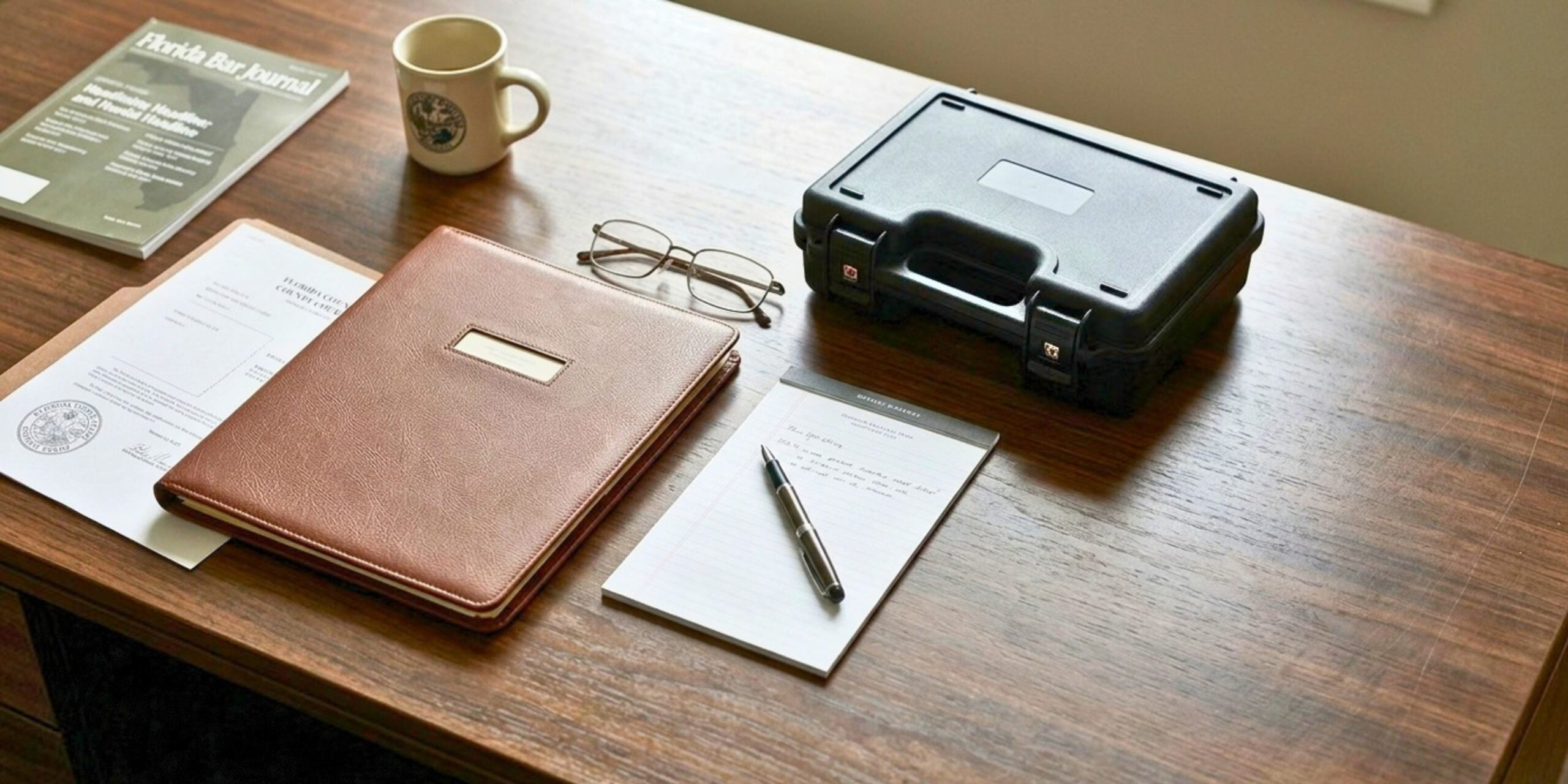
In December 2013, The Florida Bar Journal published “Grandparents, Guns, and Guardianship: Incapacity and the Right to Bear Arms” by Carla-Michelle Adams. The article argued that Florida’s guardianship statutes did not specifically address whether an incapacitated person’s right to bear arms could be removed.
Then, in February 2014, attorneys Caroline S. A. Zoes and J. Marcos Martinez responded with “Wards and Guns.” Their position was that becoming a ward does not automatically erase constitutional rights.
The exchange is useful today because it identified the exact problem: guardianship law and firearm law were not using the same framework.
Florida’s statutes have since developed firearm-specific restrictions that make the analysis different from the one presented in those 2013 and 2014 articles.
The old debate is still worth reading, though. It explains why the relationship between guardianship, incapacity, and gun rights has never been as simple as “the judge appointed a guardian, so the guns are gone.”
Florida Guardianship Forms Mention Firearms
There is an unusually specific clue in Florida’s guardianship paperwork.
The Florida Supreme Court’s guardianship forms include a question asking whether the respondent may or may not have a license to carry a firearm or possess a weapon or firearm. The form appears in the court’s guardianship rules and forms governing incapacity and guardianship proceedings.
That does not mean the form itself creates a firearm disability.
It does show that firearms are something the guardianship process can require the court to address.
The same form separately identifies the rights that may be delegated to a guardian. Those include contracts, lawsuits, government benefits, property management, residence, health care, and social-environment decisions. Firearm possession does not appear in that list of delegable guardianship rights.
That distinction is worth keeping straight.
Can an Incapacitated Person Still Have a Concealed Weapons License?
Not necessarily. An incapacity-related firearm disability can also affect eligibility for or continued possession of a Florida concealed weapons or firearms license.
Florida’s firearm background-check statute requires the state to consider whether a person has been adjudicated mentally defective or committed to a mental institution. The statute also directs the Department of Law Enforcement to provide relevant information to the Department of Agriculture and Consumer Services when determining eligibility for a concealed weapons or firearms license or whether an existing license should be suspended or revoked.
So a family should not assume that the question ends with the firearms sitting in a gun safe.
There may also be a licensing issue.
Can Someone Regain Gun Rights After an Incapacity Adjudication?
Possibly, but restoration of capacity and restoration of firearm rights are separate legal processes.
Florida law allows a person to seek relief from a firearm disability arising from an adjudication or commitment. Under §790.065, the petition is presented to the appropriate court, the state attorney may object, and the court considers evidence concerning the person’s reputation, mental health record, criminal history when applicable, the circumstances surrounding the firearm disability, and other evidence.
The court must determine that the person is not likely to act in a manner dangerous to public safety and that granting relief would not be contrary to the public interest before granting relief under that statute.
Florida’s guardianship law separately provides a procedure for restoring a ward to capacity when the person can again exercise rights that were previously removed.
Those two procedures should not be treated as interchangeable.
Someone whose capacity has been restored should still determine whether a separate firearm disability remains and whether formal relief under Chapter 790 is required.
What If the Guardian and the Family Disagree About the Guns?
Imagine the Coral Springs family again.
Dad’s daughter is now his guardian. Dad’s son thinks the guns should stay in the house. Dad insists that nothing has changed and wants access to them.
Nobody agrees.
The daughter says, “I’m his guardian.”
The son says, “They’re his guns.”
Dad says, “They’re mine.”
None of those statements, by itself, resolves the legal issue.
The family needs to look at the incapacity order, the guardianship authority actually granted, and the firearm statutes that apply to the adjudication.
If a firearm disability exists under Chapter 790, the possession question becomes very different from a dispute over who owns a piece of ordinary personal property.
And if the family believes the incapacity determination itself should be changed, that is a separate guardianship issue.
This is one of those situations where pulling the actual court file is considerably more useful than arguing around the kitchen table.
What Does This Mean for Families in Coral Springs and Broward County?
For families in Coral Springs and Broward County, guardianship proceedings are handled through Florida’s court system, and the details of the incapacity order can determine what happens next.
A family dealing with an aging parent, dementia, cognitive decline, or another condition affecting decision-making may already be dealing with medical records, financial accounts, powers of attorney, and property issues.
Firearms can add another layer.
If the person owns firearms, the family should identify that issue early in the guardianship process rather than assuming the appointment of a guardian answers it.
The relevant documents may include:
- The petition to determine incapacity
- The examining committee reports
- The order determining incapacity
- The order appointing the guardian
- Letters of guardianship
- Any order addressing firearm possession
- Records relating to a firearm or concealed weapons license
- Any later order restoring capacity or granting relief from firearm disabilities
The legal analysis is fact specific. A guardianship attorney in Coral Springs or elsewhere in Broward County may need to review the actual orders before giving a definitive answer about a particular person’s firearm rights.
Frequently Asked Questions
Can guardianship take away your gun rights in Florida?
- Guardianship alone does not automatically remove gun rights. However, a qualifying incapacity adjudication can trigger a separate firearm disability under Florida’s Chapter 790.
Does an incapacity adjudication prevent someone from buying a gun in Florida?
- It can. Florida’s firearm purchase statute includes certain judicial findings of incapacity within the definition of “adjudicated mentally defective,” which can make a person prohibited from purchasing a firearm.
Can an incapacitated person possess a firearm in Florida?
- Not if the person is subject to the firearm possession disability in §790.064. That statute prohibits a person covered by its definition from owning or possessing a firearm until relief from the disability is obtained.
Could a guardian take away a ward’s guns?
- A guardian does not automatically receive authority over firearms simply because the guardian was appointed. The guardian’s authority depends on the rights removed and powers delegated by the court, while firearm possession may also be governed independently by Chapter 790.
Can someone regain firearm rights after an incapacity adjudication in Florida?
- Florida law provides a procedure for seeking relief from a firearm disability. The firearm-relief process is separate from the general procedure for restoring capacity under the guardianship statutes.
Does restoring capacity automatically restore gun rights in Florida?
- Do not assume that it does. Restoration of capacity and relief from a firearm disability arise under different statutory procedures. The person’s specific court orders and firearm records should be reviewed.
Can an incapacity adjudication affect a concealed weapons license?
- Yes. Florida law directs relevant firearm-disability information to the state agency responsible for determining eligibility for concealed weapons or firearms licenses and for considering suspension or revocation of existing licenses.
Guardianship and Gun Rights in Coral Springs, Broward County, and South Florida
The unusual combination of guardianship and gun rights in Florida creates a legal problem that does not fit neatly into either a standard guardianship checklist or a standard firearm question.
A person can have a guardian without every legal right disappearing. At the same time, a qualifying incapacity adjudication can create a separate firearm disability under Florida law.
For families in Coral Springs, Broward County, and throughout South Florida, the starting point is the actual incapacity order and the firearm statutes that apply to it.
Reinfeld & Cabrera P.A. handles guardianship, probate, and related legal matters in Coral Springs and throughout Broward County. If a guardianship proceeding involves firearms or questions about an existing firearm disability, the attorneys can review the circumstances and explain the legal issues that may apply.
This article provides general information about Florida guardianship and firearm law. It is not legal advice and does not determine whether a particular person may lawfully possess, purchase, or carry a firearm.