
Quick Answer: The Florida Medicaid 5-Year Lookback Rule allows the Department of Children and Families (DCF) to review all financial transactions and asset transfers made within 60 months prior to applying for Nursing Home Medicaid. Gifting real estate or transferring home ownership below fair market value triggers severe penalty periods of Medicaid ineligibility.
However, homeowners can legally shield their residence from long-term care costs and Medicaid Estate Recovery (MERP) through statutory exceptions—such as the Caregiver Child Exemption, spousal transfers, Medicaid Asset Protection Trusts (MAPTs) created outside the 5-year window, or Lady Bird Deeds that bypass probate without violating lookback rules.
1. How the Florida Medicaid 5-Year Lookback Rule Operates
When an individual applies for Institutional Care Program (ICP) Medicaid in Florida, the state evaluates both income and countable assets. To prevent applicants from gifting away assets to qualify for state benefits, Florida enforces a strict 60-month “lookback” period.
Month 60 to Application Date: The window of scrutiny evaluated by the state.
Uncompensated Asset Transfer: Any transfer of property, cash, or real estate for less than fair market value during this 60-month window.
Penalty Period Enforcement: DCF calculates a period of Medicaid ineligibility based on the total value of the uncompensated transfer.
The Penalty Period Calculation
If the Florida Department of Children and Families (DCF) discovers an uncompensated transfer within the 60 months preceding the application date, DCF imposes a penalty period during which the applicant is disqualified from Medicaid coverage.
During this penalty period, the applicant must pay for nursing home care entirely out-of-pocket—often exceeding $10,000 to $12,000 per month in South Florida facilities—before Medicaid coverage can begin.
Is the Primary Residence a Countable Asset?
In Florida, a primary residence homestead is generally considered an exempt asset for initial Medicaid eligibility if the applicant’s equity interest does not exceed the state’s maximum equity limit and the applicant indicates an “intent to return home” on the application.
However, holding a primary residence as an exempt asset during life does not protect it after death. Without proactive legal structuring, the home remains vulnerable to post-death creditor claims by the state.
2. The Threat of Medicaid Estate Recovery (MERP)
Qualifying for Medicaid during life is only half the battle. Under Fla. Stat. § 409.9101, Florida operates the Medicaid Estate Recovery Program (MERP). Upon the Medicaid recipient’s death, the state becomes a creditor against their probate estate to recoup every dollar paid out for long-term care services.
Property Titled in Deceased’s Name Alone: Passes through formal probate administration, allowing MERP to execute claims and attach liens to force a sale.
Property Structured Outside Probate: Passes directly to designated heirs via deed or trust, completely avoiding probate administration and blocking MERP claims.
If the home passes through formal probate administration, the state can attach a lien to the real estate, forcing heirs to sell the property to satisfy the Medicaid debt. Protecting the family home requires strategies that insulate the residence during the lookback analysis while simultaneously ensuring the home bypasses probate court at death.
3. Statutory Exceptions and Exemption Strategies
Florida Medicaid rules contain explicit statutory safe harbors that permit home transfers within the 5-year window without triggering a penalty period.
Transfer Strategy / Exemption
Lookback Penalty Status
Primary Legal Advantage
Transfer to Surviving Spouse
Fully Exempt
Preserves full ownership for the well spouse (Community Spouse) without penalty.
Caregiver Child Exemption
Fully Exempt
Transfers home title directly to an adult child who provided in-home care.
Transfer to Disabled Child
Fully Exempt
Protects property for a child verified as permanently disabled under SSI/SSDI rules.
Lady Bird Deed (Enhanced Life Estate)
Fully Exempt
Retains lifetime control, avoids probate, and blocks MERP claims.
Medicaid Asset Protection Trust (MAPT)
Subject to 5-Year Lookback
Must be executed >60 months prior to application; provides total asset protection.
The Caregiver Child Exemption
Under Florida Medicaid guidelines, an applicant can transfer full title of the homestead to their adult child without incurring a transfer penalty if specific conditions are met:
The adult child lived in the parent’s primary residence for at least two consecutive years immediately prior to the parent’s admission to a nursing home or long-term care facility.
The child provided documented care that permitted the parent to reside safely at home rather than in a medical care facility during those two years.
The care provided is verified through medical records, physician attestations, and detailed care logs.
Spousal Transfers and Community Spouse Resource Allowance (CSRA)
Transferring the primary residence to a Community Spouse (the spouse who remains living in the community) is completely exempt from the 5-year lookback rule. The well spouse can receive full title to the home without impacting the institutionalized spouse’s Medicaid application.
Lady Bird Deeds (Enhanced Life Estate Deeds)
A Florida Lady Bird Deed allows a property owner to retain an enhanced life estate (including full rights to sell, mortgage, or revoke the deed) while designating remainder beneficiaries who inherit the property automatically at death.
Why it passes lookback scrutiny: Because the owner retains full control to revoke the deed during life, recording a Lady Bird Deed is not classified as a completed uncompensated gift by Florida DCF.
Why it blocks MERP: The property transfers automatically upon death outside of probate administration, effectively shielding the homestead from state estate recovery claims under Fla. Stat. § 409.9101.
4. Real-World Execution Scenarios
Scenario A: Proactive Planning (7 Years Before Long-Term Care Needs)
Profile: A 70-year-old homeowner in Broward County with early-stage health concerns wants to protect her home valued at $500,000 for her two adult children.
Strategy: The homeowner executes a Medicaid Asset Protection Trust (MAPT) and deeds her home into the irrevocable trust.
Outcome: Because the transfer occurred more than 60 months before she ever required nursing care, the 5-year lookback window expires cleanly. The home is completely sheltered from long-term care costs, and she retains the right to live in the home for life.
Scenario B: Emergency Crisis Planning (Immediate Nursing Home Admission)
Profile: An 82-year-old widower suffers a severe stroke and requires immediate, permanent placement in a Coral Springs skilled nursing facility. He has lived with his adult daughter for the past three years, during which she managed his daily medical needs.
Strategy: His legal team gathers medical documentation and physician certifications establishing the Caregiver Child Exemption, while simultaneously executing a Lady Bird Deed as a secondary safeguard.
Outcome: The home is transferred directly to the daughter without triggering a Medicaid penalty period, preserving the home from immediate spend-down and future Medicaid estate recovery.
Frequently Asked Questions
Can Medicaid take my home while I am still alive in Florida?
No. Florida law does not allow Medicaid to place a lien on or seize your primary residence while you are alive, provided your equity remains under the state limit and you state an intent to return home. Threat of home loss occurs after death through the Medicaid Estate Recovery Program (MERP) during probate administration.
Does executing a Lady Bird Deed trigger a 5-year lookback penalty?
No. Because a Florida Lady Bird Deed allows you to retain total unilateral control to sell, refinance, or revoke the conveyance during your lifetime, Florida DCF does not treat it as a completed gift or uncompensated transfer. It does not trigger a Medicaid penalty period.
What evidence is required for the Caregiver Child Exemption in Florida?
Florida DCF requires clear written proof, including:
Proof of joint residency (such as tax returns, driver’s licenses, or utility bills) covering the two years prior to facility admission.
A signed written statement from the treating physician confirming that the care provided by the adult child allowed the parent to remain safely at home instead of entering a nursing facility.
Protect Your Family Home and Assets Before a Crisis Strikes
Navigating Florida Medicaid rules and protecting your real estate from long-term care costs requires proactive, highly technical legal planning. A single misstep with uncompensated asset transfers or failing to structure your property outside of probate can expose your family home to devastating out-of-pocket nursing home expenses and Medicaid Estate Recovery liens.
Do not leave your family’s legacy vulnerable to the uncertainties of the 5-year lookback window. Connect directly with our estate planning and elder law team to build a secure, customized asset protection strategy tailored to your circumstances.
Call Our Office Today: Speak with our team directly at 954-866-4878 to discuss your options.
Under Article X, Section 4 of the Florida Constitution, a primary residence (homestead) is subject to strict constitutional inheritance laws that override standard terms written in a Will or Trust. If a Florida homestead owner dies while survived by a spouse or minor child, state law dictates who receives the home, preventing the owner from freely disinheriting their immediate family.
Direct Answer: When a married Florida homestead owner dies with surviving descendants, Florida Statute § 732.401 gives the surviving spouse two choices: a Life Estate (the right to live in the home for life with a vested remainder to descendants) OR an election to take an undivided 50% ownership share as Tenants in Common. The spouse must file this 50% election within 6 months of the owner’s date of death.
Can You Disinherit a Spouse or Child from a Florida Homestead in Your Will?
Florida’s constitutional restrictions prevent homeowners from leaving their primary residence to outside parties if they have a legal spouse or minor children at the time of death.
If you have minor children: You cannot leave the home entirely to your spouse or anyone else in a Will. Any attempt to do so is legally void under Florida law.
If you have a spouse (and no minor children): You can only leave the home outright to your surviving spouse. Leaving it to a friend, charity, or adult child from a previous marriage without spousal waiver is invalid.
If you have no spouse and no minor children: You are free to leave the property to whomever you choose.
If a Will attempts to convey homestead property in violation of these rules, Florida probate courts treat the gift as an invalid devise. The property automatically passes according to Florida’s statutory rules under Fla. Stat. § 732.401.
Life Estate vs. 50% Election: What Are a Surviving Spouse’s Rights Under Fla. Stat. § 732.401?
When a homestead owner dies survived by a spouse and children (adult or minor), Florida Statute § 732.401 governs how ownership splits between them.
Option 1: Default Life Estate
By default, the surviving spouse receives a Life Estate.
Spouse’s Rights: The right to live in, use, and occupy the residence for the remainder of their lifetime.
Children’s Rights: The decedent’s children receive a vested remainder, automatically assuming 100% ownership after the surviving spouse passes away.
Limitations: The surviving spouse cannot sell, mortgage, or transfer the home without the full consent of all children holding the remainder interest.
Option 2: The 50% Tenant-in-Common Election
To prevent friction between surviving spouses and adult stepchildren, Florida law permits the surviving spouse to opt out of the Life Estate.
Spouse’s Rights: The spouse takes an undivided 50% ownership interest as a Tenant in Common.
Children’s Rights: The decedent’s children collectively share the remaining 50% ownership interest.
Benefits: Either side can file a court action to force a sale (partition action) if both sides cannot agree on maintaining or selling the home.
Comparison Table: Florida Homestead Life Estate vs. 50% Tenant-in-Common Election (Fla. Stat. § 732.401)
Ownership Feature
Option 1: Default Life Estate
Option 2: 50% Tenant-in-Common Election
Spousal Control
Exclusive right to live in property for life
50% legal ownership share
Heir Control
Future ownership after spouse dies
Immediate 50% collective ownership share
Routine Costs (Taxes, Insurance)
Spouse pays 100% of property taxes & maintenance
Split 50/50 between spouse and heirs
Mortgage Principal
Split according to statutory interest formulas
Split 50/50 between spouse and heirs
Forced Sale (Partition)
Cannot be forced by heirs or spouse
Either party can initiate partition to sell property
Strict Deadline
None (automatic default)
6 months from owner’s date of death
Is a Florida Homestead Protected From Estate Creditors After Death?
Beyond inheritance rules, Article X, Section 4(b) of the Florida Constitution provides strong creditor protections that pass directly to heirs.
If the primary home passes to an exempt heir (a surviving spouse, child, sibling, niece, or nephew), the home transfers free and clear of most estate debts. Unsecured creditors; such as credit card companies, medical providers, or personal loan lenders, cannot force the sale of a Florida homestead to satisfy the decedent’s unpaid debts during probate.
(Note: Under Florida’s probate framework, homestead property is entirely excluded when calculating eligibility for summary administration.)
Only three specific debt types can attach to a Florida homestead:
Mortgages signed on the property.
Unpaid real estate property taxes or special assessments.
Mechanics’ and contractors’ liens for work performed directly on the home.
How Do You Establish Legal Homestead Status in Florida Probate Court?
Homestead protections do not apply automatically on paper; they must be formally recognized by a probate judge in the local circuit court (such as the 17th Judicial Circuit in Broward County, 15th Circuit in Palm Beach, or 11th Circuit in Miami-Dade).
File a Petition for Order Determining Homestead Status: A probate attorney files an official petition asking the court to confirm that the property meets constitutional homestead qualifications.
Obtain the Judicial Order: Once signed by the probate judge, the Order Determining Homestead removes the residence from the general probate estate, transfers title to the legal heirs, and shields it from general creditors.
Record the Notice of Election (If Applicable): If taking the 50% Tenant-in-Common election, an official Notice of Election containing the property’s legal description must be signed and recorded in county land records within the strict 6-month statutory window.
Resolving Florida Homestead Disputes and Protecting Estate Rights
Florida’s constitutional homestead protections exist to protect families from displacement and unmanageable creditor claims following a loved one’s passing.
However, the strict constitutional mandates surrounding testamentary freedom, paired with the mandatory 6-month statutory window under Fla. Stat. § 732.401, mean that minor procedural errors can result in forfeited spousal rights, clouded property titles, or unexpected co-ownership disputes between spouses and stepchildren.
Navigating a homestead determination requires swift action in the local probate court to secure clear legal title, enforce statutory elections, and shield the home from unauthorized creditor claims.
Whether you are a surviving spouse evaluating a Life Estate vs. 50% Tenant-in-Common Election, an heir seeking to establish homestead creditor protections, or a personal representative executing an estate, the probate team at Reinfeld Cabrera Tison provides experienced guidance throughout the entire judicial process.
Office Address: 9625 W Sample Rd, Coral Springs, FL 33065
Contact Phone: (954) 866-4878 | 954-866-HURT
Local Probate Venues Served: 17th Judicial Circuit (Broward County Courthouse, Fort Lauderdale), 15th Judicial Circuit (Palm Beach County), 11th Judicial Circuit (Miami-Dade County), and 16th Judicial Circuit (Monroe County).
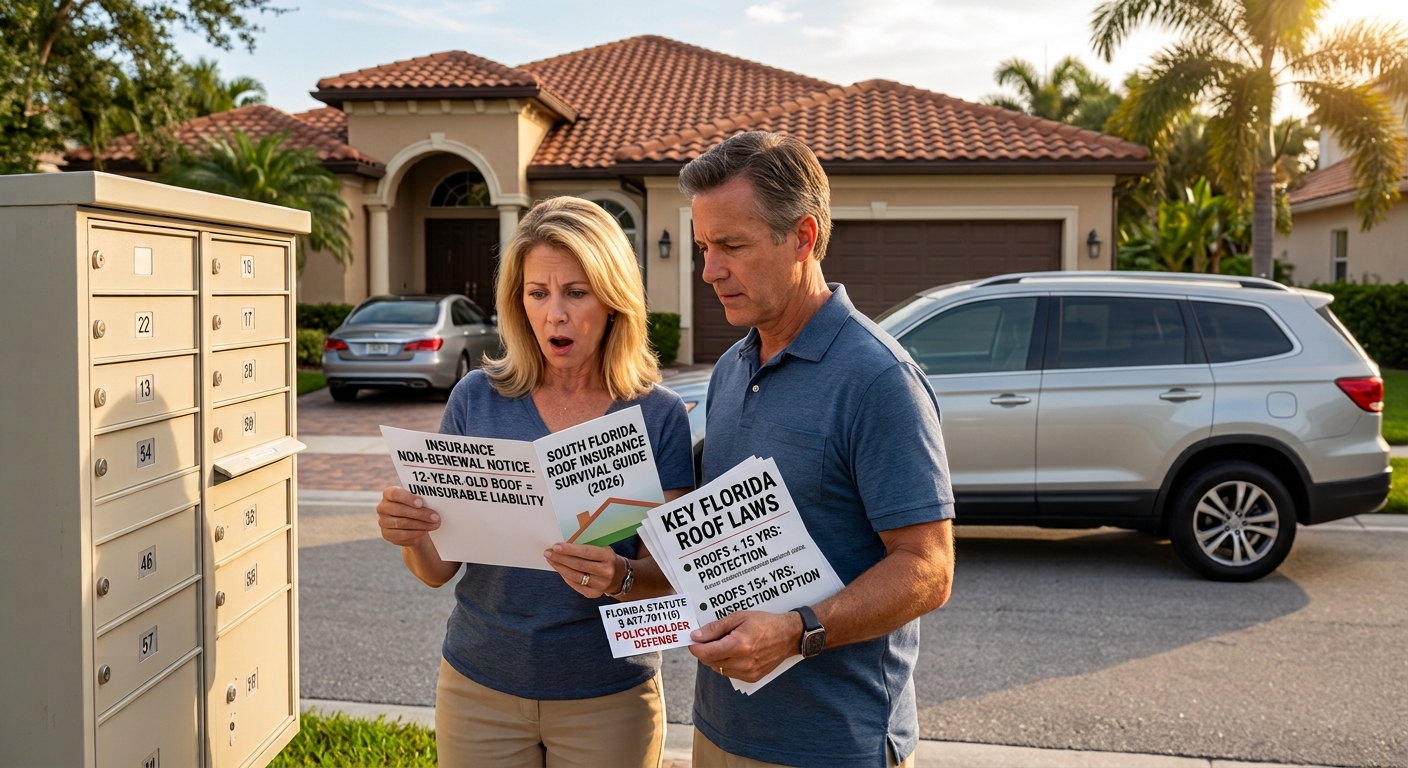
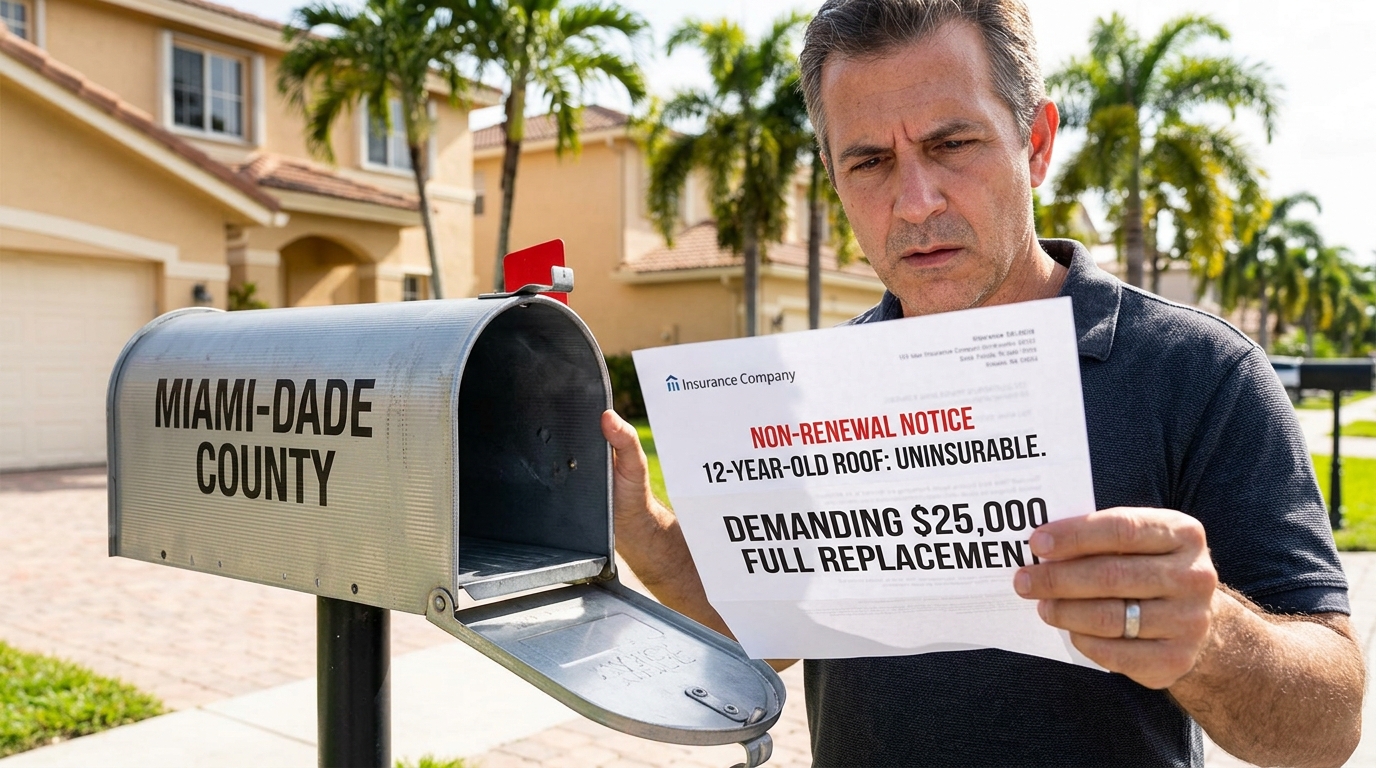
Opening your mailbox in Broward, Miami-Dade, or Palm Beach County often feels like an unpredictable gamble. One afternoon you are enjoying South Florida weather, and the next you are holding a notice from your insurance carrier stating that your 12-year-old roof is suddenly an uninsurable liability—demanding a $25,000 full replacement under threat of immediate non-renewal.
Before panicking or signing a contract with a door-to-door roofer, understand the ground rules. Florida property insurance regulations give homeowners explicit statutory protections that many carriers conveniently omit in their automated non-renewal letters.
Executive Legal Summary: Florida’s Roof Age Laws at a Glance
Roofs Under 15 Years Old: Under Florida Statute § 627.7011(5), property insurance carriers cannot deny coverage or refuse to renew a policy solely based on the age of your roof.
Roofs 15 Years or Older: Insurers can require a roof inspection, but they cannot deny coverage or force a replacement if an authorized inspector certifies that the roof has at least 5 years of remaining useful life.
Authorized Inspector Qualifications: Inspections must be completed by a licensed general contractor, building contractor, residential contractor, professional engineer, professional architect, or certified building code inspector.
Citizens Property Insurance Thresholds: Citizens requires roofs over 25 years old (for shingle) or 50 years old (for tile/metal) to submit a 4-Point or Roof Inspection Form proving 5+ years of useful life.
Many homeowners mistakenly believe that reaching the 10- or 12-year mark on an asphalt shingle roof gives an insurer automatic legal authorization to cancel their policy. That is false.
FLORIDA ROOF AGE STATUTORY TIMELINE
[0 to 14 Years Old] ================================> CANNOT NON-RENEW SOLELY ON AGE
(Fla. Stat. § 627.7011(5))
[15+ Years Old] ================================> INSPECTION REQUIRED
│
├─> 5+ Years Useful Life = COVERAGE MANDATED
└─> <5 Years Useful Life = Replacement/Repair
Protection for Roofs Under 15 Years
Florida Statute § 627.7011(5) explicitly states that an insurance company issuing or renewing a homeowners policy cannot refuse coverage solely because of roof age if the roof surface is less than 15 years old. If your carrier sends a non-renewal notice citing only a 12-year or 14-year roof age, they are violating state insurance guidelines.
The “5-Year Useful Life” Rule for Older Roofs
Once your roof hits or exceeds 15 years of age, the insurer gains the right to demand a professional roof inspection prior to policy renewal. However, the law still protects you: if the inspection proves your roof has at least 5 years of remaining useful life, the insurance company cannot reject your renewal application or force a complete replacement based on age alone.
2. Insurance Company Scare Tactics vs. Florida Statutory Law
Claim Made by Insurance Carrier
Actual Florida Legal & Statutory Standard
Impact on Property Owner
“Your shingle roof is 12 years old, so you must replace it within 30 days to keep your policy.”
Violates Fla. Stat. § 627.7011(5). Insurers cannot drop policies solely for roof age under 15 years.
You do not have to replace a functional 12-year-old roof just because the carrier requests it.
“Your 16-year-old roof failed our satellite image review, so we are non-renewing.”
Insurers must allow you to hire an authorized inspector to perform an in-person evaluation.
Aerial satellite photos cannot override a physical inspection certifying 5+ years of useful life.
“Only our internal adjusters can determine if your roof is acceptable.”
Inspections can be completed by any licensed Florida contractor, engineer, or home inspector.
You have the right to hire your own independent inspector to document your roof’s actual condition.
“You must switch to an Actual Cash Value (ACV) endorsement or face immediate cancellation.”
Policy changes must comply with OIR filings, and insurers must give advance written notice of endorsement alterations.
ACV reduces payouts by factoring in heavy depreciation; understand what rights you give up before signing.
3. RCV vs. ACV: The Hidden Policy Trap
Understanding how your insurance carrier calculates roof damage payouts is essential when navigating renewals and storm damage claims.
Replacement Cost Value (RCV): The insurer covers the actual cost to repair or replace the damaged roof with similar materials at current market prices, without deducting money for age or wear and tear.
Actual Cash Value (ACV): The insurer deducts depreciation based on the age and condition of the roof before issuing a payment.
If a 15-year-old roof with a 20-year lifespan suffers severe storm damage under an ACV policy, the insurer may only pay 25% of the replacement cost, leaving the homeowner responsible for the remaining 75% out-of-pocket. Pay close attention to policy renewal documents—carriers frequently attempt to slip ACV roof endorsements onto older homes during annual renewals.
4. Roof Materials & Expected Insurable Lifespans
The material covering your home dramatically influences underwriting guidelines across private carriers and state-backed insurers like Citizens Property Insurance Corporation.
Asphalt Shingle Roofs: Private carriers scrutinize shingle roofs most heavily starting at year 15. However, high-grade architectural shingles often maintain structural integrity well beyond 15 years if properly maintained.
Tile & Metal Roofs: Concrete tiles, clay tiles, and standing-seam metal roofs regularly handle South Florida wind loads for decades. Citizens Property Insurance allows tile and metal roofs to reach up to 50 years before mandatory age-based useful life documentation is triggered.
5. Step-by-Step Defense Action Plan: Responding to a Non-Renewal Notice
If an insurance company delivers a notice demanding roof replacement or threatening non-renewal in Broward, Miami-Dade, or Palm Beach County, follow this structured response plan:
Check stated reasons Independent 4-Point Provide 5-year cert Enforce statutory
and roof age dates. Roof Inspection. to insurance carrier. rights if denied.
Audit the Non-Renewal Letter: Check the exact reason cited by the carrier. If the only reason listed is that your roof is between 1 and 14 years old, the notice violates Fla. Stat. § 627.7011(5).
Order an Independent Roof Inspection: Contact a licensed Florida general contractor, building inspector, or engineer. Ask specifically for a Florida 4-Point Inspection or Roof Condition Verification Form.
Secure the 5-Year Useful Life Certification: Ensure the inspector documents that the roof has at least 5 years of remaining useful life. This written verification serves as your primary protection under state law.
Submit Formal Documentation via Certified Mail: Send the completed inspection report directly to your insurance agent and carrier. Request formal written confirmation that the non-renewal notice has been rescinded.
Consult Legal Counsel if the Carrier Refuses: If an insurer ignores state statute and refuses to accept a valid 5-year useful life certification, legal intervention may be required to protect your property rights and coverage.
6. Frequently Asked Questions
Can my insurance company drop me if my shingle roof is only 12 years old?
No. Under Florida Statute § 627.7011(5), insurance companies cannot refuse to issue or renew a homeowners insurance policy solely because of roof age if the roof is less than 15 years old.
Who qualifies as an “authorized inspector” in Florida?
Under state law, authorized inspectors include licensed general contractors, building contractors, residential contractors, professional engineers, professional architects, and certified building code inspectors.
What happens if my roof is over 15 years old but in great condition?
If an authorized inspector certifies that your 15+ year old roof has at least 5 years of remaining useful life, Florida law prevents the insurer from denying or non-renewing your coverage solely based on roof age.
Does Citizens Property Insurance follow the same roof rules?
Yes, Citizens Property Insurance must comply with Florida statutory requirements. Citizens requires documentation verifying at least 5 years of remaining useful life for shingle roofs older than 25 years and tile/metal roofs older than 50 years.
Protecting Your Property Rights Across South Florida
When insurance carriers issue arbitrary non-renewal demands, knowing the statutory rules keeps you in control. If your insurance company is threatening improper non-renewal, forcing unnecessary roof replacements, or mishandling a property damage claim, our team can help you enforce your statutory protections.
Disclaimer: The information provided in this guide is for general informational and educational purposes only and does not constitute formal legal advice. Property insurance laws and underwriting rules change frequently. Consult a qualified Florida legal professional regarding your specific situation.
A Lady Bird Deed in Florida is an enhanced life estate deed that allows a property owner to name someone who will receive the property after the owner’s death while retaining broad control over the property during life.
Unlike a traditional life estate, a properly drafted Lady Bird Deed can allow the owner to sell, mortgage, or otherwise convey the property without the future beneficiary’s permission. It can also allow the property to pass outside the ordinary probate process.
Because Florida does not have a statutory form called a “Lady Bird Deed,” the language used in the deed is especially important.
How Does It Work?
The property owner transfers the property through a deed that reserves an enhanced life estate and identifies one or more people who are intended to receive the property after the owner’s death.
During the owner’s lifetime, the owner generally retains the right to:
Live in and use the property
Sell the property
Mortgage the property
Convey the property to someone else
Change or defeat the beneficiary’s future interest, depending on the deed’s language
If the owner dies while the deed remains effective, the property can pass to the designated beneficiary without becoming part of the owner’s probate estate.
The exact result depends on the language of the deed and the circumstances surrounding the property.
Lady Bird Deed vs. a Regular Life Estate
The most important difference is the amount of control retained by the original owner.
With a traditional life estate, the owner keeps the right to possess and use the property for life but gives another person a present remainder interest. Selling or mortgaging the entire property can therefore require the remainderman’s participation.
An enhanced life estate, by contrast, can reserve the owner’s power to sell, mortgage, or convey the property without the beneficiary joining the transaction.
Florida courts have recognized this distinction. In Hirschenson v. Compu-Link Corp. of MI, the Third District Court of Appeal discussed an enhanced life estate as allowing the holder to sell, convey, mortgage, and otherwise manage the property without the remainderman’s joinder.
Does It Avoid Probate?
One reason Florida property owners consider this type of deed is probate avoidance.
If the deed is properly executed and remains effective when the owner dies, the designated beneficiary can receive the property without the real estate passing through the owner’s ordinary probate estate.
That does not mean every Lady Bird Deed will accomplish the same result. The deed must be legally effective, the property’s ownership must be correctly identified, and other Florida property laws may affect the transfer.
Why the Deed’s Language Matters
The enhanced powers need to be clearly established in the deed.
A Florida appellate case illustrates what can happen when the language is unclear. In Hirschenson, the deed contained inconsistent language concerning the power to mortgage the property. The resulting dispute required the court to determine what the deed actually meant, and the trial court ultimately reformed the deed. The appellate court affirmed that decision.
This is why a Lady Bird Deed should not simply be copied from an unidentified online form.
Can You Sell or Mortgage the Property?
A properly drafted enhanced life estate deed can preserve the owner’s ability to sell or mortgage the property without obtaining the future beneficiary’s consent.
That retained control is one of the defining characteristics of the arrangement.
However, the specific deed should be reviewed before a sale or mortgage. The deed’s wording, the property’s current title, and the requirements of the lender or title company can all matter.
What If the Beneficiary Dies First?
This depends on how the deed was drafted.
If the named beneficiary dies before the property owner, the deed should be reviewed to determine what happens to that person’s future interest. The owner may want to name alternate beneficiaries or include other provisions addressing this possibility.
This is one reason the beneficiary provisions should be considered carefully when the deed is prepared.
What If the Property Is Florida Homestead?
Homestead property requires additional care.
Florida law places special restrictions on the disposition of homestead, particularly when the owner has a spouse or minor children. Sections 732.4015 and 732.4017 of the Florida Statutes address important rules concerning homestead and lifetime transfers.
A Lady Bird Deed involving a Florida homestead therefore should not be evaluated solely on whether it can avoid probate. The owner’s family situation, title, and homestead status should all be considered before the deed is prepared.
Who Actually Owns the Property?
Before preparing the deed, it is important to determine how the property is currently titled.
For example, the property may be owned individually, jointly, through a trust, or subject to an existing interest.
In Johnson v. Johnson, Florida’s First District Court of Appeal considered enhanced life estate deeds that had been prepared in an individual’s name even though the properties were actually held by a living trust. The court affirmed reformation of the deeds based on the evidence concerning the mistake.
The practical lesson is simple: the current deed and ownership records should be checked before preparing a new conveyance.
When Might a Lady Bird Deed Be Useful?
A Florida property owner may consider an enhanced life estate deed when the goal is to:
Retain control of the property during life
Continue living in the property
Designate who should receive it after death
Preserve the ability to sell or mortgage the property
Potentially transfer the property outside probate
It may not be appropriate for every estate plan. More complicated family circumstances, multiple properties, trusts, creditor issues, or other planning concerns may call for a different approach.
It is an enhanced life estate deed that allows a property owner to retain substantial control over real estate while designating who should receive the property after the owner’s death.
Does a Lady Bird Deed avoid probate?
A properly drafted and effective deed can allow the property to pass to the designated beneficiary outside the ordinary probate process.
Is a Lady Bird Deed the same as a life estate?
No. A Lady Bird Deed is an enhanced form of life estate that can reserve significantly greater powers for the original owner.
Can I sell my house after signing a Lady Bird Deed?
Generally, an enhanced life estate can preserve the owner’s power to sell or convey the property without the beneficiary’s consent. The specific deed should be reviewed to confirm the powers it reserves.
Can I mortgage property with a Lady Bird Deed?
A properly drafted deed can reserve the owner’s power to mortgage the property. The exact language matters.
What happens when the owner dies?
If the deed remains effective and the property has not otherwise been conveyed, the designated beneficiary can receive the property according to the deed’s terms, potentially without probate.
Does a Lady Bird Deed work for Florida homestead?
It can, but Florida’s homestead rules create additional considerations involving spouses, minor children, and the owner’s particular circumstances.
Florida Estate Planning Attorneys Serving South Florida
A Lady Bird Deed can be a useful way to plan for the future of Florida real estate while retaining control during life. But the deed needs to match the property’s title and the owner’s circumstances.
Estate planning is the process of deciding how your property, financial affairs, and health care decisions should be handled during your lifetime, during periods of incapacity, and after your death.
For families in Coral Springs and throughout Broward County, an estate plan may include a will, revocable trust, durable power of attorney, health care surrogate designation, living will, preneed guardian designation, or other documents depending on the person’s circumstances.
There is no single set of documents that every person needs. The important question is whether the plan addresses the situations that could actually affect you and your family.
What Does an Estate Plan Actually Do?
A basic estate plan addresses two different periods of life.
During your lifetime, it can establish who may manage financial matters or make health care decisions if you become unable to make those decisions yourself.
After your death, it can determine who receives your property, who administers your estate, who manages assets held in trust, and how certain property should be transferred.
Those functions are handled by different documents. A will, for example, does not give someone authority to manage your finances while you are alive. A health care surrogate designation does not determine who inherits your house. A durable power of attorney does not replace a will.
Understanding those distinctions is one of the foundations of effective estate planning.
1. Last Will and Testament
A last will and testament allows you to state how certain property should be distributed after your death and nominate a personal representative to administer your estate.
A will can also address other matters, including the nomination of a guardian for minor children.
But there is an important misconception to avoid:
Having a will does not automatically avoid probate.
A will generally becomes effective through the probate process when it governs probate assets. Property may instead pass outside probate through mechanisms such as joint ownership, beneficiary designations, or a properly funded trust.
Recent Florida litigation illustrates how specific the probate process can become. In Property Solutions Powerhouse, LLC v. Nelson, decided by Florida’s Second District Court of Appeal in 2025, the court addressed a dispute involving a lost will, probate, notice to interested persons, and Florida homestead. The court ultimately upheld the administration and concluded that the decedent, who had no surviving spouse or children, could devise her homestead to the named beneficiary.
The case is a useful reminder that having a will does not mean every question about an estate is automatically settled. The validity of the will, the identity of interested persons, the nature of the property, and Florida’s homestead rules can all matter.
2. Revocable Living Trust
A revocable living trust allows a person to place assets into a trust during life and establish instructions for how those assets should be managed during incapacity and distributed after death.
The person creating the trust can generally retain control while capable and can name a successor trustee to take over management if necessary.
A revocable trust can also help keep properly funded trust assets outside ordinary probate administration. But the trust has to be properly funded. Simply signing a trust agreement does not automatically transfer every asset into it.
The trust is therefore only one part of an estate plan. Its effectiveness depends on how the document is structured, which assets are transferred to it, and how the rest of the estate plan is coordinated.
For a more detailed explanation, see What Is a Revocable Living Trust in Florida?
3. Durable Power of Attorney
A durable power of attorney allows you to authorize another person, called an agent, to act on your behalf within the authority granted by the document.
In Florida, a power of attorney is durable when it contains language showing that the authority continues despite the principal’s subsequent incapacity. Florida law also establishes specific execution requirements, including signing by the principal and two subscribing witnesses and acknowledgment before a notary in the circumstances specified by statute.
The scope of an agent’s authority depends on the powers granted in the document and Florida law.
This is why simply assuming that a spouse or adult child can handle everything for you can create problems. Ownership of a bank account or property does not automatically give another person authority to act on your behalf concerning assets or legal matters that belong to you individually.
A properly prepared power of attorney can be particularly important when someone becomes incapacitated and needs another person to handle financial or legal matters without waiting for a guardianship proceeding.
4. Health Care Surrogate Designation
A health care surrogate designation allows you to name someone to make health care decisions for you if you become unable to make those decisions yourself.
Florida law provides that a designated surrogate may have authority to make health care decisions during the principal’s incapacity, subject to the principal’s instructions and any limitations placed on the surrogate’s authority.
The designation is different from a living will.
A health care surrogate designation identifies who may make health care decisions.
A living will communicates your wishes concerning life prolonging procedures in specified medical circumstances.
Those documents can work together.
Florida law also provides a mechanism for judicial review when an interested person believes, among other things, that a surrogate’s decision conflicts with the patient’s known wishes, that the advance directive is ambiguous, or that the surrogate has abused their authority.
5. Living Will
A Florida living will allows a competent adult to state preferences concerning life prolonging procedures if the person later has a terminal condition, end stage condition, or is in a persistent vegetative state.
Florida law establishes specific execution requirements and provides that a properly executed living will creates a rebuttable presumption of clear and convincing evidence of the person’s wishes.
A living will therefore serves a different purpose from a health care surrogate designation.
The surrogate is the person who may make health care decisions within the authority granted.
The living will communicates your own instructions about life prolonging treatment in the circumstances covered by the document.
6. Preneed Guardian Designation
Florida law also allows a competent adult to name a preferred guardian in advance.
A preneed guardian designation is a written declaration naming the person the individual wants to serve as guardian if a court later determines that the individual is incapacitated. Florida law requires the declaration to be signed in the presence of at least two witnesses. If an incapacity proceeding is later filed, the declaration creates a rebuttable presumption that the designated person should serve, although the court is not required to appoint someone who is unqualified.
The distinction is important: a preneed guardian designation does not eliminate the possibility of a guardianship proceeding. Instead, it allows the individual to express a preference before incapacity occurs.
When Estate Planning Documents Have to Work Together
Estate planning documents are most useful when they form a coordinated plan rather than a collection of unrelated forms.
For example:
A will can address probate assets and nominate a personal representative.
A revocable trust can govern assets properly transferred to the trust.
A durable power of attorney can authorize an agent to handle financial and legal matters during incapacity.
A health care surrogate designation can identify someone to make health care decisions.
A living will can communicate wishes concerning life prolonging procedures.
A preneed guardian designation can identify a preferred guardian if a guardianship proceeding becomes necessary.
The documents can also interact with beneficiary designations, jointly owned property, retirement accounts, insurance policies, business interests, and real estate.
That is why changing one document without reviewing the rest of the plan can create unintended results.
A Florida Case Shows Why Advance Planning Matters
A recent Florida appellate decision provides an unusually clear example of how these documents can operate together.
InFrank v. Frank, decided by Florida’s Fourth District Court of Appeal in 2026, a woman had executed a durable power of attorney, health care surrogate designation, trust, and will before a guardianship dispute arose. The documents named her daughter, Alicia, to manage her affairs and established her intentions concerning the family home and estate.
The trial court later appointed a different person despite those prior designations. The Fourth District Court of Appeal reversed because the lower court had failed to make the specific findings required to overcome the statutory presumption supporting the woman’s previously expressed choice. The appellate court emphasized that the record showed she had repeatedly confirmed her estate planning decisions before the guardianship dispute.
The case does not mean that a person’s chosen agent or guardian can never be replaced. It demonstrates something more practical: advance planning can provide evidence of a person’s wishes before a family dispute reaches court.
An older Florida Fourth District case, Martinez v. The Guardianship of J. Alan Smith, similarly involved a person who had executed a health care surrogate designation, preneed guardian designation, and durable power of attorney before suffering a serious injury.
The appellate court reversed because the trial court had not made the required finding that the person’s chosen representative was contrary to the ward’s best interests.
What Happens If You Do Nothing?
If you die without a valid will, Florida’s intestacy laws determine who inherits property subject to those laws.
If you become incapacitated without appropriate planning, family members may have to rely on whatever legal mechanisms are available under the circumstances. A guardianship proceeding may become necessary for some decisions, although Florida law recognizes advance directives and other planning tools that can sometimes provide alternatives or affect the scope of a guardianship.
The important point is not that everyone needs every available document.
It is that leaving the decisions entirely to default legal rules may produce a result different from the one you would have chosen yourself.
Estate Planning After Marriage, Divorce, or Other Major Changes
An estate plan should not necessarily remain unchanged for decades.
A major life event may require a review of:
Your will
Revocable trust
Beneficiary designations
Durable power of attorney
Health care surrogate
Living will
Preneed guardian designation
Ownership of real estate
Retirement accounts
Life insurance
Business interests
Divorce is a particularly important example. Florida law contains rules affecting fiduciary appointments and certain estate planning documents after dissolution proceedings begin or a final judgment is entered. The Florida Bar has noted that durable powers of attorney and health care surrogate designations require particular attention during divorce planning.
A plan should also be reviewed when a beneficiary or fiduciary dies, a child reaches adulthood, substantial assets are acquired or sold, or the person’s family circumstances change.
“The best estate plan is one that makes the owner’s intentions clear before the family is forced to interpret them under pressure. A trust can provide that structure, but the document and the ownership of the assets need to work together.”
That principle applies beyond trusts. Estate planning works best when the documents, property ownership, beneficiary designations, and the person’s actual wishes are coordinated.
Common Estate Planning Questions
Do I need a will if I have a revocable living trust?
Often, yes. A will can serve purposes that a revocable trust does not, including addressing assets that were never transferred to the trust and nominating a personal representative or guardian where appropriate. The specific documents needed depend on the estate plan.
Does a will avoid probate in Florida?
No. A will generally directs the distribution of probate assets through the probate process. Some property may pass outside probate through trusts, beneficiary designations, joint ownership, or other mechanisms.
What is the difference between a living will and a health care surrogate?
A health care surrogate designation identifies someone who can make health care decisions within the authority granted when you cannot make them yourself. A living will communicates your wishes concerning life prolonging procedures in the circumstances covered by Florida law.
Does my spouse automatically have authority to manage everything if I become incapacitated?
Not necessarily. Marriage and joint ownership do not automatically give one spouse every legal authority that a properly executed power of attorney or health care designation can provide.
Can I choose who I want as my guardian?
Florida allows a competent adult to designate a preferred preneed guardian. The designation creates a rebuttable presumption in favor of the named person, but the court can decline to appoint someone who is unqualified or whose appointment is otherwise contrary to the applicable legal standard.
When should I review my estate plan?
Reviewing an estate plan after marriage, divorce, a death in the family, the birth or maturation of children, a major change in assets, a change in beneficiaries, or a significant change in your circumstances can help keep the plan consistent with your current wishes.
Estate Planning for Families in Coral Springs and Broward County
Estate planning is not limited to deciding who receives your property after death. For families in Coral Springs, Broward County, and surrounding South Florida communities, an effective plan can also address incapacity, health care decisions, financial management, real estate, beneficiary designations, trusts, and the administration of an estate.
The appropriate documents depend on the person’s family circumstances, property, financial affairs, and wishes.
A review of an existing plan can also be useful when the documents were prepared years ago or when major changes have occurred in the family or the assets involved.
A Florida parenting plan is a court ordered set of rules governing how separated or divorced parents share responsibility for their children. It can address where a child stays, when each parent has time sharing, how exchanges take place, how parents communicate, school related decisions, holidays, travel, and other matters affecting the child.
Problems arise when one parent does not follow those terms.
A missed exchange may be an isolated mistake. Repeatedly refusing scheduled time sharing is a different situation. So is taking a child on a trip without complying with the parenting plan, refusing to provide required information, or interfering with the other parent’s communication with the child.
Florida law provides several ways to address these disputes. But a parent who believes a violation occurred still has to establish what the parenting plan required and what actually happened.
What Counts as a Parenting Plan Violation?
The answer depends on the language of the particular parenting plan.
Florida parenting plans can contain detailed provisions concerning time sharing, transportation, holidays, school breaks, extracurricular activities, communication, travel, and parental decision making. A parent may violate the plan by failing to follow one of those provisions.
Examples can include:
Refusing to release a child for scheduled time sharing.
Returning a child late without a legitimate reason.
Failing to follow the agreed exchange location or transportation arrangements.
Preventing scheduled telephone or electronic communication between the child and the other parent.
Failure to provide information or notice required by the parenting plan.
Interfering with the child’s scheduled activities when the plan requires participation.
Denying holiday or vacation time that belongs to the other parent.
Taking a child somewhere in violation of travel restrictions contained in the order.
Repeatedly disregarding other specific requirements of the court ordered plan.
The details matter. A parent who arrives thirty minutes late once is not necessarily in the same legal position as a parent who repeatedly refuses to make the child available for scheduled time sharing.
How the wording of the actual order is done matters too.
Does Every Violation Amount to Contempt?
No.
A violation of a parenting plan does not automatically mean that a parent is in contempt of court. Florida courts generally require more than proof that something went wrong.
In Merlihan v. Skinner, the Fourth District Court of Appeal addressed a contempt finding involving a parenting plan. The appellate court explained that a contempt finding requires evidence that the parent had the ability to comply with the order and willfully refused to do so. The court also emphasized that the underlying order must be sufficiently clear and precise for a person to know what compliance requires.
That distinction is important in practical terms.
Suppose a parenting plan says that a child will be exchanged at a particular location at a particular time. If a parent repeatedly refuses to make the exchange despite being able to do so, the evidence may support an enforcement or contempt proceeding.
But if the order itself is ambiguous, or circumstances made compliance impossible, the analysis can be different.
A court therefore has to look at the order, the circumstances surrounding the alleged violation, and the evidence presented by both parents.
What Can a Florida Court Do When Time Sharing Is Improperly Denied?
Florida Statutes section 61.13 provides specific remedies when a parent fails to honor the time sharing schedule established in a parenting plan.
Depending on the circumstances, the court may order:
Makeup time sharing for the parent who was improperly denied time.
Reasonable court costs and attorney’s fees.
A parenting course.
Community service in circumstances authorized by the statute.
Certain transportation related expenses.
Other reasonable sanctions.
Contempt proceedings.
Makeup time sharing can be particularly significant because the remedy can address the time that was actually lost.
For example, in Varner v. Varner, a parent was held in contempt after failing to comply with provisions governing exchanges. The court awarded the other parent 17 overnight visits as makeup time sharing.
That illustrates an important point about enforcement. The remedy does not necessarily stop at telling the offending parent to follow the order in the future. Depending on the circumstances, the court can attempt to restore parenting time that was improperly denied.
Attorney’s Fees Can Be Part of the Enforcement Remedy
Parenting plan disputes can also create substantial legal expenses.
Florida law allows a court to award reasonable attorney’s fees and costs in certain enforcement proceedings. The purpose is not simply to punish a parent for causing a dispute. The court considers the statutory requirements and the circumstances of the case.
A particularly concrete example appears in Lett v. Lett, a 2025 decision from Florida’s Fifth District Court of Appeal.
That case involved a long running dispute over compliance with a 50/50 parenting schedule. The record included multiple contempt proceedings concerning alleged violations of the parenting plan. The trial court ultimately found the mother in willful contempt and awarded the father makeup time sharing. It also awarded him $19,693.46 in attorney’s fees.
The appellate court affirmed the fee award.
This figure demonstrates how quickly repeated parenting plan litigation can become financially significant. It also shows why documenting individual incidents can matter when a dispute develops into a larger enforcement proceeding.
Child Support and Time Sharing Are Separate Obligations
One of the most common misconceptions in parenting disputes is that child support and time sharing can be used as bargaining tools against each other.
Generally, they cannot.
A parent who has not received child support does not ordinarily acquire the right to withhold the other parent’s court ordered time sharing. Likewise, a parent who has been denied time sharing does not ordinarily acquire the right to stop paying court ordered child support.
Florida law treats these obligations separately.
That means a parent dealing with unpaid child support should use the appropriate child support enforcement procedures rather than withholding the child’s scheduled time with the other parent.
The same principle applies in reverse. A parent whose time sharing is being denied should pursue the appropriate enforcement remedy rather than simply stopping child support payments.
A Parenting Plan Dispute in Broward County
Florida appellate decisions provide useful examples of what these disputes can look like in practice.
In Merlihan v. Skinner, the underlying case came from Broward County and the Seventeenth Judicial Circuit. The Fourth District Court of Appeal ultimately reversed a contempt ruling because the trial court had not made the necessary findings concerning the parent’s ability to comply and willful refusal to do so.
This case is useful because it shows why a parenting plan enforcement case is not simply a matter of one parent saying, “The other parent broke the rules.”
The court has to determine what the order required and whether the evidence establishes the legal requirements for contempt.
Other cases show different patterns.
For Thornton v. Thornton, the Fourth District addressed allegations involving several aspects of a parenting arrangement, including extracurricular activities, travel information, birthday time sharing, and communication between a parent and children. The case demonstrates how enforcement disputes can involve considerably more than missed weekend visits.
In Erlinger v. Federico, the First District reviewed a record involving approximately ten months without visitation and seven enforcement motions over a two year period. The record also stated that 84 days of visitation had been denied during 2016.
These numbers come from the particular court record. They are not statistics showing how frequently parenting plan violations occur throughout Florida. Florida does not appear to maintain a reliable statewide statistic measuring all parenting plan violations.
What the cases do show is that repeated interference can produce a substantial litigation record when the problem continues.
A Parenting Plan Can Be Too Vague to Enforce
Sometimes the problem is not simply that a parent refuses to follow the plan.
The plan itself may not say enough.
Florida law requires parenting plans to establish a time sharing schedule. If important provisions are too vague, parents can end up disagreeing about what the court actually ordered.
The Fifth District addressed this issue in Kiswani v. Hafza in 2025. The appellate court reversed because the parenting plan did not establish a sufficiently specific time sharing schedule as required by Florida law.
This creates an important distinction.
A parent cannot necessarily be held in contempt for violating an obligation that the order never clearly established.
“A parenting plan should give both parents a workable understanding of what they are expected to do. When the language is vague or contradictory, disputes can become much harder to resolve because the parents may disagree about what the court actually ordered.”
For that reason, reviewing the exact wording of a parenting plan should usually be one of the first steps in an enforcement dispute.
What About Moving Away With a Child?
Relocation presents a separate legal issue.
Florida law contains specific procedures governing the relocation of a child. A parent generally cannot simply move the child a substantial distance and deal with the consequences afterward.
Florida’s relocation statute, section 61.13001, establishes requirements concerning proposed relocations and gives the other parent an opportunity to object. Depending on the circumstances, court approval may be required.
A parenting plan may also contain specific restrictions concerning travel outside Florida or outside the United States.
This is why “moving without notice” should not be treated as merely another ordinary parenting plan violation. Relocation can trigger its own statutory procedures and remedies.
In Fuentes Neira v. Cardona Acosta, the Third District considered an arrangement involving relocation between Miami and Colombia. The court concluded that the agreement did not satisfy Florida’s statutory requirements for a relocation agreement because it did not adequately establish the required time sharing schedule and transportation arrangements.
For families in South Florida, international travel and relocation can create particularly complicated questions because the practical consequences may extend beyond the ordinary exchange schedule.
What Evidence Matters in a Parenting Plan Dispute?
A parenting plan enforcement case often turns on details.
The strongest evidence is usually evidence that allows the court to compare the written order with what actually happened.
Depending on the dispute, useful records may include:
The current parenting plan and any later court orders modifying it.
Text messages, emails, or other communications between the parents.
Records showing scheduled and actual exchanges.
School or extracurricular records.
Travel information and notices.
Calendars documenting missed or changed time sharing.
Receipts or other records showing transportation expenses.
Records concerning repeated requests to exercise scheduled time sharing.
Evidence concerning attempts to resolve the problem before filing a motion.
Documentation showing why compliance was impossible, if that is the position of the parent accused of violating the order.
A chronological record can be particularly useful.
Instead of simply stating that the other parent “always violates the parenting plan,” it is usually more informative to identify the date, the provision involved, what was supposed to happen, what actually happened, and what communications followed.
That gives the court something concrete to evaluate.
What If the Violations Keep Happening?
Repeated violations can change the nature of the dispute.
A single incident may be resolved without extensive litigation. A continuing pattern can require formal enforcement.
Florida courts have several possible remedies available under section 61.13, including makeup time sharing, fees and costs, sanctions, and contempt where the legal requirements are satisfied.
But repeated violations do not automatically mean that the existing parenting plan should be replaced.
Sometimes enforcement is the appropriate issue.
Other times, circumstances have changed so substantially that the existing schedule no longer works for the child or the parents. In that situation, a modification proceeding may be more appropriate.
Those are different legal questions.
A parent should not simply stop following the existing order because they believe a different arrangement would be better. Until a court changes the order, the existing order generally remains the governing requirement.
What Should You Do After a Parenting Plan Violation?
The first step is to identify exactly what happened.
Review the current parenting plan and determine which provision applies. Then preserve the communications and other records relating to the incident.
It can also help to separate an isolated problem from a continuing pattern.
Consider documenting:
What the parenting plan required.
So – what happened instead.
When it happened.
Whether the other parent provided an explanation.
Did the problem affected scheduled time sharing or another specific obligation.
Whether similar incidents happened before.
What steps were taken to resolve the issue.
Not every disagreement requires a court filing. Parents sometimes resolve individual scheduling problems through communication or an agreed temporary change.
But repeated violations, denied time sharing, interference with commnication, relocation disputes, or conduct that continues despite attempts to resolve the problem may require legal enforcement.
Before taking action, it is also important to determine whether the existing order is clear enough to enforce and whether the facts support enforcement, contempt, modification, or another legal remedy.
“When a parenting plan dispute reaches the point where a court may become involved, the details matter. The question is not simply whether one parent believes the other acted unfairly. The court needs to know what the order required, what actually happened, and whether the circumstances support enforcement or a change to the existing plan.”
Frequently Asked Questions
Can I withhold visitation because the other parent is not paying child support?
Generally, no. Child support and time sharing are separate obligations. A parent should use the appropriate legal process to enforce unpaid child support rather than withholding court ordered parenting time.
Could I stop paying child support because the other parent is denying visitation?
Mostly, no. A denied parenting schedule does not ordinarily eliminate a separate child support obligation.
A parent can be held in contempt for violating a parenting plan?
Potentially, yes. But a violation does not automatically establish contempt. The court must consider the requirements for contempt, including whether the order was sufficiently clear and whether the parent had the ability to comply and willfully refused to do so.
Can I get makeup time if the other parent denied my scheduled time?
Florida law allows courts to award makeup time sharing in appropriate circumstances when a parent fails to honor the established time sharing schedule.
Can I recover attorney’s fees?
Maybe. Florida law allows attorney’s fees and costs in certain parenting plan enforcement proceedings. The amount and whether an award is appropriate depend on the circumstances and applicable statutory requirements.
What if the parenting plan is unclear?
An unclear parenting plan can make enforcement more difficult. Florida courts have emphasized the need for sufficiently specific parenting plans and court orders, particularly when contempt is being considered.
What if the other parent repeatedly violates the parenting plan?
Repeated violations may support a request for enforcement and, when the legal requirements are met, contempt or other remedies. If circumstances have changed, a modification proceeding may also need to be considered.
So if the other parent wants to move with our child?
Relocation is governed by specific Florida statutes. The legal process can depend on the proposed distance, the existing parenting arrangement, the other parent’s position, and whether an agreement can be reached.
Parenting Plan Enforcement in Coral Springs and Broward County
For parents in Coral Springs, Broward County, and the surrounding South Florida area, a parenting plan dispute can involve much more than a disagreement over a particular weekend.
The appropriate response depends on the language of the existing order, the history of the dispute, the evidence available, and the legal remedy being sought.
No. Florida does not require an attorney to be present at every real estate closing.
That is the straightforward legal answer. But it does not necessarily answer the more useful question: what can an attorney do for you that the ordinary closing process does not?
Florida law allows licensed title insurers, title agents and agencies, and attorney agents to perform authorized closing services. Those services can include preparing documents, conducting the closing, and handling the disbursement of funds. Title professionals also handle the title work involved in determining insurability and addressing underwriting requirements.
That is the legal baseline. It is not a statement that legal representation is unnecessary.
Perhaps you have been told that the title company will “take care of everything.” Perhaps a title commitment has arrived and you are unsure which parts deserve attention. Or perhaps you have bought property before without an attorney.
For whatever reason brought you here, the useful question is not simply whether Florida requires a lawyer. It is what legal work needs to be done, who is responsible for doing it, and whose interests that person represents.
Does Florida Require a Real Estate Attorney at Closing?
No. Florida does not make independent legal representation a condition of closing a real estate transaction.
A title company or other authorized closing agent can perform substantial work on the transaction. Florida’s title insurance statutes recognize closing services that include preparing necessary documents, conducting the closing, and handling the disbursement of funds. The law also recognizes title services involving title information, underwriting requirements, title commitments, and policies.
That is what the law permits.
The Florida Bar’s consumer guidance, however, recommends consulting an experienced Florida licensed real estate lawyer before signing a purchase contract. It also emphasizes the importance of proper legal representation of a buyer’s or seller’s interests throughout the transaction.
The timing matters. A lawyer who becomes involved before the contract is signed can address issues while they are still negotiable. A lawyer who first sees the transaction at closing is working with a much narrower set of options.
What Does a Real Estate Attorney Do at Closing?
An attorney may represent a buyer or seller independently, or may also act as a title or closing agent. The roles can overlap, but they are not necessarily the same.
When an attorney represents you, the legal work may include:
Reviewing and negotiating the purchase contract
Explaining provisions affecting your rights and obligations
Reviewing the title commitment and title exceptions
Examining liens, judgments, easements, restrictions, and ownership issues
Reviewing deeds and other legal documents
Addressing condominium or homeowners’ association issues
Coordinating with the title company, lender, broker, surveyor, and other professionals
Advising you when a legal problem arises before closing
The distinction is important.
A closing agent can be responsible for conducting the transaction correctly. An attorney representing you can also answer a different question:
Is what you are being asked to sign actually in your legal interest?
What Does a Title Company Do?
A title company performs important work. It is not simply an administrative participant.
Florida law defines closing services to include preparing documents necessary to close, conducting the closing, and handling the disbursement of funds. Title services can include determining insurability based on title information, addressing underwriting objections and requirements, and preparing title commitments and policies.
A title search may reveal mortgages, liens, judgments, easements, restrictions, defects in recorded documents, or questions concerning the chain of ownership.
Many title issues can be resolved without litigation. Some cannot.
This is where title services and independent legal representation become different things.
A title professional may identify an issue and determine what is required for the title insurer to proceed. An attorney representing you can advise what the issue means for your rights and what legal options may be available.
Is a Title Company the Same as a Real Estate Attorney?
No.
There can be substantial overlap, particularly because an attorney may also act as a title agent or closing agent. But the fact that a title company can perform important legal and transactional functions does not mean it is automatically acting as your personal legal counsel.
The distinction becomes obvious when a problem appears.
Suppose a title search reveals an old judgment. Or a deed contains an error. Perhaps the seller’s ownership is connected to an estate. Or a former spouse may have an interest in the property.
The title agent can identify the problem and explain what is required for the title insurer to proceed.
But there may be a separate question:
What should you do about it?
That is a legal question.
What Happens If the Title Search Finds a Problem?
The phrase “title problem” covers a wide range of circumstances.
An old mortgage that was never properly released is one thing. A dispute over who actually owns the property is another. One may be resolved with documentation. The other could require litigation.
A Florida case illustrates why the distinction matters.
Endruschat v. American Title Insurance Co.
In Endruschat v. American Title Insurance Co., two buyers purchased property intending to convert it into a dental clinic. They did not obtain their own legal counsel and relied on the title company involved in the transaction.
A recorded restriction limiting the property’s use to a single-family residence was not identified in the title materials. The problem was later discovered, construction was halted, and the buyers ultimately had to retain attorneys to resolve the title issue.
The case does not establish that every purchaser must hire an attorney. It illustrates something more specific:
Knowing what appears in the public record and understanding what that information means for your particular transaction are not always the same task.
If you are purchasing property for a particular purpose, a restriction that looks minor on a title document may be anything but minor to you.
What Responsibilities Does a Closing Agent Have?
It would also be inaccurate to portray a title company as a passive participant that simply collects signatures.
In Florida Southern Abstract & Title Co. v. Bjellos, the buyers’ contract required a negative termite inspection. The title company’s closing agent received documentation that did not establish that the contractual condition had been satisfied, yet the transaction proceeded. The buyers later discovered a substantial termite infestation.
The appellate court held that the title company, having undertaken to supervise the closing, was required to perform that role with reasonable care. But the court also drew an important boundary: it did not hold that the title company had to provide a legal opinion about the sufficiency of every document presented at closing.
That distinction is worth remembering.
A closing agent has responsibilities. An attorney representing a client has responsibilities to that client. Those responsibilities can intersect without becoming identical.
What Does a Real Estate Attorney Review Before Closing?
In many transactions, some of the most valuable legal work happens before the closing itself.
The purchase contract
The contract establishes the obligations of the buyer and seller. It can address price, deposits, financing, inspections, repairs, title, possession, default, and other matters.
An attorney can explain what those provisions mean and negotiate changes before they become binding obligations.
The title commitment
The title commitment identifies requirements that must be satisfied and exceptions to the coverage the title insurer proposes to provide.
Some exceptions are routine. Others deserve closer attention.
An attorney can help determine whether a title issue should be accepted, corrected, negotiated, or investigated further.
The deed
The deed conveys the property. Its language, the identity and authority of the grantor, and the circumstances of the transfer can all matter.
The closing statement
Purchase price, deposits, credits, prorations, taxes, mortgage payoffs, title charges, recording fees, and other costs must be accounted for.
When those figures are affected by a contractual dispute, payoff problem, title issue, or other legal question, legal review can become important.
When Is a Real Estate Attorney Particularly Important?
There is no statutory purchase price at which Florida suddenly requires a lawyer. The circumstances are more important than the number.
The property has a complicated or disputed title history
There are liens or judgments
The property is being transferred through an estate or trust
Divorce or marital ownership affects the property
Multiple owners disagree about the transaction
A business entity owns the property
The contract contains unusual provisions
The transaction involves seller financing
There is a boundary or survey dispute
A condominium or homeowners’ association issue affects the transaction
A party is involved in bankruptcy or another legal proceeding
A significant problem appears shortly before closing
These circumstances do not automatically mean that litigation is coming.
They mean the transaction deserves closer legal attention.
Do I Need an Attorney If I Already Have a Real Estate Agent?
A real estate agent and a real estate attorney perform different functions.
An agent may help locate the property, negotiate the transaction, coordinate inspections, and communicate with the other side.
An attorney can analyze the legal implications of the transaction, advise a client about legal rights and obligations, negotiate legal provisions, and provide legal representation when an issue arises.
The same principle applies to the title company.
Several professionals can be involved in a transaction without performing the same role or representing the same interests.
What Should I Ask Before Hiring a Real Estate Attorney?
If you are considering legal representation, ask what the attorney will actually do.
Will the attorney review the purchase contract?
Will the attorney represent only me?
Will the attorney also act as the closing agent?
Who handles title objections?
Will the attorney review the title commitment?
Will the attorney attend the closing?
What happens if a legal problem appears shortly before closing?
Are legal fees separate from title insurance and other closing costs?
Does the representation include contract negotiation?
These questions prevent a common misunderstanding:
“There is an attorney involved” does not necessarily tell you what that attorney is doing for you.
The scope of the representation matters. So does the timing.
Why Legal Advice Can Matter Before the Closing Table
There is a familiar image of the real estate attorney as the person who appears at the end of the transaction, reviews a stack of documents, and sits beside everyone while the signatures happen.
Sometimes that is exactly what the lawyer does.
But some of the most consequential work may happen weeks earlier.
A contract can be negotiated before it is signed. A title problem can be investigated before the parties are committed to a closing date. An ownership question can be addressed before the moving truck is booked. A questionable provision can be changed before it becomes an obligation.
Once everyone is sitting at the closing table, those options may be considerably narrower.
Florida law does not require an attorney at every real estate closing.
It also does not eliminate the legal questions that arise in a real estate transaction.
That is where independent legal representation can matter.
Frequently Asked Questions
Do I legally need a real estate attorney at closing in Florida?
No. Florida does not require an attorney to be present at every real estate closing. Authorized title professionals can perform permitted closing services.
Can a title company close a Florida real estate transaction without an attorney?
Yes. Florida law permits authorized title professionals to perform closing services, including preparing documents, conducting the closing, and handling disbursement of funds.
Is a title company the same as a real estate attorney?
No. A title company can perform title and closing services, while an attorney representing a client can provide independent legal advice and representation. An attorney may also act as a title or closing agent.
Should I have an attorney review my Florida purchase contract?
The Florida Bar recommends consulting an experienced Florida licensed real estate lawyer before signing a purchase contract.
What happens if a title problem is found before closing?
It depends on the problem. Some issues can be corrected through documentation or other routine measures. Others may require negotiation, further investigation, or litigation.
Can an attorney handle both title work and the closing?
Yes. Florida law recognizes attorneys acting as title agents in connection with closing services.
Real Estate Closings in Coral Springs and Broward County
If you are buying or selling property in Coral Springs, the closing may involve a real estate agent, title company, lender, surveyor, inspector, and other professionals.
That is normal.
What is less obvious is who is responsible for answering which questions.
A title agent may be handling title and closing. A lender has its own requirements. A real estate agent has a different professional role. An attorney representing you is there to address your legal interests.
The distinction matters throughout Broward County and South Florida, particularly when a transaction involves an estate, multiple owners, liens, financing complications, condominium restrictions, or disputed title.
Florida law does not require every buyer or seller to retain an attorney.
But the absence of a legal requirement is not the same thing as the absence of a legal question.
Yes, a landlord or tenant can handle some Florida eviction cases without an attorney. Florida law does not require a lawyer in every eviction proceeding. But an eviction still involves specific notice requirements, court filings, service of process, deadlines, and rules governing defenses and possession. A mistake at any of those stages can affect the outcome of the case.
For landlords, the process generally begins with the legally required notice and can proceed to a county court action if the tenant does not leave. For tenants, receiving an eviction lawsuit creates deadlines for responding and, in some cases, requirements for paying disputed rent into the court registry.
The issue matters in Broward County, where there were 16,666 eviction filings in 2025 and 7,955 more during the first six months of 2026.
So when is an eviction simple enough to handle on your own, and when does the situation call for legal assistance? The answer usually depends on the reason for the eviction, the lease, the notice, and whether the other side contests the case.
Can You Handle an Eviction Without an Attorney?
Yes.
Florida does not require every landlord or tenant to hire an attorney for an eviction. Broward County provides self service information and forms for people handling certain eviction matters themselves. The Clerk also explains that its deputy clerks can provide procedural information, but cannot prepare legal forms or give legal advice.
The complexity of the case matters.
A straightforward dispute involving unpaid rent may be different from a case involving:
A disputed lease violation.
Questions about whether the required notice was valid.
A commercial lease.
A disagreement about the amount of rent actually owed.
A claim that the landlord failed to maintain the property.
A retaliation defense.
A security deposit dispute.
A lease renewal or termination dispute.
A claim for damages in addition to possession.
An eviction can also become more complicated when the parties disagree about basic facts.
That is where legal advice may become useful.
Why Does the Eviction Process Matter?
Florida provides a summary procedure for eviction cases. The purpose is to provide a more direct procedure for resolving possession disputes.
“Summary” does not mean informal.
Florida law still requires the landlord to establish the legal basis for possession and follow the applicable requirements. The Broward County Clerk describes the basic local process as:
Issue the required notice.
Complete and file the required forms.
Properly serve the tenant.
Obtain a judgment and, when appropriate, a writ of possession.
Each stage can raise separate issues.
A defective notice can create a problem before the case even reaches a judge.
A service problem can affect whether the case can proceed.
A tenant who fails to respond properly can lose important defenses.
A landlord who tries to bypass the court process can create a different legal problem altogether.
Eviction law has very little patience for the idea that everyone can simply improvise.
What Notice Does a Landlord Have to Give?
The required notice depends on the reason for ending the tenancy.
For example, Florida law provides specific procedures for nonpayment of rent and for certain lease violations. The notice requirements are contained in section 83.56 of the Florida Statutes and are not simply optional language that the parties can rewrite in a lease.
For nonpayment cases, the applicable notice period and calculation depend on the tenancy and the circumstances. Florida’s statutory framework also specifies how certain periods are calculated.
For other violations, the landlord may need to give the tenant an opportunity to correct the problem when the law provides a cure period.
This distinction matters because an eviction notice is not interchangeable with every other type of demand letter.
The reason for the termination affects what the landlord may need to do next.
A notice can become a legal issue in itself
Consider a tenant who receives a notice claiming that rent was not paid.
The tenant might disagree about:
Whether the rent was actually due.
How much was owed.
Whether payment was made.
Whether the notice was properly served.
Whether the notice contained the required information.
Whether the landlord complied with the applicable statutory requirements.
Those questions can affect what happens after the notice.
The notice is therefore more than a warning. It can become part of the legal record.
What Happens After the Notice?
If the tenant does not leave and the landlord has the legal basis to seek possession, the landlord can file an action for possession.
Florida Statute §83.59 governs actions to recover possession. The landlord must proceed through the court rather than simply taking possession personally.
Broward County’s Clerk describes the next stages as filing the required documents and serving the tenant. The tenant then has to follow the instructions in the summons and respond within the applicable time.
This is one reason an eviction should not be treated like an ordinary argument between a landlord and tenant.
Once a lawsuit has been filed, deadlines and procedural rules become part of the dispute.
What Can a Tenant Do After Receiving an Eviction Lawsuit?
A tenant is not automatically removed simply because a landlord files an eviction case.
Florida law permits tenants to raise certain legal and equitable defenses. Depending on the circumstances, those defenses can involve alleged landlord noncompliance, defective notices, retaliation, payment disputes, or other issues recognized by law.
But there is an important procedural requirement that tenants should understand.
When a tenant raises a defense other than payment in a nonpayment case, section 83.60 generally requires the tenant to pay the accrued rent into the court registry or timely file a motion asking the court to determine the amount that must be deposited.
Failure to comply can result in waiver of defenses other than payment and can allow the landlord to obtain an immediate default judgment for possession.
That is not a minor technicality.
It can change the course of the case.
A Broward County case shows why this matters
In Muscella v. Johnson, a 2024 Fourth District Court of Appeal decision arising from Broward County, the tenants did not pay the rent into the court registry or timely move to determine the amount as required by section 83.60(2).
The Fourth DCA reversed the county court and explained that, under the circumstances, the landlord was entitled to the writ of possession.
The court stated that when the statutory requirement is not met, the landlord can be entitled to possession without another hearing.
That case illustrates the practical importance of understanding procedural requirements.
But the Same Rules Can Protect a Tenant Who Responds Properly
A different Broward County case demonstrates the other side.
In Kaufman v. High Seas, LLC, the landlord sought possession for alleged nonpayment of rent. The tenant disputed the landlord’s allegations, raised defenses, and timely filed a motion asking the court to determine the amount of rent that should be deposited into the court registry.
The trial court entered an eviction judgment without resolving that motion.
The Fourth DCA reversed and remanded, holding that the trial court needed to address the pending motion before entering the eviction judgment.
The case is useful because it shows why neither side should assume that an eviction case is automatic.
The landlord had procedural requirements.
The tenant had procedural requirements.
And the court had to apply the statute to what actually happened in the case.
Landlord vs. Tenant: What Is at Stake?
The obligations are different depending on which side of the dispute you are on.
Issue
Landlord
Tenant
Before filing
Must establish the basis for termination and provide the required notice
Should understand what the notice alleges and what deadline applies
Lease
Must establish the contractual or statutory basis for possession
May dispute the interpretation or enforcement of the lease
Court filing
Must file the appropriate action and supporting documents
Must respond according to the summons and applicable rules
Rent dispute
May seek possession and, where legally available, damages
May have court registry requirements when raising certain defenses
Defenses
Must respond to defenses raised by the tenant
May raise legal or equitable defenses recognized by Florida law
Possession
Cannot simply bypass the court process
Has statutory protections against certain forms of self help
After judgment
May obtain a writ of possession through the court
Must comply with a valid writ while retaining whatever legal remedies remain available
The table is not a substitute for the statute or legal advice. It simply illustrates why an eviction case involves obligations on both sides.
Can a Landlord Change the Locks Instead?
No.
For residential properties covered by Florida’s landlord tenant law, section 83.67 prohibits a landlord from preventing a tenant from obtaining reasonable access to the dwelling, including by changing the locks or using a bootlock.
The statute also prohibits a landlord from interrupting utility services as a way of dealing with the tenancy.
That means a landlord generally cannot avoid the eviction process by deciding to remove the tenant personally.
The lawful process is different.
After a judgment in the landlord’s favor, Florida law provides for a writ of possession issued to the sheriff. The sheriff then executes the writ after the statutory notice period. Section 83.62 currently provides for 24 hours’ notice posted on the premises before the sheriff puts the landlord in possession.
In other words:
A court judgment and writ of possession are not the same thing as a landlord changing the locks on their own.
That distinction matters.
What If the Dispute Is About More Than Rent?
Not every landlord tenant dispute is really a simple nonpayment eviction.
The underlying disagreement might involve:
A commercial lease.
An assignment or sublease.
A disputed renewal option.
Property damage.
A security deposit.
Alleged nuisance.
A claim of constructive eviction.
Abandonment of personal property.
Lease provisions concerning rent increases.
Claims for damages in addition to possession.
Some of these matters may arise alongside an eviction. Others may require separate legal analysis.
A recent Fourth DCA case illustrates the point.
In Destiny Fulfilled Outreach Ministries v. Investments SWK, the dispute involved a commercial tenancy and disagreement over the nature and duration of the parties’ lease arrangement. The Fourth DCA affirmed the eviction judgment after the lower court determined that the parties had not established the claimed lease term.
The lesson is not that every commercial eviction looks like that case.
It is that the right to possession can depend on questions about the lease itself.
What About Attorney’s Fees?
Attorney’s fees can also become part of an eviction dispute when a statute, lease, or other applicable legal authority permits an award.
A 2025 Fourth DCA case arising from Broward County illustrates that even a fee award following an eviction judgment can create a separate appellate issue.
In Gordon v. Pinoargotty, the Fourth DCA reversed an attorney’s fee award because the trial court had not made the required findings concerning reasonable hours and the reasonable hourly rate. The underlying eviction judgment was not what the appeal addressed.
This is another reason to avoid thinking of an eviction as simply:
notice → tenant leaves → finished.
Depending on the case, possession, rent, damages, attorney’s fees, and other issues can all require separate attention.
When Does an Eviction Become More Complicated?
There is no single point at which every eviction suddenly requires an attorney.
Some situations, however, deserve closer attention.
Legal advice may be particularly useful when:
The tenant disputes the facts.
The landlord is unsure which notice applies.
The tenant claims the notice was defective.
There are questions about rent payments or the amount owed.
The lease contains complicated provisions.
The property is commercial.
There are counterclaims or substantial damages.
A tenant alleges retaliation.
The case involves habitability or property condition issues.
The landlord and tenant disagree about whether the lease has ended.
A prior eviction case or judgment is involved.
A party has received court papers and is unsure how to respond.
The more issues that exist beyond straightforward possession, the less useful a generic eviction form becomes.
What About Coral Springs and Broward County?
For someone in Coral Springs, an eviction case does not take place in a legal vacuum.
Coral Springs is part of Broward County and the Seventeenth Judicial Circuit, so local filing and court procedures matter in addition to the statewide landlord tenant statutes.
The Broward County Clerk’s current eviction information identifies the required sequence of notice, filing, service, judgment, and writ of possession. It also directs filers to the applicable Seventeenth Judicial Circuit administrative order for the location where county civil actions are filed.
Broward’s numbers show why this is not an obscure area of law.
The county recorded:
15,588 eviction filings in 2019
17,657 in 2022
18,670 in 2023
18,335 in 2024
16,666 in 2025
The 2023 figure was the highest in that series. The 2025 total represented a decline from the prior year, but still amounted to more than 16,000 filings.
During the first six months of 2026, Broward recorded 7,955 filings, including 1,562 in January and 1,426 in June.
There is no reliable public source in the data reviewed here that isolates eviction filings specifically for Coral Springs. It is therefore more accurate to use Broward County as the local statistical measure rather than assigning a countywide number to Coral Springs.
What If You Cannot Afford an Attorney?
A private attorney is not the only possible source of help.
The Legal Aid Service of Broward County provides civil legal assistance to eligible low income Broward residents and specifically identifies landlord tenant matters and eviction assistance among its housing services. Eligibility requirements apply.
Broward County also provides self service information for people handling certain eviction matters without counsel.
That does not mean every case is appropriate for self representation.
It does mean that someone facing an eviction should not assume the only choices are hiring a private lawyer immediately or doing nothing.
What Should You Do If You Receive an Eviction Notice?
Start by determining exactly what you received.
An eviction notice is different from an eviction lawsuit.
If you have received only a notice from the landlord, review the reason stated and the deadline carefully.
If you have received a court summons or complaint, the situation is more urgent because the court’s procedural deadlines now matter.
Keep copies of:
The lease.
The eviction notice.
Proof of rent payments.
Communications with the landlord.
Repair requests.
Photographs or videos of relevant property conditions.
Court documents.
Receipts and other supporting records.
Do not assume that an unanswered court document will simply disappear.
It will not.
What Should a Landlord Do Before Filing?
A landlord should similarly organize the underlying record before beginning an eviction case.
That can include:
The signed lease.
Payment records.
The applicable notice.
Proof of delivery or service.
Communications with the tenant.
Records concerning alleged lease violations.
Property inspection records.
Photographs where relevant.
Documentation supporting any claimed damages.
The landlord should also make sure that the legal basis for possession matches the notice and the facts.
An eviction is not improved by filing quickly with the wrong theory.
The Bigger Point: Eviction Is a Process, Not a Threat
The old idea that an eviction is simply a landlord versus tenant argument misses what actually happens in court.
Florida law creates a process.
The landlord has to establish a basis for possession.
The tenant may have defenses.
Both sides have procedural obligations.
The court applies the governing law.
And if the landlord ultimately obtains judgment, possession is transferred through the statutory process rather than by private force.
The recent Broward cases make that clear from opposite directions.
In Muscella, the tenants’ failure to comply with the rent registry requirement had immediate consequences.
In Kaufman, the tenant’s timely motion to determine rent meant that the trial court could not simply enter the eviction judgment without addressing the pending issue.
Neither case establishes that every landlord needs an attorney or that every tenant will successfully defend an eviction.
They demonstrate something more practical:
The details matter.
Frequently Asked Questions
Can I evict a tenant without an attorney in Florida?
Mostly. Florida does not require every landlord to hire an attorney for an eviction. However, the landlord must still comply with the applicable statutes, court rules, notice requirements, filing requirements, and service requirements.
Could a tenant fight an eviction without an attorney?
Yes. Tenants can represent themselves and may raise defenses permitted by Florida law. But some defenses trigger specific procedural requirements, including requirements concerning rent paid into the court registry.
Can my landlord change the locks instead of evicting me?
For residential tenancies governed by Florida’s landlord tenant law, a landlord generally may not prevent a tenant from accessing the dwelling by changing the locks or using similar devices. Florida law also prohibits certain utility shutoffs used to interfere with a tenancy.
How long does an eviction take in Florida?
There is no single answer. Timing depends on the type of case, the notice, whether the tenant responds, whether defenses are raised, court scheduling, service, and other circumstances. Florida uses a summary procedure for eviction cases, but summary does not mean automatic.
What happens after a landlord wins an eviction?
After a judgment for the landlord, the clerk issues a writ of possession to the sheriff. Florida law provides for 24 hours’ notice to be posted before the sheriff puts the landlord in possession.
Can a tenant raise defenses to an eviction?
Yes. Florida law permits certain legal and equitable defenses. In nonpayment cases, however, a tenant raising defenses other than payment generally must comply with the rent registry requirements in section 83.60.
Does an eviction case always involve unpaid rent?
No. Eviction disputes can involve alleged lease violations, expiration or termination of a tenancy, possession disputes, and other issues. Commercial cases can also involve questions about lease terms and renewal rights.
Where are eviction cases handled in Broward County?
Eviction matters are handled through the county civil system within the Seventeenth Judicial Circuit. The Broward County Clerk provides current filing information and directs filers to the applicable administrative order concerning filing locations.
Is there legal help for tenants in Broward County who cannot afford a lawyer?
Legal Aid Service of Broward County provides civil legal services to eligible low income residents and offers housing and eviction assistance subject to its eligibility requirements.
Eviction and Landlord Tenant Disputes in Coral Springs
An eviction can look simple from the outside.
A landlord wants the property back. A tenant wants to remain there. A notice is delivered. A lawsuit may follow.
The actual legal process can be more complicated.
For landlords and tenants in Coral Springs, Broward County, and throughout South Florida, understanding the applicable Florida law is the first step. The next question is whether the particular dispute is straightforward enough to handle without legal assistance or whether the consequences of a procedural mistake make professional advice worthwhile.
Reinfeld & Cabrera represents landlords and tenants in eviction and landlord tenant disputes, including residential and commercial matters, lease disputes, security deposit claims, wrongful or constructive eviction claims, and other related issues.