
If you manage or own rental property in South Florida, tenant turnovers and the occasional eviction are bound to happen. But here is the catch: when a lease ends or a tenant vacates under court order, how you handle their security deposit can make or break your legal standing.
Can you simply keep the deposit to cover unpaid rent or property damage? Not without following Florida procedural rules to the letter. Missing a statutory deadline or skipping a certified letter notice can strip away your legal right to hold those funds even if the tenant destroyed your floors or walked out owing months of rent.
So how does Fla. Stat. § 83.49 actually work when you are standing inside an empty unit staring at ruined drywall? What concrete steps must you take right now to protect your bottom line, and how can you keep yourself far away from costly disputes in local South Florida courtrooms? Let us break down everything you need to navigate move outs safely.
What Are Florida Security Deposit Notice Deadlines?
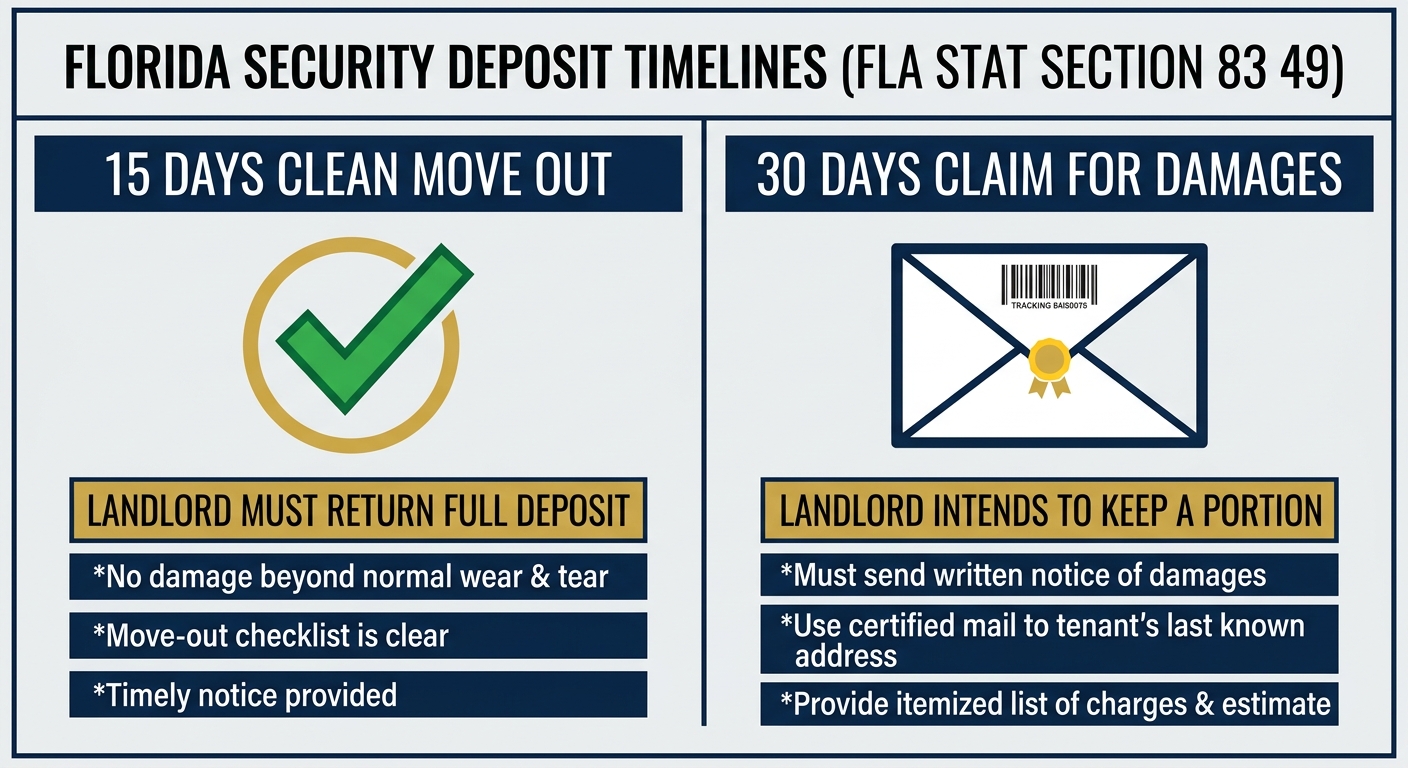
Quick Answer: Under Fla. Stat. § 83.49, Florida landlords have 15 days to return a security deposit in full if no deductions are being made. However, if you are claiming money for property damage, deep cleaning, or unpaid rent, you have 30 days to send an itemized claim via Certified Mail to the tenant last known address. If you fail to send this notice within 30 days, you legally forfeit your right to claim any part of the deposit.
The Core Rule: 15 Days vs 30 Days
Why do so many property owners get tripped up by Florida security deposit timelines? Usually, it comes down to confusing a clean turnover with a damage claim. You might ask yourself: Am I simply handing back their money, or am I preparing to fight for repair costs? The law divides move outs into two distinct paths:
- No Claim on Deposit (15 Days): Timeline is 15 days from move out. Action requires a full refund plus accrued interest if held in an interest account. Target is clean turnovers.
- Imposing a Claim (30 Days): Timeline is 30 days from move out. Action requires sending an itemized claim via Certified Mail containing required statutory text. Target covers physical damage, back rent, or unpaid utility fees.
1. The Clean Turnover (15 Day Window)
Suppose your tenant moves out, hands over the keys, and leaves the home in excellent shape with zero unpaid rent. Under Fla. Stat. § 83.49(3)(a), you have exactly 15 days from the date they vacate to return their full deposit along with any accrued interest if kept in an interest bearing account.
2. The Damage or Back Rent Claim (30 Day Window)
Now, what if you walk into the property and find broken drywall, ruined carpets, or an unpaid utility balance? Would a quick text message or an informal email suffice to let them know you are withholding funds? Absolutely not.
In this scenario, you have 30 days to issue a formal written notice detailing your intent to keep part or all of the deposit. Florida law strictly mandates that this notice must be sent by Certified Mail to the tenant forwarding address or last known mailing address. I often tell property owners to treat that certified mail receipt like pure gold because without it, proving you met your 30 day clock becomes nearly impossible.
What Happens if You Skip the Statutory Warning Language?
Here is a detail that continuously catches self managing landlords off guard: it is never enough to write a quick note stating, “I am keeping $500 for carpet repairs.”
Florida statute explicitly mandates that your notice include specific statutory warning language informing the tenant of their right to object within 15 days. What actually happens if you leave this mandatory wording out? Legally, the entire notice becomes invalid. That means you forfeit your right to retain the deposit and could end up paying the tenant legal fees under Fla. Stat. § 83.48 if they retain an attorney to contest your error.
I always think: Why risk losing thousands over a missed paragraph when the statute gives you the exact script to copy?
The 15 Day Tenant Objection Clock
Once the tenant receives your certified letter, the ball moves directly into their court:
- If they do not object within 15 days: You are legally authorized to deduct the claimed amount from the deposit and return any remaining balance to them within 30 days of the original notice date.
- If they object in writing: You now have a formal legal dispute on your hands. If that disagreement escalates into county court in Broward, Miami Dade, or Palm Beach County, a judge will review whether every single statutory notice rule was meticulously followed.
What Counts as Legitimate Deductions vs Normal Wear and Tear?
One of the most frequent friction points between landlords and departing tenants is deciding what damage justifies keeping deposit funds.
Before you start writing up your itemized bill, ask yourself: Is this issue the natural result of everyday human living, or does it represent actual property destruction and tenant negligence?
Permissible Deductions (Tenant Damage)
- Unpaid rent, fees, or utility balances
- Holes in drywall, broken doors, or cracked floor tiles
- Pet damage such as scratched doors, carpet stains, or deep odors
- Trash removal and heavy cleaning charges for abandoned personal property
Impermissible Deductions (Normal Wear and Tear)
- Faded wall paint or small nail holes from picture frames
- Minor carpet wear or light scuffs along high traffic hallways
- Aging, worn door handles or standard cabinet hinges
- Routine HVAC filter servicing or standard dust accumulation
Frequently Asked Questions for Florida Landlords
What if I completely miss the 30 day Certified Mail deadline?
- If you miss the 30 day window, you automatically forfeit your right to retain the security deposit under Fla. Stat. § 83.49, meaning you must return 100 percent of the money to the tenant. Does this mean you are completely out of options if they wrecked your rental property? Not entirely. Missing the deposit deadline prevents you from holding onto their deposit money, but it does not prevent you from filing a separate lawsuit against the former tenant in court for breach of contract or physical property damage.
Does winning an eviction judgment mean I can automatically keep the deposit?
- Surprisingly, no. Even if you secure a writ of possession in the 17th Judicial Circuit Court of Broward County, you remain legally bound to send the 30 day certified claim notice if you intend to apply the security deposit toward back rent or damages caused by the evicted tenant. I see landlords fall into this exact trap all the time assuming an eviction order wipes out their security deposit duties.
Can I include a clause in my lease waiving these notice rules?
- No. Florida courts treat Fla. Stat. § 83.49 as a mandatory protection statute. Any clause inside a residential rental agreement that attempts to bypass, shorten, or alter these statutory notice timelines is considered legally null and void.
Protect Your Real Estate Investments with Legal Counsel
Whether you manage a single rental home in Coral Springs or an apartment complex in Fort Lauderdale, administrative slip ups during tenant move outs can cost you thousands in lost funds and legal fee awards.
The real estate litigation team at Reinfeld & Cabrera P.A. helps South Florida landlords, investors, and property managers enforce lease agreements, execute formal evictions, and navigate security deposit compliance smoothly.
Schedule a Property Law Consultation
Facing a tenant dispute or need assistance structuring legally compliant lease agreements? Speak directly with a South Florida real estate attorney today:
- Direct Telephone: (954) 866 4878 | Toll Free: 954 866 HURT
- Coral Springs Office: 9625 W Sample Rd, Coral Springs, FL 33065
- Fort Lauderdale Office: 2933 W Cypress Creek Rd, Suite 201, Ft Lauderdale, FL 33309
- Website: mypersonalattorneys.com
- Local Coverage: Coral Springs, Fort Lauderdale, Parkland, Tamarac, Margate, and surrounding communities across Broward, Miami Dade, and Palm Beach Counties.