
Quick Answer :
Under Florida law (Fla. Stat. § 744.3046), parents can name a guardian for minor children by executing a formal Preneed Guardian Designation signed in the presence of two simultaneous witnesses. Unlike a will, which only activates upon death, a preneed designation protects your children during parental death or medical incapacity.
The document creates a strong presumption in court favoring your chosen primary and alternate guardians, allowing you to split physical care (Guardian of the Person) from financial management (Guardian of the Property).
Let us be completely honest with each other for a moment. Nobody wakes up on a sunny Saturday, pours a mug of coffee, and cheerfully says, “You know what sounds fun today? Figuring out who raises my children if my spouse and I get eaten by a shark or crushed by a meteor.”
It is uncomfortable. It makes your stomach do little flip flops. And if you are like most parents in South Florida, your default setting is simply to kick the can down the road, assuming your sister or your mother will just step in and figure it out if the unthinkable happens.
Except Florida law does not work on gentle assumptions. If you do not formally put your wishes in writing using proper legal execution rules, a circuit court judge who has never met your family will be forced to make that choice for you.
So how do you actually name a guardian for your minor children in Florida, avoid a holiday dinner feud between the in laws, and make sure your intentions stand up in court? Let us break down how parental designations work without any dry corporate nonsense or confusing legalese.
Why the Internet Gets Child Guardianships Wrong
If you search online late at night while spiraling into panic, you will find plenty of generic advice. Telling you to just type up a short note or throw a sentence into a basic Last Will and Testament.
Nominating a guardian in your will is a very common approach. But relying solely on a will leaves a massive, gaping hole in your legal safety net.
Ask yourself: What happens if you and your spouse are in a serious car accident and end up in a coma for six months?
A will only springs to life after you pass away. If you are incapacitated rather than deceased, a judge cannot use your will to authorize someone to care for your kids or handle their day to day needs. That is why Florida estate planning relies on specialized advance designations that cover both incapacitation and death.
Preneed Guardians vs. Standby Guardians: Decoding the Legal Jargon
Florida law gives parents two primary legal mechanisms to nominate who steps in when disaster strikes. You do not need a law degree to understand them, but you do need to know which one fits your situation.
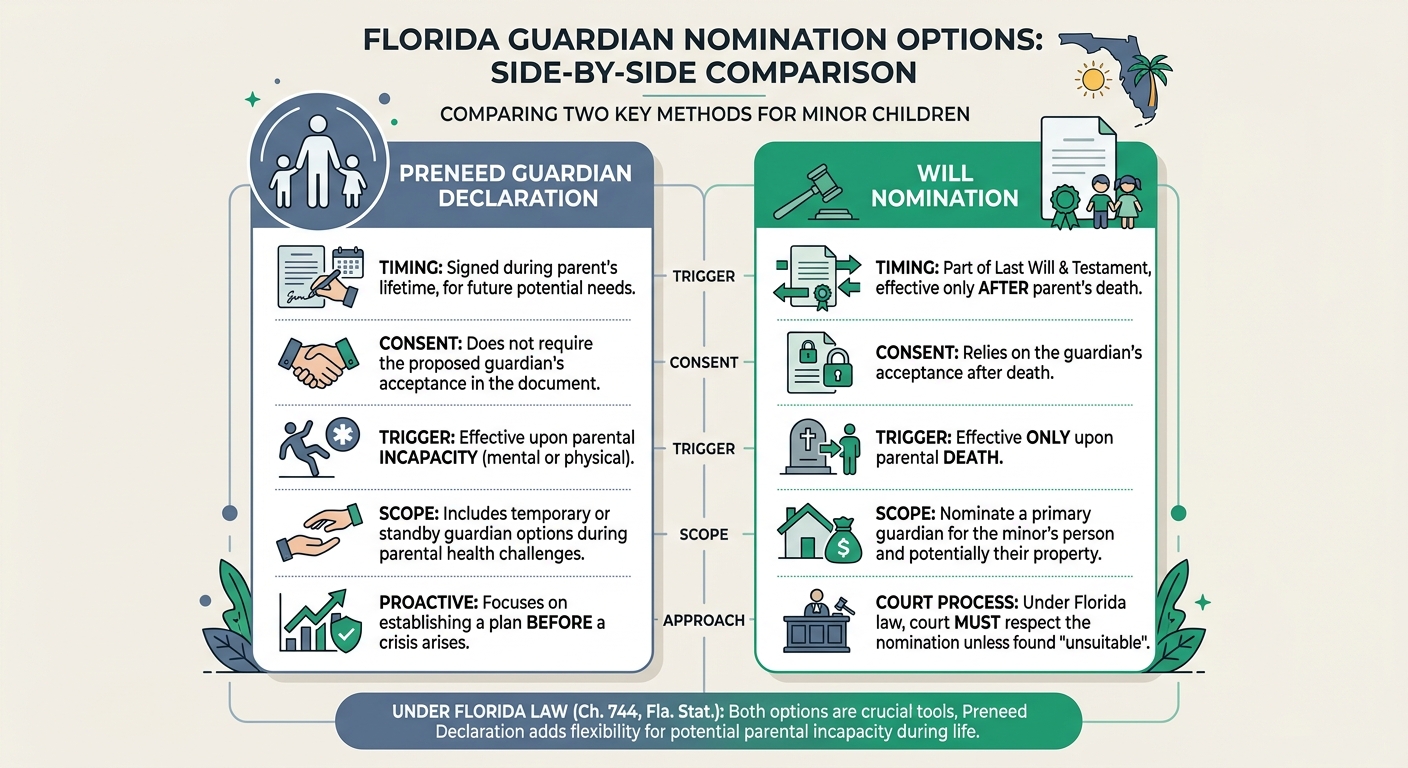
1. The Preneed Guardian Designation (Fla. Stat. § 744.3046)
Think of this as your official written nomination letter to the local probate court. Under Florida law, parents can sign a formal declaration naming a primary guardian and an alternate guardian.
- How it works: You sign the document ahead of time with two attesting witnesses present at the exact same time. If both parents pass away or become incapacitated, the document is produced in court. This creates a powerful legal presumption that the judge should honor your chosen person.
- Why it matters: It covers both death and medical incapacity, seamlessly closing the gap that a standard will leaves behind.
2. Standby Guardianship (Fla. Stat. § 744.304)
A standby guardian is a slightly different tool designed for immediate handoffs.
- How it works: This involves a pre approved court petition where a designated guardian stands in the wings. He or she is ready to act instantly upon a specific triggering event (like severe medical decline or death). The standby guardian assumes duties immediately and then has 20 days to file a formal petition for court confirmation.
The Person vs. The Property: You Do Not Have to Pick Just One Human
Here is a common dilemma that paralyzes parents: Your brother is incredible with kids, warm, patient, and living in a great school district, but he handles money like a golden retriever with a stolen credit card. Meanwhile, your accountant sister is a financial wizard, but her idea of childcare is handing a toddler a spreadsheet.
Good news: Florida law allows you to split these responsibilities down the middle.
- Guardian of the Person: This person gets physical custody, decides where the kids live, manages their schooling, signs permission slips, and handles medical decisions.
- Guardian of the Property: This person manages the financial inheritance, holds onto money left for the children, pays for their expenses out of a trust or court supervised account, and ensures nobody wastes their funds.
You can name the same person for both roles, or you can split them up so your kids get loving care while your financial hawk protects their inheritance.
How to Choose an Alternate (and Avoid In-Law Meltdowns)
Always, always name an alternate guardian. Life happens. Your primary choice might move across the globe, face health challenges of their own, or simply realize that taking on two active toddlers at age fifty five is more than they can physically handle.
When selecting guardians, look beyond raw emotional attachment and evaluate practical realities:
- Shared Values and Lifestyle: Do they raise children with similar boundaries, educational goals, and emotional warmth?
- Geographic Location: Would your children have to move across the country, switch schools, and leave their support network behind during a time of intense grief?
- Financial and Physical Capacity: Do they have the health, energy, and space in their life to raise children through high school and college?
Pro Tip: Talk to the people you want to name before you sign the papers. Finding out after the fact that your prospective guardian never wanted kids in the first place makes for an extremely awkward conversation.
Frequently Asked Questions About Naming a Guardian in Florida
How do I name a guardian for my child in Florida?
- You can document your intent by executing a formal Preneed Guardian Designation under Fla. Stat. § 744.3046 or by nominating a guardian within your Last Will and Testament. The document must comply strictly with Florida signing formalities, including two simultaneous attesting witnesses.
Can I name a guardian for my minor child in my will?
- Yes. Florida law allows parents to nominate a guardian inside a will. However, because a will only takes effect upon death, pairing it with a Preneed Guardian Designation ensures your choices are legally documented if you become incapacitated.
What is a preneed guardian for a minor in Florida?
- A preneed guardian is a person formally nominated by living parents to step in, take custody, or manage property for a minor child if the parents die or lose legal capacity.
Can I name an alternate guardian for my child?
- Yes. Florida statutes explicitly encourage parents to name an alternate preneed guardian in case your primary choice is unable or unwilling to serve when the time comes.
What happens if both parents die without naming a guardian?
- If no written designation exists, any interested family member or party can petition the court for guardianship. A judge in the 17th Judicial Circuit will hold hearings and choose a guardian based on what they determine is in the child’s best interests, which may not align with who you would have wanted.
Does the court have to appoint the person named by the parents?
- While Florida courts give immense weight and priority to a valid preneed designation signed by the parents, the judge retains ultimate authority to verify that the nominee meets statutory qualifications and that the appointment serves the child’s best interests.
Can a guardian be named for a child’s property as well as the child?
- Yes. Florida law explicitly separates guardianship of the person (physical care and custody) from guardianship of the property (financial management), allowing parents to appoint the same individual or two separate people.
What is the difference between a preneed guardian and a standby guardian?
- A preneed guardian is nominated in advance on paper and awaits a potential future appointment by the court. A standby guardian is pre approved by court order prior to an emergency and can take physical custody instantly upon a triggering event, with 20 days to get final confirmation from the judge.
Can I change or revoke the guardian I have named for my child?
- Yes. As long as you are competent, you can revoke, modify, or replace your preneed guardian designation at any time by executing a new written declaration that meets Florida statutory requirements.
Does naming a guardian eliminate the need for a full estate plan?
- No. Naming a guardian addresses who cares for your children, but it does not manage how your home, bank accounts, or life insurance proceeds are handled. Pairing your guardian designations with a revocable living trust ensures your money is protected and managed smoothly for your kids without ongoing court oversight.
Protecting Your Children and Your Peace of Mind
At the end of the day, naming a guardian is not about dwelling on tragic worst case scenarios. It is about taking control, removing uncertainty, and giving yourself total peace of mind knowing that your kids will always be raised by people who love them and share your values.
The estate planning attorneys at Reinfeld & Cabrera P.A. help parents across South Florida establish airtight preneed guardian designations, revocable living trusts, and comprehensive family protection plans.
Schedule a Confidential Consultation
Do not leave your family’s future up to chance or a courtroom schedule. Speak directly with an attorney today to set up your parental designations:
- Direct Telephone: (954) 866 4878 | Toll Free: (954) 866 HURT
- Coral Springs Office: 9625 W Sample Rd, Coral Springs, FL 33065
- Fort Lauderdale Office: 2933 W Cypress Creek Rd, Suite 201, Ft Lauderdale, FL 33309
- Website: mypersonalattorneys.com
- Local Coverage: Coral Springs, Fort Lauderdale, Parkland, Tamarac, Margate, and all surrounding communities across Broward, Miami Dade, and Palm Beach Counties.