Quick Answer: The Florida Medicaid 5-Year Lookback Rule allows the Department of Children and Families (DCF) to review all financial transactions and asset transfers made within 60 months prior to applying for Nursing Home Medicaid. Gifting real estate or transferring home ownership below fair market value triggers severe penalty periods of Medicaid ineligibility.
However, homeowners can legally shield their residence from long-term care costs and Medicaid Estate Recovery (MERP) through statutory exceptions—such as the Caregiver Child Exemption, spousal transfers, Medicaid Asset Protection Trusts (MAPTs) created outside the 5-year window, or Lady Bird Deeds that bypass probate without violating lookback rules.
1. How the Florida Medicaid 5-Year Lookback Rule Operates
When an individual applies for Institutional Care Program (ICP) Medicaid in Florida, the state evaluates both income and countable assets. To prevent applicants from gifting away assets to qualify for state benefits, Florida enforces a strict 60-month “lookback” period.
Month 60 to Application Date: The window of scrutiny evaluated by the state.
Uncompensated Asset Transfer: Any transfer of property, cash, or real estate for less than fair market value during this 60-month window.
Penalty Period Enforcement: DCF calculates a period of Medicaid ineligibility based on the total value of the uncompensated transfer.
The Penalty Period Calculation
If the Florida Department of Children and Families (DCF) discovers an uncompensated transfer within the 60 months preceding the application date, DCF imposes a penalty period during which the applicant is disqualified from Medicaid coverage.
During this penalty period, the applicant must pay for nursing home care entirely out-of-pocket—often exceeding $10,000 to $12,000 per month in South Florida facilities—before Medicaid coverage can begin.
Is the Primary Residence a Countable Asset?
In Florida, a primary residence homestead is generally considered an exempt asset for initial Medicaid eligibility if the applicant’s equity interest does not exceed the state’s maximum equity limit and the applicant indicates an “intent to return home” on the application.
However, holding a primary residence as an exempt asset during life does not protect it after death. Without proactive legal structuring, the home remains vulnerable to post-death creditor claims by the state.
2. The Threat of Medicaid Estate Recovery (MERP)
Qualifying for Medicaid during life is only half the battle. Under Fla. Stat. § 409.9101, Florida operates the Medicaid Estate Recovery Program (MERP). Upon the Medicaid recipient’s death, the state becomes a creditor against their probate estate to recoup every dollar paid out for long-term care services.
Property Titled in Deceased’s Name Alone: Passes through formal probate administration, allowing MERP to execute claims and attach liens to force a sale.
Property Structured Outside Probate: Passes directly to designated heirs via deed or trust, completely avoiding probate administration and blocking MERP claims.
If the home passes through formal probate administration, the state can attach a lien to the real estate, forcing heirs to sell the property to satisfy the Medicaid debt. Protecting the family home requires strategies that insulate the residence during the lookback analysis while simultaneously ensuring the home bypasses probate court at death.
3. Statutory Exceptions and Exemption Strategies
Florida Medicaid rules contain explicit statutory safe harbors that permit home transfers within the 5-year window without triggering a penalty period.
Transfer Strategy / Exemption
Lookback Penalty Status
Primary Legal Advantage
Transfer to Surviving Spouse
Fully Exempt
Preserves full ownership for the well spouse (Community Spouse) without penalty.
Caregiver Child Exemption
Fully Exempt
Transfers home title directly to an adult child who provided in-home care.
Transfer to Disabled Child
Fully Exempt
Protects property for a child verified as permanently disabled under SSI/SSDI rules.
Lady Bird Deed (Enhanced Life Estate)
Fully Exempt
Retains lifetime control, avoids probate, and blocks MERP claims.
Medicaid Asset Protection Trust (MAPT)
Subject to 5-Year Lookback
Must be executed >60 months prior to application; provides total asset protection.
The Caregiver Child Exemption
Under Florida Medicaid guidelines, an applicant can transfer full title of the homestead to their adult child without incurring a transfer penalty if specific conditions are met:
The adult child lived in the parent’s primary residence for at least two consecutive years immediately prior to the parent’s admission to a nursing home or long-term care facility.
The child provided documented care that permitted the parent to reside safely at home rather than in a medical care facility during those two years.
The care provided is verified through medical records, physician attestations, and detailed care logs.
Spousal Transfers and Community Spouse Resource Allowance (CSRA)
Transferring the primary residence to a Community Spouse (the spouse who remains living in the community) is completely exempt from the 5-year lookback rule. The well spouse can receive full title to the home without impacting the institutionalized spouse’s Medicaid application.
Lady Bird Deeds (Enhanced Life Estate Deeds)
A Florida Lady Bird Deed allows a property owner to retain an enhanced life estate (including full rights to sell, mortgage, or revoke the deed) while designating remainder beneficiaries who inherit the property automatically at death.
Why it passes lookback scrutiny: Because the owner retains full control to revoke the deed during life, recording a Lady Bird Deed is not classified as a completed uncompensated gift by Florida DCF.
Why it blocks MERP: The property transfers automatically upon death outside of probate administration, effectively shielding the homestead from state estate recovery claims under Fla. Stat. § 409.9101.
4. Real-World Execution Scenarios
Scenario A: Proactive Planning (7 Years Before Long-Term Care Needs)
Profile: A 70-year-old homeowner in Broward County with early-stage health concerns wants to protect her home valued at $500,000 for her two adult children.
Strategy: The homeowner executes a Medicaid Asset Protection Trust (MAPT) and deeds her home into the irrevocable trust.
Outcome: Because the transfer occurred more than 60 months before she ever required nursing care, the 5-year lookback window expires cleanly. The home is completely sheltered from long-term care costs, and she retains the right to live in the home for life.
Scenario B: Emergency Crisis Planning (Immediate Nursing Home Admission)
Profile: An 82-year-old widower suffers a severe stroke and requires immediate, permanent placement in a Coral Springs skilled nursing facility. He has lived with his adult daughter for the past three years, during which she managed his daily medical needs.
Strategy: His legal team gathers medical documentation and physician certifications establishing the Caregiver Child Exemption, while simultaneously executing a Lady Bird Deed as a secondary safeguard.
Outcome: The home is transferred directly to the daughter without triggering a Medicaid penalty period, preserving the home from immediate spend-down and future Medicaid estate recovery.
Frequently Asked Questions
Can Medicaid take my home while I am still alive in Florida?
No. Florida law does not allow Medicaid to place a lien on or seize your primary residence while you are alive, provided your equity remains under the state limit and you state an intent to return home. Threat of home loss occurs after death through the Medicaid Estate Recovery Program (MERP) during probate administration.
Does executing a Lady Bird Deed trigger a 5-year lookback penalty?
No. Because a Florida Lady Bird Deed allows you to retain total unilateral control to sell, refinance, or revoke the conveyance during your lifetime, Florida DCF does not treat it as a completed gift or uncompensated transfer. It does not trigger a Medicaid penalty period.
What evidence is required for the Caregiver Child Exemption in Florida?
Florida DCF requires clear written proof, including:
Proof of joint residency (such as tax returns, driver’s licenses, or utility bills) covering the two years prior to facility admission.
A signed written statement from the treating physician confirming that the care provided by the adult child allowed the parent to remain safely at home instead of entering a nursing facility.
Protect Your Family Home and Assets Before a Crisis Strikes
Navigating Florida Medicaid rules and protecting your real estate from long-term care costs requires proactive, highly technical legal planning. A single misstep with uncompensated asset transfers or failing to structure your property outside of probate can expose your family home to devastating out-of-pocket nursing home expenses and Medicaid Estate Recovery liens.
Do not leave your family’s legacy vulnerable to the uncertainties of the 5-year lookback window. Connect directly with our estate planning and elder law team to build a secure, customized asset protection strategy tailored to your circumstances.
Call Our Office Today: Speak with our team directly at 954-866-4878 to discuss your options.
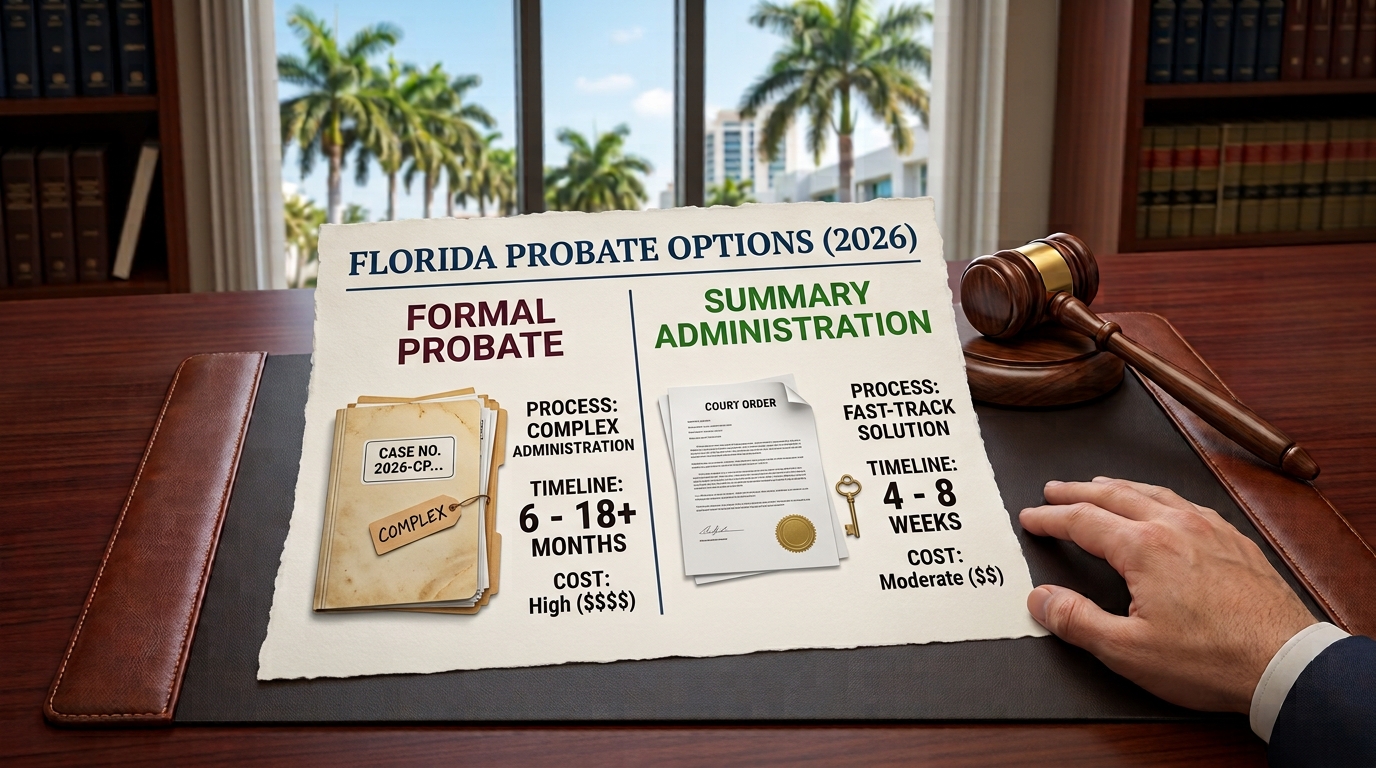
When a loved one passes away in Florida, families often assume they are facing a year-long legal battle filled with court dates, stacks of paperwork, and exorbitant administrative costs. However, under Chapter 735 of the Florida Probate Code, many families qualify for a fast-track judicial process known as Summary Administration.
Effective July 1, 2026, Florida doubled the statutory limit for small estate probate under Fla. Stat. § 735.201 from $75,000 to $150,000. This critical update allows significantly more families to distribute estate assets in a matter of weeks rather than months.
Direct Answer
What are the requirements for Summary Administration in Florida?
To qualify for Summary Administration in Florida under Fla. Stat. § 735.201, an estate must satisfy either of the following two criteria:
The $150,000 Asset Cap: The total value of non-exempt Florida probate assets is $150,000 or less (for deaths on or after July 1, 2026).
The 2-Year Rule: The decedent has been deceased for more than two years, regardless of total estate value.
Additionally, the decedent’s Last Will and Testament must not explicitly mandate Formal Estate Administration.
The Two Pathways to Qualifying for Summary Probate
Unlike Formal Administration—which requires the court to appoint a Personal Representative (Executor) and oversee a lengthy administration period—Summary Administration acts as a direct judicial order transferring assets straight to beneficiaries.
For decedents passing on or after July 1, 2026, the estate’s total non-exempt probate assets must not exceed $150,000. (For deaths occurring prior to July 1, 2026, the statutory limit remains $75,000).
2. The Two-Year Statute of Repose Rule
If the decedent passed away more than two years ago, the estate automatically qualifies for Summary Administration, regardless of how millions of dollars the estate is worth. Under Fla. Stat. § 733.710, Florida enforces a strict two-year statute of repose that permanently bars unfiled creditor claims, removing the necessity for a formal personal representative to manage debts.
Why “On-Paper” Net Worth Misleads Most Heirs
One of the most frequent misconceptions beneficiaries encounter is assuming that if a relative owned a high-value home in South Florida, they are automatically forced into Formal Probate.
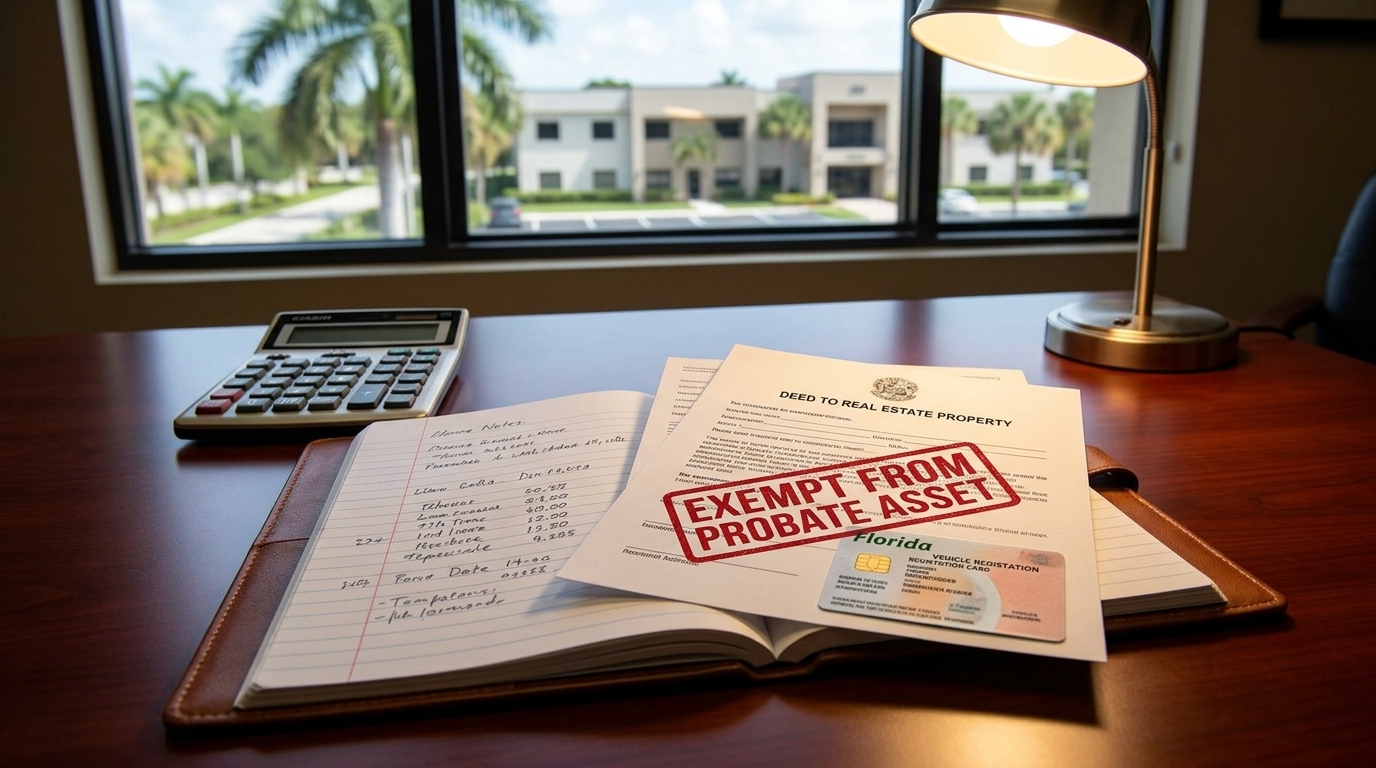
Florida law only evaluates probate assets subject to court distribution. The following major asset categories are entirely excluded from the $150,000 threshold calculation:
Florida Protected Homestead Real Estate: Under Article X, Section 4 of the Florida Constitution, a primary residence passing to a surviving spouse or lineal heirs is constitutionally protected from general creditors. Because homestead rights vest immediately upon death, the home’s value (whether $400,000 or $2,000,000) does not count toward the $150,000 limit when petitions are properly structured.
Statutory Exempt Personal Property: Under Fla. Stat. § 732.402, up to $20,000 in household furniture/furnishings and two personal motor vehicles used by the decedent are exempt from creditor claims and excluded from the asset tally.
Non-Probate Financial Transfers: Bank accounts with Payable-on-Death (POD) or Transfer-on-Death (TOD) designations, life insurance policies with named beneficiaries, jointly owned property with rights of survivorship, and assets held inside a Revocable Living Trust bypass probate entirely.
“Many families walk into our office believing they owe thousands in court fees because their parent owned a $700,000 house in Coral Springs. Once we isolate the constitutional homestead and exempt vehicles, the actual probate asset is just a $40,000 checking account—qualifying them for fast-track Summary Administration instantly.”
— Devin P. Tison, Esq., Lead Partner at Reinfeld Cabrera Tison
Real-World Case Studies: How Summary Administration Works in Practice
Case Study 1: Bypassing Formal Probate for a Broward County Home & Bank Account
Scenario: A widow in Fort Lauderdale passed away, leaving a home valued at $550,000 and a sole-name savings account containing $65,000. Her two adult children were named as equal beneficiaries in her Will.
The Legal Challenge: A traditional law firm informed the siblings they needed Formal Administration due to the $615,000 gross estate value, quoting an estimated 9-month process and thousands in hourly fees.
The RCT Solution: Our probate team filed a Petition for Determination of Homestead Property alongside aPetition for Summary Administration. Because the $550,000 home was protected homestead, its value dropped to $0 for qualification purposes. The only remaining asset was the $65,000 account—well under the statutory limit.
Outcome: The Broward County Probate Court issued an Order of Summary Administration in 5 weeks. The bank released the funds directly to the siblings, and the homestead order cleared title for them to sell the home without appointing a Personal Representative.
Case Study 2: Settling an Estate Decades Later for Out-of-State Heirs
Scenario: A father passed away in Miami-Dade County in 2018 owning an unlinked parcel of land. His heirs, living in New York, never probated the estate because they believed the process was too complex from out-of-state.
The Legal Challenge: The land grew in value to $220,000. The heirs wanted to sell the land but could not clear title without court authorization.
The RCT Solution: Because the decedent had been deceased for over two years, the estate qualified under the 2-Year Rule regardless of the $220,000 property value. We managed the entire filing remotely via Florida’s electronic court portal without requiring the heirs to travel to Florida.
Outcome: The court signed the distribution order within 4 weeks, enabling the title company to execute a seamless sale.
Detailed Comparison: Summary vs. Formal Administration
Key Feature
Summary Administration (Fla. Stat. § 735.201)
Formal Administration (Fla. Stat. Ch. 733)
Statutory Eligibility
Non-exempt assets $\le \$150,000$ OR death > 2 years ago
Estates over $\$150,000$ or complex litigation cases
Average Timeline
4 to 8 weeks
6 to 12+ months
Personal Representative
None appointed by the court
Court appoints an Executor/PR
Letters of Administration
Not issued
Issued (gives PR power to act for estate)
Primary Court Order
Order of Summary Administration
Order of Discharge
Legal Costs
Significantly lower; often structured as a Flat Fee
Higher court fees, inventory costs, and hourly rates
Frequently Asked Questions (FAQ)
Does Florida have a Small Estate Affidavit to avoid probate?
No. Florida does not recognize a standalone “Small Estate Affidavit” for transferring real estate or bank accounts like some other states do. Florida’s equivalent for small estates is Summary Administration or, for extremely small asset values under funeral costs, Disposition Without Administration (Fla. Stat. § 735.301).
What happens to outstanding creditor debts in Summary Administration?
Because no Personal Representative is appointed to manage estate claims, beneficiaries who receive assets through Summary Administration remain personally liable for valid debts of the decedent up to the dollar value of what they inherited. To eliminate this risk, a probate attorney can publish an optional Notice to Creditors in a local South Florida newspaper, initiating a 30-day window that permanently bars unfiled claims.
Can an out-of-state beneficiary file for Summary Administration in Florida?
Yes. Florida probate courts utilize 100% digital filing systems. Out-of-state heirs in New York, New Jersey, or anywhere across the country can hire a local Florida probate lawyer to execute the entire proceeding remotely without ever stepping foot inside a courtroom.
How long does it take to get an Order of Summary Administration?
In South Florida courts (Broward, Miami-Dade, and Palm Beach counties), an uncontested Petition for Summary Administration typically takes 4 to 8 weeks from initial filing to final judge signature, depending on judicial caseloads.
Why Choose Reinfeld & Cabrera, P.A. for South Florida Probate?
Navigating court petitions while grieving a family member can feel overwhelming. At Reinfeld & Cabrera, P.A. (mypersonalattorneys.com), we simplify the Florida probate process with transparency and local courtroom experience:
Transparent Flat-Fee Pricing: We eliminate financial anxiety by offering predictable flat legal fees for uncontested Summary Administration—no hidden hourly bills.
Bilingual Legal Representation: Our attorneys and staff speak fluent English and Spanish, ensuring clear communication for non-English speaking beneficiaries.
Full-Service Local Filings: We handle all court communication across Broward (17th Judicial Circuit), Miami-Dade (11th Judicial Circuit), and Palm Beach (15th Judicial Circuit) counties.
If you need to transfer real estate, recover frozen bank accounts, or resolve an estate in South Florida, contact Reinfeld & Cabrera, P.A. today for a free case evaluation.
Direct Phone: (954) 334-1520 / (855) 529-7123
Coral Springs Office: 9625 W. Sample Rd, Coral Springs, FL 33065
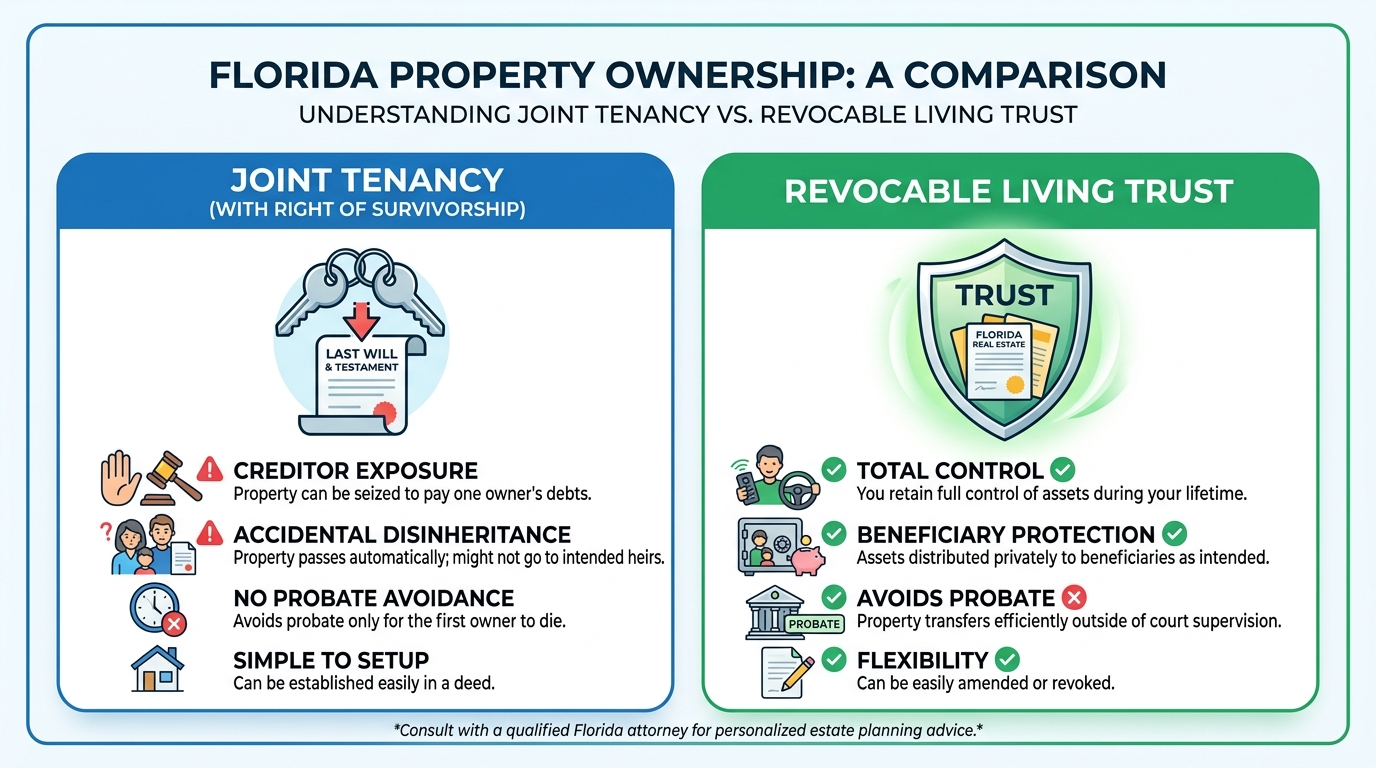
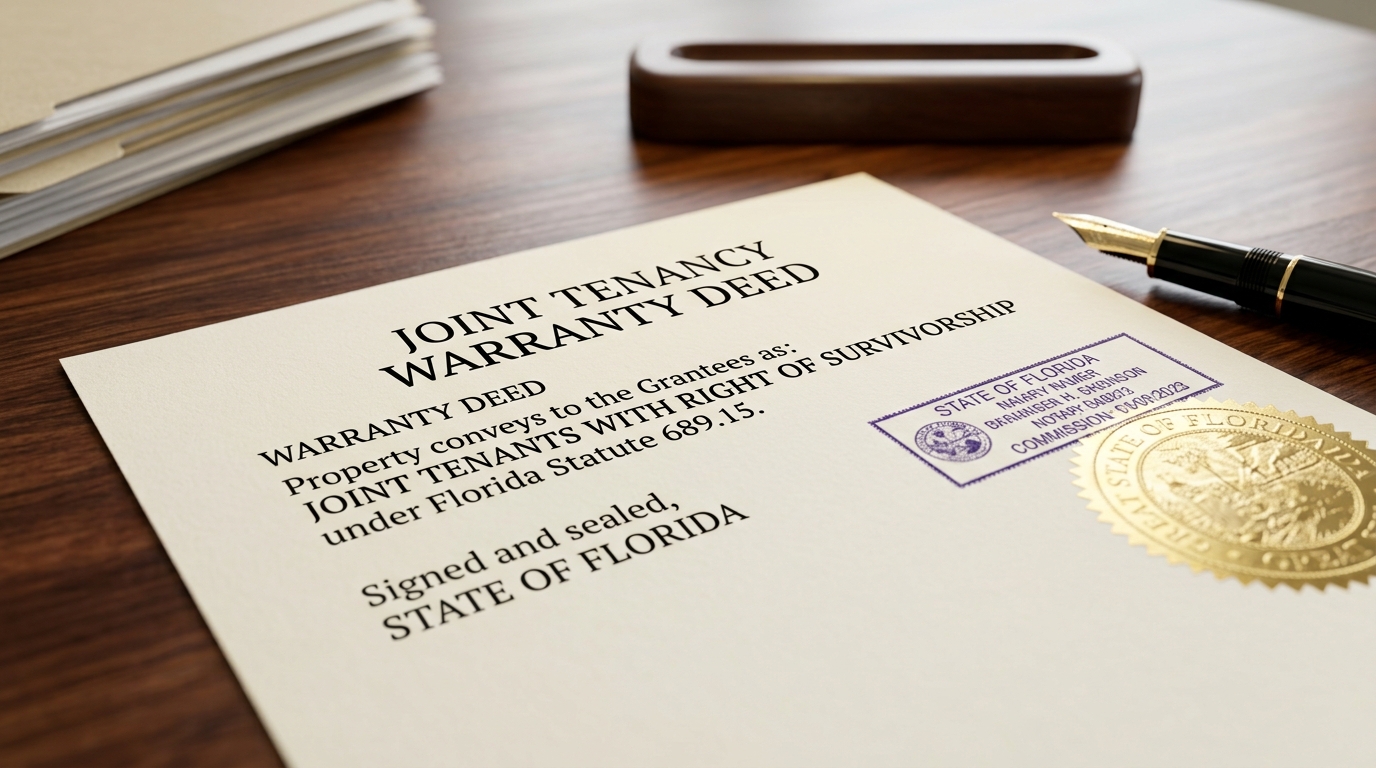
Joint Tenancy with Right of Survivorship (JTWROS) in Florida bypasses probate under Fla. Stat. § 689.15, but it completely overrides your Last Will and Testament. Upon the death of one joint owner, title vests immediately and automatically in the surviving owner. This exposes assets to the survivor’s future creditors, potential remarriage claims, and total disinheritance of biological children from prior marriages.
Governed by Will DirectivesJoint Tenancy completely overrides your Will. A Revocable Trust strictly enforces every distribution instruction in your estate plan.
Co Owner Creditor ProtectionJoint Tenancy exposes your assets to co owner debts and lawsuits. A Revocable Trust protects assets from third party beneficiary liabilities.
Many South Florida homeowners and account holders add adult children, second spouses, or relatives to bank accounts and real estate deeds as a quick shortcut to avoid formal probate court proceedings.
While adding a joint owner appears convenient on the surface, Joint Tenancy with Right of Survivorship (JTWROS) is one of the most unpredictable, blunt force mechanisms in estate planning. Under Florida property and probate law, joint titling strips away your lifetime financial control, exposes your hard earned assets to outside lawsuits, and routinely triggers accidental family disinheritance.
3 Fatal Vulnerabilities of Joint Ownership Under Florida Estate Law
1. Automatic Property Transfer Overrides Your Will and Intentions
Under Florida Statute § 689.15, when property or financial assets are held as joint tenants with right of survivorship, the deceased co owner’s interest transfers instantly to the surviving co owner upon death by operation of law.
Your Last Will and Testament, Revocable Trust instructions, or verbal promises made to family members carry zero legal weight. If a parent adds one adult child to a Coral Springs real estate deed purely for administrative convenience or convenience check writing, that child becomes the sole legal owner upon the parent’s death, completely cutting out their siblings regardless of what the parent’s Will specifies.
2. Immediate Asset Exposure to Co Owner Liabilities and Creditors
The moment you name a joint owner on a bank account or Broward County real estate deed, that individual gains immediate legal ownership rights. If your co owner faces a divorce proceeding, automobile accident lawsuit, business bankruptcy, or personal tax lien, judgment creditors can attach claims directly to your shared asset. You effectively gamble your lifelong financial security on your co owner’s personal financial discipline and legal stability.
3. The Blended Family Disinheritance Trap
In blended families with children from prior relationships, joint titling regularly causes catastrophic estate outcomes.
When a married couple holds real estate or bank accounts jointly with right of survivorship, all assets vest exclusively in the surviving spouse upon the first spouse’s death. When that surviving spouse eventually passes away, the entire estate passes to their personal biological children or designated heirs. The biological children of the spouse who passed away first receive nothing, creating permanent financial alienation between stepfamilies.
Real World Legal Case Study: In re Estate of Kester
A clear example of how joint titling destroys testamentary intent is illustrated in the official Florida legal precedent In re Estate of Kester, Fla. 4th DCA 1986), decided by the Fourth District Court of Appeal in West Palm Beach.
The Case Background
In this landmark dispute, a mother executed a formal Last Will and Testament directing that her entire estate be divided equally among her children. However, for everyday banking convenience, she established joint bank accounts and credit union shares with right of survivorship naming only one of her daughters as a co owner.
The Legal Conflict
Following the mother’s death, the siblings brought legal action in court, arguing that the funds in the joint accounts were intended for the benefit of all children under the terms of the mother’s Will, and that the joint owner held those funds merely as a fiduciary for the estate.
The Court Ruling
The Fourth District Court of Appeal ruled firmly against the other siblings. The appellate court held that under Florida statutory law governing joint accounts, titling an account as joint tenancy with right of survivorship creates a strong legal presumption of an absolute gift to the surviving joint owner.
Because the disappointed siblings could not provide clear and convincing written evidence proving the mother did not intend to create a survivorship right at the exact moment the accounts were established, the surviving joint daughter kept the entirety of the money. The clear instructions contained inside the mother’s Last Will and Testament were completely ignored and legally powerless.
Superior Florida Legal Alternatives to Joint Ownership
Rather than risking loss of control or accidental disinheritance through joint titling shortcuts, comprehensive estate plans utilize flexible legal structures designed under Florida statutory law:
1. Revocable Living Trust
Establishing a trust under Fla. Stat. Chapter 736 allows you to maintain 100 percent sole authority over your real estate and financial accounts during your lifetime. Upon death, your named successor trustee distributes property to your designated beneficiaries according to your exact written terms, achieving complete probate court avoidance without exposing your assets to co owner debts or disinheriting loved ones.
2. Florida Financial Durable Power of Attorney
If your main objective is allowing a trusted child or relative to assist with bill paying, property maintenance, or financial management during a health crisis, executing a Durable Power of Attorney (Fla. Stat. § 709.2104) grants them legal administrative authority without giving them property ownership rights or subjecting your assets to their personal creditors.
3. Enhanced Life Estate Deed (Lady Bird Deed)
For primary residential property in Coral Springs, Fort Lauderdale, or anywhere in Broward County, an Enhanced Life Estate Deed allows a property owner to retain total lifetime ownership rights, including the right to sell, lease, or mortgage the home without obtaining permission, while designating an automatic transfer on death beneficiary that completely bypasses Florida probate.
Frequently Asked Questions
Does joint ownership avoid probate in Broward County?
Yes, joint tenancy with right of survivorship avoids probate upon the death of the first co owner. However, when the surviving owner eventually passes away without establishing formal trust planning, the property must pass through formal Florida probate administration.
Can I remove a joint owner from my Florida real estate deed without their consent?
No. Once an individual is added to a deed as a joint tenant in Florida, you cannot remove them, sell the property, or execute mortgages without their formal notarized signature, even if you originally paid for the entire property yourself.
What is the legal difference between Joint Tenancy and Tenancy by the Entirety in Florida?
Tenancy by the Entirety is a specialized form of joint ownership reserved strictly for legally married couples under Florida law. It provides built in creditor protection against individual spouse liabilities that standard Joint Tenancy does not offer.
Can a Last Will override a joint bank account in Florida?
No. Under Florida law, joint accounts with right of survivorship transfer automatically upon death. A Last Will carries no legal authority to alter or redistribute funds held in a valid joint survivorship account.
Protect Your Property and Family Autonomy in Coral Springs
Selecting an estate planning and probate attorney in Coral Springs requires evaluating local Broward County courtroom experience, mastery of Florida trust statutes (Fla. Stat. Chapter 736), and integrated knowledge of Florida constitutional homestead laws (Fla. Const. art. X, § 4).
A qualified local attorney ensures wills, revocable trusts, and powers of attorney comply with strict execution requirements while guiding personal representatives through formal or summary probate proceedings in the 17th Judicial Circuit Court of Broward County.
Critical Evaluation Framework for Local Legal Counsel
Florida Statutory Compliance
Fla. Stat. Chapter 736 (Trust Code)
Fla. Stat. Chapter 709 (Durable Power of Attorney)
Fla. Stat. Chapter 765 (Health Care Directives)
Broward Judicial Experience
17th Judicial Circuit Court Rules
Local Broward Clerk Filing Protocols
Probate Division Judicial Orders
Reinfeld & Cabrera Legal Representation Hub
Securing your family’s financial future, protecting physical property, and ensuring seamless asset distribution requires thoughtful legal strategy. While online document assembly services promise cheap, automated legal templates, generic forms regularly fail under Florida probate court scrutiny.
Florida estate law involves intricate statutory execution rules, unique real estate protections, and strict probate filings across Broward County. Understanding how to choose an experienced local attorney is the single most important step in protecting your life savings and preserving your legacy.
5 Essential Standards When Evaluating Coral Springs Estate Legal Counsel
1. Direct Mastery of Florida Specific Estate and Trust Statutes
Florida law does not follow generic federal templates or out of state legal norms. Your legal counsel must maintain a daily transactional practice grounded in specific Florida legislation:
Florida Trust Code (Fla. Stat. Chapter 736): Regulates the creation, amendment, revoking, and administration of revocable and irrevocable trusts. It establishes strict fiduciary standards for named trustees and protects beneficiary distribution rights.
Florida Power of Attorney Act (Fla. Stat. Chapter 709): Governs financial durable powers of attorney. Under Florida law, general sweeping clauses are ineffective unless specific statutory superpowers under Fla. Stat. § 709.2114 are explicitly initialed by the principal.
Florida Probate Code (Fla. Stat. Chapters 731 through 735): Controls the judicial validation of wills, opening of estates, creditor notification periods, and final asset distribution.
Florida Health Care Advance Directives (Fla. Stat. Chapter 765): Outlines the legal appointment of health care surrogates, living wills, and anatomical gifts.
2. Local Courtroom and Judicial Experience in Broward County
Estate planning and probate are deeply localized practice areas. An attorney who regularly represents clients before the 17th Judicial Circuit Court in Fort Lauderdale understands local judicial preferences, divisional filing protocols, and clerk processing workflows.
When a loved one passes away, local judicial experience ensures that petitions for administration, orders appointing personal representatives, and letters of administration move through the Broward County probate court system without administrative rejections or unnecessary delays.
For the vast majority of Coral Springs and Parkland homeowners, primary residential real estate represents their largest asset. Under Florida Constitution Article X, Section 4, primary residential property enjoys unique protection from forced sale by creditors.
However, Florida homestead devise restrictions strictly limit how a primary home can be left in a Will or Trust if the owner is survived by a spouse or minor children. An experienced Coral Springs attorney knows how to structure deeds, trusts, and spousal waivers to preserve homestead protections while avoiding title clouding or unintended tax consequences.
Florida Constitutional Homestead Advantages
Creditor Exemption ProtectionProtects primary residential equity from forced sale by judgment creditors under Florida law.
Property Tax Cap LimitsLocks annual assessed property value increases under Florida Save Our Homes assessment caps.
Strict Devise RestrictionsProtects rights of surviving spouses and minor children regarding real estate transfers.
4. Comprehensive Probate Avoidance and Administration Capabilities
A complete legal counselor does not simply hand you a stack of paper and send you on your way. Your attorney must possess expertise across both proactive planning and reactive administration:
Incapacity Avoidance: Structuring financial durable powers of attorney and health care surrogates to prevent involuntary adult guardianship court hearings under Fla. Stat. Chapter 744.
Summary Probate Administration: Navigating expedited court proceedings under Fla. Stat. Chapter 735 for estates under $75,000 or where the decedent has been deceased for more than two years.
Formal Probate Administration: Managing complex court supervised estates requiring personal representative appointments, formal notice to creditors, estate accounting, and tax releases.
5. Proven Community Reputation and Legal Continuity
Estate planning is an ongoing lifetime relationship. As your family grows, assets change, and Florida tax laws evolve, your estate plan requires periodic reviews.
Recognized over the years by local Coral Springs community awards, Reinfeld & Cabrera, P.A. has established a decade long legacy of personal legal representation across Broward County. Choosing a stable, locally rooted firm ensures that the attorneys who drafted your trust will be available decades later to guide your loved ones through its execution.
Comparing Online DIY Legal Forms vs. Local Attorney Representation
Operational Feature
Online DIY Document Generator
Local Coral Springs Legal Counsel
Florida Execution Compliance
High risk of improper witnessing or notarization
Strict compliance with Fla. Stat. § 732.502
Homestead Protection Integration
Generic forms ignore Florida constitutional restrictions
Customized deed drafting and tax cap protection
Local Probate Court Knowledge
Zero court presence or regional administrative support
Direct filing experience in 17th Judicial Circuit Court
Fiduciary Guidance
No legal advice on selecting agents or trustees
Professional counseling on trustee appointment
Custom Contingency Planning
Rigid templates that fail during complex family changes
Bespoke trust structures adapted to family dynamics
Frequently Asked Questions
Why shouldn’t I use a basic online Will template in Florida?
Florida law requires strict execution formalities under Fla. Stat. § 732.502, including execution in the presence of two signing witnesses and a qualifying notary public. Online templates routinely miss unique Florida requirements, such as statutory power of attorney superpowers or constitutional homestead devise limits, rendering documents invalid or triggering expensive probate disputes.
What is the difference between summary administration and formal probate in Broward County?
Summary administration is an abbreviated court proceeding available if the total value of probate assets subject to administration is $75,000 or less, or if the decedent has been deceased for over two years. Formal administration is required for larger estates and involves appointing a personal representative to marshal assets, clear creditor claims, and manage distributions.
How often should I review my Coral Springs estate plan with an attorney?
You should review your estate plan every three to five years, or immediately following major life events such as marriage, divorce, the birth of a child, purchase of new real estate, significant changes in financial assets, or relocation to Florida from another state.
Can an out of state Will be used in Florida?
A Will executed in another state can be valid in Florida if it strictly met the execution laws of the state where it was signed. However, out of state Wills often name non resident personal representatives who may not qualify under Florida eligibility rules (Fla. Stat. § 733.304) or fail to utilize Florida specific probate shortcuts.
Dedicated Estate Planning and Probate Counsel in Coral Springs
At Reinfeld & Cabrera, P.A., lead attorney Alan J. Reinfeld and our legal team deliver tailored estate planning and probate solutions to South Florida families. We take the time to understand your personal goals, protect your real estate assets, and provide clear legal guidance through every stage of life.
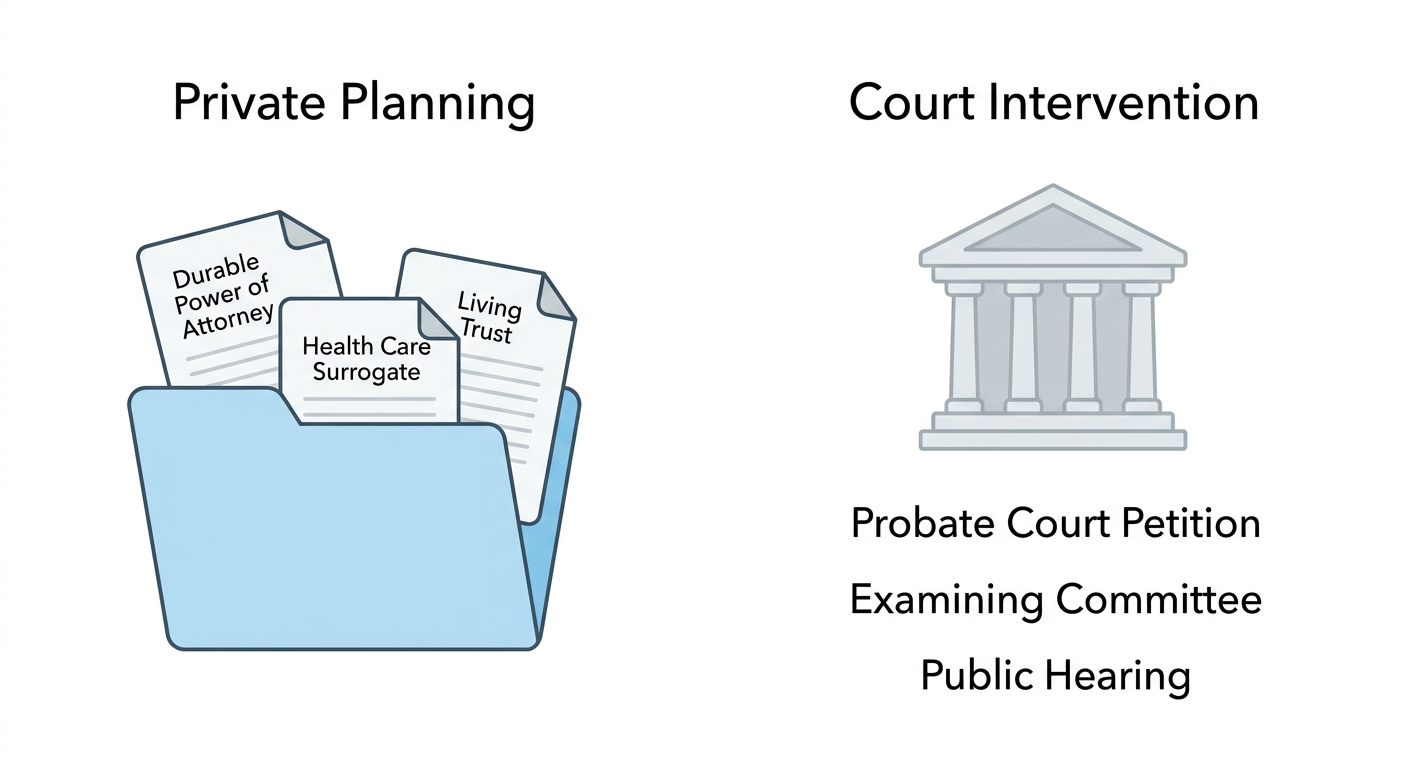
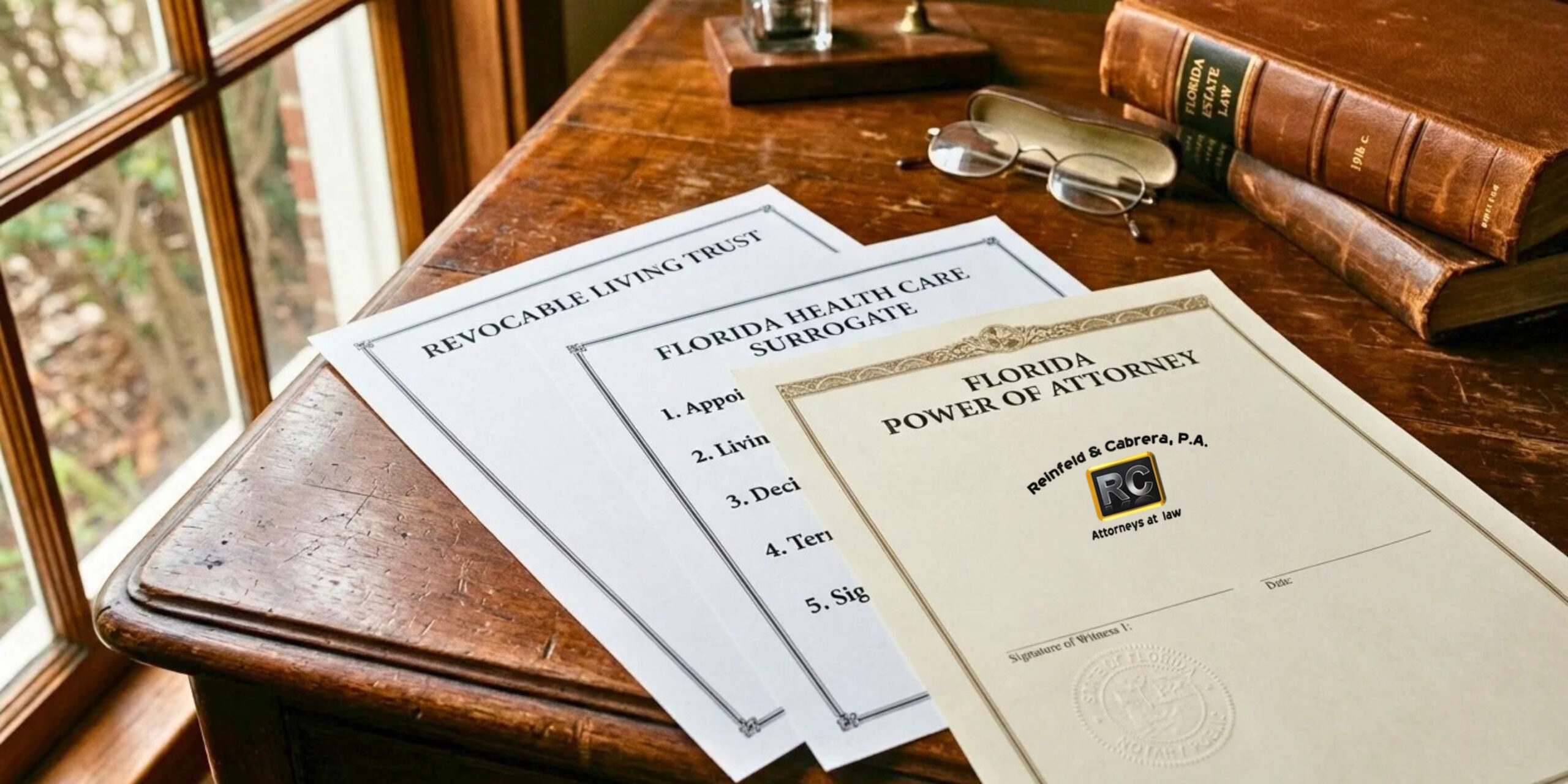
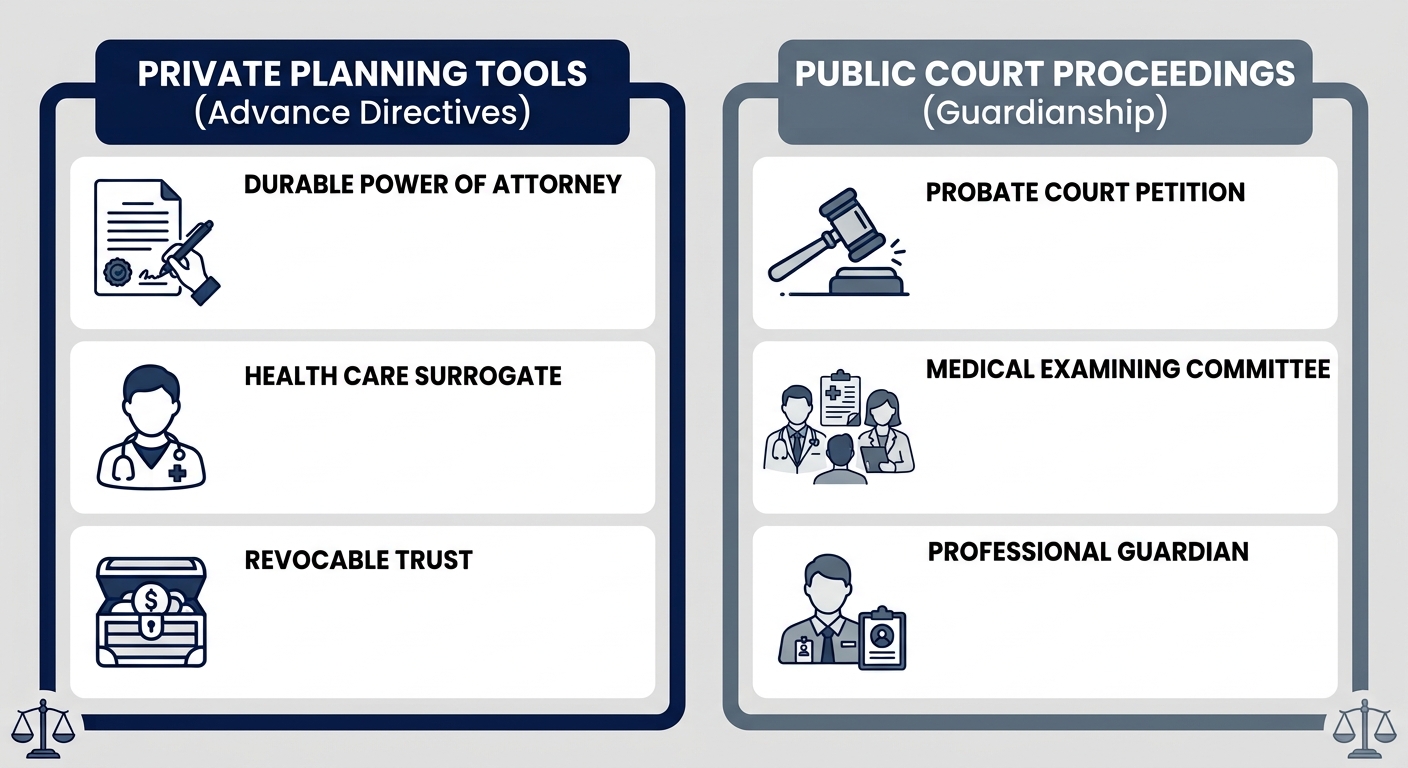
In Florida, adult guardianship is avoided by executing three proactive, legally binding instruments while mentally competent: a Durable Power of Attorney (Fla. Stat. § 709.2104), a Designation of Health Care Surrogate (Fla. Stat. § 765.202), and a Revocable Living Trust. Together, these documents grant immediate, private decision-making authority to chosen surrogates, preventing the 17th Judicial Circuit Court of Broward County from declaring incompetence or appointing a court-monitored professional guardian under Fla. Stat. Chapter 744.
Why a Florida Last Will and Testament Fails During a Lifetime Health Crisis
The most pervasive misconception among Florida property owners is the belief that a well-crafted Will protects their business, real estate, and financial accounts if they suffer a debilitating stroke, traumatic brain injury, or severe cognitive decline.
A Will is legally dormant until death. It grants zero authority during your lifetime.
If you lose legal capacity without specific lifetime governance documents, your family cannot simply present your Will to Bank of America, Chase, or a Broward County title company. Instead, your loved ones are forced into a rigid, public, and adversarial legal process known as Involuntary Adult Guardianship.
Path A: Proactive Planning (Private)
Path B: Court Intervention (Guardianship)
1. Key Legal Instruments:
Durable Power of Attorney
Health Care Surrogate
Revocable Living Trust
1. Emergency Court Petition:
Filed in the Broward County Circuit Court by family, health care providers, or interested third parties.
2. Immediate Authority:
Your designated agent or trustee steps in immediately without court permission.
2. 3-Member Examining Committee:
Court appoints a physician, medical expert, and layperson to evaluate your mental competency.
3. Privacy & Autonomy:
Financial affairs and health decisions remain strictly private within the family.
3. Public Incompetency Hearing:
Formal court hearing stripping fundamental constitutional rights and declaring legal incapacity.
Final Outcome: Seamless Family Management
Zero court fees, no public record, immediate operational continuity.
Final Outcome: Court Guardian Control
Appointed professional guardian, mandatory annual audits, assets drained by legal fees.
The Financial and Personal Realities of Florida Guardianship Proceedings
When a court petition is filed under Florida Statute Chapter 744, you become the “Alleged Incapacitated Person” (AIP). The judicial process moves quickly, privately stripping personal freedoms through public records:
1. Mandatory 3-Member Examining Committee
Under Fla. Stat. § 744.331, the court appoints an examining committee consisting of three professionals (at least one must be a medical doctor or psychiatrist). These individuals visit your home or hospital room, conduct cognitive testing, and submit written assessments directly to the Broward County judge.
2. Immediate Loss of Fundamental Civil Rights
If the court finds you incapacitated, you do not just lose access to your checking account. You lose the legal right to:
Contract, sign deeds, or manage business interests
Choose where you live or consent to medical treatment
Vote, hold a driver’s license, or marry
Retain personal legal counsel of your choice
3. The Financial Strain of Professional Guardianship
A court-appointed guardian is entitled to reasonable compensation paid directly out of your assets. Every financial move—selling a home in Coral Springs, liquidating stock, or paying for specialized memory care—requires formal court petitions, attorney appearances, and annual financial audits overseen by the clerk of court.
Real World Precedent: How Lack of Planning Triggers Systemic Vulnerability
To understand why Florida courts step in so forcefully, one needs to look no further than the notorious state guardianship cases that led to major legislative reforms across South Florida.
Consider the real life case of Jan Garwood, a Central Florida resident who suffered a sudden medical crisis without a complete, active incapacity plan in place.
┌────────────────────────────────────────────────────────┐
│               THE REALITY OF COURT CONTROL             │
├───────────────────────────┬────────────────────────────┤
│    WITHOUT A DPOA / TRUST │  WITH PROACTIVE R&C PLAN   │
├───────────────────────────┼────────────────────────────┤
│ Forced court petition     │ Private family transition  │
│ 3-person medical panel    │ Designated agent steps in  │
│ Court-appointed guardian  │ Zero court costs or fees   │
│ House sold without consent│ Assets fully protected     │
└───────────────────────────┴────────────────────────────┘
After an emergency hospital admission under the Baker Act, the hospital petitioned the court to appoint a professional guardian. Because Garwood lacked a updated Durable Power of Attorney and Revocable Living Trust specifically naming trusted family members to handle her affairs:
The Court Intervened Immediately: A judge declared her incompetent based on brief examining committee reports, bypassing her family.
Loss of Property: The court appointed professional guardian gained complete control over her finances, eventually selling her home to cover facility care costs.
Loss of Autonomy: Garwood spent three years in a locked assisted living facility before independent attorneys managed to restore her rights, by which time her personal assets had been liquidated.
Cases like Garwood’s—and the widespread Florida state investigations into court appointed guardians that followed—highlight a critical legal reality: If you do not choose your own decision makers through private estate planning documents, a Florida probate court will choose one for you.
The Incapacity Avoidance Triad: 3 Key Documents
To lock out judicial interference, an incapacity strategy must unite three precise legal instruments under Florida law:
1. Florida Financial Durable Power of Attorney (DPOA)
Governed by Fla. Stat. § 709.2104, a Florida DPOA must contain specific “superpowers” (explicit initialed clauses under Fla. Stat. § 709.2114) granting your named agent the legal right to manage real estate, conduct banking, handle tax returns, and qualify for governmental benefits without court approval.
2. Florida Designation of Health Care Surrogate
UnderFla. Stat. § 765.202, this instrument allows your named surrogate to consult with doctors, review HIPAA-protected medical records, authorise surgeries, and make end-of-life decisions if you become unable to provide informed consent.
3. Revocable Living Trust
Holding property, financial accounts, and business equity inside a revocable trust creates an unbroken chain of authority. If you face incapacity, your named Successor Trustee steps in seamlessly to manage trust assets according to your written directives, eliminating the need for court supervision.
Frequently Asked Questions
Can my spouse automatically handle my finances if I become incapacitated?
No. Spousal status alone does not grant legal authority to sign deeds, alter bank accounts, or manage individually held assets in Florida. Without a valid Durable Power of Attorney or Trust, a spouse must petition the court for guardianship just like any third party.
What is the difference between a Power of Attorney and a Guardian?
A Power of Attorney agent is chosen privately by you while you are mentally sound. A Guardian is appointed by a judge after a court determination of incompetence.
Does a Durable Power of Attorney expire upon incapacity in Florida?
No. Unlike a standard power of attorney, a Durable Power of Attorney explicitly remains effective during temporary or permanent mental incapacity under Fla. Stat. § 709.2104.
Protect Your Independence with a Coral Springs Estate Planning Attorney
Maintaining total control over your health choices, personal dignity, and financial assets requires clear legal planning before a sudden health crisis occurs.
The estate planning attorneys at Reinfeld & Cabrera, P.A. help individuals and families across Coral Springs, Fort Lauderdale, and Broward County construct airtight incapacity plans that bypass court intervention entirely.
A Lady Bird Deed in Florida is an enhanced life estate deed that allows a property owner to name someone who will receive the property after the owner’s death while retaining broad control over the property during life.
Unlike a traditional life estate, a properly drafted Lady Bird Deed can allow the owner to sell, mortgage, or otherwise convey the property without the future beneficiary’s permission. It can also allow the property to pass outside the ordinary probate process.
Because Florida does not have a statutory form called a “Lady Bird Deed,” the language used in the deed is especially important.
How Does It Work?
The property owner transfers the property through a deed that reserves an enhanced life estate and identifies one or more people who are intended to receive the property after the owner’s death.
During the owner’s lifetime, the owner generally retains the right to:
Live in and use the property
Sell the property
Mortgage the property
Convey the property to someone else
Change or defeat the beneficiary’s future interest, depending on the deed’s language
If the owner dies while the deed remains effective, the property can pass to the designated beneficiary without becoming part of the owner’s probate estate.
The exact result depends on the language of the deed and the circumstances surrounding the property.
Lady Bird Deed vs. a Regular Life Estate
The most important difference is the amount of control retained by the original owner.
With a traditional life estate, the owner keeps the right to possess and use the property for life but gives another person a present remainder interest. Selling or mortgaging the entire property can therefore require the remainderman’s participation.
An enhanced life estate, by contrast, can reserve the owner’s power to sell, mortgage, or convey the property without the beneficiary joining the transaction.
Florida courts have recognized this distinction. In Hirschenson v. Compu-Link Corp. of MI, the Third District Court of Appeal discussed an enhanced life estate as allowing the holder to sell, convey, mortgage, and otherwise manage the property without the remainderman’s joinder.
Does It Avoid Probate?
One reason Florida property owners consider this type of deed is probate avoidance.
If the deed is properly executed and remains effective when the owner dies, the designated beneficiary can receive the property without the real estate passing through the owner’s ordinary probate estate.
That does not mean every Lady Bird Deed will accomplish the same result. The deed must be legally effective, the property’s ownership must be correctly identified, and other Florida property laws may affect the transfer.
Why the Deed’s Language Matters
The enhanced powers need to be clearly established in the deed.
A Florida appellate case illustrates what can happen when the language is unclear. In Hirschenson, the deed contained inconsistent language concerning the power to mortgage the property. The resulting dispute required the court to determine what the deed actually meant, and the trial court ultimately reformed the deed. The appellate court affirmed that decision.
This is why a Lady Bird Deed should not simply be copied from an unidentified online form.
Can You Sell or Mortgage the Property?
A properly drafted enhanced life estate deed can preserve the owner’s ability to sell or mortgage the property without obtaining the future beneficiary’s consent.
That retained control is one of the defining characteristics of the arrangement.
However, the specific deed should be reviewed before a sale or mortgage. The deed’s wording, the property’s current title, and the requirements of the lender or title company can all matter.
What If the Beneficiary Dies First?
This depends on how the deed was drafted.
If the named beneficiary dies before the property owner, the deed should be reviewed to determine what happens to that person’s future interest. The owner may want to name alternate beneficiaries or include other provisions addressing this possibility.
This is one reason the beneficiary provisions should be considered carefully when the deed is prepared.
What If the Property Is Florida Homestead?
Homestead property requires additional care.
Florida law places special restrictions on the disposition of homestead, particularly when the owner has a spouse or minor children. Sections 732.4015 and 732.4017 of the Florida Statutes address important rules concerning homestead and lifetime transfers.
A Lady Bird Deed involving a Florida homestead therefore should not be evaluated solely on whether it can avoid probate. The owner’s family situation, title, and homestead status should all be considered before the deed is prepared.
Who Actually Owns the Property?
Before preparing the deed, it is important to determine how the property is currently titled.
For example, the property may be owned individually, jointly, through a trust, or subject to an existing interest.
In Johnson v. Johnson, Florida’s First District Court of Appeal considered enhanced life estate deeds that had been prepared in an individual’s name even though the properties were actually held by a living trust. The court affirmed reformation of the deeds based on the evidence concerning the mistake.
The practical lesson is simple: the current deed and ownership records should be checked before preparing a new conveyance.
When Might a Lady Bird Deed Be Useful?
A Florida property owner may consider an enhanced life estate deed when the goal is to:
Retain control of the property during life
Continue living in the property
Designate who should receive it after death
Preserve the ability to sell or mortgage the property
Potentially transfer the property outside probate
It may not be appropriate for every estate plan. More complicated family circumstances, multiple properties, trusts, creditor issues, or other planning concerns may call for a different approach.
It is an enhanced life estate deed that allows a property owner to retain substantial control over real estate while designating who should receive the property after the owner’s death.
Does a Lady Bird Deed avoid probate?
A properly drafted and effective deed can allow the property to pass to the designated beneficiary outside the ordinary probate process.
Is a Lady Bird Deed the same as a life estate?
No. A Lady Bird Deed is an enhanced form of life estate that can reserve significantly greater powers for the original owner.
Can I sell my house after signing a Lady Bird Deed?
Generally, an enhanced life estate can preserve the owner’s power to sell or convey the property without the beneficiary’s consent. The specific deed should be reviewed to confirm the powers it reserves.
Can I mortgage property with a Lady Bird Deed?
A properly drafted deed can reserve the owner’s power to mortgage the property. The exact language matters.
What happens when the owner dies?
If the deed remains effective and the property has not otherwise been conveyed, the designated beneficiary can receive the property according to the deed’s terms, potentially without probate.
Does a Lady Bird Deed work for Florida homestead?
It can, but Florida’s homestead rules create additional considerations involving spouses, minor children, and the owner’s particular circumstances.
Florida Estate Planning Attorneys Serving South Florida
A Lady Bird Deed can be a useful way to plan for the future of Florida real estate while retaining control during life. But the deed needs to match the property’s title and the owner’s circumstances.
Florida does not require every homebuyer to hire an attorney, but legal review can be valuable before signing a purchase contract. A real estate attorney can identify contractual, title, ownership, and closing issues that may affect your rights as a buyer.
For a home purchase in Coral Springs or elsewhere in Broward County, the legal review may involve:
Title: Examining the ownership history and identifying liens, judgments, probate issues, defective deeds, easements, or other recorded interests.
Deed and ownership: Determining how the property will be titled and whether the proposed ownership structure fits the buyer’s circumstances.
Closing: Reviewing documents and addressing unresolved legal issues before ownership transfers.
Florida homestead: Evaluating homestead considerations when the property will be the buyer’s primary residence.
Estate planning: Considering how the new property fits into the buyer’s will, trust, and broader estate plan.
Probate: Identifying potential probate issues when the property was inherited or when its future transfer may involve an estate.
The timing of the legal review matters. A lawyer who examines the transaction before the purchase contract is signed may be able to identify provisions that become difficult to change later. Title and ownership issues should also be addressed before closing, when resolving them can become more complicated.
For buyers in Coral Springs and Broward County, these questions arise under Florida real estate law, but the appropriate legal strategy depends on the specific property, contract, ownership structure, and family circumstances.
When should you hire a real estate attorney?
Many buyers think about hiring a lawyer when they reach the closing table. By that point, the most important contractual decisions may already have been made.
The purchase contract establishes the legal framework for the transaction. It can determine the buyer’s rights concerning financing, inspections, repairs, deposits, title, closing dates, and termination.
The Florida Bar recommends consulting an experienced Florida real estate lawyer before signing a purchase contract. Its consumer guidance explains that important provisions can become difficult to change once the agreement has been signed.
That timing matters whether you are buying a home in Coral Springs, Fort Lauderdale, Parkland, Coconut Creek, or another Broward County community.
Suppose an inspection later reveals substantial roof damage. The buyer may want the seller to make repairs or provide a credit. Whether the buyer can demand either remedy depends on the contract and the circumstances surrounding the transaction.
The same principle applies to financing problems, delays, title defects, and disputes about property condition.
A lawyer who reviews the agreement before signature can explain what the buyer has agreed to and identify provisions that deserve attention.
What does a real estate attorney do for a homebuyer?
The work depends on the transaction.
A real estate attorney may review the purchase agreement, examine title records, review the deed, address liens and judgments, examine closing documents, advise on ownership, and represent the buyer if a dispute develops.
Some transactions require little legal intervention after the contract and title are reviewed. Others become complicated because of the property’s history.
A house in Broward County may have changed hands several times. A previous owner may have died. A divorce may have affected ownership. An old mortgage may remain in the public record. A judgment may have attached to an owner’s interest. A deed may contain an error.
The current seller may have no knowledge of any of these issues.
That does not necessarily prevent the sale. It does mean that the issue should be identified and resolved before the buyer accepts the property.
For a buyer purchasing a home in Coral Springs, the property’s recorded history deserves the same attention as its current condition.
Why title matters when buying a house
A real estate listing tells you who is selling the property. It does not establish the entire legal history of the property.
A title examination looks at recorded documents affecting ownership. Depending on the property, those records may include deeds, mortgages, liens, judgments, probate documents, and other instruments.
Florida law governs the recording of interests in real property. Florida Statutes Section 695.01 addresses the recording of conveyances, mortgages, and other interests in land and explains when recorded instruments have priority against certain creditors and subsequent purchasers.
For a buyer, the practical issue is whether the seller can deliver the ownership interest required by the purchase contract.
Consider a property that has passed through several generations.
The owner listed on the tax record may have inherited the house from a parent. That parent may have inherited it from someone else. At some point, an estate may have been administered incorrectly or a deed may have failed to include someone whose interest mattered.
The problem can remain hidden until the property is sold.
A title examination can reveal that history.
This is particularly relevant in established Broward County neighborhoods, where some properties have changed ownership several times over many years.
What happens when the seller inherited the house?
Inherited property can create title questions that do not appear in an ordinary residential sale.
If the seller acquired the property through an estate, the circumstances surrounding that transfer may need to be examined. The buyer may need documentation showing how ownership passed from the deceased person to the current seller.
Probate can therefore become part of a real estate transaction.
This is one reason real estate law and probate law sometimes meet in the same file.
A buyer does not need to become an expert in probate procedure. The important question is whether the person selling the property has the legal authority to transfer the interest the buyer expects to receive.
If that authority is unclear, the transaction may need additional documentation or court action before closing.
A buyer should not assume that an inherited property has a clean title simply because the seller has lived there for years.
The deed deserves careful attention
The deed is the document that transfers the seller’s interest in the property.
Buyers sometimes give it little attention because the purchase agreement and mortgage receive most of the discussion. The deed deserves its own review.
The buyer should understand what interest is being conveyed and who will receive it.
That second question is particularly important.
A person buying a house alone may have a straightforward ownership arrangement. A married couple may have different estate planning concerns. Two unmarried people purchasing together may need to consider what happens if one owner dies or wants to sell.
Parents sometimes purchase property with adult children. Some buyers consider a trust or another ownership arrangement.
Each situation raises different legal questions.
The answer should be based on the buyer’s circumstances rather than a generic preference about how property should be titled.
How you take title can affect your estate
Buying a house creates an asset that may eventually become part of your estate.
The way that asset is owned can affect what happens after death.
Certain forms of ownership can affect whether an interest passes through probate. Other ownership arrangements may require the property to be addressed through the owner’s estate.
This is why the deed and the estate plan should be considered together.
A person might have a carefully prepared will but never review whether the way the person’s property is titled supports the intended estate plan.
That can create problems later.
The purchase of a home is therefore a useful point to review the larger ownership picture.
For a Coral Springs homeowner purchasing a primary residence, that conversation may also involve Florida homestead law.
Florida’s homestead laws deserve special attention when the property will be the buyer’s primary residence.
Florida provides significant legal protections for qualifying homestead property. The state also has specific rules concerning what happens to homestead property after the owner’s death.
Florida Statutes Section 732.401 addresses the descent of homestead property when an owner dies. Section 732.4015 places restrictions on the owner’s ability to devise homestead property when certain family members survive the owner.
These rules can affect surviving spouses and children.
For example, when a Florida homeowner dies while survived by a spouse and descendants, the disposition of the homestead may be governed by statutory rules rather than by whatever result the owner assumed a will would produce.
The details depend on the family and ownership circumstances.
That is why homeowners in Coral Springs and Broward County should not assume that a will alone determines what happens to their Florida homestead.
Can a will control who receives your house?
Sometimes. Florida law can limit what a homeowner may accomplish through a will when the property qualifies as homestead.
The owner’s family situation matters.
The ownership structure matters.
The type of property matters.
The timing of transfers can matter as well.
Florida Statutes Section 732.4015 contains specific restrictions concerning the devise of homestead when a spouse or minor child survives the owner. Section 732.401 also establishes rules concerning descent when a Florida resident dies without a valid disposition controlling the property.
This is one reason estate planning should be based on the actual assets a person owns.
A will should not be viewed in isolation from deeds, trusts, beneficiary arrangements, and Florida’s property laws.
Should you put your house in a trust?
A trust can be useful in some estate plans. It is not the right ownership arrangement for every homeowner.
The decision depends on what the owner wants the estate plan to accomplish.
A revocable living trust, for example, may be considered as part of an incapacity and estate administration plan. Other trusts can serve different purposes.
The important question is whether a particular trust arrangement fits the person’s property, family circumstances, and estate planning objectives.
Florida also has specific rules concerning transfers of homestead property into trusts and other lifetime transfers. Florida Statutes Section 732.4017 addresses certain transfers of homestead property and explains circumstances affecting the way the property is treated under the homestead rules.
That makes professional review useful before changing the title to a Florida home.
A homeowner should understand the consequences of the transfer before signing a new deed.
What if the inspection reveals serious damage?
A home inspection and a legal review serve different purposes.
An inspector examines the physical condition of the house. An attorney examines the legal rights and obligations created by the transaction.
Suppose an inspection reveals structural damage.
The buyer may want the seller to make repairs. A buyer may prefer a price reduction. The buyer may want a credit at closing. The buyer may decide that the property is no longer worth purchasing.
The purchase agreement determines which options are available.
An inspection report does not automatically give the buyer a right to cancel the transaction.
The contract may contain deadlines governing inspection objections. It may establish particular procedures for repairs or termination. Missing those deadlines can affect the buyer’s rights.
A lawyer can explain the relevant provisions before the buyer takes action.
What happens when a title search reveals a lien?
A lien does not always mean the buyer has to abandon the transaction.
The first step is understanding what the lien is and whose obligation created it.
A mortgage may need to be satisfied at closing. A judgment may require resolution. A construction lien may involve a contractor or subcontractor. An estate matter may require additional documentation.
The appropriate solution depends on the problem.
This is where title work becomes practical rather than abstract. The buyer needs to know whether the defect can be resolved before closing and whether the title company will insure the buyer’s intended ownership.
A buyer should also understand any exceptions listed in the title commitment.
Accepting an exception without understanding it can leave the buyer with a title issue that was visible before closing.
Is title insurance enough?
Title insurance provides protection against covered title risks under the terms of the policy.
It does not perform the same function as an attorney representing the buyer.
The Florida Bar explains that a title examination generally precedes issuance of a title insurance policy. A title commitment identifies requirements that must be satisfied before the policy can be issued and lists exceptions to coverage.
Those exceptions deserve attention.
A buyer should know what the policy covers and what it does not cover.
The buyer should also know who represents the buyer.
A closing attorney may be involved in the transaction without representing the buyer personally. The Florida Bar specifically advises consumers to determine who the closing attorney represents.
If you want independent legal advice, ask that question before closing.
When should a Broward County homebuyer consider legal representation?
Some circumstances call for particular caution.
Consider speaking with a Florida real estate attorney when:
The purchase contract contains provisions you do not understand.
The seller inherited the property.
The property has been involved in probate.
The title search identifies a lien or judgment.
A previous deed appears defective.
A divorce affected ownership.
You are buying with someone who is not your spouse.
You are considering buying the property through a trust or business entity.
The house will be a major part of your estate.
The inspection reveals serious defects.
The seller disputes a repair obligation.
The transaction involves seller financing.
The property has unusual easements or restrictions.
A dispute develops before closing.
You are unsure how the property should be titled.
These circumstances are not limited to any particular Broward County neighborhood. They can arise in a Coral Springs purchase just as they can in a transaction elsewhere in South Florida.
The common factor is uncertainty.
A buyer does not need to wait until a dispute reaches court before asking a lawyer to review the transaction.
What should you bring to the attorney?
The purchase contract is the obvious starting point.
If you have not signed it, bring the proposed agreement.
If you have already signed it, bring the complete version along with any amendments.
Other useful documents can include the title commitment, inspection report, seller disclosures, survey, mortgage documents, homeowners association documents, and written communications about repairs.
If the property was inherited, information about the estate can also be important.
If you are purchasing the property as part of an estate plan, bring the relevant estate planning documents.
The attorney also needs to know what you intend to do with the property.
Will it be your primary residence?
Will you own it alone?
Will someone else share ownership?
Do you expect to leave the property to your children?
Are you considering a trust?
Those answers can change the legal analysis.
What does this have to do with probate?
A house can become one of the largest assets handled by an estate.
When the owner dies, the legal treatment of that property depends on how it was owned and the circumstances surrounding the owner’s death.
Some properties pass through probate. Others may pass through a different legal mechanism. Homestead can create additional rules.
This is why the deed signed at the time of purchase can become relevant years later in an estate administration.
A buyer may be thinking about a mortgage and a move.
An estate planning attorney may also need to think about incapacity, death, family rights, and the eventual transfer of the property.
Both perspectives concern the same asset.
For families in Coral Springs and throughout Broward County, that connection can be particularly useful when a home is expected to remain in the family.
A house can create legal consequences long after closing
The closing date is only one point in the property’s legal history.
The deed remains part of the public record. The mortgage may remain for decades. The property may become subject to homestead protections. Ownership may change through marriage, divorce, death, or another transfer.
The house may eventually become part of a probate estate.
That is why a home purchase can be a useful time to review an estate plan.
If you live in Coral Springs or elsewhere in Broward County, the attorney reviewing your purchase should understand the Florida laws that govern the property and your ownership interest.
The goal is to understand the legal consequences before they become difficult to correct.
Questions to ask before signing a purchase contract
A buyer does not need a law degree to ask useful questions.
Start with these:
Who owns the property now?
The answer should be supported by the title records.
Can the seller deliver the title required by the contract?
A title examination can identify issues that need attention.
What happens if the inspection reveals a serious problem?
The answer should come from the purchase agreement and applicable law.
What happens if financing is delayed or denied?
The contract should establish the buyer’s rights in that situation.
Who will own the property after closing?
The deed should reflect the intended ownership arrangement.
What happens to the property if one owner dies?
That question can bring estate planning into the discussion.
Does the property qualify as homestead?
If it will be the buyer’s primary residence, Florida’s homestead laws deserve attention.
Does my estate plan account for this property?
If the house will be a significant asset, the answer should be clear.
The right legal question is often a little earlier
Homebuyers usually have plenty of practical questions.
How much will the mortgage cost?
When can we move in?
Did the inspection find anything serious?
Are the repairs finished?
Those questions matter.
There is another question worth asking before signing:
Do I understand the legal rights I am acquiring and the obligations I am accepting?
If the answer is uncertain, a Florida real estate attorney can review the transaction before the buyer becomes committed to terms that may be difficult to change.
For buyers in Coral Springs and throughout Broward County, that conversation can also include estate planning and probate considerations when the property is expected to remain a significant family asset.
A home purchase creates ownership.
The way that ownership is established can matter for years afterward.
Frequently Asked Questions
Do I need a real estate attorney to buy a house in Florida?
Florida does not require every residential buyer to hire a lawyer. The Florida Bar recommends that prospective buyers consult an experienced Florida licensed real estate attorney before signing a purchase contract. Legal advice can be particularly useful when the transaction involves title questions, unusual contract terms, probate, ownership concerns, or estate planning.
What does a real estate attorney check when buying a house?
A real estate attorney can review the purchase contract, examine title records, review the deed and closing documents, identify liens or other title problems, advise on ownership, and address disputes that arise before closing.
Should I hire an attorney before signing a purchase contract?
If you want legal advice about the agreement, reviewing it before signing gives the attorney an opportunity to identify provisions that could affect your rights. The Florida Bar specifically recommends consulting a Florida real estate lawyer before signing a purchase contract.
Can buying a house affect my estate plan?
Yes. The way a home is owned can affect what happens to the property during incapacity and after death. Florida also has special rules concerning homestead property.
Does a will determine who receives my Florida home?
A will may control some aspects of an estate, but Florida homestead law can restrict how a homestead property may be devised when a surviving spouse or minor child is involved. The ownership structure and family circumstances need to be considered.
Can a house become part of probate?
Yes. Real estate can become part of a probate estate when its owner dies, depending on the ownership structure and circumstances. Property that belonged to a deceased owner may therefore require probate administration before it can be transferred or sold.
Is a title search the same as a home inspection?
No. A home inspection examines the physical condition of the property. A title examination investigates ownership and recorded interests affecting the property.
Does title insurance replace a real estate attorney?
No. Title insurance protects against covered risks under the policy. An attorney can provide legal advice about the contract, title, ownership, closing documents, and other legal issues affecting the buyer.
Should I discuss estate planning when buying a house?
It can be useful when the property will be a significant asset or when the buyer has specific plans for its future ownership. The purchase may be a good opportunity to review the relationship between the new property, the deed, and the existing estate plan.
Can I put my Florida home into a trust?
A Florida homeowner may be able to transfer a home into a trust, but the consequences depend on the type of trust, the property, the owner’s circumstances, and Florida homestead law. Legal advice should be obtained before changing the title.
Talk with an attorney before signing
A home purchase can involve questions about contracts, title, ownership, homestead, probate, and estate planning.
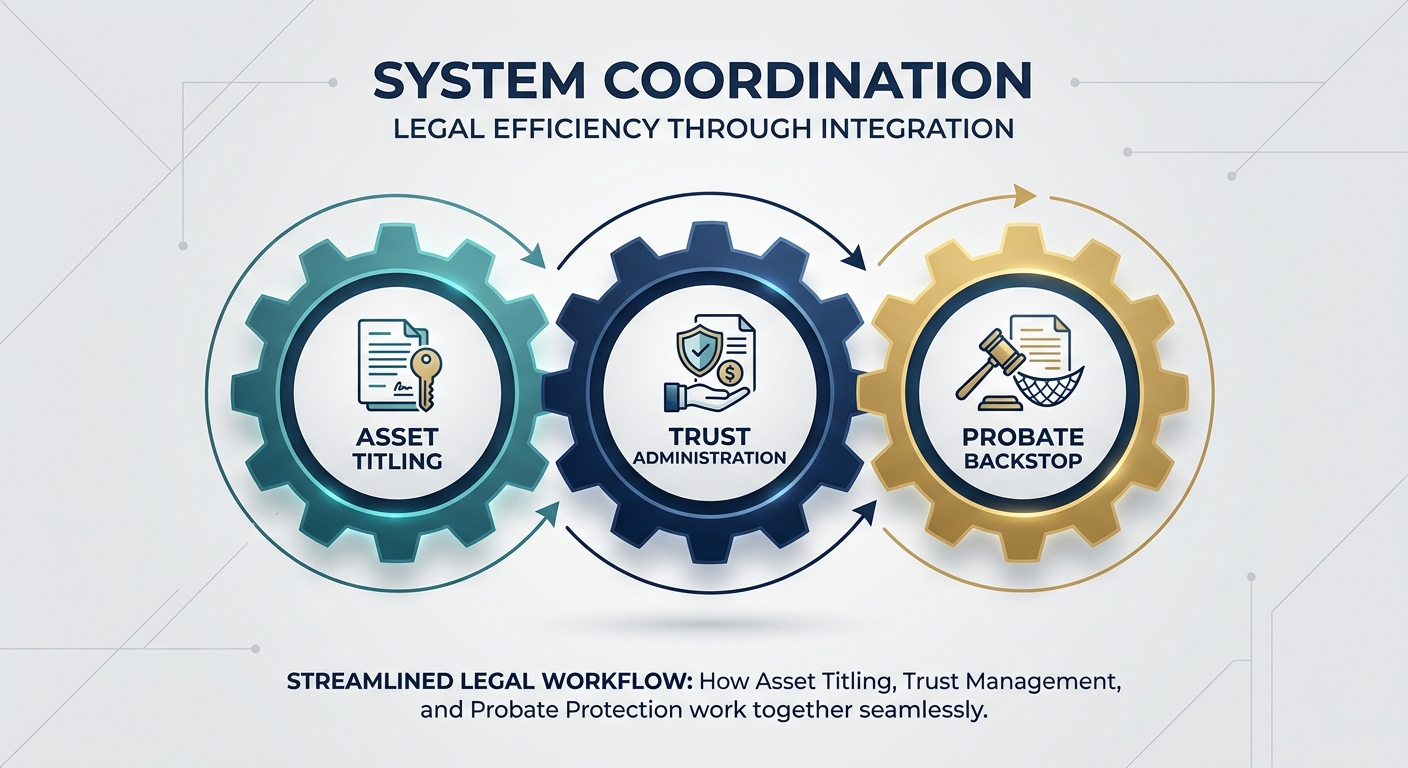
An estate plan under Florida law is not a single isolated document, but an interlocking system of distinct legal instruments.
To function effectively, it coordinates asset titling (how property is owned), contractual beneficiary designations (such as life insurance and retirement accounts that bypass probate), revocable living trusts (for private asset management), and a Last Will and Testament (which acts as an administrative backstop for stray assets and nominates guardians for minor children under the 17th Judicial Circuit probate framework).
Direct Transfer InstrumentsBeneficiary designations and trusts that bypass probate to route funds directly to intended recipients.
The Backstop AdministrationWills and probate courts acting as the administrative safety net for any leftover or stray assets.
A common misconception among clients entering an attorney’s office is that estate planning is merely a shopping exercise. People assume they need to choose between buying a will or setting up a trust. As if these documents were competing consumer products on a shelf.
In practice, a durable estate plan functions less like a single document and more like an interlocking machine. Each piece: whether it is a deed, a beneficiary designation, a trust agreement, or a last will and testament – answers a different legal question about your property, your care, and your family’s future security under Florida law.
Asset Ownership Sets the Foundation
Every legal instrument relies entirely on the underlying registration of your property.
The name on a title holds more legal authority over where property goes than almost any standard clause you can write down. Consider how differently law treats various holdings. A commercial storefront in Coral Springs tied to a corporate entity, a family home structured with survivorship rights, or an ordinary checking account carrying no payable on death instructions. Each follows its own strict statutory track.
Property registration and testamentary instruments point in opposite directions. The title or contractual beneficiary designation almost always supersedes your written documents. For instance, naming a child in a will has no legal effect on a bank account where a different individual is listed as the sole payable on death recipient. A thorough planning process evaluates these existing ownership titles first. Therefore ensuring that deeds, corporate shares, and financial accounts are adjusted or harmonized before any wills or trusts are finalized.
Different Assets Can Follow Different Paths
When an individual passes away, their property does not automatically flow down one universal river. Different asset classes utilize entirely distinct legal conduits:
Contractual Transfers: Life insurance policies, retirement accounts, and payable on death bank accounts bypass both wills and trusts entirely. Thus transferring directly to named beneficiaries by operation of contract law.
Trust Administration: Assets properly titled in the name of a revocable living trust flow privately through trustee administration without judicial interference.
Probate Administration: Assets left solely in an individual name with no beneficiary designation must be processed through the probate court system.
Understanding that these pathways operate simultaneously is the key to grasping how an estate plan actually functions.
The Operational Reality of Financial Accounts and Institutional Payables
A common blind spot in estate planning is assuming that legal documents command absolute authority over every dollar an individual owns. In practice, financial institutions, such as major banks operating in Coral Springs and regional credit unions, don’t act like this. They do not look to your will or trust first when an account holder passes away.
Instead, financial operations are strictly governed by internal institutional protocols and direct account contracts. When a bank representative reviews an account after a death certificate is presented, they execute whatever binding agreement is physically attached to that specific account file. If a bank ledger lists an individual payable on death designation, or if a brokerage account registers a transfer on death instruction, institutional compliance departments are legally bound to disburse those funds directly to the named individual, bypassing any instructions found in a trust agreement or a court supervised will.
An integrated estate plan accounts for this operational friction by auditing every institutional account agreement during the drafting phase. Therefore ensuring that corporate paperwork matches your overarching legal strategy before a financial institution ever faces a disbursement decision.
Where the Will Fits Into the Plan
Rather than acting as the absolute ruler of your entire estate, a Last Will and Testament serves a specific structural purpose within the broader system.
Within an integrated plan, a will functions primarily as a legal backstop. It catches stray assets that were never retitled into a trust. Names guardians for minor children. It also nominates the personal representative to manage the probate administration process if court intervention becomes necessary.
Where a Trust Fits Into the Plan
A revocable living trust operates as an alternative operating system for asset management and distribution.
When properly funded during your lifetime, the trust holds legal title to your major property holdings. Instead of directing asset distribution through public probate filings, the trust instrument coordinates private management rules. It establishes exact conditions for beneficiaries, and governs how assets are handled if you experience temporary or permanent incapacity.
If certain assets remain outside your trust or lack beneficiary designations, the probate court becomes the mandatory administrative mechanism required to clear title and transfer ownership. The goal of comprehensive planning is not always to eliminate every possibility of court involvement, but to ensure that probate handles only what is necessary while private mechanisms handle the bulk of your wealth.
What Happens When the Pieces Do Not Match?
The most critical test of an estate plan occurs when its individual instruments conflict with one another.
Consider a scenario where an individual executes a trust directing that their financial account be divided equally among three children, but the underlying bank account form lists only one child as a payable on death beneficiary. Under Florida law, the contractual beneficiary designation on the account typically overrides the instructions in the trust or will.
When beneficiary designations, trust agreements, and asset titles point in opposing directions, family disputes and unintended disinheritances frequently follow. Coordination prevents these friction points.
Through durable powers of attorney and healthcare surrogate designations, your plan designates trusted individuals to manage financial transactions, sign documents, and make medical decisions if you are unable to speak for yourself. These instruments integrate seamlessly with your property management framework, ensuring continuity whether you are navigating daily life or managing a medical crisis in Broward County.
Frequently Asked Questions
Does having a revocable living trust mean my estate will completely avoid probate in Florida?
Not automatically. A trust only avoids probate for assets that were properly titled in the name of the trust during your lifetime. Any remaining individually owned assets left outside the trust at the time of death will still require a probate administration unless alternative transfer mechanisms apply.
Can a beneficiary designation override the instructions written in my last will and testament?
Yes. Contractual arrangements such as life insurance policies, retirement accounts, and payable on death bank accounts operate independently of a will. The financial institution distributes funds directly to the named beneficiary on file, regardless of what your will states.
Why is asset titling just as important as drafting a will or trust?
Asset titling dictates the legal pathway property travels upon death or incapacity. If your legal documents specify one distribution plan but your deeds or account titles are registered under a conflicting ownership structure, the ownership title or beneficiary form frequently overrides your written documents.
How does local court jurisdiction in Broward County affect the administration of an estate plan?
When an estate plan requires judicial oversight, such as formal or summary administration through the 17th Judicial Circuit Court in Broward County, local procedural rules govern how property titles are cleared and distributed.
An integrated estate plan accounts for these local court requirements ahead of time, minimizing administrative delays for real estate located in Coral Springs, Parkland, or Fort Lauderdale by ensuring property deeds and trust funding are properly structured before probate ever becomes necessary.
What happens if instructions in a revocable living trust contradict a financial account beneficiary form?
If a revocable living trust states that all liquid accounts should be divided equally among beneficiaries, but an individual retirement account or bank account lists a single person as a payable on death recipient, the financial institution is legally bound to honor the beneficiary form.
A comprehensive estate audit resolves these discrepancies proactively to prevent unintended disinheritances.
Coordinate Your Estate Plan in Broward County
The goal of estate planning is not to accumulate the largest stack of legal documents. It is to ensure that your ownership titles, beneficiary forms, trusts, and wills work together as a unified system to protect your family and assets.
When a married couple creates an estate plan, most of the attention naturally goes toward what happens after both spouses have died. But there is another moment that can be just as important: the death of the first spouse.
That event can change ownership of assets, activate provisions in a trust, affect beneficiary designations, create tax filing opportunities, and alter the plan the surviving spouse will eventually leave behind.
For families in Coral Springs and throughout Broward County, this is one reason an estate plan should be reviewed after a spouse dies. The documents may still be valid, but the circumstances they were designed to address have changed.
And that can make a surprisingly big difference under Florida law.
The First Death Is a Turning Point, Not the End of the Plan
An estate plan for a married couple is usually built around two different deaths.
The first death determines what happens to the deceased spouse’s property and what the surviving spouse receives or controls. The second death determines what ultimately passes to children, other beneficiaries, charities, or other intended recipients.
Those two events are connected.
For example, a couple may have arranged their assets so that the surviving spouse has financial security while certain property remains subject to a particular trust structure. Another couple may have arranged for most assets to pass directly to the surviving spouse.
Both plans can be legally sound. But they can produce very different results later.
The important question after the first death is therefore not simply, “Who inherited?”
It is:
“What did the first death activate, and what does the surviving spouse’s estate now look like?”
What Happens to the Assets After the First Spouse Dies?
The answer depends on how each asset was owned and how the estate plan directed it.
Some property may pass under a will. Some may pass according to a trust. Other assets may pass through beneficiary designations or forms of joint ownership.
This is why looking only at the will is rarely enough.
The surviving spouse and the estate’s attorney may need to review:
Real estate ownership
Bank and investment accounts
Retirement accounts
Life insurance
Business interests
Jointly owned property
Beneficiary designations
Trust assets
Debts and obligations
Prior gifts
Property that may be included in the deceased spouse’s taxable estate
The practical problem is that these pieces do not necessarily follow the same path.
A beneficiary designation can control an account without sending it through the will. A jointly owned asset can operate differently from separately owned property. A trust can contain instructions that become relevant immediately after death.
This is one reason the death of a spouse should trigger a full review of the estate plan in South Florida, rather than simply checking off the probate process and moving on.
The Estate Tax Question Begins With the First Death
Estate tax planning can become especially important when a married couple has substantial assets.
For deaths occurring in 2026, the federal basic exclusion amount is $15 million. (It is worth noting that Florida does not currently levy a state level estate tax). An estate generally must file Form 706 when the applicable federal filing threshold is exceeded. But there is another important reason to file: the executor can use Form 706 to elect portability of the deceased spouse’s unused exclusion for the surviving spouse.
That second point is easy to overlook.
Suppose one spouse dies with an estate substantially below the federal exclusion amount. It might appear that there is no reason to think about an estate tax return because no federal estate tax is due.
That conclusion can be premature.
A properly filed estate tax return can allow the surviving spouse to receive the deceased spouse’s deceased spousal unused exclusion amount, commonly called DSUE. The surviving spouse may then be able to use that amount against certain later taxable transfers during life or at death.
In other words, “No estate tax is due” and “there is nothing worth filing” are not necessarily the same thing.
What Is Portability?
Portability allows a deceased spouse’s unused federal estate tax exclusion to be transferred to the surviving spouse.
The surviving spouse does not receive the unused exclusion automatically. The deceased spouse’s estate must make the portability election through a properly prepared Form 706.
That deadline is one of the reasons the issue deserves attention soon after the first spouse dies.
The family may be dealing with grief, probate, property transfers, insurance claims, financial accounts, and a long list of practical problems. The tax filing may feel like something that can wait.
Sometimes it cannot.
Why the Surviving Spouse’s Future Estate Matters
Imagine a married couple with substantial assets.
The first spouse dies. Most of the property passes to the surviving spouse, who continues living in the family home, maintains the investment portfolio, and eventually receives additional assets.
Years later, the surviving spouse dies.
At that point, the estate is measured again.
The surviving spouse’s estate may look very different from the estate that existed at the first death. Investments may have appreciated. Real estate may have increased substantially in value. Retirement accounts may have changed. The surviving spouse may have received additional property or made significant gifts.
That means the planning opportunity at the first death can have consequences years later.
“The surviving spouse should not assume that the estate plan is finished simply because the first estate was administered. The first death can change the legal and financial circumstances that the original plan was built around.”
That review does not necessarily mean rewriting everything.
It means determining whether the structure still accomplishes what the couple originally intended.
Does a Trust Automatically Save Estate Taxes?
No.
This is an important distinction because older estate planning materials sometimes make trusts sound like tax saving machines.
A revocable living trust can be an important part of an estate plan, but simply placing assets in a revocable trust does not automatically eliminate federal estate tax.
The tax consequences depend on the actual structure, ownership, applicable exclusions, elections, deductions, beneficiary arrangements, and the circumstances surrounding the transfer.
The more useful question is therefore:
How does the trust operate after the first spouse dies, and what does that structure accomplish?
In some estate plans, trust provisions may help determine who controls property, who benefits from it, and how it is treated after the first death. In others, assets may pass directly to the surviving spouse.
The answer depends on the plan.
That is why copying a trust structure from another family is a particularly bad form of estate planning.
When the First Death Changes the Tax Strategy
A married couple may have several potential ways to structure property at the first death.
One approach may leave property directly to the surviving spouse. The federal marital deduction can generally allow qualifying property passing to a surviving U.S. citizen spouse to be deducted from the deceased spouse’s gross estate.
That can defer estate tax rather than necessarily eliminate it.
Other arrangements can involve trusts or other structures designed to address control, beneficiary protection, tax planning, or a combination of these concerns.
The appropriate structure depends on the family’s circumstances.
For example, a couple with a relatively straightforward estate may have different concerns from a couple who owns several properties, a closely held business, significant investments, or substantial assets expected to appreciate.
Alan Reinfeld explains the practical point this way:
“The first spouse’s death is often the moment when the surviving spouse’s estate plan needs to be reconsidered. The plan was created for two people. After one dies, it is a plan for one.”
That is especially important when the family’s wealth is likely to change substantially over time.
Case Study: When “Everything Went to My Spouse” Was Not the Whole Story
Consider a hypothetical couple living in Coral Springs, Michael and Laura.
They own their home, investment accounts, several retirement accounts, and other assets with a combined value of approximately $10 million.
Michael dies first.
The immediate result appears simple. Laura receives the property intended for her, the family home remains in her hands, and there is no federal estate tax bill because the estate is below the 2026 $15 million basic exclusion amount.
The family assumes the tax issue is finished.
But Laura’s attorney asks a different question:
Was portability elected?
Michael’s estate may have had unused federal exclusion available for Laura. If the executor makes the appropriate election, that unused amount may become available to Laura for later taxable transfers.
Now consider what happens over the next decade.
Laura’s investments appreciate. She sells one property and reinvests the proceeds. The family home increases substantially in value. She also receives additional assets.
By the time Laura dies, her estate is considerably larger than the estate Michael left behind.
The first death did not produce an immediate estate tax problem. But decisions made at that time could still affect the tax position of Laura’s eventual estate.
The lesson is not that every couple needs a complicated trust structure.
The lesson is that the first death can create decisions whose consequences will not become visible until years later.
What Should the Surviving Spouse Review?
After the first spouse dies, a surviving spouse should consider reviewing at least the following:
How each asset passed: Determine which assets passed through a will, trust, beneficiary designation, joint ownership, or another mechanism.
Whether an estate tax return should be filed: Even when no estate tax is immediately owed, filing may be important if the estate wants to elect portability.
Whether portability was elected: If the surviving spouse may benefit from the deceased spouse’s unused exclusion, confirm whether the election was made and whether the return was properly prepared.
The surviving spouse’s new asset picture: The surviving spouse may now own or control assets that were previously divided between two estates.
Future appreciation: An asset’s value today is not necessarily the value that will matter at the surviving spouse’s death.
Beneficiary designations: Retirement accounts, insurance policies, and other accounts should be reviewed to determine whether their beneficiary designations still reflect the family’s intentions.
Trust provisions: If a trust was involved, determine what happened to the trust at the first death and what rights and obligations now apply.
The surviving spouse’s own estate plan: The surviving spouse is now the person whose eventual estate plan will determine what happens to the remaining assets.
That last step is often overlooked.
The estate plan should evolve because the family has changed.
What If the Surviving Spouse Remarries?
Remarriage can introduce another layer of planning.
Federal portability rules contain a last deceased spouse limitation. Generally, a surviving spouse’s DSUE amount is tied to the spouse who was most recently deceased at the relevant time. The IRS rules also address how remarriage can affect the use of a previously received DSUE amount.
That means remarriage should prompt another estate planning review.
The same is true if the surviving spouse:
Has additional children
Changes beneficiaries
Acquires or sells major assets
Starts or sells a business
Makes significant gifts
Moves assets into different ownership structures
Experiences a major change in financial circumstances
Estate plans have a bad habit of becoming outdated quietly.
What If Nobody Thought About Portability?
There is a useful safety net, but it should not become the planning strategy.
For certain estates that were not otherwise required to file Form 706, IRS procedures provide a simplified method for making a late portability election. Under Revenue Procedure 2022-32, qualifying estates can generally use the procedure by filing a complete Form 706 on or before the fifth anniversary of the decedent’s death.
That does not mean families should wait.
Eligibility requirements matter, and estates that were already required to file a return can face different rules concerning the deadline.
The practical lesson is simple: if the first spouse died without a portability election being considered, ask about it rather than assuming the opportunity is gone.
The First Death Should Trigger a Review, Not a Filing Frenzy
Estate administration can involve a remarkable amount of paperwork.
That does not mean every surviving spouse needs to rebuild an entire estate plan immediately.
The better approach is to identify what changed first.
What assets moved? Have assets remained in trust? What tax elections are available? Do deadlines apply? What does the surviving spouse now own? What will eventually pass from the surviving spouse’s estate?
Once those questions are answered, the family can determine whether the existing plan still makes sense.
For families in Coral Springs, Broward County, and throughout South Florida, an attorney can help review the documents, asset ownership, tax filings, and beneficiary arrangements together rather than treating each document as an isolated problem.
Because the first spouse’s death may be the point where the estate plan changes from a two person plan into a one person plan.
And that is a pretty important change to leave sitting in a filing cabinet.
Frequently Asked Questions
Could a spouse automatically receive the deceased spouse’s unused estate tax exemption?
No. Portability generally requires the deceased spouse’s estate to make an election by filing Form 706. The surviving spouse may then be able to use the deceased spouse’s unused exclusion amount against certain later taxable transfers.
Does an estate tax return have to be filed if no estate tax is owed?
Not necessarily. For a 2026 death, the normal federal filing threshold is $15 million for a U.S. citizen or resident decedent, subject to applicable rules. However, Form 706 may also be filed to elect portability, even when the estate is below that threshold.
Does Florida have a state level estate tax when a spouse dies?
No. Florida does not currently impose a state estate tax or inheritance tax. Estate tax planning for families in Coral Springs and Broward County focuses entirely on federal estate tax rules, portability elections, and asset management structures.
How long does a family have to elect portability?
The normal federal deadline is nine months after death, with a possible six month extension. Certain estates that were not otherwise required to file may qualify for a simplified late election procedure within five years of the decedent’s death.
Does a living trust automatically reduce estate taxes?
No. A revocable living trust does not automatically eliminate federal estate tax. The tax consequences depend on how the assets, trust provisions, elections, deductions, and other parts of the estate plan interact.
Should the surviving spouse change the estate plan immediately?
Not necessarily. The first priority is understanding what changed after the death and identifying any deadlines or tax elections. Once the surviving spouse’s new financial and legal position is clear, the estate plan can be reviewed and changed where appropriate.
What happens to the surviving spouse’s estate when that spouse later dies?
The surviving spouse’s estate is evaluated based on the assets and applicable tax rules at that later death. The value of assets may have changed significantly since the first spouse died, which is one reason planning decisions made after the first death can have long term consequences.
Can a surviving spouse lose the benefit of a deceased spouse’s unused exclusion?
The rules are technical. Portability, later taxable transfers, and the identity of the surviving spouse’s last deceased spouse can all matter. Remarriage can also affect the use of a previously received DSUE amount.
Schedule a Consultation with Our Coral Springs Estate Planning Attorneys
If you are navigating the administration of an estate after the death of a spouse in Coral Springs, Broward County, or anywhere in South Florida, you do not have to sort through asset titles, tax elections, and trust provisions alone.
Most people think of an estate plan as a set of documents: a will, perhaps a trust, powers of attorney, and other papers kept somewhere safe.
But there is another part of estate planning that matters just as much: how each asset is actually owned and what happens to it when you die.
A bank account can pass directly to a named beneficiary. A retirement account can do the same. Property owned with rights of survivorship may pass to the surviving owner. Assets properly transferred to a revocable trust can pass through the trust rather than through probate.
Other property may still become part of the probate estate.
So avoiding probate is not usually about finding one document or legal trick that makes the entire estate disappear from court supervision. It is about deciding, asset by asset, how ownership should change when you die.
Probate Is Not One Destination for Everything You Own
Imagine someone dies owning a house, a checking account, a retirement account, an investment account, and a life insurance policy.
It would be easy to think of all of these as “the estate” and assume they follow the same process.
They do not.
The legal mechanism attached to each asset can determine what happens next.
Asset or arrangement
Possible transfer mechanism
May avoid probate?
Main consideration
Life insurance with beneficiary
Beneficiary designation
Yes
Keep the designation current
Retirement account
Beneficiary designation
Yes
The account designation matters
Bank account with POD designation
Pay on death designation
Yes
Florida law governs the transfer
Securities registered in beneficiary form
Transfer on death registration
Yes
Registration must comply with applicable requirements
Joint property with survivorship
Survivorship rights
Yes
The form of ownership matters
Properly funded revocable trust
Trust administration
Yes
Assets must actually be transferred to the trust
Solely owned property without another mechanism
Probate administration
Generally no
Probate may be required
Florida homestead
Special rules
Depends
Family and ownership circumstances matter
Florida law specifically provides for pay on death accounts and allows qualifying securities registered in beneficiary form to pass to surviving beneficiaries rather than becoming part of the deceased owner’s estate.
That is why estate planning is better understood as a system of ownership and transfer than simply a collection of documents.
Start With the Asset, Not the Will
A will is important, but it does not necessarily control every asset you own.
If a retirement account names a beneficiary, that designation can determine who receives it. A valid pay on death designation can cause funds in a qualifying account to pass directly to the surviving beneficiary. Securities registered in beneficiary form can likewise pass according to that registration.
The more useful question is therefore:
Does the way this asset is titled or designated actually match the estate plan?
A will can say one thing while an outdated beneficiary designation says another.
Marriage, divorce, the birth of children, the death of a beneficiary, remarriage, or a major change in financial circumstances can all be reasons to review these arrangements.
Beneficiary Designations: Simple, but Worth Reviewing
Beneficiary designations are among the most straightforward ways to arrange for certain assets to pass outside probate.
Florida’s pay on death statute covers deposit accounts including checking accounts, savings accounts, certificates of deposit, and similar accounts. When the relevant account owner dies, the funds generally pass according to the valid designation.
Florida also has a separate statutory system for securities registered in beneficiary form. Under §711.507, ownership passes to beneficiaries who survive the owner or owners, subject to the statutory requirements.
Similar arrangements are common with:
Life insurance
Retirement accounts
Annuities
Certain investment accounts
Pay on death bank accounts
The important word is designation.
An estate plan may have been carefully prepared years ago, but the financial institution generally follows the designation governing the account or policy.
That makes beneficiary review an important part of estate planning.
A Revocable Trust Can Avoid Probate, but It Has to Be Funded
A revocable living trust is one of the best-known probate avoidance tools.
During the owner’s lifetime, assets are transferred to the trust and managed by the trustee. After death, the successor trustee can administer trust property without requiring a probate appointment for those particular assets.
But signing the trust is only part of the process.
The Florida Bar puts it plainly: “The ‘funding’ of a revocable trust is critical to successfully avoid probate.”
A trust document does not automatically place every asset you own into the trust.
If assets remain titled solely in the deceased person’s name, those assets may still require probate. The Florida Bar notes that an incompletely funded trust can result in both probate administration for assets outside the trust and trust administration for assets held by the trust.
The documents and the ownership records therefore need to agree.
Joint Ownership Can Avoid Probate. It Can Also Change Your Rights Now.
Joint ownership with survivorship rights can allow property to pass automatically to the surviving owner.
That can be useful. It is also more consequential than simply naming someone as a beneficiary.
Adding another person as a joint owner can give that person legal rights during your lifetime. Depending on the asset and ownership arrangement, joint ownership can also create complications involving creditors, taxes, estate expenses, simultaneous deaths, or unequal treatment among heirs.
The Florida Bar warns that joint ownership can sometimes “cause more problems than it solves.”
The point is not that joint ownership is inherently problematic. It is that avoiding probate should not be the only consideration when deciding who should own an asset.
“People often think avoiding probate requires something complicated. In many cases, it starts with a few simple decisions about how your property is owned and who should receive it. A little planning can make things much easier for the people you leave behind.”
Florida Homestead Is Different
A Florida home deserves special attention because homestead does not always follow the same rules as an ordinary investment account.
Florida law establishes specific rules governing the descent of homestead. When a decedent is survived by a spouse and descendants, for example, §732.401 provides for a life estate in the surviving spouse with a vested remainder in the descendants, while also giving the spouse an option to elect an undivided one-half interest instead. That election generally must be made within six months and is irrevocable.
The statute also expressly excludes certain property owned as tenancy by the entireties or joint tenancy with rights of survivorship from its operation.
Florida also has separate rules governing lifetime transfers of homestead, including transfers involving trusts.
In other words, the family home should not simply be treated as another asset on a generic probate avoidance checklist.
Giving Property Away Is Not the Same as Avoiding Probate
The simplest version of this strategy is also the most misleading: give property away before you die and it cannot enter your probate estate.
Technically, transferring ownership during life can accomplish that.
But it also means giving up ownership during life.
That can affect control over the property, creditors, taxes, family relationships, eligibility for certain benefits, and what happens if the recipient later dies, divorces, becomes incapacitated, or experiences financial problems.
Sometimes a lifetime gift makes sense. Sometimes another estate planning mechanism accomplishes the intended result without transferring ownership immediately.
“Avoids probate” is therefore not enough reason, by itself, to give something away.
The Real Problem: When the Plan and the Assets Disagree
Consider an estate with:
A house titled individually
A retirement account naming a former spouse
A bank account with a current beneficiary
An investment account owned jointly with one child
A revocable trust that was signed but never funded
A will dividing the estate equally among three children
The documents may all look reasonable in isolation.
Together, they could produce a very different result.
The former spouse may still receive the retirement account. The joint account may pass to one child. The bank account may pass to another beneficiary. The unfunded trust may not control the assets its creator expected it to control. The house may require a separate analysis because of Florida’s homestead rules.
The will may ultimately govern only the property that remains subject to probate.
This is why estate planning is not simply a question of:
“Do I have a will?”
It is also:
“Do my assets actually pass the way I think they will?”
A Practical Probate Avoidance Review
A useful review begins with the assets themselves.
For each significant asset, ask:
Who owns it now?
How is it titled?
Does it have a beneficiary designation?
Does it have survivorship rights?
Is it owned by a trust?
What happens if the named beneficiary dies first?
Does the arrangement conflict with the will or trust?
Are there special Florida rules governing the asset?
That review can reveal that an estate plan needs only a few updates.
It can also reveal several different transfer mechanisms working against one another.
Avoiding Probate Does Not Mean Avoiding Every Legal Process
Probate is not inherently a failure of estate planning. It is a legal mechanism for administering property that falls within the probate estate.
Avoiding probate can reduce court involvement for particular assets, and trust planning can sometimes prevent additional probate proceedings in another state when someone owns property outside Florida.
But a trust does not make administration disappear.
A successor trustee still has responsibilities involving assets, debts, beneficiaries, and distribution. The Florida Bar notes that many of the practical tasks performed by a personal representative must also be performed by a trustee administering a revocable trust.
The goal, then, is not simply less paperwork.
It is a transfer plan that matches the person’s wishes, family circumstances, assets, and Florida law.
Probate Avoidance in Coral Springs and Broward County
For families in Coral Springs and Broward County, probate planning ultimately comes down to the relationship between Florida law and the way the family’s assets are actually owned.
A homeowner may have very different planning considerations from someone whose estate consists primarily of retirement and investment accounts. A married couple may face different issues from an unmarried person. Someone with children from a previous relationship may need to coordinate beneficiary designations and ownership structures particularly carefully.
There is no single “avoid probate” document that produces the same result for every Florida estate.
The better question is which legal mechanism should govern each significant asset and whether those mechanisms work together.
When an Estate Planning Attorney Can Help
If you are planning your estate in Coral Springs, Broward County, or elsewhere in South Florida, an estate planning attorney can review more than whether you have a will.
The review can include how assets are titled, whether beneficiary designations match your wishes, whether a revocable trust is appropriate and properly funded, and whether Florida’s homestead rules affect the plan.
The objective is not to avoid probate at all costs.
It is to understand which assets will pass through probate, which can pass outside it, and whether the overall plan produces the result you actually intend.
Reinfeld & Cabrera P.A. assists clients with estate planning, trusts, probate, and related matters in Coral Springs, Broward County, and throughout South Florida.
If you are reviewing an existing estate plan or creating one for the first time, contact Reinfeld & Cabrera P.A. to discuss how your assets are owned and how Florida law may affect their transfer after death.
Questions People Often Ask
Can I avoid probate completely in Florida?
Some estates can be structured so that significant assets pass outside probate. Whether that is appropriate depends on the assets, ownership structures, beneficiary designations, family circumstances, and Florida law.
Does having a will avoid probate?
No. A will generally directs the distribution of property that remains subject to probate. It does not, by itself, remove those assets from the probate process.
Does a revocable trust avoid probate in Florida?
It can, but the relevant assets must be properly transferred to the trust or otherwise coordinated with it. An unfunded trust may leave assets subject to probate.
Can a beneficiary designation avoid probate?
A valid beneficiary designation can allow certain assets to pass outside probate. Florida law specifically recognizes pay on death accounts and beneficiary registrations for qualifying securities.
Can I put my Florida home in a trust to avoid probate?
Florida homestead is subject to special constitutional and statutory rules. A trust may be appropriate in some circumstances, but homestead should not be treated like an ordinary investment asset.
Is avoiding probate always the best option?
Not necessarily. Probate serves legitimate purposes, including administration of assets that fall within the probate estate. The appropriate estate plan depends on the circumstances rather than on avoiding court involvement as an end in itself.