
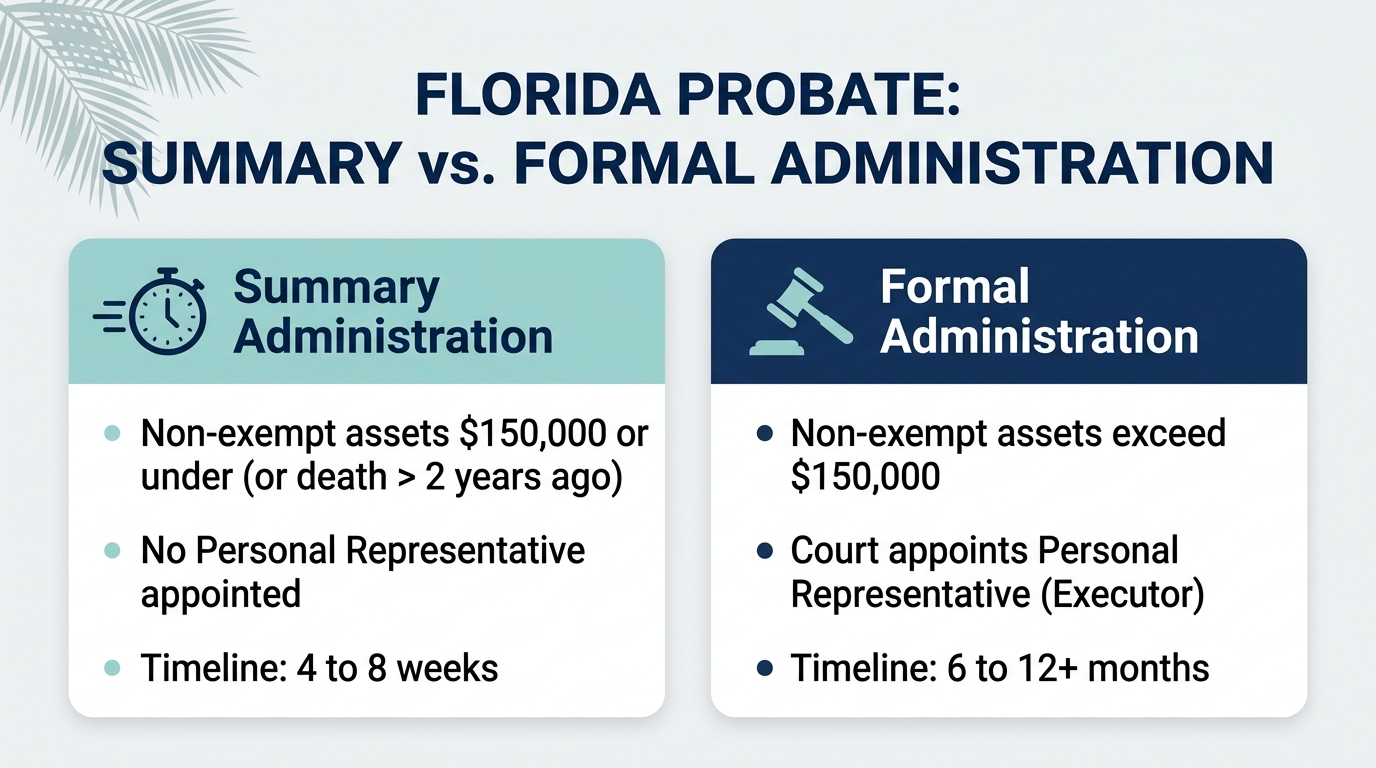
Florida law establishes two primary court-supervised probate procedures for handling an estate. Specifically, courts offer Summary Administration as an expedited process for smaller estates and Formal Administration as the traditional, fully supervised court proceeding
Whether an estate qualifies for Summary Administration depends on the total net value of non-exempt probate assets, whether the decedent has been deceased for over two years, and the complexity of outstanding creditor claims under Florida probate law (Fla. Stat. § 735.201). Understanding how these two probate paths function ensures that South Florida beneficiaries receive their inheritance as quickly and cost-effectively as possible.
Summary vs. Formal Administration at a Glance
| Qualification & Process Feature | Summary Administration (Fla. Stat. § 735.201) | Formal Administration (Florida Probate Rules) |
| Estate Value Threshold | Non-exempt probate assets are $150,000 or less (for deaths on/after July 1, 2026), OR the decedent has been deceased for over 2 years. | Required for estates exceeding $150,000 in non-exempt probate assets (if death occurred within 2 years). |
| Personal Representative | Not appointed. No Letters of Administration are issued by the court. | Required. Court officially appoints a Personal Representative (Executor) with fiduciary authority. |
| Average Timeline | 4 to 8 weeks (subject to Broward County court docket schedules). | 6 to 12+ months (includes mandatory 90-day newspaper creditor notice period). |
| Creditor Claims Process | Creditors must be resolved or served prior to distribution; or barred if death occurred over 2 years ago. | Formal 3-month Notice to Creditors published in local media to legally bar future claims. |
| Primary Judicial Order | Order Summary Administration directly transfers legal title of assets to beneficiaries. | Letters of Administration issued at inception; Order of Discharge issued at estate closing. |
When Does Summary Administration Apply in Florida?
Furthermore, Summary Administration provides an expedited judicial procedure that transfers property title to beneficiaries without opening a full probate estate.. However – to qualify under Florida law, the estate must satisfy one of two statutory criteria:
-
- The $150,000 Net Asset Test: Effective July 1, 2026, Florida increased the summary administration statutory limit. The total value of all assets subject to probate—excluding protected Florida Constitutional Homestead real estate and statutory exempt personal property—does not exceed $150,000 (for deaths on or after July 1, 2026; $75,000 for deaths prior to July 1, 2026).
-
- The Two-Year Rule: In addition, petitioners can file for Summary Administration if the decedent died more than two years prior. Florida law waives the asset limit after this two-year period expires. Under Fla. Stat. § 733.710, two years establishes a non-claim statute of repose that automatically bars unfiled creditor claims.
Key Distinction: No Personal Representative Appointed
In Summary Administration, the court does not appoint a Personal Representative and does not issue Letters of Administration. Instead, the petitioner files a petition asking the judge to transfer specific assets, such as a bank account or vehicle, directly to named beneficiaries.
Some estates require active ongoing legal authority to access restricted medical records, pursue a wrongful death lawsuit, or negotiate complex business debts. Consequently, the petitioner must open Formal Administration regardless of the estate’s total value.
When Is Formal Administration Mandatory?
Formal Administration is the comprehensive, fully supervised probate process in Florida. It is mandatory when:
-
- Non-exempt probate assets exceed $150,000 and the decedent passed away within the last two years.
-
- The decedent’s Last Will and Testament explicitly mandates formal probate administration.
-
- The estate involves disputed creditor claims, contested wills, or missing heirs.
-
- In addition, the appointed Personal Representative must actively list, market, and sell real estate during probate by signing legal contracts and closing documents.
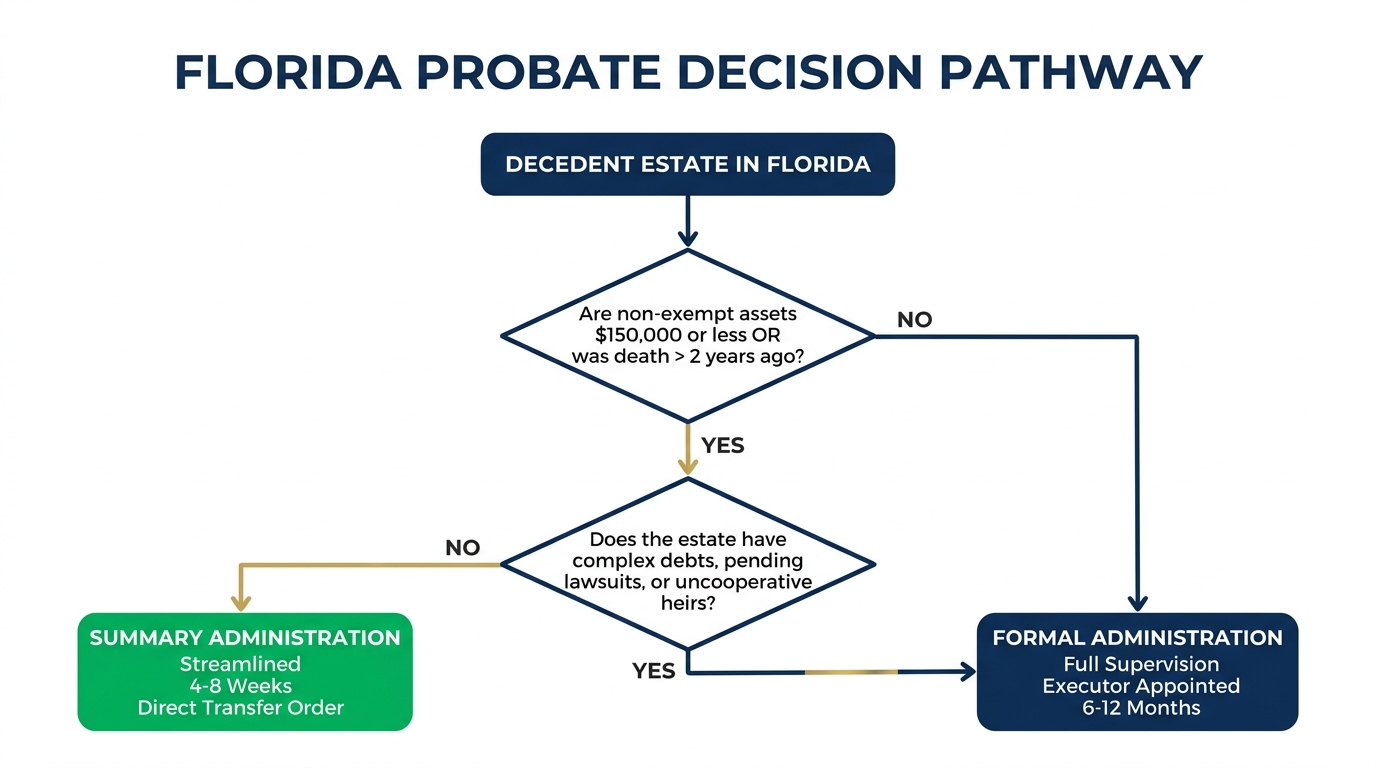
FLORIDA PROBATE DECISION PATH
OR has the decedent been deceased > 2 years?
6-12 Month Duration
What About Very Small Estates? (Disposition Without Administration)
For extremely modest estates where the decedent left no real estate, Florida offers an informal non-probate process under Fla. Stat. § 735.301 known as Disposition of Personal Property Without Administration.
This simplified filing is available only when remaining non-exempt personal property does not exceed the total sum of preferred funeral expenses and necessary medical bills incurred during the last 60 days of the decedent’s final illness.
Strategic Risk Factors: Creditor Exposure & Multi-State Assets
Selecting between Summary and Formal Administration involves critical legal trade-offs beyond estate size:
1. The Post-Probate Creditor Exposure Risk
Under Fla. Stat. § 735.206, Summary Administration directly distributes assets to beneficiaries without opening a mandatory 90-day newspaper creditor publication window.
Consequently, if the petitioner files the petition before the two-year non-claim period expires, creditor claims can still affect the estate. (Fla. Stat. § 733.710). Beneficiaries remain personally liable to valid estate creditors up to the full value of the property received. If unknown debts emerge post-distribution, Formal Administration is often safer because publishing a statutory Notice to Creditors permanently cuts off future claims after 90 days.
2. Ancillary Administration for Out-of-State Residents
However, an out-of-state court order cannot transfer real estate in Broward County or anywhere in South Florida when a non-resident dies. An Ancillary Probate proceeding (Fla. Stat. § 734.102) must be opened in Florida. Depending on the non-exempt Florida land value, Ancillary proceedings can be conducted as either Summary or Formal Administration.
Frequently Asked Questions
Does Florida Homestead Property count toward the $150,000 Summary Administration limit?
-
- No. Protected Florida Constitutional Homestead property passes to heirs outside general creditor claims. Furthermore, the court excludes this property when calculating the $150,000 Summary Administration threshold, provided the petitioner files a formal Petition to Determine Homestead Status alongside the summary petition.
What is the 10-day Will Deposit Rule in Florida?
-
- Under Fla. Stat. § 732.901, whoever holds the decedent’s original Last Will and Testament must deposit it with the Clerk of the Circuit Court in the county where the decedent resided within 10 days of receiving notice of death, regardless of whether formal probate will be opened.
What is the current Florida Summary Administration asset threshold?
-
- Effective July 1, 2026 (Fla. Stat. § 735.201), the Florida Legislature increased the non-exempt probate asset threshold for Summary Administration from $75,000 to $150,000 for deaths occurring on or after July 1, 2026 (or where the decedent has been deceased for more than 2 years). Protected homestead property continues to be excluded from this calculation.
How long does Formal Administration take in Broward County?
-
- A routine, uncontested Formal Administration in Broward County typically takes between 6 and 12 months. This timeframe accommodates publishing the mandatory Notice to Creditors, observing the 90-day statutory creditor claim window, marshaling asset inventories, preparing tax accountings, and securing final court discharge.
Can the court convert a summary administration to a formal administration if a dispute arises?
-
- Yes. Unexpected creditor claims, beneficiary disputes, or newly discovered assets can push an estate’s total value over $150,000. Consequently, any interested party or petitioner can motion the court to convert the summary proceeding into a Formal Administration.
Do I need a probate attorney for Summary Administration in Broward County?
-
- Florida law technically permits self-representation in Summary Administration when the court does not appoint a Personal Representative. However, court clerk offices cannot provide legal advice or assist you with legal filings.. Drafting accurate petitions, verifying homestead status, and coordinating creditor searches require specialized legal guidance to avoid judicial rejection.
Don’t Let an Outdated Deed Dictate Your Family’s Future
Choosing the correct probate pathway prevents costly administrative delays, court rejections, and personal liability for estate debts. Your family may qualify for an expedited Summary Administration or require full Formal Administration in South Florida. Regardless, working with experienced legal counsel ensures that you protect every estate asset.
Schedule a Property Deed & Titling Audit
Consequently, you should structure your real estate title and probate strategy so assets pass seamlessly outside of or through probate court. Contact the attorneys at Reinfeld & Cabrera, P.A. today to review your estate and property deeds with our South Florida legal team.
-
- Office Locations: Coral Springs | Fort Lauderdale | Plantation
-
- Direct Telephone: (954) 334-1520
-
- Email: Info@lawrct.com
-
- Website: mypersonalattorneys.com
-
- Local Practice Coverage: Coral Springs, Fort Lauderdale, Tamarac, Plantation, and Broward County