
When you sit down at the kitchen table to sort through a parent’s papers after they pass away, the last thing you want is a fresh wave of bureaucratic dread.
What happens to the house now? How do we pay the lingering bills? And why does everyone make probate sound like a multi year hostage negotiation with the state of Florida?
Quick Answer:
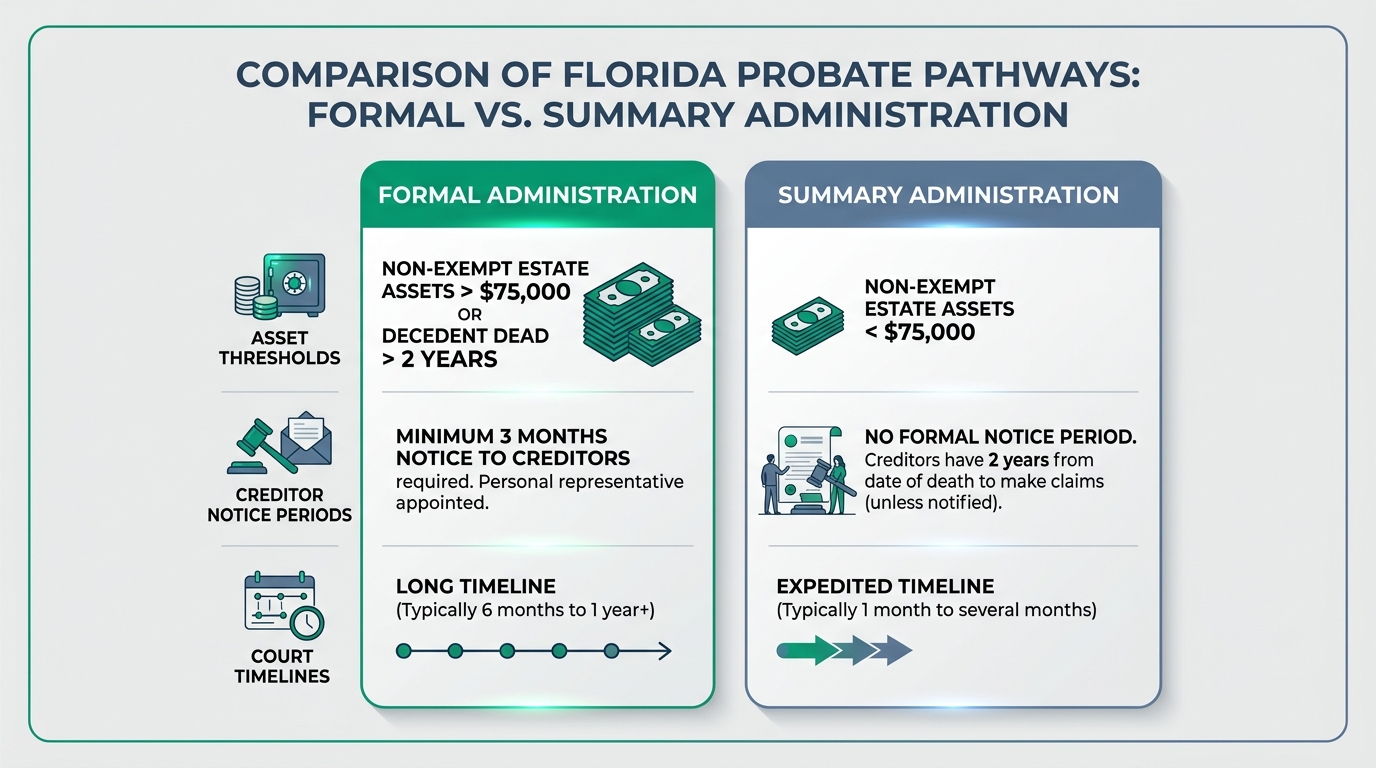
Under Florida probate law, administering an estate through the 17th Judicial Circuit in Broward County involves formal or summary court proceedings to settle debts and transfer property. Formal administration typically takes between six months and over a year due to mandatory creditor notice windows, whereas summary administration offers an expedited process for estates valued under $75,000 or where the decedent passed away more than two years ago.
If you search online for estate guidance, you will drown in dry textbook definitions. Most treat probate like an unavoidable trap or a magical cure all. Neither description captures reality. Probate is simply the legal mechanism the state uses to clear title to property. It’s how to pay legitimate creditors, and transition assets when someone passes away without proper advance planning.
So what do Florida families and property owners actually need to know about navigating the Broward County court system. What do they need to get to manage a estate, and keep your hard earned assets out of unnecessary courtrooms? Let us pull back the curtain and talk about how estate administration really works in South Florida without any legal mumbo jumbo.
Why the Internet Gets Probate Wrong (And Why Wills Do Not Avoid Court)
There is a stubborn myth floating around the internet that having a last will and testament means your family completely bypasses the probate court. People assume a will acts like a VIP backstage pass that lets your heirs walk right past the judges and walk away with your property.
Nothing could be further from the truth.
Ask yourself: If I spend my entire life building equity in a home and saving for my children, why would I hand them a legal document that explicitly instructs a judge to oversee how those assets get handed out?
A will does not avoid probate. A will is instructions for the probate court. It tells the judge who you want to inherit your belongings. But the court still has to supervise the process, validate the signature, notify creditors, and formally authorize your personal representative to act. If you want to spare your family from court supervision, you have to look beyond a basic will. You should utilize tools like revocable living trusts, payable on death designations, and properly structured joint ownership.
What Actually Goes Through Probate in Florida?
Not every asset a person owns gets sucked into the probate vortex upon death. Understanding the dividing line between probate and non probate property is the first step toward building a sensible estate plan.
- Probate Assets: Solely owned real estate, bank accounts held in a single name without payable on death instructions, and personal belongings like vehicles or jewelry without designated beneficiaries must go through court administration to change legal ownership.
- Non Probate Assets: Assets governed by contract or operation of law pass directly to beneficiaries without court interference. This includes living trusts, life insurance policies with named beneficiaries, retirement accounts. It also includes real estate held as tenants by the entirety or joint tenants with rights of survivorship.
If your estate consists entirely of beneficiary designated accounts and trust owned property, things change. Your family might never set foot inside a courtroom. But if a single deed or bank account was left in your individual name, the probate doors swing wide open.
Formal Administration Versus Summary Administration in Broward County
When a probate estate is opened in the 17th Judicial Circuit in Broward County, the administration generally follows one of two statutory paths. Both depend on the size of the estate and how long the decedent has been gone:
- Formal Administration: This is the standard, comprehensive court process required for larger estates or complex matters involving multiple creditors and disputed claims. The court appoints a personal representative, issues letters of administration, requires formal publication of notice to creditors, and mandates a multi month inventory and accounting process.
- Summary Administration: A streamlined, expedited court procedure available in Florida if the value of the entire estate subject to probate does not exceed $75,000, or if the decedent has been dead for more than two years. Summary administration bypasses the appointment of a personal representative and moves much faster, though it still requires a formal petition filed by an attorney.
Avoiding Dual Tracking and Creditor Traps During Estate Administration
When a personal representative steps up to manage an estate in South Florida, they quickly realize that administering assets is a minefield of strict statutory deadlines and creditor notification rules under Florida Probate Code.
How do you handle aggressive credit card companies or mortgage lenders demanding payment while the estate is still frozen in court?
- The Creditor Notice Period: Florida law requires a diligent search for known creditors and publication of a formal notice in a local legal periodical. Creditors have a strict window (typically three months from the first publication of notice) to file formal claims against the estate.
- The Priority of Claims: You cannot simply pay out inheritance money to family members while valid estate debts remain unpaid. Florida law establishes a rigid priority structure for paying funeral expenses, administrative costs, taxes, and medical bills before beneficiaries see a dime. Failing to follow this order can expose the personal representative to personal financial liability.
Real World Case Example: Untangling an Estate in Broward County
To see how these rules play out in local practice, consider a scenario our firm frequently handles across Coral Springs and Fort Lauderdale.
A client came to our office after losing a parent who owned a residential home in Broward County without a living trust. The parent had left a simple will naming our client as personal representative, but because the deed was in the parent’s individual name, the property was completely frozen. To make matters worse, a home equity line of credit was past due, and the lender was threatening default proceedings while the family was still grieving.
How Our Legal Team Resolved the Crisis
- Opening Formal Administration: We immediately filed a petition for formal administration in the 17th Judicial Circuit, securing letters of administration so our client had the legal authority to deal with the bank.
- Publishing Creditor Notice: We managed the statutory creditor notice period. We shield the personal representative from harassing collection calls and ensuring claims were evaluated through proper legal channels.
- Resolving the Debt and Transferring Title: By coordinating with the mortgage lender and liquidating a small non probate account to cover arrears, we stabilized the property, avoided foreclosure, and ultimately transferred clear title of the home to the rightful heirs.

Frequently Asked Questions About Florida Probate
How long does the probate process take in Broward County?
- An uncontested formal administration in Florida typically spans 6 to 12 months. This timeline is largely dictated by mandatory statutory creditor notice periods and court review schedules in the 17th Judicial Circuit. Complex estates involving will contests or contested creditor claims can take significantly longer.
Can I avoid probate simply by writing a last will and testament?
- No. A common misconception is that having a will avoids probate. In reality, a will provides instructions for the probate court on how you want your assets distributed. To avoid probate entirely, assets must pass outside the will via living trusts, beneficiary designations, or survivorship titles.
What happens if someone dies intestate without a will in Florida?
- If a person dies without a valid will, Florida intestacy statutes dictate how assets are distributed among surviving spouses, children, or extended relatives. This rigid statutory formula rarely matches what the decedent would have actually wanted. And it often forces court sales of family property to divide proceeds among heirs.
Do I need a probate attorney if I am appointed as a personal representative?
- Yes. Under Florida probate rules, a personal representative representing an estate with multiple beneficiaries or outstanding creditors is generally required by law to be represented by a licensed attorney admitted to practice in Florida.
Protect Your Estate and Your Family Legacy
Planning for the future or handling the aftermath of a loved one’s passing is not something you should do alone. Whether you want to bulletproof your own estate with a comprehensive living trust or you need experienced local counsel to guide you through a Broward County probate administration, having the right advocate changes everything.
The estate planning and probate attorneys at Reinfeld Cabrera Tison help families across South Florida secure their assets. We establish durable trusts, and resolve complex court proceedings with absolute confidence.
Schedule a Confidential Consultation
Do not wait until a crisis forces your family into court. Speak directly with an experienced attorney today to review your options:
- Direct Telephone: (954) 866 4878 | Toll Free: (954) 866 HURT
- Coral Springs Office: 9625 W Sample Rd, Coral Springs, FL 33065
- Fort Lauderdale Office: 2933 W Cypress Creek Rd, Suite 201, Ft Lauderdale, FL 33309
- Website: mypersonalattorneys.com
- Local Coverage: Coral Springs, Fort Lauderdale, Parkland, Tamarac, Margate. All surrounding communities across Broward, Miami Dade, and Palm Beach Counties.