Commercial litigation encompasses legal disputes arising from business operations, corporate governance, and commercial transactions. In Florida, when a breach of contract or business dispute cannot be resolved through pre-suit negotiation, parties litigate through the civil court system or pursue alternative dispute resolution (ADR) under Florida Statutes and 17th Judicial Circuit local rules.
Running a business in Coral Springs and throughout South Florida involves the constant creation and execution of agreements, vendor partnerships, and financial transactions. When a business partner breaches an operating agreement, a key supplier fails to deliver, or a corporate client withholds payment on a substantial invoice, the operational and financial impact can threaten the viability of your enterprise.
For business owners facing a serious dispute, understanding how commercial litigation functions within the 17th Judicial Circuit (Broward County) is critical to protecting corporate assets and mitigating damages.
Many business owners assume commercial litigation is reserved exclusively for Fortune 500 corporations. In practice, commercial litigation covers any civil dispute arising directly from business and commercial activities.
In Broward County courts, commercial litigation typically involves several distinct categories of legal action:
Breach of Written and Oral Contracts: When a party fails to perform any material term of a commercial lease, vendor agreement, service contract, or promissory note without a lawful legal excuse.
Corporate and Partnership Governance Disputes: Internal deadlocks between shareholders, members of a Limited Liability Company (LLC), or partners regarding management control, profit distribution, breach of fiduciary duty, or involuntary dissolution.
Business Torts and Unfair Competition: Claims involving tortious interference with contractual relationships, fraudulent misrepresentation, civil theft, or violations of non-compete and trade secret agreements.
Commercial Debt Recovery and Foreclosure: Pursuing high-value unpaid business accounts receivable, enforcing security interests under the Uniform Commercial Code (UCC), or foreclosing on commercial mortgages.
2. The Statutory Framework: Governing Florida Business Disputes
Commercial litigation in Florida is governed by a combination of statutory frameworks, civil procedure rules, and common law precedent. Two critical statutory pillars govern most commercial actions in the state:
Florida Statutes Chapter 95 (Statutes of Limitations)
Timing is everything in commercial litigation. Waiting too long to address a breach can permanently bar your claim. Under Florida law:
Written Contracts: Actions for breach of a written contract generally carry a 5-year statute of limitations (F.S. 95.11(2)(b)).
Oral Agreements: Actions based on unwritten or oral contracts carry a shortened 4-year statute of limitations (F.S. 95.11(3)(k)).
Open Accounts: Actions to recover on an open account or unstated business debt also carry a 4-year limit (F.S. 95.11(3)(f)).
Florida Statutes Chapter 607 and Chapter 605
For corporate and LLC disputes in Coral Springs, litigation frequently hinges on the interpretation of Florida’s Business Corporation Act (Chapter 607) and Florida Revised Limited Liability Company Act (Chapter 605), which dictate voting rights, derivative actions, and member dissociation standards.
3. The Lifecycle of a Commercial Lawsuit in Broward County
When a business dispute escalates to formal litigation in the 17th Judicial Circuit, the case generally moves through several distinct procedural phases:
Step One: Pre-Suit Demand and Strategic Positioning
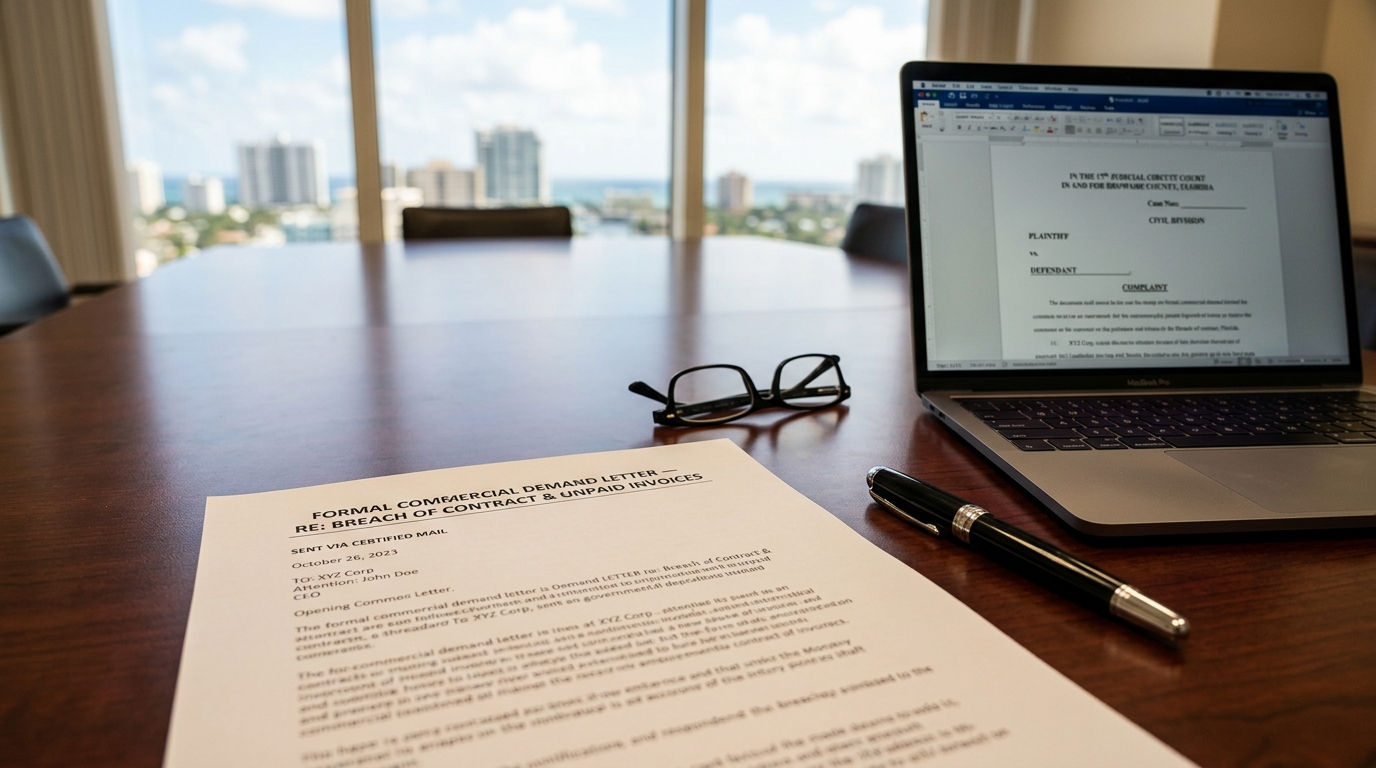
Before a complaint is filed, experienced counsel will typically issue a formal commercial demand letter. This document outlines the legal basis of the breach, details damages, and sets a strict deadline for cure or settlement. Under many Florida contracts, sending a proper demand letter is a statutory or contractual prerequisite to recovering attorney’s fees.
Phase Two: Pleadings and Motion Practice
If the dispute is not resolved pre-suit, the plaintiff files a formal Complaint in County or Circuit Civil court, depending on the amount in controversy. The defendant has 20 calendar days to respond, often filing motions to dismiss or asserting affirmative defenses (such as waiver, estoppel, or failure of consideration).
Part Three: Discovery and Expert Analysis
Commercial litigation is document-heavy. During discovery, both sides exchange emails, financial statements, ledgers, and corporate records through Requests for Production, Interrogatories, and Depositions. In complex cases, forensic accountants or industry experts are retained to calculate lost profits and business valuation.
Phase Four: Court-Mandated Mediation
Before a judge will permit a commercial case to proceed to trial in Broward County, the court will universally order the parties to attend mediation. Mediation is a confidential settlement conference overseen by a certified mediator. A high percentage of commercial disputes successfully resolve at this juncture, saving companies substantial trial expenses.
Phase Five: Trial and Judgment Enforcement
If mediation fails, the case proceeds to a bench or jury trial. Once a Final Judgment is secured, the prevailing party utilizes post-judgment discovery, writs of garnishment, or execution sales to collect the awarded funds.
4. Why Pro Se Representation is Prohibited for Florida Businesses
A common and costly mistake made by small business owners is attempting to represent their LLC or corporation pro se (without an attorney) in court.
Under established Florida law and court rules, a corporation or LLC is a distinct legal entity whose owner, member, or officer cannot represent it in court unless that individual is a licensed attorney.. Any pleading or court appearance filed by a non-attorney on behalf of an entity is subject to immediate striking and dismissal, leaving the business entirely unprotected.
5. Shareholder and Partnership Deadlock: When Internal Disputes Threaten Corporate Survival
While breach of contract actions make up a large portion of commercial litigation, they are not the only problem. Some of the most complex and emotionally charged disputes happen internally between business partners, co-founders, or corporate shareholders.
In Florida, when two 50/50 owners disagree fundamentally on corporate direction, financial management, or operational strategy, a corporate deadlock occurs. Left unresolved, deadlock can paralyze the business, drain operating capital, and expose the company to severe operational risks.
Judicial Dissolution and Involuntary Buyouts under Florida Law
When governance breaks down and dispute-resolution clauses fail, owners have to resort to court intervention under Statutes 607 (for Corporations). Or Chapter 605 (for LLCs).
Depending on the corporate structure and governing documents, litigation remedies can include:
Judicial Dissolution: Petitioning the 17th Judicial Circuit to order the formal winding down and liquidation of the company’s assets.
Involuntary Buyout Rights: Forcing a statutory buyout where one faction purchases the shares of the departing member at a court-determined fair value.
Claims for Breach of Fiduciary Duty: Pursuing damages against a managing partner who engaged in self-dealing or excluded co-owners from corporate records.
Having professionally drafted operating agreements with pre-established buyout formulas or tie-breaking mechanisms is the best defense against crippling partnership litigation. However, when those safeguards are missing, aggressive legal strategy in Broward County courts becomes essential to protect your financial investment.
Frequently Asked Questions
What is the difference between a breach of contract and a business tort?
A breach of contract involves the failure to perform a specific promise outlined in a binding agreement. Courts generally limit damages to economic losses contemplated by the contract.. A business tort (such as fraudulent misrepresentation) arises from a breach of a legal duty independent of the contract. This may allow for the recovery of punitive damages.
Can my business recover attorney’s fees if we win a contract lawsuit?
In Florida, the “American Rule” dictates that each party pays its own attorney’s fees unless a fee-shifting provision is explicitly written into the contract or authorized by a specific statute. Ensuring your business agreements contain robust attorney’s fees clauses is essential.
How are commercial disputes handled if my contract has an arbitration clause?
If your agreement includes a mandatory arbitration clause, the dispute will bypass the public court system entirely. Instead, it is submitted to an independent arbitration provider (such as the American Arbitration Association) where an appointed arbitrator hears evidence and issues a binding decision.
Schedule a Consultation with Our Coral Springs Business Attorneys
Protecting your enterprise from breach of contract, partnership deadlock, or commercial disputes requires decisive legal strategy.
Filing for bankruptcy in the Fort Lauderdale Division can trigger an automatic stay. This generally stops foreclosure proceedings, wage garnishments, collection lawsuits, and other efforts to collect qualifying debts. The effect depends on the type of bankruptcy filed and the debtor’s circumstances. Chapter 7 can discharge certain unsecured debts relatively quickly. On the othersidem, Chapter 13 allows eligible debtors to repay some obligations through a court supervised plan and may provide a way to address mortgage arrears.
Debt problems can develop for very different reasons. A sudden medical expense may leave someone relying on credit cards. On the flipside a decline in business income can make previously manageable obligations difficult to maintain. For a homeowner facing foreclosure, receiving a notice from a lender can turn a financial problem into a legal concern.
For residents of Coral Springs and elsewhere in Broward County, understanding how bankruptcy affects creditor collection and secured debts is therefore important before deciding whether to file. Bankruptcy is not automatically appropriate for every financial situation, and filing can have significant legal and financial consequences. It is a federal legal process that can, however, provide qualifying debtors with protection from collection activity. It is a mechanism for resolving debts under the Bankruptcy Code.
The process is handled through the U.S. Bankruptcy Court for the Southern District of Florida. Understanding how the automatic stay works, which debts may be discharged, and how Chapter 7 differs from Chapter 13 can make the legal consequences of filing easier to evaluate.
1. The Immediate Relief: The Automatic Stay
The very day you file a bankruptcy petition with the court, a legal order called the automatic stay kicks in.
Think of it as a legal force field around you and your finances. The moment it goes into effect, the law legally bars creditors from touching you:
Foreclosure stops dead in its tracks, halting scheduled auctions on your home.
Wage garnishments and bank levies must stop immediately, letting you keep your paycheck.
Collection calls, harassing letters, and lawsuits have to cease.
For anyone in Florida staring down a sheriff sale or a creditor lawsuit, that automatic stay provides instant breathing room. This is crucial so you can figure out your next move without panic.
2. Chapter 7: The Clean Slate
Chapter 7 is what most people picture when they think of bankruptcy. The main aspect of Chapter 7 is a straightforward liquidation process designed for individuals and families whose income simply does not provide enough room to dig out from under their debts.
Passing the Means Test
To qualify for Chapter 7 in Florida, your household income is measured against the state median income for a family of your size. If you fall below that median, or can show through standard calculations that your disposable income is tapped out, you qualify.
What Happens to What You Own?
A common fear is that filing for Chapter 7 means losing everything you have worked for. But Florida has some of the strongest debtor protection laws in the country:
Your Home: Under Florida constitutional homestead exemption, your primary residence is overwhelmingly protected from general unsecured creditors.
Your Belongings: State law exempts essential personal property, vehicle equity limits, and certain wages.
For many clients who qualify, Chapter 7 successfully wipes the slate clean on unsecured debts, like credit cards, medical bills, and personal loans, usually within four to six months.
3. Chapter 13: Reorganizing and Protecting Your Assets
Sometimes, Chapter 7 is not the right fit. If you have a steady income, own non-exempt property you cannot afford to lose, or are behind on your mortgage payments, Chapter 13 offers a structured way forward.
Instead of wiping everything out quickly, Chapter 13 lets you put together a court-approved repayment plan lasting three to five years. You make one manageable monthly payment to a trustee, who handles distribution to your creditors.
Saving Your Home from Foreclosure: If you have fallen behind on mortgage payments, Chapter 13 lets you roll those past-due arrears into your monthly plan over time, allowing you to catch up while keeping your home.
Keeping Control: It gives you breathing room to deal with priority debts, like certain taxes or support obligations, without having your assets sold off.
4. Critical Warnings: Traps to Avoid Before Filing
When financial pressure mounts, people often make impulsive moves that inadvertently trigger severe legal consequences. Before filing for bankruptcy in Broward County, keep these major statutory traps in mind:
The 1215 Day Homestead Rule: Federal bankruptcy law imposes a strict rule on Florida homestead exemptions. If you purchased your home or moved substantial equity into it less than 1,215 days (roughly three years and four months) before filing, your homestead protection may be capped under federal statute, regardless of Florida constitutional rules.
Do Not Transfer Assets to Family: Giving a car to a relative or putting a sibling name on a bank account right before filing is viewed by trustees as a fraudulent transfer. Courts can claw those assets back and even deny your discharge entirely.
Avoid Sudden Credit Card Ramping: Running up luxury charges or cash advances on credit cards just months before filing can lead creditors to file adversary proceedings claiming fraud, making those specific debts non dischargeable.
5. Real World Application: Stopping a Broward County Foreclosure
To see how these laws function in practice, consider a typical scenario handled by our firm.
A homeowner in Coral Springs fell twelve months behind on their mortgage after a sudden business interruption. The bank scheduled a foreclosure auction date through the 17th Judicial Circuit Court. By filing an emergency Chapter 13 petition on the eve of the sale, the automatic stay stopped the auction instantly.
Instead of losing their family home, the debtor utilized a three year Chapter 13 repayment plan to cure the missed mortgage arrears incrementally while resuming regular monthly payments. The plan saved the home and managed unsecured credit card debt. This secured long term financial stability for the family without displacement.
6. Attorney Perspective: Why Local Experience Matters
“Clients often walk into our Coral Springs office feeling like bankruptcy is a personal failure. Our job is to reframe it. It is a federally protected economic tool. When aggressive creditors or foreclosure dates are moving fast in the Fort Lauderdale division, you need a strategy that respects local court nuances and strict filing schedules so you can protect what matters most.”
7. How the Process Works in the Fort Lauderdale Division
For residents across Coral Springs, Tamarac, and Pompano Beach, the U.S. Bankruptcy Court handles your case. Bankruptcy Court for the Southern District of Florida Fort Lauderdale Division downtown.
While the court process is formal, having an experienced guide makes it manageable:
The Meeting of Creditors: About a month after filing, you and your attorney attend a short meeting with the bankruptcy trustee. In the Fort Lauderdale division, these are often handled smoothly via video or phone. We prepare you thoroughly so there are no surprises.
Guidance Every Step of the Way: From mandatory credit counseling to filing your paperwork correctly the first time, our goal is to keep you out of procedural trouble and moving toward your fresh start.
Frequently Asked Questions
Will I lose my house or car if I file?
In most cases, no. Florida homestead exemption protects your primary home, and Chapter 13 is explicitly designed to help you catch up on missed mortgage payments. For cars, specific vehicle exemptions or straightforward reaffirmation agreements often allow you to keep driving.
What debts do not go away in bankruptcy?
While credit cards, medical bills, and personal loans are wiped out, certain obligations survive. These include most student loans, recent tax debts, child support, alimony, and debts resulting from fraud.
Can a business file for bankruptcy?
Yes. Local businesses, LLCs, and corporations can file for Chapter 7 to wind down or Chapter 11 to restructure. Keep in mind that a business entity does not receive a personal debt discharge the way an individual does, but it provides an orderly way to handle corporate liabilities.
What is the 341 meeting of creditors in the Fort Lauderdale division?
The 341 meeting of creditors is a mandatory proceeding where the bankruptcy trustee questions you under oath about your financial affairs, assets, and debts. For residents of Coral Springs and Broward County, the Fort Lauderdale division typically conducts these hearings via video or phone, and your attorney prepares you thoroughly so you know exactly what to expect.
Can I file for bankruptcy in Florida if I just moved here from another state?
You can file in Florida, but federal law requires you to have lived in the state for the greater part of the 180 days preceding the filing—specifically, the 730 days (two years) prior—before you can use Florida specific property exemptions. If you moved within the last two years, federal rules dictate that you may have to use the exemption laws of your previous home state.
Carrying heavy financial stress does not mean you have to figure it out alone. Whether you are looking at Chapter 7 relief or trying to save your home through Chapter 13 in Coral Springs, Broward County, or South Florida, Alan Reinfeld and Stuart Reinfeld are here to help you sort through your options honestly and without judgment. Contact our office today to take back control of your future.
Buying an existing business in Florida can save you years of work. You may inherit an established customer base, trained employees, valuable equipment, and a reputation that took the previous owner decades to build. There is one thing you probably do not want to inherit: the previous owner’s unpaid tax bill.
Quick Overview
Yes, a buyer can be held responsible for certain unpaid taxes owed by a previous business owner under Florida Statute § 213.758. The law applies to qualifying transfers involving more than 50% of a business, its assets, or its inventory. It can expose a buyer to tax liabilities arising from the seller’s business operations, even when the buyer did not personally incur those liabilities.
Florida law also provides exceptions and procedures that can protect qualifying buyers. Obtaining the appropriate documentation from the Florida Department of Revenue before closing is one of the most important steps.
For anyone considering a business acquisition in Coral Springs, Broward County, or elsewhere in Florida, understanding these rules can prevent an expensive surprise after the purchase agreement has been signed.
Key points to know:
Florida generally requires a conventional will to be in writing and signed under specific witness formalities.
Notarization alone does not replace the required witnesses.
A valid will does not necessarily control every asset or avoid probate.
Florida recognizes electronic wills, but they must follow a separate statutory framework.
A will that is legally valid can still be unsuitable for the person’s family or financial circumstances.
What Is Florida’s Law on Unpaid Taxes When Buying a Business?
Florida Statute § 213.758, titled Transfer of Tax Liabilities, establishes when a qualifying buyer can become liable for unpaid taxes arising from the previous owner’s operation of a business.
Under the statute, a transferee who acquires more than 50% of a business, its assets, or its stock of goods can become jointly and severally liable with the seller for covered unpaid taxes. The buyer’s liability is subject to the statutory maximum and the exceptions established by the law.
The statute covers certain taxes administered by the Florida Department of Revenue. These can include sales and use taxes, reemployment assistance taxes, and other covered taxes, together with applicable interest, penalties, surcharges, and fees. The statute’s definition of tax expressly excludes corporate income tax under Chapter 220.
The exact exposure depends on the transaction, the taxes involved, and whether a statutory exception applies.
The central point is straightforward. Buying a business does not automatically make you responsible for every debt the previous owner accumulated. However, Florida’s transfer of tax liabilities statute creates a specific risk that buyers should investigate before completing an acquisition.
When Can a Buyer Become Responsible for the Seller’s Unpaid Taxes?
Section 213.758 defines a business transfer using a threshold of more than 50% of any one of three categories.
1. Acquiring more than 50% of a business
A buyer who acquires more than half of a business may fall within the statute. The definition of business is broad. It covers activities regularly conducted for private or public gain, benefit, or advantage.
The transaction does not necessarily have to involve purchasing every part of the seller’s operation.
2. Acquiring more than 50% of the business’s assets
Buying the assets of a business instead of acquiring the entire operating entity does not automatically eliminate the risk.
For example, imagine that a buyer purchases most of a Florida company’s equipment, operating assets, and other property. The seller retains the original legal entity and intends to use it for a different purpose.
The transaction may still meet the statutory threshold because the law expressly covers transfers of business assets.
This is an important distinction when evaluating an asset purchase. The parties must analyze the assets being transferred rather than relying on transaction structure to resolve the tax issue
3. Acquiring more than 50% of the business’s inventory
Florida law also addresses the transfer of a business’s stock of goods. The statute defines this as inventory held for sale to customers in the ordinary course of business.
Suppose a retailer sells nearly all its inventory to another retailer before shutting down. The buyer may have acquired more than 50% of the seller’s stock of goods, even though the buyer never purchased the seller’s company.
The inventory transaction therefore deserves its own tax review.
What if the transaction is divided into separate purchases?
Section 213.758 covers direct and indirect transfers. It also addresses groups of transferees acting in concert.
A transaction should not be assumed to fall outside the statute merely because the assets are divided among different buyers or transferred through separate agreements.
The statute also requires considering certain business divisions together when they are not separate legal entities.
Practical takeaway: Before closing, identify precisely what is being transferred and determine whether the transaction satisfies the statutory threshold. The purchase agreement’s title alone does not settle the question.
Which Unpaid Taxes Can Affect a Florida Business Purchase?
Sales tax is an important concern because businesses may collect tax from customers and then fail to remit the required amounts to the state.
However, § 213.758 is not limited to sales tax.
Its definition of tax incorporates Chapter 443 and the chapters identified in Florida Statute § 213.05, subject to the express exclusion for corporate income tax under Chapter 220.
Depending on the business and its activities, relevant tax obligations may include:
Sales and use taxes. A business may have collected sales tax without properly reporting or remitting the required amounts.
Reemployment assistance taxes. Outstanding obligations under Chapter 443 may be relevant to a qualifying transfer.
Communications services taxes. These may matter when the business provides services subject to the applicable tax provisions.
Fuel taxes and other industry specific obligations. Businesses operating in regulated or specialized industries may have additional tax exposure under the covered chapters.
This list is illustrative. The statute’s precise definition controls whether a particular obligation falls within its scope.
Corporate income tax is expressly excluded from the definition used in § 213.758. That does not mean every other tax associated with a corporation is excluded. The underlying tax provision must be examined.
Federal tax liabilities and certain local tax obligations may raise separate legal questions.You should not automatically treat them as liabilities imposed under this Florida statute.
How Much Can You Owe for a Previous Owner’s Tax Debt?
Florida law establishes a maximum amount of liability for a qualifying transferee.
Under § 213.758(6), the maximum liability is the greater of the fair market value of the transferred business, assets, or inventory and the total purchase price paid for the transferred property. The statute provides specific adjustments for liens and liabilities.
This calculation can have significant consequences when an owner sells a business at a discount or when the transaction involves substantial assets.
Example: The business has an unpaid tax bill of $80,000
Imagine that you purchase a business for $400,000. The adjusted fair market value of the transferred property is $500,000.
The previous owner has $80,000 in unpaid taxes covered by the statute.
The statutory maximum would be $500,000 because that is the greater of the two valuation measures. This does not mean that you automatically owe $500,000. The amount of qualifying unpaid tax liability remains central to determining what the state can collect.
Example: The purchase price exceeds fair market value
Now imagine that the purchase price is $700,000, while the adjusted fair market value is $600,000. The seller has $120,000 in qualifying unpaid taxes.
The statutory maximum would be $700,000. The buyer would not automatically owe that entire amount simply because it represents the statutory ceiling.
These examples illustrate the valuation rule. Actual calculations depend on the transaction documents, the assets involved, and the statutory adjustments.
Why liens and assumed liabilities matter
Florida law requires adjustments when calculating fair market value and purchase price.
The statute excludes certain insider liabilities from the adjustments. It also differentiates liabilities the buyer assumes based on whether the buyer owes them to insiders
This means buyers should not simply subtract every outstanding debt from the purchase price and assume the resulting number is the correct statutory maximum.
A careful review of the transaction’s financial structure is necessary.
How Can You Check Whether the Seller Owes Florida Taxes?
One of the most useful steps is to request appropriate documentation from the Florida Department of Revenue before closing.
The Department publishes guidance specifically for buyers and sellers of existing businesses. It recommends that buyers request documentation of taxes, penalties, and interest owed in connection with the business.
Two documents deserve particular attention.
Certificate of Compliance
A Certificate of Compliance provides evidence of the seller’s tax account status for a business sale.
Under § 213.758(4)(a)(1), one statutory exception requires the transferor to provide a Department receipt or certificate of compliance showing that the transferor has not received a notice of audit and has filed all required tax returns and paid the taxes arising from the business that are identified on those returns.
The exception also requires that no insiders be in common between the transferor and transferee at the time of the transfer.
Both requirements matter. Obtaining a certificate does not eliminate the need to examine the parties’ relationships.
A Tax Clearance Letter provides information about a taxpayer’s account status for certain purposes, including applications for federal grants or loans.
Taxpayers should not treat it as an automatic substitute for the certificate contemplated by § 213.758.
The Department also explains that its clearance documents reflect the account status at a particular point in time. A document issued well before closing may not reflect subsequent developments.
For that reason, buyers should coordinate the timing of their request with the anticipated closing date.
How long does the process take?
The Department gives a standard processing estimate of approximately seven to ten business days for a certificate of compliance or tax clearance request.
That estimate is not a guarantee. Buyers should allow additional time if the seller’s tax position requires further investigation.
The process also involves confidentiality restrictions. The person requesting documentation must satisfy the Department’s identification and authorization requirements. A buyer may need the seller’s cooperation to obtain the necessary information.
Addressing this issue while parties negotiate the transaction works better than discovering it while everyone waits to close.
What Is a Transferee Liability Audit?
A transferee liability audit allows the Florida Department of Revenue to examine the seller’s books and records to determine whether the seller owes covered taxes, interest, or penalties.
Section 213.758(4)(a)(2) establishes an exception when the Department determines after an audit that the transferor owes no such amounts.
Either the buyer or the seller can request the audit.
A purchaser applying through Form DR 843 must include documentation verifying the sale or proposed sale. The Department’s instructions identify a signed sales agreement as a required attachment.
How long does the audit take?
For an audit outside the certified audit program, § 213.758 requires the Department to complete the audit within 90 days after the records are made available to it.
The starting point matters. The period does not automatically begin on the day the buyer submits the application.
The statute also allows the Department to charge an audit fee when it had not issued a notice of intent to audit by the time the request was received.
For sales tax, a qualified certified public accountant may conduct an audit through the Department’s Certified Audit Program. The Department states that sales tax is the only tax for which this certified audit option is available.
Will the buyer receive the audit results?
Not necessarily.
The Department explains that tax information is confidential and that it generally provides the audit results and transferee liability certificate to the seller. Its guidance describes an exception when it asserts liability against the buyer or another responsible person based on the certificate’s contents.
Buyers should therefore address cooperation and disclosure in the purchase agreement. Submitting an application does not guarantee unrestricted access to the seller’s confidential tax information.
Can You Protect Yourself Through the Purchase Agreement?
Yes. Contractual protections can help allocate the financial risk between buyer and seller.
However, a private agreement does not automatically prevent the state from pursuing a buyer who is liable under § 213.758.
Several provisions deserve attention during negotiations.
Tax representations
The seller can represent that required returns have been filed, taxes have been paid, and known tax assessments or disputes have been disclosed.
These representations give the buyer a contractual basis for addressing inaccurate statements.
Tax indemnification
An indemnification provision can require the seller to reimburse the buyer for specified losses arising from pre closing tax obligations.
Its value depends on the wording, the seller’s financial resources, and the circumstances in which the provision can be enforced.
An indemnification clause is less comforting when the seller has already distributed the purchase proceeds and has no remaining assets.
Escrow arrangements
The parties can arrange for a portion of the purchase price to remain in escrow while an identified tax issue is resolved.
The agreement should specify who controls the funds, which events permit payment to the state, and when any remaining balance may be released.
The Florida Department of Revenue recommends considering an escrow arrangement equal to the potential liability while the sale is pending.
Withholding purchase consideration
Section 213.758(4)(b) expressly allows a transferee to withhold part of the purchase consideration to pay qualifying taxes owed by the seller.
The withheld consideration must be paid to the state within 30 days after the transfer. If the amount withheld is insufficient, the seller remains liable for the deficiency.
This is a statutory payment mechanism, not simply an informal agreement to retain money indefinitely.
Closing conditions
The buyer can negotiate a requirement that the seller provide specified tax documentation before the transaction closes.
The agreement can also address what happens if the documentation reveals an unpaid assessment or the Department cannot complete the necessary review within the expected timeframe.
The essential distinction is between allocating responsibility and eliminating liability. A seller’s promise to pay a tax debt may give the buyer a contractual remedy. It does not necessarily prevent the state from asserting a claim against the buyer.
What Happens If You Discover the Tax Debt After Closing?
Discovering an unpaid tax assessment after acquiring a business can complicate both the financial and operational side of the transaction.
Under § 213.758(5), qualifying transferees are jointly and severally liable with the transferor for covered taxes, subject to the transferee’s statutory maximum liability.
Joint and several liability means that the buyer cannot assume the Department must exhaust every collection option against the seller before pursuing the buyer.
Can Florida prevent the business from operating?
Section 213.758(4)(c) authorizes the Department to seek an injunction preventing further business activity by a transferee who is liable for the seller’s unpaid taxes and fails to pay the applicable maximum liability.
The statute establishes conditions for a temporary injunction. The assessment must be final, the applicable challenge period must have expired or a challenge must have resulted in a final, nonappealable judgment sustaining some part of the assessment, and the Department must provide at least 20 days’ prior written notice of its intention to seek the injunction.
This is not an automatic consequence of discovering a potential tax debt. The statutory requirements must be satisfied.
Nevertheless, it illustrates why the issue deserves attention before an acquisition is completed. A dispute over a predecessor’s tax obligations can threaten the operation of the business that the buyer paid to acquire.
How long do you have to challenge a transferee liability assessment?
Section 213.758(7) gives a transferee 60 days after notice of transferee liability to file an action under Chapter 72.
That statute contains additional requirements concerning jurisdiction, payment of uncontested amounts, and the deposit or security of contested assessments, subject to its provisions.
A buyer who receives a notice asserting transferee liability should seek legal advice promptly. Waiting until negotiations with the former owner are finished can jeopardize the opportunity to challenge the assessment.
Practical Examples of Florida Business Purchase Tax Liability
The following examples illustrate how the rules may apply in different transactions.
Buying a restaurant with unpaid sales taxes
A buyer acquires a restaurant, including its equipment, inventory, and operating assets. The previous owner failed to remit sales taxes collected from customers.
The buyer should determine whether the transaction meets the statutory threshold. It should also investigate the seller’s account status and consider whether a transferee liability audit is appropriate.
The purchase agreement should address the tax issue before the purchase price is released.
Purchasing another company’s inventory
A retailer buys most of a competitor’s inventory while leaving the competitor’s legal entity intact.
Because Florida law expressly addresses transfers of more than 50% of a business’s stock of goods, the buyer should not assume that the transaction is exempt simply because it involves inventory rather than the entire business.
Acquiring a business through a related entity
An owner arranges for a related company to acquire an existing business. The seller provides a certificate of compliance.
The buyer should investigate the common insider requirement before relying on the certificate exception. The relationship between the parties can affect whether that protection is available.
Buying a business when the seller has an outstanding assessment
The seller discloses an unpaid tax assessment during negotiations.
The buyer may still want to proceed with the acquisition. Before doing so, the parties should determine the status and amount of the assessment and establish how it will be resolved.
Depending on the circumstances, withholding purchase consideration or establishing an escrow arrangement may help protect the buyer’s position.
Buying commercial real estate without acquiring the business
A buyer purchases an owner occupied commercial property but does not acquire the seller’s inventory or other business assets.
Section 213.758(8)(b) contains a specific exception for certain transfers of owner occupied commercial real property, subject to its conditions. The exception may be relevant when the property is transferred without other business assets and the transferee is not an insider.
A buyer should not assume that the exception applies when the transaction also includes equipment, inventory, or other assets of the operating business.
Frequently Asked Questions About Buying a Florida Business With Unpaid Taxes
Can I be responsible for the previous owner’s sales tax debt?
Yes. Florida Statute § 213.758 can make a qualifying transferee liable for unpaid sales taxes arising from the previous owner’s business operations. The applicable exceptions and statutory maximum must be considered.
Does buying a business through an asset purchase protect me from unpaid taxes?
No. An asset purchase does not automatically eliminate the risk. The statute expressly covers qualifying transfers of business assets and inventory.
Is a Certificate of Compliance enough to protect a buyer?
Not in every situation. The statutory certificate exception also requires that no insiders be in common between the seller and buyer at the time of the transfer. The certificate reflects the seller’s account status at a particular point in time.
Can I ask the Florida Department of Revenue to audit the seller before closing?
Yes. Either the buyer or seller can request a transferee liability audit. A purchaser generally submits Form DR 843 with a signed sales agreement. The Department’s confidentiality rules affect how the results are disclosed.
Does the buyer have to pay every tax debt owed by the seller?
No. Liability under § 213.758 concerns qualifying unpaid taxes arising from the seller’s business operations. The buyer’s liability is subject to the statute’s maximum and its exceptions. Other kinds of debt require separate analysis.
Can the seller agree to pay all unpaid taxes after closing?
The parties can allocate responsibility through the purchase agreement. However, a contractual promise does not automatically prevent the state from asserting a statutory claim against the buyer.
What if the seller has no money left to pay the taxes?
The seller’s financial condition can affect the practical value of indemnification. A buyer should consider whether an escrow arrangement or withholding purchase consideration is appropriate while the tax position is unresolved.
How long does a Florida transferee liability audit take?
For an audit outside the certified audit program, § 213.758 establishes a 90 day completion period beginning when the Department has the records available. The actual acquisition timeline may be longer because other steps and documentation may be required.
What should I do if Florida asserts liability after closing?
Obtain the notice, review the assessment, and seek legal advice promptly. Section 213.758 provides a 60 day period after notice of transferee liability for filing an action under Chapter 72. Additional statutory requirements may apply.
Why Legal Review Before Closing Matters
Buying a business involves evaluating much more than revenue, equipment, and customer relationships. A transaction can also raise questions about tax compliance, outstanding assessments, and liabilities that arose before the buyer took ownership.
Florida Statute § 213.758 gives the state a specific route to pursue qualifying transferees for certain unpaid taxes. The same statute establishes exceptions and procedures that can help buyers investigate and address the risk.
A careful review before closing can help identify unresolved liabilities while the parties still have an opportunity to negotiate protections. That is generally a better position than discovering a tax dispute after the purchase funds have changed hands.
“Before you sign, make sure the numbers tell the whole story. A purchase price is only part of the financial picture if the business comes with unresolved tax obligations.”
This article provides general legal information about Florida law. It does not constitute legal advice for a particular transaction. The application of Florida Statute § 213.758 depends on the facts of the transfer and the relevant tax obligations.
When a commercial contract breaks down, an invoice goes unpaid, or a business partner fails to deliver, rushing straight into a lawsuit is rarely the smartest first move. Litigation in South Florida courts can easily take 12 to 18 months, cost tens of thousands of dollars in legal fees, and permanently destroy valuable commercial relationships.
In many cases, a strategically drafted commercial demand letter from an experienced business attorney is all it takes to enforce your rights, recover owed funds, and force a resolution—saving your business time, capital, and unnecessary stress.
What Is a Commercial Demand Letter?
Quick Answer: A commercial demand letter is a formal legal instrument sent by an attorney outlining a breach of contract or unpaid debt, detailing the exact financial or performance remedy required under Florida law, and setting a firm deadline to comply. It transitions an informal dispute into an active legal matter, establishes an official evidentiary record, and provides maximum settlement leverage before initiating formal court proceedings.
Why Demand Letters Resolve Disputes Effectively
Informal emails, text messages, and phone calls are easy for a non-paying client or defaulting vendor to ignore. However, receiving a formal legal letter on law firm letterhead fundamentally shifts the dynamics of a dispute. It signals that your business has engaged counsel and is fully prepared to take legal action if necessary.
Specifically, a well-crafted demand letter accomplishes four critical objectives:
Establishes an Unassailable Evidentiary Record: It clearly documents the timeline of the deal, the precise contractual terms, the exact nature of the breach, and the total financial damages incurred.
Imposes a Firm Compliance Deadline: Giving the opposing party a strict window (typically 10 to 30 days) forces them to pause, consult with their own legal counsel, and evaluate their potential exposure in court.
Triggers Florida Pre-Suit Statutory Prerequisites: Certain causes of action under Florida law require written pre-suit notice. Sending a formal demand satisfies these prerequisites while preserving your right to claim statutory default interest under Fla. Stat. § 55.03.
Protects Confidentiality: Unlike court pleadings filed in public records, settlement negotiations prompted by a demand letter remain completely private between the parties.
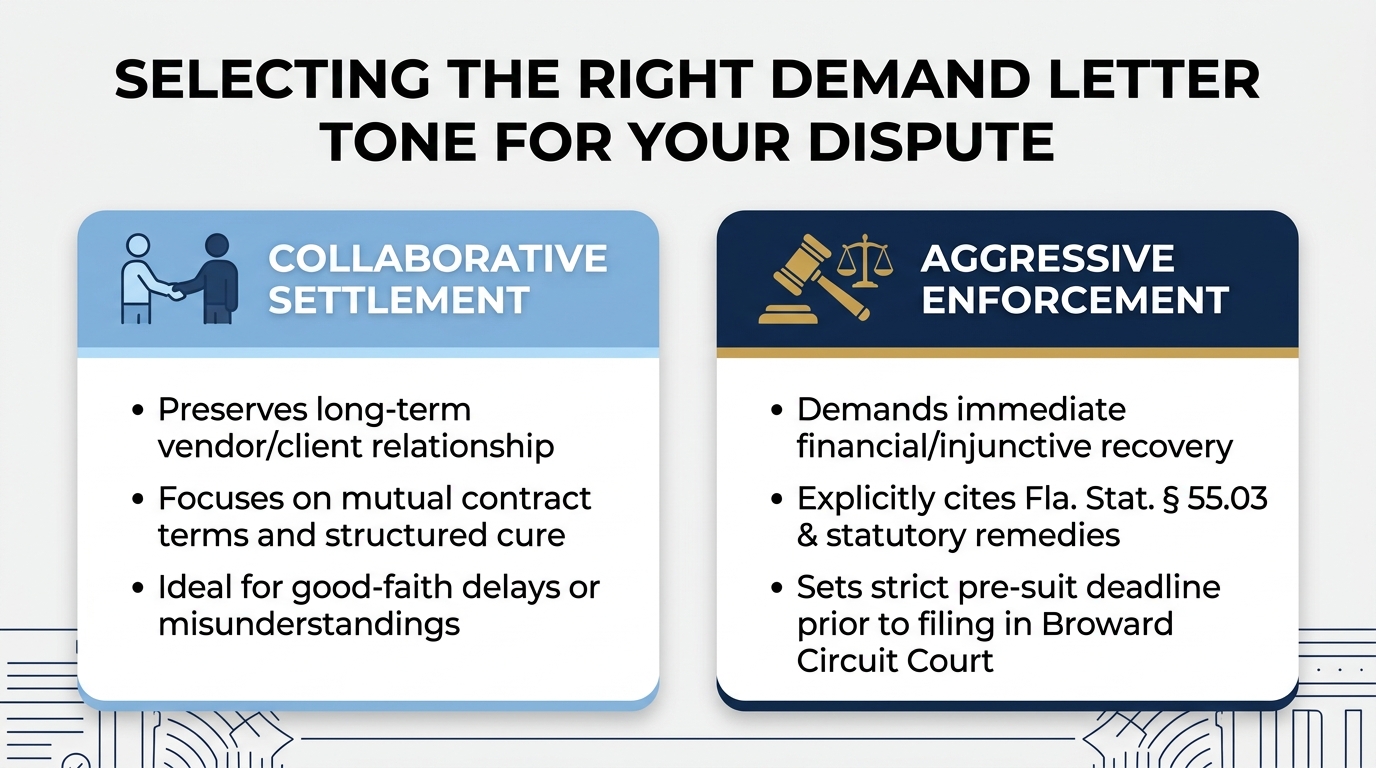
Strategic Tone Selection: Tough vs. Tactful
Before your attorney drafts the letter, you must evaluate one essential question: Do you want to preserve a commercial relationship with this party after the dispute is resolved?
Your business objectives determine the tone and posture of the letter.
┌──────────────────────────────────────────────────────────────────────────┐
│              COMMERCIAL DEMAND LETTER STRATEGIC MATRIX                   │
├────────────────────────────────────┬─────────────────────────────────────┤
│      COLLABORATIVE SETTLEMENT      │        AGGRESSIVE ENFORCEMENT       │
├────────────────────────────────────┼─────────────────────────────────────┤
│ • Objective: Preserve an ongoing   │ • Objective: Rapid financial or     │
│   vendor, client, or partner deal  │   injunctive recovery               │
│ • Focus: Mutual contract terms     │ • Focus: Strict pre-suit notice,    │
│   and structured cure options      │   damages, and statutory remedies   │
│ • Ideal For: Minor delays or       │ • Ideal For: Severe breach, fraud,  │
│   good-faith misunderstandings     │   or persistent non-payment         │
└────────────────────────────────────┴─────────────────────────────────────┘
1. The Collaborative Settlement Approach
If the dispute stems from a temporary cash flow hiccup, operational delay, or honest miscommunication with a long-term partner, an overly aggressive letter can backfire. In such cases, the demand letter adopts a firm yet professional tone. It emphasizes the underlying agreement, specifies the performance gap, and offers workable solutions—such as a structured payment plan—without burning bridges.
2. The Direct Enforcement Approach
Conversely, if you are dealing with intentional contract evasion, fraud, or a debtor refusing to communicate, soft language will yield no results. Consequently, the letter adopts an uncompromising legal stance. It explicitly details statutory causes of action, calculates interest and penalties, attaches supporting exhibits, and gives clear notice that failure to comply will result in an immediate lawsuit filed in local courts like the 17th Judicial Circuit in Broward County.
4 Essential Elements of an Enforceable Florida Demand Letter
To ensure your demand letter commands authority and holds up if the case proceeds to trial, your attorney will structure it with four core components:
1.1. Contractual & Factual Recital: Establishing the factual timeline.
A clear, detailed chronological background outlining the original agreement, purchase orders, or scope of work executed between the parties, alongside specific evidence showing full performance on your part.
2.2. Specific Allegation of Breach: Identifying the exact legal failure.
An explicit accounting of how the opposing party failed to perform, citing specific clauses of the contract, delivery deadlines missed, or unpaid invoices.
3.3. Itemized Statement of Damages: Calculating financial exposure.
A precise breakdown of direct financial losses, incidental expenses, and accrued statutory interest under Fla. Stat. § 55.03, demonstrating exactly what the non-compliance is costing your company.
4.4. Demand for Cure & Litigation Warning: Setting the litigation threshold.
A specific date by which full payment or cure action must occur, accompanied by explicit notice that non-compliance will trigger a civil complaint seeking full damages, court costs, and attorney fees where applicable.
Comparing Dispute Resolution Options
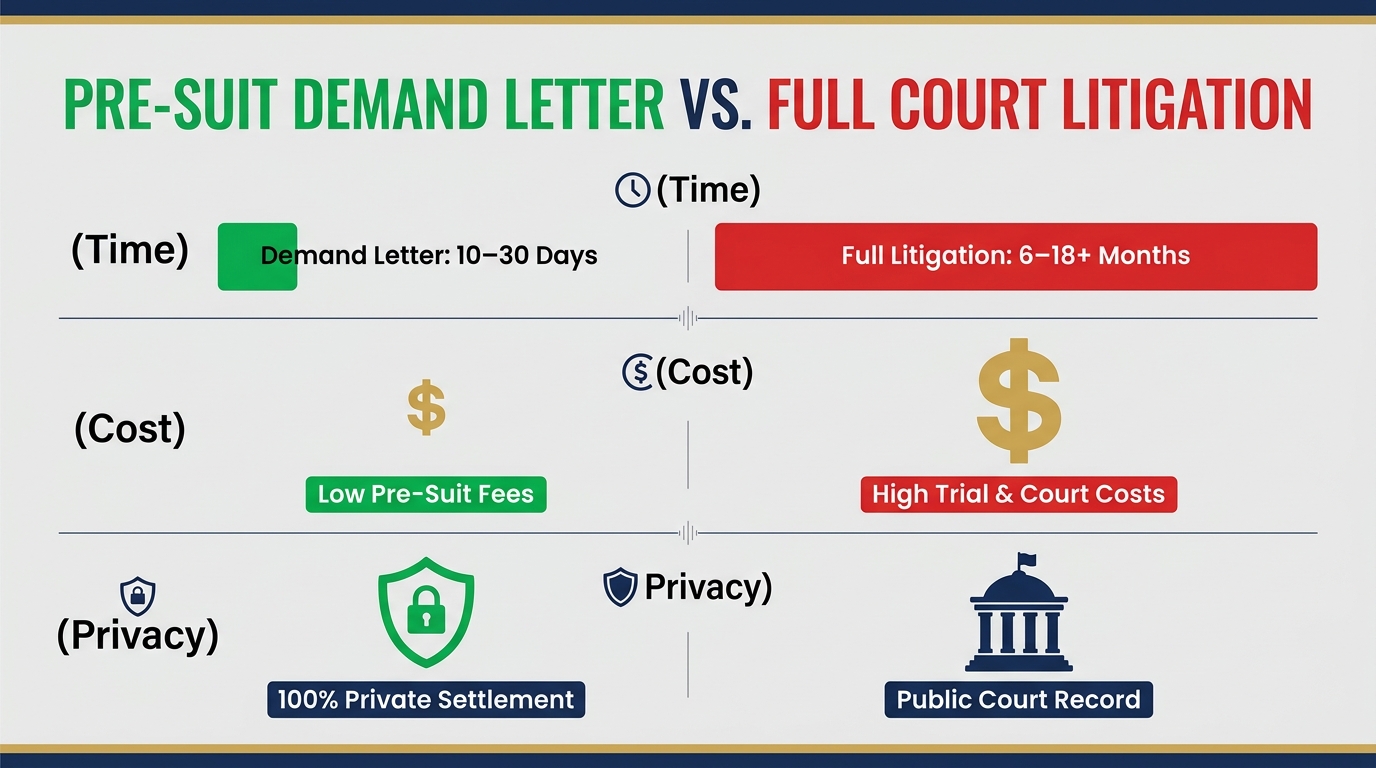
Understanding how a pre-suit demand letter compares to traditional litigation highlights why it should almost always be your first line of defense:
Feature
Legal Demand Letter
Full Court Litigation
Time to Resolution
10 to 30 Days
6 to 18+ Months
Legal Costs
Low, Fixed & Predictable
High (Discovery, Depositions, Trial)
Privacy & Publicity
100% Private
Public Court Record
Business Relationship
Potential to Preserve
Almost Always Destroyed
Enforcement Leverage
High (Pre-suit notice & pressure)
Binding Court Judgment
Protect Your Business Interests with South Florida Counsel
Allowing unpaid invoices, breach of contract, or vendor default to linger threatens your company’s cash flow and growth. The commercial litigation team at Reinfeld & Cabrera P.A. helps business owners across South Florida resolve complex disputes swiftly through strategic demand letters and aggressive trial representation when required.
Schedule a Commercial Consultation
If your company is facing a contract dispute, unpaid account, or partnership conflict, speak directly with an attorney to evaluate your legal remedies:
Direct Line: (954) 866-4878 | Toll-Free: 954-866-HURT
Coral Springs Office: 9625 W. Sample Rd, Coral Springs, FL 33065
Fort Lauderdale Office: 2933 W. Cypress Creek Rd, Suite 201, Ft. Lauderdale, FL 33309
Website: mypersonalattorneys.com
Serving: Coral Springs, Fort Lauderdale, Parkland, Tamarac, Margate, and all of Broward, Miami-Dade, and Palm Beach Counties.
What happens if the other party completely ignores a demand letter?
If the receiving party fails to respond or cure the default within the designated deadline (typically 10 to 30 days), your attorney will move forward with filing a formal civil complaint in the appropriate court—such as the 17th Judicial Circuit Court in Broward County or the 11th Judicial Circuit Court in Miami-Dade County. Furthermore, the demand letter serves as key evidence demonstrating that you made a good-faith pre-suit effort to resolve the dispute, which can influence court decisions regarding legal costs and interest.
Can I write and send a demand letter myself without an attorney?
While a business owner can technically write their own letter, DIY demand letters rarely carry the legal weight needed to force a settlement. Specifically, letters drafted without counsel often omit necessary statutory citations, fail to properly preserve rights to pre-judgment interest under Fla. Stat. § 55.03, or reveal strategic weaknesses that the opposing party’s legal team can exploit. A formal letter on law firm letterhead demonstrates immediate litigation readiness.
Can a demand letter include a claim for statutory attorney fees in Florida?
Yes. Under Florida law, attorney fees are recoverable if explicitly authorized by the underlying contract or by specific Florida statutes, such as Fla. Stat. § 57.105 (sanctions for unsupported claims/defenses) or statutory civil theft claims under Fla. Stat. § 772.11. Consequently, including a specific statutory fee warning in the demand letter significantly increases your settlement leverage.
How much does it cost to have a South Florida lawyer send a demand letter?
Drafting and serving a commercial demand letter is typically billed as a predictable flat fee or a few hours of attorney time, making it significantly more cost-effective than initiating full-scale civil litigation. As a result, most South Florida businesses recover their investment many times over through early pre-suit settlements or full debt recovery.
Before you have a complicated commercial dispute arise, you need to have the commercial litigation attorneys from Reinfeld & Cabrera’s Coral Springs office on your side. We will represent your interests in the courtroom, if necessary, or even during negotiations. Most litigation can be headed off by having your commercial contracts properly reviewed before signing them.
We are experienced commercial litigation attorneys and we will deliver a comprehensive approach to representing you, even in the most complex commercial issues. In today’s competitive business world, you need commercial litigation attorneys who will protect your rights and interests, and you will find us in our Coral Springs office.
You don’t want to be caught in a business dispute without having commercial litigation attorneys to represent you. Reinfeld & Cabrera’s Coral Springs office attorneys will make sure they contribute to your company’s success by providing sound and beneficial advice, guiding you through Florida’s commercial and business laws.
Whether you are looking to form a business partnership or limited liability, or draft partnership, shareholder, or operating agreements, our commercial litigation attorneys in Coral Springs will bring their knowledge and experience to the table. We can also help you with collections of account receivables, any breaches of contract, contract negotiation and preparation and sales disputes and litigations.
We have experience representing all sized business, so it does not matter if you are a new start-up or a well-established multinational corporation, our commercial litigation attorneys in Coral Springs will be able to provide appropriate and valuable counsel.
So whether you are an entrepreneur looking to establish and build your company, or need help resolving a commercial dispute involving your already established company, we are the commercial litigation attorneys for you.
Commercial litigation in Florida may be necessary when a business suffers a significant breach of contract, faces an unresolved ownership dispute, or needs court intervention to protect its legal rights. Before filing a lawsuit, business owners should assess whether litigation is justified by examining:
The legal claim: Whether the other party breached an enforceable agreement or violated a legally protected right.
The available evidence: Whether contracts, financial records, and communications support the claim.
The potential recovery: Whether the damages a business can reasonably recover justify the expense of litigation.
The available alternatives: Whether negotiation, mediation, or another dispute-resolution process could achieve a satisfactory result.
The applicable deadlines: Whether the claim can still be filed within the relevant statute of limitations.
For businesses in Coral Springs and Broward County, evaluating these factors early can help prevent avoidable legal expenses and protect business interests. A commercial litigation attorney can assess the circumstances and explain which legal options may be appropriate.
When Should a Business Consider Commercial Litigation in Florida?
A business should consider commercial litigation in Florida when a serious dispute cannot be resolved through negotiation and legal action may be necessary to enforce its rights or recover losses. Before filing a lawsuit, business owners should evaluate several factors:
Legal grounds: Does the dispute involve a potential breach of contract, a business ownership conflict, or another actionable claim?
Evidence: Can contracts, financial records, and communications substantiate the claim?
Financial exposure: Is the potential recovery sufficient to justify the cost and uncertainty of litigation?
Alternative solutions: Could negotiation, mediation, or arbitration resolve the dispute more efficiently?
Filing deadlines: Is there still time to bring the claim under the applicable Florida statute of limitations?
For businesses in Coral Springs and Broward County, evaluating these factors early can help protect commercial interests and prevent avoidable legal expenses. A commercial litigation attorney can assess the circumstances and explain which legal options may be appropriate.
Why Commercial Litigation Matters to Small Businesses
The financial stakes of business litigation deserve serious attention. A legal dispute can consume resources that a smaller company needs for payroll, inventory, or daily operations. Poor decisions before filing a claim can make the situation worse.
A January 2024 report from the U.S. Chamber of Commerce’s Institute for Legal Reform estimated that U.S. commercial liability costs reached $347 billion in 2021. Small businesses bore approximately $160 billion of that amount. The report also estimated that, relative to revenue, these costs were seven times greater for businesses earning $1 million or less annually than for businesses earning at least $50 million.
A separate report published in November 2024 estimated that the U.S. tort system accounted for $529 billion in costs and compensation during 2022. For Florida, the report estimated total tort costs of approximately $48.18 billion. It also reported average annual tort-cost growth of 8.7% for business cases nationwide between 2016 and 2022.
These figures require an important distinction. Both reports examine tort-related costs, which are not equivalent to the cost of ordinary commercial contract litigation. They do not establish what a particular business lawsuit will cost or how often a contract dispute ends in court. The figures nevertheless illustrate the broader financial exposure that legal disputes can create for businesses.
For a company in Coral Springs, the practical lesson is to assess a potential claim carefully before spending heavily on litigation. A strong legal position matters, but the likely recovery must justify the expense and uncertainty of pursuing it.
When Should a Business Consider Commercial Litigation?
The decision to file a commercial lawsuit depends on the nature of the dispute and the available legal remedies. Several situations may justify a closer assessment by a commercial litigation attorney.
1. A Contractual Breach Has Caused Substantial Losses
A breach of contract occurs when a party fails to perform an obligation required by an enforceable agreement, without a valid legal excuse. Examples include a supplier refusing to deliver goods, a contractor abandoning agreed work, or a customer failing to pay for completed services.
The existence of a disagreement does not automatically establish a breach. The agreement’s language matters, as do any conditions that had to be satisfied before performance became due.
A business considering litigation should identify the specific contractual obligation at issue. It should then assess whether the other party failed to meet that obligation and what losses can be supported by evidence.
Case example: Chetu, Inc. v. CA Short Company (2026)
In this case, the Fourth District Court of Appeal considered a software services contract that expressly excluded certain categories of damages. After the software provider stopped performing, the customer incurred costs to complete the project using other programmers. Although the trial court awarded those replacement costs, the appellate court reversed the $95,505.42 award because the contract barred the consequential damages at issue.
The decision demonstrates why businesses should review limitation-of-liability clauses before signing an agreement and again when a dispute arises. A company may suffer genuine financial losses yet remain unable to recover particular categories of damages because of its contract.
2. A Business Partnership Dispute Has Become Unmanageable
Disagreements between business owners can become difficult to resolve when the parties disagree over financial obligations or control of the company. A dispute may involve access to business records, the distribution of profits, or the interpretation of an operating agreement.
Some disagreements can be resolved through negotiation or mediation. Litigation may become necessary when one party refuses to honor an enforceable agreement or when court intervention is needed to determine legal rights.
Case example: McDowell v. Moore (2026)
The Fourth District Court of Appeal reviewed a dispute involving the compensation arrangements of a former owner of a water sports business. The parties had discussed commission payments, but they never finalized a specific commission schedule. The court’s decision addressed the enforceability of the compensation arrangement in the context of the broader business relationship.
The case illustrates the risks of leaving essential financial terms unresolved. An agreement may describe the parties’ intentions without providing a sufficiently definite basis for enforcing a particular payment obligation.
Negotiation is often a sensible first step when a dispute arises. The parties may be able to agree on payment terms, revised performance obligations, or another solution without filing a lawsuit.
However, negotiation has limits. A business may need to consider litigation when the other party refuses to engage meaningfully or continues conduct that threatens its contractual rights.
Before filing, an attorney can evaluate the available evidence and determine whether a formal demand, mediation, arbitration, or court action is the most appropriate next step.
Some disputes involve rights or remedies that cannot be secured through an informal agreement alone. Depending on the facts and applicable law, a business may seek a court order, a determination of contractual rights, or monetary damages.
The appropriate remedy depends on the claim. A court will not automatically grant the relief a business requests simply because the relationship has deteriorated.
An attorney should evaluate the legal basis for the requested remedy before a company commits to a lawsuit. This assessment is particularly important when the dispute could affect business operations or involve substantial financial exposure.
What Should You Do Before Filing a Commercial Lawsuit?
Preparation can influence how effectively a business pursues its claim. Before filing a lawsuit in Broward County, business owners should consider the following steps.
Preserve Relevant Documents and Communications
Keep copies of the signed contract and any amendments. Emails, invoices, payment records, meeting notes, and messages may help establish what the parties agreed to do and whether either side failed to perform.
Avoid deleting relevant communications or altering business records after a dispute emerges. An attorney can explain which documents should be preserved and how to organize the evidence.
Review the Contract Carefully
The agreement may contain provisions governing dispute resolution, notice requirements, attorney’s fees, damages, or the location where a lawsuit must be filed.
These provisions can affect the available options. For example, a contract may require mediation or arbitration before a party can pursue other remedies. A limitation-of-liability clause may also restrict the damages available after a breach.
The terms should be reviewed in the context of the actual dispute rather than treated as boilerplate.
Calculate the Potential Financial Recovery
A business should estimate the losses it can reasonably establish rather than rely on its initial assessment of what the dispute has cost. Unpaid invoices, documented expenses, and other recoverable losses may be relevant, depending on the claim and applicable law.
The analysis should also account for legal fees, litigation expenses, the time required from employees or owners, and the possibility that the other party will be unable to pay a judgment.
A claim can have legal merit without being economically sensible to pursue in court.
Assess the Other Party’s Position
A business should consider the defenses the other party may raise. The opposing party might dispute the existence of an agreement or argue that it performed its obligations. It may also claim that the business failed to meet a contractual condition.
Identifying these issues early helps an attorney assess the strengths and weaknesses of the case. It can also clarify whether a negotiated resolution would be preferable to litigation.
Check the Applicable Deadline
Florida law imposes deadlines for filing civil claims. Under section 95.11 of the Florida Statutes, the general limitation period is five years for many actions founded on a written instrument and four years for many actions on contracts or obligations not founded on a written instrument. Exceptions and other rules can affect the applicable deadline.
The period may depend on the type of claim, the date the cause of action accrued, and other facts. Businesses should not assume that every contract dispute follows the same deadline.
Can a Business Resolve a Dispute Without Going to Court?
Yes. Litigation is one option, but it is not always the most effective way to resolve a commercial disagreement.
Negotiation allows the parties to communicate directly and explore a settlement. Mediation introduces a neutral third party who helps them work toward an agreement, although the mediator generally does not impose a decision. Arbitration involves submitting a dispute to an arbitrator for a decision under the applicable arbitration agreement and rules.
The best option depends on the contract and the nature of the conflict. A business should review any dispute-resolution clause before choosing a process.
Settlement also requires careful drafting. In Trace Elements, Inc. v. Mackensen (2026), the Florida Supreme Court held that a joint proposal for settlement must allocate the amount and terms attributable to each party under Florida Rule of Civil Procedure 1.442(c)(3). The ruling underscores the importance of following procedural requirements when a settlement proposal could affect a party’s entitlement to attorney’s fees.
A settlement proposal should therefore be evaluated as a legal document, not merely as a figure offered to end a disagreement. Depending on the circumstances, the wording and structure of an offer can have consequences beyond the immediate negotiations.
A commercial litigation attorney can evaluate whether the facts support a legal claim and explain the remedies that may be available. The attorney can also review the contract, assess the evidence, and identify issues that could affect the outcome.
Legal guidance may be useful before a lawsuit is filed. Early review can help a business understand its position and avoid decisions that weaken its case.
If litigation becomes necessary, counsel can prepare the pleadings and develop a strategy for presenting the claim. The process may involve exchanging evidence, taking depositions, participating in mediation, or presenting the dispute at trial.
The appropriate strategy depends on the dispute. Some cases turn on the interpretation of a written agreement, while others require a closer examination of business records or witness testimony.
As Stuart Reinfeld explains:
“A business dispute should be evaluated in light of the agreement the parties actually made, the evidence available, and the remedy the law permits. Acting before those issues are clear can make an already difficult situation more expensive.”
The goal is to make informed decisions at each stage of the dispute. A lawsuit should serve a defined legal and business purpose rather than become an automatic response to a disagreement.
Commercial Litigation in Coral Springs and Broward County
Businesses in Coral Springs and throughout Broward County may face disputes involving unpaid contractual obligations, ownership disagreements, or failed commercial transactions. The appropriate response depends on the legal rights involved and the practical consequences of leaving the dispute unresolved.
An attorney familiar with commercial disputes can help assess the merits of a potential claim and explain the available routes to resolution. That assessment should account for the agreement’s terms, the evidence supporting the claim, and the financial implications of pursuing legal action.
Alan Reinfeld notes:
“The decision to pursue a business dispute should begin with a clear understanding of what went wrong and what a successful resolution would accomplish. The legal process is most useful when it serves a realistic objective.”
If your business is facing a commercial dispute in Coral Springs or elsewhere in Broward County, consider obtaining legal advice before taking steps that could affect your position.
Frequently Asked Questions About Commercial Litigation in Florida
What is the most common reason for commercial litigation?
Contract disputes are a major category of commercial litigation. These cases can involve unpaid invoices, disagreements over performance, or disputes about the meaning of a contractual provision. The specific grounds for a lawsuit depend on the facts and applicable law.
How do I know whether my business should file a lawsuit?
Consider whether you have an enforceable legal claim and evidence supporting it. You should also assess the potential recovery against the expected cost of litigation. An attorney can help evaluate these issues before you decide how to proceed.
How long do I have to file a commercial lawsuit in Florida?
The deadline depends on the claim. Many actions founded on a written instrument have a five-year limitation period, while many actions on contracts not founded on a written instrument have a four-year period under Florida Statutes § 95.11. Exceptions may apply, so the deadline should be confirmed for the specific dispute.
Can a commercial dispute be resolved without litigation?
Yes. Negotiation or mediation may produce a settlement without a court proceeding. Arbitration may also be available or required under the contract. The appropriate process depends on the agreement and the parties’ willingness to resolve the matter.
What evidence is important in a commercial litigation case?
The relevant evidence depends on the dispute. A case may require the signed contract, invoices, payment records, emails, or other communications showing what the parties agreed to do. Financial records may also help establish the losses a business claims.
Can a business recover attorney’s fees in a commercial lawsuit?
Sometimes. Recovery may depend on a contractual provision, a statute, or another applicable legal basis. Florida’s offer-of-judgment framework can also affect attorney’s fees in qualifying cases, but its requirements must be satisfied. Businesses should not assume that the losing party will automatically have to pay the winner’s legal fees.
Should I send a demand letter before filing a lawsuit?
A demand letter may help explain the legal basis of a claim and give the other party an opportunity to resolve the dispute. Whether it is advisable depends on the contract, the urgency of the situation, and any applicable notice requirements. A lawyer can help determine whether a demand letter is an appropriate first step.