
How to Collect a Business Debt in Florida: From Unpaid Invoice to Judgment

Business debt collection attorney meeting with a Coral Springs business owner

A business does not have to accept an unpaid invoice as the cost of doing business.

When another company, customer, contractor, or client stops paying, the first step is usually figuring out exactly what is owed, why it is owed, and what evidence supports the claim. From there, a creditor may negotiate payment, send a formal demand, pursue a lawsuit, or, if a judgment is obtained, use Florida’s judgment enforcement procedures to pursue available assets.

There is an important difference between winning a debt case and collecting the money.

A judgment establishes a legal obligation. It does not automatically put a check in your company’s bank account.

Florida’s courts handle an enormous civil caseload. The state’s 2023-24 statistical report shows nearly 2.4 million county civil filings statewide, including small claims and other county civil matters. Florida’s trial courts as a whole manage more than two million civil case filings annually.

Business debt collection is only one part of that system, but the basic lesson is useful: a claim for money needs to be treated as a legal claim, not merely as an increasingly irritated series of emails.


What Should You Do When a Business Owes You Money?

Start by establishing the debt.

Look at the contract, invoice, purchase order, delivery records, emails, payment history, account statements, and any other documents showing what was agreed and what happened afterward.

Ask a few straightforward questions:

  • What did the debtor agree to pay?
  • What did your business provide?
  • When was payment due?
  • How much has been paid?
  • What remains outstanding?
  • Has the debtor disputed the amount or the underlying work?
  • Does the contract contain provisions concerning interest, attorney’s fees, venue, or dispute resolution?
  • Did anyone personally guarantee the obligation?

That last question can become important.

If the customer is an LLC or corporation, the company’s debt does not automatically become the owner’s personal debt. A creditor needs a legal basis for pursuing an individual separately, such as a guaranty or another applicable theory of liability.

That is one reason the paperwork deserves attention before anyone starts threatening to sue.


What Evidence Do You Need to Collect a Business Debt?

A creditor’s strongest evidence often consists of ordinary business records.

A signed contract is useful. So are invoices showing the amounts due, records showing that goods were delivered or services were performed, correspondence acknowledging the balance, and payment records showing what happened afterward.

Sometimes there is no single document that tells the whole story.

Florida recognizes an account stated claim in appropriate circumstances. The Florida Supreme Court has explained that an account stated depends on an agreement concerning the amount owed and an obligation to pay that amount.

Florida’s standard jury instructions describe an account stated as involving transactions for which a specific amount is due and note that an account statement is not automatically conclusive if evidence establishes fraud, mistake, or error.

So an unpaid invoice should not be treated as magic evidence.

A debtor can dispute what was billed, whether the work was completed, whether the goods were delivered, whether the amount is correct, or whether the person receiving the invoice had authority to incur the obligation.

The more clearly the business can reconstruct the transaction, the easier it becomes to evaluate the claim.


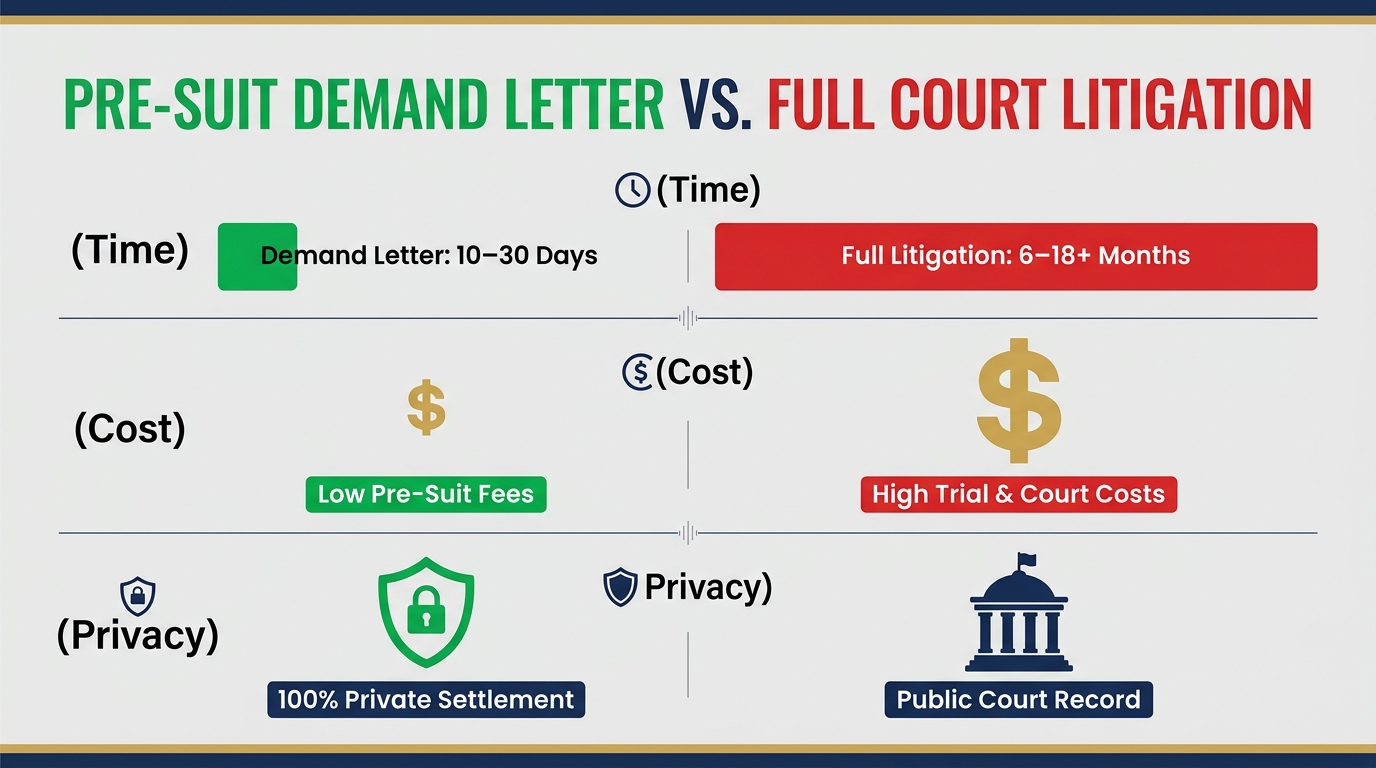
Should You Send a Demand for Payment Before Suing?

Often, yes.

A demand letter can identify the amount claimed, explain the contractual or factual basis for the debt, establish a deadline for payment, and give the debtor an opportunity to resolve the matter before litigation.

It can also reveal what the actual dispute is.

A company that responds, “We agree that we owe $40,000 but need 90 days” presents one problem.

A company that responds, “Your employees never completed the work and we owe nothing” presents another.

And a company that stops answering altogether presents yet another.

The demand process therefore has a practical purpose beyond giving someone one final chance to pay.

It can help establish what the parties actually disagree about.


Can You Sue a Business for an Unpaid Debt?

Yes, when the facts support a legally recognized claim.

The appropriate cause of action depends on the transaction. A creditor may have a breach of contract claim, an account stated claim, an open account claim, or another theory depending on the circumstances.

The contract itself can also determine what remedies are available.

Florida law generally gives five years to bring a legal or equitable action founded on a written contract or other liability founded on a written instrument. The limitations period is different for various other types of claims, including claims based on unwritten obligations.

That makes one piece of advice particularly important:

Do not assume you have plenty of time because the debtor keeps promising to pay.

A business can spend months or years hearing variations of “the check is coming” while the legal clock continues to run.


A recent Florida case illustrates the problem.

An Unpaid Legal Bill That Stayed Unpaid for Years

In LAD Commercial, LLC v. Eagle Trace at Vero Beach Homeowners’ Association, Inc., the Fourth District Court of Appeal considered a breach of contract claim arising from unpaid legal services.

The invoices totaled $20,179.08. The alleged unpaid work dated back years, and the defendant argued that the claim was barred by the statute of limitations. The litigation ultimately required the appellate court to examine when the cause of action accrued and how the contract’s payment provisions affected that analysis.

The lesson is not that every unpaid invoice becomes a statute of limitations dispute.

It is that waiting can turn a collection problem into a limitations problem.


What If the Debtor Disputes the Debt?

Then the case needs to be analyzed rather than treated as a simple collection matter.

Suppose a contractor invoices a business for $75,000. The business refuses to pay and says the contractor abandoned the project.

Now there are factual questions:

  • Was there a contract?
  • What work was required?
  • What work was actually completed?
  • Were there change orders?
  • Did the customer approve them?
  • Was the work defective?
  • Did the customer terminate the contract?
  • What damages did either side suffer?

The invoice alone cannot answer those questions.

Commercial litigation often turns on reconstructing the transaction from the documents and testimony rather than simply proving that an invoice exists.


Can You Sue the Owner of an LLC Personally?

Not merely because the LLC owes the money.

An LLC is a separate legal entity, and the existence of a business debt does not automatically create personal liability for its members.

A personal guaranty can change that.

So can other circumstances, depending on the facts and applicable law.

This is an area where careless collection advice can create a serious problem. A creditor should identify the actual legal basis for pursuing an individual instead of assuming that the person who owns the company and the company itself are interchangeable.

If the contract says that the company’s owner personally guarantees payment, that provision deserves close examination.

If there is no guaranty, the analysis is different.


What Happens If You File a Business Debt Lawsuit?

The case moves into the ordinary civil litigation process.

Depending on the claim and amount involved, that can include:

  1. Filing the complaint
  2. Serving the defendant
  3. Receiving the defendant’s response
  4. Conducting discovery
  5. Negotiating a settlement
  6. Resolving motions and disputed legal issues
  7. Preparing for trial if necessary
  8. Obtaining a judgment
Commercial litigation attorney reviewing business debt evidence in Broward County

Florida’s civil procedure system was significantly updated beginning January 1, 2025. The changes emphasize active case management, deadlines, initial discovery disclosures, supplementation, and discovery proportional to the needs of the case.

That does not mean every unpaid invoice will turn into a dramatic courtroom battle.

Many cases settle.

Some are resolved through motion practice.

Some proceed to trial.

And some defendants simply fail to respond, creating a different procedural situation.

The important point is that filing a lawsuit starts a legal process. It does not mean the creditor can immediately take the debtor’s property.


What Happens After You Win a Judgment?

This is the part that the old article barely addressed.

A judgment is not the same thing as payment.

Florida law provides several mechanisms for enforcing money judgments.

Under Florida Statute § 77.03, a judgment creditor can seek a writ of garnishment after obtaining a judgment. Garnishment can reach certain money or property held by a third party for the judgment debtor, subject to the requirements and limitations of Florida law.

Florida’s execution statutes also provide for levy and sale of certain property to satisfy a judgment. Section 56.061 identifies categories of property subject to execution, including certain real and personal property and corporate stock.

Florida also permits a judgment creditor to acquire a judgment lien on certain personal property, including property subject to execution and certain payment intangibles and accounts.

Those remedies can matter when a debtor has assets but simply refuses to pay.

They also have limits.

Property may be exempt. Other creditors may have priority. Secured creditors may have existing rights. Bankruptcy can change the situation entirely.

A judgment gives the creditor legal leverage and enforcement tools. It does not create assets that do not exist.


Can You Garnish a Business Bank Account?

Potentially, but garnishment has a specific legal procedure.

Florida Statute § 77.03 provides for issuance of a writ after judgment. Florida law also permits pre-judgment garnishment in certain circumstances, but the requirements are considerably more specific. Section 77.031 requires a verified motion or affidavit containing particular factual allegations, including the nature and amount of the claim and why the plaintiff believes the defendant will not have sufficient property available for execution.

That is a good example of why “just garnish their account” is not legal strategy.

There is a procedure.

There are requirements.

And there may be defenses and exemptions.


What If the Debtor Has Assets but Still Refuses to Pay?

Florida’s judgment enforcement statutes give creditors tools for investigating and reaching certain property.

Chapter 56 includes proceedings supplementary, which can be used in appropriate circumstances after a judgment. Florida law also addresses discovery concerning a judgment debtor’s assets and execution procedures.

A judgment creditor may therefore have options even when the debtor has not voluntarily written the check.

But those options depend heavily on what the debtor actually owns, how the assets are titled, whether other creditors have claims, and whether exemptions or other legal restrictions apply.

That investigation can become particularly important when a business appears to be operating normally while claiming that it has no money to satisfy a judgment.


Can You Recover Attorney’s Fees and Interest?

Sometimes.

Attorney’s fees are not automatically awarded simply because a business wins a lawsuit.

A contract may provide for attorney’s fees. Florida Statute § 57.105(7) provides reciprocity for certain contractual attorney’s fee provisions, allowing the prevailing party to recover reasonable attorney’s fees in an action concerning a contract when the statutory requirements are met.

Florida’s courts have also dealt with the issue in collection cases.

In Ham v. Portfolio Recovery Associates, LLC, the Florida Supreme Court considered whether a contractual attorney’s fee provision could become reciprocal when the creditor pursued an account stated claim rather than suing directly under the underlying credit agreement. The Court held that the statutory reciprocity provision applied because of the relationship between the account stated claim and the underlying contract.

That is a useful warning against treating attorney’s fees as an automatic add-on to every debt.

The contract, the cause of action, and the applicable statute all matter.

Interest also has its own rules. Florida Statute § 55.03 establishes the framework for the interest rate applicable to judgments and provides for quarterly adjustments based on the statutory formula.


What If You Already Have a Judgment but Still Have Not Been Paid?

Then the legal problem has changed.

You are no longer trying to establish that the debtor owes the money. You are trying to enforce an established judgment.

That can involve:

  • Judgment liens
  • Garnishment
  • Execution
  • Discovery concerning assets
  • Proceedings supplementary
  • Negotiated payment arrangements
  • Other enforcement mechanisms permitted by law

Florida Statute § 55.081 provides that a judgment generally cannot remain a lien on Florida real or personal property indefinitely; the statutory period is 20 years from entry of the judgment, subject to the statute’s provisions.

That does not mean a creditor should wait 19 years and see what happens.

It means Florida gives judgments a legal life that can extend well beyond the original lawsuit.


What If the Business Is Closing or Moving Assets?

This is where timing can become particularly important.

A creditor who has reason to believe that a debtor is transferring assets, shutting down operations, or reorganizing its affairs may need legal advice quickly.

Florida law contains procedures governing execution, judgment liens, proceedings supplementary, and other post-judgment remedies. The appropriate response depends on what is actually happening and what assets are involved.

A creditor should also avoid taking matters into its own hands.

Threatening customers, seizing property without legal authority, making false accusations, or attempting to bypass court procedures can create entirely new legal problems.

Collection is supposed to recover a debt.

It should not create another lawsuit.


How Long Do You Have to Collect a Business Debt in Florida?

There is no single limitations period for every business debt.

For example, Florida Statute § 95.11 generally provides a five-year limitations period for an action founded on a written instrument. Other claims can have different periods.

The nature of the obligation matters.

So does the date on which the particular cause of action accrued.

A creditor should identify the legal claim before assuming that an old invoice is still enforceable.

This is one reason an attorney should review an aging account before the business simply writes it off or sends another routine reminder.


A Business Debt Is Still a Business Problem

An unpaid $5,000 invoice can be irritating.

Some unpaid $50,000 invoice can disrupt payroll.

An unpaid $500,000 obligation can change whether a business can continue operating.

That is why debt collection should be approached in proportion to the amount at stake, the strength of the evidence, the debtor’s financial position, and the cost of pursuing the claim.

There is also a relationship question.

A company may want the money without destroying a valuable customer relationship. Another company may have reached the point where continuing to negotiate makes little economic sense.

Those are business decisions.

The legal job is to identify the available remedies and the consequences of using them.


When Should You Hire a Business Debt Collection Attorney?

Legal advice can be particularly useful when:

  • The amount owed is substantial
  • The debtor disputes the debt
  • The contract contains complicated provisions
  • A personal guaranty is involved
  • Several businesses or individuals are connected to the transaction
  • The debtor has stopped responding
  • You suspect assets are being moved
  • The debt is approaching a limitations deadline
  • You need to file a lawsuit
  • You already have a judgment
  • You need to investigate enforcement options
  • Bankruptcy has been threatened or filed

The earlier the legal analysis occurs, the more options may still be available.

That does not mean every $2,000 invoice needs a lawsuit.

Sometimes a well-supported demand gets the check.

There are cases where a payment agreement makes commercial sense.

Sometimes litigation is necessary.

And sometimes the debtor’s financial condition makes collecting the judgment itself the hardest part.

Florida attorney discussing judgment enforcement with a business owner

Frequently Asked Questions

How do I collect a business debt in Florida?

  • Begin by documenting the debt, reviewing the contract and supporting records, and determining whether the debtor disputes the amount or the underlying obligation. Depending on the circumstances, collection may involve a demand for payment, negotiation, litigation, judgment, and post-judgment enforcement.

Can I sue a business for an unpaid invoice?

  • Yes, when the facts support a legally recognized claim. The appropriate claim depends on the transaction, contract, records, and applicable Florida law.

Can I personally sue the owner of an LLC for the company’s debt?

  • Not automatically. An LLC is a separate legal entity. Personal liability generally requires its own legal basis, such as a personal guaranty or another applicable theory.

Could I recover attorney’s fees in a business debt lawsuit?

  • Possibly. A contract, statute, or other legal basis may authorize recovery. Florida Statute § 57.105(7) provides for reciprocal attorney’s fee rights in certain contract actions when the statutory requirements are satisfied.

Can I garnish a debtor’s bank account in Florida?

  • Potentially. Florida law provides procedures for garnishment, including post-judgment garnishment under § 77.03. Exemptions, procedural requirements, and the identity of the account holder can affect whether garnishment is available.

What happens after I win a judgment?

  • The creditor may have several enforcement options, including garnishment, execution, judgment liens, and proceedings supplementary, depending on the debtor’s assets and the circumstances.

How long do I have to sue for an unpaid business debt in Florida?

  • It depends on the legal claim. Florida generally provides five years for actions founded on a written instrument, while other claims can have different limitations periods.

Is a judgment the same as getting paid?

  • No. A judgment establishes the legal obligation, but the creditor may still need to use available enforcement procedures to collect the judgment.

Collecting Business Debts in Coral Springs and Broward County

A business in Coral Springs may sell services to another Broward County company, supply goods to customers across South Florida, or have contracts with companies anywhere in the country.

The location of the debtor, the terms of the contract, the applicable law, and the debtor’s assets can all affect the collection strategy.

For a Coral Springs business dealing with a significant unpaid account, the first useful step may be a review of the transaction itself: the contract, invoices, communications, payment history, and any documents showing what the debtor agreed to pay.

From there, the appropriate path may be a demand, negotiation, lawsuit, judgment enforcement, or some combination of those steps.

The important thing is to know which problem you actually have.

An unpaid invoice is one problem. A disputed contract is another. An unpaid judgment is a third.

Treating all three as “someone hasn’t paid us yet” is how a relatively straightforward collection matter can become unnecessarily expensive.


Talk With a Coral Springs Business Litigation Attorney

If your business is owed money by a customer, contractor, company, or other party, Reinfeld & Cabrera, P.A. can review the underlying transaction and discuss the legal options available for pursuing the debt.

That may mean evaluating the contract and records before a lawsuit is filed. It may mean negotiating payment. It may mean litigating the claim. And if you already have a judgment, the analysis may shift toward enforcement.

The right approach depends on the debt, the evidence, the debtor, and the remedies available under Florida law.

Contact Reinfeld & Cabrera, P.A. in Coral Springs to discuss your business debt collection matter.

This article provides general information about Florida business debt collection and is not a substitute for legal advice concerning a particular debt, contract, lawsuit, or judgm



What Happens to Your Business If You Die or Become Incapacitated?

Business succession planning attorney meeting with a business owner in Coral Springs, Florida

Fast Answer: If a Florida business owner dies or becomes incapacitated, what happens to the business depends on the business structure, governing documents, estate plan, and applicable Florida law. Ownership may pass to heirs or other beneficiaries, while management authority may remain with other owners or designated decision makers. A business succession plan can establish what happens to the owner’s interest and who can manage the company when the owner can no longer do so.

Business owners spend years building companies that depend on their judgment, relationships, skills, and decisions.

Then life does what life does.

An owner dies. An illness leaves someone unable to work. A business partner suddenly has to deal with an estate. Family members inherit an ownership interest without knowing how the company operates. Employees are left wondering who can sign contracts, access accounts, or make decisions.

These situations raise two separate questions:

Who owns the business interest, and who has authority to run the business?

Those answers do not always point to the same person.

A Florida business succession plan addresses what happens to ownership and management when an owner dies, becomes incapacitated, retires, or otherwise can no longer participate in the company. Depending on the business, that plan may involve an operating agreement, shareholder agreement, buy-sell agreement, trust, power of attorney, estate plan, or several of these documents working together.


What Happens to a Business When the Owner Dies?

The answer depends heavily on the type of business and its governing documents.

If a person owns an interest in a Florida LLC, the ownership interest does not necessarily give the person’s heirs an automatic right to step into the owner’s management role.

Florida’s LLC statute distinguishes between a transferable interest and the rights of a member. A transferee generally receives the economic rights associated with the transferred interest but does not automatically acquire the right to participate in management or access company records.

Death can also cause an individual to cease being a member under Florida’s LLC statute, while the consequences of that dissociation depend on the governing law and the company’s operating agreement.

That can create a surprisingly awkward situation.

Imagine a company owned by two siblings. One dies and leaves everything to a spouse who has never worked in the business. The spouse may inherit an economic interest, while the surviving sibling continues operating the company.

Now everyone has a legitimate interest in what happens next.

The spouse wants to know what the inherited interest is worth. The surviving sibling wants to know who has authority to make business decisions. The company needs to continue operating.

An operating agreement or buy-sell arrangement can address those questions before anyone has to improvise.


What Happens If a Business Owner Becomes Incapacitated?

Death and incapacity create different legal problems.

When an owner dies, the estate and succession process becomes relevant. When an owner becomes incapacitated, the business may need someone with legal authority to act while the owner is still alive.

Florida’s Power of Attorney Act defines incapacity in part as the inability to take actions necessary to obtain, administer, and dispose of property, including business property.

A properly drafted durable power of attorney can allow an agent to continue exercising specified authority despite the principal’s later incapacity.

The document needs to grant the authority actually required. Florida law provides that an agent may exercise authority specifically granted in the power of attorney, and certain powers require specific enumeration.

That makes the details important for a business owner.

A document authorizing someone to handle personal banking does not necessarily answer every question involving ownership interests, company management, securities, contracts, or other business decisions.

A succession plan should therefore consider incapacity separately from death.


Does a Will Control My Business After I Die?

A will can determine who receives assets that pass through the estate, including an ownership interest in a business.

But the will does not automatically rewrite the company’s governing documents.

An LLC’s operating agreement governs important aspects of the company’s internal affairs. Florida law expressly provides that an LLC is bound by its operating agreement and that a person who becomes a member is generally bound by it as well.

Corporations have their own governing documents and statutory rules concerning shareholders, shares, directors, officers, and shareholder agreements. Florida’s Business Corporation Act separately addresses restrictions on share transfers and shareholder agreements.

This creates an important planning issue:


Your estate plan and your business documents need to work together.

Suppose a business owner leaves the company to three children in equal shares. The will may produce three equal ownership interests.

But what happens if one child wants to run the company, another wants to sell, and the third wants cash rather than an operating role?

The will alone may not provide a practical answer.


Can a Trust Own a Business Interest?

Yes. A trust can hold certain business interests, and trusts can be part of a broader estate and succession plan.

That does not mean putting an LLC interest into a trust automatically solves the succession problem.

The trust document has to address who controls the trust, who benefits from it, and what the trustee can do with the property. Florida law gives trustees significant powers, including powers to acquire and sell trust property, subject to the terms of the trust and the trustee’s fiduciary duties.

The business documents also have to be considered.

For example, an LLC operating agreement may contain restrictions or requirements concerning transfers, membership, voting, management, or the admission of new members.

A trust can therefore be one component of a succession plan rather than a substitute for the entire plan.


What Is a Buy-Sell Agreement?

A buy-sell agreement establishes rules for what happens to an owner’s business interest when a specified event occurs.

Depending on how it is drafted, the triggering event might include death, disability, retirement, divorce, termination of employment, or another circumstance affecting ownership.

A typical arrangement might give the company or the remaining owners the right, or sometimes the obligation, to purchase the departing owner’s interest.

The agreement can also address valuation and payment terms.

Consider the three-sibling example again.

If one sibling dies, the agreement might provide a mechanism for the surviving owners to purchase that sibling’s interest at a defined valuation methodology. The estate receives value, while the remaining owners retain control of the company.

That is a very different outcome from leaving three people to negotiate ownership after the death.

The details matter. Valuation formulas that seemed reasonable five years ago may produce strange results after the business has grown substantially. Funding also needs consideration. A purchase obligation is useful only if the parties have a realistic way to pay for it.


What Happens to a Family Business When the Owner Dies?

Family businesses create another succession problem: inheritance and management can point in different directions.

A child may inherit an ownership interest without having any experience running the company. Another child may have spent twenty years working in the business and expect to continue operating it.

Those interests can coexist, but the documents need to account for them.

A useful succession plan can address:

  • Who can own the business
  • Who can manage the business
  • Whether family members can transfer their interests
  • Whether existing owners have purchase rights
  • How an owner’s interest will be valued
  • How a purchase will be funded
  • What happens if an heir does not want to participate in the company
  • What happens if the owners disagree
  • What happens if an owner becomes incapacitated

As Alan Reinfeld puts it:

“A 50/50 split sounds wonderfully democratic until two people have a 50/50 disagreement.”

That problem becomes considerably harder when one of the two owners has died and the surviving owner is now dealing with the deceased owner’s estate.

Attorney discussing business continuity and incapacity planning with a Broward County business owner

Who Runs the Business While the Estate Is Being Settled?

This is one of the practical questions business owners often overlook.

A business does not necessarily stop operating because its owner has died. Employees still need to be paid. Customers still expect service. Contracts still need attention. Taxes and other obligations continue.

But the legal authority to make decisions can become complicated depending on the company’s structure and the owner’s role.

An LLC may be member-managed or manager-managed. Florida law provides different management structures, with management generally vested in the members of a member-managed LLC and in the managers of a manager-managed LLC.

That means the succession plan should account for management authority, not merely inheritance.

The same principle applies to corporations, partnerships, and other business structures.

The person who inherits the business and the person who runs the business do not necessarily have to be the same person.


What Documents Should a Business Owner Have in Place?

There is no universal package that works for every business.

Depending on the circumstances, a Florida business owner may need to coordinate several documents:

Operating agreement

For an LLC, the operating agreement can establish rules concerning ownership, management, voting, transfers, and other internal matters. Florida law gives operating agreements an important role in governing the company’s affairs.

Shareholder agreement

Corporations may use shareholder agreements to establish rules concerning ownership and the relationship among shareholders.

Buy-sell agreement

This can establish what happens when an owner dies, becomes disabled, retires, or experiences another specified triggering event.

Will

A will can address assets that pass through the estate, including business interests that are part of the probate estate.

Trust

A trust may hold business interests and establish rules for their administration and eventual distribution.

Durable power of attorney

A properly drafted durable power of attorney can address authority during incapacity, subject to the powers actually granted in the document.

These documents should be coordinated.

A business succession plan can become surprisingly fragile when the operating agreement says one thing, the buy-sell agreement says another, and the estate plan was drafted years earlier without considering the company.


What If the Business Has Multiple Owners?

Multiple-owner businesses need succession planning even when everyone is getting along.

Especially when everyone is getting along.

The difficult provisions are often the ones people are least interested in discussing when the company is doing well.

  • What happens if one owner dies?
  • What if an owner’s spouse inherits the interest?
  • What if one owner wants out?
  • What if an owner becomes unable to work?
  • What if two owners disagree about selling the company?
  • What if the business becomes significantly more valuable?

These are business questions, but they also become estate-planning questions when ownership changes because of death or incapacity.


Stuart Reinfeld puts it this way:

“Most business partnerships start with optimism. The operating agreement is where you discuss what happens when optimism takes a day off.”

That conversation can be uncomfortable. It is also considerably easier to have while everyone is alive, healthy, and still speaking to one another.


How Do You Plan for Business Succession in Florida?

Start by identifying the business interest itself.

Is the company an LLC, corporation, partnership, or another structure? Who owns it? Who manages it? What does the governing agreement say about transfers and management?

Then consider the two events that tend to create the biggest disruption: death and incapacity.

For death, determine how ownership should transfer and whether the remaining owners should have a purchase right or obligation.

For incapacity, determine who can exercise the necessary authority while the owner is alive.

Then coordinate those decisions with the owner’s estate plan.

The goal is not necessarily to create a complicated stack of documents. It is to make sure the documents already governing the business and the documents governing the owner’s estate do not contradict one another.

South Florida business attorney discussing ownership and management succession with business partners

Business Succession Planning in Coral Springs and Broward County

For business owners in Coral Springs, succession planning can involve both business law and estate planning.

A company may have an operating agreement, shareholder agreement, employment arrangements, commercial contracts, and financial obligations. The owner may separately have a will, trust, power of attorney, and other estate-planning documents.

Those pieces should be reviewed together when ownership of the business represents a significant part of the owner’s estate.

The same considerations apply throughout Broward County and South Florida.

A succession plan drafted when a company has two owners and $200,000 in annual revenue may need substantial revision after the company has ten employees, several million dollars in revenue, and three generations of family members involved.


Frequently Asked Questions

What happens to my LLC if I die in Florida?

  • The result depends on the LLC’s operating agreement, ownership structure, and applicable Florida law. Death can cause an individual member to dissociate, while the economic interest and management rights associated with the business interest can be treated differently.

Can my children inherit my business?

  • They may inherit a business interest depending on the business structure, estate plan, governing agreements, and applicable law. Inheriting an ownership interest does not necessarily mean inheriting the right to manage the company.

Does a will determine who runs my business?

  • Not necessarily. A will can address ownership passing through the estate, but management may be governed by the company’s operating agreement, corporate documents, or other applicable rules.

Can a trust own my LLC interest?

  • A trust can hold certain business interests, but the trust terms and the company’s governing documents need to be considered together.

What happens to my business if I become incapacitated?

  • The answer depends on the business structure and the authority available to someone else to act for you. A properly drafted durable power of attorney can provide authority that continues despite later incapacity, subject to its terms and Florida law.

Do I need a buy-sell agreement if I have business partners?

  • It can be useful when the owners need predetermined rules for what happens after death, disability, retirement, or another triggering event. Whether one is appropriate depends on the business and the owners’ objectives.

Planning for the Future of a Florida Business

A business succession plan answers a very practical question:

What happens to the company when the person who currently controls it cannot continue doing so?

For some owners, the answer may involve an operating agreement. For others, it may require a buy-sell agreement, trust, durable power of attorney, revised estate plan, or several documents working together.

The important part is making those decisions while the owner can still make them.

Reinfeld & Cabrera P.A. assists business owners in Coral Springs, Broward County, and throughout South Florida with business planning, estate planning, and legal matters involving ownership and succession. Contact the firm to discuss how your business interests fit into your broader estate and succession plan.

This article provides general information about Florida law and is not a substitute for legal advice concerning a particular business or estate.

Avoiding Probate in Florida: Estate Planning Mistakes to Watch For

Estate planning attorney reviewing probate avoidance options with a client in Coral Springs, Florida

Can avoiding probate create problems?

Yes. An estate plan can keep an asset out of probate while creating a different problem involving ownership, inheritance, control, or family disputes.

Joint accounts, beneficiary designations, trusts, and survivorship ownership can all be useful estate-planning tools. Problems arise when one of those arrangements is created without considering how it fits with the rest of the estate plan.

A person may add a child to a bank account because the child will receive it automatically at death. Someone else may name a beneficiary on a retirement account and never update it. A homeowner may add a child to a deed to make a future transfer easier.

Each decision can accomplish its immediate purpose. It can also produce an unintended result elsewhere.


When Probate Avoidance Changes the Intended Inheritance

The central problem is coordination.

Suppose a parent wants three children to inherit equally. The will reflects that intention, but one child is the beneficiary of a bank account, another is the beneficiary of a life insurance policy, and the house is jointly owned with the third.

The probate estate may then tell only part of the story.

Florida recognizes numerous arrangements that allow assets to pass outside probate. Some nonprobate assets can nevertheless remain relevant for other estate-planning purposes. For example, Florida’s elective-share statute includes certain payable-on-death, transfer-on-death, in-trust-for, and survivorship accounts when calculating a surviving spouse’s elective estate.

Avoiding probate and determining who should ultimately receive an estate are therefore separate questions.


Can Adding Someone to a Bank Account Cause an Inheritance Problem?

It can.

Adding a child or other person to an account may be intended to provide convenience during the owner’s lifetime or allow the account to pass automatically at death.

But joint ownership can affect both control and inheritance.

The Florida Bar warns that joint ownership can produce unintended consequences involving creditor exposure, unequal treatment of heirs, estate expenses, and other issues.

For example, a parent might add one child to an account because that child helps manage the parent’s finances. If the account carries survivorship rights, the arrangement may also determine who receives the money when the parent dies.

That result may be completely different from an intention to divide the estate equally among several children.


Can a Beneficiary Designation Conflict With a Will?

Yes.

A beneficiary designation can determine who receives certain assets without the asset passing through probate.

That can be useful until an old designation conflicts with a later estate plan.

Suppose someone signs a new will leaving the estate equally to two children. A retirement account still names one child as the sole beneficiary.

The new will does not necessarily change that beneficiary designation.

Beneficiary designations should therefore be reviewed whenever the overall estate plan changes and after major life events such as marriage, divorce, or the death of a beneficiary.


What If I Create a Trust but Forget to Transfer an Asset?

A trust document does not automatically place every asset into the trust.

If someone creates a revocable trust intending for it to hold an investment account, but the account remains solely in that person’s individual name, the trust may not control the account simply because the trust document says it should.

The same issue can arise with real estate, business interests, and other significant property.

The planning documents and ownership records need to match.


Can Putting a Child on Your House Cause Problems?

It can.

Adding a child to real estate can affect ownership and control during the parent’s lifetime as well as what happens after death.

The parent may have intended to make the eventual transfer easier. Instead, the arrangement can create a co-ownership relationship that affects decisions about selling, refinancing, or managing the property.

Florida homestead adds another layer of rules. Florida law places restrictions on the devise of homestead when a surviving spouse or minor child is involved, and separate provisions address certain lifetime transfers.

An ownership change intended to avoid probate therefore needs to be considered under the homestead rules as well.

Broward County estate planning attorney reviewing conflicting beneficiary and ownership arrangements

What Happens When Estate Documents Disagree?

Consider a simple example:

  • The will divides the estate equally among three children.
  • A bank account names Child A as beneficiary.
  • A life insurance policy names Child B.
  • The house is jointly owned with Child C.
  • A trust was created to hold the house, but the deed was never transferred to the trust.

There is no single document explaining the entire estate.

Each asset may have its own transfer mechanism. The family may then have to determine which arrangement controls each asset and whether any of them create additional legal rights.

The underlying problem is coordination.


Should Every Asset Be Arranged to Avoid Probate?

No.

Some assets may appropriately pass through probate. Others may be better handled through a trust, beneficiary designation, survivorship arrangement, or another structure.

The useful planning exercise is to identify the major assets, determine how each is currently owned, and ask how each will pass at death.

Then compare that result with the intended distribution.

That review can reveal inconsistencies before they become disputes.


Avoiding Probate in Coral Springs and Broward County

For families in Coral Springs and Broward County, these issues can arise when an estate includes a Florida homestead, investment accounts, business interests, jointly owned property, or multiple beneficiaries.

They can also arise when someone moves to Florida with estate documents and account arrangements created years earlier in another state.

A will, trust, beneficiary designation, deed, and account title can each serve a legitimate purpose. Problems arise when they produce different results.


Frequently Asked Questions

Can avoiding probate cause problems?

  • Yes. Probate avoidance can create unintended ownership, inheritance, control, or family issues if the arrangement is inconsistent with the rest of the estate plan.

Can adding someone to my bank account change who inherits the money?

  • Yes. Depending on the account’s ownership and survivorship terms, adding another person can affect who receives the account at death.

Could a beneficiary designation conflict with my will?

  • Yes. Certain beneficiary designations control the transfer of assets outside probate and may produce a different result from a later will.

Can I create a trust but still have assets go through probate?

  • Yes. An asset that remains outside the trust and is otherwise a probate asset may still require probate administration.

Can putting my child on my house cause problems?

  • Yes. Adding a child as an owner can affect control and ownership during life, while Florida homestead law imposes additional rules on certain transfers and inheritance.

Should every asset be arranged to avoid probate?

  • No. The appropriate treatment depends on the asset, the owner’s objectives, family circumstances, and applicable Florida law.

When Probate Avoidance Becomes an Estate-Planning Problem

Keeping an asset out of probate can be useful. It can also change who owns it, who controls it, and who receives it.

The important question is whether the way an asset avoids probate produces the result the owner actually intended.

Reinfeld & Cabrera P.A. assists clients in Coral Springs, Broward County, and throughout South Florida with estate planning, trusts, probate, and related matters. If you are considering changing ownership, adding beneficiaries, creating a trust, or restructuring your estate to avoid probate, the firm can review the arrangement alongside the rest of your estate plan.

This article provides general information about Florida law and is not a substitute for legal advice concerning a particular estate.

When Does a Landlord Have to Return a Security Deposit in Florida?


How Long Does a Landlord Have to Return a Security Deposit?

Florida Statute §83.49 creates two different timelines.

If the landlord is not making a claim against the security deposit, the deposit must be returned within 15 days after the tenancy ends.

If the landlord intends to keep some or all the deposit, the landlord has 30 days to notify the tenant. He provides a copy in writing of the intention to impose a claim and the reason for it. The notice must be sent as required by the statute. This by certified mail to the tenant’s last known mailing address or, when the parties have properly agreed to electronic notices, by email.

That difference is important. The 15-day rule is about returning a deposit when there is no claim. The 30-day rule gives the landlord time to notify the former tenant about a claim against the deposit.


What If the Landlord Wants to Keep Part of the Deposit?

A landlord cannot simply decide that the security deposit has become a convenient repair fund.

When a landlord intends to impose a claim, the required notice must state the amount claimed. It should also state the reason for the claim. The tenant then has 15 days after receiving the notice to object in writing.

If the tenant does not object within that period, things change. The landlord may deduct the claim and must send the remaining balance within the time required by the statute.

A late objection does not necessarily eliminate every possible legal claim by the tenant. Florida law says that failing to object within the 15-day period doesn’t waive the right to seek damages.


What Can a Landlord Deduct From a Security Deposit in Florida?

A security deposit exists to secure the tenant’s obligations under the rental agreement. A dispute can arise over unpaid rent, damage to the property, or other amounts the landlord claims are owed under the lease.

The recurring fight, however, is usually about damage versus ordinary wear and tear.

A tenant who has lived in an apartment for several years shouldn’t expect it to look as it did on move-in day. Normal deterioration is different from a broken fixture, a damaged door, or other physical damage caused during the tenancy.

The lease, the property’s condition, and the evidence surrounding the claimed damage all matter.

For that reason, both sides should preserve useful records:

  • The lease and any amendments
  • Move-in and move-out photographs
  • Inspection reports
  • Messages about repairs
  • Photographs of claimed damage
  • Repair invoices or estimates
  • Proof of rent payments
  • The tenant’s forwarding address
  • The landlord’s deposit correspondence

A photograph taken on moving day can be considerably more useful than an argument six months later about what the carpet looked like.


What Happens If the Landlord Misses the 30-Day Deadline?

This is one of the most important Florida security deposit rules.

If a landlord fails to give the required notice within the 30-day period, the landlord forfeits the right to impose a claim against the security deposit. The statute still allows the landlord to bring an action for damages after returning the deposit.

That does not mean every late notice automatically ends every dispute between the parties. It means the landlord cannot use the security deposit itself as a setoff after missing the statutory notice deadline.

For a tenant who has been waiting for a deposit, the date the tenancy ended and the date the landlord sent the notice can therefore become important evidence.


What If the Tenant Disagrees With the Deduction?

A tenant who receives a claim against the deposit has 15 days after receiving the notice to object in writing.

The objection should address the actual dispute. If the landlord claims $2,000 for repairs and the tenant believes the property suffered ordinary wear and tear, thing vary. The tenant can explain that disagreement and preserve the relevant evidence.

Photographs, inspection records, repair communications, and the condition of the property at move-in can all become useful.

If the dispute cannot be resolved, either party can bring an action to determine who is entitled to the security deposit. Florida law provides that the prevailing party is entitled to court costs and a reasonable attorney fee in an action concerning the deposit.

That can make the size and strength of the claim relevant when deciding how to proceed.


Does a Florida Security Deposit Earn Interest?

It can.

Florida law allows a landlord to hold a security deposit in a separate non-interest-bearing account, a separate interest-bearing account, or under certain circumstances through a surety bond.

When the deposit is held in an interest-bearing account, the tenant must receive interest calculated under the formula in §83.49. The statute also provides a 5% simple-interest requirement when the landlord uses the specified surety-bond option.

The landlord must also give the tenant written information about how the deposit is being held and whether the tenant is entitled to interest, subject to the statutory exceptions.


What If I Paid a Fee Instead of a Security Deposit?

Florida law now recognizes a separate arrangement in which a landlord may offer a tenant the option to pay a fee in lieu of a security deposit.

That fee is legally different from a traditional security deposit. The arrangement has its own disclosure requirements and rules concerning claims for unpaid rent, fees, and property damage. The statute applies to rental agreements entered into or renewed on or after July 1, 2023.

So if the money paid at the beginning of the tenancy was called a “deposit waiver fee,” “deposit alternative,” or something similar, the first step is to determine what agreement the tenant actually signed.

The ordinary security-deposit rules should not automatically be applied to a different arrangement.


What If the Tenant Never Gave a Forwarding Address?

Give the landlord one.

Florida’s statutory security-deposit notice specifically tells tenants to provide a new address after moving out so the landlord can send notices concerning the deposit. Section 83.49 also contains separate rules concerning a tenant who vacates or abandons a property without giving the required notice.

A forwarding address also removes one very unnecessary source of confusion.

If there is a dispute over the deposit, keep proof that the new address was provided and keep copies of the communication.


Security Deposit Disputes in Coral Springs and Broward County

A security deposit dispute in Coral Springs is governed primarily by Florida’s statewide landlord-tenant law. Florida expressly preempts local regulation of matters covered by Part II of Chapter 83, including security deposits and landlord-tenant notice requirements.

The same statutory framework applies across Broward County and South Florida, whether the rental property is in Coral Springs, Tamarac, Fort Lauderdale, Parkland, or another community.

The facts of the dispute will still be local: the rental property, the lease, the inspection records, the communications between the parties, and the evidence supporting the claimed deduction.


Landlord or tenant? Get the deposit dispute reviewed before it gets bigger.

If you are a tenant and your security deposit was withheld, bring the lease, the landlord’s notice, photographs, and your move-out records to an attorney who can evaluate whether the deduction and notice complied with Florida law.

If you are a landlord, have the lease, deposit records, photographs, invoices, and notice reviewed before assuming a deduction is enforceable. A mistake in the notice or timing can affect your ability to claim against the deposit.

Reinfeld & Cabrera, P.A. represents both landlords and tenants in South Florida landlord-tenant disputes, including security deposit claims. Contact the firm in Coral Springs to discuss the circumstances, review the relevant documents, and determine what legal options may be available.


Frequently Asked Questions

How long does a landlord have to return a security deposit in Florida?

  • Generally, 15 days after the tenancy ends if the landlord does not intend to make a claim against the deposit. If the landlord intends to make a claim, the landlord generally has 30 days to provide the required notice.

Can a landlord keep a security deposit for damages in Florida?

  • A landlord may have a claim against a security deposit for amounts the tenant owes under the rental agreement, including qualifying damage. The landlord must follow Florida’s statutory notice procedure when making a claim.

What is the 30-day rule for security deposits in Florida?

  • If a landlord intends to impose a claim against the security deposit, the landlord generally must give the tenant written notice of the claim and its reason within 30 days after the tenancy ends.

How long does a tenant have to dispute a security deposit deduction in Florida?

  • A tenant generally has 15 days after receiving the landlord’s claim notice to object in writing.

What happens if a landlord does not return a security deposit in Florida?

  • The answer depends on whether the landlord made a claim and whether the required statutory notices were provided on time. A landlord who misses the 30-day claim-notice deadline forfeits the right to impose a claim against the deposit itself, although the statute allows a later action for damages after the deposit is returned.

This article provides general information about Florida landlord-tenant law and security deposits. It is not legal advice for a particular landlord or tenant, and the outcome of a dispute depends on the lease, the facts, and the applicable law.

Florida Property Deeds & Titling: Choosing the Right Ownership Structure to Avoid Probate

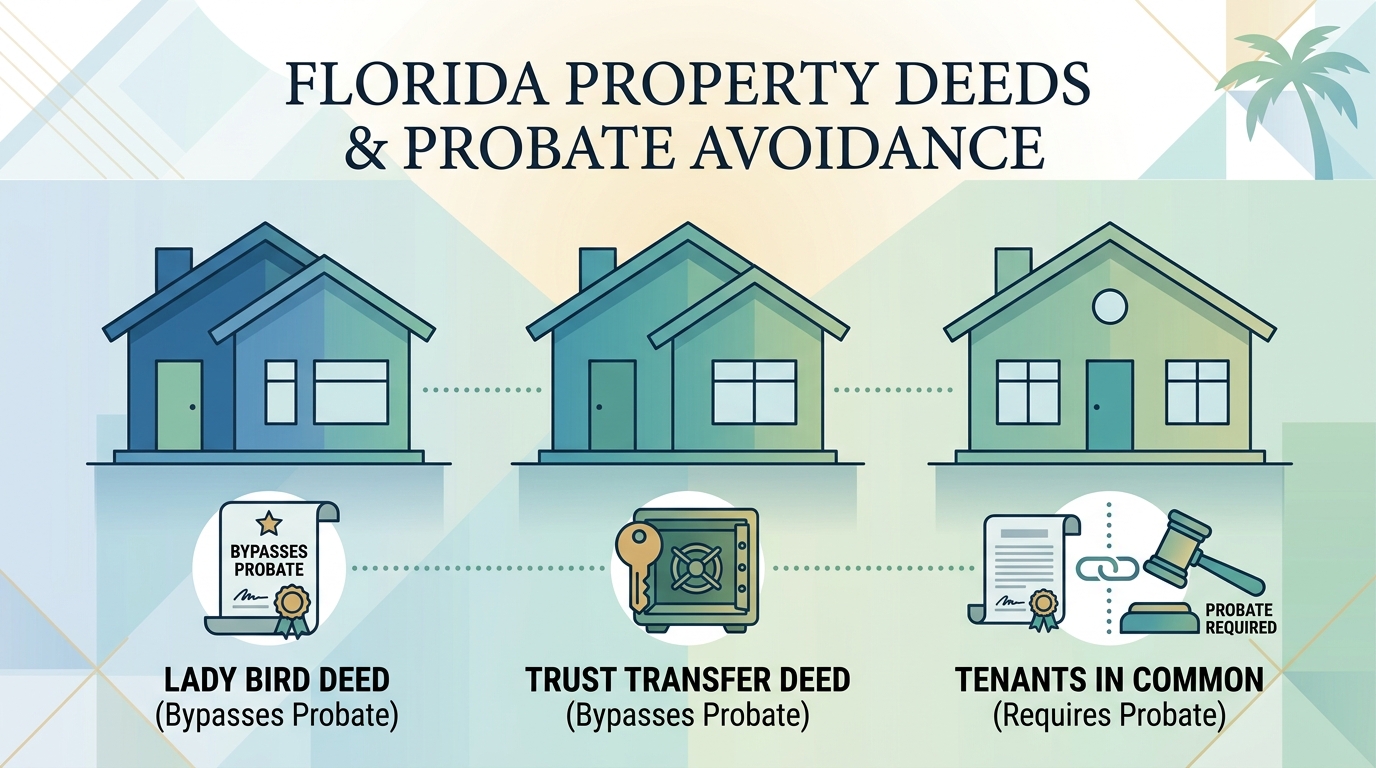
An illustrative visual guide comparing Florida property deeds including Lady Bird Deeds, Quitclaim Deeds, and Trust Transfer Deeds for probate avoidance.

The primary property deeds used in Florida estate planning are Warranty Deeds, Quitclaim Deeds, and Enhanced Life Estate Deeds (commonly called Lady Bird Deeds).

While a deed physically transfers legal title to real estate, the way ownership is titled determines a lot. For example – whether your home must pass through Broward County probate court or transfer automatically to your loved ones upon your death. Understanding the distinction between legal deeds and property titling structures is one of the most effective ways to protect real estate assets, minimize tax exposure, and prevent costly judicial delays for Florida families.


Deeds vs. Titling: Understanding the Fundamental Difference

To build an effective estate plan, it is critical to separate the transfer instrument from the form of ownership:

  • The Deed (The Vehicle): The legal document signed, executed, and recorded in the county public records to transfer real estate ownership from a grantor to a grantee.
  • The Titling / Ownership Form (The Rules): The specific statutory language. Written directly into the deed that dictates who holds ownership rights today. For example how liabilities are shared, and what happens to the property when an owner passes away.

Even a perfectly drafted Warranty Deed will fail to keep your home out of probate court if the underlying titling structure is misconfigured under Florida real estate law.


Comprehensive Comparison: Florida Property Deeds & Estate Planning Tools

Different real estate deeds serve distinct legal purposes during property transfers and estate planning:

Deed / Structure TypeProbate Avoidance?Owner Retains Lifetime Control?Primary Estate Planning & Legal Use Case
Lady Bird Deed (Enhanced Life Estate)YesYes (Can sell, mortgage, or revoke without consent)Passing a Florida primary homestead directly to named beneficiaries outside probate without sacrificing Medicaid eligibility or lifetime control.
Traditional Life Estate DeedYesNo (Requires remainder beneficiary consent to sell or refinance)Transferring property with irrevocable remainder rights. Rarely used in modern estate planning due to loss of owner flexibility.
Trust Transfer DeedYesYes (Managed seamlessly via Trustee)Conveying real estate into a Revocable Living Trust to coordinate complex, multi-property, or multi-state real estate holdings.
Quitclaim DeedNo (Unless combined with joint titling)YesTransferring property without title warranties, commonly between family members, during divorce settlements, or to clear title defects.
General / Special Warranty DeedNo (Unless combined with joint titling)YesStandard commercial or residential real estate purchases where the grantor guarantees clear title free of encumbrances.

The Power of the Florida Lady Bird Deed (Enhanced Life Estate)

In South Florida, the Enhanced Life Estate Deed—popularly known as a Lady Bird Deed—is one of the most powerful probate-avoidance tools available to homeowners.

Unlike a traditional life estate deed, which restricts the primary owner from selling or mortgaging the home without written permission from the named beneficiaries, a Lady Bird Deed allows you to maintain total lifetime control over the property:

  • Full Unilateral Control: You reserve the right to sell, gift, lease, or mortgage the property during your lifetime. You do not need to notify or obtain consent from the named remainder beneficiaries.
  • Automatic Post-Death Transfer: Upon your passing, full legal ownership automatically transfers to your named beneficiaries. This is done by recording a certified death certificate in the Broward County public records, completely bypassing probate court.
  • Preservation of Homestead Protections: A Lady Bird Deed maintains your Florida Constitutional Homestead tax exemptions (including the Save Our Homes cap). And it also keeps the property protected from general judgment creditors.
  • Medicaid Eligibility Protection: Because reserving an enhanced life estate is not considered an immediate gift or transfer of asset value under current Florida Medicaid rules, it generally does not trigger Medicaid penalty periods.

How Property Titling Controls Probate Under Florida Law

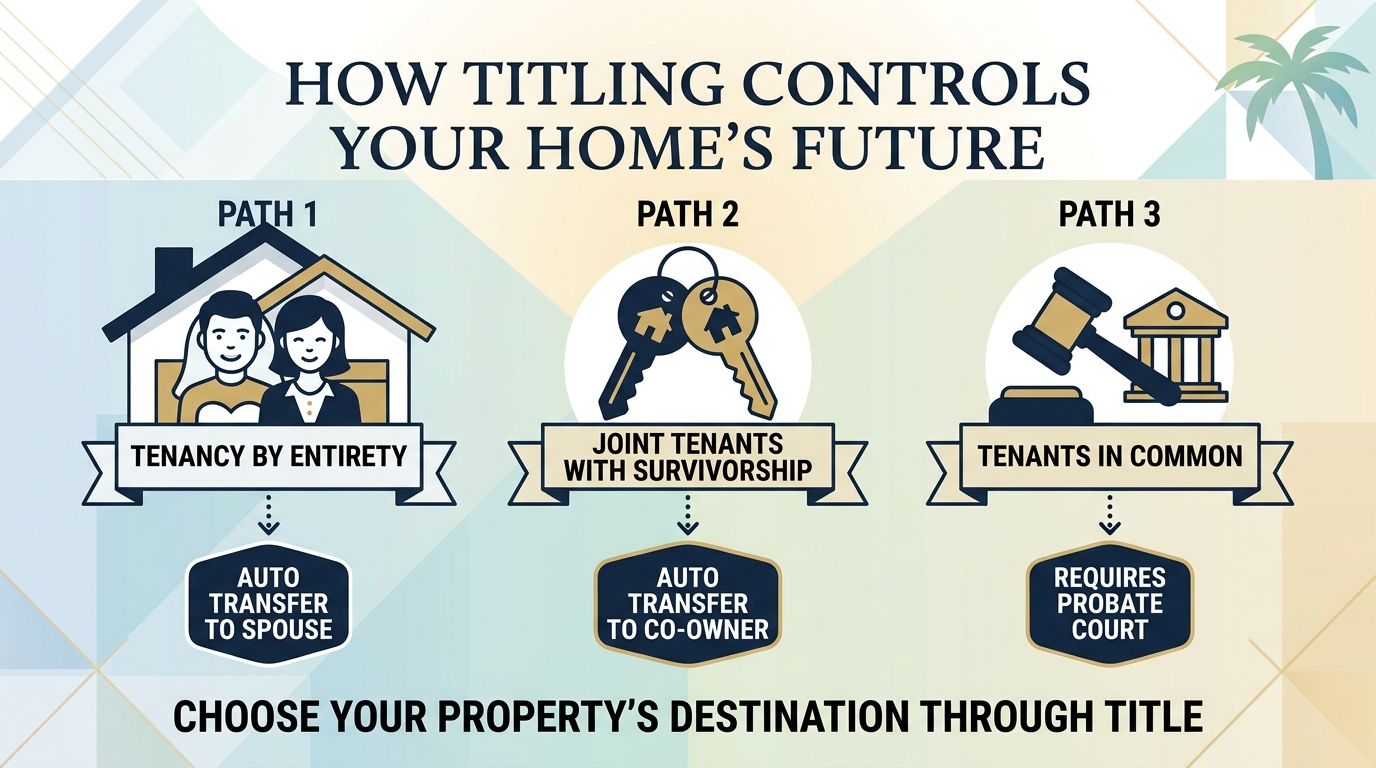
When two or more individuals hold title to Florida real estate, the specific legal language on the recorded deed dictates how ownership passes upon death:

                                 FLORIDA PROPERTY TITLING
                                            │
               ┌────────────────────────────┼────────────────────────────┐
               ▼                            ▼                            ▼
      Tenants in Common         Joint Tenants w/ Survivorship    Tenancy by the Entirety
   (Default for Unmarried)           (Unmarried Co-Owners)             (Married Couples)
               │                            │                            │
               ▼                            ▼                            ▼
       Requires Probate            Bypasses Probate             Bypasses Probate
  (Passes to Deceased's Estate)    (Passes to Surviving Owner)  (Passes to Surviving Spouse)

1. Tenancy by the Entirety (Married Couples)

Under Florida law (F.S. § 689.115), real property jointly acquired by a married couple is legally presumed to be held as Tenancy by the Entirety. Each spouse owns an undivided 100% interest in the entire property. Upon the death of one spouse, full title automatically vests in the surviving spouse outside of probate. Additionally, this form of titling provides strong creditor protection against debt obligations incurred by only one spouse.

2. Joint Tenants with Right of Survivorship (JTWROS)

Frequently used by unmarried co-owners, adult siblings, or parents and children, Joint Tenants with Right of Survivorship explicitly mandates that when one joint owner dies, their ownership share automatically absorbs into the surviving owner’s share. This transfer occurs outside of probate court. However, adding non-spouse co-owners exposes the property to the joint owner’s personal financial liabilities, tax liens, or lawsuits.

3. Tenants in Common (TIC)

Tenants in Common is the default legal ownership structure for unmarried co-owners in Florida unless the deed explicitly specifies otherwise. Each co-owner holds a distinct, separate fractional percentage of the property. When a Tenant in Common dies, their ownership percentage does NOT pass to the surviving co-owner—it becomes part of the deceased person’s probate estate and must be distributed through court according to their Will or Florida’s intestate laws.


Pitfalls of DIY Deed Transfers & Co-Ownership

While deeding real estate directly to family members may seem like a quick alternative to formal estate planning, self-drafted quitclaim deeds frequently cause severe financial and legal consequences:

  1. Title Defects & Clouded Titles: Missing marital status disclosures, incorrect legal descriptions, or improper witness attestations can cloud the title, preventing future sales or requiring costly quiet title lawsuits.
  2. Unintended Tax Consequences: Gifting real estate during your lifetime through a standard quitclaim deed causes the beneficiary to inherit your original tax cost basis. Conversely, inheriting property upon death via a Lady Bird Deed or Trust provides a step-up in cost basis, drastically reducing capital gains taxes when sold.
  3. Creditor & Divorce Exposure: Adding an adult child to your deed gives their creditors, judgment holders, or divorcing spouse a legal claim against your home.
An infographic diagram explaining how property titling structures like Joint Tenants with Right of Survivorship and Tenancy by the Entirety impact probate under Florida law.

Don’t Let an Outdated Deed Dictate Your Family’s Future

A single unreviewed property deed can trigger months of unexpected probate court proceedings, cloud your title, or expose your home to unnecessary tax liabilities. Whether you need to draft an Enhanced Life Estate (Lady Bird) Deed, transfer real estate into a Revocable Living Trust, or audit an existing deed after marriage or divorce, taking action now prevents costly legal disputes later.

Schedule a Property Deed & Titling Audit

Ensure your real estate title is structured to pass seamlessly outside of probate court. Contact Reinfeld Cabrera PA today to review your property deeds with our South Florida legal team.

  • Coral Springs Office: 9625 W. Sample Rd, Coral Springs, FL 33065
  • Direct Line: (954) 866-4878 | Toll-Free: 954-866-HURT
  • Local Practice Coverage: Coral Springs, Fort Lauderdale, Parkland, Tamarac, Margate, and Broward County

Frequently Asked Questions

What is a Florida Lady Bird Deed, and why is it popular in estate planning?

  • An Enhanced Life Estate Deed (Lady Bird Deed) allows a property owner to retain full lifetime control over their property—including the right to sell, mortgage, or revoke the deed—while naming a beneficiary who automatically inherits the real estate upon the owner’s death without probate court involvement.

Does adding my adult child to my deed avoid probate in Florida?

  • Adding an adult child as a Joint Tenant with Right of Survivorship can avoid probate, but it carries significant risk. It subjects your primary residence to your child’s creditors, financial judgments, bankruptcy proceedings, or marital disputes during your lifetime. Utilizing a Revocable Living Trust or Lady Bird Deed is generally a far safer legal alternative.

Do I need to update my deed after getting married or divorced?

  • Yes. Under Florida law, a final decree of divorce automatically converts property held as Tenancy by the Entirety into a Tenants in Common arrangement. Without an updated deed or property settlement agreement, your ex-spouse’s share will no longer pass automatically to you upon death, requiring court probate to settle.

Can I transfer Florida homestead property into a Revocable Living Trust?

  • Yes. Florida homestead real estate can be transferred into a properly drafted Revocable Living Trust without losing homestead tax exemptions or Save Our Homes caps, provided the trust agreement preserves your legal right to reside on the property during your lifetime.

What is the difference between a Quitclaim Deed and a Warranty Deed in Florida?

  • A Warranty Deed provides formal legal guarantees that the grantor holds clear, marketable title free of undisclosed liens or encumbrances. A Quitclaim Deed simply transfers whatever ownership interest the grantor currently holds without any guarantees regarding title quality.

When Does a Florida HOA or Condo Association Need a Lawyer?

Community association attorney reviewing HOA governing documents with board members in Coral Springs, Florida

A Florida homeowners association (HOA) or condominium association should consult a community association attorney when a legal question could affect its governing documents, board decisions, enforcement actions, or financial obligations. Early legal guidance can help the board understand its authority and avoid mistakes that lead to disputes or litigation.

A Florida community association should consider hiring an attorney when it needs to:

  • Interpret governing documents: Determine whether the declaration, bylaws, or community rules authorize a proposed action.
  • Enforce restrictions: Address violations consistently and assess the legal risks of disputes with residents.
  • Review contracts: Evaluate vendor agreements, construction contracts, or potential conflicts of interest.
  • Handle financial disputes: Address unpaid assessments, collection proceedings, or disagreements over association funds.
  • Respond to legal claims: Manage threatened lawsuits, formal demands, or allegations of improper board conduct.
  • Protect board decisions: Confirm that proposed actions comply with applicable Florida law and the association’s governing documents.

Florida law distinguishes between homeowners associations, generally governed by Chapter 720, and condominium associations, generally governed by Chapter 718. The rules applicable to a particular association depend on its legal structure and the issue involved.

For associations in Coral Springs and across Broward County, a community association attorney can assess the relevant documents, explain the board’s legal options, and help determine the appropriate response before a disagreement escalates.


What Does a Community Association Attorney Actually Do?

A community association attorney advises homeowners associations and condominium associations on their legal rights and responsibilities. The work may involve reviewing governing documents, assessing enforcement decisions, advising on proposed amendments, or representing the association in a dispute.

Florida law distinguishes between homeowners associations governed primarily by Chapter 720 of the Florida Statutes and condominium associations governed by Chapter 718. Although these organizations share some concerns, their legal obligations are not identical. The correct advice depends on the type of association and the documents that govern the particular community.

An attorney may help an association with:

  • Governing documents: Interpreting declarations, bylaws, and rules to determine whether a proposed board action is authorized.
  • Rule enforcement: Assessing whether an enforcement decision complies with applicable law and the association’s governing documents.
  • Contracts: Reviewing construction agreements or management contracts before the association commits substantial funds.
  • Assessments and collections: Advising on legally compliant procedures for collecting unpaid assessments.
  • Disputes: Representing the association in mediation, litigation, or other proceedings when appropriate.

These services are related, but they do not all require the same response. A routine maintenance question may be resolved through the management process. A proposed amendment that changes property rights presents a different legal problem.


When Should a Florida HOA Hire an Attorney?

There is no universal rule requiring an HOA to consult a lawyer before every board decision. The need for legal advice depends on the decision’s consequences and the applicable law. Several situations deserve particular attention.


1. When the board is unsure whether it has the authority to act

An association’s authority comes from applicable statutes and its governing documents. A board cannot necessarily create a new restriction simply because its members believe the restriction would benefit the community.

Consider an HOA in Coral Springs that wants to prohibit a particular type of exterior modification. The declaration contains architectural standards, but it does not clearly authorize the proposed prohibition. The board could adopt the rule and begin issuing violation notices, only to discover that its authority to impose the restriction is disputed.

An attorney can examine the declaration, applicable statutes, and relevant court decisions before the board commits to a potentially unenforceable policy.

This review is especially important when a proposed decision could affect owners’ property rights or require an amendment to recorded documents.


2. When an association plans to amend its governing documents

Amending an HOA declaration or condominium declaration is not simply a matter of changing a few sentences. The association may need to comply with specific voting requirements, notice procedures, approval thresholds, and recording requirements.

The Florida Supreme Court’s guidance on community association managers addresses this distinction. In The Florida Bar Re: Advisory Opinion—Activities of Community Association Managers, 681 So. 2d 1119 (Fla. 1996), as clarified in a 2015 opinion, the Court explained that certain tasks requiring legal interpretation or the preparation of documents affecting legal rights constitute the practice of law.

The Court-approved guidance states:

“Although CAMs may be able to draft the documents, they cannot advise the association as to the legal consequences of taking a certain course of action.”

Read the Florida Supreme Court’s 2015 opinion.

The distinction is practical. A community association manager may handle many administrative tasks, but deciding how a statute applies to a proposed amendment is a different responsibility.

An attorney can help determine which approvals are necessary before the association circulates a proposal or schedules a vote. That can prevent a costly do-over if the amendment process is defective.


3. When the board needs to enforce a community rule

Enforcement disputes can arise over architectural modifications, property maintenance, parking restrictions, or other community rules. Before taking action against an owner, the association should confirm that the restriction is legally valid and that its enforcement process is consistent with applicable requirements.

A rule that appears straightforward on paper can become complicated when the declaration is ambiguous or the association has treated similar violations differently.

In White Egret Condominium, Inc. v. Franklin, 379 So. 2d 346 (Fla. 1979), the Florida Supreme Court considered a condominium’s restriction on children under twelve. The Court concluded that the restriction could be enforceable if reasonably related to a lawful objective and applied reasonably. However, the association had applied the restriction arbitrarily and selectively in the circumstances before the Court.

Read the White Egret decision.

The lesson is not that every inconsistent enforcement decision invalidates a rule. Rather, the association’s authority and its actual enforcement practices can both matter.

Imagine that a board has permitted several homeowners to maintain similar exterior structures for years. It then threatens one owner with legal action over a comparable structure. The owner challenges the decision, arguing that the association has singled out the property.

The outcome would depend on the governing documents and the evidence. Legal advice can help the board determine whether it has a defensible basis for enforcement before the dispute escalates.


4. When an owner challenges assessments or requests association records

Disagreements over assessments and access to records can create legal problems if an association responds incorrectly. Florida statutes establish rules governing association records and the obligations of owners.

For homeowners associations, Section 720.303 addresses association powers, official records, meetings, and financial reporting. Condominium associations have separate requirements under Chapter 718, including Section 718.111.

An owner who questions an assessment does not automatically have the right to withhold payment. In Ocean Trail Unit Owners Association v. Mead, 650 So. 2d 4 (Fla. 1994), the Florida Supreme Court addressed the distinction between challenging association conduct and refusing to pay assessments to protect against a judgment lawfully entered against the association.

Read the Ocean Trail decision.

The same need for care applies to records requests. An association should identify which documents must be made available under the applicable statute and respond within the required time. If a request involves disputed records or potentially privileged communications, the board should obtain appropriate guidance rather than assume that every document is either public or confidential.


5. When a contract or potential conflict of interest raises concerns

An HOA or condominium association may enter contracts for maintenance, construction, management, and other services. The board should understand the association’s obligations before approving an agreement that could affect its finances for years.

Suppose a director recommends a contractor who is a close relative. The proposed price appears reasonable, and the board wants to approve the contract quickly.

The association should determine whether disclosure or other conflict-of-interest procedures apply. Florida’s condominium statute, Section 718.3027, addresses certain transactions involving conflicts of interest. The applicable requirements depend on the type of association and the circumstances.

An attorney can help the board assess the proposed transaction before it commits association funds. This is not an accusation of wrongdoing whenever a director knows a contractor. It is a way to identify the applicable rules and protect the integrity of the decision.


HOA governing documents, meeting minutes, and contracts prepared for an attorney review in Broward County, Florida.

Who Does an HOA Attorney Represent?

An HOA attorney generally represents the association as a legal entity. The attorney’s client is not automatically every homeowner, every member of the board, or the property manager.

This distinction becomes particularly important when an individual director’s interests diverge from those of the association.

For example, an owner may accuse a director of misconduct and demand that the association investigate. The association’s attorney may need to advise the association about its obligations and response. If the director faces personal allegations, that director may need independent legal representation.

The same principle applies when homeowners disagree with a board decision. The association’s attorney is not automatically their personal attorney, even though the decision affects their homes.

An owner who believes the board has violated the governing documents may need independent legal advice about the owner’s own rights and available remedies.


Can an HOA Manager Provide Legal Advice?

Community association managers perform valuable administrative and operational work. They may coordinate maintenance, prepare budgets, assist with meetings, and help the board carry out its responsibilities. Florida law nevertheless draws a boundary between management functions and activities that constitute the practice of law.

The Florida Supreme Court’s advisory opinion identifies legal tasks that may require an attorney, including certain interpretations of statutes and governing documents. It also distinguishes those tasks from routine administrative work that does not require legal analysis.

Read the Florida Bar’s explanation of the Court’s guidance.

This distinction protects the association as well as the manager. A manager may know the community’s operations extremely well but still need an attorney to determine whether a proposed action is legally authorized.

The practical approach is to let the manager handle operational matters within the manager’s role and involve counsel when the decision requires legal judgment.


What Can Happen When an Association Handles a Dispute Incorrectly?

The consequences of a poorly handled association dispute depend on the facts. Some disagreements can be resolved through discussion or mediation. Others result in litigation, court orders, or awards of attorney fees and costs.

A recent example illustrates why covenant enforcement deserves careful attention.

In Mooney v. Color Le Palais of Boynton Beach Homeowners Association, Inc., decided by Florida’s Fourth District Court of Appeal on August 27, 2025, the court considered whether an HOA seeking an injunction to enforce a restrictive covenant had to plead and prove irreparable harm and the absence of an adequate remedy at law. The court held that those requirements did not apply under the Florida law governing that dispute.

The homeowners had brought their property into compliance during the litigation, yet the case continued to involve a judgment and an award of prevailing-party attorney fees and costs.

Read the 2025 appellate opinion.

The decision does not mean that an association automatically wins every covenant-enforcement case. It does show why a dispute over a seemingly minor property condition can have financial consequences beyond the original correction.

An attorney can help the board evaluate the legal basis for enforcement and the potential consequences before proceeding.


Does Attorney-Client Privilege Protect an HOA’s Legal Communications?

Attorney-client privilege can protect confidential communications made for the purpose of obtaining or providing legal services. However, not every email involving a lawyer is automatically privileged.

In Las Olas River House Condominium Association, Inc. v. Lorh, LLC, No. 4D15-2289 (Fla. 4th DCA Dec. 9, 2015), a dispute arose over communications involving a condominium association, its management company, and association representatives. The trial court had ordered the production of documents over a claim of privilege without first conducting an in-camera inspection. The appellate court granted relief.

Read the Las Olas River House decision.

The case illustrates a subtle but important point. A manager’s involvement in communications with counsel does not automatically destroy privilege, nor does it guarantee that every communication is protected. The purpose of the communication and the manager’s role in the legal consultation matter.

Boards should establish sensible procedures for communicating with counsel and distributing legal advice. Forwarding sensitive legal analysis to a broad group of residents can create unnecessary complications.


Community association attorney discussing an HOA dispute with a homeowner and board representative in Coral Springs, Florida.

How Can Legal Counsel Help Prevent Conflicts Within an Association?

Disagreements between homeowners and boards are not always caused by bad faith. Sometimes the parties interpret the same governing document differently. In other cases, an owner believes a rule has been applied unfairly, while the board believes it is carrying out its responsibilities.

An attorney can help the association distinguish a legal disagreement from a routine management issue. Counsel may identify a defensible interpretation of the governing documents or recommend a procedure for addressing the dispute before litigation becomes necessary.

Legal advice can also help boards recognize when a decision requires additional review. A director who has a personal interest in a transaction may need to follow specific disclosure procedures. A board considering a new restriction may need to confirm that it has the authority to adopt it.

In Cinco v. Coquina Palms Homeowners Association, Inc., 325 So. 3d 137 (Fla. 5th DCA 2020), the appellate court addressed claims arising from a board member’s breach of fiduciary duty and a conspiracy to defraud the association. The court also ruled that a particular award of attorney fees as damages could not stand because the required special damage had not been pleaded.

Read the Cinco decision.

The case demonstrates that association disputes can involve both substantive wrongdoing and procedural requirements. Even when an association establishes misconduct, the legal basis for each requested remedy matters.


When Is Hiring a Community Association Attorney Worth the Cost?

Legal counsel is an expense, and associations have a responsibility to manage their funds carefully. The question is not whether a lawyer should review every routine decision. It is whether the potential cost of proceeding without legal advice justifies obtaining it before acting.

Consider an association preparing to sign a substantial construction contract. A legal review may identify unclear payment terms or inadequate protections before the agreement is signed. Correcting those provisions at the outset may be easier than disputing them after work has begun.

The same reasoning applies to a proposed amendment. If the association invests time and money in an invalid voting process, it may need to repeat the process or defend a challenge.

Legal counsel also provides continuity when board membership changes. Governing documents and contractual obligations can remain in force long after the directors who approved them leave office. Clear records and sound legal guidance help a new board understand existing obligations.

No attorney can guarantee that litigation will be avoided. The value lies in making informed decisions and identifying legal problems while the association still has options.


What Should a Coral Springs HOA Look for When Choosing an Association Attorney?

A homeowners association in Coral Springs should look for an attorney who understands Florida community association law and has experience interpreting governing documents, advising boards, and resolving disputes involving homeowners. Local familiarity can also help when a matter involves Broward County courts or established procedures for handling property-related litigation.

Before retaining counsel, an association should consider the nature of its legal needs. A community facing a disputed covenant amendment may require different expertise from one negotiating a major construction contract or defending an enforcement action.

The board should also clarify how the attorney will communicate with directors, what work falls within the engagement, and how fees will be handled. For recurring legal needs, a clear arrangement can help the association obtain advice before a decision becomes urgent.

Associations should not choose counsel solely on the basis of price. The least expensive initial consultation may not provide the most useful guidance if the attorney lacks experience with the legal issue at hand. Conversely, not every routine management question requires a lengthy legal opinion.

For HOAs and condominium associations in Coral Springs, Broward County, and South Florida, the objective is to find counsel who can explain the applicable law in practical terms and help the board make informed decisions.


What Documents Should an HOA Board Gather Before Consulting an Attorney?

Preparing the relevant records before a legal consultation can help an association obtain more focused advice and avoid spending time reconstructing the history of a dispute.

The documents needed will depend on the issue, but an HOA or condominium board should consider gathering the following:

  • Governing documents: The declaration, bylaws, current rules, and any amendments relevant to the dispute.
  • Board records: Meeting minutes, resolutions, notices, and records showing how the decision was approved.
  • Correspondence: Relevant communications with the homeowner, contractor, property manager, or other parties.
  • Contracts and financial records: The agreement at issue, invoices, payment records, or assessment statements, where applicable.
  • Enforcement history: Previous violation notices and records of how comparable situations were handled.
  • Deadlines and pending proceedings: Any demand letters, court filings, hearing notices, or statutory response deadlines.

The association should preserve relevant records and avoid altering documents once a dispute is anticipated. It should also identify any approaching deadlines when contacting counsel. Waiting until a hearing or response date is imminent may limit the available options.

Providing complete, organized records helps an attorney assess the association’s position more efficiently. It does not guarantee a particular outcome, but it gives counsel a clearer basis for explaining the available options and potential risks.


Florida attorney reviewing community association legal materials in a Coral Springs law office.

Frequently Asked Questions About Florida HOA and Condo Association Lawyers


Does a Florida HOA have to hire an attorney?

  • Not every HOA decision requires an attorney, and the need for counsel depends on the issue and applicable law. An association should seek legal advice when a proposed action requires legal interpretation or presents a significant risk of a dispute. Specific statutory requirements may apply to particular matters.

Can an HOA manager interpret Florida law for the board?

  • A manager can handle many administrative tasks, but certain activities involving legal interpretation constitute the practice of law under Florida Supreme Court guidance. The distinction depends on the task and whether it requires legal analysis rather than routine administration.

Does an HOA attorney represent individual homeowners?

  • Generally, no. The association’s attorney represents the association as the client. A homeowner involved in an individual dispute with the board may need independent counsel to assess personal rights and remedies.

Can an HOA enforce a rule without consulting an attorney?

  • An association may handle routine enforcement under established procedures. Legal review becomes particularly useful when the rule’s validity is uncertain, the governing documents are ambiguous, or the owner challenges the association’s authority.

Can an HOA board member be personally liable for a decision?

  • Potential liability depends on the applicable law, the governing documents, and the director’s conduct. Florida law imposes duties on association directors and officers, but it does not make every mistaken decision a basis for personal liability. Conflicts of interest or conduct that violates applicable duties may raise different concerns.

Are HOA attorney communications confidential?

  • Some communications may be protected by attorney-client privilege when they meet the applicable legal requirements. The presence of an attorney does not automatically make every email or document privileged. The purpose of the communication and the circumstances of disclosure matter.

When should a condominium association consult a lawyer?

  • A condominium association should consider legal advice when it proposes changes to governing documents, faces a significant enforcement dispute, negotiates a substantial contract, or needs to interpret its statutory obligations. The appropriate response depends on the particular issue.

Community Association Legal Guidance in Broward County

Community associations must make decisions that affect shared property, community finances, and individual owners’ rights. Understanding the association’s legal authority can help its board act responsibly and address disputes before they become more difficult to resolve.

For an HOA or condominium association in Coral Springs, Broward County, or elsewhere in South Florida, legal counsel can help clarify governing-document requirements and assess proposed actions under Florida law.

Reinfeld, Cabrera & Tison can advise on community association legal matters and related property-law issues. If your association is facing a dispute over rule enforcement, a proposed amendment, or a significant contract, obtaining legal guidance early can help the board understand its options before deciding how to proceed.

Contact the firm to discuss your association’s circumstances and determine what legal assistance may be appropriate.


This article provides general information about Florida community association law. It is not legal advice for a particular association or dispute.

How a Demand Letter Can Resolve Business Disputes Without Going to Court

When a commercial contract breaks down, an invoice goes unpaid, or a business partner fails to deliver, rushing straight into a lawsuit is rarely the smartest first move. Litigation in South Florida courts can easily take 12 to 18 months, cost tens of thousands of dollars in legal fees, and permanently destroy valuable commercial relationships.

In many cases, a strategically drafted commercial demand letter from an experienced business attorney is all it takes to enforce your rights, recover owed funds, and force a resolution—saving your business time, capital, and unnecessary stress.


What Is a Commercial Demand Letter?

Quick Answer: A commercial demand letter is a formal legal instrument sent by an attorney outlining a breach of contract or unpaid debt, detailing the exact financial or performance remedy required under Florida law, and setting a firm deadline to comply. It transitions an informal dispute into an active legal matter, establishes an official evidentiary record, and provides maximum settlement leverage before initiating formal court proceedings.


Why Demand Letters Resolve Disputes Effectively

Informal emails, text messages, and phone calls are easy for a non-paying client or defaulting vendor to ignore. However, receiving a formal legal letter on law firm letterhead fundamentally shifts the dynamics of a dispute. It signals that your business has engaged counsel and is fully prepared to take legal action if necessary.

Specifically, a well-crafted demand letter accomplishes four critical objectives:

  1. Establishes an Unassailable Evidentiary Record: It clearly documents the timeline of the deal, the precise contractual terms, the exact nature of the breach, and the total financial damages incurred.
  2. Imposes a Firm Compliance Deadline: Giving the opposing party a strict window (typically 10 to 30 days) forces them to pause, consult with their own legal counsel, and evaluate their potential exposure in court.
  3. Triggers Florida Pre-Suit Statutory Prerequisites: Certain causes of action under Florida law require written pre-suit notice. Sending a formal demand satisfies these prerequisites while preserving your right to claim statutory default interest under Fla. Stat. § 55.03.
  4. Protects Confidentiality: Unlike court pleadings filed in public records, settlement negotiations prompted by a demand letter remain completely private between the parties.

Strategic Tone Selection: Tough vs. Tactful

Before your attorney drafts the letter, you must evaluate one essential question: Do you want to preserve a commercial relationship with this party after the dispute is resolved?

Your business objectives determine the tone and posture of the letter.


┌──────────────────────────────────────────────────────────────────────────┐
│              COMMERCIAL DEMAND LETTER STRATEGIC MATRIX                   │
├────────────────────────────────────┬─────────────────────────────────────┤
│      COLLABORATIVE SETTLEMENT      │        AGGRESSIVE ENFORCEMENT       │
├────────────────────────────────────┼─────────────────────────────────────┤
│ • Objective: Preserve an ongoing   │ • Objective: Rapid financial or     │
│   vendor, client, or partner deal  │   injunctive recovery               │
│ • Focus: Mutual contract terms     │ • Focus: Strict pre-suit notice,    │
│   and structured cure options      │   damages, and statutory remedies   │
│ • Ideal For: Minor delays or       │ • Ideal For: Severe breach, fraud,  │
│   good-faith misunderstandings     │   or persistent non-payment         │
└────────────────────────────────────┴─────────────────────────────────────┘

1. The Collaborative Settlement Approach

If the dispute stems from a temporary cash flow hiccup, operational delay, or honest miscommunication with a long-term partner, an overly aggressive letter can backfire. In such cases, the demand letter adopts a firm yet professional tone. It emphasizes the underlying agreement, specifies the performance gap, and offers workable solutions—such as a structured payment plan—without burning bridges.

2. The Direct Enforcement Approach

Conversely, if you are dealing with intentional contract evasion, fraud, or a debtor refusing to communicate, soft language will yield no results. Consequently, the letter adopts an uncompromising legal stance. It explicitly details statutory causes of action, calculates interest and penalties, attaches supporting exhibits, and gives clear notice that failure to comply will result in an immediate lawsuit filed in local courts like the 17th Judicial Circuit in Broward County.


4 Essential Elements of an Enforceable Florida Demand Letter

To ensure your demand letter commands authority and holds up if the case proceeds to trial, your attorney will structure it with four core components:

1.1. Contractual & Factual Recital: Establishing the factual timeline.

A clear, detailed chronological background outlining the original agreement, purchase orders, or scope of work executed between the parties, alongside specific evidence showing full performance on your part.

2.2. Specific Allegation of Breach: Identifying the exact legal failure.

An explicit accounting of how the opposing party failed to perform, citing specific clauses of the contract, delivery deadlines missed, or unpaid invoices.

3.3. Itemized Statement of Damages: Calculating financial exposure.

A precise breakdown of direct financial losses, incidental expenses, and accrued statutory interest under Fla. Stat. § 55.03, demonstrating exactly what the non-compliance is costing your company.

4.4. Demand for Cure & Litigation Warning: Setting the litigation threshold.

A specific date by which full payment or cure action must occur, accompanied by explicit notice that non-compliance will trigger a civil complaint seeking full damages, court costs, and attorney fees where applicable.


Comparing Dispute Resolution Options

Understanding how a pre-suit demand letter compares to traditional litigation highlights why it should almost always be your first line of defense:

FeatureLegal Demand LetterFull Court Litigation
Time to Resolution10 to 30 Days6 to 18+ Months
Legal CostsLow, Fixed & PredictableHigh (Discovery, Depositions, Trial)
Privacy & Publicity100% PrivatePublic Court Record
Business RelationshipPotential to PreserveAlmost Always Destroyed
Enforcement LeverageHigh (Pre-suit notice & pressure)Binding Court Judgment

Protect Your Business Interests with South Florida Counsel

Allowing unpaid invoices, breach of contract, or vendor default to linger threatens your company’s cash flow and growth. The commercial litigation team at Reinfeld & Cabrera P.A. helps business owners across South Florida resolve complex disputes swiftly through strategic demand letters and aggressive trial representation when required.

Schedule a Commercial Consultation

If your company is facing a contract dispute, unpaid account, or partnership conflict, speak directly with an attorney to evaluate your legal remedies:

  • Direct Line: (954) 866-4878 | Toll-Free: 954-866-HURT
  • Coral Springs Office: 9625 W. Sample Rd, Coral Springs, FL 33065
  • Fort Lauderdale Office: 2933 W. Cypress Creek Rd, Suite 201, Ft. Lauderdale, FL 33309
  • Website: mypersonalattorneys.com
  • Serving: Coral Springs, Fort Lauderdale, Parkland, Tamarac, Margate, and all of Broward, Miami-Dade, and Palm Beach Counties.

Frequently Asked Questions: Florida Commercial Demand Letters

What happens if the other party completely ignores a demand letter?

  • If the receiving party fails to respond or cure the default within the designated deadline (typically 10 to 30 days), your attorney will move forward with filing a formal civil complaint in the appropriate court—such as the 17th Judicial Circuit Court in Broward County or the 11th Judicial Circuit Court in Miami-Dade County. Furthermore, the demand letter serves as key evidence demonstrating that you made a good-faith pre-suit effort to resolve the dispute, which can influence court decisions regarding legal costs and interest.

Can I write and send a demand letter myself without an attorney?

  • While a business owner can technically write their own letter, DIY demand letters rarely carry the legal weight needed to force a settlement. Specifically, letters drafted without counsel often omit necessary statutory citations, fail to properly preserve rights to pre-judgment interest under Fla. Stat. § 55.03, or reveal strategic weaknesses that the opposing party’s legal team can exploit. A formal letter on law firm letterhead demonstrates immediate litigation readiness.

Can a demand letter include a claim for statutory attorney fees in Florida?

  • Yes. Under Florida law, attorney fees are recoverable if explicitly authorized by the underlying contract or by specific Florida statutes, such as Fla. Stat. § 57.105 (sanctions for unsupported claims/defenses) or statutory civil theft claims under Fla. Stat. § 772.11. Consequently, including a specific statutory fee warning in the demand letter significantly increases your settlement leverage.

How much does it cost to have a South Florida lawyer send a demand letter?

  • Drafting and serving a commercial demand letter is typically billed as a predictable flat fee or a few hours of attorney time, making it significantly more cost-effective than initiating full-scale civil litigation. As a result, most South Florida businesses recover their investment many times over through early pre-suit settlements or full debt recovery.

Broward County Probate Attorney Guide: Formal Administration and Estate Planning

Florida probate attorney reviewing estate planning documents and living trusts in a South Florida law office.

When you sit down at the kitchen table to sort through a parent’s papers after they pass away, the last thing you want is a fresh wave of bureaucratic dread.

What happens to the house now? How do we pay the lingering bills? And why does everyone make probate sound like a multi year hostage negotiation with the state of Florida?


Quick Answer:

Under Florida probate law, administering an estate through the 17th Judicial Circuit in Broward County involves formal or summary court proceedings to settle debts and transfer property. Formal administration typically takes between six months and over a year due to mandatory creditor notice windows, whereas summary administration offers an expedited process for estates valued under $75,000 or where the decedent passed away more than two years ago.


If you search online for estate guidance, you will drown in dry textbook definitions. Most treat probate like an unavoidable trap or a magical cure all. Neither description captures reality. Probate is simply the legal mechanism the state uses to clear title to property. It’s how to pay legitimate creditors, and transition assets when someone passes away without proper advance planning.

So what do Florida families and property owners actually need to know about navigating the Broward County court system. What do they need to get to manage a estate, and keep your hard earned assets out of unnecessary courtrooms? Let us pull back the curtain and talk about how estate administration really works in South Florida without any legal mumbo jumbo.


Why the Internet Gets Probate Wrong (And Why Wills Do Not Avoid Court)

There is a stubborn myth floating around the internet that having a last will and testament means your family completely bypasses the probate court. People assume a will acts like a VIP backstage pass that lets your heirs walk right past the judges and walk away with your property.

Nothing could be further from the truth.

Ask yourself: If I spend my entire life building equity in a home and saving for my children, why would I hand them a legal document that explicitly instructs a judge to oversee how those assets get handed out?

A will does not avoid probate. A will is instructions for the probate court. It tells the judge who you want to inherit your belongings. But the court still has to supervise the process, validate the signature, notify creditors, and formally authorize your personal representative to act. If you want to spare your family from court supervision, you have to look beyond a basic will. You should utilize tools like revocable living trusts, payable on death designations, and properly structured joint ownership.


What Actually Goes Through Probate in Florida?

Not every asset a person owns gets sucked into the probate vortex upon death. Understanding the dividing line between probate and non probate property is the first step toward building a sensible estate plan.

  • Probate Assets: Solely owned real estate, bank accounts held in a single name without payable on death instructions, and personal belongings like vehicles or jewelry without designated beneficiaries must go through court administration to change legal ownership.
  • Non Probate Assets: Assets governed by contract or operation of law pass directly to beneficiaries without court interference. This includes living trusts, life insurance policies with named beneficiaries, retirement accounts. It also includes real estate held as tenants by the entirety or joint tenants with rights of survivorship.

If your estate consists entirely of beneficiary designated accounts and trust owned property, things change. Your family might never set foot inside a courtroom. But if a single deed or bank account was left in your individual name, the probate doors swing wide open.


Formal Administration Versus Summary Administration in Broward County

When a probate estate is opened in the 17th Judicial Circuit in Broward County, the administration generally follows one of two statutory paths. Both depend on the size of the estate and how long the decedent has been gone:

  1. Formal Administration: This is the standard, comprehensive court process required for larger estates or complex matters involving multiple creditors and disputed claims. The court appoints a personal representative, issues letters of administration, requires formal publication of notice to creditors, and mandates a multi month inventory and accounting process.
  2. Summary Administration: A streamlined, expedited court procedure available in Florida if the value of the entire estate subject to probate does not exceed $75,000, or if the decedent has been dead for more than two years. Summary administration bypasses the appointment of a personal representative and moves much faster, though it still requires a formal petition filed by an attorney.
Infographic comparing formal probate administration and summary administration pathways under Florida law.

Avoiding Dual Tracking and Creditor Traps During Estate Administration

When a personal representative steps up to manage an estate in South Florida, they quickly realize that administering assets is a minefield of strict statutory deadlines and creditor notification rules under Florida Probate Code.

How do you handle aggressive credit card companies or mortgage lenders demanding payment while the estate is still frozen in court?

  • The Creditor Notice Period: Florida law requires a diligent search for known creditors and publication of a formal notice in a local legal periodical. Creditors have a strict window (typically three months from the first publication of notice) to file formal claims against the estate.
  • The Priority of Claims: You cannot simply pay out inheritance money to family members while valid estate debts remain unpaid. Florida law establishes a rigid priority structure for paying funeral expenses, administrative costs, taxes, and medical bills before beneficiaries see a dime. Failing to follow this order can expose the personal representative to personal financial liability.

Real World Case Example: Untangling an Estate in Broward County

To see how these rules play out in local practice, consider a scenario our firm frequently handles across Coral Springs and Fort Lauderdale.

A client came to our office after losing a parent who owned a residential home in Broward County without a living trust. The parent had left a simple will naming our client as personal representative, but because the deed was in the parent’s individual name, the property was completely frozen. To make matters worse, a home equity line of credit was past due, and the lender was threatening default proceedings while the family was still grieving.


How Our Legal Team Resolved the Crisis

  • Opening Formal Administration: We immediately filed a petition for formal administration in the 17th Judicial Circuit, securing letters of administration so our client had the legal authority to deal with the bank.
  • Publishing Creditor Notice: We managed the statutory creditor notice period. We shield the personal representative from harassing collection calls and ensuring claims were evaluated through proper legal channels.
  • Resolving the Debt and Transferring Title: By coordinating with the mortgage lender and liquidating a small non probate account to cover arrears, we stabilized the property, avoided foreclosure, and ultimately transferred clear title of the home to the rightful heirs.
The Broward County judicial complex in Fort Lauderdale where 17th Judicial Circuit probate proceedings take place.

Frequently Asked Questions About Florida Probate

How long does the probate process take in Broward County?

  • An uncontested formal administration in Florida typically spans 6 to 12 months. This timeline is largely dictated by mandatory statutory creditor notice periods and court review schedules in the 17th Judicial Circuit. Complex estates involving will contests or contested creditor claims can take significantly longer.

Can I avoid probate simply by writing a last will and testament?

  • No. A common misconception is that having a will avoids probate. In reality, a will provides instructions for the probate court on how you want your assets distributed. To avoid probate entirely, assets must pass outside the will via living trusts, beneficiary designations, or survivorship titles.

What happens if someone dies intestate without a will in Florida?

  • If a person dies without a valid will, Florida intestacy statutes dictate how assets are distributed among surviving spouses, children, or extended relatives. This rigid statutory formula rarely matches what the decedent would have actually wanted. And it often forces court sales of family property to divide proceeds among heirs.

Do I need a probate attorney if I am appointed as a personal representative?

  • Yes. Under Florida probate rules, a personal representative representing an estate with multiple beneficiaries or outstanding creditors is generally required by law to be represented by a licensed attorney admitted to practice in Florida.

Protect Your Estate and Your Family Legacy

Planning for the future or handling the aftermath of a loved one’s passing is not something you should do alone. Whether you want to bulletproof your own estate with a comprehensive living trust or you need experienced local counsel to guide you through a Broward County probate administration, having the right advocate changes everything.

The estate planning and probate attorneys at Reinfeld Cabrera Tison help families across South Florida secure their assets. We establish durable trusts, and resolve complex court proceedings with absolute confidence.

Schedule a Confidential Consultation

Do not wait until a crisis forces your family into court. Speak directly with an experienced attorney today to review your options:

  • Direct Telephone: (954) 866 4878 | Toll Free: (954) 866 HURT
  • Coral Springs Office: 9625 W Sample Rd, Coral Springs, FL 33065
  • Fort Lauderdale Office: 2933 W Cypress Creek Rd, Suite 201, Ft Lauderdale, FL 33309
  • Website: mypersonalattorneys.com
  • Local Coverage: Coral Springs, Fort Lauderdale, Parkland, Tamarac, Margate. All surrounding communities across Broward, Miami Dade, and Palm Beach Counties.

How Long Does Probate Take in Florida? Timeline and Common Delays

How long probate takes in Florida with estate documents and a calendar

If you are waiting for a Florida estate to close, the frustrating part is often that nobody can give you a single number.

One estate may be resolved relatively quickly. Another may remain open for a year or longer. The difference usually has less to do with the passage of time itself than with what has to happen before the estate can be distributed and closed.


So, how long does probate take in Florida?

For many estates going through formal administration, probate takes months rather than weeks. Some uncomplicated estates can move faster. Others take considerably longer because of creditor claims, real estate, tax issues, missing beneficiaries, disputes, litigation, or problems with the estate administration.

Florida also has a simplified procedure called summary administration. For deaths occurring under the current law, summary administration generally applies when the property subject to administration does not exceed $150,000, after excluding property exempt from creditors, or when the decedent has been dead for more than two years.

The important point is that there is no single Florida probate timeline that applies to every estate.


What Determines How Long Probate Takes in Florida?

Probate is not one event. It is a series of legal and practical tasks.

The court must recognize the will, if there is one, and appoint a personal representative when formal administration is required. The personal representative then has to identify and protect estate property, address debts and creditor claims, deal with taxes when applicable, resolve outstanding issues, distribute the remaining assets, and complete the steps required to close the estate.

Florida law requires a personal representative to settle and distribute the estate as efficiently as is consistent with the interests of the estate and the people involved.

That does not mean every task can happen immediately.

A house may need to be sold. A bank account may need to be located. A creditor may file a claim. A beneficiary may object to something the personal representative has done. An estate asset may have to be appraised before it can be distributed.

Each of those issues can change the timetable.


How Long Does Formal Probate Usually Take?

Formal administration is the more involved form of Florida probate. It is generally used when the estate does not qualify for summary administration or when the circumstances require a formal proceeding.

There is no statutory rule saying that every formal probate case must be completed within a particular number of months.

That matters because two estates with similar values can have very different timelines.

Consider two hypothetical estates.

The first consists mainly of a Florida bank account, a vehicle, and other easily identified assets. There are no significant disputes, no difficult property issues, and no contested creditor claims.

The second includes a Coral Springs home, several financial accounts, an unresolved debt, a beneficiary who cannot be located, and disagreement among family members over the will.

Both estates are subject to the same general probate framework. Their practical timelines could be very different.

The question is therefore not simply how long does probate court take in Florida? It is what still has to be resolved before this particular estate can be closed?


How Long Does Summary Administration Take?

Summary administration is designed for qualifying estates that can be handled without the full administration process.

Under current Florida law, an estate may qualify when the value of the property subject to administration, after excluding property exempt from creditors, does not exceed $150,000. An estate may also qualify when the decedent has been dead for more than two years, subject to the requirements of the statute.

Summary administration can be substantially different from formal administration because the court may enter an order allowing distribution of estate assets without the same sequence of administration required in a formal case. Florida law specifically permits the court to authorize immediate distribution through the summary administration order.

That does not mean every small estate is resolved immediately.

The court still needs the required information. Known or reasonably ascertainable creditors must be addressed, and the people entitled to the estate must be properly identified.

If there is a dispute about the will, ownership of property, debts, or the people entitled to inherit, the matter may become more complicated regardless of the estate’s value.


What Is the 90-Day Creditor Period in Florida Probate?

One reason probate can take longer than a family expects is the period for creditors to present claims.

Under Florida Statute §733.702, certain claims against an estate generally must be filed by the later of three months after the first publication of the notice to creditors or 30 days after service of the notice on a creditor who is required to receive it.

This is one reason an estate cannot necessarily be distributed as soon as the personal representative finds the assets and identifies the beneficiaries.

There may still be claims to address.

The law also contains additional timing rules when a claim is disputed. For example, Florida Statute §733.705 gives interested parties a period to object to claims and provides procedures for claims that proceed into litigation.

So when someone asks why an estate is still open several months after the death, the answer may be that the administration is still dealing with creditor claims or other unresolved obligations.


What Can Delay Probate in Florida?

Some delays are ordinary parts of estate administration. Others result from complications that have to be resolved before distribution.

Common examples include:

  • A will that is being challenged
  • Disagreement among beneficiaries
  • Disputed creditor claims
  • Real estate that must be sold or otherwise transferred
  • Difficulty locating estate assets
  • Missing heirs or beneficiaries
  • Property with unclear ownership
  • Tax or accounting issues
  • Litigation involving the estate
  • A personal representative who is not completing required tasks
  • A personal representative who needs to be replaced
  • Assets located in another state
  • Complications involving another estate or trust

The size of an estate matters, but it is not the only factor.

A relatively modest estate can become complicated if the family is fighting over a house. A larger estate can sometimes be administered without the same level of delay if the assets, beneficiaries, and obligations are clear.


Common probate delays involving property, creditor claims, and estate disputes in Florida

Can a Will Contest Make Probate Take Longer?

Yes.

A dispute over the validity or interpretation of a will can turn an otherwise routine estate administration into litigation.

That changes the nature of the case. The court may need to resolve issues concerning the validity of the will, the rights of beneficiaries, the meaning of particular provisions, or other contested questions before the estate can be distributed.

The same basic problem can arise when beneficiaries dispute the actions of the personal representative.

In those situations, the probate proceeding is no longer simply a matter of collecting property and distributing it. There is a legal dispute that has to be resolved.

That can add substantial time to the administration.


What Happens If the Personal Representative Is Delaying Probate?

The personal representative has legal duties. Florida law describes the personal representative as a fiduciary and requires the estate to be settled and distributed efficiently and in accordance with the will and the Florida Probate Code.

That does not mean a personal representative must distribute everything immediately.

Some assets cannot properly be distributed until debts, claims, taxes, expenses, or other issues have been addressed.

But there is a difference between necessary administration and unnecessary inaction.

Florida law provides procedures for removing a personal representative in certain circumstances, including failure to comply with a court order, failure to account for estate property, wasting or maladministration of the estate, and other specified grounds.

If beneficiaries believe an estate is being delayed because the personal representative is failing to perform required duties, that may require a legal proceeding rather than simply waiting longer.


Can Beneficiaries Receive an Inheritance Before Probate Ends?

Sometimes.

Florida law permits certain distributions before the administration is completely finished when the statutory requirements are satisfied. But a personal representative must consider the estate’s outstanding obligations before distributing property.

This is especially important when the estate still has unpaid debts, creditor claims, expenses, taxes, or unresolved disputes.

A beneficiary therefore should not assume that an asset is available for distribution simply because the will says that person is supposed to receive it.

The estate may need to retain enough property to satisfy obligations before the final distribution can occur.


Why Is My Probate Case Taking So Long?

If a Florida probate case seems unusually slow, look at what remains unresolved rather than simply counting the months since the death.

For example:

The estate has a house that has not been sold.

  • The administration may need to address the property’s title, mortgage, taxes, insurance, sale, or distribution.

A creditor filed a claim.

  • The personal representative may need to determine whether the claim is valid and whether it shoul be paid or challenged.

A beneficiary cannot be located.

  • The estate may need additional work before property can be distributed safely.

Family members are fighting.

  • A dispute can require formal court proceedings rather than ordinary estate administration.

The personal representative has not completed required work.

  • The beneficiaries may need to ask the probate court to address the problem.

This is why asking only “How long does probate take?” can produce a misleading answer.

A more useful question is:

What is preventing this estate from closing?


Can You Speed Up Probate in Florida?

Sometimes the answer is yes, but there is no shortcut that allows a personal representative to ignore required procedures.

The practical way to reduce unnecessary delay is to identify problems early.

That can mean locating estate assets promptly, identifying creditors, responding to claims within the applicable deadlines, resolving beneficiary disputes before they become larger litigation, handling real estate issues efficiently, and making sure required court filings are completed correctly.

It also means recognizing when a problem is genuinely legal rather than administrative.

For example, if a beneficiary objects to the validity of a will, repeatedly asking the personal representative to “move faster” will not resolve the underlying dispute.

Likewise, if an estate asset has a title problem, distribution may have to wait until ownership is established.


When Does a Florida Probate Estate Finally Close?

Probate ends when the administration has been completed and the required closing procedures have been satisfied.

Florida Statute §733.901 provides that after administration has been completed, the personal representative is discharged.

In practical terms, that generally means the estate’s remaining legal and financial obligations have been addressed, the property that should be distributed has been distributed, and the personal representative has completed the steps necessary to finish the administration.

The exact procedure depends on the estate and the type of administration.

That is why the date of death alone cannot tell you when probate will end.


How Long Does It Take to Settle an Estate in Florida?

For a straightforward estate, the process may be measured in months. A more complicated formal administration can take considerably longer.

There is no responsible way to promise that a particular Florida probate case will finish within a fixed number of months without knowing what the estate contains and what issues remain unresolved.

For a family in Coral Springs, Broward County, or elsewhere in South Florida, the most useful starting point is usually to identify the type of administration and then determine which legal or practical issues are keeping the estate open.

Once those issues are known, the timeline becomes much easier to understand.


Frequently Asked Questions

How long does probate take in Florida?

  • There is no single timeline for every Florida estate. Formal administration commonly takes months, while a straightforward case may move faster and a disputed or complicated estate may remain open considerably longer.

How long does summary administration take in Florida?

  • Summary administration can be faster because it is a simplified procedure for qualifying estates. Under current Florida law, the procedure generally applies to estates with no more than $150,000 in property subject to administration, after applicable exclusions, or to estates where the decedent has been dead for more than two years.

What time does it take to settle an estate in Florida?

  • The time depends on the type of probate, the estate’s assets and debts, creditor claims, property issues, beneficiary disputes, litigation, and how efficiently the administration proceeds.

What causes probate to take longer?

  • Common causes include creditor claims, will contests, beneficiary disputes, real estate issues, missing heirs, tax matters, litigation, difficult-to-locate assets, and delays in estate administration.

How long do creditors have to make a claim against an estate in Florida?

  • Under Florida Statute §733.702, certain claims generally must be filed by the later of three months after the first publication of the notice to creditors or 30 days after service on a creditor who is required to receive notice.

Can a personal representative delay probate?

  • A personal representative has a fiduciary duty to administer and distribute the estate efficiently and in accordance with Florida law and the decedent’s will. If the personal representative fails to perform required duties, Florida law provides procedures that can address misconduct or other grounds for removal.

Does probate end when the beneficiaries receive their inheritance?

  • Not necessarily. The estate still has to satisfy the requirements for completing the administration and discharging the personal representative. Florida law provides for discharge after administration has been completed.

The Bottom Line

There is no standard number of days or months that applies to every Florida probate case.

A simple estate may move relatively quickly. An estate involving real property, creditor claims, family disputes, litigation, or other unresolved issues can take much longer.

If you are trying to understand why an estate in Coral Springs or elsewhere in Broward County is still open, the important question is not simply how much time has passed.

It is what remains to be done before the estate can legally be closed.


Need Help With a Florida Probate Case?

If an estate has been open longer than expected, or a dispute is holding up distribution, a Florida probate attorney can review the administration and explain what is causing the delay.

MyPersonalAttorneys helps families in Coral Springs, Broward County, and throughout South Florida with probate and estate administration matters.