When a Financial Power of Attorney Goes Wrong: What Can Families Do?

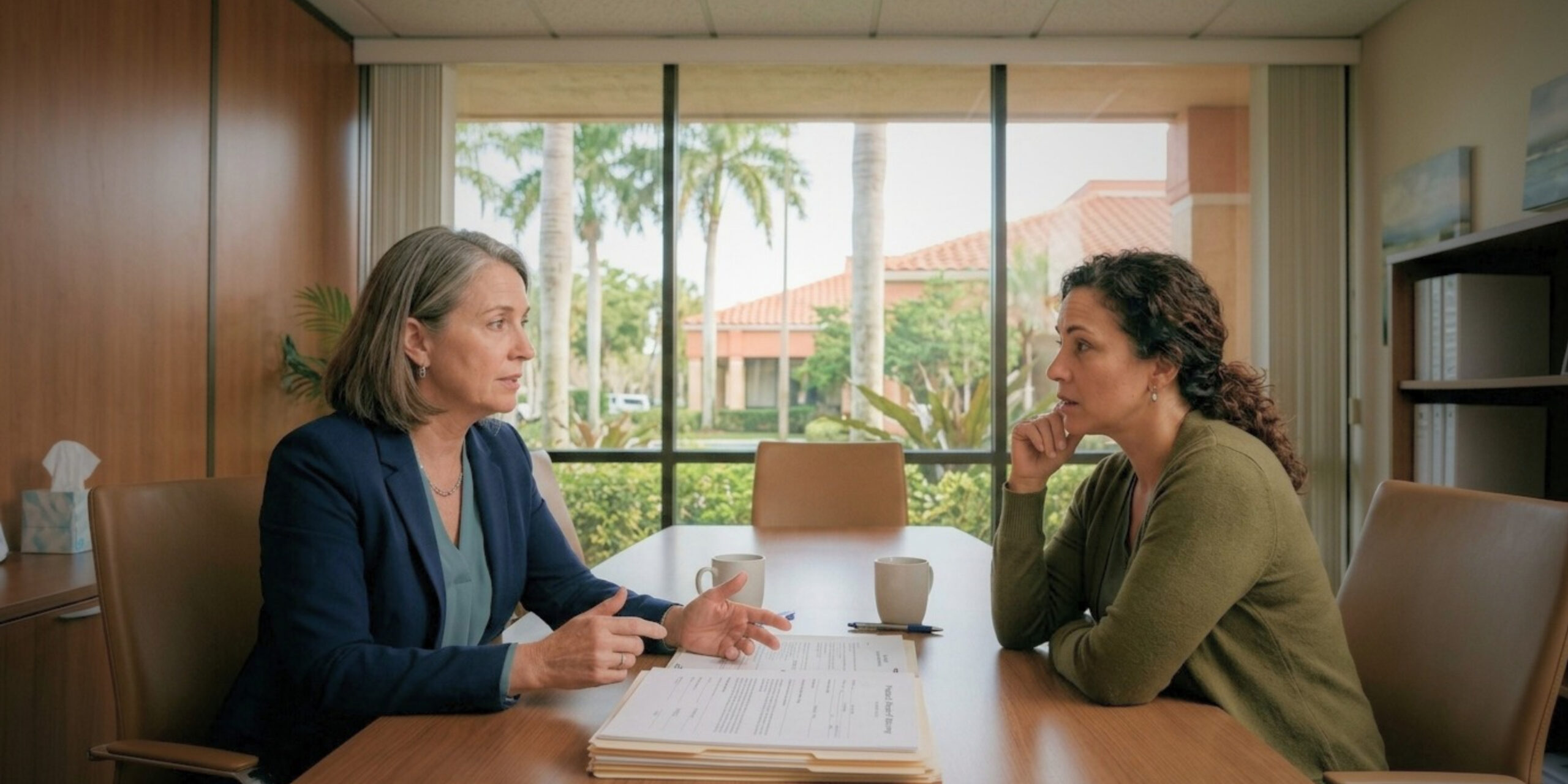
Family discussing a financial power of attorney with an attorney in Coral Springs, Florida

If you believe someone has misused a financial power of attorney in Florida, there are legal ways to challenge what happened. Depending on the circumstances, a court may review the agent’s conduct, require an accounting, remove the agent, terminate the agent’s authority, or order other relief.

Usually, though, nobody starts with a lawsuit.

It starts with a bank statement.

A parent gave a son or daughter power of attorney to handle the bills. An elderly relative needed someone to manage investments. Everything seemed ordinary until a family member noticed a withdrawal that did not make sense.

Then there is another one.

Maybe money went to the agent. Perhaps a house was sold. Maybe someone suddenly has a very good explanation for why several thousand dollars disappeared.

The uncomfortable part is that having power of attorney does give someone real authority. The document may allow an agent to handle bank accounts, investments, real estate, and other financial matters. But that authority comes with legal duties, and the agent has to stay within the authority the principal actually granted.

So what happens when the numbers stop making sense?

The answer usually starts with the power of attorney itself, the agent’s actions, and the financial records showing what happened to the principal’s money.


What Is a Financial Power of Attorney?

A power of attorney allows one person, called the principal, to authorize another person, called the agent, to act on the principal’s behalf.

The authority can be broad or limited. Depending on the document, an agent may be able to handle bank accounts, investments, contracts, real estate, or other financial matters.

Florida law generally limits an agent to the authority actually granted in the power of attorney. A broad statement saying that the agent can perform every act the principal could perform does not automatically create every possible specific power under the statute. Certain powers require separate, signed authorization.

That detail can become extremely important when a family disputes a transaction.

The document itself has to be examined.


What Does Financial Power of Attorney Abuse Look Like?

There is no single transaction that automatically proves abuse.

An agent might legitimately withdraw money to pay the principal’s mortgage. The same type of withdrawal could become a serious problem if the money goes toward the agent’s own mortgage.

Warning signs can include:

  • Unexplained withdrawals from bank or investment accounts
  • Transfers to the agent or the agent’s relatives
  • Personal expenses paid from the principal’s accounts
  • Property transferred or sold for the agent’s benefit
  • Large gifts that do not fit the principal’s history or instructions
  • Financial accounts being changed without a clear explanation
  • Missing receipts or financial records
  • Transactions occurring after the power of attorney was revoked

The records matter.

Florida requires an agent to keep records of transactions made on behalf of the principal, and the Florida Bar notes that an agent may be required to provide an accounting.


As Alan Reinfeld puts it:

“A power of attorney gives someone authority to act for another person. It does not give that person ownership of the principal’s money.”


Can a Power of Attorney Agent Take Money From the Principal?

An agent can use the principal’s money when the transaction is authorized and consistent with the agent’s legal duties.

The agent cannot simply treat the principal’s checking account as a second personal account.

Florida law describes the agent as a fiduciary. The agent generally must act loyally for the sole benefit of the principal, avoid conflicts that interfere with impartial decision-making, and exercise the care, competence, and diligence ordinarily expected in similar circumstances.

Consider a simple example.

A daughter has power of attorney for her father. She uses his account to pay his property taxes, medical bills, insurance, and other expenses. Those transactions may be entirely appropriate.

Then she transfers $50,000 to herself and says, “Dad wanted me to have it.”

That raises a very different set of questions.

  • Was the gift authorized?
  • Did the power of attorney contain the necessary authority?
  • Was the transaction consistent with the father’s known wishes?
  • Did the agent have a conflict of interest?
  • What records exist?

A court looking at a disputed transaction may need to answer those questions rather than simply deciding whether money changed hands.


Can a Power of Attorney Agent Use the Principal’s Property?

Real estate can create especially complicated disputes.

Florida law allows a power of attorney to grant authority to convey or mortgage homestead property, but the applicable formalities and statutory requirements matter. The Florida Bar likewise explains that an agent may sell a principal’s home when the power of attorney satisfies the applicable requirements and grants the necessary authority.

Suppose an agent sells a property and deposits the proceeds into an account belonging to the principal. That may be an ordinary transaction.

Suppose the proceeds instead end up financing the agent’s own house.

Now the transaction deserves serious scrutiny.

The same problem can arise when an agent uses the principal’s money to purchase property that is titled in the agent’s name.


A Broward County case shows how messy this can become

In Sacco-Martin v. Romano, decided by Florida’s Fourth District Court of Appeal in August 2025, elderly parents had granted powers of attorney to their daughter and her husband in 2019 and 2020. They revoked those powers of attorney in May 2021. A subsequent guardian alleged that the former agents had nevertheless exercised control over the parents’ financial accounts and transferred hundreds of thousands of dollars.

The probate court ordered an accounting covering the period during which the agents had acted under the powers of attorney. It reviewed bank statements and testimony and ultimately ordered the former agents to return substantial funds to the guardianship estate.

The Fourth DCA affirmed most of that ruling. It did, however, reverse one $20,000 portion because the particular transfer occurred before the relevant power of attorney period and therefore fell outside the accounting period established by the probate court.

The case also involved two properties purchased with the parents’ money. One was purchased with more than $562,000 transferred from the parents’ account and titled in the parents’ names. The property was later sold. Another property was purchased around the same time, with questions about whether the parents’ money ultimately funded the purchase and why that property was titled in the former agents’ names.

That is a useful lesson in how these disputes actually develop.

The question may begin with, “Where did the money go?”

It can eventually become a dispute involving bank records, property titles, closing statements, accounting periods, alleged gifts, and the scope of the agent’s authority.


Can a Court Remove a Power of Attorney Agent in Florida?

Yes.

Florida Statutes §709.2116 allows a court to construe or enforce a power of attorney, review an agent’s conduct, terminate the agent’s authority, remove the agent, and grant other appropriate relief.

The statute also identifies people who may petition the court. They include the principal or agent, certain fiduciaries, a person authorized to make health care decisions in specified circumstances, and another interested person who can demonstrate an interest in the principal’s welfare and a good-faith belief that court intervention is necessary.

That can matter when the principal is no longer capable of handling the dispute personally.

It also means that a family disagreement does not automatically give every relative the right to take over the situation. Standing, the principal’s circumstances, the agent’s conduct, and the available evidence all matter.


Can You Force a Power of Attorney Agent to Provide an Accounting?

Potentially, yes.

Financial records are often central to a dispute over an agent’s conduct. Florida law requires an agent to maintain records of receipts, disbursements, and transactions made for the principal. The Florida Bar likewise advises agents to maintain careful records and explains that an agent may be required to provide an accounting.

An accounting can help answer basic but important questions:

  • What money came into the account?
  • What money went out?
  • Who received it?
  • What was the payment for?
  • Was the transaction authorized?
  • Was the principal’s money used for the principal’s benefit?

Sometimes the accounting clears things up.

Sometimes it creates several new questions.


What Evidence Can Help Prove Power of Attorney Abuse?

If you suspect that a financial power of attorney has been misused, preserve the records before they disappear into the digital equivalent of a junk drawer.

Useful evidence can include:

  • The original power of attorney and any amendments
  • Bank and investment statements
  • Canceled checks
  • Wire transfer records
  • Deeds
  • Closing statements
  • Tax records
  • Credit card statements
  • Receipts
  • Emails and text messages
  • Communications with banks or financial institutions
  • Records showing the principal’s usual financial practices
  • Documents concerning the principal’s estate plan

The power of attorney itself is especially important.

A transaction can look suspicious until the document reveals that the agent had express authority to perform it. The opposite can also happen: a transaction can look ordinary until the document shows that the agent lacked the authority to make it.


What If the Principal Is Still Capable?

If the principal still has the legal capacity to make financial decisions, the situation may be different from one involving a principal who can no longer manage their affairs.

Florida law provides for revocation of a power of attorney, and a principal who remains capable may be able to revoke the existing authority and appoint another agent. The details depend on the circumstances and the document.

When there are already disputed transactions, however, changing the agent may be only one part of the problem.

There may also be questions about money already transferred, property already sold, or records that have not been provided.

Reviewing financial records for suspected power of attorney misuse in Broward County

What Happens to a Financial Power of Attorney After Death?

A power of attorney generally terminates when the principal dies. Florida’s statute expressly provides that the principal’s death terminates the power of attorney.

That does not erase transactions that happened while the principal was alive.

If family members believe an agent misused the principal’s property before death, those transactions can become relevant to an estate or probate dispute.

The legal framework then shifts. The personal representative or another person with appropriate authority may need to investigate what happened to the deceased person’s assets.

This is one reason a power of attorney dispute can eventually become a probate matter.


How Common Is Financial Exploitation?

Power of attorney abuse sits within a much larger financial exploitation problem.

The Administration for Community Living reported that older Americans lost nearly $2.4 billion to fraud in 2024, up from $1.9 billion in 2023. The agency also cautioned that reported fraud represents only part of the actual harm because many incidents go unreported.

The numbers cover fraud generally, not power of attorney abuse specifically.

But the broader pattern is relevant. Financial exploitation can occur within relationships of trust, including relationships involving family members, caregivers, and other people who have access to an older person’s finances.

A South Florida federal case illustrates how severe one of these situations can become.

In 2025, federal prosecutors sentenced former financier Brett Thomas Graham to seven years in prison after he admitted defrauding an elderly family member of approximately $8.4 million. According to the U.S. Attorney’s Office, Graham later became the woman’s power of attorney and was obligated to act in her best interest while continuing to divert money for his own expenses.

That is an extreme case.

Most power of attorney disputes will not involve $8.4 million, federal wire fraud charges, or a seven-year prison sentence.

The underlying problem can be much smaller and still be devastating to a family.


What Can Families Do About Power of Attorney Abuse?

Start with the document and the records.

Find out what authority the principal actually granted. Identify the transactions that are causing concern. Gather the financial records. Establish when the transactions occurred. Determine whether the power of attorney was still effective.

Then ask the uncomfortable questions.

  • Was the transaction authorized?
  • Was it for the principal’s benefit?
  • Did the agent personally benefit?
  • Was there a gift?
  • Was there a conflict of interest?
  • Can the agent account for the money?

Those questions are far more useful than simply asking whether someone in the family “did something shady.”

And sometimes the records show that the agent acted properly.

That possibility deserves to be taken seriously too.


As Stuart Reinfeld explains:

“Financial disputes between relatives can become emotional very quickly. The documents give everyone something concrete to examine.”

Attorney reviewing a property transfer involving a financial power of attorney in Broward County

Power of Attorney Disputes in Coral Springs and Broward County

For families in Coral Springs and throughout Broward County, a financial power of attorney dispute may overlap with probate, guardianship, estate litigation, real estate, or financial exploitation proceedings.

Broward County’s Probate and Guardianship Division handles probate and guardianship matters through the Seventeenth Judicial Circuit. The county also provides procedures and resources for matters involving vulnerable adult exploitation, guardianship accountings, probate filings, and related proceedings.

That local connection matters when a dispute moves from a family disagreement into a court proceeding.

A court may be asked to review the agent’s conduct, terminate the agent’s authority, remove the agent, order an accounting, or provide another appropriate remedy under Florida law.


Frequently Asked Questions

What is a financial power of attorney in Florida?

  • A financial power of attorney allows a principal to authorize an agent to handle specified financial or property matters. The agent’s authority depends on the language of the document and Florida law.

Can a power of attorney agent take money from the principal?

  • An agent may use the principal’s money when authorized and when acting consistently with the agent’s fiduciary duties. An agent cannot simply treat the principal’s assets as personal property.

How do you prove power of attorney abuse?

  • Evidence can include the power of attorney itself, bank records, transfers, property records, closing documents, receipts, communications, and other evidence showing what authority the agent had and what the agent actually did.

Could a power of attorney agent be removed in Florida?

  • Yes. Florida law allows a court to review an agent’s conduct, terminate the agent’s authority, remove the agent, and grant other appropriate relief.

Can a family member challenge a power of attorney agent?

  • Potentially. Florida law permits certain interested persons to petition the court when they meet the statutory requirements for intervention. A family relationship by itself does not determine whether someone has standing.

Can a power of attorney agent be required to provide an accounting?

  • An agent has a statutory duty to keep records of receipts, disbursements, and transactions made for the principal, and an accounting may be required in appropriate circumstances.

What happens to a power of attorney after the principal dies?

  • The power of attorney terminates when the principal dies. Transactions carried out before death can still become relevant to a later probate or estate dispute.

When a Financial Power of Attorney Goes Wrong

A financial power of attorney is built on a simple arrangement: one person gives another person authority to handle matters the principal cannot or does not want to handle personally.

Most of the time, that arrangement exists because someone needs help.

When the relationship breaks down, the family may be left reconstructing months or years of financial decisions while trying to determine who has the legal authority to do something about them.

That is why the document, the financial records, the agent’s conduct, and the principal’s circumstances all need to be examined together.

If you believe a financial power of attorney has been misused in Coral Springs, Broward County, or elsewhere in South Florida, Reinfeld & Cabrera P.A. can review the circumstances and discuss the legal options available under Florida law.


This article provides general information about Florida law and is not a substitute for legal advice concerning a particular situation.
How to Choose an Estate Planning and Probate Attorney in Coral Springs

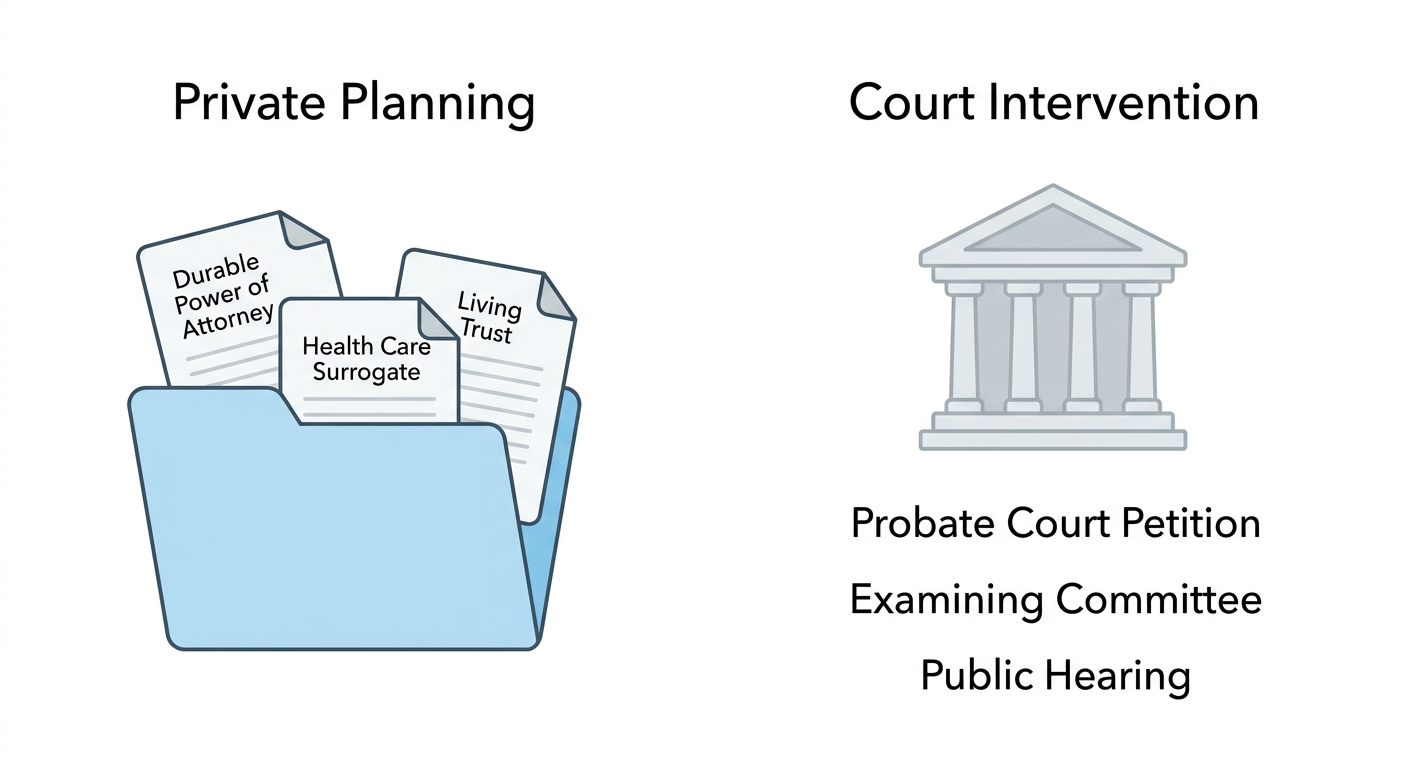
Diagram comparing private Florida incapacity planning documents with judicial probate court guardianship proceedings.

Direct Answer:

Selecting an estate planning and probate attorney in Coral Springs requires evaluating local Broward County courtroom experience, mastery of Florida trust statutes (Fla. Stat. Chapter 736), and integrated knowledge of Florida constitutional homestead laws (Fla. Const. art. X, § 4).

A qualified local attorney ensures wills, revocable trusts, and powers of attorney comply with strict execution requirements while guiding personal representatives through formal or summary probate proceedings in the 17th Judicial Circuit Court of Broward County.


Critical Evaluation Framework for Local Legal Counsel

Florida Statutory Compliance

  • Fla. Stat. Chapter 736 (Trust Code)
  • Fla. Stat. Chapter 709 (Durable Power of Attorney)
  • Fla. Stat. Chapter 765 (Health Care Directives)

Broward Judicial Experience

  • 17th Judicial Circuit Court Rules
  • Local Broward Clerk Filing Protocols
  • Probate Division Judicial Orders
Reinfeld & Cabrera Legal Representation Hub

Securing your family’s financial future, protecting physical property, and ensuring seamless asset distribution requires thoughtful legal strategy. While online document assembly services promise cheap, automated legal templates, generic forms regularly fail under Florida probate court scrutiny.

Florida estate law involves intricate statutory execution rules, unique real estate protections, and strict probate filings across Broward County. Understanding how to choose an experienced local attorney is the single most important step in protecting your life savings and preserving your legacy.


5 Essential Standards When Evaluating Coral Springs Estate Legal Counsel


1. Direct Mastery of Florida Specific Estate and Trust Statutes

Florida law does not follow generic federal templates or out of state legal norms. Your legal counsel must maintain a daily transactional practice grounded in specific Florida legislation:

  • Florida Trust Code (Fla. Stat. Chapter 736): Regulates the creation, amendment, revoking, and administration of revocable and irrevocable trusts. It establishes strict fiduciary standards for named trustees and protects beneficiary distribution rights.
  • Florida Power of Attorney Act (Fla. Stat. Chapter 709): Governs financial durable powers of attorney. Under Florida law, general sweeping clauses are ineffective unless specific statutory superpowers under Fla. Stat. § 709.2114 are explicitly initialed by the principal.
  • Florida Probate Code (Fla. Stat. Chapters 731 through 735): Controls the judicial validation of wills, opening of estates, creditor notification periods, and final asset distribution.
  • Florida Health Care Advance Directives (Fla. Stat. Chapter 765): Outlines the legal appointment of health care surrogates, living wills, and anatomical gifts.

2. Local Courtroom and Judicial Experience in Broward County

Estate planning and probate are deeply localized practice areas. An attorney who regularly represents clients before the 17th Judicial Circuit Court in Fort Lauderdale understands local judicial preferences, divisional filing protocols, and clerk processing workflows.

When a loved one passes away, local judicial experience ensures that petitions for administration, orders appointing personal representatives, and letters of administration move through the Broward County probate court system without administrative rejections or unnecessary delays.


3. Integrated Florida Constitutional Homestead Protection

For the vast majority of Coral Springs and Parkland homeowners, primary residential real estate represents their largest asset. Under Florida Constitution Article X, Section 4, primary residential property enjoys unique protection from forced sale by creditors.

However, Florida homestead devise restrictions strictly limit how a primary home can be left in a Will or Trust if the owner is survived by a spouse or minor children. An experienced Coral Springs attorney knows how to structure deeds, trusts, and spousal waivers to preserve homestead protections while avoiding title clouding or unintended tax consequences.


Florida Constitutional Homestead Advantages
Creditor Exemption Protection Protects primary residential equity from forced sale by judgment creditors under Florida law.
Property Tax Cap Limits Locks annual assessed property value increases under Florida Save Our Homes assessment caps.
Strict Devise Restrictions Protects rights of surviving spouses and minor children regarding real estate transfers.

4. Comprehensive Probate Avoidance and Administration Capabilities

A complete legal counselor does not simply hand you a stack of paper and send you on your way. Your attorney must possess expertise across both proactive planning and reactive administration:

  • Incapacity Avoidance: Structuring financial durable powers of attorney and health care surrogates to prevent involuntary adult guardianship court hearings under Fla. Stat. Chapter 744.
  • Summary Probate Administration: Navigating expedited court proceedings under Fla. Stat. Chapter 735 for estates under $75,000 or where the decedent has been deceased for more than two years.
  • Formal Probate Administration: Managing complex court supervised estates requiring personal representative appointments, formal notice to creditors, estate accounting, and tax releases.

5. Proven Community Reputation and Legal Continuity

Estate planning is an ongoing lifetime relationship. As your family grows, assets change, and Florida tax laws evolve, your estate plan requires periodic reviews.

Recognized over the years by local Coral Springs community awards, Reinfeld & Cabrera, P.A. has established a decade long legacy of personal legal representation across Broward County. Choosing a stable, locally rooted firm ensures that the attorneys who drafted your trust will be available decades later to guide your loved ones through its execution.


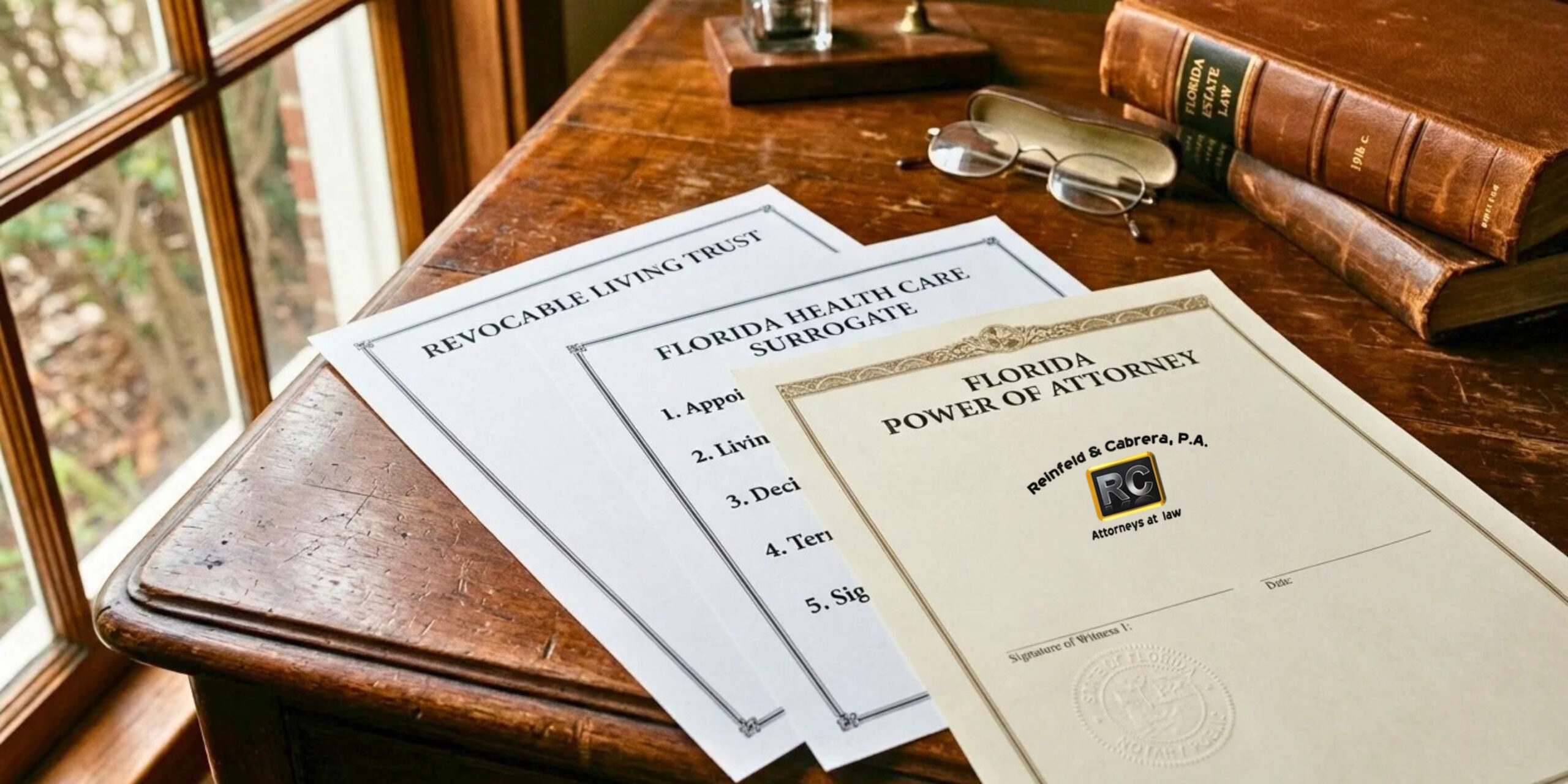
Close up photograph of executed Florida Durable Power of Attorney and Designation of Health Care Surrogate legal documents.

Comparing Online DIY Legal Forms vs. Local Attorney Representation

Operational FeatureOnline DIY Document GeneratorLocal Coral Springs Legal Counsel
Florida Execution ComplianceHigh risk of improper witnessing or notarizationStrict compliance with Fla. Stat. § 732.502
Homestead Protection IntegrationGeneric forms ignore Florida constitutional restrictionsCustomized deed drafting and tax cap protection
Local Probate Court KnowledgeZero court presence or regional administrative supportDirect filing experience in 17th Judicial Circuit Court
Fiduciary GuidanceNo legal advice on selecting agents or trusteesProfessional counseling on trustee appointment
Custom Contingency PlanningRigid templates that fail during complex family changesBespoke trust structures adapted to family dynamics

Frequently Asked Questions

Why shouldn’t I use a basic online Will template in Florida?

  • Florida law requires strict execution formalities under Fla. Stat. § 732.502, including execution in the presence of two signing witnesses and a qualifying notary public. Online templates routinely miss unique Florida requirements, such as statutory power of attorney superpowers or constitutional homestead devise limits, rendering documents invalid or triggering expensive probate disputes.

What is the difference between summary administration and formal probate in Broward County?

  • Summary administration is an abbreviated court proceeding available if the total value of probate assets subject to administration is $75,000 or less, or if the decedent has been deceased for over two years. Formal administration is required for larger estates and involves appointing a personal representative to marshal assets, clear creditor claims, and manage distributions.

How often should I review my Coral Springs estate plan with an attorney?

  • You should review your estate plan every three to five years, or immediately following major life events such as marriage, divorce, the birth of a child, purchase of new real estate, significant changes in financial assets, or relocation to Florida from another state.

Can an out of state Will be used in Florida?

  • A Will executed in another state can be valid in Florida if it strictly met the execution laws of the state where it was signed. However, out of state Wills often name non resident personal representatives who may not qualify under Florida eligibility rules (Fla. Stat. § 733.304) or fail to utilize Florida specific probate shortcuts.

Dedicated Estate Planning and Probate Counsel in Coral Springs

At Reinfeld & Cabrera, P.A., lead attorney Alan J. Reinfeld and our legal team deliver tailored estate planning and probate solutions to South Florida families. We take the time to understand your personal goals, protect your real estate assets, and provide clear legal guidance through every stage of life.


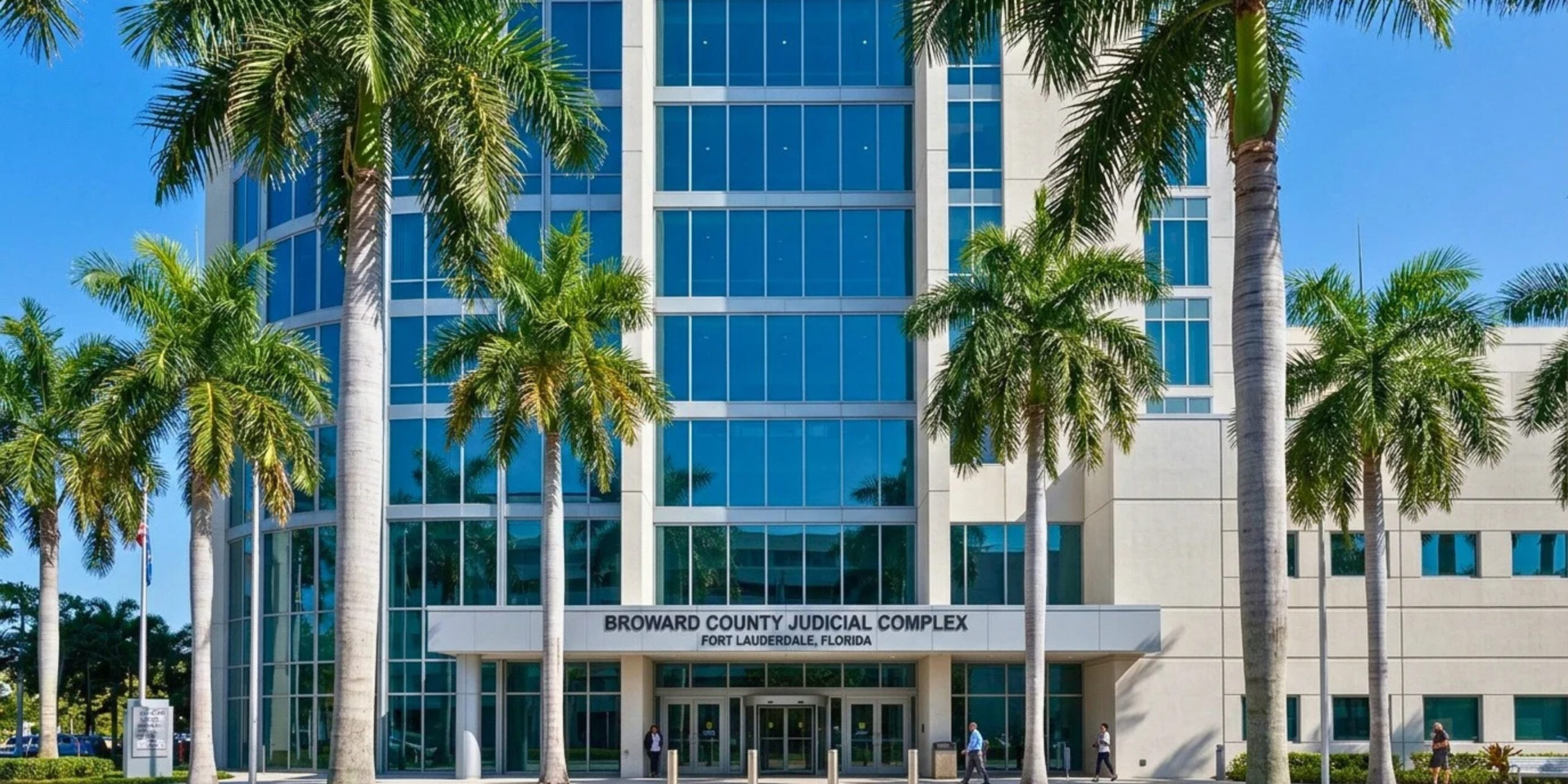
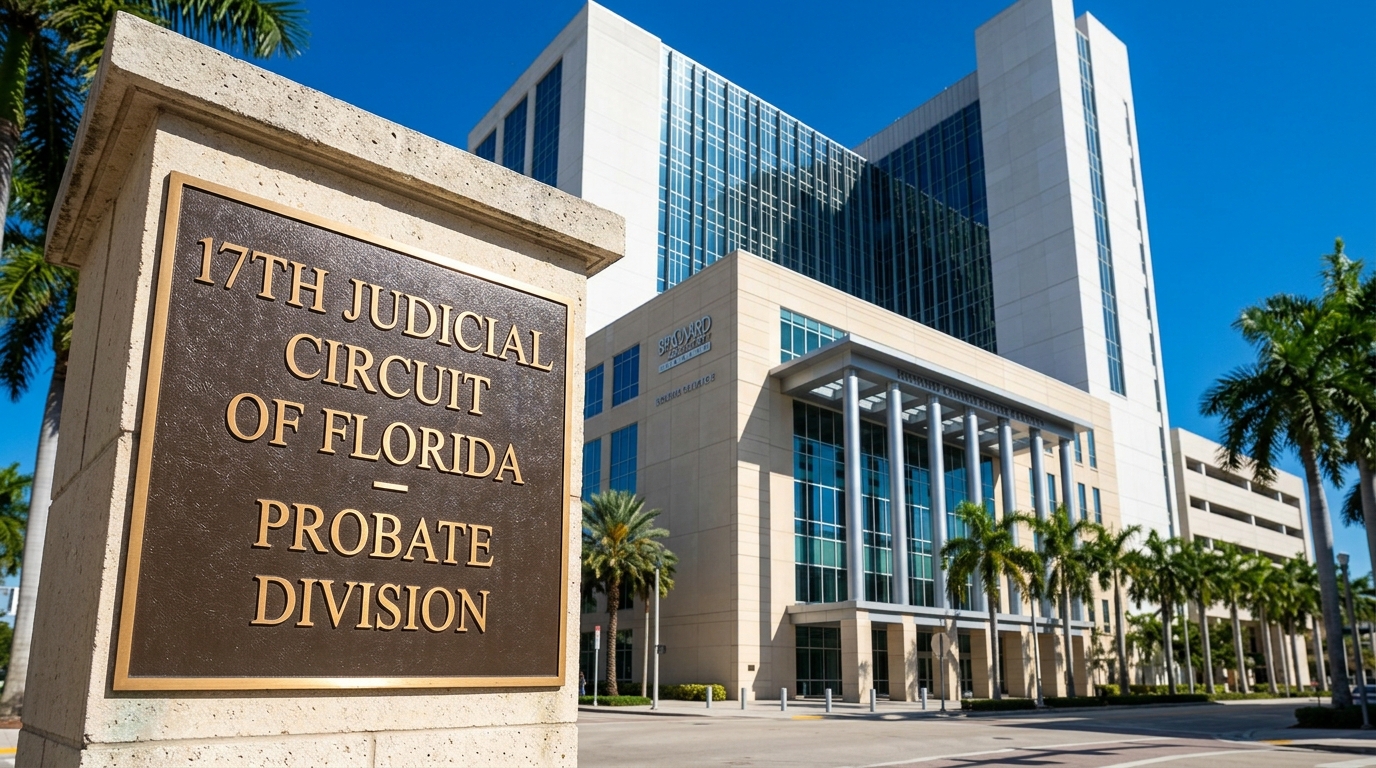
Exterior view of the Broward County Judicial Complex in Fort Lauderdale Florida home to the 17th Judicial Circuit probate division.

Schedule a Free Confidential Case Evaluation

Speak directly with an experienced Coral Springs estate attorney today:

  • Direct Phone: (954) 866-4878 | (954) 334-1520
  • Coral Springs Main Office: 9625 W Sample Rd, Coral Springs, FL 33065
  • Fort Lauderdale Office: 2933 W Cypress Creek Rd, Suite 201, Ft Lauderdale, FL 33309
  • Online Scheduling: mypersonalattorneys.com
  • Regional Coverage: Coral Springs, Fort Lauderdale, Parkland, Tamarac, Margate, Coconut Creek, and all surrounding Broward County communities.

What is Probate Litigation?

Probate litigation attorney reviewing estate documents in Florida

Probate litigation is the legal process used to resolve disputes involving a deceased person’s estate, will, trust, beneficiaries, or the administration and distribution of estate assets. In Florida, probate litigation can involve will contests, trust disputes, beneficiary disputes. And it can also cover challenges involving undue influence or improper execution. Even disagreements concerning a personal representative, and other contested estate matters.

Although people often use the term probate litigation to mean a will contest, a will contest is only one type of probate dispute. Florida probate proceedings can involve many different questions about who is entitled to inherit, how an estate should be administered, whether a particular document is legally valid, and whether someone responsible for managing an estate has properly performed their duties.

For families dealing with an estate dispute in Coral Springs, Fort Lauderdale, Broward County, or elsewhere in South Florida, understanding what probate litigation involves can help clarify when a disagreement requires formal legal action.


What Does Probate Litigation Involve?

Probate litigation can arise whenever interested parties disagree about a legal issue affecting an estate or the rights of people connected to it.

Under Florida Probate Rule 5.025, certain matters are specifically treated as adversary proceedings. These include proceedings to contest the validity of a will, revoke the probate of a will, determine beneficiaries, construe or modify a will, probate a lost or later discovered will, remove or surcharge a personal representative, and determine certain rights relating to an estate. These proceedings are generally handled in a manner similar to civil litigation, with the Florida Rules of Civil Procedure applying as provided by the probate rules.


Common examples of probate litigation include:


Will Contests

A beneficiary or other interested person may dispute whether a will is legally valid.

  • Florida law recognizes specific requirements concerning the execution of a will. A challenge can also involve allegations that the will was procured through fraud, duress, mistake, or undue influence, among other potential grounds.
  • A will contest is not simply a disagreement with how someone chose to distribute their property. The person challenging the will generally must establish a legally recognized basis for opposing probate or seeking revocation.
  • Florida law also establishes specific rules concerning the burdens of proof in will contests. The proponent of a will initially has the burden of establishing prima facie formal execution and attestation. The contestant then has the burden of establishing the grounds on which probate is opposed or revocation is sought.

Arguments Over Undue Influence

  • Family members sometimes question whether an elderly, vulnerable, or dependent person was pressured into changing a will or other estate planning document.
  • Undue influence can become an important issue in probate litigation, particularly where a person who exercised substantial influence over the decedent also benefited from a change in the estate plan.
  • Florida law contains specific rules concerning the presumption of undue influence and the allocation of the burden of proof in certain circumstances.

Disputes Over Beneficiaries

  • Sometimes the central question is not whether a will exists, but who is legally entitled to receive property from an estate.
  • Florida probate proceedings can address disputes concerning the determination of beneficiaries. Such disputes may arise from conflicting estate planning documents, questions about a beneficiary’s status, or disagreements concerning the interpretation or application of an estate plan.

Conflicts Involving a Personal Representative

  • A personal representative is responsible for administering a Florida estate according to the law and the requirements of the probate proceeding.
  • Litigation may arise when interested persons allege that a personal representative has failed to properly perform those responsibilities. Florida Probate Rule 5.025 specifically identifies proceedings to remove or surcharge a personal representative as adversary proceedings.

Disputes Over the Meaning of a Will

Not every probate dispute involves an allegation that a will is fraudulent or invalid.

  • Sometimes the document itself is valid, but the people involved disagree about what a particular provision means or how property should be distributed. Florida probate rules specifically recognize proceedings to construe, reform, or modify a will as adversary proceedings.

Later Discovered or Lost Wills

  • Questions can also arise when a will is discovered after another will has already been submitted to probate, or when a person seeks to probate a will that has been lost or destroyed.
  • Florida Probate Rule 5.025 specifically identifies proceedings involving lost, destroyed, or later discovered wills as adversary proceedings.

Is Trust Litigation the Same as a Will Contest?

No. Trust litigation is related to probate litigation but involves different legal documents and procedures.

Florida’s Trust Code allows judicial proceedings concerning trusts to address their validity, administration, or distribution. These proceedings can involve determining whether a trust is valid, appointing or removing a trustee, reviewing trustee accounts or fees, determining beneficiaries, interpreting trust provisions, and resolving questions involving the rights and duties of trustees and beneficiaries.

A trust contest can also involve a challenge to the validity or revocation of all or part of a trust. Florida law places the burden of establishing the grounds for invalidity on the person contesting the trust. Special timing rules apply to contests involving revocable trusts.

For that reason, a dispute involving a trust should not automatically be treated as a will contest. The appropriate legal analysis depends on the document involved, the circumstances surrounding it, and the specific issue being disputed.


Can You Contest a Will Before Someone Dies in Florida?

Generally, no.

Florida Statute §732.518 provides that an action contesting the validity of all or part of a will, or contesting its revocation, cannot be commenced before the testator’s death.

This distinction is important. Someone may have serious concerns about how another person is being influenced or about changes being made to an estate plan, but a formal action challenging the validity of a will generally cannot be brought until after the testator has died.

Trust disputes can involve different timing rules, particularly when the trust is revocable.

Florida probate attorney discussing an estate dispute with family members

Does Probate Litigation Always Mean Someone Is Trying to Invalidate a Will?

No.

A probate case can become contested even when nobody is arguing that the entire will should be invalidated.

For example, litigation may concern:

  • Who the beneficiaries are
  • How a provision of a will should be interpreted
  • Whether a later will should be admitted to probate
  • Whether a personal representative should be removed
  • Whether a personal representative should be held financially responsible for misconduct
  • Whether a particular asset belongs in the estate
  • How property should be distributed
  • Whether someone has been improperly excluded from an inheritance
  • Whether a trust is valid or how its provisions should be interpreted

This is why probate litigation is better understood as a broad category of estate related disputes rather than simply another name for a will contest.


What Happens During Probate Litigation?

The procedure depends on the nature of the dispute, but contested probate matters can involve formal pleadings, service of legal documents, discovery, evidence, hearings, depositions, expert testimony, settlement negotiations, and ultimately a ruling by the court.

Florida Probate Rule 5.025 provides that after formal notice in an adversary proceeding, the matter is conducted as nearly as practicable like a civil action, with the Florida Rules of Civil Procedure governing as provided by the rule.

The exact process depends on the dispute. A straightforward disagreement about the interpretation of an estate document may involve very different issues from a contested will proceeding involving allegations of undue influence or fraud.


When Should You Speak With a Probate Litigation Attorney?

It can be important to obtain legal advice before taking action when you believe an estate is being administered improperly or that an estate planning document may not reflect the decedent’s valid wishes.

Situations that may warrant legal review include:

  • You believe a will was improperly executed.
  • A new will or codicil appeared shortly before someone’s death and you have concerns about the circumstances surrounding it.
  • You believe someone exercised undue influence over the person who created the estate plan.
  • You believe a beneficiary has been improperly excluded.
  • You believe a personal representative is mishandling estate assets.
  • Family members disagree about who is entitled to inherit.
  • A dispute has developed over the meaning of a will or trust.
  • A trust’s validity or administration is being challenged.
  • You have received formal legal notice concerning a contested probate proceeding.

Probate disputes can involve strict procedural requirements and deadlines. The appropriate legal strategy depends heavily on the documents involved, the stage of the probate proceeding, and the specific facts of the dispute.


Probate Litigation in Coral Springs, Fort Lauderdale, and South Florida

MyPersonalAttorneys assists clients dealing with estate and probate matters in Coral Springs, Fort Lauderdale, Broward County, and throughout South Florida.

Probate litigation can be particularly difficult. Especially when disagreements arise between family members who are already dealing with the loss of someone close to them. A dispute may involve substantial financial interests. Yes – but it can also involve questions about the decedent’s wishes, family relationships, and the proper administration of an estate.

Understanding the nature of the dispute is the first step. Whether the issue involves a contested will, beneficiary rights, a trust, a personal representative, or another probate matter, an attorney can review the relevant documents and explain the legal issues involved.


Frequently Asked Questions About Probate Litigation


What is probate litigation?

  • Probate litigation is the legal process for resolving contested issues involving an estate, will, beneficiaries, personal representative, or related probate matter. It can include will contests, beneficiary disputes, challenges involving estate administration, and other adversary proceedings.

What is the difference between probate and probate litigation?

  • Probate is the legal process through which an estate is administered after someone dies. Probate litigation occurs when a legal dispute arises within or in connection with that process and requires formal resolution.

Is a will contest the same as probate litigation?

  • No. A will contest is one type of probate litigation. Probate litigation can also involve beneficiary disputes. Things like personal representative disputes, interpretation of a will, later discovered wills, and other contested estate matters.

Could you challenge a will in Florida?

  • Yes, but a will cannot be challenged simply because a beneficiary disagrees with the distribution. A challenge generally requires a legally recognized basis for opposing probate or seeking revocation. Florida law establishes specific rules governing will contests and their burdens of proof.

Can you contest a will before someone dies?

  • Generally, no. Florida Statute §732.518 provides that any contest of the validity of a will can’t commence before the testator’s death.

Can a trust be challenged in Florida?

  • Yes. Florida law permits judicial proceedings concerning the validity, administration, and distribution of trusts. This includes proceedings involving trustees, beneficiaries, and the interpretation of trust provisions.

Do I need a probate litigation attorney?

  • If an estate dispute involves a contested will, beneficiary rights, or another matter requiring formal litigation, you better be careful. Obtaining advice from an attorney experienced in probate disputes can help you understand your legal rights and available options.

Discuss Your Probate Dispute With MyPersonalAttorneys

If you are involved in a contested estate matter in Coral Springs, Fort Lauderdale, or South Florida, MyPersonalAttorneys can review your situation and explain the legal issues that may apply.

Call 954-334-1520 to discuss your probate or estate dispute.

Understanding the Florida Probate Process: What Happens After Someone Dies?

Florida probate process documents and estate administration materials on a legal desk

When someone dies, their family may need to go through probate before certain assets can be transferred to the people entitled to receive them. Probate is a court supervised process used to identify and gather probate assets, address valid debts and creditor claims, and distribute the remaining property according to the will or Florida law.

For families in Coral Springs, Broward County, and throughout South Florida, the process can raise practical questions quickly. Which assets have to go through probate? Who handles the estate? How are creditors paid? How long does the process take? And does every estate requi3re the same type of probate administration?

The answers depend on the assets involved, the existence and terms of a will, the value of the estate, creditor issues, and other circumstances.


What Is Probate in Florida?

Probate is a legal process for administering a deceased person’s probate estate. Florida courts describe probate as a court supervised process for identifying and gathering assets, paying debts, and distributing assets to beneficiaries. Probate generally applies only to probate assets, rather than everything the deceased person owned.

A probate asset may include a bank or investment account held solely in the deceased person’s name, or certain real property owned individually by the deceased. Assets with a valid mechanism for passing automatically to another person may not need to be administered through probate.

This distinction matters because a person’s total property does not necessarily equal the property that must be handled through a probate proceeding.


What Are the Steps in the Florida Probate Process?

Although every estate is different, a probate administration commonly involves several stages.

1. The probate case is opened

The proceeding is generally filed with the clerk of the circuit court in the appropriate Florida county. Venue is ordinarily based on the deceased person’s domicile at the time of death.

The documents required at the beginning of the case depend on the circumstances, including whether the deceased person left a will and which type of administration is appropriate.

2. The will is submitted to the court, if there is one

If the deceased left a will, it must be presented to the probate court and admitted according to Florida law.

A will does not, by itself, transfer every asset immediately to the people named in it. Probate may still be necessary to establish the authority to administer probate assets and complete the estate administration.

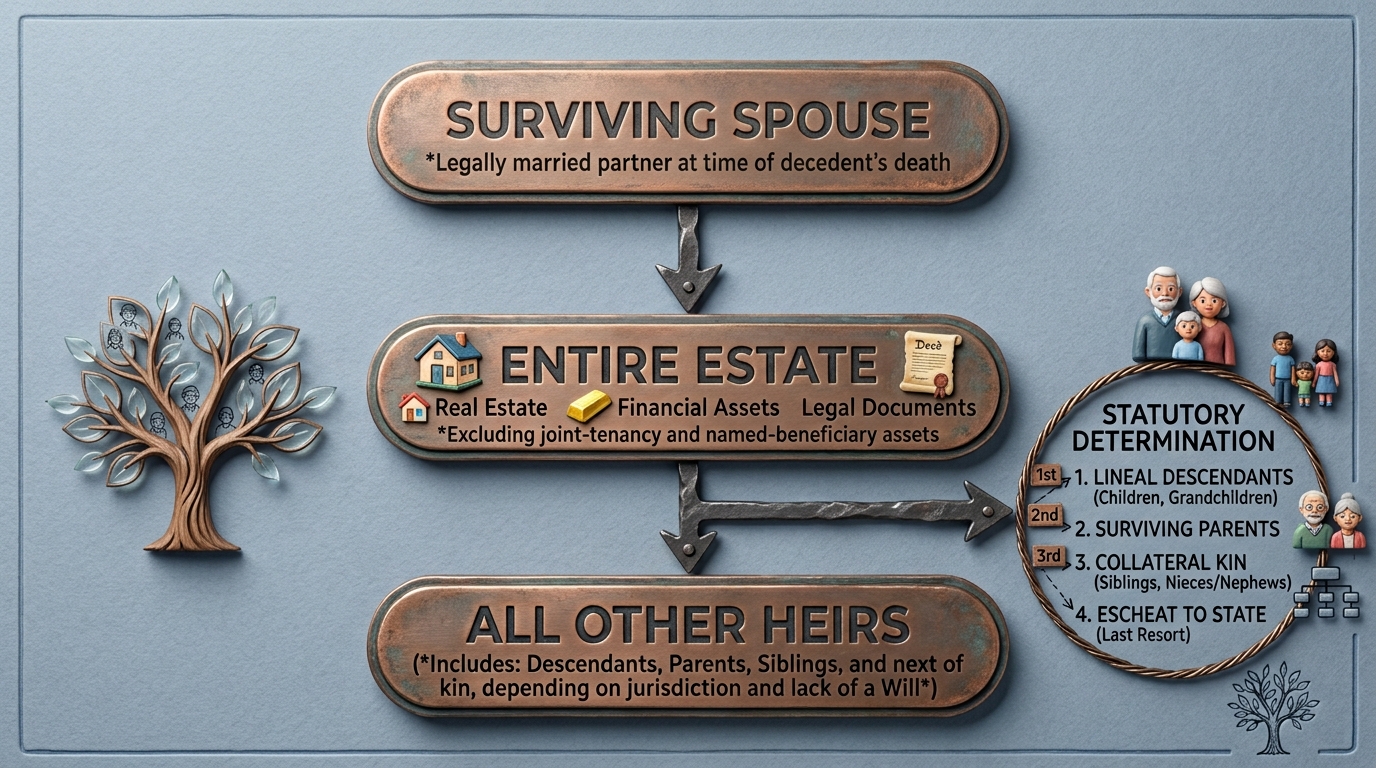
If there is no valid will governing the property, Florida’s intestacy laws determine who is entitled to inherit.

3. A personal representative is appointed

Florida generally uses the term personal representative for the person appointed to administer a probate estate.

The personal representative’s responsibilities can include identifying estate assets, dealing with creditors, protecting estate property, paying authorized expenses and obligations, and eventually distributing assets to the appropriate beneficiaries or heirs.

The personal representative is a fiduciary. Florida law requires that person to administer and distribute the estate consistently with the will and the law and to act in the best interests of the estate and interested persons.

The person nominated in a will may have priority for appointment, although the court must still apply Florida’s statutory requirements concerning who may serve.

4. The estate’s assets are identified and gathered

The personal representative must determine what property belongs to the probate estate and take the steps necessary to administer those assets.

This can involve locating financial accounts, real property, personal property, business interests, or other assets. It can also require determining whether particular assets pass outside probate because of joint ownership, beneficiary designations, trusts, or other arrangements.

This is one reason a probate case cannot always be understood simply by looking at the deceased person’s will.

5. Creditors are given an opportunity to file claims

An estate may have outstanding debts when someone dies. Florida law provides procedures for notifying creditors and establishing deadlines for claims against the estate.

A creditor’s claim generally must be filed within the applicable statutory period. Under Florida Statutes section 733.702, many claims must be filed no later than the later of three months after the first publication of the notice to creditors or 30 days after service of the notice on a creditor who is required to receive it. Untimely claims can be barred, subject to limited statutory exceptions.

The personal representative may also have to evaluate and respond to claims filed against the estate. A disputed claim can create additional proceedings and delay the administration.

6. Valid expenses and obligations are paid

Not every debt or expense is treated identically.

Florida law establishes an order of priority for paying expenses and obligations of an estate. Administration expenses, certain funeral expenses, specified taxes and debts, certain medical expenses, family allowances, and other obligations fall into statutory classes.

This means that simply finding a debt does not necessarily answer the question of whether, when, or how it will be paid.

7. Remaining assets are distributed

After the estate’s obligations have been addressed and the requirements for distribution have been satisfied, the remaining probate assets can be distributed to the beneficiaries named in the will or to the heirs entitled to receive property under Florida’s intestacy laws.

The personal representative must follow the governing legal documents and Florida law rather than simply distributing property according to informal family agreements.

8. The estate is closed

The final stage involves completing the administration and taking the steps required to close the probate estate.

The timing varies considerably. A straightforward estate with few assets and no disputes can be very different from an estate involving contested claims, difficult-to-value property, creditor disputes, litigation, or disagreements among beneficiaries.


Does Every Florida Estate Go Through the Same Probate Process?

No.

Florida recognizes formal administration and summary administration, along with limited circumstances in which certain personal property can be transferred without a formal administration.

Formal Administration

Formal administration is the more extensive probate procedure. It can involve the appointment of a personal representative, administration of estate assets, creditor procedures, payment of obligations, and distribution of the remaining property.

It is generally used when the circumstances of the estate require a full administration.

Summary Administration

Summary administration is a shorter procedure available when the statutory requirements are met.

Under current Florida law, summary administration may be available when the value of the estate subject to administration, after accounting for property exempt from creditor claims, does not exceed $150,000, or when the deceased person has been dead for more than two years.

The court can enter an order directing distribution of the estate’s assets, but summary administration still involves legal requirements concerning beneficiaries, assets, and creditors.

A smaller estate is therefore not automatically the same thing as an estate that requires no probate.


Documents representing the steps of probate administration in Florida

How Long Does Probate Take in Florida?

There is no single timeline that applies to every Florida probate case.

The length of an estate administration can depend on:

  • The type of probate administration
  • The number and nature of the estate’s assets
  • Whether real estate must be transferred or sold
  • Whether creditors file claims
  • Whether a claim is disputed
  • Whether beneficiaries disagree
  • Whether litigation becomes necessary
  • Whether assets are difficult to locate or value
  • Whether tax or other financial issues require additional work

Creditor procedures can also create important timing requirements. For example, Florida law establishes specific periods for filing and objecting to creditor claims and provides rules governing when certain claims may be paid.

For that reason, estimates based solely on the size of an estate can be misleading.


What Happens If Family Members Disagree During Probate?

Probate does not automatically prevent disputes between beneficiaries, heirs, creditors, or the personal representative.

Disagreements can involve the validity or interpretation of a will, the identification or valuation of assets, creditor claims, the conduct of the personal representative, or the proposed distribution of estate property.

Some issues can be resolved without extended litigation. Others require court intervention.

The personal representative has fiduciary duties during administration, and Florida law provides procedures for addressing problems involving the administration of an estate.


Does Having a Will Avoid Probate in Florida?

Not necessarily.

A will tells the court how the deceased person wants certain property distributed, but having a will does not automatically eliminate the need for probate.

Whether an asset passes through probate depends on how that asset is owned and whether another legal mechanism controls its transfer at death.

This is why estate planning and probate are related but distinct subjects. A person can have a carefully prepared will and still have a probate estate requiring court administration.


Probate attorney workspace serving Coral Springs and Broward County families

When Should You Speak With a Probate Attorney?

Professional advice can be particularly important when an estate includes significant assets, real property, creditor issues, business interests, disputed claims, beneficiary disagreements, or questions about the personal representative’s conduct.

The right approach also depends on whether the estate qualifies for summary administration or requires formal administration.

For families in Coral Springs, Broward County, and South Florida, understanding the type of estate involved is often the first step toward understanding what the probate process will actually require.


Frequently Asked Questions About the Florida Probate Process

What is the first step in probate in Florida?

  • The first step depends on the circumstances of the estate, but probate generally begins with filing the appropriate documents with the circuit court in the proper county. If there is a will, it is submitted to the court as part of the probate process.

How long does probate take in Florida?

  • There is no fixed timeline for every estate. The length depends on the type of administration, the assets involved, creditor issues, disputes, and other circumstances.

What is the difference between formal and summary probate in Florida?

  • Formal administration is the more extensive probate procedure. Summary administration is a shorter procedure available when statutory requirements are satisfied, including the current $150,000 estate value threshold or the alternative two year period after death.

Does every asset have to go through probate?

  • No. Probate generally applies to probate assets. Certain jointly owned assets, beneficiary designated accounts, and other property may pass outside probate depending on how they are structured.

What does a personal representative do?

  • A personal representative administers the estate. Duties can include gathering assets, dealing with creditor claims, paying authorized expenses and obligations, and distributing property according to the will and Florida law. The personal representative also has fiduciary duties to the estate and interested persons.

Can probate become a lawsuit?

  • Yes. Probate is a court proceeding, and disputes concerning wills, assets, creditor claims, beneficiaries, or estate administration can require litigation or other contested proceedings.

Can a Florida estate avoid formal probate?

  • Sometimes. Florida law provides summary administration for qualifying estates and limited procedures for disposing of certain personal property without administration. Whether one of these alternatives applies depends on the specific facts of the estate.

Probate Guidance for Families in Coral Springs and Broward County

Probate is not one identical process for every Florida family. The appropriate procedure depends on the person’s assets, debts, estate planning documents, beneficiaries, and other circumstances.

If you are dealing with an estate in Coral Springs, Broward County, or elsewhere in South Florida, a probate attorney can review the circumstances and explain which type of administration may apply and what steps are likely to follow.

Avoiding Probate in Florida: Estate Planning Mistakes to Watch For

Estate planning attorney reviewing probate avoidance options with a client in Coral Springs, Florida

Can avoiding probate create problems?

Yes. An estate plan can keep an asset out of probate while creating a different problem involving ownership, inheritance, control, or family disputes.

Joint accounts, beneficiary designations, trusts, and survivorship ownership can all be useful estate-planning tools. Problems arise when one of those arrangements is created without considering how it fits with the rest of the estate plan.

A person may add a child to a bank account because the child will receive it automatically at death. Someone else may name a beneficiary on a retirement account and never update it. A homeowner may add a child to a deed to make a future transfer easier.

Each decision can accomplish its immediate purpose. It can also produce an unintended result elsewhere.


When Probate Avoidance Changes the Intended Inheritance

The central problem is coordination.

Suppose a parent wants three children to inherit equally. The will reflects that intention, but one child is the beneficiary of a bank account, another is the beneficiary of a life insurance policy, and the house is jointly owned with the third.

The probate estate may then tell only part of the story.

Florida recognizes numerous arrangements that allow assets to pass outside probate. Some nonprobate assets can nevertheless remain relevant for other estate-planning purposes. For example, Florida’s elective-share statute includes certain payable-on-death, transfer-on-death, in-trust-for, and survivorship accounts when calculating a surviving spouse’s elective estate.

Avoiding probate and determining who should ultimately receive an estate are therefore separate questions.


Can Adding Someone to a Bank Account Cause an Inheritance Problem?

It can.

Adding a child or other person to an account may be intended to provide convenience during the owner’s lifetime or allow the account to pass automatically at death.

But joint ownership can affect both control and inheritance.

The Florida Bar warns that joint ownership can produce unintended consequences involving creditor exposure, unequal treatment of heirs, estate expenses, and other issues.

For example, a parent might add one child to an account because that child helps manage the parent’s finances. If the account carries survivorship rights, the arrangement may also determine who receives the money when the parent dies.

That result may be completely different from an intention to divide the estate equally among several children.


Can a Beneficiary Designation Conflict With a Will?

Yes.

A beneficiary designation can determine who receives certain assets without the asset passing through probate.

That can be useful until an old designation conflicts with a later estate plan.

Suppose someone signs a new will leaving the estate equally to two children. A retirement account still names one child as the sole beneficiary.

The new will does not necessarily change that beneficiary designation.

Beneficiary designations should therefore be reviewed whenever the overall estate plan changes and after major life events such as marriage, divorce, or the death of a beneficiary.


What If I Create a Trust but Forget to Transfer an Asset?

A trust document does not automatically place every asset into the trust.

If someone creates a revocable trust intending for it to hold an investment account, but the account remains solely in that person’s individual name, the trust may not control the account simply because the trust document says it should.

The same issue can arise with real estate, business interests, and other significant property.

The planning documents and ownership records need to match.


Can Putting a Child on Your House Cause Problems?

It can.

Adding a child to real estate can affect ownership and control during the parent’s lifetime as well as what happens after death.

The parent may have intended to make the eventual transfer easier. Instead, the arrangement can create a co-ownership relationship that affects decisions about selling, refinancing, or managing the property.

Florida homestead adds another layer of rules. Florida law places restrictions on the devise of homestead when a surviving spouse or minor child is involved, and separate provisions address certain lifetime transfers.

An ownership change intended to avoid probate therefore needs to be considered under the homestead rules as well.

Broward County estate planning attorney reviewing conflicting beneficiary and ownership arrangements

What Happens When Estate Documents Disagree?

Consider a simple example:

  • The will divides the estate equally among three children.
  • A bank account names Child A as beneficiary.
  • A life insurance policy names Child B.
  • The house is jointly owned with Child C.
  • A trust was created to hold the house, but the deed was never transferred to the trust.

There is no single document explaining the entire estate.

Each asset may have its own transfer mechanism. The family may then have to determine which arrangement controls each asset and whether any of them create additional legal rights.

The underlying problem is coordination.


Should Every Asset Be Arranged to Avoid Probate?

No.

Some assets may appropriately pass through probate. Others may be better handled through a trust, beneficiary designation, survivorship arrangement, or another structure.

The useful planning exercise is to identify the major assets, determine how each is currently owned, and ask how each will pass at death.

Then compare that result with the intended distribution.

That review can reveal inconsistencies before they become disputes.


Avoiding Probate in Coral Springs and Broward County

For families in Coral Springs and Broward County, these issues can arise when an estate includes a Florida homestead, investment accounts, business interests, jointly owned property, or multiple beneficiaries.

They can also arise when someone moves to Florida with estate documents and account arrangements created years earlier in another state.

A will, trust, beneficiary designation, deed, and account title can each serve a legitimate purpose. Problems arise when they produce different results.


Frequently Asked Questions

Can avoiding probate cause problems?

  • Yes. Probate avoidance can create unintended ownership, inheritance, control, or family issues if the arrangement is inconsistent with the rest of the estate plan.

Can adding someone to my bank account change who inherits the money?

  • Yes. Depending on the account’s ownership and survivorship terms, adding another person can affect who receives the account at death.

Could a beneficiary designation conflict with my will?

  • Yes. Certain beneficiary designations control the transfer of assets outside probate and may produce a different result from a later will.

Can I create a trust but still have assets go through probate?

  • Yes. An asset that remains outside the trust and is otherwise a probate asset may still require probate administration.

Can putting my child on my house cause problems?

  • Yes. Adding a child as an owner can affect control and ownership during life, while Florida homestead law imposes additional rules on certain transfers and inheritance.

Should every asset be arranged to avoid probate?

  • No. The appropriate treatment depends on the asset, the owner’s objectives, family circumstances, and applicable Florida law.

When Probate Avoidance Becomes an Estate-Planning Problem

Keeping an asset out of probate can be useful. It can also change who owns it, who controls it, and who receives it.

The important question is whether the way an asset avoids probate produces the result the owner actually intended.

Reinfeld & Cabrera P.A. assists clients in Coral Springs, Broward County, and throughout South Florida with estate planning, trusts, probate, and related matters. If you are considering changing ownership, adding beneficiaries, creating a trust, or restructuring your estate to avoid probate, the firm can review the arrangement alongside the rest of your estate plan.

This article provides general information about Florida law and is not a substitute for legal advice concerning a particular estate.

Florida Probate: Summary Administration vs. Formal Administration Explained

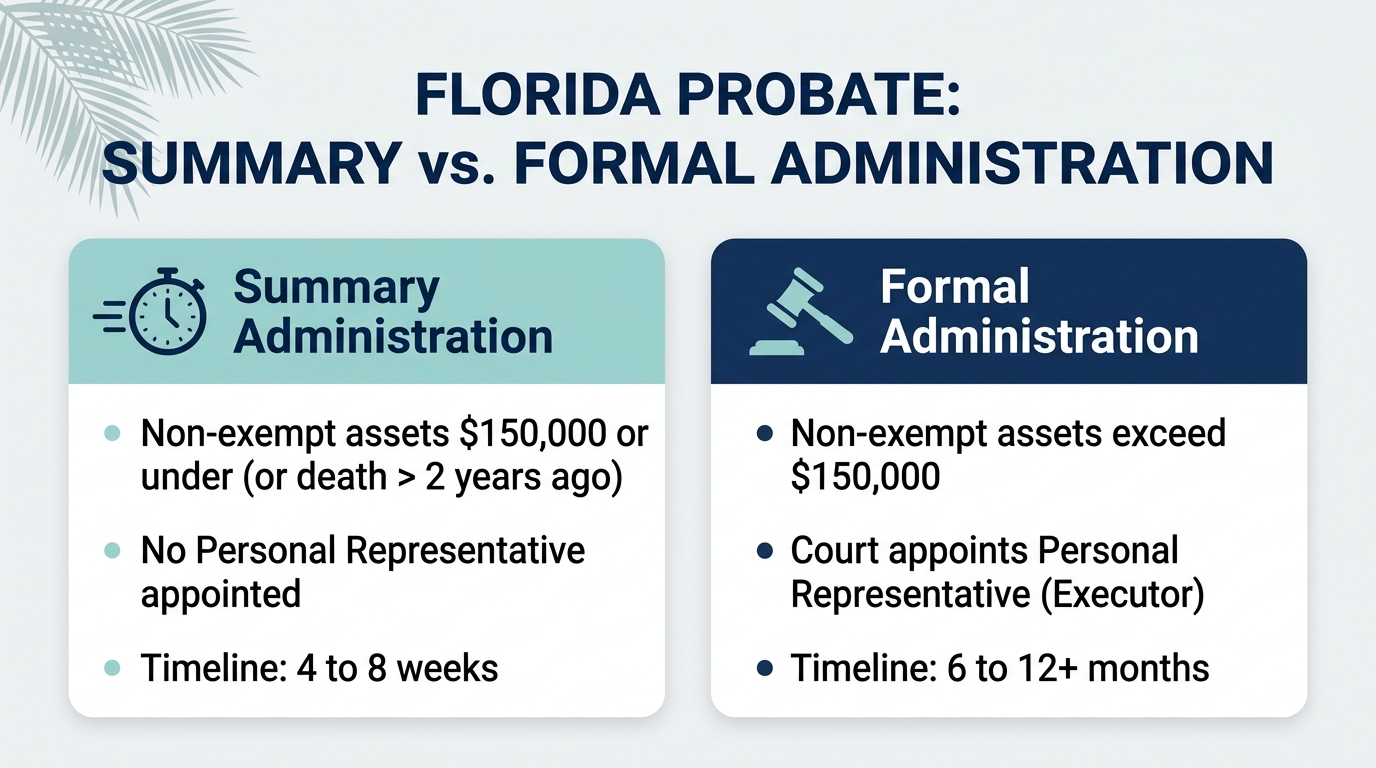
An infographic comparing Florida Summary Administration and Formal Administration eligibility rules, $150,000 asset limits, and court timelines under Florida probate law.

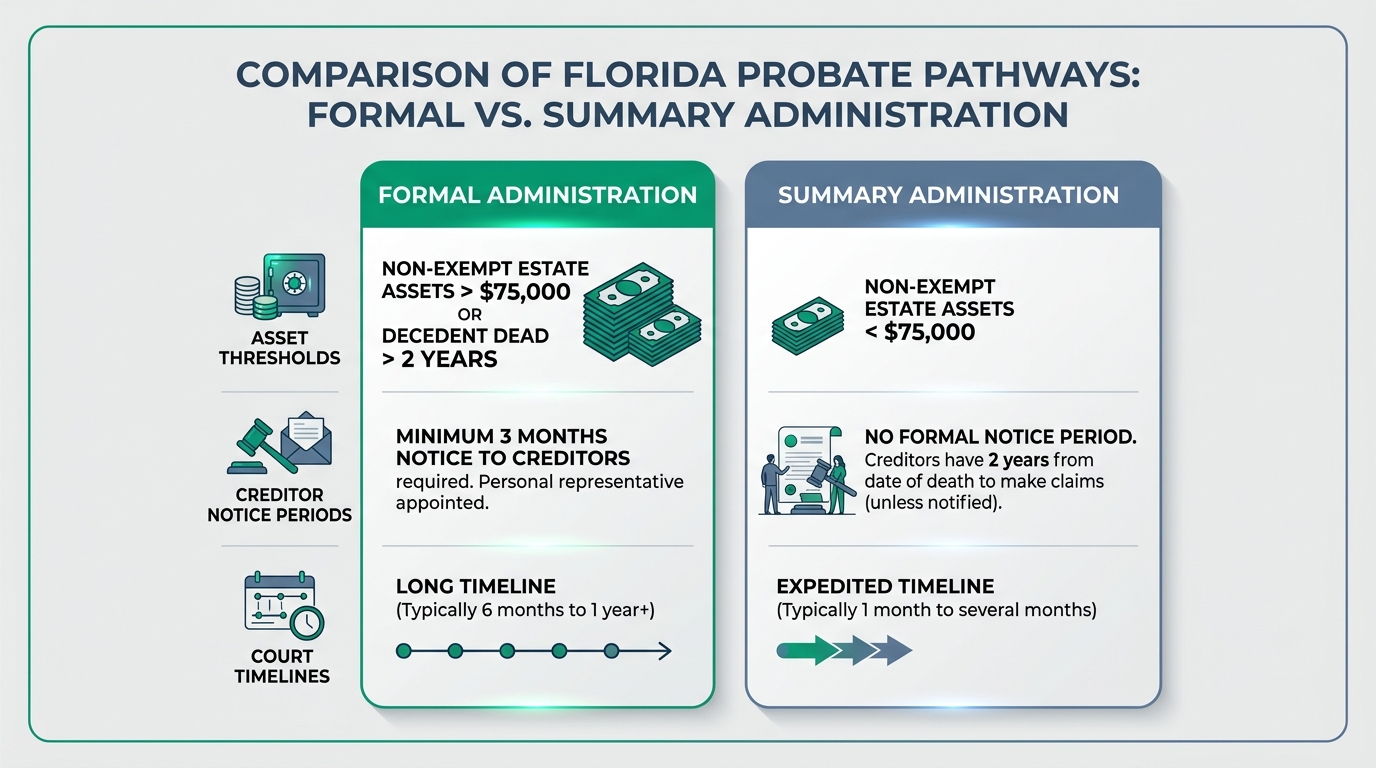
In Florida, court-supervised probate is divided into two primary procedures: Summary Administration (an expedited process for smaller or older estates) and Formal Administration (the traditional, fully supervised court process).

Whether an estate qualifies for Summary Administration depends on the total net value of non-exempt probate assets, whether the decedent has been deceased for over two years, and the complexity of outstanding creditor claims under Florida probate law (Fla. Stat. § 735.201). Understanding how these two probate paths function ensures that South Florida beneficiaries receive their inheritance as quickly and cost-effectively as possible.


Summary vs. Formal Administration at a Glance

Qualification & Process FeatureSummary Administration (Fla. Stat. § 735.201)Formal Administration (Florida Probate Rules)
Estate Value ThresholdNon-exempt probate assets are $150,000 or less (for deaths on/after July 1, 2026), OR the decedent has been deceased for over 2 years.Required for estates exceeding $150,000 in non-exempt probate assets (if death occurred within 2 years).
Personal RepresentativeNot appointed. No Letters of Administration are issued by the court.Required. Court officially appoints a Personal Representative (Executor) with fiduciary authority.
Average Timeline4 to 8 weeks (subject to Broward County court docket schedules).6 to 12+ months (includes mandatory 90-day newspaper creditor notice period).
Creditor Claims ProcessCreditors must be resolved or served prior to distribution; or barred if death occurred over 2 years ago.Formal 3-month Notice to Creditors published in local media to legally bar future claims.
Primary Judicial OrderOrder Summary Administration directly transfers legal title of assets to beneficiaries.Letters of Administration issued at inception; Order of Discharge issued at estate closing.

When Does Summary Administration Apply in Florida?

Summary Administration is an expedited judicial procedure designed to transfer title to beneficiaries without opening a full probate estate. However – to qualify under Florida law, the estate must satisfy one of two statutory criteria:

  1. The $150,000 Net Asset Test: Effective July 1, 2026, Florida increased the summary administration statutory limit. The total value of all assets subject to probate—excluding protected Florida Constitutional Homestead real estate and statutory exempt personal property—does not exceed $150,000 (for deaths on or after July 1, 2026; $75,000 for deaths prior to July 1, 2026).
  2. The Two-Year Rule: The decedent has been deceased for more than two years, regardless of the overall financial value of the estate. Under Fla. Stat. § 733.710, two years establishes a non-claim statute of repose that automatically bars unfiled creditor claims.

Key Distinction: No Personal Representative Appointed

In Summary Administration, the court does not appoint a Personal Representative and does not issue Letters of Administration. Instead, a petition is submitted asking the judge to issue a direct order transferring specific assets (such as a bank account or vehicle) directly to named beneficiaries.

If an estate requires active ongoing legal authority—such as accessing restricted medical records, pursuing a wrongful death lawsuit, or negotiating complex business debts—Formal Administration must be opened regardless of total asset value.


When Is Formal Administration Mandatory?

Formal Administration is the comprehensive, fully supervised probate process in Florida. It is mandatory when:

  • Non-exempt probate assets exceed $150,000 and the decedent passed away within the last two years.
  • The decedent’s Last Will and Testament explicitly mandates formal probate administration.
  • The estate involves disputed creditor claims, contested wills, or missing heirs.
  • Real estate must be actively listed, marketed, and sold during probate, requiring an appointed Personal Representative to sign legal contracts and closing documents.

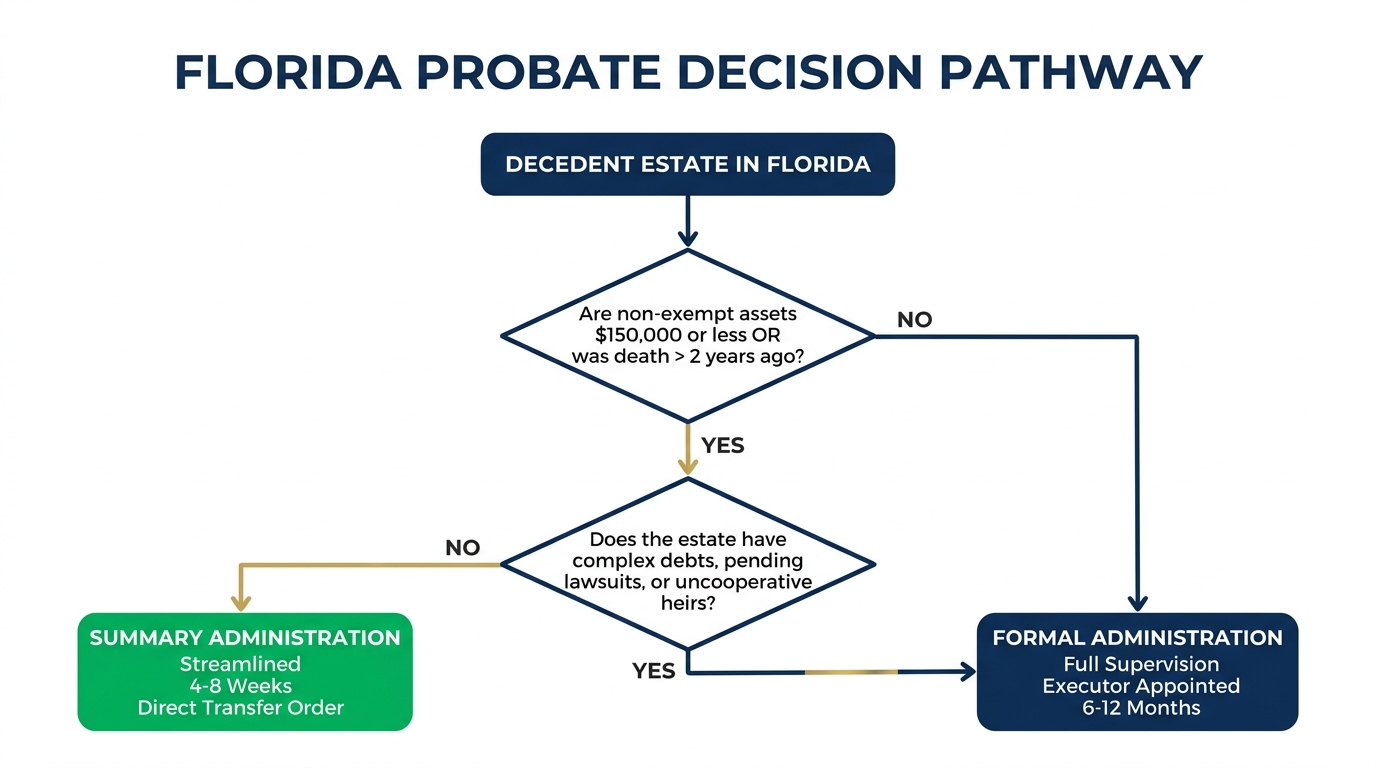
                           FLORIDA PROBATE DECISION PATH
                                         │
                    Is the non-exempt probate value under $150k
                    OR has the decedent been deceased > 2 years?
                                         │
                   ┌─────────────────────┴─────────────────────┐
                   ▼                                           ▼
                 YES                                           NO
                   │                                           │
         Are there complex debts,                              │
        disputes, or land sales                                │
         requiring an Executor?                                │
           ┌───────┴───────┐                                   │
           ▼               ▼                                   ▼
          YES              NO                        FORMAL ADMINISTRATION
           │               │                        (Full Court Process,
           │               ▼                        Personal Rep Appointed,
           │     SUMMARY ADMINISTRATION             6-12 Month Duration)
           │    (Expedited, 4-8 Weeks,
           │    Order Directly Transfers)
           └───────────────────────────────────────────────────┘

What About Very Small Estates? (Disposition Without Administration)

For extremely modest estates where the decedent left no real estate, Florida offers an informal non-probate process under Fla. Stat. § 735.301 known as Disposition of Personal Property Without Administration.

This simplified filing is available only when remaining non-exempt personal property does not exceed the total sum of preferred funeral expenses and necessary medical bills incurred during the last 60 days of the decedent’s final illness.


Strategic Risk Factors: Creditor Exposure & Multi-State Assets

Selecting between Summary and Formal Administration involves critical legal trade-offs beyond estate size:

1. The Post-Probate Creditor Exposure Risk

Under Fla. Stat. § 735.206, Summary Administration directly distributes assets to beneficiaries without opening a mandatory 90-day newspaper creditor publication window.

If a petition is filed before the two-year non-claim period expires (Fla. Stat. § 733.710), beneficiaries remain personally liable to valid estate creditors up to the full value of the property received. If unknown debts emerge post-distribution, Formal Administration is often safer because publishing a statutory Notice to Creditors permanently cuts off future claims after 90 days.


┌─────────────────────────────────────────────────────────────────────────┐
│                    CREDITOR PROTECTION COMPARISON                       │
├───────────────────────────────────┬─────────────────────────────────────┤
│      SUMMARY ADMINISTRATION       │        FORMAL ADMINISTRATION        │
├───────────────────────────────────┼─────────────────────────────────────┤
│ • No mandatory newspaper notice   │ • Formal 90-day Notice published    │
│ • Beneficiaries personally liable │ • Unfiled claims permanently barred │
│   to creditors (up to asset value)│ • Clean liability shield for heirs  │
│ • Exposure lasts up to 2 years    │ • Full judicial closure of claims   │
└───────────────────────────────────┴─────────────────────────────────────┘
A flowchart diagram illustrating how to determine whether a Florida estate qualifies for Summary Administration or requires Formal Administration.

2. Ancillary Administration for Out-of-State Residents

When a non-Florida resident dies owning real estate in Broward County or anywhere in South Florida, the home cannot be transferred by an out-of-state court order. An Ancillary Probate proceeding (Fla. Stat. § 734.102) must be opened in Florida. Depending on the non-exempt Florida land value, Ancillary proceedings can be conducted as either Summary or Formal Administration.


Frequently Asked Questions

Does Florida Homestead Property count toward the $150,000 Summary Administration limit?

  • No. Protected Florida Constitutional Homestead property passes outside the general claims of creditors and is excluded when calculating the $150,000 threshold for Summary Administration, provided a formal Petition to Determine Homestead Status is filed alongside the summary petition.

What is the 10-day Will Deposit Rule in Florida?

  • Under Fla. Stat. § 732.901, whoever holds the decedent’s original Last Will and Testament must deposit it with the Clerk of the Circuit Court in the county where the decedent resided within 10 days of receiving notice of death, regardless of whether formal probate will be opened.

What is the current Florida Summary Administration asset threshold?

  • Effective July 1, 2026 (Fla. Stat. § 735.201), the Florida Legislature increased the non-exempt probate asset threshold for Summary Administration from $75,000 to $150,000 for deaths occurring on or after July 1, 2026 (or where the decedent has been deceased for more than 2 years). Protected homestead property continues to be excluded from this calculation.

How long does Formal Administration take in Broward County?

  • A routine, uncontested Formal Administration in Broward County typically takes between 6 and 12 months. This timeframe accommodates publishing the mandatory Notice to Creditors, observing the 90-day statutory creditor claim window, marshaling asset inventories, preparing tax accountings, and securing final court discharge.

Can a summary administration be converted to a formal administration if a dispute arises?

  • Yes. If unexpected creditor claims emerge, beneficiaries dispute asset distribution, or unknown assets are uncovered that push the estate over $150,000, any interested party or petitioner can motion the court to convert the summary proceeding into a Formal Administration.

Do I need a probate attorney for Summary Administration in Broward County?

  • While Florida law technically permits self-representation in Summary Administration when no Personal Representative is appointed, court clerk offices cannot provide legal advice. Drafting accurate petitions, verifying homestead status, and coordinating creditor searches require specialized legal guidance to avoid judicial rejection.

Don’t Let an Outdated Deed Dictate Your Family’s Future

Choosing the correct probate pathway prevents costly administrative delays, court rejections, and personal liability for estate debts. Whether your family qualifies for an expedited Summary Administration or requires full Formal Administration in South Florida, taking action with experienced legal counsel guarantees that every asset is protected.

Schedule a Property Deed & Titling Audit

Ensure your real estate title and probate strategy are structured to pass seamlessly outside of or through probate court. Contact the attorneys at Reinfeld & Cabrera, P.A. today to review your estate and property deeds with our South Florida legal team.

  • Office Locations: Coral Springs | Fort Lauderdale | Plantation
  • Direct Telephone: (954) 334-1520
  • Email: Info@lawrct.com
  • Website: mypersonalattorneys.com
  • Local Practice Coverage: Coral Springs, Fort Lauderdale, Tamarac, Plantation, and Broward County

Broward County Probate Attorney Guide: Formal Administration and Estate Planning

Florida probate attorney reviewing estate planning documents and living trusts in a South Florida law office.

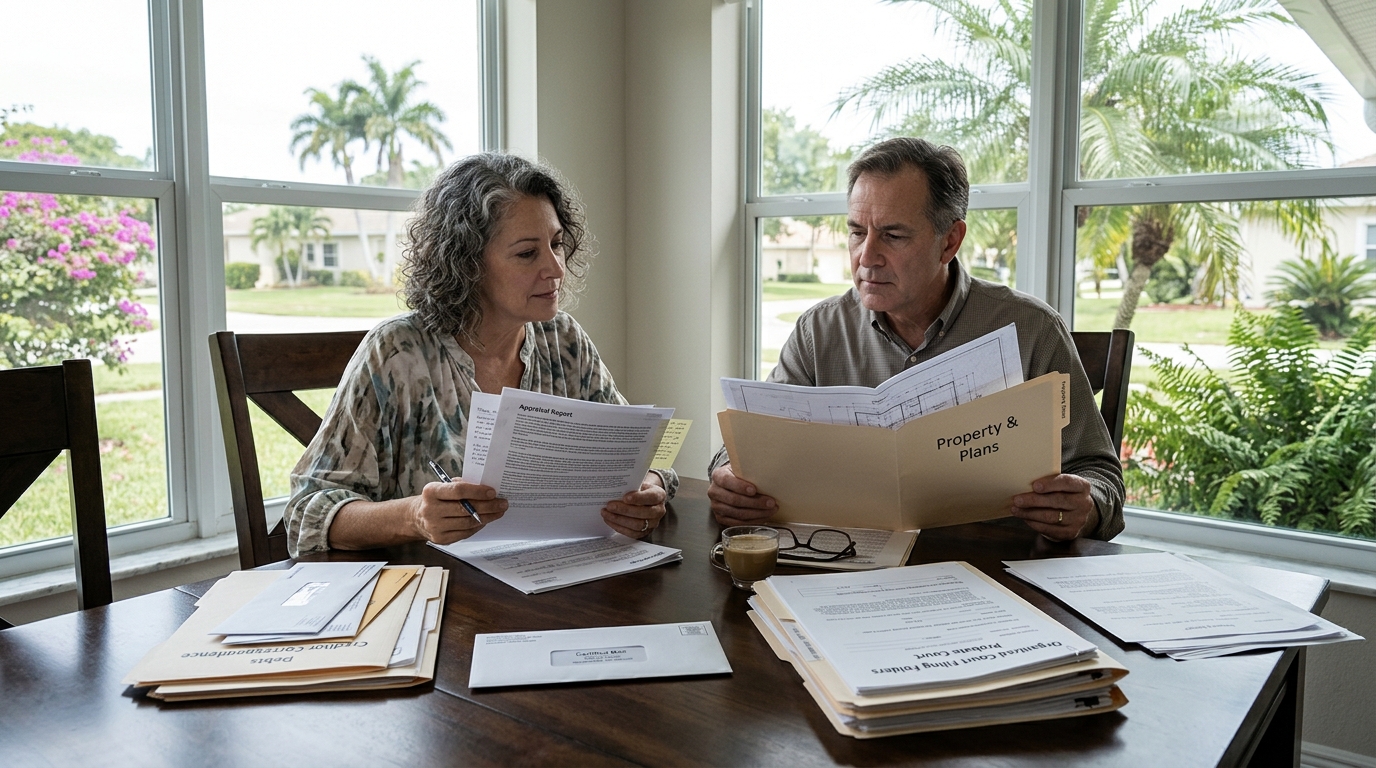
When you sit down at the kitchen table to sort through a parent’s papers after they pass away, the last thing you want is a fresh wave of bureaucratic dread.

What happens to the house now? How do we pay the lingering bills? And why does everyone make probate sound like a multi year hostage negotiation with the state of Florida?


Quick Answer:

Under Florida probate law, administering an estate through the 17th Judicial Circuit in Broward County involves formal or summary court proceedings to settle debts and transfer property. Formal administration typically takes between six months and over a year due to mandatory creditor notice windows, whereas summary administration offers an expedited process for estates valued under $75,000 or where the decedent passed away more than two years ago.


If you search online for estate guidance, you will drown in dry textbook definitions. Most treat probate like an unavoidable trap or a magical cure all. Neither description captures reality. Probate is simply the legal mechanism the state uses to clear title to property. It’s how to pay legitimate creditors, and transition assets when someone passes away without proper advance planning.

So what do Florida families and property owners actually need to know about navigating the Broward County court system. What do they need to get to manage a estate, and keep your hard earned assets out of unnecessary courtrooms? Let us pull back the curtain and talk about how estate administration really works in South Florida without any legal mumbo jumbo.


Why the Internet Gets Probate Wrong (And Why Wills Do Not Avoid Court)

There is a stubborn myth floating around the internet that having a last will and testament means your family completely bypasses the probate court. People assume a will acts like a VIP backstage pass that lets your heirs walk right past the judges and walk away with your property.

Nothing could be further from the truth.

Ask yourself: If I spend my entire life building equity in a home and saving for my children, why would I hand them a legal document that explicitly instructs a judge to oversee how those assets get handed out?

A will does not avoid probate. A will is instructions for the probate court. It tells the judge who you want to inherit your belongings. But the court still has to supervise the process, validate the signature, notify creditors, and formally authorize your personal representative to act. If you want to spare your family from court supervision, you have to look beyond a basic will. You should utilize tools like revocable living trusts, payable on death designations, and properly structured joint ownership.


What Actually Goes Through Probate in Florida?

Not every asset a person owns gets sucked into the probate vortex upon death. Understanding the dividing line between probate and non probate property is the first step toward building a sensible estate plan.

  • Probate Assets: Solely owned real estate, bank accounts held in a single name without payable on death instructions, and personal belongings like vehicles or jewelry without designated beneficiaries must go through court administration to change legal ownership.
  • Non Probate Assets: Assets governed by contract or operation of law pass directly to beneficiaries without court interference. This includes living trusts, life insurance policies with named beneficiaries, retirement accounts. It also includes real estate held as tenants by the entirety or joint tenants with rights of survivorship.

If your estate consists entirely of beneficiary designated accounts and trust owned property, things change. Your family might never set foot inside a courtroom. But if a single deed or bank account was left in your individual name, the probate doors swing wide open.


Formal Administration Versus Summary Administration in Broward County

When a probate estate is opened in the 17th Judicial Circuit in Broward County, the administration generally follows one of two statutory paths. Both depend on the size of the estate and how long the decedent has been gone:

  1. Formal Administration: This is the standard, comprehensive court process required for larger estates or complex matters involving multiple creditors and disputed claims. The court appoints a personal representative, issues letters of administration, requires formal publication of notice to creditors, and mandates a multi month inventory and accounting process.
  2. Summary Administration: A streamlined, expedited court procedure available in Florida if the value of the entire estate subject to probate does not exceed $75,000, or if the decedent has been dead for more than two years. Summary administration bypasses the appointment of a personal representative and moves much faster, though it still requires a formal petition filed by an attorney.
Infographic comparing formal probate administration and summary administration pathways under Florida law.

Avoiding Dual Tracking and Creditor Traps During Estate Administration

When a personal representative steps up to manage an estate in South Florida, they quickly realize that administering assets is a minefield of strict statutory deadlines and creditor notification rules under Florida Probate Code.

How do you handle aggressive credit card companies or mortgage lenders demanding payment while the estate is still frozen in court?

  • The Creditor Notice Period: Florida law requires a diligent search for known creditors and publication of a formal notice in a local legal periodical. Creditors have a strict window (typically three months from the first publication of notice) to file formal claims against the estate.
  • The Priority of Claims: You cannot simply pay out inheritance money to family members while valid estate debts remain unpaid. Florida law establishes a rigid priority structure for paying funeral expenses, administrative costs, taxes, and medical bills before beneficiaries see a dime. Failing to follow this order can expose the personal representative to personal financial liability.

Real World Case Example: Untangling an Estate in Broward County

To see how these rules play out in local practice, consider a scenario our firm frequently handles across Coral Springs and Fort Lauderdale.

A client came to our office after losing a parent who owned a residential home in Broward County without a living trust. The parent had left a simple will naming our client as personal representative, but because the deed was in the parent’s individual name, the property was completely frozen. To make matters worse, a home equity line of credit was past due, and the lender was threatening default proceedings while the family was still grieving.


How Our Legal Team Resolved the Crisis

  • Opening Formal Administration: We immediately filed a petition for formal administration in the 17th Judicial Circuit, securing letters of administration so our client had the legal authority to deal with the bank.
  • Publishing Creditor Notice: We managed the statutory creditor notice period. We shield the personal representative from harassing collection calls and ensuring claims were evaluated through proper legal channels.
  • Resolving the Debt and Transferring Title: By coordinating with the mortgage lender and liquidating a small non probate account to cover arrears, we stabilized the property, avoided foreclosure, and ultimately transferred clear title of the home to the rightful heirs.
The Broward County judicial complex in Fort Lauderdale where 17th Judicial Circuit probate proceedings take place.

Frequently Asked Questions About Florida Probate

How long does the probate process take in Broward County?

  • An uncontested formal administration in Florida typically spans 6 to 12 months. This timeline is largely dictated by mandatory statutory creditor notice periods and court review schedules in the 17th Judicial Circuit. Complex estates involving will contests or contested creditor claims can take significantly longer.

Can I avoid probate simply by writing a last will and testament?

  • No. A common misconception is that having a will avoids probate. In reality, a will provides instructions for the probate court on how you want your assets distributed. To avoid probate entirely, assets must pass outside the will via living trusts, beneficiary designations, or survivorship titles.

What happens if someone dies intestate without a will in Florida?

  • If a person dies without a valid will, Florida intestacy statutes dictate how assets are distributed among surviving spouses, children, or extended relatives. This rigid statutory formula rarely matches what the decedent would have actually wanted. And it often forces court sales of family property to divide proceeds among heirs.

Do I need a probate attorney if I am appointed as a personal representative?

  • Yes. Under Florida probate rules, a personal representative representing an estate with multiple beneficiaries or outstanding creditors is generally required by law to be represented by a licensed attorney admitted to practice in Florida.

Protect Your Estate and Your Family Legacy

Planning for the future or handling the aftermath of a loved one’s passing is not something you should do alone. Whether you want to bulletproof your own estate with a comprehensive living trust or you need experienced local counsel to guide you through a Broward County probate administration, having the right advocate changes everything.

The estate planning and probate attorneys at Reinfeld Cabrera Tison help families across South Florida secure their assets. We establish durable trusts, and resolve complex court proceedings with absolute confidence.

Schedule a Confidential Consultation

Do not wait until a crisis forces your family into court. Speak directly with an experienced attorney today to review your options:

  • Direct Telephone: (954) 866 4878 | Toll Free: (954) 866 HURT
  • Coral Springs Office: 9625 W Sample Rd, Coral Springs, FL 33065
  • Fort Lauderdale Office: 2933 W Cypress Creek Rd, Suite 201, Ft Lauderdale, FL 33309
  • Website: mypersonalattorneys.com
  • Local Coverage: Coral Springs, Fort Lauderdale, Parkland, Tamarac, Margate. All surrounding communities across Broward, Miami Dade, and Palm Beach Counties.

Looking For An Eviction Attorney?

How long probate takes in Florida with estate documents and a calendar

If you are waiting for a Florida estate to close, the frustrating part is often that nobody can give you a single number.

One estate may be resolved relatively quickly. Another may remain open for a year or longer. The difference usually has less to do with the passage of time itself than with what has to happen before the estate can be distributed and closed.


So, how long does probate take in Florida?

For many estates going through formal administration, probate takes months rather than weeks. Some uncomplicated estates can move faster. Others take considerably longer because of creditor claims, real estate, tax issues, missing beneficiaries, disputes, litigation, or problems with the estate administration.

Florida also has a simplified procedure called summary administration. For deaths occurring under the current law, summary administration generally applies when the property subject to administration does not exceed $150,000, after excluding property exempt from creditors, or when the decedent has been dead for more than two years.

The important point is that there is no single Florida probate timeline that applies to every estate.


What Determines How Long Probate Takes in Florida?

Probate is not one event. It is a series of legal and practical tasks.

The court must recognize the will, if there is one, and appoint a personal representative when formal administration is required. The personal representative then has to identify and protect estate property, address debts and creditor claims, deal with taxes when applicable, resolve outstanding issues, distribute the remaining assets, and complete the steps required to close the estate.

Florida law requires a personal representative to settle and distribute the estate as efficiently as is consistent with the interests of the estate and the people involved.

That does not mean every task can happen immediately.

A house may need to be sold. A bank account may need to be located. A creditor may file a claim. A beneficiary may object to something the personal representative has done. An estate asset may have to be appraised before it can be distributed.

Each of those issues can change the timetable.


How Long Does Formal Probate Usually Take?

Formal administration is the more involved form of Florida probate. It is generally used when the estate does not qualify for summary administration or when the circumstances require a formal proceeding.

There is no statutory rule saying that every formal probate case must be completed within a particular number of months.

That matters because two estates with similar values can have very different timelines.

Consider two hypothetical estates.

The first consists mainly of a Florida bank account, a vehicle, and other easily identified assets. There are no significant disputes, no difficult property issues, and no contested creditor claims.

The second includes a Coral Springs home, several financial accounts, an unresolved debt, a beneficiary who cannot be located, and disagreement among family members over the will.

Both estates are subject to the same general probate framework. Their practical timelines could be very different.

The question is therefore not simply how long does probate court take in Florida? It is what still has to be resolved before this particular estate can be closed?


How Long Does Summary Administration Take?

Summary administration is designed for qualifying estates that can be handled without the full administration process.

Under current Florida law, an estate may qualify when the value of the property subject to administration, after excluding property exempt from creditors, does not exceed $150,000. An estate may also qualify when the decedent has been dead for more than two years, subject to the requirements of the statute.

Summary administration can be substantially different from formal administration because the court may enter an order allowing distribution of estate assets without the same sequence of administration required in a formal case. Florida law specifically permits the court to authorize immediate distribution through the summary administration order.

That does not mean every small estate is resolved immediately.

The court still needs the required information. Known or reasonably ascertainable creditors must be addressed, and the people entitled to the estate must be properly identified.

If there is a dispute about the will, ownership of property, debts, or the people entitled to inherit, the matter may become more complicated regardless of the estate’s value.


What Is the 90-Day Creditor Period in Florida Probate?

One reason probate can take longer than a family expects is the period for creditors to present claims.

Under Florida Statute §733.702, certain claims against an estate generally must be filed by the later of three months after the first publication of the notice to creditors or 30 days after service of the notice on a creditor who is required to receive it.

This is one reason an estate cannot necessarily be distributed as soon as the personal representative finds the assets and identifies the beneficiaries.

There may still be claims to address.

The law also contains additional timing rules when a claim is disputed. For example, Florida Statute §733.705 gives interested parties a period to object to claims and provides procedures for claims that proceed into litigation.

So when someone asks why an estate is still open several months after the death, the answer may be that the administration is still dealing with creditor claims or other unresolved obligations.


What Can Delay Probate in Florida?

Some delays are ordinary parts of estate administration. Others result from complications that have to be resolved before distribution.

Common examples include:

  • A will that is being challenged
  • Disagreement among beneficiaries
  • Disputed creditor claims
  • Real estate that must be sold or otherwise transferred
  • Difficulty locating estate assets
  • Missing heirs or beneficiaries
  • Property with unclear ownership
  • Tax or accounting issues
  • Litigation involving the estate
  • A personal representative who is not completing required tasks
  • A personal representative who needs to be replaced
  • Assets located in another state
  • Complications involving another estate or trust

The size of an estate matters, but it is not the only factor.

A relatively modest estate can become complicated if the family is fighting over a house. A larger estate can sometimes be administered without the same level of delay if the assets, beneficiaries, and obligations are clear.


Common probate delays involving property, creditor claims, and estate disputes in Florida

Can a Will Contest Make Probate Take Longer?

Yes.

A dispute over the validity or interpretation of a will can turn an otherwise routine estate administration into litigation.

That changes the nature of the case. The court may need to resolve issues concerning the validity of the will, the rights of beneficiaries, the meaning of particular provisions, or other contested questions before the estate can be distributed.

The same basic problem can arise when beneficiaries dispute the actions of the personal representative.

In those situations, the probate proceeding is no longer simply a matter of collecting property and distributing it. There is a legal dispute that has to be resolved.

That can add substantial time to the administration.


What Happens If the Personal Representative Is Delaying Probate?

The personal representative has legal duties. Florida law describes the personal representative as a fiduciary and requires the estate to be settled and distributed efficiently and in accordance with the will and the Florida Probate Code.

That does not mean a personal representative must distribute everything immediately.

Some assets cannot properly be distributed until debts, claims, taxes, expenses, or other issues have been addressed.

But there is a difference between necessary administration and unnecessary inaction.

Florida law provides procedures for removing a personal representative in certain circumstances, including failure to comply with a court order, failure to account for estate property, wasting or maladministration of the estate, and other specified grounds.

If beneficiaries believe an estate is being delayed because the personal representative is failing to perform required duties, that may require a legal proceeding rather than simply waiting longer.


Can Beneficiaries Receive an Inheritance Before Probate Ends?

Sometimes.

Florida law permits certain distributions before the administration is completely finished when the statutory requirements are satisfied. But a personal representative must consider the estate’s outstanding obligations before distributing property.

This is especially important when the estate still has unpaid debts, creditor claims, expenses, taxes, or unresolved disputes.

A beneficiary therefore should not assume that an asset is available for distribution simply because the will says that person is supposed to receive it.

The estate may need to retain enough property to satisfy obligations before the final distribution can occur.


Why Is My Probate Case Taking So Long?

If a Florida probate case seems unusually slow, look at what remains unresolved rather than simply counting the months since the death.

For example:

The estate has a house that has not been sold.

  • The administration may need to address the property’s title, mortgage, taxes, insurance, sale, or distribution.

A creditor filed a claim.

  • The personal representative may need to determine whether the claim is valid and whether it shoul be paid or challenged.

A beneficiary cannot be located.

  • The estate may need additional work before property can be distributed safely.

Family members are fighting.

  • A dispute can require formal court proceedings rather than ordinary estate administration.

The personal representative has not completed required work.

  • The beneficiaries may need to ask the probate court to address the problem.

This is why asking only “How long does probate take?” can produce a misleading answer.

A more useful question is:

What is preventing this estate from closing?


Can You Speed Up Probate in Florida?

Sometimes the answer is yes, but there is no shortcut that allows a personal representative to ignore required procedures.

The practical way to reduce unnecessary delay is to identify problems early.

That can mean locating estate assets promptly, identifying creditors, responding to claims within the applicable deadlines, resolving beneficiary disputes before they become larger litigation, handling real estate issues efficiently, and making sure required court filings are completed correctly.

It also means recognizing when a problem is genuinely legal rather than administrative.

For example, if a beneficiary objects to the validity of a will, repeatedly asking the personal representative to “move faster” will not resolve the underlying dispute.

Likewise, if an estate asset has a title problem, distribution may have to wait until ownership is established.


When Does a Florida Probate Estate Finally Close?

Probate ends when the administration has been completed and the required closing procedures have been satisfied.

Florida Statute §733.901 provides that after administration has been completed, the personal representative is discharged.

In practical terms, that generally means the estate’s remaining legal and financial obligations have been addressed, the property that should be distributed has been distributed, and the personal representative has completed the steps necessary to finish the administration.

The exact procedure depends on the estate and the type of administration.

That is why the date of death alone cannot tell you when probate will end.


How Long Does It Take to Settle an Estate in Florida?

For a straightforward estate, the process may be measured in months. A more complicated formal administration can take considerably longer.

There is no responsible way to promise that a particular Florida probate case will finish within a fixed number of months without knowing what the estate contains and what issues remain unresolved.

For a family in Coral Springs, Broward County, or elsewhere in South Florida, the most useful starting point is usually to identify the type of administration and then determine which legal or practical issues are keeping the estate open.

Once those issues are known, the timeline becomes much easier to understand.


Frequently Asked Questions

How long does probate take in Florida?

  • There is no single timeline for every Florida estate. Formal administration commonly takes months, while a straightforward case may move faster and a disputed or complicated estate may remain open considerably longer.

How long does summary administration take in Florida?

  • Summary administration can be faster because it is a simplified procedure for qualifying estates. Under current Florida law, the procedure generally applies to estates with no more than $150,000 in property subject to administration, after applicable exclusions, or to estates where the decedent has been dead for more than two years.

What time does it take to settle an estate in Florida?

  • The time depends on the type of probate, the estate’s assets and debts, creditor claims, property issues, beneficiary disputes, litigation, and how efficiently the administration proceeds.

What causes probate to take longer?

  • Common causes include creditor claims, will contests, beneficiary disputes, real estate issues, missing heirs, tax matters, litigation, difficult-to-locate assets, and delays in estate administration.

How long do creditors have to make a claim against an estate in Florida?

  • Under Florida Statute §733.702, certain claims generally must be filed by the later of three months after the first publication of the notice to creditors or 30 days after service on a creditor who is required to receive notice.

Can a personal representative delay probate?

  • A personal representative has a fiduciary duty to administer and distribute the estate efficiently and in accordance with Florida law and the decedent’s will. If the personal representative fails to perform required duties, Florida law provides procedures that can address misconduct or other grounds for removal.

Does probate end when the beneficiaries receive their inheritance?

  • Not necessarily. The estate still has to satisfy the requirements for completing the administration and discharging the personal representative. Florida law provides for discharge after administration has been completed.

The Bottom Line

There is no standard number of days or months that applies to every Florida probate case.

A simple estate may move relatively quickly. An estate involving real property, creditor claims, family disputes, litigation, or other unresolved issues can take much longer.

If you are trying to understand why an estate in Coral Springs or elsewhere in Broward County is still open, the important question is not simply how much time has passed.

It is what remains to be done before the estate can legally be closed.


Need Help With a Florida Probate Case?

If an estate has been open longer than expected, or a dispute is holding up distribution, a Florida probate attorney can review the administration and explain what is causing the delay.

MyPersonalAttorneys helps families in Coral Springs, Broward County, and throughout South Florida with probate and estate administration matters.