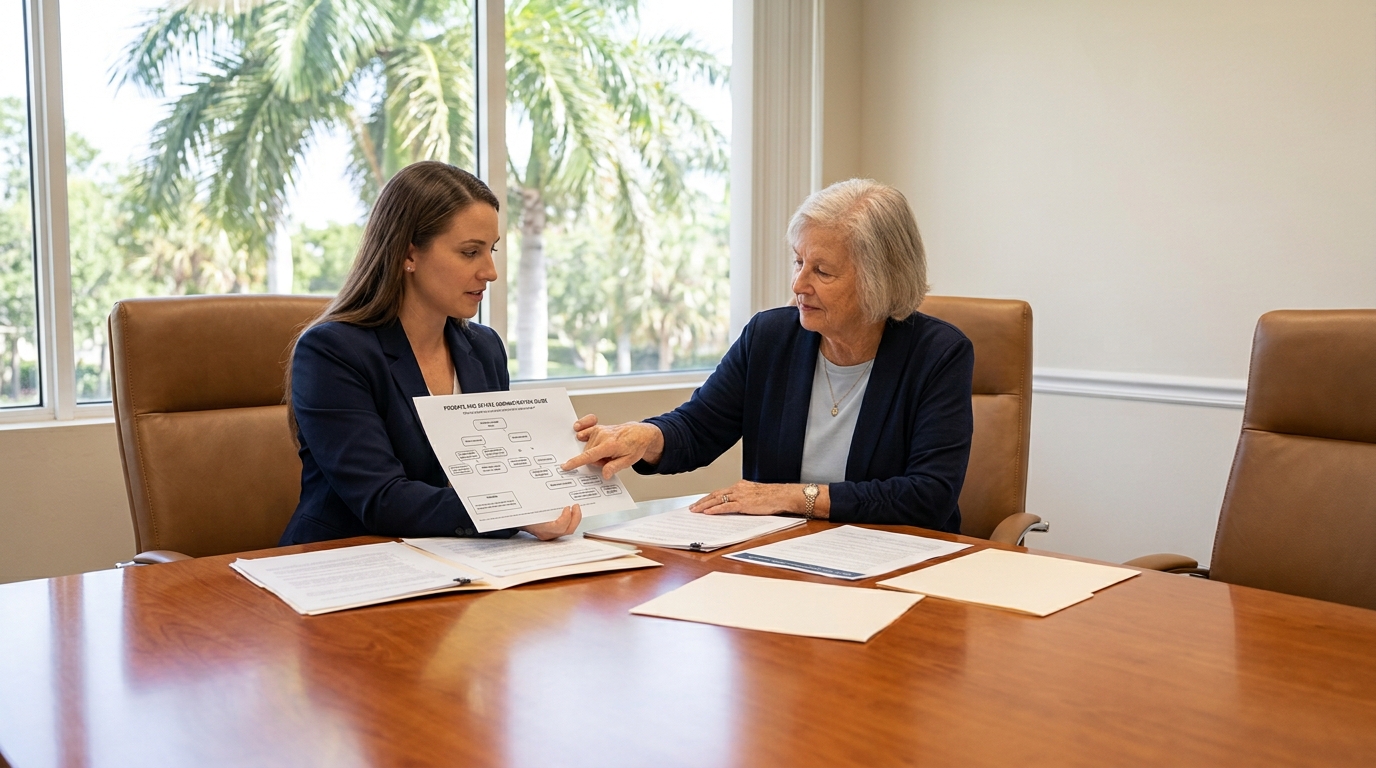

How can you protect your finances during a divorce in Florida? Start by documenting your assets and debts, understanding which property qualifies as marital or nonmarital, and reviewing the financial consequences of any proposed settlement before signing.
Under Florida Statutes § 61.075, courts generally begin with the premise that marital assets and liabilities should be divided equally, although the law permits an unequal distribution when justified by relevant factors. Separate rules govern alimony, child support, and parenting plans and time sharing.
To protect your interests during a Florida divorce:
- Document your finances. Gather bank statements, tax returns, retirement account records, property documents, and outstanding debt information.
- Understand your legal position. Identify which assets and liabilities may be marital before negotiating a settlement.
- Avoid costly financial mistakes. Do not conceal assets or make questionable transfers that could damage your legal position.
- Evaluate settlement terms carefully. Consider mortgage obligations, taxes, retirement benefits, and the practical consequences of your parenting plan.
- Seek appropriate legal advice. Consult a qualified Florida divorce attorney before making major financial decisions or signing an agreement you do not fully understand.
The biggest divorce mistakes often begin with assumptions about what the law allows. Some spouses expect everything to be divided equally. Others believe that keeping the house automatically means keeping its full value, or that a divorce judgment removes their name from a joint mortgage.
Unfortunately, the legal system does not award compensation for misplaced confidence.
This guide explains how Florida divorce law works, which financial risks deserve attention, and what you can do to protect your interests. It also examines the decisions that should ideally happen before marriage, when financial arrangements are generally easier to negotiate and nobody has yet started arguing over who gets the dining room furniture.
1. The Most Important Advice Comes Before the Wedding
The best time to discuss financial protection during a marriage is often before the marriage begins.
That advice may arrive too late for someone already considering divorce. Still, it deserves attention because the decisions couples make before marrying can affect their finances for years.
Before getting married, discuss existing debts, income differences, property ownership, retirement savings, business interests, and expectations about future expenses. These conversations can reveal disagreements that might otherwise remain hidden until the relationship deteriorates.
Consider a prenuptial agreement
A prenuptial agreement can establish certain financial arrangements before marriage. Under Florida Statutes § 61.079, a premarital agreement must be written and signed by both parties. Florida law also establishes requirements and circumstances that can affect enforceability.
Depending on its terms and applicable law, an agreement may address the treatment of property, responsibility for certain obligations, and rights that would otherwise arise upon divorce.
It is not a magic document. An agreement may face a legal challenge if the circumstances surrounding its execution or the applicable statutory requirements create grounds for doing so. The Florida Supreme Court’s decision in Casto v. Casto, 508 So. 2d 330 (Fla. 1987), discusses circumstances in which a marital agreement may be challenged, including overreaching and issues involving financial disclosure.
A prenuptial agreement also cannot simply override every legal obligation involving children.
If you are already married, ask a Florida family law attorney whether a postnuptial agreement or another lawful arrangement could address your circumstances. Do not assume that an agreement signed after a dispute begins will have the same legal effect as one negotiated before marriage.
2. Understand What Florida Actually Divides
Florida follows an equitable distribution system. That does not mean a judge can divide everything however they please.
Under Florida Statutes § 61.075, the court must identify and set apart each spouse’s nonmarital assets and liabilities. It then determines how to distribute marital property and marital debts. Equal distribution is the starting point, although statutory factors can justify a different result.
The classification of property matters because ownership, timing, financial contributions, and other circumstances can affect how an asset is treated.
Marital property is not limited to items with both names on them
Depending on the circumstances, marital property can include assets acquired during the marriage, certain retirement benefits earned during that period, and increases in the value of particular assets.
An asset held in one spouse’s name is not automatically excluded from equitable distribution. Conversely, an asset acquired before marriage does not automatically become marital property simply because the couple later divorces.
Florida law contains specific rules for identifying marital and nonmarital assets. The details matter, particularly when one spouse owned a business before marriage or received an inheritance that was later mixed with marital funds.
Make a complete financial inventory
Start gathering records before negotiations become complicated. Keep lawful copies of relevant documents, including:
- Bank and investment account statements.
- Tax returns and income records.
- Retirement plan statements and pension information.
- Mortgage documents, property deeds, and home valuation records.
- Business ownership documents and financial statements.
- Credit card balances, personal loans, and other liabilities.
- Records showing when property was acquired or inherited.
Florida’s Family Law Rule of Procedure 12.285 establishes financial disclosure requirements in many family law cases, subject to applicable exceptions and court orders.
Do not access accounts you are not authorized to use or obtain records through unlawful means. If important financial information is unavailable, ask your attorney about lawful discovery procedures.
Understand the difference between ownership and value
Suppose one spouse owns a business that increased in value during the marriage. The business’s original purchase price may tell only part of the story. Its current valuation, the source of the investment, the contributions made during the marriage, and the applicable legal classification may all matter.
The same principle applies to real estate and investment accounts.
A financial inventory should therefore identify both the asset and the evidence supporting its valuation. Guessing at values during settlement negotiations can leave you with a misleading picture of your actual financial position.

3. Do Not Hide Money or Drain Accounts
When a marriage breaks down, one spouse may be tempted to transfer money, withdraw large sums, sell property, or move assets into a relative’s name.
These actions can create serious legal problems.
Florida law specifically addresses the intentional dissipation, waste, depletion, or destruction of marital assets. Depending on the circumstances, a court may consider qualifying conduct when deciding whether an unequal distribution is justified.
The distinction between ordinary spending and intentional dissipation matters.
In Miller v. Miller, 2016, Florida’s Fourth District Court of Appeal explained that a finding of dissipation requires evidence of intentional misconduct. Ordinary mismanagement or spending that a spouse simply dislikes does not automatically satisfy that standard.
The case is a useful reminder that suspicious spending and legally established dissipation are not the same thing.
What should you do if money appears to be disappearing?
Preserve the records you can lawfully access. Make a note of unexplained withdrawals or transfers, including dates and amounts. Keep copies of account statements and other relevant documents.
Avoid retaliatory financial decisions. Emptying an account because you suspect your spouse has done the same thing can complicate your position rather than protect it.
If you believe assets are being concealed or deliberately depleted, discuss the evidence with your attorney. Depending on the circumstances, the appropriate response may involve formal financial disclosure, discovery, or a request for court intervention.
A practical example
Imagine that a couple has joint savings of $80,000. During the breakdown of the marriage, one spouse transfers $30,000 to an undisclosed account and refuses to explain the transaction.
That transfer deserves investigation. However, the legal outcome depends on the source of the money, the purpose of the transfer, the available evidence, and the applicable law.
A transfer made to conceal marital funds is different from a documented payment for legitimate household expenses. Establishing the facts is more useful than making accusations without supporting evidence.
The decision in Rabbath v. Farid, 34 So. 3d 1270 (Fla. 1st DCA 2009) illustrates how financial evidence, allegations of concealed assets, and questions about income can become significant in divorce litigation. The court also emphasized the need for adequate evidentiary support when determining income for support awards.
4. Think Carefully Before Giving Up the Marital Home
For many couples, the family home is their most valuable asset. It can also be their largest financial obligation.
The decision to keep or leave the property should not be based exclusively on emotional attachment or the desire to maintain familiar surroundings.
Before agreeing to keep the house, determine its approximate market value. Obtain the current mortgage balance and estimate the costs of ownership, including insurance, property taxes, maintenance, and any applicable association fees.
Then calculate the equity.
For example, a home valued at $500,000 with a $300,000 mortgage has approximately $200,000 in gross equity before selling costs or other adjustments. That does not mean either spouse can automatically claim $100,000. The legal classification of the property and the overall settlement affect the analysis.
Keeping the house does not necessarily mean you can afford it
A settlement might award the home to one spouse while requiring that spouse to compensate the other for an agreed share of the equity.
That arrangement may work if the spouse retaining the property can refinance the mortgage or otherwise meet the financial obligations. It can become a problem if the necessary financing is unavailable.
A divorce judgment does not automatically remove a former spouse from a mortgage contract. The Consumer Financial Protection Bureau’s guidance on mortgages after divorce explains why the lender’s obligations remain important even after the spouses have agreed on who will keep the home.
If both spouses remain borrowers, the lender may still pursue either borrower according to the loan agreement. A promise in a divorce settlement is not the same as a release from the lender.
Compare your options before deciding
Depending on the circumstances, the options may include selling the property and dividing the proceeds, refinancing so one spouse retains the home, or negotiating another arrangement that accounts for the property’s value and associated obligations.
Florida law also addresses credits and setoffs associated with the marital home. Florida Statutes § 61.077 identifies factors relevant to these issues, including possession of the property and certain housing expenses.
The right decision depends on the numbers and the legal circumstances. A house that looks like a valuable settlement asset can become a financial burden if the mortgage and maintenance costs exceed what the new household can reasonably afford.

5. Understand Child Support and Alimony Separately
Support payments can significantly affect both spouses’ financial futures. They should be evaluated separately from property division.
Alimony depends on the applicable legal standards
Florida law recognizes several forms of alimony, including temporary, bridge the gap, rehabilitative, and durational alimony. The applicable requirements and potential award depend on the circumstances described in Florida Statutes § 61.08.
A spouse should not assume that alimony is automatic after a long marriage. Nor should a higher earning spouse assume that support can never be awarded to someone who has an independent income.
The court considers statutory factors when determining whether an award is appropriate. Relevant considerations include the parties’ financial circumstances and the duration of the marriage.
Florida’s 2023 legislative reforms eliminated permanent alimony for new awards. Current law governs the forms of alimony available in a particular proceeding.
Before agreeing to a settlement, examine the proposed payment amount and duration. Consider how your income, housing costs, employment prospects, and other obligations may change after the divorce.
Child support follows separate rules
Child support is calculated under the guidelines in Florida Statutes § 61.30. The calculation considers factors including parental income and other legally relevant information.
Parents should not assume that the person with less time sharing will necessarily receive a particular amount. Nor should they treat support as a reward for one parent or a penalty against the other.
A parenting arrangement and a support obligation address different legal questions. Under Florida Statutes § 61.13, parenting plans and time sharing are governed by the child’s best interests and the applicable statutory framework.
Do not agree to an informal financial arrangement that leaves major questions unresolved. If a support order already exists, follow it unless it is modified through an appropriate legal process.
Account for taxes
Support and property transfers can have different federal tax consequences.
The Internal Revenue Service’s guidance on filing taxes after divorce or separation explains several issues that can arise, including the treatment of child support and certain property transfers. For divorce or separation agreements executed after 2018, alimony generally is not deductible by the payer or taxable to the recipient for federal income tax purposes.
Do not assume that a settlement’s stated dollar amounts represent their full economic value. If a proposed agreement involves substantial property or support payments, ask a qualified tax professional to evaluate the consequences.
6. Protect Your Relationship With Your Children
When children are involved, decisions made during divorce can affect family life long after the legal proceedings end.
Florida uses the term time sharing rather than relying exclusively on the older concept of custody. Parenting plans address the schedule and the responsibilities each parent will undertake.
Under Florida Statutes § 61.13, the child’s best interests are central to parenting decisions. The statute establishes a rebuttable presumption that equal time sharing is in the child’s best interests, subject to the law’s requirements and the facts of the case.
That presumption does not mean every family will receive an identical schedule. A child’s needs and the parents’ circumstances remain important.
Make the parenting plan specific
A workable plan should address ordinary practical questions. Where will the child stay during the school week? How will holidays be divided? Who will handle school decisions and medical appointments? What happens when a parent needs to change the schedule?
The more precisely an agreement addresses foreseeable situations, the less room there may be for disputes about its meaning.
A parent should also avoid making promises about a schedule that they cannot realistically maintain. Travel time, employment hours, school commitments, and the child’s needs all affect whether a proposed arrangement is workable.
Do not use the child as a negotiating tool
Withholding time sharing because support payments are late can violate an existing order. Florida law addresses the independence of these obligations in § 61.13(4).
Likewise, a parent should not stop paying court ordered support because the other parent has failed to follow the schedule. Seek legal enforcement or modification rather than attempting to resolve the dispute through retaliation.
If safety concerns exist, document them and seek appropriate legal advice. The child’s welfare must remain central to the response.

7. Do Not Sign a Settlement You Do Not Understand
A settlement can resolve disputes without requiring every issue to be decided at trial. However, signing an agreement without understanding its consequences can create problems that are difficult or expensive to correct.
Read the proposed agreement carefully. Make sure the financial terms match the parties’ intentions and that the document addresses the obligations each person will assume.
Check the details behind the headline numbers
A proposed settlement might award one spouse the house and the other spouse a retirement account. The apparent values could be similar, yet the assets may have very different tax implications, liquidity, and future costs.
Before agreeing, consider:
- Whether the property valuations are reliable.
- Whether the proposed division accounts for outstanding debts.
- Whether retirement assets require a qualified domestic relations order.
- Whether a mortgage lender must approve refinancing or another change.
- Whether the agreement establishes clear deadlines and enforcement mechanisms.
- Whether the support provisions reflect the parties’ actual circumstances.
The IRS guidance on retirement plans and divorce explains that many employer sponsored retirement plans require a qualified domestic relations order, commonly called a QDRO, before benefits can be paid to a former spouse.
A divorce judgment alone may not complete the administrative steps required to divide a retirement account. Ask the plan administrator and your legal adviser what documents are necessary.
Do not confuse an agreement with a completed transaction
Suppose a settlement states that one spouse will retain the home and take responsibility for the mortgage. If the loan remains in both names, the other spouse may still face financial exposure.
The agreement may create obligations between the former spouses, but it does not necessarily change the lender’s rights. Similar implementation problems can arise with vehicle loans, joint credit accounts, and retirement benefits.
A settlement should explain how these obligations will be completed. Where necessary, it should establish realistic deadlines and address what happens if a required transaction cannot be completed.
If you do not understand a provision, ask questions before signing. A short delay to clarify an obligation is usually preferable to discovering its meaning after the agreement becomes binding.
8. Common Divorce Mistakes That Can Cost You
Some financial mistakes are obvious. Others arise from seemingly reasonable decisions made without understanding their legal consequences.
Moving out without considering the practical consequences
Moving out does not automatically mean you surrender ownership of the home. However, leaving can affect household expenses, access to personal belongings, and the practical arrangements surrounding children.
Before making a major change, consider the immediate financial implications and obtain advice if ownership or parenting issues are disputed.
Do not remain in an unsafe environment merely to protect a financial position. Safety concerns require appropriate action and should take priority.
Making major purchases or taking on new debt
Large discretionary purchases during a separation can complicate the financial picture. The effect depends on the source of funds, the timing, the purpose, and the applicable legal standards.
Avoid assuming that your spouse will automatically be responsible for a debt simply because it was incurred during the marriage. Ask your attorney how the obligation may be classified and addressed.
Ignoring retirement savings
Retirement accounts can represent a substantial portion of a couple’s accumulated wealth. Focusing exclusively on the house or bank accounts may leave important assets out of settlement discussions.
Review the account balance and the legal classification of the benefits. If an employer sponsored plan is involved, confirm the process for implementing any agreed division with the plan administrator and review the IRS guidance on QDROs.
Overlooking the cost of starting over
The financial effect of divorce does not end when assets are divided. Each household may need to cover separate housing costs, utilities, insurance, transportation, and other expenses.
Prepare a realistic post divorce budget before accepting a settlement. Include recurring costs and reasonable contingency funds. A settlement that looks attractive on paper may not provide enough cash flow to support your actual needs.
Treating litigation as a contest to win at any cost
Some disputes require a judge to make a decision. Others can be resolved through negotiation or mediation.
The objective should be a legally sound outcome that protects your interests. Spending substantial sums to contest an issue with limited financial significance may be counterproductive.
That does not mean you should accept an unfair agreement simply to avoid conflict. It means evaluating the likely costs, benefits, evidence, and alternatives before choosing how to proceed.
9. How to Approach the Divorce Process
A structured approach can help you make better decisions under pressure.
Step 1: Establish your financial baseline.
List your income, regular expenses, assets, and debts. Gather records showing account balances and ownership. Identify missing information that needs to be obtained lawfully.
Step 2: Identify the urgent issues.
Consider housing, access to funds, ongoing household bills, parenting arrangements, and any immediate safety concerns. Ask a lawyer whether temporary court orders or other protective measures may be appropriate.
Step 3: Understand the applicable legal rules.
Review how equitable distribution, support, and time sharing may apply to your situation. Florida’s Chapter 61 statutes provide the statutory framework for dissolution of marriage and related matters.
One spouse must generally have resided in Florida for at least six months before the petition is filed, as provided by Florida Statutes § 61.021.
Step 4: Evaluate negotiation and mediation.
Consider whether the disputed issues can be resolved through negotiation. Mediation may help the parties explore settlement options with the assistance of a neutral mediator.
Mediation does not guarantee agreement. It also does not eliminate the need to understand the legal and financial implications of any proposed settlement.
Step 5: Review the proposed outcome in practical terms.
Calculate what you are likely to own and owe after the divorce. Consider housing expenses, support obligations, taxes, retirement benefits, and the time required to complete transactions.
Step 6: Confirm that the agreement is implemented.
After the judgment, complete any necessary transfers, refinancing, account changes, or retirement plan paperwork. Review deadlines and preserve copies of the final documents.
An agreement is only as useful as the practical arrangements that carry it out.
10. When Professional Legal Help Matters Most
Not every divorce requires the same level of legal intervention. A straightforward, uncontested case may involve fewer disputed issues than a divorce involving a business, substantial property, hidden assets, or complex parenting concerns.
Legal advice becomes particularly important when you cannot determine which assets are marital, when financial disclosures appear incomplete, or when a proposed agreement could affect your long term financial security.
A lawyer can help you understand the applicable law and identify issues that deserve closer examination. A financial professional or tax adviser may also be useful when the settlement involves complicated assets or significant tax consequences.
If you cannot afford full representation, ask whether limited scope legal services or other assistance may be available. Do not assume that the only options are full representation or handling every issue alone.
The Florida Courts’ family law resources provide information for people navigating family law matters. These resources can help you understand court procedures, although they do not replace advice about your particular circumstances.
11. The Final Checklist Before You Commit
Before filing for divorce or agreeing to settlement terms, review the following questions.
- Have you gathered reliable records of your assets and debts?
- Do you understand which property may be classified as marital?
- Have you reviewed the mortgage and other joint financial obligations?
- Have you considered retirement accounts and any required QDRO?
- Do you understand the potential effect of alimony and child support?
- Is the parenting plan realistic for your family’s circumstances?
- Have you reviewed the tax implications of the proposed settlement?
- Are there unexplained transfers or missing financial records that require investigation?
- Does the agreement establish clear obligations and deadlines?
- Have you obtained legal advice about provisions you do not understand?
You do not need to answer every question immediately. You do need to recognize which questions remain unresolved before making an irreversible decision.

Frequently Asked Questions About Conducting a Divorce in Florida
1. Does Florida automatically divide marital property equally?
- Equal distribution is the starting point under Florida Statutes § 61.075. A court may order an unequal distribution when justified by the relevant statutory factors. The classification of property as marital or nonmarital must also be addressed.
2. Can my spouse take half of everything I own?
- Not automatically. Florida law distinguishes marital property from nonmarital property. Assets acquired before marriage, inheritances, gifts, and property that has been mixed with marital assets may require closer examination. The outcome depends on the applicable legal rules and the evidence.
3. Can I keep the house if I get divorced?
- Possibly. The spouses may negotiate for one person to retain the property, or a court may address the home as part of the proceedings. The arrangement must account for the property’s value and associated obligations. If the mortgage remains in both names, the other borrower may remain liable to the lender unless the loan is changed or the lender releases that borrower.
4. Can I be required to pay alimony in Florida?
- Yes, when the applicable legal requirements are satisfied. Florida law permits several forms of alimony under § 61.08. Whether an award is appropriate depends on the parties’ circumstances and the statutory factors.
5. Does equal time sharing mean neither parent pays child support?
- No. Parenting arrangements and child support are separate legal questions. Support is determined under the applicable guidelines in Florida Statutes § 61.30, while parenting decisions are governed by the law addressing the child’s best interests.
6. What happens if my spouse hides money during a divorce?
- You can raise the issue through appropriate legal procedures and seek the relevant financial records. A court may consider intentional dissipation of marital assets when determining equitable distribution under § 61.075. The evidence must support the claim, and suspicious activity does not automatically establish wrongdoing.
7. Should I sign a divorce settlement to avoid going to court?
- Only after you understand the agreement and its consequences. Settlement can reduce conflict and legal expense, but an agreement that leaves important obligations unresolved may create problems later. Obtain legal advice when the terms are unclear or the financial consequences are significant.
8. How long do I have to live in Florida before filing for divorce?
- Generally, one spouse must have resided in Florida for at least six months before filing the petition for dissolution of marriage. This requirement appears in Florida Statutes § 61.021.
Considering Divorce in Coral Springs or Broward County?
If you are unsure what divorce would mean for your family, finances, or future, a consultation can help you understand your options before you file. Contact My Personal Attorneys to discuss your circumstances with a Florida family law attorney.
You cannot control every outcome of a divorce. You can take steps to understand your position before committing to a settlement.
Once you understand what is at stake, proceeding without appropriate advice is a risk you should take with your eyes open.