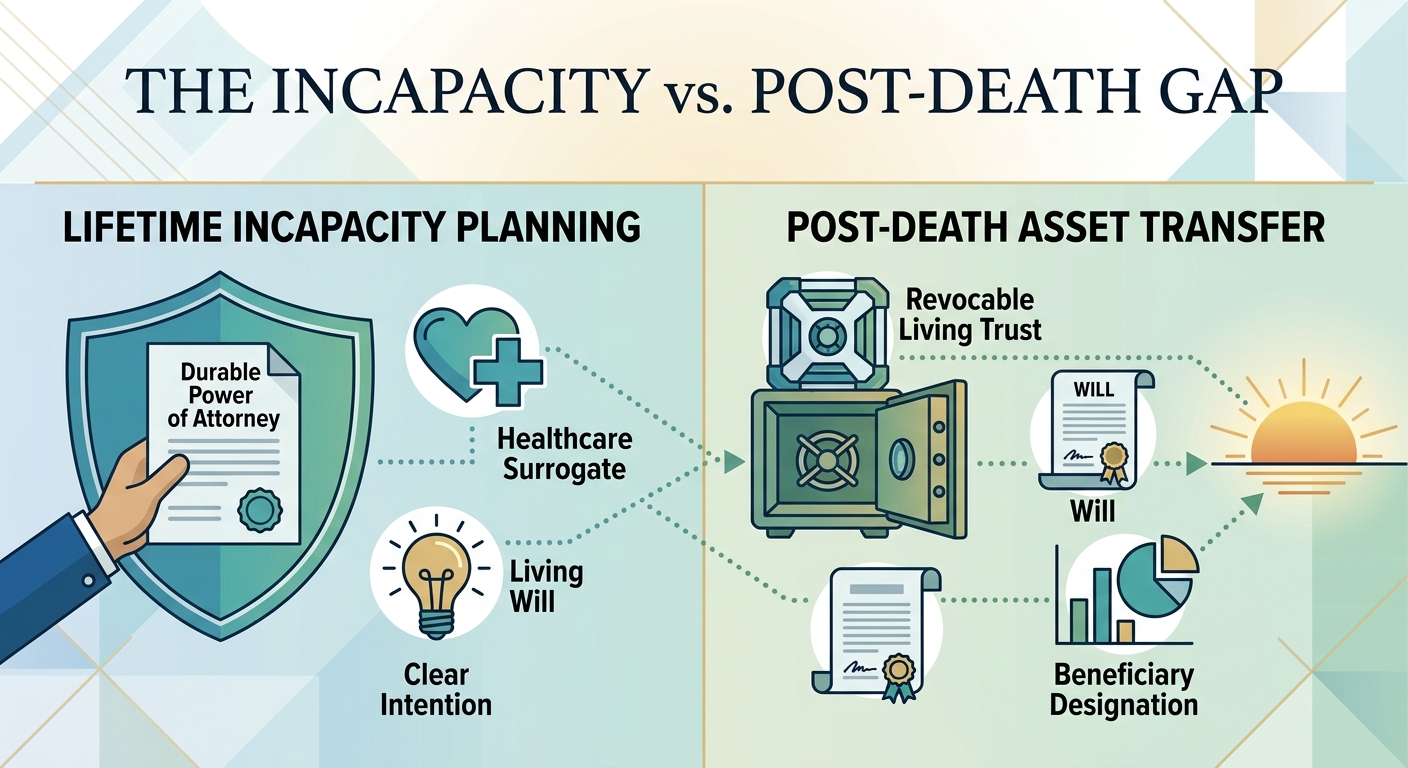
Setting up a pet trust in Coral Springs is one of the most effective ways for pet owners to ensure their companions receive lifelong care if they are ever orphaned or separated due to illness or incapacity.
Many pet parents assume that simply leaving a verbal instruction or naming a pet in a traditional Will is enough. However, under Florida law, animals are legally classified as personal property. A simple Will provisions money to a person with the hope they care for the pet, but it offers zero legal oversight.
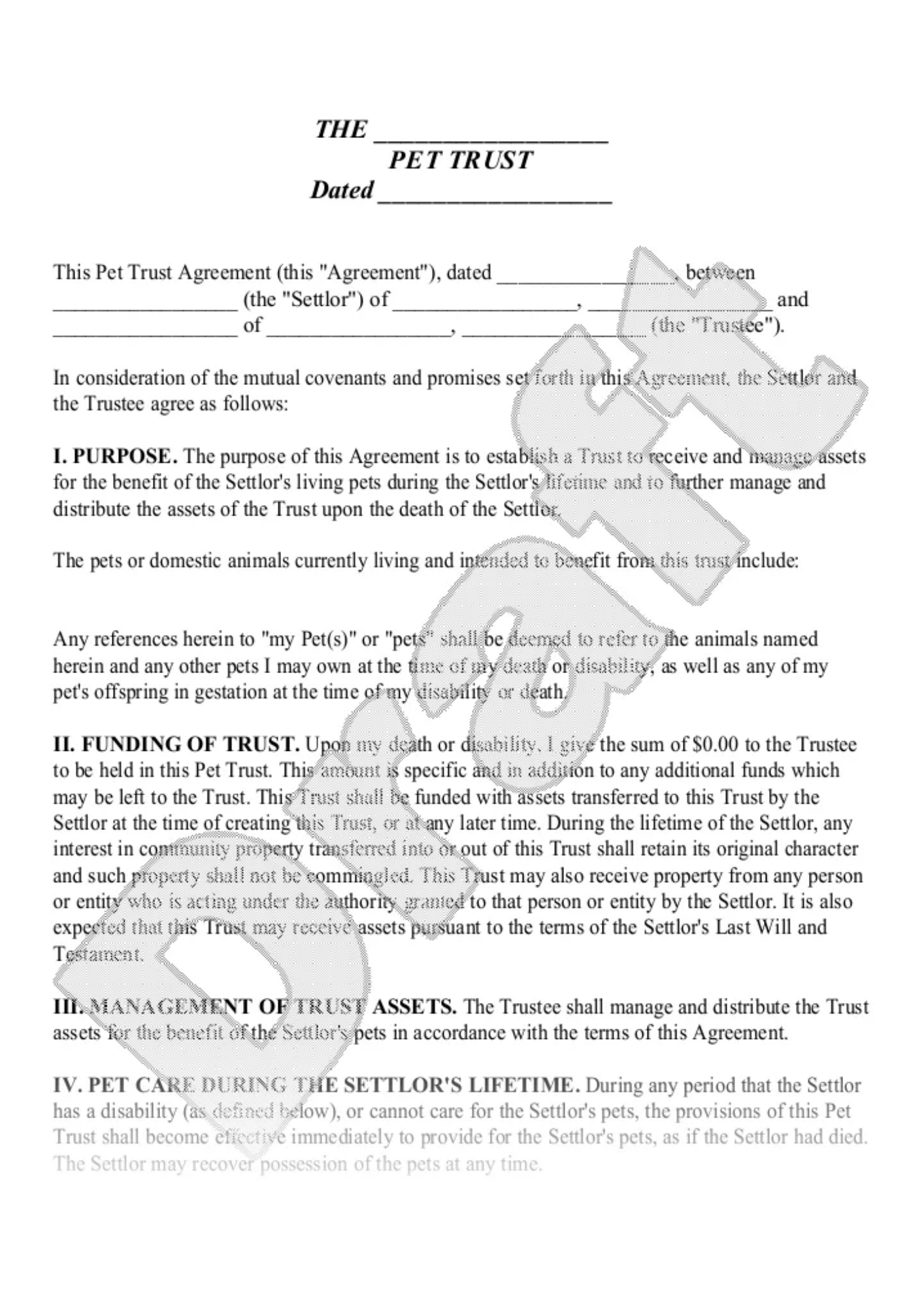
By contrast, a Florida Pet Trust created under Fla. Stat. § 736.0408 creates a legally binding fiduciary obligation that protects your funds and ensures your precise instructions for food, shelter, veterinary care, and daily routines are strictly followed.
Florida was among the pioneering states to formally codify pet trust protections. Under Florida Trust Code, a trust created for the care of an animal living during the settlor’s lifetime is valid and legally enforceable.
The statutory framework provides three critical guarantees:
Duration: The trust continues until the death of the last surviving animal covered by the trust agreement.
Fund Protection:Caregivers must spend trust funds exclusively on the designated animals, preventing any personal misuse.
Court Oversight: If the trustee or caregiver fails to perform their duties, a Florida court can appoint an enforcer or replace the trustee to safeguard the animal.
3 Essential Elements of a Florida Pet Trust
1. Choosing the Right Caregiver (and Alternates)
Your designated caregiver steps directly into your shoes as a surrogate parent to your animals. Because caring for a pet requires continuous commitment, select someone who shares your values regarding animal care.
Critical Step: Always name at least one alternate caregiver. If your primary choice is unable or unwilling to assume responsibility when the time comes, the court will appoint a replacement if no backup is specified in the trust agreement.
2. Appointing an Independent Trustee
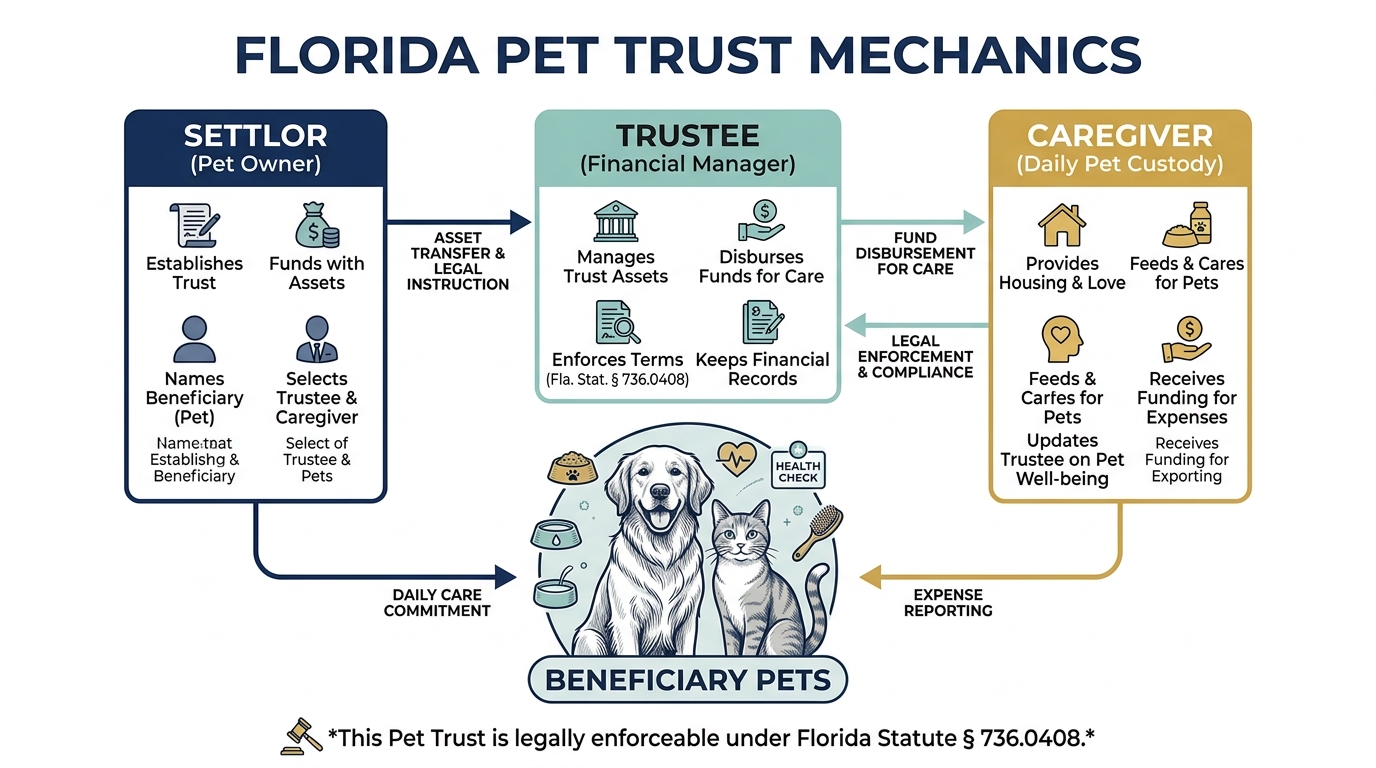
A pet trust divides responsibilities between two distinct roles:
The Caregiver: Provides physical day-to-day care, food, housing, and attention.
The Trustee: Holds and manages the trust funds, distributing money to the caregiver upon receiving receipts or budget requests for pet expenses.
Separating the role of trustee and caregiver establishes an essential checks-and-balances system. The trustee monitors the caregiver to ensure proper care and approves expenses solely for the pet’s welfare.
3. Calculating Funding Needs
Determining how much money to dedicate to a pet trust depends on several individual factors:
Life Expectancy & Species: Calculating lifetime care costs varies significantly between a senior dog, a young cat, or long-lived exotics like parrots or tortoises.
Standard of Living: Include allowance for premium nutrition, grooming, pet insurance, boarding, recreational activities, and routine health maintenance.
Veterinary Budget: Account for potential chronic conditions, surgeries, and emergency veterinary care as your pet ages.
How to Set Up a Florida Pet Trust: A Step-by-Step Checklist
Establishing a legally binding pet trust under Fla. Stat. § 736.0408 requires careful planning to ensure the document withstands judicial scrutiny and provides immediate protection. Below is the complete roadmap utilized by estate planning attorneys in South Florida:
1. Detail Daily Care Standards & Pet Identifiers:
Avoid ambiguity regarding pet identity and care requirements.
As a result, you must document your pet’s precise profile, including microchip numbers, veterinary records, dietary restrictions, preferred medical providers, and end-of-life care preferences.. Specifying these details prevents potential disputes regarding the pet’s identity or standard of living.
2. Structure the Financial Model & Funding Mechanism:
Calculate lifetime costs and select an appropriate funding vehicle.
Determine total funding by multiplying estimated annual care expenses (food, grooming, routine/emergency veterinary care, boarding) by your pet’s maximum remaining life expectancy. Next, decide whether to fund the trust immediately (inter vivos) or upon death via a pour-over Will, life insurance policy, or transfer-on-death financial account.
3. Appoint Fiduciaries & Enforcement Roles:
Separate operational duties to establish checks and balances.
Designate a Caregiver for daily custody, a Trustee to manage distributions and audit receipts, and an optional Trust Enforcer (under Fla. Stat. § 736.0408(2)) who holds legal standing to petition the 17th Judicial Circuit Court if the trustee or caregiver fails to meet statutory standards.
4. Execute in Accordance with Florida Trust Formalities:
Ensure compliance with legal signature and notarization standards.
To ensure full legal validity under the Florida Trust Code, the trust agreement must be signed by the settlor in the presence of two attesting witnesses and a Florida Notary Public, adhering to execution standards similar to those for testamentary instruments.
Frequently Asked Questions
Why isn’t leaving my pet to someone in my Will enough in Florida?
A Will only takes effect after probate court validation, which can take months. Furthermore, a Will cannot enforce ongoing behavior. Once a beneficiary inherits money designated for a pet via a Will, they have no statutory legal obligation to use those funds on the animal.
What happens to leftover money in the trust after my pet passes away?
When drafting your trust, you name a remainder beneficiary. Once the last surviving animal covered by the trust passes, any remaining funds are distributed directly to your chosen heirs, family members, or a designated animal charity.
Can a court reduce the amount of money in a pet trust?
Yes. Under Fla. Stat. § 736.0408(3), a Florida court may reduce the trust property if it determines that the amount substantially exceeds what is required for the animal’s care. Excess funds are then returned to the settlor or distributed to remainder beneficiaries.
Can a Florida Pet Trust cover pets born after the document is executed?
Yes. Under Fla. Stat. § 736.0408(1), a pet trust can cover animals living at the time of the settlor’s death, including offspring born during the settlor’s lifetime or gestating at the time of passing.
What happens if the designated caregiver in Coral Springs moves out of state?
A well-drafted pet trust specifies whether the pet may relocate out of Florida with the caregiver. Some also clear whether custody transfers to an alternate local caregiver in Broward County to keep the pet in its familiar environment.
Protect Every Member of Your Family
Your pets depend on you entirely. Incorporating a legally binding Pet Trust into your estate plan guarantees that your companions will never be left without housing. Also proper medical care, or affection.
Under Chapter 733 of the Florida Statutes, probate administration involves private bilateral contracts like beneficiary redistribution agreements, settlement compromises, or real estate purchase contracts, alongside essential court instruments like Letters of Administration, Orders Determining Homestead, and Petitions for Exempt Property.
While contracts allow heirs, personal representatives, and creditors to voluntarily restructure rights or resolve disputes, court orders and statutory filings are strictly required to clear title, transfer legal ownership, and protect protected assets in Florida probate proceedings.
Let us be completely honest with each other for a second. Nobody wakes up on a sunny Tuesday morning in South Florida thinking, I really hope I get to read a fifty page legal breakdown of Florida probate contracts today!
If you found your way to this page, someone you cared about likely passed away, or a lawyer handed you a stack of paperwork thick enough to act as a doorstop. Now you have to make sense of it all.
When an estate enters probate under Chapter 733 of the Florida Statutes, families quickly discover that the legal world runs almost entirely on paperwork. Some of these papers are genuine, two-sided contracts where living people negotiate terms. Others are formal court orders that require a judge to stamp a seal before anyone can touch a single dollar in a bank account.
Here is an honest, straightforward guide to every contract and document you might encounter in South Florida, written in plain language without the dense legalese that usually makes people fall asleep at their desks.
PART 1: Private Contracts and Bilateral Agreements in Florida Probate
In ordinary life, a contract requires a mutual agreement, an offer, and something of value changing hands. In the probate realm, contracts serve as the legal tools that let living people fix messy situations, buy out family members, or hire experts to clean out a dusty attic.
1. Private Agreements Among Interested Persons (Fla. Stat. § 733.815)
What It Is and How It Looks
A Private Agreement Among Interested Persons looks like a standard legal contract. It starts with a caption identifying the estate, followed by a long list of “Whereas” clauses that explain the background.
The main text outlines who gets what, releases everyone from liability, and includes signature lines that require proper legal validation. It must state clearly that all parties are competent adults and that no creditor is getting cheated out of money.
Detailed Scenario
Mateo and Sofia are adult siblings who inherited their late father’s estate in Coral Springs. The father’s will leaves everything split equally between them. The estate consists of a house worth $400,000 and an investment account worth $400,000.
Mateo wants to live in the house. Sofia prefers cash so she can buy a condo in Miami.
Instead of forcing a quick sale of the home that neither of them actually wants, their lawyer drafts an agreement under Section 733.815. Mateo gets full ownership of the house, Sofia gets the investment account, and Mateo pays her an extra $25,000 to cover minor valuation differences.
Legal Mechanics
Under Florida Statutes Section 733.815, heirs can agree to trade or reallocate assets however they like. The personal representative must confirm that all estate debts, final taxes, and administrative fees are covered before handing over the keys.
2. Family Settlement Agreements and Compromises (Fla. Stat. § 733.708)
What It Is and How It Looks
A Family Settlement Agreement looks like a high stakes corporate treaty. It includes agreed facts, complete releases of liability, and a clause submitting the deal to the 17th Judicial Circuit Court in Broward County.
Crucially, it includes a paragraph requiring the executor to present the contract to the probate judge for official sign off.
Detailed Scenario
A resident of Fort Lauderdale passes away and leaves behind a brand new will that disinherits his child from a first marriage, leaving everything to a second spouse. The child hires a lawyer and claims the new spouse used undue influence when the father was sick.
Both sides realize that fighting in court for three years will only make the litigation lawyers rich.
During mediation, they draft a Family Settlement Agreement. The surviving spouse agrees to pay the child a flat cash settlement and hand over a few family heirlooms. In exchange, the child drops the lawsuit and agrees never to sue the estate again.
Legal Mechanics
Florida law loves family settlements because they keep relatives from screaming at each other in courtroom hallways. Submitting the contract under Section 733.708 turns a private agreement into a binding court order. This step is mandatory if any beneficiaries are minors, since kids cannot legally sign away their rights without a judge checking the math first.
3. Personal Representative Service and Vendor Contracts (Fla. Stat. §§ 733.612 and 733.619)
What It Is and How It Looks
A Fiduciary Service Contract looks like a typical vendor agreement for home repairs or estate sales. The key difference is tucked away in the very first paragraph and the signature block.
It must state that the person signing is acting only as the representative of the estate, not as an individual paying out of their own pocket.
Detailed Scenario
The executor of an estate in Coral Springs needs to fix a damaged roof, paint the living room, and clear out forty years of accumulated furniture before putting a home on the market. The executor hires a licensed roofing company and a professional estate sale team.
This executor signs the contracts. Because they are managing someone else’s property, they must ensure the contract text protects their personal savings account if something goes wrong on the job site.
Legal Mechanics
Florida Statutes Section 733.612 gives an executor the authority to hire workers to preserve estate property. Under Section 733.619, an executor becomes personally liable for the bill if they forget to specify their official title on the signature line. If you sign your name without adding “as Personal Representative of the Estate,” the contractor can legally demand payment directly from your personal checking account.
4. Real Estate Purchase and Sale Agreements in Probate (Fla. Stat. § 733.613)
What It Is and How It Looks
A Probate Real Estate Purchase Agreement uses standard residential contract forms alongside specific probate clauses.
The seller line must list the seller in their official representative capacity. The agreement always includes a clause making the sale contingent on court approval or proper probate filings.
Detailed Scenario
A decedent owned a house in Coral Springs, and a buyer puts in a great cash offer.
The real estate agent writes up the contract, but the closing attorney notices that the deceased person died without a valid will. That means there is no written clause granting a power of sale.
Legal Mechanics
Under Florida Statutes Section 733.613, if a will does not explicitly give the executor the power to sell real estate, the executor cannot transfer title on their own. The contract sits in limbo while the probate lawyer files a formal petition with the Broward County court. All heirs receive formal notice, and the judge must sign an order approving the sale before the closing can happen.
A Creditor Compromise Agreement is a short contract between the executor and a creditor like a credit card company or hospital.
It states the original debt amount, acknowledges that the estate has limited funds, sets a lower lump sum payment, and confirms that the debt is fully canceled once the check clears.
Detailed Scenario
A decedent leaves behind $30,000 in credit card bills, but the estate only holds $12,000 in a checking account along with a protected primary home.
Credit card companies cannot touch a protected Florida homestead. That $12,000 in the bank is the only cash available to pay off every bill. The executor calls the credit card companies and offers each one a fraction of what they are owed to settle the accounts completely.
Legal Mechanics
Section 733.708 allows an executor to negotiate and settle debts for lower amounts. However, Florida law enforces a strict priority list for paying bills under Section 733.707.
Funeral costs, court administrative fees, and final hospital bills take priority over credit cards. Paying off a low priority credit card before settling the funeral bill can make the executor personally responsible for paying the funeral home out of their own pocket.
6. Attorney and Professional Engagement Agreements (Fla. Stat. §§ 733.6171 and 733.6175)
What It Is and How It Looks
A Probate Retainer Agreement is a formal contract between the executor and the law firm. It explains the legal scope of work, hourly rates or percentage fee schedules, upfront costs, and court filing expectations.
Florida law requires specific written disclosures explaining how probate attorney fees are calculated.
Detailed Scenario
A newly appointed executor in Broward County feels completely overwhelmed by the legal paperwork and hires a local probate law firm to manage the estate.
The law firm provides an engagement agreement detailing whether they will charge an hourly rate or use the standard state fee percentage based on the total value of the estate assets.
Legal Mechanics
Florida Statutes Section 733.6171 sets statutory fee guidelines that courts consider reasonable for probate lawyers. Under Section 733.6175, any heir who thinks the lawyer is charging too much can ask the probate judge to review the bill and cut the fee down to a fair amount.
7. Contracts Concerning Succession and Agreements to Make a Will (Fla. Stat. § 732.701)
What It Is and How It Looks
A Contract to Make a Will is an agreement created while the person is still alive. It looks like a hybrid between a commercial contract and a will, explicitly stating that one person agrees to leave specific property to another in exchange for a clear action or service.
Detailed Scenario
An elderly parent tells their adult child that if the child moves to Coral Springs, quits their job, and acts as a full time caregiver, the parent will leave them the family home in their will. The child moves in and takes care of the parent for five years.
When the parent passes away, a surprise will surfaces that leaves the entire house to a local pet shelter.
The child files a claim against the estate using their written caregiver contract.
Legal Mechanics
Under Florida Statutes Section 732.701, an agreement to make a will or leave an inheritance is completely useless unless it is written down and signed in front of two attesting witnesses. Casual verbal promises made over dinner carry zero weight in a Florida courtroom, no matter how unfair the situation seems.
8. Premarital and Postmarital Elective Share or Property Waivers (Fla. Stat. § 732.702)
What It Is and How It Looks
A Waiver of Spousal Probate Rights is a specialized contract, usually included inside a prenuptial or postnuptial agreement. It contains clear clauses where a spouse gives up their rights to the elective share, homestead property, exempt assets, and family allowances.
Detailed Scenario
Two people get married later in life. Both own homes in South Florida and have adult children from previous marriages. They want their homes to pass directly to their biological kids without any surviving spouse claims getting in the way.
They sign a prenuptial agreement waiving all probate inheritance rights. When the husband passes away, the wife steps aside so the kids can inherit the house cleanly.
Legal Mechanics
Under Florida Statutes Section 732.702, a spouse can sign away their inheritance rights. The document must be in writing and signed in front of two attesting witnesses. Signing this document after the wedding requires a full, honest written disclosure of all personal assets and bank accounts.
PART II: Critical Non-Contractual Probate Documents
Contracts are voluntary agreements between people. The rest of the probate world runs on court orders, official petitions, and statutory filings. You need to know these documents just as well as any contract.
1. Letters of Administration
What It Is: The official document issued by a probate judge that appoints the executor and grants them the legal authority to handle the estate.
How It Looks: A single page court document featuring the raised seal of the Broward County Clerk of Courts, the case number, and the judge’s signature.
When It Comes Into Play: You cannot move money, close accounts, or sell property without this document. Bank managers will refuse to speak with you until you hand them a certified copy of these Letters.
2. Petition and Order Determining Homestead Property (Fla. Const. Art. X, § 4 and Fla. Stat. § 732.401)
What It Is: A formal court request and judge’s order declaring that a house was the deceased person’s primary Florida residence.
How It Looks: A legal order containing the property address, legal parcel details, and an official ruling that the house passes directly to protected family members.
When It Comes Into Play: A primary residence in Florida receives massive legal protection under the state constitution. Protected homestead property passes to heirs completely free from most creditor claims, and it sits outside the standard probate estate process.
3. Petition to Determine Exempt Property (Fla. Stat. § 732.402)
What It Is: A formal court filing asking the judge to set aside specific personal belongings for the surviving spouse or minor children.
How It Looks: A court filing listing household furniture up to $20,000, college savings accounts, and up to two personal cars.
When It Comes Into Play: When creditors come knocking, the surviving spouse files this petition to protect the family cars and living room furniture from being seized to pay off old bills.
4. Statement of Claim (Fla. Stat. § 733.703)
What It Is: The official form a creditor files with the court to demand payment for an unpaid debt.
How It Looks: A short court form detailing the amount owed, the reason for the debt, and attached proof like credit card statements or medical bills.
When It Comes Into Play: Creditors must file this form within three months of the public probate notice, or within thirty days of receiving direct notice. If a creditor misses the deadline, their claim gets wiped out forever.
5. Disclaimer of Interest (Fla. Stat. § 739.104)
What It Is: An official written statement where an heir says, No thank you, I do not want this inheritance.
How It Looks: A notarized statement filed directly with the court, detailing the exact asset or inheritance share being refused.
When It Comes Into Play: People use this document when accepting an inheritance would trigger a massive tax bill, or when they want the asset to pass directly to their own children instead.
Summary Matrix: Contracts vs. Non-Contractual Probate Instruments
Document or Instrument Type
Legal Nature
Governed By
Primary Purpose in Probate
Private Agreement (§ 733.815)
Bilateral Contract
Fla. Stat. § 733.815
Lets heirs change how assets are divided among themselves.
Family Settlement Agreement
Multilateral Contract
Fla. Stat. § 733.708
Resolves serious family disputes and stops active lawsuits.
Vendor Contract
Commercial Contract
Fla. Stat. §§ 733.612, 733.619
Hires workers while protecting the executor’s personal money.
Real Estate Purchase Agreement
Commercial Contract
Fla. Stat. § 733.613
Handles the sale of estate owned houses or land.
Creditor Compromise Agreement
Bilateral Contract
Fla. Stat. § 733.708
Settles unpaid debts for lower cash payouts.
Letters of Administration
Court Order
Fla. Stat. Chapter 733
Gives the executor official authority to manage the estate.
Order Determining Homestead
Judicial Order
Fla. Const. Art. X, § 4
Protects the family home from general debt collectors.
Frequently Asked Questions (FAQs)
1. Can siblings legally change how an inheritance is divided in Florida?
Yes. Under Florida Statutes Section 733.815, competent adult heirs can sign a private contract to divide property however they want. The deal cannot cheat creditors or leave out non signing family members.
2. What happens if an executor signs a contract without using their official title?
Under Section 733.619, an executor who signs a contract without adding “as Personal Representative of the Estate” can be held personally responsible for paying the bill out of their personal savings.
3. Can you sell a house during probate in Broward County?
Yes, but the process depends on the will. If the will explicitly grants a power of sale, the executor can complete the deal. If there is no will, the contract must state that the sale depends on getting an approval order from a Broward County judge under Section 733.613.
4. Is an oral promise to leave property to someone in a Florida will valid?
No. Section 732.701 states that any agreement to leave an inheritance is completely invalid unless it is written down and signed in front of two witnesses.
5. What is the difference between a probate contract and a court order?
A probate contract is a voluntary agreement between living people. A court order is an official decision signed by a judge that carries the full force of the law.
6. Can heirs sign a contract to skip probate court entirely?
No. Private contracts cannot transfer legal ownership of assets that require court orders, like sole name real estate or locked bank accounts. Contracts only control how assets are shared within or after the court process.
7. How long do creditors have to file a claim against a Florida estate?
Under Section 733.702, creditors must file a formal Statement of Claim within three months of the published notice, or within thirty days of receiving direct notice. Late claims are permanently barred.
Let Us Take the Stress Off Your Shoulders
Trying to make sense of probate contracts, court orders, and inheritance rules while grieving a loved one is exhausting. You do not have to figure this out by yourself late at night.
If you need to settle a family dispute, protect a primary residence, or complete a property sale in Coral Springs or Broward County, reach out to our team at Reinfeld & Cabrera. Call us directly at (954) 866-8600 or send us a message online to set up a time to talk. We will handle the heavy legal lifting so you can focus on taking care of your family.
Two people can have the same business idea and end up with very different legal problems.
Imagine two friends opening a design company in Coral Springs. They agree to split everything 50/50 and decide to form an LLC. The filing takes care of the immediate problem: the company now exists.
It does not answer what happens if one of them puts in more money. Or stops working. Or wants to sell his share. Perhaps he dies. Or decides that the company should be sold while the other wants to keep it.
Those are business formation questions too.
The Florida Department of State recorded 561,143 new domestic LLC filings in 2025, and its most recent quarterly figures show more than 3 million active Florida LLCs. There are more than 4.1 million active business entities of all types in the state.
There is nothing unusual about forming an LLC in Florida.
The filing itself is usually straightforward. Deciding what the company should look like, who should own it, how it should operate, and what happens when circumstances change can require considerably more thought.
What Do You Need to Decide Before Forming a Business in Florida?
Start with the people involved.
If you are forming a business by yourself, many of the ownership questions are relatively simple. If there are two, three, or ten owners, they become part of the legal structure.
Who owns the company?
Who makes decisions?
Where does the money come from?
Who contributes equipment, intellectual property, or work?
Can one owner sell an interest without the others agreeing?
What happens if an owner wants to leave?
What happens if the business loses money?
Those questions do not appear on a basic Sunbiz filing form.
They still need answers.
The choice of entity comes after some of those questions, not before them.
Florida recognizes several forms of business organization, including corporations, limited liability companies, partnerships, limited partnerships, and limited liability partnerships.
For many small businesses, the main discussion will be whether an LLC or corporation makes sense. That is a legal and tax decision, not a matter of choosing whichever form happens to be most popular.
Should You Form an LLC or a Corporation?
There is no universal answer.
An LLC and a corporation have different rules governing ownership, management, transfers, and other aspects of the business. Their federal tax treatment can also differ.
An LLC with one member is generally treated by the IRS as a disregarded entity for federal income tax purposes unless it elects corporate treatment. A domestic LLC with two or more members is generally treated as a partnership unless it elects to be treated as a corporation.
A corporation is a different legal structure, with shares, directors and officers forming part of its statutory framework.
That does not mean a corporation is inherently more sophisticated or an LLC is inherently better for a small business. The appropriate structure depends on what the owners are trying to accomplish.
An attorney and accountant may also need to look at the same proposed business from different angles. The attorney is concerned with the legal structure and documents. The accountant is concerned with tax treatment and financial consequences. Those questions overlap, but they are not the same question.
What about a partnership?
Partnership structures can also be appropriate in some circumstances. Florida has statutes governing general partnerships, limited partnerships, and limited liability partnerships.
The point is not that every entrepreneur needs a tour through every entity available under Florida law.
It is that “LLC or corporation?” is sometimes too early a question.
First figure out what the ownership and business arrangement actually looks like.
“I like to know what the owners expect the business to look like before we start talking about forms. A company with one owner and a company with four owners may both be called an LLC, but the legal questions can be completely different.”
How Do You Choose a Name for a Florida Business?
The name has to work legally as well as commercially.
For a Florida LLC, the name must be distinguishable on the records of the Department of State and must contain an appropriate designation such as “LLC.” A Florida profit corporation has its own naming requirements and must likewise use a distinguishable name. The state recommends searching its records before filing.
There is an important qualification to the old idea that another business simply cannot have “the exact same name.”
The state’s naming rules concern whether a proposed name is distinguishable on its records. That is a narrower question than whether nobody anywhere has rights in the name.
A Sunbiz search is not a trademark search.
That distinction becomes important if the business will spend substantial money on a brand, website, signs, advertising, packaging, or other intellectual property.
What if the business uses another name?
Florida also allows registration of a fictitious name, commonly called a DBA, when a person or business operates under a name different from its legal name. The registration is intended to tell the public who is conducting business under that name. It does not give the registrant ownership of the name or prevent someone else from registering or using it.
So there are several different concepts that people often lump together:
The legal name of the entity.
A fictitious or DBA name.
Trademark rights.
They are not interchangeable.
How Do You Form an LLC in Florida?
A Florida LLC is formed by filing Articles of Organization with the Division of Corporations.
The filing identifies the LLC and its registered agent and provides other information required by Florida law. The registered agent must have a physical street address in Florida.
The current filing instructions also make something important clear: the Division of Corporations is an administrative filing agency. It does not provide legal, accounting, or tax advice, and it recommends that legal counsel review formation documents when appropriate.
That tells you something about the limits of the filing process.
The state can process your Articles of Organization. It does not decide whether the ownership arrangement between you and your business partner is sensible.
How Do You Form a Corporation in Florida?
A Florida profit corporation is formed by filing Articles of Incorporation.
The document includes the corporation’s name, principal office, registered agent and other required information. A corporation must also identify the number of shares it is authorized to issue.
Again, the terminology matters.
LLC: Articles of Organization.
Corporation: Articles of Incorporation.
The two entities also operate under different statutory frameworks after formation.
The Florida Department of State specifically recommends legal review of Articles of Incorporation when the circumstances call for it.
That can be particularly relevant when the corporation will have several shareholders, unusual ownership arrangements, outside investors, or other provisions that go beyond the minimum filing requirements.
Do You Need an EIN for a Florida Business?
The answer depends on the business.
The IRS treats a single member LLC differently from a multi member LLC for federal income tax purposes. A single member LLC that has not elected corporate treatment is generally disregarded for federal income tax purposes. A multi member domestic LLC is generally treated as a partnership unless it elects otherwise.
That does not mean a single member LLC can simply ignore EINs.
The IRS says an LLC will need an EIN if it has employees or certain excise tax obligations. A single member disregarded LLC that does not have those obligations may not need an EIN for federal income tax purposes, although it may still obtain one for purposes such as opening a bank account or satisfying another requirement.
The old rule that a corporation “definitely” needs an EIN while an LLC simply gets to choose is therefore too crude.
The entity, its tax classification, its employees, and its activities all matter.
What Licenses and Tax Registrations Does a Florida Business Need?
There is no single Florida business license that covers every company.
The requirements depend on what the business actually does.
A business selling taxable goods or services may have to register with the Florida Department of Revenue before beginning those activities. The Department provides an online registration system that determines applicable tax registrations based on information about the business.
Other businesses may have professional licensing requirements, industry specific permits, local requirements, or regulations tied to their location.
A restaurant and a software consultant can both be Florida LLCs. Their regulatory obligations can be very different.
That is why “get your business license” is not much of a checklist.
The useful questions are:
What does the business sell?
Where does it operate?
Does the industry require a professional or occupational license?
Can the business collect a tax that requires registration?
Does the local government impose additional requirements?
Those questions produce a much more accurate answer.
What Documents Should Business Owners Have?
The state filing establishes the entity. It does not necessarily establish the relationship between its owners.
This becomes especially important with a multi member LLC.
Florida law expressly recognizes operating agreements and allows people who intend to become LLC members to make an agreement that will become the company’s operating agreement when the LLC is formed. The operating agreement governs important aspects of the company’s internal relationship.
An operating agreement can address issues such as:
Ownership percentages
Management
Voting
Contributions
Distributions
Transfers of ownership
Admission of new members
Withdrawal of a member
Events affecting the business when a member dies or becomes unable to participate
Procedures for resolving disagreements
Not every LLC needs the same document.
A one person consulting business does not present the same problems as a four person company whose owners are contributing different amounts of money and labor.
A Florida LLC Dispute Shows Why the Agreement Matters
In Dinuro Investments, LLC v. Camacho, a dispute among members of an LLC reached the Third District Court of Appeal. The case concerned when an individual LLC member could bring claims against other members in an individual capacity rather than bringing a derivative action on behalf of the company. The court adopted a framework distinguishing direct injuries from injuries belonging to the LLC itself and also recognized the importance of contractual or statutory duties owed directly to a member.
The case involved a real estate development company, not a hypothetical neighborhood startup.
That is useful precisely because disputes between owners do not stay theoretical for long once money and contractual rights are involved.
The operating agreement can become one of the documents the lawyers have to examine when trying to determine what the members agreed to and what rights they have.
Proposed quote — Stuart Reinfeld: “Two people can be completely comfortable with a 50/50 arrangement when the business is making its first dollar. The harder conversation is what happens when they disagree about the hundred thousandth dollar.”
What Happens After the Business Is Formed?
This is where the old six step checklist stopped too early.
Once the entity exists, the owners still have to run it.
Depending on the business, that can include:
Obtaining an EIN
Opening business banking and accounting systems
Establishing ownership and management records
Adopting an operating agreement or corporate governance documents
Obtaining licenses and permits
Registering for applicable Florida taxes
Preparing contracts
Hiring employees and addressing employment requirements
Maintaining the registered agent
Filing annual reports
Florida LLCs must file annual reports to maintain active status. The filing period runs from January 1 through May 1 of the applicable year, and failure to file can result in administrative dissolution. Corporations have the same basic annual reporting requirement.
The annual report is not a financial statement. It updates the state’s records about the entity.
That is a small administrative obligation with a very concrete consequence if it is ignored.
The company can disappear from the state’s active records even though the owners are still thinking about it as an operating business.
Why Should Business and Personal Finances Be Kept Separate?
Someone forming an LLC or corporation is creating a separate legal entity. The way the business is actually operated should reflect that.
That includes maintaining appropriate financial records and avoiding the casual mixing of company and personal money.
Florida courts have recognized the separate nature of business entities while also addressing circumstances in which members or shareholders seek to impose liability on individuals behind the entity.
In Dinuro, for example, the Third District discussed the limited liability associated with an LLC and the distinction between claims belonging to the company and claims belonging directly to an individual member.
There is no magic bank account that makes an owner immune from personal liability.
There is also no good reason to make the company’s records harder to understand than they need to be.
If the business buys equipment, the records should show who bought it.
Perhaps an owner puts money into the company, the transaction should be documented appropriately.
If the company signs a contract, the correct legal entity should be identified.
These are ordinary business practices. They also become very important when an owner later has to explain what happened to the company’s money or property.
What Can Go Wrong When Business Partners Do Not Plan Ahead?
Consider a common situation.
Two friends form an LLC. One contributes $100,000. The other contributes less money but works full time in the business. They decide to own the company equally because, at the time, that feels fair.
Three years later, the business is profitable.
The working owner believes his contribution should give him greater control. The other owner believes the original 50/50 agreement is still the agreement.
Neither is necessarily behaving irrationally.
They simply reached the point where the assumptions they made at the beginning no longer answer the questions they now have.
That is the sort of problem an operating agreement can address before the dispute exists.
Florida’s appellate courts have dealt with similar questions in actual LLC disputes. In Demir v. Schollmeier, the Third District considered an agreement between LLC members and concluded that the agreement governed their relationship even though it was not titled an “operating agreement” and was not executed at the time the LLC was originally formed.
The case involved a particular dispute and particular contractual language. It does not mean that every informal agreement between business partners will produce the same result.
It does illustrate why the arrangements between owners deserve attention when the company is being created.
When Should You Talk to a Business Attorney?
You can form a Florida business through the state’s online filing system without hiring a lawyer to click the buttons for you.
The harder question is whether the business has legal decisions that deserve advice before those buttons are clicked.
That is particularly true when:
There are multiple owners
Owners are contributing different amounts of money or labor
The business will have investors
Ownership may change
The business involves intellectual property
The company will own significant property
The owners are family members
The business is buying another company
The company will enter substantial contracts
A professional license is involved
The owners want restrictions on transfers
The business may eventually be sold
The owners have different ideas about management or control
In those circumstances, the formation documents are only part of the legal work.
The attorney may need to look at the proposed ownership structure, operating agreement, contracts, licensing requirements, intellectual property, real estate, or other issues before the business begins operating.
“The state filing tells you that the entity exists. It does not tell you whether the arrangement between the people who own it will work. That is usually where the more interesting legal questions begin.”
Frequently Asked Questions
How do I form a business in Florida?
You generally begin by choosing an appropriate legal structure, selecting a name, designating a registered agent, and filing the required formation documents with the Florida Department of State. The business may also need tax registrations, licenses, permits, and internal ownership or governance documents.
Is an LLC or corporation better for a Florida business?
Neither is automatically better. The appropriate structure depends on ownership, management, taxation, financing, liability considerations, and the way the owners expect the business to operate.
What is the difference between Articles of Organization and Articles of Incorporation?
Articles of Organization are used to form a Florida LLC. Articles of Incorporation are used to form a Florida profit corporation.
Do I need an EIN for a Florida LLC?
It depends on the LLC’s circumstances and federal tax classification. A single member LLC that is disregarded for federal income tax purposes may not need an EIN solely for federal income tax reporting if it has no employees and no applicable excise tax obligations, although an EIN may still be needed or useful for other purposes.
Do I need a business license in Florida?
There is no single license required for every Florida business. Requirements depend on the business activity, industry, location, and applicable state or local rules.
What happens after I form an LLC in Florida?
The owners may need to obtain an EIN, establish business banking and accounting procedures, prepare an operating agreement, obtain licenses and permits, register for applicable taxes, and maintain the entity’s state records and annual filings.
Does a Florida LLC need an operating agreement?
Florida law recognizes operating agreements as governing documents for LLCs. Whether a particular business needs a detailed agreement depends on its circumstances, but an operating agreement can establish important rules concerning ownership, management, transfers, and the relationship among members.
Can I use a different name from my company’s legal name?
Yes. A Florida business can generally register a fictitious name, commonly called a DBA, when it operates under a name different from its legal name. The registration does not give the business exclusive ownership of that name.
Starting a Business in Coral Springs or Broward County
Someone opening a business in Coral Springs deals with the same Florida entity laws as someone forming a company elsewhere in the state.
The local details can still matter.
A business may have a physical location, employees, professional licensing requirements, local regulatory issues, or tax and registration obligations connected to where it operates. A company working from a home office can have a different set of practical issues from a restaurant, medical practice, construction company, or retail store.
For business owners in Coral Springs and throughout Broward County, the formation decision should therefore account for the business that actually exists rather than an imaginary generic “Florida business.”
That is also why two businesses that both file as LLCs can need very different legal documents.
Talk With a Florida Business Attorney
If you are forming a business in Coral Springs, Broward County, or elsewhere in Florida, Reinfeld & Cabrera, P.A. can review the proposed structure, ownership arrangement, formation documents, and other legal issues involved in setting up the company.
A consultation can also be useful when the basic filing is straightforward but the relationship between the owners, the company’s contracts, its property, or its future plans raises questions that a state filing form cannot answer.
This article provides general information about Florida business formation and is not a substitute for legal, tax, or accounting advice concerning a particular business.
A business does not have to accept an unpaid invoice as the cost of doing business.
When another company, customer, contractor, or client stops paying, the first step is usually figuring out exactly what is owed, why it is owed, and what evidence supports the claim. From there, a creditor may negotiate payment, send a formal demand, pursue a lawsuit, or, if a judgment is obtained, use Florida’s judgment enforcement procedures to pursue available assets.
There is an important difference between winning a debt case and collecting the money.
A judgment establishes a legal obligation. It does not automatically put a check in your company’s bank account.
Florida’s courts handle an enormous civil caseload. The state’s 2023-24 statistical report shows nearly 2.4 million county civil filings statewide, including small claims and other county civil matters. Florida’s trial courts as a whole manage more than two million civil case filings annually.
Business debt collection is only one part of that system, but the basic lesson is useful: a claim for money needs to be treated as a legal claim, not merely as an increasingly irritated series of emails.
What Should You Do When a Business Owes You Money?
Start by establishing the debt.
Look at the contract, invoice, purchase order, delivery records, emails, payment history, account statements, and any other documents showing what was agreed and what happened afterward.
Ask a few straightforward questions:
What did the debtor agree to pay?
What did your business provide?
When was payment due?
How much has been paid?
What remains outstanding?
Has the debtor disputed the amount or the underlying work?
Does the contract contain provisions concerning interest, attorney’s fees, venue, or dispute resolution?
Did anyone personally guarantee the obligation?
That last question can become important.
If the customer is an LLC or corporation, the company’s debt does not automatically become the owner’s personal debt. A creditor needs a legal basis for pursuing an individual separately, such as a guaranty or another applicable theory of liability.
That is one reason the paperwork deserves attention before anyone starts threatening to sue.
What Evidence Do You Need to Collect a Business Debt?
A creditor’s strongest evidence often consists of ordinary business records.
A signed contract is useful. So are invoices showing the amounts due, records showing that goods were delivered or services were performed, correspondence acknowledging the balance, and payment records showing what happened afterward.
Sometimes there is no single document that tells the whole story.
Florida recognizes an account stated claim in appropriate circumstances. The Florida Supreme Court has explained that an account stated depends on an agreement concerning the amount owed and an obligation to pay that amount.
Florida’s standard jury instructions describe an account stated as involving transactions for which a specific amount is due and note that an account statement is not automatically conclusive if evidence establishes fraud, mistake, or error.
So an unpaid invoice should not be treated as magic evidence.
A debtor can dispute what was billed, whether the work was completed, whether the goods were delivered, whether the amount is correct, or whether the person receiving the invoice had authority to incur the obligation.
The more clearly the business can reconstruct the transaction, the easier it becomes to evaluate the claim.
Should You Send a Demand for Payment Before Suing?
Often, yes.
A demand letter can identify the amount claimed, explain the contractual or factual basis for the debt, establish a deadline for payment, and give the debtor an opportunity to resolve the matter before litigation.
It can also reveal what the actual dispute is.
A company that responds, “We agree that we owe $40,000 but need 90 days” presents one problem.
A company that responds, “Your employees never completed the work and we owe nothing” presents another.
And a company that stops answering altogether presents yet another.
The demand process therefore has a practical purpose beyond giving someone one final chance to pay.
It can help establish what the parties actually disagree about.
Can You Sue a Business for an Unpaid Debt?
Yes, when the facts support a legally recognized claim.
The appropriate cause of action depends on the transaction. A creditor may have a breach of contract claim, an account stated claim, an open account claim, or another theory depending on the circumstances.
The contract itself can also determine what remedies are available.
Florida law generally gives five years to bring a legal or equitable action founded on a written contract or other liability founded on a written instrument. The limitations period is different for various other types of claims, including claims based on unwritten obligations.
That makes one piece of advice particularly important:
Do not assume you have plenty of time because the debtor keeps promising to pay.
A business can spend months or years hearing variations of “the check is coming” while the legal clock continues to run.
A recent Florida case illustrates the problem.
An Unpaid Legal Bill That Stayed Unpaid for Years
In LAD Commercial, LLC v. Eagle Trace at Vero Beach Homeowners’ Association, Inc., the Fourth District Court of Appeal considered a breach of contract claim arising from unpaid legal services.
The invoices totaled $20,179.08. The alleged unpaid work dated back years, and the defendant argued that the claim was barred by the statute of limitations. The litigation ultimately required the appellate court to examine when the cause of action accrued and how the contract’s payment provisions affected that analysis.
The lesson is not that every unpaid invoice becomes a statute of limitations dispute.
It is that waiting can turn a collection problem into a limitations problem.
What If the Debtor Disputes the Debt?
Then the case needs to be analyzed rather than treated as a simple collection matter.
Suppose a contractor invoices a business for $75,000. The business refuses to pay and says the contractor abandoned the project.
Now there are factual questions:
Was there a contract?
What work was required?
What work was actually completed?
Were there change orders?
Did the customer approve them?
Was the work defective?
Did the customer terminate the contract?
What damages did either side suffer?
The invoice alone cannot answer those questions.
Commercial litigation often turns on reconstructing the transaction from the documents and testimony rather than simply proving that an invoice exists.
Can You Sue the Owner of an LLC Personally?
Not merely because the LLC owes the money.
An LLC is a separate legal entity, and the existence of a business debt does not automatically create personal liability for its members.
A personal guaranty can change that.
So can other circumstances, depending on the facts and applicable law.
This is an area where careless collection advice can create a serious problem. A creditor should identify the actual legal basis for pursuing an individual instead of assuming that the person who owns the company and the company itself are interchangeable.
If the contract says that the company’s owner personally guarantees payment, that provision deserves close examination.
If there is no guaranty, the analysis is different.
What Happens If You File a Business Debt Lawsuit?
The case moves into the ordinary civil litigation process.
Depending on the claim and amount involved, that can include:
Filing the complaint
Serving the defendant
Receiving the defendant’s response
Conducting discovery
Negotiating a settlement
Resolving motions and disputed legal issues
Preparing for trial if necessary
Obtaining a judgment
Florida’s civil procedure system was significantly updated beginning January 1, 2025. The changes emphasize active case management, deadlines, initial discovery disclosures, supplementation, and discovery proportional to the needs of the case.
That does not mean every unpaid invoice will turn into a dramatic courtroom battle.
Many cases settle.
Some are resolved through motion practice.
Some proceed to trial.
And some defendants simply fail to respond, creating a different procedural situation.
The important point is that filing a lawsuit starts a legal process. It does not mean the creditor can immediately take the debtor’s property.
What Happens After You Win a Judgment?
This is the part that the old article barely addressed.
A judgment is not the same thing as payment.
Florida law provides several mechanisms for enforcing money judgments.
Under Florida Statute § 77.03, a judgment creditor can seek a writ of garnishment after obtaining a judgment. Garnishment can reach certain money or property held by a third party for the judgment debtor, subject to the requirements and limitations of Florida law.
Florida’s execution statutes also provide for levy and sale of certain property to satisfy a judgment. Section 56.061 identifies categories of property subject to execution, including certain real and personal property and corporate stock.
Florida also permits a judgment creditor to acquire a judgment lien on certain personal property, including property subject to execution and certain payment intangibles and accounts.
Those remedies can matter when a debtor has assets but simply refuses to pay.
They also have limits.
Property may be exempt. Other creditors may have priority. Secured creditors may have existing rights. Bankruptcy can change the situation entirely.
A judgment gives the creditor legal leverage and enforcement tools. It does not create assets that do not exist.
Can You Garnish a Business Bank Account?
Potentially, but garnishment has a specific legal procedure.
Florida Statute § 77.03 provides for issuance of a writ after judgment. Florida law also permits pre-judgment garnishment in certain circumstances, but the requirements are considerably more specific. Section 77.031 requires a verified motion or affidavit containing particular factual allegations, including the nature and amount of the claim and why the plaintiff believes the defendant will not have sufficient property available for execution.
That is a good example of why “just garnish their account” is not legal strategy.
There is a procedure.
There are requirements.
And there may be defenses and exemptions.
What If the Debtor Has Assets but Still Refuses to Pay?
Florida’s judgment enforcement statutes give creditors tools for investigating and reaching certain property.
Chapter 56 includes proceedings supplementary, which can be used in appropriate circumstances after a judgment. Florida law also addresses discovery concerning a judgment debtor’s assets and execution procedures.
A judgment creditor may therefore have options even when the debtor has not voluntarily written the check.
But those options depend heavily on what the debtor actually owns, how the assets are titled, whether other creditors have claims, and whether exemptions or other legal restrictions apply.
That investigation can become particularly important when a business appears to be operating normally while claiming that it has no money to satisfy a judgment.
Can You Recover Attorney’s Fees and Interest?
Sometimes.
Attorney’s fees are not automatically awarded simply because a business wins a lawsuit.
A contract may provide for attorney’s fees. Florida Statute § 57.105(7) provides reciprocity for certain contractual attorney’s fee provisions, allowing the prevailing party to recover reasonable attorney’s fees in an action concerning a contract when the statutory requirements are met.
Florida’s courts have also dealt with the issue in collection cases.
In Ham v. Portfolio Recovery Associates, LLC, the Florida Supreme Court considered whether a contractual attorney’s fee provision could become reciprocal when the creditor pursued an account stated claim rather than suing directly under the underlying credit agreement. The Court held that the statutory reciprocity provision applied because of the relationship between the account stated claim and the underlying contract.
That is a useful warning against treating attorney’s fees as an automatic add-on to every debt.
The contract, the cause of action, and the applicable statute all matter.
Interest also has its own rules. Florida Statute § 55.03 establishes the framework for the interest rate applicable to judgments and provides for quarterly adjustments based on the statutory formula.
What If You Already Have a Judgment but Still Have Not Been Paid?
Then the legal problem has changed.
You are no longer trying to establish that the debtor owes the money. You are trying to enforce an established judgment.
That can involve:
Judgment liens
Garnishment
Execution
Discovery concerning assets
Proceedings supplementary
Negotiated payment arrangements
Other enforcement mechanisms permitted by law
Florida Statute § 55.081 provides that a judgment generally cannot remain a lien on Florida real or personal property indefinitely; the statutory period is 20 years from entry of the judgment, subject to the statute’s provisions.
That does not mean a creditor should wait 19 years and see what happens.
It means Florida gives judgments a legal life that can extend well beyond the original lawsuit.
What If the Business Is Closing or Moving Assets?
This is where timing can become particularly important.
A creditor who has reason to believe that a debtor is transferring assets, shutting down operations, or reorganizing its affairs may need legal advice quickly.
Florida law contains procedures governing execution, judgment liens, proceedings supplementary, and other post-judgment remedies. The appropriate response depends on what is actually happening and what assets are involved.
A creditor should also avoid taking matters into its own hands.
Threatening customers, seizing property without legal authority, making false accusations, or attempting to bypass court procedures can create entirely new legal problems.
Collection is supposed to recover a debt.
It should not create another lawsuit.
How Long Do You Have to Collect a Business Debt in Florida?
There is no single limitations period for every business debt.
For example, Florida Statute § 95.11 generally provides a five-year limitations period for an action founded on a written instrument. Other claims can have different periods.
The nature of the obligation matters.
So does the date on which the particular cause of action accrued.
A creditor should identify the legal claim before assuming that an old invoice is still enforceable.
This is one reason an attorney should review an aging account before the business simply writes it off or sends another routine reminder.
A Business Debt Is Still a Business Problem
An unpaid $5,000 invoice can be irritating.
Some unpaid $50,000 invoice can disrupt payroll.
An unpaid $500,000 obligation can change whether a business can continue operating.
That is why debt collection should be approached in proportion to the amount at stake, the strength of the evidence, the debtor’s financial position, and the cost of pursuing the claim.
There is also a relationship question.
A company may want the money without destroying a valuable customer relationship. Another company may have reached the point where continuing to negotiate makes little economic sense.
Those are business decisions.
The legal job is to identify the available remedies and the consequences of using them.
When Should You Hire a Business Debt Collection Attorney?
Legal advice can be particularly useful when:
The amount owed is substantial
The debtor disputes the debt
The contract contains complicated provisions
A personal guaranty is involved
Several businesses or individuals are connected to the transaction
The debtor has stopped responding
You suspect assets are being moved
The debt is approaching a limitations deadline
You need to file a lawsuit
You already have a judgment
You need to investigate enforcement options
Bankruptcy has been threatened or filed
The earlier the legal analysis occurs, the more options may still be available.
That does not mean every $2,000 invoice needs a lawsuit.
Sometimes a well-supported demand gets the check.
There are cases where a payment agreement makes commercial sense.
Sometimes litigation is necessary.
And sometimes the debtor’s financial condition makes collecting the judgment itself the hardest part.
Frequently Asked Questions
How do I collect a business debt in Florida?
Begin by documenting the debt, reviewing the contract and supporting records, and determining whether the debtor disputes the amount or the underlying obligation. Depending on the circumstances, collection may involve a demand for payment, negotiation, litigation, judgment, and post-judgment enforcement.
Can I sue a business for an unpaid invoice?
Yes, when the facts support a legally recognized claim. The appropriate claim depends on the transaction, contract, records, and applicable Florida law.
Can I personally sue the owner of an LLC for the company’s debt?
Not automatically. An LLC is a separate legal entity. Personal liability generally requires its own legal basis, such as a personal guaranty or another applicable theory.
Could I recover attorney’s fees in a business debt lawsuit?
Possibly. A contract, statute, or other legal basis may authorize recovery. Florida Statute § 57.105(7) provides for reciprocal attorney’s fee rights in certain contract actions when the statutory requirements are satisfied.
Can I garnish a debtor’s bank account in Florida?
Potentially. Florida law provides procedures for garnishment, including post-judgment garnishment under § 77.03. Exemptions, procedural requirements, and the identity of the account holder can affect whether garnishment is available.
What happens after I win a judgment?
The creditor may have several enforcement options, including garnishment, execution, judgment liens, and proceedings supplementary, depending on the debtor’s assets and the circumstances.
How long do I have to sue for an unpaid business debt in Florida?
It depends on the legal claim. Florida generally provides five years for actions founded on a written instrument, while other claims can have different limitations periods.
Is a judgment the same as getting paid?
No. A judgment establishes the legal obligation, but the creditor may still need to use available enforcement procedures to collect the judgment.
Collecting Business Debts in Coral Springs and Broward County
A business in Coral Springs may sell services to another Broward County company, supply goods to customers across South Florida, or have contracts with companies anywhere in the country.
The location of the debtor, the terms of the contract, the applicable law, and the debtor’s assets can all affect the collection strategy.
For a Coral Springs business dealing with a significant unpaid account, the first useful step may be a review of the transaction itself: the contract, invoices, communications, payment history, and any documents showing what the debtor agreed to pay.
From there, the appropriate path may be a demand, negotiation, lawsuit, judgment enforcement, or some combination of those steps.
The important thing is to know which problem you actually have.
An unpaid invoice is one problem. A disputed contract is another. An unpaid judgment is a third.
Treating all three as “someone hasn’t paid us yet” is how a relatively straightforward collection matter can become unnecessarily expensive.
Talk With a Coral Springs Business Litigation Attorney
If your business is owed money by a customer, contractor, company, or other party, Reinfeld & Cabrera, P.A. can review the underlying transaction and discuss the legal options available for pursuing the debt.
That may mean evaluating the contract and records before a lawsuit is filed. It may mean negotiating payment. It may mean litigating the claim. And if you already have a judgment, the analysis may shift toward enforcement.
The right approach depends on the debt, the evidence, the debtor, and the remedies available under Florida law.
This article provides general information about Florida business debt collection and is not a substitute for legal advice concerning a particular debt, contract, lawsuit, or judgm
When two businesses have a serious disagreement, a lawsuit is only one possible destination.
The parties can negotiate directly. They can bring in a mediator. Some can agree to arbitration. They can also end up in court.
Those processes are different in ways that matter. Negotiation leaves the decision with the parties. Mediation brings in a neutral person to help them reach an agreement. Arbitration gives a neutral decision maker authority to decide the dispute. Litigation puts the dispute into the court system.
The contract may have something to say about all of this, too.
A business that understands its dispute resolution options can make better decisions about how to proceed. A business that discovers its contract requires arbitration after the dispute has already exploded may have a rather different experience.
Can a Business Resolve a Dispute Without Going to Court?
Yes.
Businesses can resolve disputes through negotiation, mediation, arbitration, or settlement after litigation has begun.
A contract may also require one of these processes. For example, an agreement might require the parties to attempt mediation before filing a lawsuit or require arbitration instead of litigation.
Florida law recognizes written agreements to arbitrate existing or future disputes as valid and enforceable, subject to ordinary legal grounds for revoking a contract. Florida law also gives courts authority to determine whether an agreement to arbitrate exists and whether a particular dispute falls within its scope. Fla. Stat. § 682.02.
So before deciding how to resolve a dispute, read the contract that created the business relationship.
It may have already made some decisions for you.
What Is Negotiation in a Business Dispute?
Negotiation is the most direct form of dispute resolution.
The businesses, their representatives, or their attorneys discuss the disagreement and attempt to reach an agreement. No judge or arbitrator imposes an outcome.
That gives the parties considerable freedom.
A court might award damages. Two businesses negotiating with each other could agree to something entirely different. They might restructure a payment schedule, modify a contract, provide credits, exchange services, return equipment, or agree to end the relationship on specific terms.
Negotiation can also preserve options that disappear once someone else has the authority to decide the case.
And there is one obvious advantage: the parties get to decide what they are willing to accept.
That sounds simple until you have watched two perfectly intelligent business owners spend three hours arguing over a $4,000 invoice because the invoice has somehow become a matter of principle.
What Is Mediation?
Mediation adds a neutral third person to the discussion.
The mediator facilitates communication, helps identify the issues, explores possible solutions, and assists the parties in reaching a voluntary agreement. The mediator does not decide who wins. Florida law expressly defines the mediator’s role this way. Fla. Stat. § 44.403.
That distinction separates mediation from arbitration.
A mediator cannot order one business to pay another. The parties decide whether to settle and what the settlement will contain.
Mediation can therefore be useful when the parties are capable of reaching an agreement but have reached the point where talking directly produces more frustration than progress.
Florida law also provides confidentiality and privilege protections for mediation communications, subject to statutory exceptions. Fla. Stat. § 44.405.
That can give parties room to discuss settlement possibilities without assuming that every statement made during mediation will later appear in court.
The protection has limits. For example, a signed written settlement reached during mediation is not automatically treated as confidential in the same way as ordinary mediation communications.
Is Mediation Required in Florida?
Not every business dispute has to go through mediation.
Mediation may be required by a contract, ordered by a court, or chosen voluntarily by the parties. Florida law specifically provides for court ordered mediation and other forms of mediation and arbitration.
The distinction matters because a contractual mediation clause can impose requirements that would not exist in a purely voluntary mediation.
The Florida court system also has rules governing mediation in civil cases.
So if a business receives notice that mediation has been scheduled, the right response is not necessarily, “We never agreed to this.”
There may be a court order, a contractual provision, or another legal basis for the mediation.
What Is Arbitration?
Arbitration is different from mediation because the arbitrator can decide the dispute.
The parties present their positions and evidence to an arbitrator or arbitration panel. The arbitrator then issues an award under the applicable agreement and law.
Mediation helps the parties make the decision. Arbitration gives the decision to someone else.
Arbitration can also provide procedures suited to a particular commercial dispute. Florida law permits arbitrators to issue subpoenas and, under certain circumstances, allow depositions and other evidence gathering. Fla. Stat. § 682.08.
That makes arbitration considerably more formal than sitting down with a mediator and trying to find a number everyone can live with.
Negotiation vs. Mediation vs. Arbitration vs. Court
Negotiation
Mediation
Arbitration
Court
Who decides?
The parties
The parties
Arbitrator
Judge or jury
Neutral involved?
No
Yes
Yes
Yes
Can the neutral impose a result?
No
No
Yes
Yes
Binding decision without settlement?
No
No
Generally yes
Yes
Confidentiality
Depends
Protected by Florida law, subject to exceptions
Depends on agreement and applicable rules
Court proceedings are generally public
Procedural flexibility
High
High
Varies
Governed by court rules
The table captures the basic differences, but the contract can change the details.
That is particularly important with arbitration.
What Does an Arbitration Clause Actually Do?
An arbitration clause can determine where and how future disputes will be resolved.
A business contract might specify:
Which disputes must be arbitrated
Whether mediation comes first
How the arbitrator is selected
Which arbitration rules apply
Where arbitration takes place
What discovery is available
What remedies may be awarded
How fees are allocated
Whether attorney’s fees can be recovered
Florida law recognizes written arbitration agreements as enforceable and gives courts authority to determine whether an agreement exists and whether a dispute falls within its scope. Fla. Stat. § 682.02.
That creates an amusing legal possibility.
Sometimes the first dispute is about the contract.
Then everyone discovers that the contract contains a provision explaining how disputes about the contract are supposed to be resolved.
Now the parties are arguing about where they are allowed to argue.
The wording of the clause can therefore matter considerably before anyone has hired an arbitrator, mediator, or litigator.
Can You Challenge an Arbitration Award?
Yes, but judicial review is limited.
Florida’s Arbitration Code establishes specific grounds for vacating an award. They include circumstances such as fraud or corruption, evident partiality, certain forms of arbitrator misconduct, an arbitrator exceeding their authority, or the absence of an agreement to arbitrate in circumstances covered by the statute. Fla. Stat. § 682.13.
The law also provides limited grounds for modifying or correcting an award. Fla. Stat. § 682.14.
That makes arbitration an important decision to understand before the proceeding begins.
A party should not assume that arbitration simply provides a private version of a trial followed by the same broad appeal process.
It does not.
When Might Mediation Make Sense for a Business?
Mediation can be useful when both sides have reasons to consider a negotiated solution.
That may include situations where:
The businesses still need to work together.
The dispute involves several issues that can be traded against one another.
The parties want control over the final agreement.
The possible settlement could include terms a court would not conveniently impose.
The parties want a neutral person to help move negotiations forward.
Consider a supplier and customer arguing over defective products, unpaid invoices, delivery deadlines, and the future of their relationship.
A court can decide the claims that properly come before it.
The businesses, however, might agree to a credit, revised delivery schedule, replacement products, a partial payment, and a new contract.
Mediation gives them room to construct that kind of solution.
When Might Arbitration Make Sense?
Arbitration may be appropriate when the parties have agreed to it or choose it under applicable law.
Arbitration therefore should not be treated as simply “court, but faster.”
The decision maker, procedures, evidence, costs, and review process can all be different.
What Should a Business Look for in an ADR Clause?
Before signing a contract containing an alternative dispute resolution provision, read the clause carefully.
Look for:
Mandatory versus voluntary mediation
Mandatory versus voluntary arbitration
The disputes covered
Any requirement to mediate first
Selection of the mediator or arbitrator
Applicable rules
Location
Fee allocation
Attorney’s fee provisions
Discovery rights
Available remedies
Confidentiality provisions
Whether the arbitration is binding
Procedures for challenging the result
These provisions can sit unnoticed in a contract for years.
Then one day somebody has a dispute, opens the agreement, and discovers that the contract has already planned the itinerary.
Contracts are patient that way.
Resolving Business Disputes in Coral Springs and Broward County
Businesses in Coral Springs and throughout Broward County face many of the same commercial disagreements found elsewhere in Florida: contract disputes, vendor conflicts, partnership disagreements, payment disputes, ownership issues, and disagreements over the performance or termination of business agreements.
The appropriate process depends on the circumstances.
A business with a mandatory arbitration clause may have fewer choices than it expects. A business without one may have several. A company dealing with a continuing commercial relationship may approach mediation differently from one seeking a final decision.
The important first step is understanding what the contract requires and what each available process can actually accomplish.
Frequently Asked Questions
Is mediation the same as arbitration?
No. A mediator helps the parties reach their own agreement. An arbitrator can decide the dispute and issue an award under the applicable agreement and law.
A mediation requires in Florida business disputes?
Not automatically. Mediation may be required by contract, ordered by a court, or chosen voluntarily by the parties.
Is arbitration binding in Florida?
Arbitration can result in a binding award when the parties have agreed to binding arbitration or applicable law provides for it. Florida’s Arbitration Code governs the enforcement and review of arbitration awards.
Can an arbitration award be challenged?
Yes. Florida law provides specific grounds for vacating or modifying an arbitration award, but judicial review is limited. Fla. Stat. §§ 682.13–682.14.
Is mediation confidential in Florida?
Generally, yes. Florida law provides confidentiality and privilege protections for mediation communications, subject to statutory exceptions.
Can businesses settle after mediation?
Yes. The parties can continue settlement discussions after a mediation ends unless another legal or contractual provision prevents it.
Business Dispute Resolution in Coral Springs
Negotiation, mediation, arbitration, and litigation give businesses different ways to resolve disagreements.
The differences are practical: who controls the outcome, who makes the decision, how the process works, what remedies are available, and what happens after a decision is reached.
A business does not have to choose the same process for every dispute.
Sometimes the contract has already made the choice.
And sometimes the most useful legal advice is figuring out which process addresses the actual dispute instead of spending the next six months arguing about the process itself.
This article provides general information about Florida business dispute resolution and is not a substitute for legal advice concerning a particular dispute or contract.
Fast Answer: If a Florida business owner dies or becomes incapacitated, what happens to the business depends on the business structure, governing documents, estate plan, and applicable Florida law. Ownership may pass to heirs or other beneficiaries, while management authority may remain with other owners or designated decision makers. A business succession plan can establish what happens to the owner’s interest and who can manage the company when the owner can no longer do so.
Business owners spend years building companies that depend on their judgment, relationships, skills, and decisions.
Then life does what life does.
An owner dies. An illness leaves someone unable to work. A business partner suddenly has to deal with an estate. Family members inherit an ownership interest without knowing how the company operates. Employees are left wondering who can sign contracts, access accounts, or make decisions.
These situations raise two separate questions:
Who owns the business interest, and who has authority to run the business?
Those answers do not always point to the same person.
A Florida business succession plan addresses what happens to ownership and management when an owner dies, becomes incapacitated, retires, or otherwise can no longer participate in the company. Depending on the business, that plan may involve an operating agreement, shareholder agreement, buy-sell agreement, trust, power of attorney, estate plan, or several of these documents working together.
What Happens to a Business When the Owner Dies?
The answer depends heavily on the type of business and its governing documents.
If a person owns an interest in a Florida LLC, the ownership interest does not necessarily give the person’s heirs an automatic right to step into the owner’s management role.
Florida’s LLC statute distinguishes between a transferable interest and the rights of a member. A transferee generally receives the economic rights associated with the transferred interest but does not automatically acquire the right to participate in management or access company records.
Death can also cause an individual to cease being a member under Florida’s LLC statute, while the consequences of that dissociation depend on the governing law and the company’s operating agreement.
That can create a surprisingly awkward situation.
Imagine a company owned by two siblings. One dies and leaves everything to a spouse who has never worked in the business. The spouse may inherit an economic interest, while the surviving sibling continues operating the company.
Now everyone has a legitimate interest in what happens next.
The spouse wants to know what the inherited interest is worth. The surviving sibling wants to know who has authority to make business decisions. The company needs to continue operating.
An operating agreement or buy-sell arrangement can address those questions before anyone has to improvise.
What Happens If a Business Owner Becomes Incapacitated?
Death and incapacity create different legal problems.
When an owner dies, the estate and succession process becomes relevant. When an owner becomes incapacitated, the business may need someone with legal authority to act while the owner is still alive.
Florida’s Power of Attorney Act defines incapacity in part as the inability to take actions necessary to obtain, administer, and dispose of property, including business property.
A properly drafted durable power of attorney can allow an agent to continue exercising specified authority despite the principal’s later incapacity.
The document needs to grant the authority actually required. Florida law provides that an agent may exercise authority specifically granted in the power of attorney, and certain powers require specific enumeration.
That makes the details important for a business owner.
A document authorizing someone to handle personal banking does not necessarily answer every question involving ownership interests, company management, securities, contracts, or other business decisions.
A succession plan should therefore consider incapacity separately from death.
Does a Will Control My Business After I Die?
A will can determine who receives assets that pass through the estate, including an ownership interest in a business.
But the will does not automatically rewrite the company’s governing documents.
An LLC’s operating agreement governs important aspects of the company’s internal affairs. Florida law expressly provides that an LLC is bound by its operating agreement and that a person who becomes a member is generally bound by it as well.
Corporations have their own governing documents and statutory rules concerning shareholders, shares, directors, officers, and shareholder agreements. Florida’s Business Corporation Act separately addresses restrictions on share transfers and shareholder agreements.
This creates an important planning issue:
Your estate plan and your business documents need to work together.
Suppose a business owner leaves the company to three children in equal shares. The will may produce three equal ownership interests.
But what happens if one child wants to run the company, another wants to sell, and the third wants cash rather than an operating role?
The will alone may not provide a practical answer.
Can a Trust Own a Business Interest?
Yes. A trust can hold certain business interests, and trusts can be part of a broader estate and succession plan.
That does not mean putting an LLC interest into a trust automatically solves the succession problem.
The trust document has to address who controls the trust, who benefits from it, and what the trustee can do with the property. Florida law gives trustees significant powers, including powers to acquire and sell trust property, subject to the terms of the trust and the trustee’s fiduciary duties.
The business documents also have to be considered.
For example, an LLC operating agreement may contain restrictions or requirements concerning transfers, membership, voting, management, or the admission of new members.
A trust can therefore be one component of a succession plan rather than a substitute for the entire plan.
What Is a Buy-Sell Agreement?
A buy-sell agreement establishes rules for what happens to an owner’s business interest when a specified event occurs.
Depending on how it is drafted, the triggering event might include death, disability, retirement, divorce, termination of employment, or another circumstance affecting ownership.
A typical arrangement might give the company or the remaining owners the right, or sometimes the obligation, to purchase the departing owner’s interest.
The agreement can also address valuation and payment terms.
Consider the three-sibling example again.
If one sibling dies, the agreement might provide a mechanism for the surviving owners to purchase that sibling’s interest at a defined valuation methodology. The estate receives value, while the remaining owners retain control of the company.
That is a very different outcome from leaving three people to negotiate ownership after the death.
The details matter. Valuation formulas that seemed reasonable five years ago may produce strange results after the business has grown substantially. Funding also needs consideration. A purchase obligation is useful only if the parties have a realistic way to pay for it.
What Happens to a Family Business When the Owner Dies?
Family businesses create another succession problem: inheritance and management can point in different directions.
A child may inherit an ownership interest without having any experience running the company. Another child may have spent twenty years working in the business and expect to continue operating it.
Those interests can coexist, but the documents need to account for them.
A useful succession plan can address:
Who can own the business
Who can manage the business
Whether family members can transfer their interests
Whether existing owners have purchase rights
How an owner’s interest will be valued
How a purchase will be funded
What happens if an heir does not want to participate in the company
“A 50/50 split sounds wonderfully democratic until two people have a 50/50 disagreement.”
That problem becomes considerably harder when one of the two owners has died and the surviving owner is now dealing with the deceased owner’s estate.
Who Runs the Business While the Estate Is Being Settled?
This is one of the practical questions business owners often overlook.
A business does not necessarily stop operating because its owner has died. Employees still need to be paid. Customers still expect service. Contracts still need attention. Taxes and other obligations continue.
But the legal authority to make decisions can become complicated depending on the company’s structure and the owner’s role.
An LLC may be member-managed or manager-managed. Florida law provides different management structures, with management generally vested in the members of a member-managed LLC and in the managers of a manager-managed LLC.
That means the succession plan should account for management authority, not merely inheritance.
The same principle applies to corporations, partnerships, and other business structures.
The person who inherits the business and the person who runs the business do not necessarily have to be the same person.
What Documents Should a Business Owner Have in Place?
There is no universal package that works for every business.
Depending on the circumstances, a Florida business owner may need to coordinate several documents:
Operating agreement
For an LLC, the operating agreement can establish rules concerning ownership, management, voting, transfers, and other internal matters. Florida law gives operating agreements an important role in governing the company’s affairs.
Shareholder agreement
Corporations may use shareholder agreements to establish rules concerning ownership and the relationship among shareholders.
Buy-sell agreement
This can establish what happens when an owner dies, becomes disabled, retires, or experiences another specified triggering event.
Will
A will can address assets that pass through the estate, including business interests that are part of the probate estate.
Trust
A trust may hold business interests and establish rules for their administration and eventual distribution.
Durable power of attorney
A properly drafted durable power of attorney can address authority during incapacity, subject to the powers actually granted in the document.
These documents should be coordinated.
A business succession plan can become surprisingly fragile when the operating agreement says one thing, the buy-sell agreement says another, and the estate plan was drafted years earlier without considering the company.
What If the Business Has Multiple Owners?
Multiple-owner businesses need succession planning even when everyone is getting along.
Especially when everyone is getting along.
The difficult provisions are often the ones people are least interested in discussing when the company is doing well.
What happens if one owner dies?
What if an owner’s spouse inherits the interest?
What if one owner wants out?
What if an owner becomes unable to work?
What if two owners disagree about selling the company?
What if the business becomes significantly more valuable?
These are business questions, but they also become estate-planning questions when ownership changes because of death or incapacity.
“Most business partnerships start with optimism. The operating agreement is where you discuss what happens when optimism takes a day off.”
That conversation can be uncomfortable. It is also considerably easier to have while everyone is alive, healthy, and still speaking to one another.
How Do You Plan for Business Succession in Florida?
Start by identifying the business interest itself.
Is the company an LLC, corporation, partnership, or another structure? Who owns it? Who manages it? What does the governing agreement say about transfers and management?
Then consider the two events that tend to create the biggest disruption: death and incapacity.
For death, determine how ownership should transfer and whether the remaining owners should have a purchase right or obligation.
For incapacity, determine who can exercise the necessary authority while the owner is alive.
Then coordinate those decisions with the owner’s estate plan.
The goal is not necessarily to create a complicated stack of documents. It is to make sure the documents already governing the business and the documents governing the owner’s estate do not contradict one another.
Business Succession Planning in Coral Springs and Broward County
For business owners in Coral Springs, succession planning can involve both business law and estate planning.
A company may have an operating agreement, shareholder agreement, employment arrangements, commercial contracts, and financial obligations. The owner may separately have a will, trust, power of attorney, and other estate-planning documents.
Those pieces should be reviewed together when ownership of the business represents a significant part of the owner’s estate.
The same considerations apply throughout Broward County and South Florida.
A succession plan drafted when a company has two owners and $200,000 in annual revenue may need substantial revision after the company has ten employees, several million dollars in revenue, and three generations of family members involved.
Frequently Asked Questions
What happens to my LLC if I die in Florida?
The result depends on the LLC’s operating agreement, ownership structure, and applicable Florida law. Death can cause an individual member to dissociate, while the economic interest and management rights associated with the business interest can be treated differently.
Can my children inherit my business?
They may inherit a business interest depending on the business structure, estate plan, governing agreements, and applicable law. Inheriting an ownership interest does not necessarily mean inheriting the right to manage the company.
Does a will determine who runs my business?
Not necessarily. A will can address ownership passing through the estate, but management may be governed by the company’s operating agreement, corporate documents, or other applicable rules.
Can a trust own my LLC interest?
A trust can hold certain business interests, but the trust terms and the company’s governing documents need to be considered together.
What happens to my business if I become incapacitated?
The answer depends on the business structure and the authority available to someone else to act for you. A properly drafted durable power of attorney can provide authority that continues despite later incapacity, subject to its terms and Florida law.
Do I need a buy-sell agreement if I have business partners?
It can be useful when the owners need predetermined rules for what happens after death, disability, retirement, or another triggering event. Whether one is appropriate depends on the business and the owners’ objectives.
Planning for the Future of a Florida Business
A business succession plan answers a very practical question:
What happens to the company when the person who currently controls it cannot continue doing so?
For some owners, the answer may involve an operating agreement. For others, it may require a buy-sell agreement, trust, durable power of attorney, revised estate plan, or several documents working together.
The important part is making those decisions while the owner can still make them.
To properly execute a paper will in Florida, the testator must sign at the end of the will, or direct another person to sign for them in their presence. The testator’s signing or acknowledgment must occur in the presence of at least two witnesses, and those witnesses must sign in the presence of the testator and each other. Florida also permits electronic wills under separate statutory requirements.
The rules may sound straightforward. The details matter.
A will can contain exactly what someone intended to leave to their family and still create a problem if the document was not executed according to Florida law. That is why signing a will deserves more attention than simply putting a signature on the last page.
What Are the Requirements for Executing a Will in Florida?
The testator must sign at the end of the will, or direct another person to sign the testator’s name in the testator’s presence.
The testator must sign or acknowledge the will in the presence of at least two attesting witnesses.
The witnesses must sign the will in the presence of the testator and in the presence of each other.
Florida law does not require a particular set of magic words for a will to be valid. The required formalities are what matter.
Codicils, which modify an existing will, generally must be executed with the same formalities as a will.
That last point is easy to overlook. Adding a handwritten instruction to an existing estate-planning document does not automatically turn the instruction into a valid codicil.
How Many Witnesses Are Required for a Florida Will?
A Florida paper will requires at least two attesting witnesses.
The witnesses do not merely sign a document that the testator hands them.
Florida law requires the testator’s signing or acknowledgment to occur in their presence. The witnesses then sign in the presence of both the testator and each other.
The order of events can therefore matter.
A proper execution ceremony gives everyone a clear understanding that the document being signed is the testator’s will and that the required witnesses are participating in its execution.
This is one reason formal will execution is usually handled as a deliberate process rather than as an administrative afterthought.
Does a Florida Will Have to Be Notarized?
No. A notary is not a substitute for the two witnesses required to execute a traditional Florida will.
Notarization enters the picture in a different way when a will is made self proved.
Under Florida Statute §732.503, a will that has been properly executed can be made self proved through the testator’s acknowledgment and the affidavits of the witnesses before an officer authorized to administer oaths.
The self proving affidavit is therefore connected to the proof of the will. It does not replace the basic execution requirements.
That distinction is important because people sometimes assume that a notarized will is automatically valid.
A notary stamp cannot repair an execution process that failed to comply with the statutory requirements.
What Is a Self Proving Affidavit?
A self proving affidavit is a sworn statement associated with a properly executed will.
The testator acknowledges the will, and the witnesses swear to the circumstances of its execution before an authorized officer. When the statutory requirements are satisfied, the will can be admitted to probate without further proof of execution.
Florida law also provides that a self proving affidavit can establish prima facie formal execution and attestation in a will contest.
In practical terms, that can make the later probate process easier because the estate does not necessarily have to locate a witness years later simply to establish how the will was signed.
A self proving affidavit does not make an improperly executed will valid.
The underlying will still needs to satisfy the applicable execution requirements.
Can a Handwritten Will Be Valid in Florida?
This is one of the areas where Florida law can surprise people.
Florida does not generally allow a person to bypass its execution requirements merely because the person wrote the will by hand.
A document written entirely in the testator’s handwriting is commonly called a holographic will. Florida’s statute specifically excludes holographic and nuncupative wills from the ordinary out of state validity provision, while requiring wills executed in Florida to comply with the state’s formal requirements.
Writing “This is my will” on a sheet of paper and signing it is therefore not a reliable substitute for a properly executed Florida will.
There are situations involving wills executed under another state’s law, military testamentary instruments, and other special circumstances, so an individual document should be evaluated under the law applicable to it.
Can a Will Be Signed Electronically in Florida?
Yes.
Florida has a statutory framework for electronic wills. An electronic will uses an electronic signature and must be executed according to the requirements established in Part V of Chapter 732.
Florida law also permits the required presence of individuals to be satisfied through qualifying audio video communication technology in circumstances involving online notarization and the statutory requirements for electronic execution.
Electronic wills have additional requirements that do not apply in exactly the same way to an ordinary paper will.
For example, Florida law addresses qualified custodians and establishes requirements concerning the custody of an electronic will before it is offered for probate.
An electronic will should therefore not be treated as a PDF version of a paper will. It is a separate legal framework with its own execution and custody requirements.
Can a Beneficiary Witness a Will in Florida?
Florida law specifically addresses who may serve as a witness.
Florida Statute §732.504 provides that a person who is an interested witness is not disqualified from witnessing a will merely because the person has an interest under the will.
That does not mean that choosing beneficiaries as witnesses is necessarily the best practical approach.
When witnesses are available who have no personal interest in the estate, using disinterested witnesses can avoid unnecessary questions later about the circumstances surrounding the execution.
The important point is that the witness question should be considered deliberately rather than handled by asking whichever two people happen to be standing nearby.
What Happens If a Will Was Not Properly Executed?
An execution problem can become important when the will is presented for probate.
Florida law places the initial burden on the person offering a will to establish prima facie formal execution and attestation in a will contest. A self proving affidavit executed under the statute can establish that prima facie showing.
If the formal execution of the document is challenged, the circumstances surrounding the signing may therefore become part of the probate dispute.
That does not mean every mistake produces the same legal result.
A document signed in another state may be governed by rules concerning the validity of out of state wills. Military testamentary instruments have separate statutory treatment. Electronic wills are governed by their own provisions.
The circumstances surrounding the document matter.
Is an Out of State Will Valid in Florida?
Often, yes.
Florida Statute §732.502 provides that a will executed by a nonresident can be valid in Florida if it was valid under the laws of the state or country where it was executed, subject to the statutory limitations.
This can matter frequently in Florida estate planning.
Someone may have created a will in New York, New Jersey, Illinois, or another state before moving to Coral Springs. The fact that the person now lives in Florida does not automatically mean the old will is worthless.
It does mean the document deserves review.
The same applies when someone has moved between countries or has estate documents prepared under another jurisdiction’s laws.
A Florida estate-planning review can determine whether an existing will works with the person’s current circumstances and Florida law.
What If I Need to Change My Will?
Changing a will requires care.
Florida law provides several methods for revoking or modifying testamentary documents, and a codicil must be executed with the same formalities as a will.
That makes informal changes risky.
Writing a new instruction in the margin, crossing out a provision, attaching a note, or creating a separate document does not necessarily accomplish what the person intends.
If the goal is to change the estate plan, the safer approach is to use a legally recognized method of modification or replacement and execute the resulting document properly.
There is a reason lawyers tend to be suspicious of the sentence, “I just made a few changes to the old will.”
What Should You Do When Signing a Will?
The execution ceremony should be treated as part of the legal document, not as a routine signing appointment.
Before signing, make sure the document being executed is the final version.
The people participating should understand their roles.
The testator should follow the signing and acknowledgment procedure required by the applicable law. The witnesses should sign as witnesses and follow the required presence rules. If a self proving affidavit is being executed, that process should be completed at the same time when appropriate.
The original should then be stored somewhere it can actually be found.
A beautifully drafted will hidden in an unknown filing cabinet is not a particularly useful estate-planning document.
What Can Go Wrong With Poor Will Execution?
Several problems can complicate probate:
A required witness did not actually witness the testator’s signing or acknowledgment.
The witnesses did not sign in the required presence of the testator and each other.
Someone made handwritten changes without properly executing a new document or codicil.
The family cannot determine which version is the final will.
An electronic will was not created or maintained according to the statutory requirements.
A will prepared in another state has not been reviewed after the testator moved to Florida.
The original document cannot be located.
A later dispute raises questions about the circumstances surrounding execution.
Some of these problems can be addressed through evidence or other legal procedures. Others can produce genuine probate litigation.
The simplest time to discover an execution problem is while the person who made the will is still alive and able to correct it.
Does a Lawyer Have to Execute My Will?
No. Florida law does not require every will to be prepared or executed by an attorney.
A person can prepare their own estate-planning documents.
The legal requirements do not become optional because the document was prepared without a lawyer, however. A do-it-yourself will still has to comply with the applicable rules if it is going to function as intended.
Legal review can also identify issues that have nothing to do with the signature ceremony itself, including conflicts between an old will and newer estate-planning documents, beneficiary designations, trusts, business interests, or property ownership.
Execution is one part of estate planning.
It is an important part, but it is not the entire plan.
Proper Will Execution in Coral Springs and Broward County
For residents of Coral Springs and Broward County, will execution questions often arise when an older will is being updated, when someone has moved to Florida from another state, or when family circumstances have changed since the original document was signed.
The signing process should account for the applicable Florida requirements and for the rest of the person’s estate plan.
Reinfeld & Cabrera P.A. assists clients in Coral Springs, Broward County, and throughout South Florida with wills, trusts, probate, and related estate-planning matters.
Frequently Asked Questions
How many witnesses are required for a will in Florida?
A traditional Florida paper will generally requires at least two attesting witnesses. The testator must sign or acknowledge the will in their presence, and the witnesses must sign in the presence of the testator and each other.
Does a Florida will need to be notarized?
No. A notary does not replace the two required witnesses. A properly executed will can be made self proved through the statutory affidavit process.
Is a handwritten will valid in Florida?
A handwritten will does not generally avoid Florida’s execution requirements merely because it was written by the testator. The circumstances under which the document was executed matter.
What is a self proving affidavit?
It is a sworn statement by the testator and witnesses that satisfies Florida’s statutory requirements for making a properly executed will self proved. A self proved will can generally be admitted to probate without additional proof of execution.
Can a beneficiary witness a will in Florida?
Florida law does not automatically disqualify an interested person from serving as a witness. Even so, selecting appropriate witnesses should be handled carefully.
Can I make an electronic will in Florida?
Yes. Florida recognizes electronic wills under a separate statutory framework that includes requirements concerning electronic signatures, witnesses, notarization, and, for self proof, qualified custody.
Is an out of state will valid in Florida?
A will executed outside Florida can be valid in Florida when it satisfies the applicable requirements of the state or country where it was executed, subject to Florida’s statutory rules.
Do I need a lawyer to execute a will?
Florida law does not require an attorney to be present for every will execution. A lawyer can nevertheless review the document and execution process and identify issues that could affect its validity or its interaction with the rest of an estate plan.
This article provides general information about Florida law and is not a substitute for legal advice concerning a particular estate or will.
Yes. An estate plan can keep an asset out of probate while creating a different problem involving ownership, inheritance, control, or family disputes.
Joint accounts, beneficiary designations, trusts, and survivorship ownership can all be useful estate-planning tools. Problems arise when one of those arrangements is created without considering how it fits with the rest of the estate plan.
A person may add a child to a bank account because the child will receive it automatically at death. Someone else may name a beneficiary on a retirement account and never update it. A homeowner may add a child to a deed to make a future transfer easier.
Each decision can accomplish its immediate purpose. It can also produce an unintended result elsewhere.
When Probate Avoidance Changes the Intended Inheritance
The central problem is coordination.
Suppose a parent wants three children to inherit equally. The will reflects that intention, but one child is the beneficiary of a bank account, another is the beneficiary of a life insurance policy, and the house is jointly owned with the third.
The probate estate may then tell only part of the story.
Florida recognizes numerous arrangements that allow assets to pass outside probate. Some nonprobate assets can nevertheless remain relevant for other estate-planning purposes. For example, Florida’s elective-share statute includes certain payable-on-death, transfer-on-death, in-trust-for, and survivorship accounts when calculating a surviving spouse’s elective estate.
Avoiding probate and determining who should ultimately receive an estate are therefore separate questions.
Can Adding Someone to a Bank Account Cause an Inheritance Problem?
It can.
Adding a child or other person to an account may be intended to provide convenience during the owner’s lifetime or allow the account to pass automatically at death.
But joint ownership can affect both control and inheritance.
The Florida Bar warns that joint ownership can produce unintended consequences involving creditor exposure, unequal treatment of heirs, estate expenses, and other issues.
For example, a parent might add one child to an account because that child helps manage the parent’s finances. If the account carries survivorship rights, the arrangement may also determine who receives the money when the parent dies.
That result may be completely different from an intention to divide the estate equally among several children.
Can a Beneficiary Designation Conflict With a Will?
Yes.
A beneficiary designation can determine who receives certain assets without the asset passing through probate.
That can be useful until an old designation conflicts with a later estate plan.
Suppose someone signs a new will leaving the estate equally to two children. A retirement account still names one child as the sole beneficiary.
The new will does not necessarily change that beneficiary designation.
Beneficiary designations should therefore be reviewed whenever the overall estate plan changes and after major life events such as marriage, divorce, or the death of a beneficiary.
What If I Create a Trust but Forget to Transfer an Asset?
A trust document does not automatically place every asset into the trust.
If someone creates a revocable trust intending for it to hold an investment account, but the account remains solely in that person’s individual name, the trust may not control the account simply because the trust document says it should.
The same issue can arise with real estate, business interests, and other significant property.
The planning documents and ownership records need to match.
Can Putting a Child on Your House Cause Problems?
It can.
Adding a child to real estate can affect ownership and control during the parent’s lifetime as well as what happens after death.
The parent may have intended to make the eventual transfer easier. Instead, the arrangement can create a co-ownership relationship that affects decisions about selling, refinancing, or managing the property.
Florida homestead adds another layer of rules. Florida law places restrictions on the devise of homestead when a surviving spouse or minor child is involved, and separate provisions address certain lifetime transfers.
An ownership change intended to avoid probate therefore needs to be considered under the homestead rules as well.
What Happens When Estate Documents Disagree?
Consider a simple example:
The will divides the estate equally among three children.
A bank account names Child A as beneficiary.
A life insurance policy names Child B.
The house is jointly owned with Child C.
A trust was created to hold the house, but the deed was never transferred to the trust.
There is no single document explaining the entire estate.
Each asset may have its own transfer mechanism. The family may then have to determine which arrangement controls each asset and whether any of them create additional legal rights.
The underlying problem is coordination.
Should Every Asset Be Arranged to Avoid Probate?
No.
Some assets may appropriately pass through probate. Others may be better handled through a trust, beneficiary designation, survivorship arrangement, or another structure.
The useful planning exercise is to identify the major assets, determine how each is currently owned, and ask how each will pass at death.
Then compare that result with the intended distribution.
That review can reveal inconsistencies before they become disputes.
Avoiding Probate in Coral Springs and Broward County
For families in Coral Springs and Broward County, these issues can arise when an estate includes a Florida homestead, investment accounts, business interests, jointly owned property, or multiple beneficiaries.
They can also arise when someone moves to Florida with estate documents and account arrangements created years earlier in another state.
A will, trust, beneficiary designation, deed, and account title can each serve a legitimate purpose. Problems arise when they produce different results.
Frequently Asked Questions
Can avoiding probate cause problems?
Yes. Probate avoidance can create unintended ownership, inheritance, control, or family issues if the arrangement is inconsistent with the rest of the estate plan.
Can adding someone to my bank account change who inherits the money?
Yes. Depending on the account’s ownership and survivorship terms, adding another person can affect who receives the account at death.
Could a beneficiary designation conflict with my will?
Yes. Certain beneficiary designations control the transfer of assets outside probate and may produce a different result from a later will.
Can I create a trust but still have assets go through probate?
Yes. An asset that remains outside the trust and is otherwise a probate asset may still require probate administration.
Can putting my child on my house cause problems?
Yes. Adding a child as an owner can affect control and ownership during life, while Florida homestead law imposes additional rules on certain transfers and inheritance.
Should every asset be arranged to avoid probate?
No. The appropriate treatment depends on the asset, the owner’s objectives, family circumstances, and applicable Florida law.
When Probate Avoidance Becomes an Estate-Planning Problem
Keeping an asset out of probate can be useful. It can also change who owns it, who controls it, and who receives it.
The important question is whether the way an asset avoids probate produces the result the owner actually intended.
How Long Does a Landlord Have to Return a Security Deposit?
Florida Statute §83.49 creates two different timelines.
If the landlord is not making a claim against the security deposit, the deposit must be returned within 15 days after the tenancy ends.
If the landlord intends to keep some or all the deposit, the landlord has 30 days to notify the tenant. He provides a copy in writing of the intention to impose a claim and the reason for it. The notice must be sent as required by the statute. This by certified mail to the tenant’s last known mailing address or, when the parties have properly agreed to electronic notices, by email.
That difference is important. The 15-day rule is about returning a deposit when there is no claim. The 30-day rule gives the landlord time to notify the former tenant about a claim against the deposit.
What If the Landlord Wants to Keep Part of the Deposit?
A landlord cannot simply decide that the security deposit has become a convenient repair fund.
When a landlord intends to impose a claim, the required notice must state the amount claimed. It should also state the reason for the claim. The tenant then has 15 days after receiving the notice to object in writing.
If the tenant does not object within that period, things change. The landlord may deduct the claim and must send the remaining balance within the time required by the statute.
A late objection does not necessarily eliminate every possible legal claim by the tenant. Florida law says that failing to object within the 15-day period doesn’t waive the right to seek damages.
What Can a Landlord Deduct From a Security Deposit in Florida?
A security deposit exists to secure the tenant’s obligations under the rental agreement. A dispute can arise over unpaid rent, damage to the property, or other amounts the landlord claims are owed under the lease.
The recurring fight, however, is usually about damage versus ordinary wear and tear.
A tenant who has lived in an apartment for several years shouldn’t expect it to look as it did on move-in day. Normal deterioration is different from a broken fixture, a damaged door, or other physical damage caused during the tenancy.
The lease, the property’s condition, and the evidence surrounding the claimed damage all matter.
For that reason, both sides should preserve useful records:
The lease and any amendments
Move-in and move-out photographs
Inspection reports
Messages about repairs
Photographs of claimed damage
Repair invoices or estimates
Proof of rent payments
The tenant’s forwarding address
The landlord’s deposit correspondence
A photograph taken on moving day can be considerably more useful than an argument six months later about what the carpet looked like.
What Happens If the Landlord Misses the 30-Day Deadline?
This is one of the most important Florida security deposit rules.
If a landlord fails to give the required notice within the 30-day period, the landlord forfeits the right to impose a claim against the security deposit. The statute still allows the landlord to bring an action for damages after returning the deposit.
That does not mean every late notice automatically ends every dispute between the parties. It means the landlord cannot use the security deposit itself as a setoff after missing the statutory notice deadline.
For a tenant who has been waiting for a deposit, the date the tenancy ended and the date the landlord sent the notice can therefore become important evidence.
What If the Tenant Disagrees With the Deduction?
A tenant who receives a claim against the deposit has 15 days after receiving the notice to object in writing.
The objection should address the actual dispute. If the landlord claims $2,000 for repairs and the tenant believes the property suffered ordinary wear and tear, thing vary. The tenant can explain that disagreement and preserve the relevant evidence.
Photographs, inspection records, repair communications, and the condition of the property at move-in can all become useful.
If the dispute cannot be resolved, either party can bring an action to determine who is entitled to the security deposit. Florida law provides that the prevailing party is entitled to court costs and a reasonable attorney fee in an action concerning the deposit.
That can make the size and strength of the claim relevant when deciding how to proceed.
Does a Florida Security Deposit Earn Interest?
It can.
Florida law allows a landlord to hold a security deposit in a separate non-interest-bearing account, a separate interest-bearing account, or under certain circumstances through a surety bond.
When the deposit is held in an interest-bearing account, the tenant must receive interest calculated under the formula in §83.49. The statute also provides a 5% simple-interest requirement when the landlord uses the specified surety-bond option.
The landlord must also give the tenant written information about how the deposit is being held and whether the tenant is entitled to interest, subject to the statutory exceptions.
What If I Paid a Fee Instead of a Security Deposit?
Florida law now recognizes a separate arrangement in which a landlord may offer a tenant the option to pay a fee in lieu of a security deposit.
That fee is legally different from a traditional security deposit. The arrangement has its own disclosure requirements and rules concerning claims for unpaid rent, fees, and property damage. The statute applies to rental agreements entered into or renewed on or after July 1, 2023.
So if the money paid at the beginning of the tenancy was called a “deposit waiver fee,” “deposit alternative,” or something similar, the first step is to determine what agreement the tenant actually signed.
The ordinary security-deposit rules should not automatically be applied to a different arrangement.
What If the Tenant Never Gave a Forwarding Address?
Give the landlord one.
Florida’s statutory security-deposit notice specifically tells tenants to provide a new address after moving out so the landlord can send notices concerning the deposit. Section 83.49 also contains separate rules concerning a tenant who vacates or abandons a property without giving the required notice.
A forwarding address also removes one very unnecessary source of confusion.
If there is a dispute over the deposit, keep proof that the new address was provided and keep copies of the communication.
Security Deposit Disputes in Coral Springs and Broward County
A security deposit dispute in Coral Springs is governed primarily by Florida’s statewide landlord-tenant law. Florida expressly preempts local regulation of matters covered by Part II of Chapter 83, including security deposits and landlord-tenant notice requirements.
The same statutory framework applies across Broward County and South Florida, whether the rental property is in Coral Springs, Tamarac, Fort Lauderdale, Parkland, or another community.
The facts of the dispute will still be local: the rental property, the lease, the inspection records, the communications between the parties, and the evidence supporting the claimed deduction.
Landlord or tenant? Get the deposit dispute reviewed before it gets bigger.
If you are a tenant and your security deposit was withheld, bring the lease, the landlord’s notice, photographs, and your move-out records to an attorney who can evaluate whether the deduction and notice complied with Florida law.
If you are a landlord, have the lease, deposit records, photographs, invoices, and notice reviewed before assuming a deduction is enforceable. A mistake in the notice or timing can affect your ability to claim against the deposit.
How long does a landlord have to return a security deposit in Florida?
Generally, 15 days after the tenancy ends if the landlord does not intend to make a claim against the deposit. If the landlord intends to make a claim, the landlord generally has 30 days to provide the required notice.
Can a landlord keep a security deposit for damages in Florida?
A landlord may have a claim against a security deposit for amounts the tenant owes under the rental agreement, including qualifying damage. The landlord must follow Florida’s statutory notice procedure when making a claim.
What is the 30-day rule for security deposits in Florida?
If a landlord intends to impose a claim against the security deposit, the landlord generally must give the tenant written notice of the claim and its reason within 30 days after the tenancy ends.
How long does a tenant have to dispute a security deposit deduction in Florida?
A tenant generally has 15 days after receiving the landlord’s claim notice to object in writing.
What happens if a landlord does not return a security deposit in Florida?
The answer depends on whether the landlord made a claim and whether the required statutory notices were provided on time. A landlord who misses the 30-day claim-notice deadline forfeits the right to impose a claim against the deposit itself, although the statute allows a later action for damages after the deposit is returned.
This article provides general information about Florida landlord-tenant law and security deposits. It is not legal advice for a particular landlord or tenant, and the outcome of a dispute depends on the lease, the facts, and the applicable law.
The best time to create or update an estate plan in Florida is immediately upon reaching legal adulthood (age 18) or directly following major life changes, such as acquiring real estate, getting married, having children, or relocating to Florida.
While many people assume estate planning is an end-of-life task triggered by age or net worth, Florida law operates on specific triggers—such as constitutional homestead rules, healthcare decision rights, and asset titling—that take effect regardless of your wealth.
Estate Planning Triggers Matrix: What to Secure & When
Rather than treating estate planning as a single document created at one point in time, effective planning responds to specific life milestones:
Life Trigger
Primary Focus
Critical Florida Legal Instruments
Turning 18
Medical & Financial Decision-Making
Healthcare Surrogate Designation, Living Will, Durable Power of Attorney
Buying Property / Moving to FL
Homestead Protection & Probate Avoidance
Lady Bird Deed (Enhanced Life Estate Deed), Revocable Living Trust
Business Power of Attorney, Transfer-on-Death Structures
Why Timing Matters Under Florida Law
Waiting to create or update an estate plan leaves critical decisions to default state statutes and court procedures. In Florida, three specific factors highlight why early planning is essential:
1. Healthcare Rights at Age 18
Once a child turns 18, parents no longer have automatic legal authority to view their medical records or make emergency healthcare decisions. Establishing a Healthcare Surrogate and Durable Power of Attorney ensures loved ones can act in a crisis without requiring court-ordered guardianship.
2. Florida Constitutional Homestead Rules
Florida’s constitutional homestead protections (Fla. Const. art. X, § 4) restrict how a primary residence can be transferred if a homeowner dies while survived by a spouse or minor child. Planning early prevents unintended devises that conflict with state homestead law.
3. Coordinating Assets Beyond a Will
A will alone does not avoid probate court in Florida. Assets with direct beneficiary designations (like life insurance or retirement accounts) or property titled with rights of survivorship bypass a will entirely. Coordinating asset titles and trust funding early prevents conflicting inheritance outcomes.
Incapacity vs. After-Death Planning: The Hidden Gap in Timing
Most people assume estate planning only dictates what happens after death. However, the most urgent reason to plan early is managing sudden incapacity during your lifetime.
In Florida, if an unexpected illness or injury leaves you unable to communicate or handle financial decisions, loved ones cannot automatically sign documents or manage accounts on your behalf—even if you are legally married.
Without proactive planning, your family must petition the court for a costly, time-consuming legal guardianship.
┌────────────────────────────────────────────────────────────────────────┐
│                        TWO PATHS OF ESTATE PLANNING                    │
├───────────────────────────────────┬────────────────────────────────────┤
│         LIFETIME INCAPACITY       │          POST-DEATH TRANSFERS      │
├───────────────────────────────────┼────────────────────────────────────┤
│ • Durable Power of Attorney       │ • Revocable Living Trust           │
│ • Healthcare Surrogate            │ • Last Will and Testament          │
│ • Living Will                     │ • Lady Bird (Life Estate) Deeds    │
│ • Pre-Need Guardian Designation   │ • Pay-on-Death (POD) Designations  │
└───────────────────────────────────┴────────────────────────────────────┘
By putting lifetime incapacity documents in place early, you ensure trusted individuals can manage your healthcare and financial affairs immediately without judicial intervention.
Take Control of Your Future Today
You do not need a massive fortune or decades of preparation to protect your family—you simply need an estate plan that aligns with Florida law and responds to your life’s milestones.
Whether you are securing your first property, starting a family, or relocating to South Florida, waiting until “someday” leaves critical decisions to courts and rigid default laws.
What happens if I move to Florida with an estate plan created in another state?
While Florida law generally recognizes out-of-state wills, specific instruments (like real estate deeds, durable powers of attorney, and healthcare directives) must strictly comply with Florida statutes to function properly. Additionally, out-of-state plans rarely account for Florida’s unique constitutional homestead restrictions.
Can I change my estate plan after it is created?
Yes. Most foundational estate plans utilize revocable living trusts and alterable wills. As long as you maintain legal capacity, you can update, amend, or completely revoke your documents whenever major family or financial life triggers occur.
How does a Revocable Living Trust help during my lifetime?
A properly funded revocable trust acts as both a lifetime management tool and an estate transfer vehicle. If you become incapacitated, your designated successor trustee can seamlessly step in to manage trust assets without needing court permission.
Is a Last Will and Testament sufficient on its own in Florida?
A will is essential for nominating personal representatives and naming legal guardians for minor children. However, a will alone does not avoid probate court or manage assets during lifetime incapacity. Complete plans combine wills with trusts and incapacity directives.