
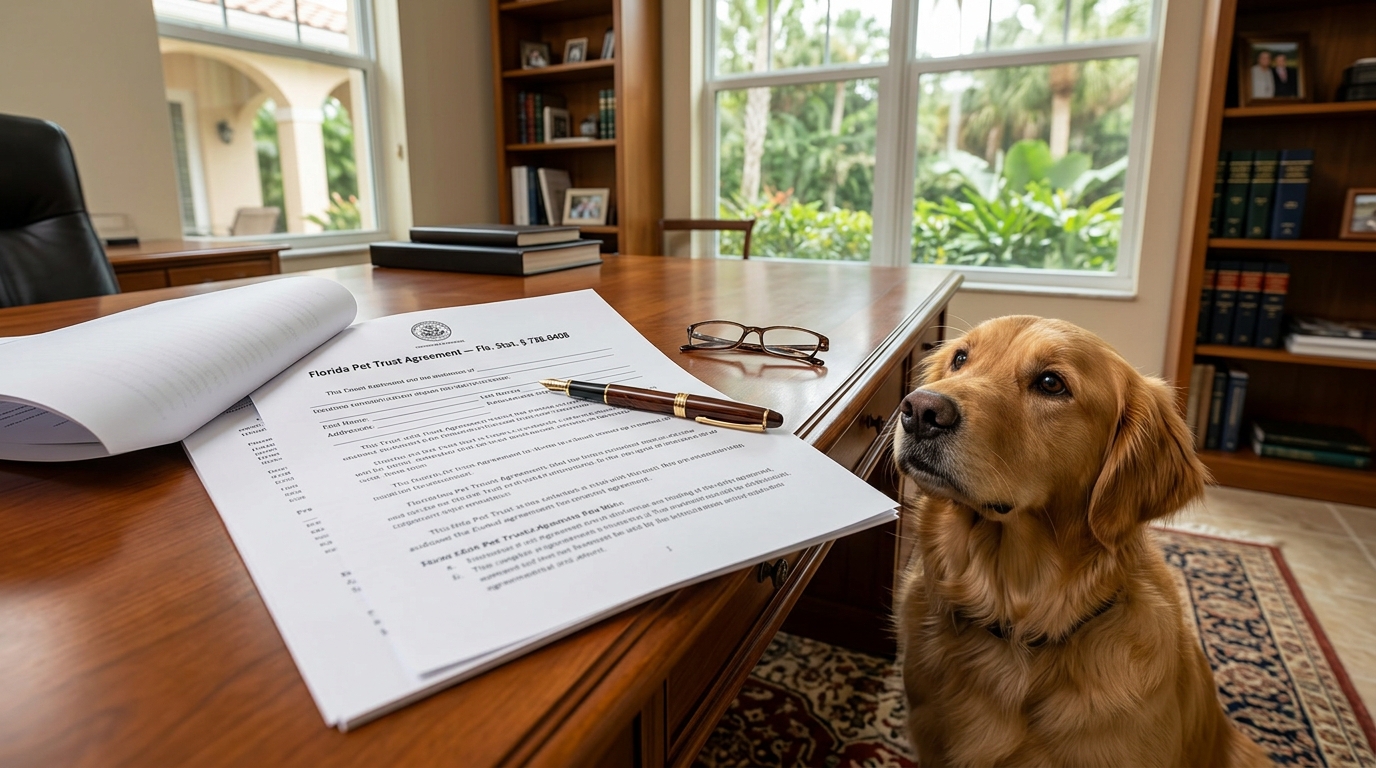
Setting up a pet trust in Coral Springs is one of the most effective ways for pet owners to ensure their companions receive lifelong care if they are ever orphaned or separated due to illness or incapacity.
Many pet parents assume that simply leaving a verbal instruction or naming a pet in a traditional Will is enough. However, under Florida law, animals are legally classified as personal property. A simple Will provisions money to a person with the hope they care for the pet, but it offers zero legal oversight.
By contrast, a Florida Pet Trust created under Fla. Stat. § 736.0408 creates a legally binding fiduciary obligation that protects your funds and ensures your precise instructions for food, shelter, veterinary care, and daily routines are strictly followed.
How Florida Pet Trusts Work (Fla. Stat. § 736.0408)
Florida was among the pioneering states to formally codify pet trust protections. Under Florida Trust Code, a trust created for the care of an animal living during the settlor’s lifetime is valid and legally enforceable.
The statutory framework provides three critical guarantees:
- Duration: The trust continues until the death of the last surviving animal covered by the trust agreement.
- Fund Protection:Caregivers must spend trust funds exclusively on the designated animals, preventing any personal misuse.
- Court Oversight: If the trustee or caregiver fails to perform their duties, a Florida court can appoint an enforcer or replace the trustee to safeguard the animal.
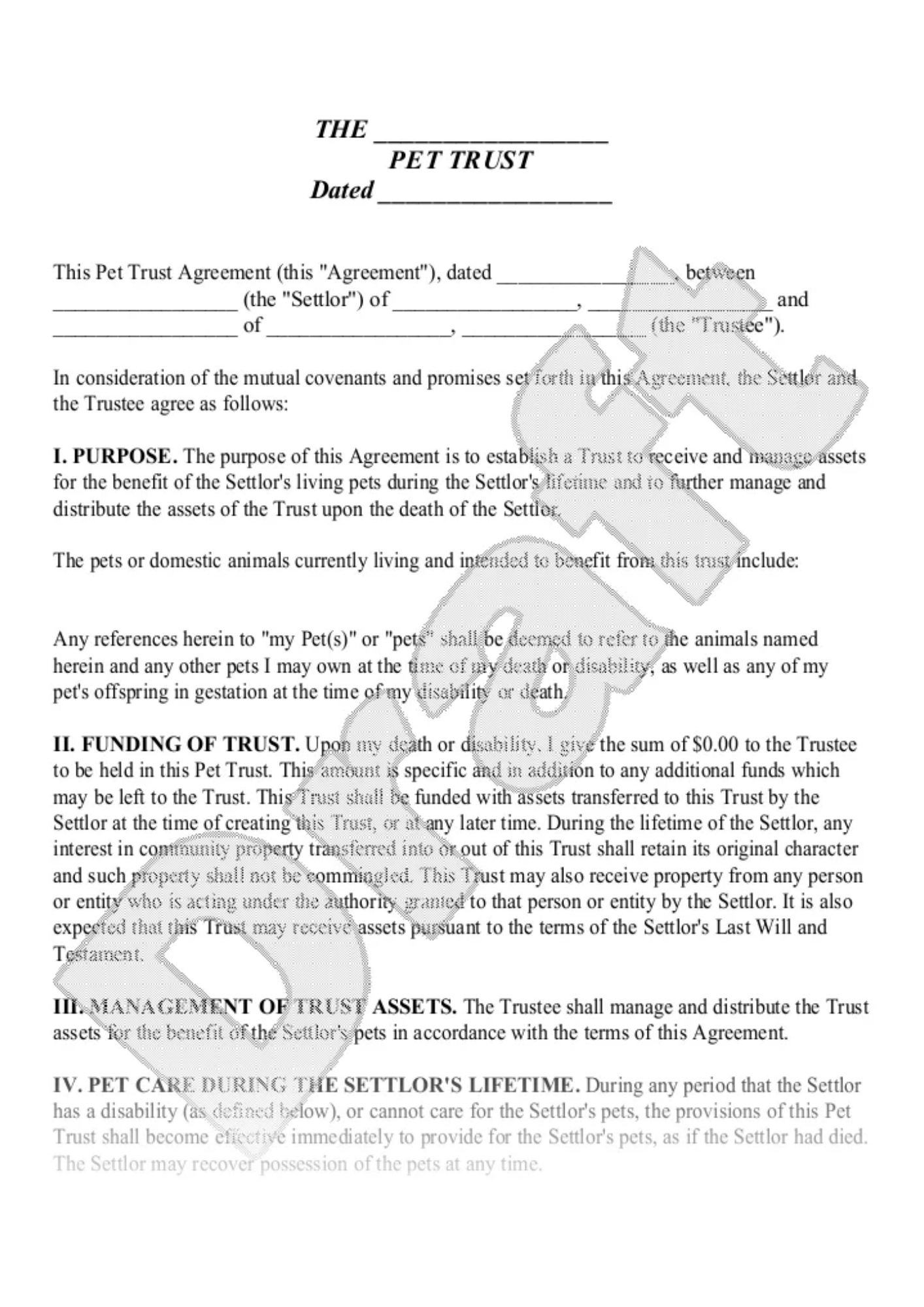
3 Essential Elements of a Florida Pet Trust
1. Choosing the Right Caregiver (and Alternates)
Your designated caregiver steps directly into your shoes as a surrogate parent to your animals. Because caring for a pet requires continuous commitment, select someone who shares your values regarding animal care.
- Critical Step: Always name at least one alternate caregiver. If your primary choice is unable or unwilling to assume responsibility when the time comes, the court will appoint a replacement if no backup is specified in the trust agreement.
2. Appointing an Independent Trustee
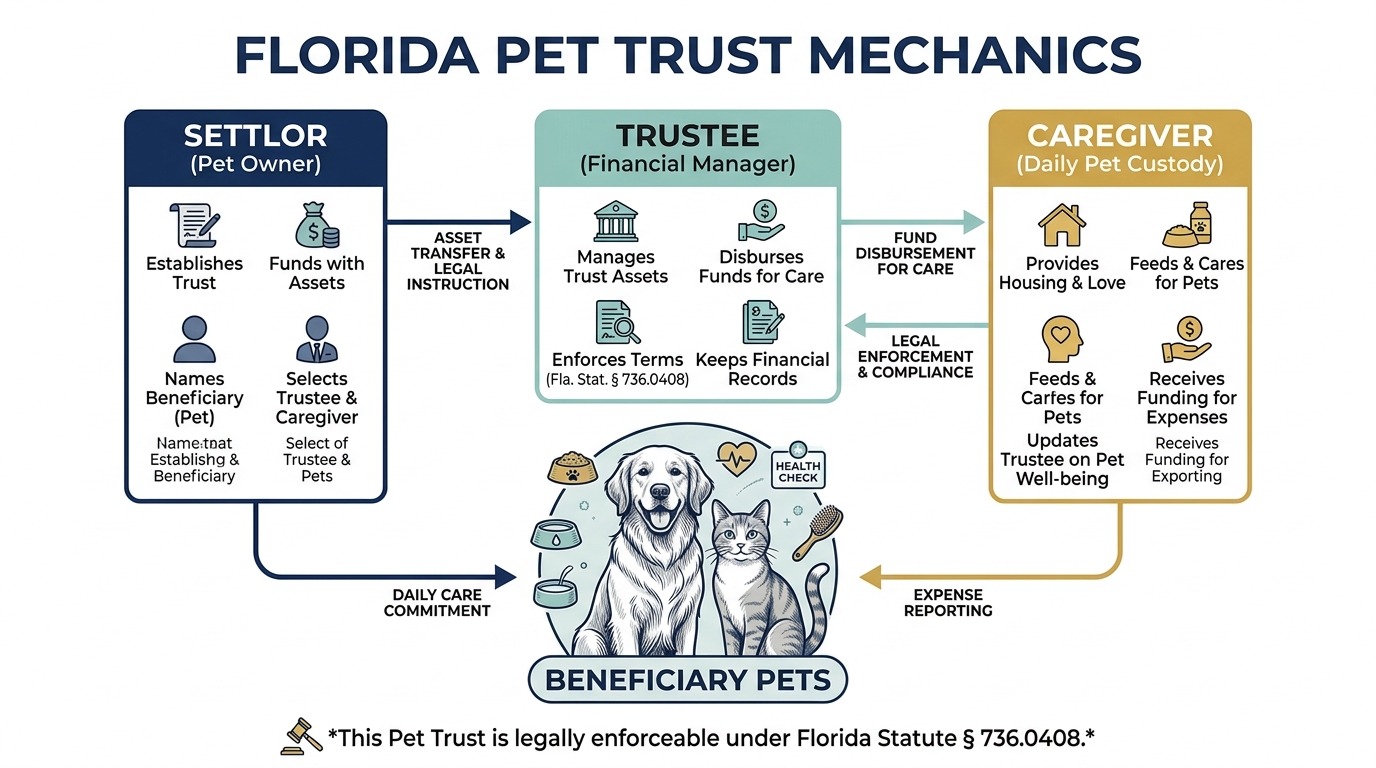
A pet trust divides responsibilities between two distinct roles:
- The Caregiver: Provides physical day-to-day care, food, housing, and attention.
- The Trustee: Holds and manages the trust funds, distributing money to the caregiver upon receiving receipts or budget requests for pet expenses.
Separating the role of trustee and caregiver establishes an essential checks-and-balances system. The trustee monitors the caregiver to ensure proper care and approves expenses solely for the pet’s welfare.
3. Calculating Funding Needs
Determining how much money to dedicate to a pet trust depends on several individual factors:
- Life Expectancy & Species: Calculating lifetime care costs varies significantly between a senior dog, a young cat, or long-lived exotics like parrots or tortoises.
- Standard of Living: Include allowance for premium nutrition, grooming, pet insurance, boarding, recreational activities, and routine health maintenance.
- Veterinary Budget: Account for potential chronic conditions, surgeries, and emergency veterinary care as your pet ages.
┌─────────────────────────────────────────────────────────────────────────┐
│                      FLORIDA PET TRUST STRUCTURE                        │
├─────────────────────────────────────────────────────────────────────────┤
│                                SETTLOR                                  │
│                   (Pet Owner creates trust agreement)                   │
│                                   │                                     │
│               ┌───────────────────┴───────────────────┐                 │
│               ▼                                       ▼                 │
│            TRUSTEE                                CAREGIVER             │
│   (Manages funds & releases             (Provides daily housing,        │
│    payments upon verification)           veterinary care & love)        │
│               │                                       │                 │
│               └───────────────────┬───────────────────┘                 │
│                                   ▼                                     │
│                            PET BENEFICIARY                              │
│                 (Protected under Fla. Stat. § 736.0408)                 │
└─────────────────────────────────────────────────────────────────────────┘
How to Set Up a Florida Pet Trust: A Step-by-Step Checklist
Establishing a legally binding pet trust under Fla. Stat. § 736.0408 requires careful planning to ensure the document withstands judicial scrutiny and provides immediate protection. Below is the complete roadmap utilized by estate planning attorneys in South Florida:
1. Detail Daily Care Standards & Pet Identifiers:
Avoid ambiguity regarding pet identity and care requirements.
As a result, you must document your pet’s precise profile, including microchip numbers, veterinary records, dietary restrictions, preferred medical providers, and end-of-life care preferences.. Specifying these details prevents potential disputes regarding the pet’s identity or standard of living.
2. Structure the Financial Model & Funding Mechanism:
Calculate lifetime costs and select an appropriate funding vehicle.
Determine total funding by multiplying estimated annual care expenses (food, grooming, routine/emergency veterinary care, boarding) by your pet’s maximum remaining life expectancy. Next, decide whether to fund the trust immediately (inter vivos) or upon death via a pour-over Will, life insurance policy, or transfer-on-death financial account.
3. Appoint Fiduciaries & Enforcement Roles:
Separate operational duties to establish checks and balances.
Designate a Caregiver for daily custody, a Trustee to manage distributions and audit receipts, and an optional Trust Enforcer (under Fla. Stat. § 736.0408(2)) who holds legal standing to petition the 17th Judicial Circuit Court if the trustee or caregiver fails to meet statutory standards.
4. Execute in Accordance with Florida Trust Formalities:
Ensure compliance with legal signature and notarization standards.
To ensure full legal validity under the Florida Trust Code, the trust agreement must be signed by the settlor in the presence of two attesting witnesses and a Florida Notary Public, adhering to execution standards similar to those for testamentary instruments.
Frequently Asked Questions
Why isn’t leaving my pet to someone in my Will enough in Florida?
- A Will only takes effect after probate court validation, which can take months. Furthermore, a Will cannot enforce ongoing behavior. Once a beneficiary inherits money designated for a pet via a Will, they have no statutory legal obligation to use those funds on the animal.
What happens to leftover money in the trust after my pet passes away?
- When drafting your trust, you name a remainder beneficiary. Once the last surviving animal covered by the trust passes, any remaining funds are distributed directly to your chosen heirs, family members, or a designated animal charity.
Can a court reduce the amount of money in a pet trust?
- Yes. Under Fla. Stat. § 736.0408(3), a Florida court may reduce the trust property if it determines that the amount substantially exceeds what is required for the animal’s care. Excess funds are then returned to the settlor or distributed to remainder beneficiaries.
Can a Florida Pet Trust cover pets born after the document is executed?
- Yes. Under Fla. Stat. § 736.0408(1), a pet trust can cover animals living at the time of the settlor’s death, including offspring born during the settlor’s lifetime or gestating at the time of passing.
What happens if the designated caregiver in Coral Springs moves out of state?
- A well-drafted pet trust specifies whether the pet may relocate out of Florida with the caregiver. Some also clear whether custody transfers to an alternate local caregiver in Broward County to keep the pet in its familiar environment.
Protect Every Member of Your Family
Your pets depend on you entirely. Incorporating a legally binding Pet Trust into your estate plan guarantees that your companions will never be left without housing. Also proper medical care, or affection.
Schedule Your Estate Planning & Trust Audit
- Office Locations: Coral Springs | Fort Lauderdale
- Direct Telephone: (954) 334-1520
- Email: Info@lawrct.com
- Website: mypersonalattorneys.com
- Local Practice Coverage: Coral Springs, Fort Lauderdale, Tamarac, Plantation, and Broward County