Florida Property Deeds & Titling: Choosing the Right Ownership Structure to Avoid Probate

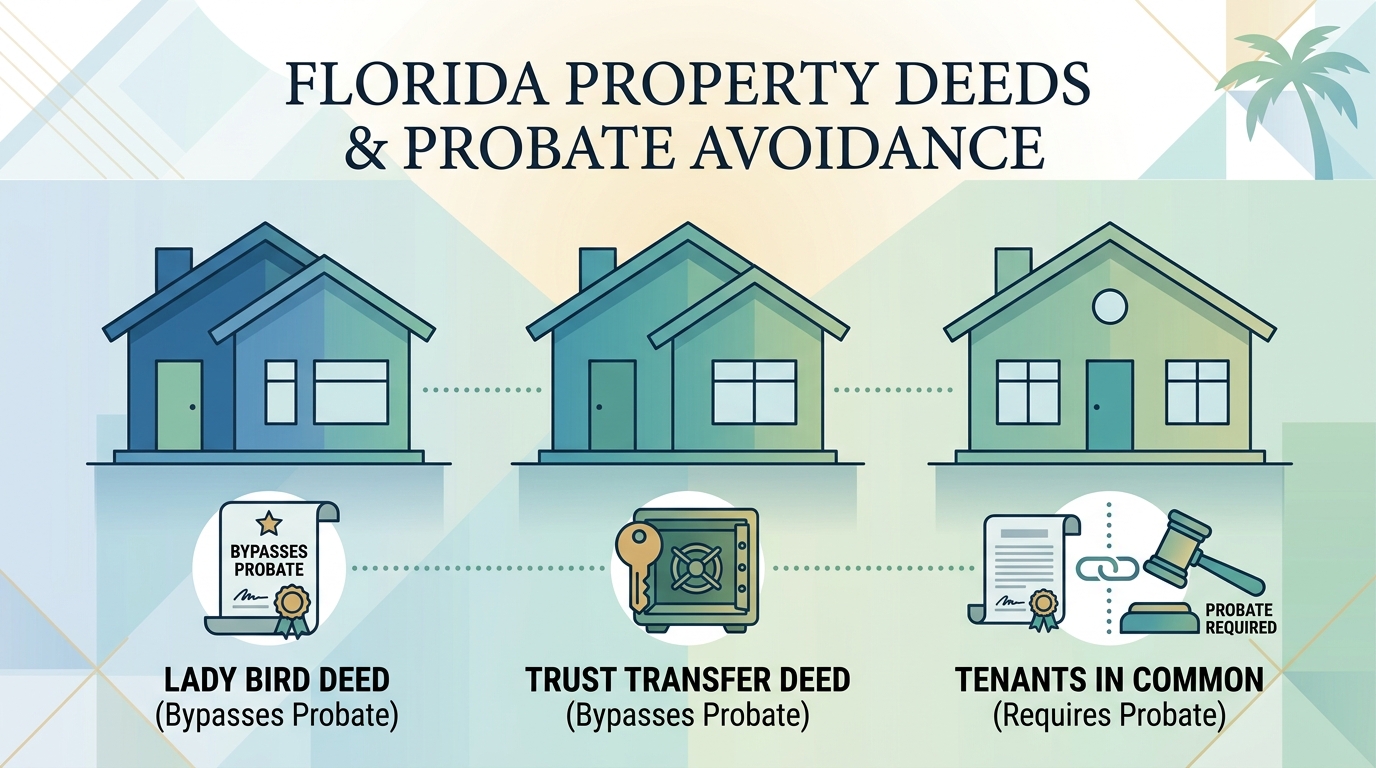
An illustrative visual guide comparing Florida property deeds including Lady Bird Deeds, Quitclaim Deeds, and Trust Transfer Deeds for probate avoidance.

The primary property deeds used in Florida estate planning are Warranty Deeds, Quitclaim Deeds, and Enhanced Life Estate Deeds (commonly called Lady Bird Deeds).

While a deed physically transfers legal title to real estate, the way ownership is titled determines a lot. For example – whether your home must pass through Broward County probate court or transfer automatically to your loved ones upon your death. Understanding the distinction between legal deeds and property titling structures is one of the most effective ways to protect real estate assets, minimize tax exposure, and prevent costly judicial delays for Florida families.


Deeds vs. Titling: Understanding the Fundamental Difference

To build an effective estate plan, it is critical to separate the transfer instrument from the form of ownership:

  • The Deed (The Vehicle): The legal document signed, executed, and recorded in the county public records to transfer real estate ownership from a grantor to a grantee.
  • The Titling / Ownership Form (The Rules): The specific statutory language. Written directly into the deed that dictates who holds ownership rights today. For example how liabilities are shared, and what happens to the property when an owner passes away.

Even a perfectly drafted Warranty Deed will fail to keep your home out of probate court if the underlying titling structure is misconfigured under Florida real estate law.


Comprehensive Comparison: Florida Property Deeds & Estate Planning Tools

Different real estate deeds serve distinct legal purposes during property transfers and estate planning:

Deed / Structure TypeProbate Avoidance?Owner Retains Lifetime Control?Primary Estate Planning & Legal Use Case
Lady Bird Deed (Enhanced Life Estate)YesYes (Can sell, mortgage, or revoke without consent)Passing a Florida primary homestead directly to named beneficiaries outside probate without sacrificing Medicaid eligibility or lifetime control.
Traditional Life Estate DeedYesNo (Requires remainder beneficiary consent to sell or refinance)Transferring property with irrevocable remainder rights. Rarely used in modern estate planning due to loss of owner flexibility.
Trust Transfer DeedYesYes (Managed seamlessly via Trustee)Conveying real estate into a Revocable Living Trust to coordinate complex, multi-property, or multi-state real estate holdings.
Quitclaim DeedNo (Unless combined with joint titling)YesTransferring property without title warranties, commonly between family members, during divorce settlements, or to clear title defects.
General / Special Warranty DeedNo (Unless combined with joint titling)YesStandard commercial or residential real estate purchases where the grantor guarantees clear title free of encumbrances.

The Power of the Florida Lady Bird Deed (Enhanced Life Estate)

In South Florida, the Enhanced Life Estate Deed—popularly known as a Lady Bird Deed—is one of the most powerful probate-avoidance tools available to homeowners.

Unlike a traditional life estate deed, which restricts the primary owner from selling or mortgaging the home without written permission from the named beneficiaries, a Lady Bird Deed allows you to maintain total lifetime control over the property:

  • Full Unilateral Control: You reserve the right to sell, gift, lease, or mortgage the property during your lifetime. You do not need to notify or obtain consent from the named remainder beneficiaries.
  • Automatic Post-Death Transfer: Upon your passing, full legal ownership automatically transfers to your named beneficiaries. This is done by recording a certified death certificate in the Broward County public records, completely bypassing probate court.
  • Preservation of Homestead Protections: A Lady Bird Deed maintains your Florida Constitutional Homestead tax exemptions (including the Save Our Homes cap). And it also keeps the property protected from general judgment creditors.
  • Medicaid Eligibility Protection: Because reserving an enhanced life estate is not considered an immediate gift or transfer of asset value under current Florida Medicaid rules, it generally does not trigger Medicaid penalty periods.

How Property Titling Controls Probate Under Florida Law

When two or more individuals hold title to Florida real estate, the specific legal language on the recorded deed dictates how ownership passes upon death:

                                 FLORIDA PROPERTY TITLING
                                            │
               ┌────────────────────────────┼────────────────────────────┐
               ▼                            ▼                            ▼
      Tenants in Common         Joint Tenants w/ Survivorship    Tenancy by the Entirety
   (Default for Unmarried)           (Unmarried Co-Owners)             (Married Couples)
               │                            │                            │
               ▼                            ▼                            ▼
       Requires Probate            Bypasses Probate             Bypasses Probate
  (Passes to Deceased's Estate)    (Passes to Surviving Owner)  (Passes to Surviving Spouse)

1. Tenancy by the Entirety (Married Couples)

Under Florida law (F.S. § 689.115), real property jointly acquired by a married couple is legally presumed to be held as Tenancy by the Entirety. Each spouse owns an undivided 100% interest in the entire property. Upon the death of one spouse, full title automatically vests in the surviving spouse outside of probate. Additionally, this form of titling provides strong creditor protection against debt obligations incurred by only one spouse.

2. Joint Tenants with Right of Survivorship (JTWROS)

Frequently used by unmarried co-owners, adult siblings, or parents and children, Joint Tenants with Right of Survivorship explicitly mandates that when one joint owner dies, their ownership share automatically absorbs into the surviving owner’s share. This transfer occurs outside of probate court. However, adding non-spouse co-owners exposes the property to the joint owner’s personal financial liabilities, tax liens, or lawsuits.

3. Tenants in Common (TIC)

Tenants in Common is the default legal ownership structure for unmarried co-owners in Florida unless the deed explicitly specifies otherwise. Each co-owner holds a distinct, separate fractional percentage of the property. When a Tenant in Common dies, their ownership percentage does NOT pass to the surviving co-owner—it becomes part of the deceased person’s probate estate and must be distributed through court according to their Will or Florida’s intestate laws.


Pitfalls of DIY Deed Transfers & Co-Ownership

While deeding real estate directly to family members may seem like a quick alternative to formal estate planning, self-drafted quitclaim deeds frequently cause severe financial and legal consequences:

  1. Title Defects & Clouded Titles: Missing marital status disclosures, incorrect legal descriptions, or improper witness attestations can cloud the title, preventing future sales or requiring costly quiet title lawsuits.
  2. Unintended Tax Consequences: Gifting real estate during your lifetime through a standard quitclaim deed causes the beneficiary to inherit your original tax cost basis. Conversely, inheriting property upon death via a Lady Bird Deed or Trust provides a step-up in cost basis, drastically reducing capital gains taxes when sold.
  3. Creditor & Divorce Exposure: Adding an adult child to your deed gives their creditors, judgment holders, or divorcing spouse a legal claim against your home.
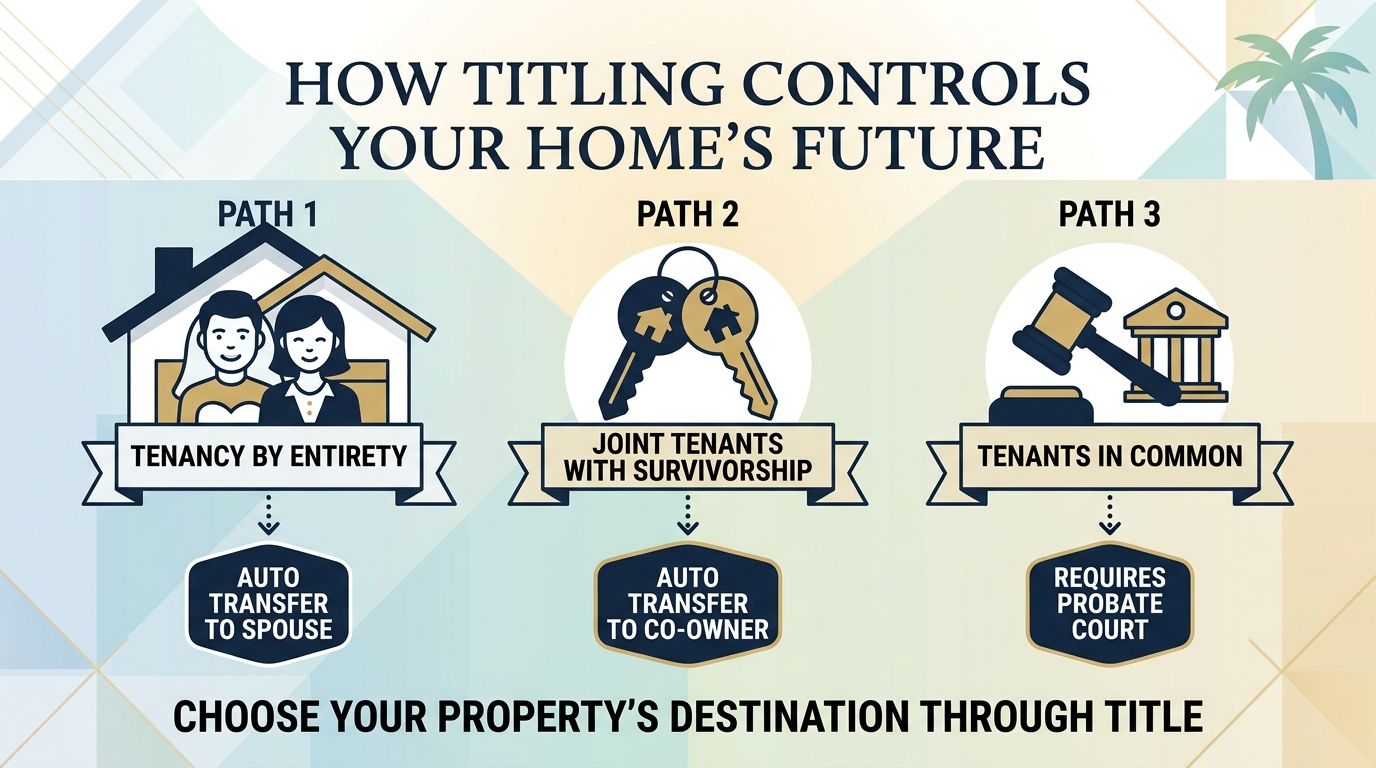
An infographic diagram explaining how property titling structures like Joint Tenants with Right of Survivorship and Tenancy by the Entirety impact probate under Florida law.

Don’t Let an Outdated Deed Dictate Your Family’s Future

A single unreviewed property deed can trigger months of unexpected probate court proceedings, cloud your title, or expose your home to unnecessary tax liabilities. Whether you need to draft an Enhanced Life Estate (Lady Bird) Deed, transfer real estate into a Revocable Living Trust, or audit an existing deed after marriage or divorce, taking action now prevents costly legal disputes later.

Schedule a Property Deed & Titling Audit

Ensure your real estate title is structured to pass seamlessly outside of probate court. Contact Reinfeld Cabrera PA today to review your property deeds with our South Florida legal team.

  • Coral Springs Office: 9625 W. Sample Rd, Coral Springs, FL 33065
  • Direct Line: (954) 866-4878 | Toll-Free: 954-866-HURT
  • Local Practice Coverage: Coral Springs, Fort Lauderdale, Parkland, Tamarac, Margate, and Broward County

Frequently Asked Questions

What is a Florida Lady Bird Deed, and why is it popular in estate planning?

  • An Enhanced Life Estate Deed (Lady Bird Deed) allows a property owner to retain full lifetime control over their property—including the right to sell, mortgage, or revoke the deed—while naming a beneficiary who automatically inherits the real estate upon the owner’s death without probate court involvement.

Does adding my adult child to my deed avoid probate in Florida?

  • Adding an adult child as a Joint Tenant with Right of Survivorship can avoid probate, but it carries significant risk. It subjects your primary residence to your child’s creditors, financial judgments, bankruptcy proceedings, or marital disputes during your lifetime. Utilizing a Revocable Living Trust or Lady Bird Deed is generally a far safer legal alternative.

Do I need to update my deed after getting married or divorced?

  • Yes. Under Florida law, a final decree of divorce automatically converts property held as Tenancy by the Entirety into a Tenants in Common arrangement. Without an updated deed or property settlement agreement, your ex-spouse’s share will no longer pass automatically to you upon death, requiring court probate to settle.

Can I transfer Florida homestead property into a Revocable Living Trust?

  • Yes. Florida homestead real estate can be transferred into a properly drafted Revocable Living Trust without losing homestead tax exemptions or Save Our Homes caps, provided the trust agreement preserves your legal right to reside on the property during your lifetime.

What is the difference between a Quitclaim Deed and a Warranty Deed in Florida?

  • A Warranty Deed provides formal legal guarantees that the grantor holds clear, marketable title free of undisclosed liens or encumbrances. A Quitclaim Deed simply transfers whatever ownership interest the grantor currently holds without any guarantees regarding title quality.
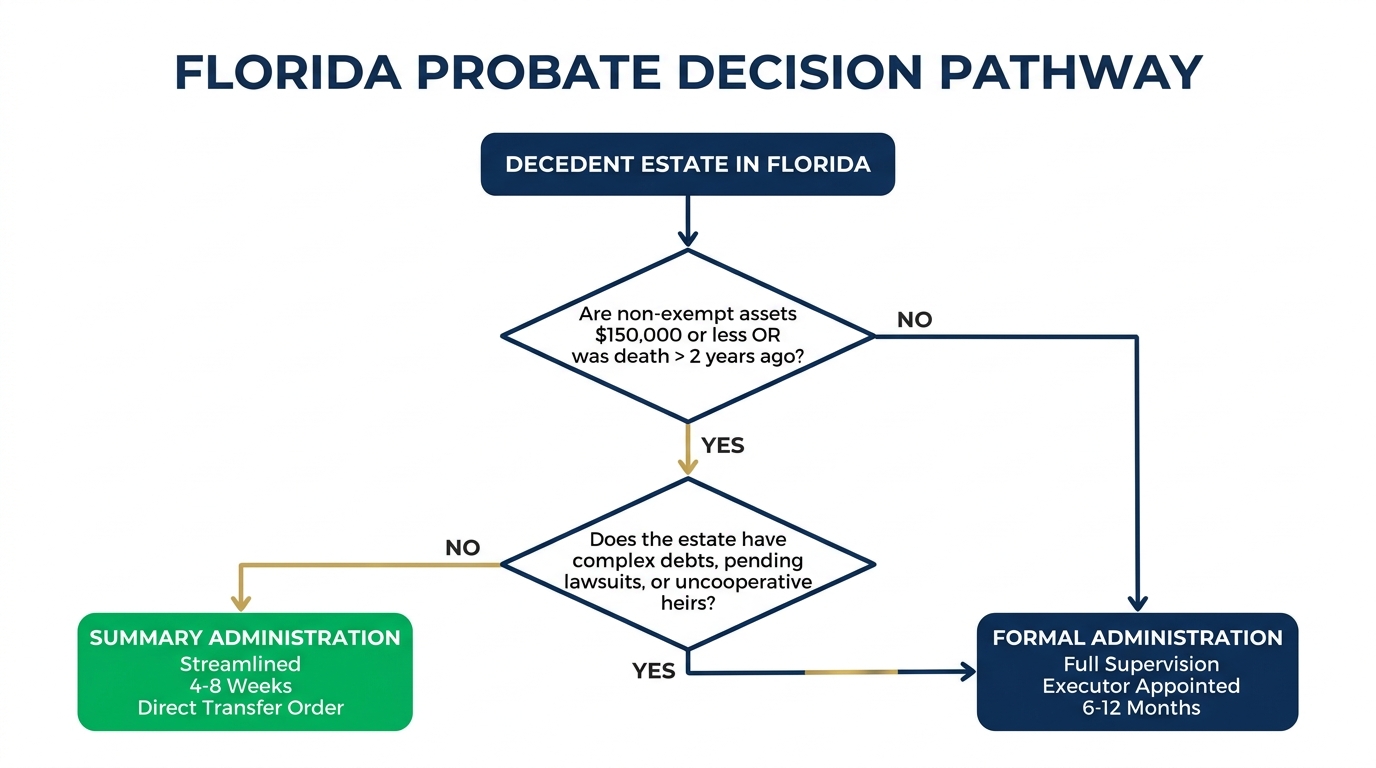
Florida Probate: Summary Administration vs. Formal Administration Explained

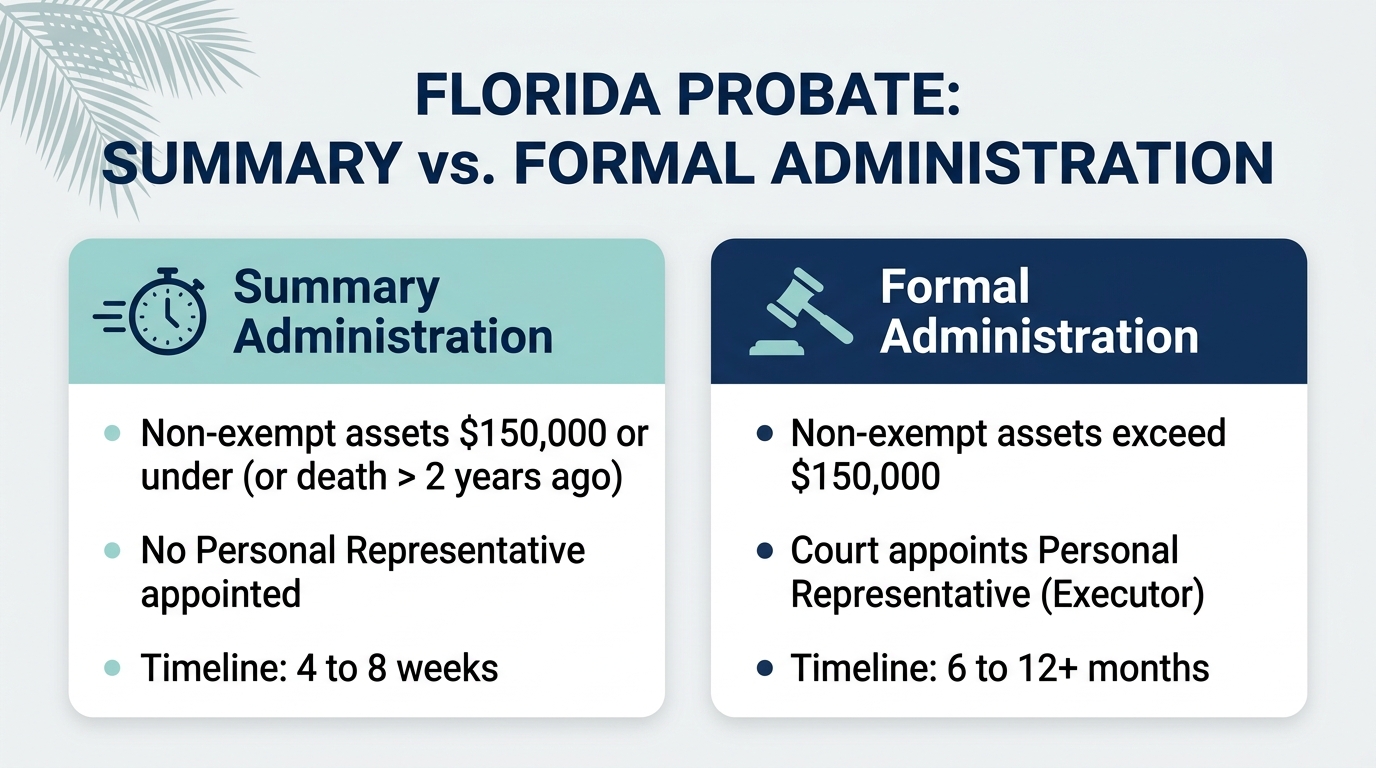
An infographic comparing Florida Summary Administration and Formal Administration eligibility rules, $150,000 asset limits, and court timelines under Florida probate law.

In Florida, court-supervised probate is divided into two primary procedures: Summary Administration (an expedited process for smaller or older estates) and Formal Administration (the traditional, fully supervised court process).

Whether an estate qualifies for Summary Administration depends on the total net value of non-exempt probate assets, whether the decedent has been deceased for over two years, and the complexity of outstanding creditor claims under Florida probate law (Fla. Stat. § 735.201). Understanding how these two probate paths function ensures that South Florida beneficiaries receive their inheritance as quickly and cost-effectively as possible.


Summary vs. Formal Administration at a Glance

Qualification & Process FeatureSummary Administration (Fla. Stat. § 735.201)Formal Administration (Florida Probate Rules)
Estate Value ThresholdNon-exempt probate assets are $150,000 or less (for deaths on/after July 1, 2026), OR the decedent has been deceased for over 2 years.Required for estates exceeding $150,000 in non-exempt probate assets (if death occurred within 2 years).
Personal RepresentativeNot appointed. No Letters of Administration are issued by the court.Required. Court officially appoints a Personal Representative (Executor) with fiduciary authority.
Average Timeline4 to 8 weeks (subject to Broward County court docket schedules).6 to 12+ months (includes mandatory 90-day newspaper creditor notice period).
Creditor Claims ProcessCreditors must be resolved or served prior to distribution; or barred if death occurred over 2 years ago.Formal 3-month Notice to Creditors published in local media to legally bar future claims.
Primary Judicial OrderOrder Summary Administration directly transfers legal title of assets to beneficiaries.Letters of Administration issued at inception; Order of Discharge issued at estate closing.

When Does Summary Administration Apply in Florida?

Summary Administration is an expedited judicial procedure designed to transfer title to beneficiaries without opening a full probate estate. However – to qualify under Florida law, the estate must satisfy one of two statutory criteria:

  1. The $150,000 Net Asset Test: Effective July 1, 2026, Florida increased the summary administration statutory limit. The total value of all assets subject to probate—excluding protected Florida Constitutional Homestead real estate and statutory exempt personal property—does not exceed $150,000 (for deaths on or after July 1, 2026; $75,000 for deaths prior to July 1, 2026).
  2. The Two-Year Rule: The decedent has been deceased for more than two years, regardless of the overall financial value of the estate. Under Fla. Stat. § 733.710, two years establishes a non-claim statute of repose that automatically bars unfiled creditor claims.

Key Distinction: No Personal Representative Appointed

In Summary Administration, the court does not appoint a Personal Representative and does not issue Letters of Administration. Instead, a petition is submitted asking the judge to issue a direct order transferring specific assets (such as a bank account or vehicle) directly to named beneficiaries.

If an estate requires active ongoing legal authority—such as accessing restricted medical records, pursuing a wrongful death lawsuit, or negotiating complex business debts—Formal Administration must be opened regardless of total asset value.


When Is Formal Administration Mandatory?

Formal Administration is the comprehensive, fully supervised probate process in Florida. It is mandatory when:

  • Non-exempt probate assets exceed $150,000 and the decedent passed away within the last two years.
  • The decedent’s Last Will and Testament explicitly mandates formal probate administration.
  • The estate involves disputed creditor claims, contested wills, or missing heirs.
  • Real estate must be actively listed, marketed, and sold during probate, requiring an appointed Personal Representative to sign legal contracts and closing documents.

                           FLORIDA PROBATE DECISION PATH
                                         │
                    Is the non-exempt probate value under $150k
                    OR has the decedent been deceased > 2 years?
                                         │
                   ┌─────────────────────┴─────────────────────┐
                   ▼                                           ▼
                 YES                                           NO
                   │                                           │
         Are there complex debts,                              │
        disputes, or land sales                                │
         requiring an Executor?                                │
           ┌───────┴───────┐                                   │
           ▼               ▼                                   ▼
          YES              NO                        FORMAL ADMINISTRATION
           │               │                        (Full Court Process,
           │               ▼                        Personal Rep Appointed,
           │     SUMMARY ADMINISTRATION             6-12 Month Duration)
           │    (Expedited, 4-8 Weeks,
           │    Order Directly Transfers)
           └───────────────────────────────────────────────────┘

What About Very Small Estates? (Disposition Without Administration)

For extremely modest estates where the decedent left no real estate, Florida offers an informal non-probate process under Fla. Stat. § 735.301 known as Disposition of Personal Property Without Administration.

This simplified filing is available only when remaining non-exempt personal property does not exceed the total sum of preferred funeral expenses and necessary medical bills incurred during the last 60 days of the decedent’s final illness.


Strategic Risk Factors: Creditor Exposure & Multi-State Assets

Selecting between Summary and Formal Administration involves critical legal trade-offs beyond estate size:

1. The Post-Probate Creditor Exposure Risk

Under Fla. Stat. § 735.206, Summary Administration directly distributes assets to beneficiaries without opening a mandatory 90-day newspaper creditor publication window.

If a petition is filed before the two-year non-claim period expires (Fla. Stat. § 733.710), beneficiaries remain personally liable to valid estate creditors up to the full value of the property received. If unknown debts emerge post-distribution, Formal Administration is often safer because publishing a statutory Notice to Creditors permanently cuts off future claims after 90 days.


┌─────────────────────────────────────────────────────────────────────────┐
│                    CREDITOR PROTECTION COMPARISON                       │
├───────────────────────────────────┬─────────────────────────────────────┤
│      SUMMARY ADMINISTRATION       │        FORMAL ADMINISTRATION        │
├───────────────────────────────────┼─────────────────────────────────────┤
│ • No mandatory newspaper notice   │ • Formal 90-day Notice published    │
│ • Beneficiaries personally liable │ • Unfiled claims permanently barred │
│   to creditors (up to asset value)│ • Clean liability shield for heirs  │
│ • Exposure lasts up to 2 years    │ • Full judicial closure of claims   │
└───────────────────────────────────┴─────────────────────────────────────┘
A flowchart diagram illustrating how to determine whether a Florida estate qualifies for Summary Administration or requires Formal Administration.

2. Ancillary Administration for Out-of-State Residents

When a non-Florida resident dies owning real estate in Broward County or anywhere in South Florida, the home cannot be transferred by an out-of-state court order. An Ancillary Probate proceeding (Fla. Stat. § 734.102) must be opened in Florida. Depending on the non-exempt Florida land value, Ancillary proceedings can be conducted as either Summary or Formal Administration.


Frequently Asked Questions

Does Florida Homestead Property count toward the $150,000 Summary Administration limit?

  • No. Protected Florida Constitutional Homestead property passes outside the general claims of creditors and is excluded when calculating the $150,000 threshold for Summary Administration, provided a formal Petition to Determine Homestead Status is filed alongside the summary petition.

What is the 10-day Will Deposit Rule in Florida?

  • Under Fla. Stat. § 732.901, whoever holds the decedent’s original Last Will and Testament must deposit it with the Clerk of the Circuit Court in the county where the decedent resided within 10 days of receiving notice of death, regardless of whether formal probate will be opened.

What is the current Florida Summary Administration asset threshold?

  • Effective July 1, 2026 (Fla. Stat. § 735.201), the Florida Legislature increased the non-exempt probate asset threshold for Summary Administration from $75,000 to $150,000 for deaths occurring on or after July 1, 2026 (or where the decedent has been deceased for more than 2 years). Protected homestead property continues to be excluded from this calculation.

How long does Formal Administration take in Broward County?

  • A routine, uncontested Formal Administration in Broward County typically takes between 6 and 12 months. This timeframe accommodates publishing the mandatory Notice to Creditors, observing the 90-day statutory creditor claim window, marshaling asset inventories, preparing tax accountings, and securing final court discharge.

Can a summary administration be converted to a formal administration if a dispute arises?

  • Yes. If unexpected creditor claims emerge, beneficiaries dispute asset distribution, or unknown assets are uncovered that push the estate over $150,000, any interested party or petitioner can motion the court to convert the summary proceeding into a Formal Administration.

Do I need a probate attorney for Summary Administration in Broward County?

  • While Florida law technically permits self-representation in Summary Administration when no Personal Representative is appointed, court clerk offices cannot provide legal advice. Drafting accurate petitions, verifying homestead status, and coordinating creditor searches require specialized legal guidance to avoid judicial rejection.

Don’t Let an Outdated Deed Dictate Your Family’s Future

Choosing the correct probate pathway prevents costly administrative delays, court rejections, and personal liability for estate debts. Whether your family qualifies for an expedited Summary Administration or requires full Formal Administration in South Florida, taking action with experienced legal counsel guarantees that every asset is protected.

Schedule a Property Deed & Titling Audit

Ensure your real estate title and probate strategy are structured to pass seamlessly outside of or through probate court. Contact the attorneys at Reinfeld & Cabrera, P.A. today to review your estate and property deeds with our South Florida legal team.

  • Office Locations: Coral Springs | Fort Lauderdale | Plantation
  • Direct Telephone: (954) 334-1520
  • Email: Info@lawrct.com
  • Website: mypersonalattorneys.com
  • Local Practice Coverage: Coral Springs, Fort Lauderdale, Tamarac, Plantation, and Broward County

When Should a Business Consider Commercial Litigation in Florida?

Commercial-Litigation

Before you have a complicated commercial dispute arise, you need to have the commercial litigation attorneys from Reinfeld & Cabrera’s Coral Springs office on your side. We will represent your interests in the courtroom, if necessary, or even during negotiations. Most litigation can be headed off by having your commercial contracts properly reviewed before signing them.

We are experienced commercial litigation attorneys and we will deliver a comprehensive approach to representing you, even in the most complex commercial issues. In today’s competitive business world, you need commercial litigation attorneys who will protect your rights and interests, and you will find us in our Coral Springs office.

You don’t want to be caught in a business dispute without having commercial litigation attorneys to represent you. Reinfeld & Cabrera’s Coral Springs office attorneys will make sure they contribute to your company’s success by providing sound and beneficial advice, guiding you through Florida’s commercial and business laws.

Whether you are looking to form a business partnership or limited liability, or draft partnership, shareholder, or operating agreements, our commercial litigation attorneys in Coral Springs will bring their knowledge and experience to the table. We can also help you with collections of account receivables, any breaches of contract, contract negotiation and preparation and sales disputes and litigations.

We have experience representing all sized business, so it does not matter if you are a new start-up or a well-established multinational corporation, our commercial litigation attorneys in Coral Springs will be able to provide appropriate and valuable counsel.

So whether you are an entrepreneur looking to establish and build your company, or need help resolving a commercial dispute involving your already established company, we are the commercial litigation attorneys for you.

Commercial litigation in Florida may be necessary when a business suffers a significant breach of contract, faces an unresolved ownership dispute, or needs court intervention to protect its legal rights. Before filing a lawsuit, business owners should assess whether litigation is justified by examining:

  • The legal claim: Whether the other party breached an enforceable agreement or violated a legally protected right.
  • The available evidence: Whether contracts, financial records, and communications support the claim.
  • The potential recovery: Whether the damages a business can reasonably recover justify the expense of litigation.
  • The available alternatives: Whether negotiation, mediation, or another dispute-resolution process could achieve a satisfactory result.
  • The applicable deadlines: Whether the claim can still be filed within the relevant statute of limitations.

For businesses in Coral Springs and Broward County, evaluating these factors early can help prevent avoidable legal expenses and protect business interests. A commercial litigation attorney can assess the circumstances and explain which legal options may be appropriate.


When Should a Business Consider Commercial Litigation in Florida? 

A business should consider commercial litigation in Florida when a serious dispute cannot be resolved through negotiation and legal action may be necessary to enforce its rights or recover losses. Before filing a lawsuit, business owners should evaluate several factors:

  • Legal grounds: Does the dispute involve a potential breach of contract, a business ownership conflict, or another actionable claim?
  • Evidence: Can contracts, financial records, and communications substantiate the claim?
  • Financial exposure: Is the potential recovery sufficient to justify the cost and uncertainty of litigation?
  • Alternative solutions: Could negotiation, mediation, or arbitration resolve the dispute more efficiently?
  • Filing deadlines: Is there still time to bring the claim under the applicable Florida statute of limitations?

For businesses in Coral Springs and Broward County, evaluating these factors early can help protect commercial interests and prevent avoidable legal expenses. A commercial litigation attorney can assess the circumstances and explain which legal options may be appropriate.


Why Commercial Litigation Matters to Small Businesses

The financial stakes of business litigation deserve serious attention. A legal dispute can consume resources that a smaller company needs for payroll, inventory, or daily operations. Poor decisions before filing a claim can make the situation worse.

A January 2024 report from the U.S. Chamber of Commerce’s Institute for Legal Reform estimated that U.S. commercial liability costs reached $347 billion in 2021. Small businesses bore approximately $160 billion of that amount. The report also estimated that, relative to revenue, these costs were seven times greater for businesses earning $1 million or less annually than for businesses earning at least $50 million.

Source: U.S. Chamber of Commerce, The U.S. Lawsuit System Costs America’s Small Businesses $160 Billion.


A separate report published in November 2024 estimated that the U.S. tort system accounted for $529 billion in costs and compensation during 2022. For Florida, the report estimated total tort costs of approximately $48.18 billion. It also reported average annual tort-cost growth of 8.7% for business cases nationwide between 2016 and 2022.

Source: U.S. Chamber of Commerce, The Hidden Costs of Lawsuits Continue to Grow.

These figures require an important distinction. Both reports examine tort-related costs, which are not equivalent to the cost of ordinary commercial contract litigation. They do not establish what a particular business lawsuit will cost or how often a contract dispute ends in court. The figures nevertheless illustrate the broader financial exposure that legal disputes can create for businesses.

For a company in Coral Springs, the practical lesson is to assess a potential claim carefully before spending heavily on litigation. A strong legal position matters, but the likely recovery must justify the expense and uncertainty of pursuing it.


When Should a Business Consider Commercial Litigation?

The decision to file a commercial lawsuit depends on the nature of the dispute and the available legal remedies. Several situations may justify a closer assessment by a commercial litigation attorney.


1. A Contractual Breach Has Caused Substantial Losses

A breach of contract occurs when a party fails to perform an obligation required by an enforceable agreement, without a valid legal excuse. Examples include a supplier refusing to deliver goods, a contractor abandoning agreed work, or a customer failing to pay for completed services.

The existence of a disagreement does not automatically establish a breach. The agreement’s language matters, as do any conditions that had to be satisfied before performance became due.

A business considering litigation should identify the specific contractual obligation at issue. It should then assess whether the other party failed to meet that obligation and what losses can be supported by evidence.

Case example: Chetu, Inc. v. CA Short Company (2026)

In this case, the Fourth District Court of Appeal considered a software services contract that expressly excluded certain categories of damages. After the software provider stopped performing, the customer incurred costs to complete the project using other programmers. Although the trial court awarded those replacement costs, the appellate court reversed the $95,505.42 award because the contract barred the consequential damages at issue.

The decision demonstrates why businesses should review limitation-of-liability clauses before signing an agreement and again when a dispute arises. A company may suffer genuine financial losses yet remain unable to recover particular categories of damages because of its contract.

Read the decision: Chetu, Inc. v. CA Short Company, No. 4D2024-2977 (Fla. 4th DCA Apr. 1, 2026).


2. A Business Partnership Dispute Has Become Unmanageable

Disagreements between business owners can become difficult to resolve when the parties disagree over financial obligations or control of the company. A dispute may involve access to business records, the distribution of profits, or the interpretation of an operating agreement.

Some disagreements can be resolved through negotiation or mediation. Litigation may become necessary when one party refuses to honor an enforceable agreement or when court intervention is needed to determine legal rights.

Case example: McDowell v. Moore (2026)

The Fourth District Court of Appeal reviewed a dispute involving the compensation arrangements of a former owner of a water sports business. The parties had discussed commission payments, but they never finalized a specific commission schedule. The court’s decision addressed the enforceability of the compensation arrangement in the context of the broader business relationship.

The case illustrates the risks of leaving essential financial terms unresolved. An agreement may describe the parties’ intentions without providing a sufficiently definite basis for enforcing a particular payment obligation.

Read the decision: McDowell v. Moore, No. 4D2023-2783 (Fla. 4th DCA May 6, 2026).


3. Informal Negotiations Have Failed

Negotiation is often a sensible first step when a dispute arises. The parties may be able to agree on payment terms, revised performance obligations, or another solution without filing a lawsuit.

However, negotiation has limits. A business may need to consider litigation when the other party refuses to engage meaningfully or continues conduct that threatens its contractual rights.

Before filing, an attorney can evaluate the available evidence and determine whether a formal demand, mediation, arbitration, or court action is the most appropriate next step.

A demand letter can sometimes resolve a dispute before litigation begins. For a closer look at that option, see our article on how a demand letter can resolve business disputes without going to court.


4. A Business Needs Court Intervention

Some disputes involve rights or remedies that cannot be secured through an informal agreement alone. Depending on the facts and applicable law, a business may seek a court order, a determination of contractual rights, or monetary damages.

The appropriate remedy depends on the claim. A court will not automatically grant the relief a business requests simply because the relationship has deteriorated.

An attorney should evaluate the legal basis for the requested remedy before a company commits to a lawsuit. This assessment is particularly important when the dispute could affect business operations or involve substantial financial exposure.


What Should You Do Before Filing a Commercial Lawsuit?

Preparation can influence how effectively a business pursues its claim. Before filing a lawsuit in Broward County, business owners should consider the following steps.

Preserve Relevant Documents and Communications

Keep copies of the signed contract and any amendments. Emails, invoices, payment records, meeting notes, and messages may help establish what the parties agreed to do and whether either side failed to perform.

Avoid deleting relevant communications or altering business records after a dispute emerges. An attorney can explain which documents should be preserved and how to organize the evidence.

Review the Contract Carefully

The agreement may contain provisions governing dispute resolution, notice requirements, attorney’s fees, damages, or the location where a lawsuit must be filed.

These provisions can affect the available options. For example, a contract may require mediation or arbitration before a party can pursue other remedies. A limitation-of-liability clause may also restrict the damages available after a breach.

The terms should be reviewed in the context of the actual dispute rather than treated as boilerplate.


Calculate the Potential Financial Recovery

A business should estimate the losses it can reasonably establish rather than rely on its initial assessment of what the dispute has cost. Unpaid invoices, documented expenses, and other recoverable losses may be relevant, depending on the claim and applicable law.

The analysis should also account for legal fees, litigation expenses, the time required from employees or owners, and the possibility that the other party will be unable to pay a judgment.

A claim can have legal merit without being economically sensible to pursue in court.


Assess the Other Party’s Position

A business should consider the defenses the other party may raise. The opposing party might dispute the existence of an agreement or argue that it performed its obligations. It may also claim that the business failed to meet a contractual condition.

Identifying these issues early helps an attorney assess the strengths and weaknesses of the case. It can also clarify whether a negotiated resolution would be preferable to litigation.


Check the Applicable Deadline

Florida law imposes deadlines for filing civil claims. Under section 95.11 of the Florida Statutes, the general limitation period is five years for many actions founded on a written instrument and four years for many actions on contracts or obligations not founded on a written instrument. Exceptions and other rules can affect the applicable deadline.

The period may depend on the type of claim, the date the cause of action accrued, and other facts. Businesses should not assume that every contract dispute follows the same deadline.

Review Florida Statutes § 95.11.


Can a Business Resolve a Dispute Without Going to Court?

Yes. Litigation is one option, but it is not always the most effective way to resolve a commercial disagreement.

Negotiation allows the parties to communicate directly and explore a settlement. Mediation introduces a neutral third party who helps them work toward an agreement, although the mediator generally does not impose a decision. Arbitration involves submitting a dispute to an arbitrator for a decision under the applicable arbitration agreement and rules.

The best option depends on the contract and the nature of the conflict. A business should review any dispute-resolution clause before choosing a process.

Settlement also requires careful drafting. In Trace Elements, Inc. v. Mackensen (2026), the Florida Supreme Court held that a joint proposal for settlement must allocate the amount and terms attributable to each party under Florida Rule of Civil Procedure 1.442(c)(3). The ruling underscores the importance of following procedural requirements when a settlement proposal could affect a party’s entitlement to attorney’s fees.

Read the decision: Trace Elements, Inc. v. Mackensen, No. SC2024-1274 (Fla. July 2, 2026).

A settlement proposal should therefore be evaluated as a legal document, not merely as a figure offered to end a disagreement. Depending on the circumstances, the wording and structure of an offer can have consequences beyond the immediate negotiations.

For more information, read our related article on negotiation, mediation, and arbitration for Florida businesses.


How Can a Commercial Litigation Attorney Help?

A commercial litigation attorney can evaluate whether the facts support a legal claim and explain the remedies that may be available. The attorney can also review the contract, assess the evidence, and identify issues that could affect the outcome.

Legal guidance may be useful before a lawsuit is filed. Early review can help a business understand its position and avoid decisions that weaken its case.

If litigation becomes necessary, counsel can prepare the pleadings and develop a strategy for presenting the claim. The process may involve exchanging evidence, taking depositions, participating in mediation, or presenting the dispute at trial.

The appropriate strategy depends on the dispute. Some cases turn on the interpretation of a written agreement, while others require a closer examination of business records or witness testimony.


As Stuart Reinfeld explains:

“A business dispute should be evaluated in light of the agreement the parties actually made, the evidence available, and the remedy the law permits. Acting before those issues are clear can make an already difficult situation more expensive.”

The goal is to make informed decisions at each stage of the dispute. A lawsuit should serve a defined legal and business purpose rather than become an automatic response to a disagreement.


Commercial Litigation in Coral Springs and Broward County

Businesses in Coral Springs and throughout Broward County may face disputes involving unpaid contractual obligations, ownership disagreements, or failed commercial transactions. The appropriate response depends on the legal rights involved and the practical consequences of leaving the dispute unresolved.

An attorney familiar with commercial disputes can help assess the merits of a potential claim and explain the available routes to resolution. That assessment should account for the agreement’s terms, the evidence supporting the claim, and the financial implications of pursuing legal action.

Alan Reinfeld notes:

“The decision to pursue a business dispute should begin with a clear understanding of what went wrong and what a successful resolution would accomplish. The legal process is most useful when it serves a realistic objective.”

If your business is facing a commercial dispute in Coral Springs or elsewhere in Broward County, consider obtaining legal advice before taking steps that could affect your position.

Contact My Personal Attorneys to discuss your situation and determine what legal options may be available.


Frequently Asked Questions About Commercial Litigation in Florida


What is the most common reason for commercial litigation?

  • Contract disputes are a major category of commercial litigation. These cases can involve unpaid invoices, disagreements over performance, or disputes about the meaning of a contractual provision. The specific grounds for a lawsuit depend on the facts and applicable law.

How do I know whether my business should file a lawsuit?

  • Consider whether you have an enforceable legal claim and evidence supporting it. You should also assess the potential recovery against the expected cost of litigation. An attorney can help evaluate these issues before you decide how to proceed.

How long do I have to file a commercial lawsuit in Florida?

  • The deadline depends on the claim. Many actions founded on a written instrument have a five-year limitation period, while many actions on contracts not founded on a written instrument have a four-year period under Florida Statutes § 95.11. Exceptions may apply, so the deadline should be confirmed for the specific dispute.

Can a commercial dispute be resolved without litigation?

  • Yes. Negotiation or mediation may produce a settlement without a court proceeding. Arbitration may also be available or required under the contract. The appropriate process depends on the agreement and the parties’ willingness to resolve the matter.

What evidence is important in a commercial litigation case?

  • The relevant evidence depends on the dispute. A case may require the signed contract, invoices, payment records, emails, or other communications showing what the parties agreed to do. Financial records may also help establish the losses a business claims.

Can a business recover attorney’s fees in a commercial lawsuit?

  • Sometimes. Recovery may depend on a contractual provision, a statute, or another applicable legal basis. Florida’s offer-of-judgment framework can also affect attorney’s fees in qualifying cases, but its requirements must be satisfied. Businesses should not assume that the losing party will automatically have to pay the winner’s legal fees.

Should I send a demand letter before filing a lawsuit?

  • A demand letter may help explain the legal basis of a claim and give the other party an opportunity to resolve the dispute. Whether it is advisable depends on the contract, the urgency of the situation, and any applicable notice requirements. A lawyer can help determine whether a demand letter is an appropriate first step.

How Long Does Probate Take in Florida? Timeline and Common Delays

How long probate takes in Florida with estate documents and a calendar

If you are waiting for a Florida estate to close, the frustrating part is often that nobody can give you a single number.

One estate may be resolved relatively quickly. Another may remain open for a year or longer. The difference usually has less to do with the passage of time itself than with what has to happen before the estate can be distributed and closed.


So, how long does probate take in Florida?

For many estates going through formal administration, probate takes months rather than weeks. Some uncomplicated estates can move faster. Others take considerably longer because of creditor claims, real estate, tax issues, missing beneficiaries, disputes, litigation, or problems with the estate administration.

Florida also has a simplified procedure called summary administration. For deaths occurring under the current law, summary administration generally applies when the property subject to administration does not exceed $150,000, after excluding property exempt from creditors, or when the decedent has been dead for more than two years.

The important point is that there is no single Florida probate timeline that applies to every estate.


What Determines How Long Probate Takes in Florida?

Probate is not one event. It is a series of legal and practical tasks.

The court must recognize the will, if there is one, and appoint a personal representative when formal administration is required. The personal representative then has to identify and protect estate property, address debts and creditor claims, deal with taxes when applicable, resolve outstanding issues, distribute the remaining assets, and complete the steps required to close the estate.

Florida law requires a personal representative to settle and distribute the estate as efficiently as is consistent with the interests of the estate and the people involved.

That does not mean every task can happen immediately.

A house may need to be sold. A bank account may need to be located. A creditor may file a claim. A beneficiary may object to something the personal representative has done. An estate asset may have to be appraised before it can be distributed.

Each of those issues can change the timetable.


How Long Does Formal Probate Usually Take?

Formal administration is the more involved form of Florida probate. It is generally used when the estate does not qualify for summary administration or when the circumstances require a formal proceeding.

There is no statutory rule saying that every formal probate case must be completed within a particular number of months.

That matters because two estates with similar values can have very different timelines.

Consider two hypothetical estates.

The first consists mainly of a Florida bank account, a vehicle, and other easily identified assets. There are no significant disputes, no difficult property issues, and no contested creditor claims.

The second includes a Coral Springs home, several financial accounts, an unresolved debt, a beneficiary who cannot be located, and disagreement among family members over the will.

Both estates are subject to the same general probate framework. Their practical timelines could be very different.

The question is therefore not simply how long does probate court take in Florida? It is what still has to be resolved before this particular estate can be closed?


How Long Does Summary Administration Take?

Summary administration is designed for qualifying estates that can be handled without the full administration process.

Under current Florida law, an estate may qualify when the value of the property subject to administration, after excluding property exempt from creditors, does not exceed $150,000. An estate may also qualify when the decedent has been dead for more than two years, subject to the requirements of the statute.

Summary administration can be substantially different from formal administration because the court may enter an order allowing distribution of estate assets without the same sequence of administration required in a formal case. Florida law specifically permits the court to authorize immediate distribution through the summary administration order.

That does not mean every small estate is resolved immediately.

The court still needs the required information. Known or reasonably ascertainable creditors must be addressed, and the people entitled to the estate must be properly identified.

If there is a dispute about the will, ownership of property, debts, or the people entitled to inherit, the matter may become more complicated regardless of the estate’s value.


What Is the 90-Day Creditor Period in Florida Probate?

One reason probate can take longer than a family expects is the period for creditors to present claims.

Under Florida Statute §733.702, certain claims against an estate generally must be filed by the later of three months after the first publication of the notice to creditors or 30 days after service of the notice on a creditor who is required to receive it.

This is one reason an estate cannot necessarily be distributed as soon as the personal representative finds the assets and identifies the beneficiaries.

There may still be claims to address.

The law also contains additional timing rules when a claim is disputed. For example, Florida Statute §733.705 gives interested parties a period to object to claims and provides procedures for claims that proceed into litigation.

So when someone asks why an estate is still open several months after the death, the answer may be that the administration is still dealing with creditor claims or other unresolved obligations.


What Can Delay Probate in Florida?

Some delays are ordinary parts of estate administration. Others result from complications that have to be resolved before distribution.

Common examples include:

  • A will that is being challenged
  • Disagreement among beneficiaries
  • Disputed creditor claims
  • Real estate that must be sold or otherwise transferred
  • Difficulty locating estate assets
  • Missing heirs or beneficiaries
  • Property with unclear ownership
  • Tax or accounting issues
  • Litigation involving the estate
  • A personal representative who is not completing required tasks
  • A personal representative who needs to be replaced
  • Assets located in another state
  • Complications involving another estate or trust

The size of an estate matters, but it is not the only factor.

A relatively modest estate can become complicated if the family is fighting over a house. A larger estate can sometimes be administered without the same level of delay if the assets, beneficiaries, and obligations are clear.


Common probate delays involving property, creditor claims, and estate disputes in Florida

Can a Will Contest Make Probate Take Longer?

Yes.

A dispute over the validity or interpretation of a will can turn an otherwise routine estate administration into litigation.

That changes the nature of the case. The court may need to resolve issues concerning the validity of the will, the rights of beneficiaries, the meaning of particular provisions, or other contested questions before the estate can be distributed.

The same basic problem can arise when beneficiaries dispute the actions of the personal representative.

In those situations, the probate proceeding is no longer simply a matter of collecting property and distributing it. There is a legal dispute that has to be resolved.

That can add substantial time to the administration.


What Happens If the Personal Representative Is Delaying Probate?

The personal representative has legal duties. Florida law describes the personal representative as a fiduciary and requires the estate to be settled and distributed efficiently and in accordance with the will and the Florida Probate Code.

That does not mean a personal representative must distribute everything immediately.

Some assets cannot properly be distributed until debts, claims, taxes, expenses, or other issues have been addressed.

But there is a difference between necessary administration and unnecessary inaction.

Florida law provides procedures for removing a personal representative in certain circumstances, including failure to comply with a court order, failure to account for estate property, wasting or maladministration of the estate, and other specified grounds.

If beneficiaries believe an estate is being delayed because the personal representative is failing to perform required duties, that may require a legal proceeding rather than simply waiting longer.


Can Beneficiaries Receive an Inheritance Before Probate Ends?

Sometimes.

Florida law permits certain distributions before the administration is completely finished when the statutory requirements are satisfied. But a personal representative must consider the estate’s outstanding obligations before distributing property.

This is especially important when the estate still has unpaid debts, creditor claims, expenses, taxes, or unresolved disputes.

A beneficiary therefore should not assume that an asset is available for distribution simply because the will says that person is supposed to receive it.

The estate may need to retain enough property to satisfy obligations before the final distribution can occur.


Why Is My Probate Case Taking So Long?

If a Florida probate case seems unusually slow, look at what remains unresolved rather than simply counting the months since the death.

For example:

The estate has a house that has not been sold.

  • The administration may need to address the property’s title, mortgage, taxes, insurance, sale, or distribution.

A creditor filed a claim.

  • The personal representative may need to determine whether the claim is valid and whether it shoul be paid or challenged.

A beneficiary cannot be located.

  • The estate may need additional work before property can be distributed safely.

Family members are fighting.

  • A dispute can require formal court proceedings rather than ordinary estate administration.

The personal representative has not completed required work.

  • The beneficiaries may need to ask the probate court to address the problem.

This is why asking only “How long does probate take?” can produce a misleading answer.

A more useful question is:

What is preventing this estate from closing?


Can You Speed Up Probate in Florida?

Sometimes the answer is yes, but there is no shortcut that allows a personal representative to ignore required procedures.

The practical way to reduce unnecessary delay is to identify problems early.

That can mean locating estate assets promptly, identifying creditors, responding to claims within the applicable deadlines, resolving beneficiary disputes before they become larger litigation, handling real estate issues efficiently, and making sure required court filings are completed correctly.

It also means recognizing when a problem is genuinely legal rather than administrative.

For example, if a beneficiary objects to the validity of a will, repeatedly asking the personal representative to “move faster” will not resolve the underlying dispute.

Likewise, if an estate asset has a title problem, distribution may have to wait until ownership is established.


When Does a Florida Probate Estate Finally Close?

Probate ends when the administration has been completed and the required closing procedures have been satisfied.

Florida Statute §733.901 provides that after administration has been completed, the personal representative is discharged.

In practical terms, that generally means the estate’s remaining legal and financial obligations have been addressed, the property that should be distributed has been distributed, and the personal representative has completed the steps necessary to finish the administration.

The exact procedure depends on the estate and the type of administration.

That is why the date of death alone cannot tell you when probate will end.


How Long Does It Take to Settle an Estate in Florida?

For a straightforward estate, the process may be measured in months. A more complicated formal administration can take considerably longer.

There is no responsible way to promise that a particular Florida probate case will finish within a fixed number of months without knowing what the estate contains and what issues remain unresolved.

For a family in Coral Springs, Broward County, or elsewhere in South Florida, the most useful starting point is usually to identify the type of administration and then determine which legal or practical issues are keeping the estate open.

Once those issues are known, the timeline becomes much easier to understand.


Frequently Asked Questions

How long does probate take in Florida?

  • There is no single timeline for every Florida estate. Formal administration commonly takes months, while a straightforward case may move faster and a disputed or complicated estate may remain open considerably longer.

How long does summary administration take in Florida?

  • Summary administration can be faster because it is a simplified procedure for qualifying estates. Under current Florida law, the procedure generally applies to estates with no more than $150,000 in property subject to administration, after applicable exclusions, or to estates where the decedent has been dead for more than two years.

What time does it take to settle an estate in Florida?

  • The time depends on the type of probate, the estate’s assets and debts, creditor claims, property issues, beneficiary disputes, litigation, and how efficiently the administration proceeds.

What causes probate to take longer?

  • Common causes include creditor claims, will contests, beneficiary disputes, real estate issues, missing heirs, tax matters, litigation, difficult-to-locate assets, and delays in estate administration.

How long do creditors have to make a claim against an estate in Florida?

  • Under Florida Statute §733.702, certain claims generally must be filed by the later of three months after the first publication of the notice to creditors or 30 days after service on a creditor who is required to receive notice.

Can a personal representative delay probate?

  • A personal representative has a fiduciary duty to administer and distribute the estate efficiently and in accordance with Florida law and the decedent’s will. If the personal representative fails to perform required duties, Florida law provides procedures that can address misconduct or other grounds for removal.

Does probate end when the beneficiaries receive their inheritance?

  • Not necessarily. The estate still has to satisfy the requirements for completing the administration and discharging the personal representative. Florida law provides for discharge after administration has been completed.

The Bottom Line

There is no standard number of days or months that applies to every Florida probate case.

A simple estate may move relatively quickly. An estate involving real property, creditor claims, family disputes, litigation, or other unresolved issues can take much longer.

If you are trying to understand why an estate in Coral Springs or elsewhere in Broward County is still open, the important question is not simply how much time has passed.

It is what remains to be done before the estate can legally be closed.


Need Help With a Florida Probate Case?

If an estate has been open longer than expected, or a dispute is holding up distribution, a Florida probate attorney can review the administration and explain what is causing the delay.

MyPersonalAttorneys helps families in Coral Springs, Broward County, and throughout South Florida with probate and estate administration matters.

How to Protect Cryptocurrency and Digital Assets in Your Florida Estate Plan


Direct Answer:

Under the Florida Fiduciary Access to Digital Assets Act (Fla. Stat. Chapter 740), standard Last Will and Testament provisions do not grant your personal representative or executor legal authority to access, manage, or transfer online brokerage accounts, cryptocurrencies, or digital wallets. Without specific fiduciary powers and explicit digital consent language in your estate documents, online custodians will legally lock your family out of digital wealth forever.

Most people meticulously plan for physical assets like homes in Coral Springs, bank accounts, and personal vehicles. However, they completely overlook the massive portfolio of digital wealth they accumulate over a lifetime.

From online brokerage accounts and digital business portals to cryptocurrency wallets, NFTs, and high value cloud storage, modern wealth is increasingly digital. Under federal privacy laws and strict technology agreements, if you pass away or become incapacitated without explicit digital asset provisions in your estate plan, your loved ones face an impenetrable digital wall.


The Legal Barrier: Federal Privacy vs. Florida Probate Authority

When a family member passes away, executors assume they have the inherent legal right to log into computers, unlock smartphones, and access online financial portals. In reality, doing so can violate federal laws such as the Stored Communications Act (SCA), and technology companies routinely freeze accounts when presented with standard death certificates unless specific legal authorization is established.

The Limits of Standard Wills

A traditional Last Will and Testament distributes physical property, but it rarely grants the specific fiduciary legal authority required by tech platforms like Apple, Google, Coinbase, or Fidelity to turn over control of digital accounts. Without targeted language authorized by state statute, tech providers will legally refuse to cooperate with your personal representative.


The Florida Fiduciary Access to Digital Assets Act

To resolve these conflicts, Florida enacted Chapter 740 of the Florida Statutes, formally known as the Florida Fiduciary Access to Digital Assets Act. This legal framework establishes how digital executors and trustees can interact with online custodians, but it relies heavily on how you draft your legal documents while you are alive.


1. The Order of Priority for Digital Access

Under Fla. Stat. § 740.04, online custodians look for instructions in a specific hierarchical order:

  • First Priority: An online tool provided by the tech platform itself (such as a Google Inactive Account Manager or Apple Legacy Contact).
  • Second Priority: Explicit directions written inside a governing legal instrument such as a Revocable Living Trust, a Last Will and Testament, or a Durable Power of Attorney.
  • Third Priority: The standard terms of service agreements of the digital platform if no estate planning instructions exist (which frequently result in permanent account closure).

2. The Danger of Leaving Crypto Keys Unmanaged

Cryptocurrencies like Bitcoin and Ethereum operate entirely on decentralized blockchains secured by private cryptographic keys and seed phrases. If an investor passes away without leaving structured instructions and secure access protocols for their personal representative, that digital currency is locked in the blockchain forever with zero customer support numbers to call and no court order that can reset a password.


How to Properly Structure Digital Asset Protection

Integrating digital wealth and online accounts into a comprehensive Broward County estate plan requires specific legal drafting:

1. Digital Fiduciary Powers in Powers of Attorney

To prevent financial chaos during a medical emergency or mental incapacity, your Durable Power of Attorney (Fla. Stat. § 709.2104) must explicitly grant your designated agent the statutory authority to access, control, and modify your digital accounts, online banking portals, and electronic communications.

2. Trust and Will Custody Provisions

Your estate planning documents should explicitly name a digital executor or trustee empowered to handle digital assets, paired with comprehensive language waiving traditional liability so your fiduciary can lawfully navigate encrypted files and digital currency exchanges.

3. Secure Asset Inventory and Access Protocols

While sensitive passwords and private seed phrases should never be written directly into public legal documents like a Last Will and Testament (which becomes a public court record during probate), your plan should incorporate a secure, confidential memorandum or encrypted digital vault instruction sheet maintained alongside your estate portfolio.


Frequently Asked Questions

Can my executor legally access my email or online accounts with just a Will in Florida?

  • Usually no. Under federal privacy protections and the Florida Fiduciary Access to Digital Assets Act, tech custodians require specific statutory authorization or court orders explicitly granting digital access rights to your personal representative.

Should I write my cryptocurrency seed phrases in my Living Trust?

  • No. Trusts become accessible public records during formal trust administration or probate. Private keys and cryptocurrency seed phrases should be stored securely using encrypted offline hardware or specialized digital asset management tools referenced confidentially by your estate plan.

How does Florida law treat digital currency during probate?

  • Cryptocurrency and digital tokens are legally classified as intangible personal property under Florida law. They must be inventoried, appraised, and distributed through probate or trust administration just like traditional stocks or bank accounts, provided the executor can access the wallet.

Safeguard Your Digital Legacy in Coral Springs

As personal wealth shifts online, ensuring your digital assets and cryptocurrency holdings are legally protected is critical to preventing family disputes and permanent financial loss. The legal team at Reinfeld & Cabrera, P.A. helps clients across Broward County secure both their traditional and digital estates.


Schedule a Free Confidential Consultation

Ensure your digital portfolio remains fully protected under Florida law:

  • Direct Phone: (954) 866-4878 | (954) 334-1520
  • Coral Springs Main Office: 9625 W Sample Rd, Coral Springs, FL 33065
  • Fort Lauderdale Office: 2933 W Cypress Creek Rd, Suite 201, Ft Lauderdale, FL 33309
  • Website: mypersonalattorneys.com