Florida Intestate Succession: Who Inherits When There Is No Will?

Probate attorney consulting with a client regarding Florida intestate succession and heirship determination.

Who inherits when someone dies without a will in Florida?

The answer depends on the decedent’s surviving relatives and on which property is actually part of the intestate estate. Under Florida Statute § 732.101, property that is not effectively disposed of by a will passes to the decedent’s heirs under Florida’s intestacy laws. The right to that intestate property vests at death.

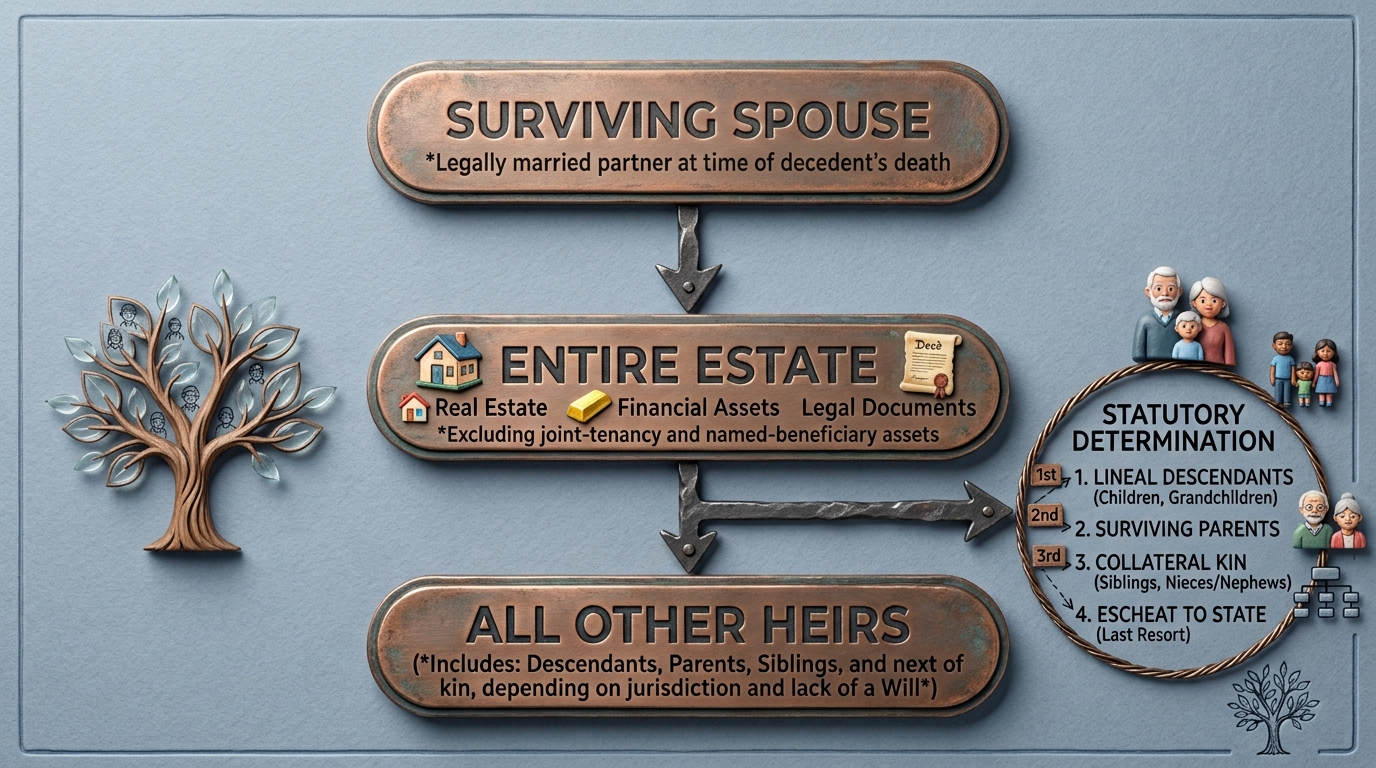
Florida’s rules do not give every relative an inheritance claim. A surviving spouse may receive the entire intestate estate in some families, while the spouse receives one half when certain descendants or blended family circumstances exist. If no spouse inherits the property, Florida law turns to descendants, parents, siblings, and progressively more remote relatives according to the hierarchy in § 732.103.


Florida Intestate Succession Hierarchy Structure

That hierarchy can produce results that surprise families. A half sibling can receive a different share from a whole blood sibling. A child who died before the decedent can leave a branch of descendants who inherit under the per stirpes rule. An alleged heir may have to prove the claimed family relationship before receiving anything. A distant relative may discover that being biologically related to the decedent does not place that person within a statutory class of heirs.

Florida law also treats some property differently from ordinary intestate assets. A jointly owned asset may pass through survivorship rights. A trust can control property outside the probate estate. A beneficiary designation can determine who receives certain financial assets. Florida homestead has its own inheritance rules that can change the analysis when a surviving spouse and descendants are involved.


The result is a legal question with several layers:

Who qualifies as an heir?

What share does that heir receive?

Is the property subject to intestate succession at all?

Those questions become particularly important when a Florida estate involves a blended family, disputed heirship, distant relatives, or a home owned by the decedent.


What Is Intestate Succession in Florida?

Intestate succession is the statutory process used to determine who inherits property that a Florida decedent did not effectively dispose of through a will.

Florida’s principal intestacy rules appear in Part I of Chapter 732 of the Florida Statutes. The provisions address the intestate estate, the surviving spouse’s share, the shares of other heirs, per stirpes inheritance, half blood relatives, afterborn heirs, escheat, adopted persons, children born outside marriage, and termination of parental rights.

The term therefore has a narrower legal meaning than “everything a person owned when they died.”

A person can die without a will while some assets pass through another legal mechanism. The intestacy statutes become relevant to property that remains subject to the statutory inheritance scheme.


Can someone have a will and still have an intestate estate?

Yes.

Florida Statute § 732.101 applies when part of an estate has not been effectively disposed of by will. A person can therefore leave a valid will while some property passes to heirs under intestate succession.

This is known as partial intestacy.

For example, a will might dispose of several assets but fail to provide an effective disposition for a particular piece of property. That property can pass under the intestacy statutes even though the decedent left a will.

That distinction matters throughout probate.

The relevant question is not simply whether a document called a will exists. The question is whether the will effectively disposes of the property at issue.


What Is Intestate Succession in Florida?

Florida intestate succession is the legal system that determines who receives property when a person dies without an effective will. Under Florida Statute § 732.101, property that is not effectively disposed of by a will passes to the decedent’s heirs under the intestacy statutes. The heirs’ rights to that intestate property vest at death.

The absence of a will does not mean that the estate has no legal rules governing inheritance. It means the legislature has supplied those rules.

Florida Statute § 732.102 addresses the surviving spouse. Section 732.103 determines who inherits the remaining estate when there is no surviving spouse or when the spouse does not receive the entire intestate estate. The result depends heavily on the decedent’s family relationships at the time of death.

That distinction matters because intestate succession applies only to property that actually belongs in the intestate estate. A person can die without a will while some assets pass through another legal mechanism. The ownership structure or beneficiary designation attached to an asset may determine what happens to it without applying the intestacy hierarchy.


Which Property Is Subject to Intestate Succession?

The first question in an intestate estate is not simply who the relatives are. It is whether the particular property passes through intestacy at all.

Florida Statute § 732.101 applies to property that was not effectively disposed of by will. This can include property that the decedent owned individually and that does not have another valid method of passing at death.

An asset may therefore fall outside the intestate estate because of the way it was owned or because another legal arrangement controls its transfer. For example, property held with another person in a form that carries a right of survivorship may pass to the surviving owner. Certain accounts and insurance policies may pass according to a valid beneficiary designation.

This distinction becomes particularly important when someone says that a deceased relative had “no will.” The absence of a will does not automatically mean that every asset must be divided under Chapter 732.

It is possible to have an estate with both intestate property and property that passes outside intestacy.

That situation is sometimes called partial intestacy. A will may also create partial intestacy if it fails to dispose effectively of some property. Florida law addresses the property that remains undisposed of through the intestacy statutes.


Who Inherits First Under Florida Intestacy Law?

The surviving spouse receives special treatment under Florida law.

If the decedent leaves no surviving descendants, the surviving spouse receives the entire intestate estate. The same result generally applies when every surviving descendant is also a descendant of the surviving spouse and the spouse has no descendant from another relationship.

The result changes when the family structure is different.

If the decedent has a surviving descendant who is not also a lineal descendant of the surviving spouse, the spouse receives one half of the intestate estate. The other half passes according to the rules governing the decedent’s descendants.

Florida law also addresses a less obvious blended family situation. Even if every surviving child of the decedent is also the spouse’s child, the spouse receives one half when the spouse has a descendant from another relationship who is not a descendant of the decedent.


Example: A Married Person With Children From Another Relationship

Suppose Maria dies without an effective will. She leaves a husband and two children. Both children are also her husband’s children.

If her husband has another child from a previous relationship, the statute treats the family differently from a marriage in which the surviving spouse has no children outside the marriage.

Under § 732.102, Maria’s husband receives one half of the intestate estate. The remaining half passes under the rules for Maria’s descendants.

This is one reason a simple statement such as “the spouse inherits everything” can be legally misleading.

Modern law office desk in Coral Springs, Florida, reviewing Florida probate and intestate succession documents.

What Happens If There Is No Surviving Spouse?

When there is no surviving spouse, Florida Statute § 732.103 supplies the succession rules.

The estate first passes to the decedent’s descendants. If the decedent has no descendants, the statute moves to the parents.

In some cases if neither parent survives, the statute reaches the decedent’s brothers and sisters and the descendants of deceased siblings.

If those relatives do not exist, the statute moves farther into the family tree. Florida divides this stage between the decedent’s paternal and maternal kindred. Grandparents receive priority within those branches. If the relevant grandparents are not living, the statute addresses aunts and uncles and the descendants of deceased aunts and uncles.

The statute does not continue indefinitely through every person who can establish some biological connection to the decedent.

That limitation became important in a recent Broward County case.


How Far Does Florida Intestacy Law Reach?

In State of Florida, Department of Legal Affairs v. Estate of Kyle William Bruening, the Fourth District Court of Appeal considered an intestate estate involving distant relatives.

Kyle Bruening died without a will. No spouse or children survived him. His parents and grandparents had also died, and there were no surviving siblings or aunts and uncles within the categories recognized by the statute. Several distant relatives claimed the estate because they shared great grandparents with Bruening.

The trial court treated those relatives as heirs. The Fourth District reversed.

The appellate court held that sharing great grandparents with the decedent did not place those relatives within a class of heirs recognized by § 732.103. The court explained that the statute identifies the relatives who inherit through intestacy and does not create a general right of inheritance for every distant blood relative.

The case arose in Broward County, which makes it particularly relevant to probate disputes in Coral Springs and elsewhere in South Florida.

The practical point is straightforward. A family connection is not enough by itself. The relationship must fall within a category recognized by Florida intestacy law.


What Does Per Stirpes Mean in Florida?

Florida Statute § 732.104 provides that intestate descent is per stirpes. The rule applies to descendants and to collateral heirs.

The concept becomes important when an heir who would have inherited directly has already died.

Consider a decedent who has two children. One child survives the decedent. The other child died before the decedent but left two children of their own.

The surviving child does not simply take the entire estate. The deceased child’s branch remains relevant. The descendants of that deceased child can receive the share attributable to that branch under the per stirpes rule.

This can produce a different result from dividing an estate equally among every living descendant. Florida law preserves the deceased heir’s branch when the statute reaches that branch of the family.

A family tree can therefore matter at several generations.


Can One Side of the Family Receive the Entire Estate?

Yes.

People sometimes miss this point because they assume that intestate property must always be divided equally between the maternal and paternal sides of the family.

Section 732.103 does not require that result when one side has no qualifying heirs.

In Faskowitz v. Department of Legal Affairs, the decedent had no surviving descendants. His will had attempted to leave his property to his wife, but she died before him and the will did not provide an alternate beneficiary. Relatives on the paternal side established their status as heirs. The probate court had treated half of the property as potentially belonging to unknown maternal relatives.

The Second District Court of Appeal rejected that approach. Under § 732.103, if there is no qualifying kindred on one side, the surviving kindred on the other side can receive the entire estate.

The case demonstrates why determining heirship requires more than locating one relative and assuming the estate will be divided along a simple family line.


What Happens If Family Members Disagree About Who Is an Heir?

Disputes over family relationships can easily turn an intestate estate contentious.

Florida Statute § 733.105 allows an interested person to ask the probate court to determine who is entitled to receive property or what share a person should receive when there is doubt about the proper beneficiaries.

That proceeding can require evidence about the decedent’s family history.

The Florida Supreme Court addressed this problem in State v. Rudawski, a case involving the estate of Jacob Tim. Tim died intestate in Miami Beach. More than fifty people appeared claiming different degrees of relationship to him. The court ultimately held that the claimants had failed to establish their entitlement to the estate.

The case illustrates a basic probate principle that can become decisive in an intestate estate: a person claiming inheritance must establish the legal basis for that claim.

A surname is not enough. A family story is not enough. The evidence must establish the relationship required by the applicable law.


Do Adopted Children Inherit Under Florida Intestacy Law?

Yes. Florida law generally treats an adopted person as a descendant of the adopting parent for purposes of intestate succession.

Section 732.108 provides that an adopted person becomes a descendant of the adopting parent and a member of that family for intestate succession purposes. The statute also contains specific exceptions involving certain adoptions by a natural parent’s spouse and other family relationships.

The details can matter when an adoption changes the legal relationship between the child and the natural family.

For that reason, a probate court may need to examine the adoption itself rather than relying on a family description used informally during the decedent’s lifetime.


What Happens With a Half Sibling?

Florida has a specific rule for half blood relatives.

When property passes to collateral relatives and some are related to the decedent by whole blood while others are related by half blood, the half blood relatives receive half as much as the whole blood relatives. If all of the relevant collateral relatives are half blood relatives, they receive equal shares.

This rule can matter when an estate reaches the sibling portion of the intestacy hierarchy.

For example, assume an intestate estate reaches the decedent’s siblings. When a surviving full sibling and a surviving half sibling both inherit, the statute does not automatically give them equal shares.

Therefore, you should calculate the shares under § 732.105 rather than treating every sibling as having the same statutory relationship.


Can a Child Born After the Parent’s Death Inherit?

Florida law expressly addresses this situation.

Under § 732.106, an heir who was conceived before the decedent’s death but born afterward inherits intestate property as though the child had been born during the decedent’s lifetime.

The timing of the birth therefore does not by itself eliminate the child’s inheritance rights.

Other legal questions can arise when parentage is disputed. Those questions should be addressed under the statutes governing the particular relationship rather than assumed from the family’s understanding of who the child’s parent was.


Suburban residential home in South Florida subject to Florida homestead inheritance rules.

What Happens to a Florida Homestead When There Is No Will?

Florida homestead property requires separate attention because constitutional protections and Florida statutes impose special rules.

Section 732.401 provides that homestead generally descends under the intestacy rules when it has not been validly devised. When the decedent leaves a surviving spouse and descendants, however, the surviving spouse receives a life estate with a vested remainder in the descendants who were living at the decedent’s death. The spouse may instead elect an undivided one half interest as a tenant in common, with the remaining half passing to the descendants per stirpes.

This means a family home cannot always be treated like an ordinary asset in an intestate estate.

A surviving spouse may have rights that differ substantially from the result produced by simply dividing the home according to the general intestacy hierarchy.

The homestead rules also make property ownership particularly important. Before assuming that a house must be distributed through intestacy, the probate lawyer must determine how the property was titled and whether Florida’s homestead protections apply.


Can Intestate Succession Create Problems With a Family Home?

Yes.

Suppose a person dies in Coral Springs without a will and leaves a house to several descendants. Those heirs may acquire ownership interests in the property rather than receiving an automatic cash distribution.

The situation can become difficult when one heir wants to sell and another wants to keep the property. The heirs may also disagree about maintenance or the use of the house.

The problem can become larger with later deaths. An heir who receives an interest can later die without a will, causing that interest to pass through another estate. Over time, ownership can become divided among a growing number of relatives.

This is one reason intestate succession can have consequences long after the initial probate administration.


What Happens If No Legal Heir Can Be Found?

Florida law provides for escheat when a person dies without leaving anyone entitled to the estate.

Under § 732.107, property that has no person entitled to receive it can escheat to the State of Florida. The statute provides a procedure for handling the property and permits a person with a valid claim to seek the proceeds within the statutory period.

Escheat is not the first step merely because relatives are difficult to locate.

The question is whether a person legally entitled to inherit exists under the applicable statutes. Bruening demonstrates that a court will not expand the statutory categories simply because a distant relative can establish a biological connection.

Faskowitz demonstrates the other side of the problem. When qualifying heirs exist on one side of the family, the absence of qualifying heirs on the other side does not automatically send half the estate to the State.


Who Handles an Estate When There Is No Will?

An intestate estate still requires administration.

Florida law establishes a preference for appointment as personal representative in an intestate estate. The surviving spouse has the first preference. The statute then addresses selection by the heirs and the heir nearest in degree.

The personal representative is responsible for administering the estate under Florida probate law.

That role does not give the representative ownership of the estate. The representative administers property that belongs to the estate and distributes it according to the law after the required probate process has been completed.

A dispute over who should serve as personal representative can therefore be separate from a dispute over who inherits.


What If Nobody Knows Exactly Who the Heirs Are?

Florida provides a court procedure for this problem.

Under § 733.105, an interested person can petition the probate court to determine the beneficiaries or their respective shares when property passes through intestate succession and there is uncertainty about entitlement.

This can become relevant when relatives have incomplete records or when different family members provide conflicting accounts of the decedent’s family history.

The evidence may include civil records and other documentation establishing the claimed relationship. In a difficult estate, a genealogical investigation may also become necessary.

The objective is not to identify every person who might be related to the decedent. The objective is to establish the relatives who fall within the statutory categories of heirs.


What If the Person Had a Will That Did Not Cover Everything?

A person does not have to die completely intestate for the intestacy statutes to matter.

Section 732.101 applies to any part of an estate that was not effectively disposed of by will.

Imagine a will that leaves a particular bank account to one beneficiary but does not effectively dispose of the remainder of the estate.

The undisposed property can pass under Florida intestacy law.

This distinction matters when reviewing an older will after a death. The question is not simply whether the decedent signed a document called a will. The question is whether that document actually controls the property now at issue.


Why Intestate Succession Can Produce Surprising Results

Florida intestacy law follows statutory categories rather than the family’s idea of what would have been fair.

A decedent may have been especially close to a niece while having little contact with a sibling. That does not allow the niece to inherit simply because the relationship was closer.

A person may have supported one child financially during life while providing little support to another. Intestacy law does not generally adjust the statutory inheritance share because the family considers one relationship stronger.

The statute applies the legal relationships recognized by the Probate Code.

That is why the consequences can feel unexpected when a family has never discussed estate planning.


What Should a Family Do After Someone Dies Without a Will?

The first step is to determine what property actually belongs in the probate estate.

The next question is who may have inheritance rights under Florida law. That inquiry should account for the surviving spouse and the decedent’s descendants before moving farther into the family tree.

The family should also determine whether the decedent owned a Florida homestead. That property can be subject to special rules that change the ordinary intestacy analysis.

If relatives disagree about heirship, the probate court can determine who is entitled to the property and what share each person should receive. Section 733.105 specifically provides a procedure for resolving that uncertainty.

In Coral Springs and elsewhere in Broward County, these questions can arise in estates involving a family home, multiple generations, or relatives who have lived in different states for many years.

Waiting can make the factual investigation harder. Birth records may be difficult to locate. Family members may have incomplete information. Property may remain titled in the decedent’s name while relatives disagree about what should happen next.

A Florida probate attorney can review the ownership records and family relationships against the applicable statutes before the estate is distributed.
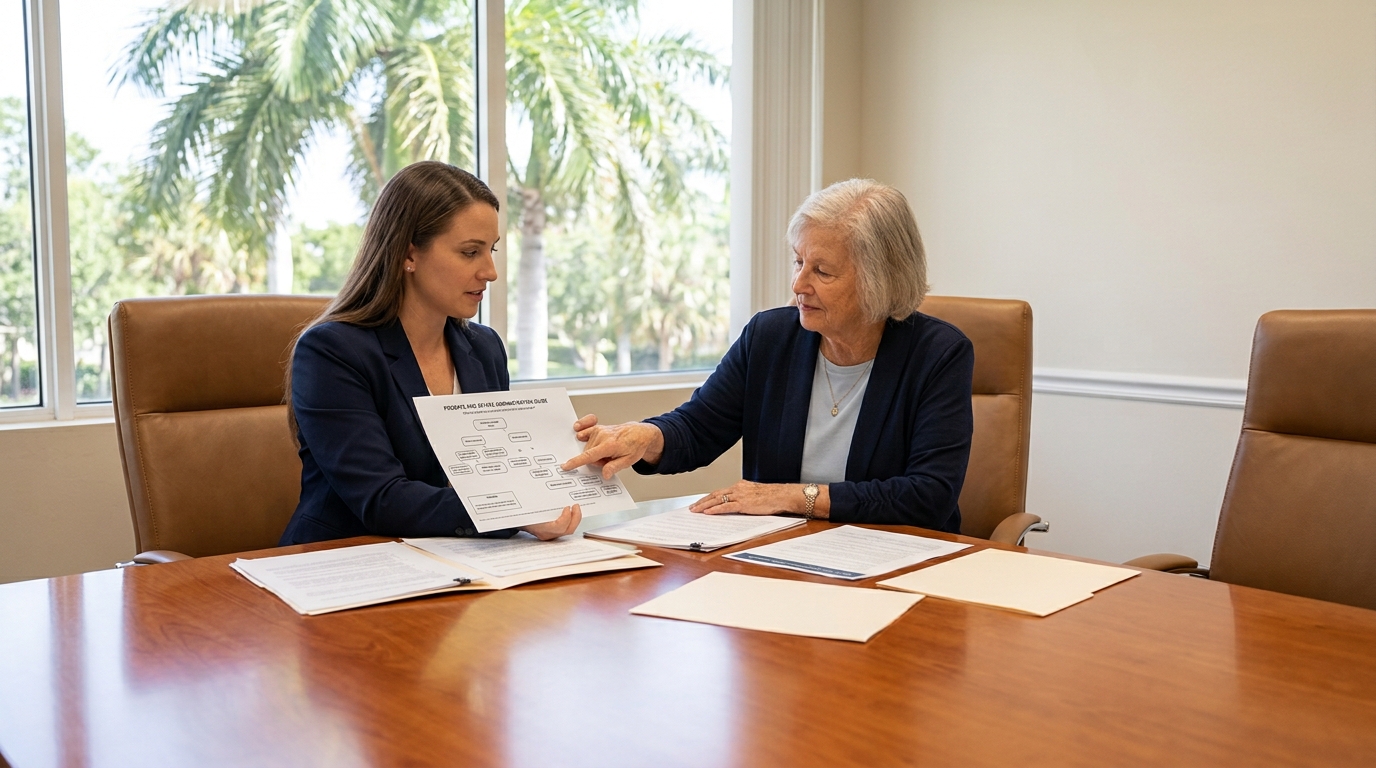

Probate attorney consulting with a client regarding Florida intestate succession and heirship determination.

Frequently Asked Questions About Florida Intestate Succession

Who inherits if someone dies without a will in Florida?

  • The answer depends on the decedent’s surviving relatives and the property involved. A surviving spouse may receive the entire intestate estate or one half, depending on the family structure. If no spouse survives, descendants generally take priority under § 732.103.

Does the oldest child inherit more under Florida intestacy law?

  • No. Age does not give the oldest child a larger intestate share. When descendants inherit directly, Florida applies its statutory distribution rules.

Does a surviving spouse always inherit everything?

  • No. The surviving spouse receives the entire intestate estate in several situations, but § 732.102 reduces the spouse’s share to one half in specified family structures involving descendants.

Do grandchildren inherit if their parent is alive?

  • Generally, the inheritance hierarchy reaches the decedent’s descendants directly before moving to more remote relatives. The per stirpes rule becomes particularly important when a descendant who would have inherited has already died.

Can a niece or nephew inherit from an aunt or uncle who dies without a will?

  • A niece or nephew may inherit when the intestacy hierarchy reaches the descendants of a deceased sibling. The exact result depends on which relatives survive the decedent and how the statutory branches apply.

Can a second cousin inherit under Florida intestacy law?

  • Usually not merely because the person is a second cousin. In Bruening, the Fourth District held that relatives who shared great grandparents with the decedent did not fall within the statutory class of heirs applicable to that estate.

Do adopted children inherit from their adoptive parents?

  • Yes. Florida generally treats an adopted child as a descendant of the adopting parent for intestate succession. The statute contains specific exceptions that can affect relationships with natural family members.

Does a half sibling inherit the same amount as a full sibling?

  • Not always. When the relevant collateral heirs include both whole blood and half blood relatives, Florida law gives a half blood relative half the share of a whole blood relative.

What happens to a Florida house when the owner dies without a will?

  • The answer depends on the ownership of the property and the circumstances of the family. Florida homestead law contains special inheritance rules when a surviving spouse and descendants exist.

Can the State of Florida inherit an intestate estate?

  • Yes, but only when the statutory conditions for escheat are satisfied. If someone legally entitled to the estate exists under Florida law, the property does not simply pass to the State because the family is difficult to identify.

What if family members disagree about who should inherit?

  • An interested person can ask the probate court to determine who is entitled to the property or what share each person should receive. Florida Statute § 733.105 provides the procedure for that determination.

Florida Intestate Succession Requires a Property and Family Analysis

Dying without a will does not leave an estate without rules. Florida law supplies a statutory inheritance system that begins with the surviving spouse and descendants before reaching more remote relatives.

The difficult cases arise when the family structure is complicated or the property does not fit neatly into the ordinary probate estate. Homestead property can require a separate analysis. A distant relative may have a biological connection without having a statutory right to inherit. A surviving relative on one side of the family may receive the entire estate when the other side has no qualifying heirs.

For families in Coral Springs and Broward County, an intestate estate should be examined under the current Florida statutes before property is distributed. The right heir may not be the person the family expects, and the property that appears to belong to the estate may not all be subject to intestate succession.


If a family member has died without an effective will, a Florida probate attorney can review the estate and determine which intestacy rules apply to the property and family involved.

How to Collect a Business Debt in Florida: From Unpaid Invoice to Judgment

Business debt collection attorney meeting with a Coral Springs business owner

A business does not have to accept an unpaid invoice as the cost of doing business.

When another company, customer, contractor, or client stops paying, the first step is usually figuring out exactly what is owed, why it is owed, and what evidence supports the claim. From there, a creditor may negotiate payment, send a formal demand, pursue a lawsuit, or, if a judgment is obtained, use Florida’s judgment enforcement procedures to pursue available assets.

There is an important difference between winning a debt case and collecting the money.

A judgment establishes a legal obligation. It does not automatically put a check in your company’s bank account.

Florida’s courts handle an enormous civil caseload. The state’s 2023-24 statistical report shows nearly 2.4 million county civil filings statewide, including small claims and other county civil matters. Florida’s trial courts as a whole manage more than two million civil case filings annually.

Business debt collection is only one part of that system, but the basic lesson is useful: a claim for money needs to be treated as a legal claim, not merely as an increasingly irritated series of emails.


What Should You Do When a Business Owes You Money?

Start by establishing the debt.

Look at the contract, invoice, purchase order, delivery records, emails, payment history, account statements, and any other documents showing what was agreed and what happened afterward.

Ask a few straightforward questions:

  • What did the debtor agree to pay?
  • What did your business provide?
  • When was payment due?
  • How much has been paid?
  • What remains outstanding?
  • Has the debtor disputed the amount or the underlying work?
  • Does the contract contain provisions concerning interest, attorney’s fees, venue, or dispute resolution?
  • Did anyone personally guarantee the obligation?

That last question can become important.

If the customer is an LLC or corporation, the company’s debt does not automatically become the owner’s personal debt. A creditor needs a legal basis for pursuing an individual separately, such as a guaranty or another applicable theory of liability.

That is one reason the paperwork deserves attention before anyone starts threatening to sue.


What Evidence Do You Need to Collect a Business Debt?

A creditor’s strongest evidence often consists of ordinary business records.

A signed contract is useful. So are invoices showing the amounts due, records showing that goods were delivered or services were performed, correspondence acknowledging the balance, and payment records showing what happened afterward.

Sometimes there is no single document that tells the whole story.

Florida recognizes an account stated claim in appropriate circumstances. The Florida Supreme Court has explained that an account stated depends on an agreement concerning the amount owed and an obligation to pay that amount.

Florida’s standard jury instructions describe an account stated as involving transactions for which a specific amount is due and note that an account statement is not automatically conclusive if evidence establishes fraud, mistake, or error.

So an unpaid invoice should not be treated as magic evidence.

A debtor can dispute what was billed, whether the work was completed, whether the goods were delivered, whether the amount is correct, or whether the person receiving the invoice had authority to incur the obligation.

The more clearly the business can reconstruct the transaction, the easier it becomes to evaluate the claim.


Should You Send a Demand for Payment Before Suing?

Often, yes.

A demand letter can identify the amount claimed, explain the contractual or factual basis for the debt, establish a deadline for payment, and give the debtor an opportunity to resolve the matter before litigation.

It can also reveal what the actual dispute is.

A company that responds, “We agree that we owe $40,000 but need 90 days” presents one problem.

A company that responds, “Your employees never completed the work and we owe nothing” presents another.

And a company that stops answering altogether presents yet another.

The demand process therefore has a practical purpose beyond giving someone one final chance to pay.

It can help establish what the parties actually disagree about.


Can You Sue a Business for an Unpaid Debt?

Yes, when the facts support a legally recognized claim.

The appropriate cause of action depends on the transaction. A creditor may have a breach of contract claim, an account stated claim, an open account claim, or another theory depending on the circumstances.

The contract itself can also determine what remedies are available.

Florida law generally gives five years to bring a legal or equitable action founded on a written contract or other liability founded on a written instrument. The limitations period is different for various other types of claims, including claims based on unwritten obligations.

That makes one piece of advice particularly important:

Do not assume you have plenty of time because the debtor keeps promising to pay.

A business can spend months or years hearing variations of “the check is coming” while the legal clock continues to run.


A recent Florida case illustrates the problem.

An Unpaid Legal Bill That Stayed Unpaid for Years

In LAD Commercial, LLC v. Eagle Trace at Vero Beach Homeowners’ Association, Inc., the Fourth District Court of Appeal considered a breach of contract claim arising from unpaid legal services.

The invoices totaled $20,179.08. The alleged unpaid work dated back years, and the defendant argued that the claim was barred by the statute of limitations. The litigation ultimately required the appellate court to examine when the cause of action accrued and how the contract’s payment provisions affected that analysis.

The lesson is not that every unpaid invoice becomes a statute of limitations dispute.

It is that waiting can turn a collection problem into a limitations problem.


What If the Debtor Disputes the Debt?

Then the case needs to be analyzed rather than treated as a simple collection matter.

Suppose a contractor invoices a business for $75,000. The business refuses to pay and says the contractor abandoned the project.

Now there are factual questions:

  • Was there a contract?
  • What work was required?
  • What work was actually completed?
  • Were there change orders?
  • Did the customer approve them?
  • Was the work defective?
  • Did the customer terminate the contract?
  • What damages did either side suffer?

The invoice alone cannot answer those questions.

Commercial litigation often turns on reconstructing the transaction from the documents and testimony rather than simply proving that an invoice exists.


Can You Sue the Owner of an LLC Personally?

Not merely because the LLC owes the money.

An LLC is a separate legal entity, and the existence of a business debt does not automatically create personal liability for its members.

A personal guaranty can change that.

So can other circumstances, depending on the facts and applicable law.

This is an area where careless collection advice can create a serious problem. A creditor should identify the actual legal basis for pursuing an individual instead of assuming that the person who owns the company and the company itself are interchangeable.

If the contract says that the company’s owner personally guarantees payment, that provision deserves close examination.

If there is no guaranty, the analysis is different.


What Happens If You File a Business Debt Lawsuit?

The case moves into the ordinary civil litigation process.

Depending on the claim and amount involved, that can include:

  1. Filing the complaint
  2. Serving the defendant
  3. Receiving the defendant’s response
  4. Conducting discovery
  5. Negotiating a settlement
  6. Resolving motions and disputed legal issues
  7. Preparing for trial if necessary
  8. Obtaining a judgment
Commercial litigation attorney reviewing business debt evidence in Broward County

Florida’s civil procedure system was significantly updated beginning January 1, 2025. The changes emphasize active case management, deadlines, initial discovery disclosures, supplementation, and discovery proportional to the needs of the case.

That does not mean every unpaid invoice will turn into a dramatic courtroom battle.

Many cases settle.

Some are resolved through motion practice.

Some proceed to trial.

And some defendants simply fail to respond, creating a different procedural situation.

The important point is that filing a lawsuit starts a legal process. It does not mean the creditor can immediately take the debtor’s property.


What Happens After You Win a Judgment?

This is the part that the old article barely addressed.

A judgment is not the same thing as payment.

Florida law provides several mechanisms for enforcing money judgments.

Under Florida Statute § 77.03, a judgment creditor can seek a writ of garnishment after obtaining a judgment. Garnishment can reach certain money or property held by a third party for the judgment debtor, subject to the requirements and limitations of Florida law.

Florida’s execution statutes also provide for levy and sale of certain property to satisfy a judgment. Section 56.061 identifies categories of property subject to execution, including certain real and personal property and corporate stock.

Florida also permits a judgment creditor to acquire a judgment lien on certain personal property, including property subject to execution and certain payment intangibles and accounts.

Those remedies can matter when a debtor has assets but simply refuses to pay.

They also have limits.

Property may be exempt. Other creditors may have priority. Secured creditors may have existing rights. Bankruptcy can change the situation entirely.

A judgment gives the creditor legal leverage and enforcement tools. It does not create assets that do not exist.


Can You Garnish a Business Bank Account?

Potentially, but garnishment has a specific legal procedure.

Florida Statute § 77.03 provides for issuance of a writ after judgment. Florida law also permits pre-judgment garnishment in certain circumstances, but the requirements are considerably more specific. Section 77.031 requires a verified motion or affidavit containing particular factual allegations, including the nature and amount of the claim and why the plaintiff believes the defendant will not have sufficient property available for execution.

That is a good example of why “just garnish their account” is not legal strategy.

There is a procedure.

There are requirements.

And there may be defenses and exemptions.


What If the Debtor Has Assets but Still Refuses to Pay?

Florida’s judgment enforcement statutes give creditors tools for investigating and reaching certain property.

Chapter 56 includes proceedings supplementary, which can be used in appropriate circumstances after a judgment. Florida law also addresses discovery concerning a judgment debtor’s assets and execution procedures.

A judgment creditor may therefore have options even when the debtor has not voluntarily written the check.

But those options depend heavily on what the debtor actually owns, how the assets are titled, whether other creditors have claims, and whether exemptions or other legal restrictions apply.

That investigation can become particularly important when a business appears to be operating normally while claiming that it has no money to satisfy a judgment.


Can You Recover Attorney’s Fees and Interest?

Sometimes.

Attorney’s fees are not automatically awarded simply because a business wins a lawsuit.

A contract may provide for attorney’s fees. Florida Statute § 57.105(7) provides reciprocity for certain contractual attorney’s fee provisions, allowing the prevailing party to recover reasonable attorney’s fees in an action concerning a contract when the statutory requirements are met.

Florida’s courts have also dealt with the issue in collection cases.

In Ham v. Portfolio Recovery Associates, LLC, the Florida Supreme Court considered whether a contractual attorney’s fee provision could become reciprocal when the creditor pursued an account stated claim rather than suing directly under the underlying credit agreement. The Court held that the statutory reciprocity provision applied because of the relationship between the account stated claim and the underlying contract.

That is a useful warning against treating attorney’s fees as an automatic add-on to every debt.

The contract, the cause of action, and the applicable statute all matter.

Interest also has its own rules. Florida Statute § 55.03 establishes the framework for the interest rate applicable to judgments and provides for quarterly adjustments based on the statutory formula.


What If You Already Have a Judgment but Still Have Not Been Paid?

Then the legal problem has changed.

You are no longer trying to establish that the debtor owes the money. You are trying to enforce an established judgment.

That can involve:

  • Judgment liens
  • Garnishment
  • Execution
  • Discovery concerning assets
  • Proceedings supplementary
  • Negotiated payment arrangements
  • Other enforcement mechanisms permitted by law

Florida Statute § 55.081 provides that a judgment generally cannot remain a lien on Florida real or personal property indefinitely; the statutory period is 20 years from entry of the judgment, subject to the statute’s provisions.

That does not mean a creditor should wait 19 years and see what happens.

It means Florida gives judgments a legal life that can extend well beyond the original lawsuit.


What If the Business Is Closing or Moving Assets?

This is where timing can become particularly important.

A creditor who has reason to believe that a debtor is transferring assets, shutting down operations, or reorganizing its affairs may need legal advice quickly.

Florida law contains procedures governing execution, judgment liens, proceedings supplementary, and other post-judgment remedies. The appropriate response depends on what is actually happening and what assets are involved.

A creditor should also avoid taking matters into its own hands.

Threatening customers, seizing property without legal authority, making false accusations, or attempting to bypass court procedures can create entirely new legal problems.

Collection is supposed to recover a debt.

It should not create another lawsuit.


How Long Do You Have to Collect a Business Debt in Florida?

There is no single limitations period for every business debt.

For example, Florida Statute § 95.11 generally provides a five-year limitations period for an action founded on a written instrument. Other claims can have different periods.

The nature of the obligation matters.

So does the date on which the particular cause of action accrued.

A creditor should identify the legal claim before assuming that an old invoice is still enforceable.

This is one reason an attorney should review an aging account before the business simply writes it off or sends another routine reminder.


A Business Debt Is Still a Business Problem

An unpaid $5,000 invoice can be irritating.

Some unpaid $50,000 invoice can disrupt payroll.

An unpaid $500,000 obligation can change whether a business can continue operating.

That is why debt collection should be approached in proportion to the amount at stake, the strength of the evidence, the debtor’s financial position, and the cost of pursuing the claim.

There is also a relationship question.

A company may want the money without destroying a valuable customer relationship. Another company may have reached the point where continuing to negotiate makes little economic sense.

Those are business decisions.

The legal job is to identify the available remedies and the consequences of using them.


When Should You Hire a Business Debt Collection Attorney?

Legal advice can be particularly useful when:

  • The amount owed is substantial
  • The debtor disputes the debt
  • The contract contains complicated provisions
  • A personal guaranty is involved
  • Several businesses or individuals are connected to the transaction
  • The debtor has stopped responding
  • You suspect assets are being moved
  • The debt is approaching a limitations deadline
  • You need to file a lawsuit
  • You already have a judgment
  • You need to investigate enforcement options
  • Bankruptcy has been threatened or filed

The earlier the legal analysis occurs, the more options may still be available.

That does not mean every $2,000 invoice needs a lawsuit.

Sometimes a well-supported demand gets the check.

There are cases where a payment agreement makes commercial sense.

Sometimes litigation is necessary.

And sometimes the debtor’s financial condition makes collecting the judgment itself the hardest part.

Florida attorney discussing judgment enforcement with a business owner

Frequently Asked Questions

How do I collect a business debt in Florida?

  • Begin by documenting the debt, reviewing the contract and supporting records, and determining whether the debtor disputes the amount or the underlying obligation. Depending on the circumstances, collection may involve a demand for payment, negotiation, litigation, judgment, and post-judgment enforcement.

Can I sue a business for an unpaid invoice?

  • Yes, when the facts support a legally recognized claim. The appropriate claim depends on the transaction, contract, records, and applicable Florida law.

Can I personally sue the owner of an LLC for the company’s debt?

  • Not automatically. An LLC is a separate legal entity. Personal liability generally requires its own legal basis, such as a personal guaranty or another applicable theory.

Could I recover attorney’s fees in a business debt lawsuit?

  • Possibly. A contract, statute, or other legal basis may authorize recovery. Florida Statute § 57.105(7) provides for reciprocal attorney’s fee rights in certain contract actions when the statutory requirements are satisfied.

Can I garnish a debtor’s bank account in Florida?

  • Potentially. Florida law provides procedures for garnishment, including post-judgment garnishment under § 77.03. Exemptions, procedural requirements, and the identity of the account holder can affect whether garnishment is available.

What happens after I win a judgment?

  • The creditor may have several enforcement options, including garnishment, execution, judgment liens, and proceedings supplementary, depending on the debtor’s assets and the circumstances.

How long do I have to sue for an unpaid business debt in Florida?

  • It depends on the legal claim. Florida generally provides five years for actions founded on a written instrument, while other claims can have different limitations periods.

Is a judgment the same as getting paid?

  • No. A judgment establishes the legal obligation, but the creditor may still need to use available enforcement procedures to collect the judgment.

Collecting Business Debts in Coral Springs and Broward County

A business in Coral Springs may sell services to another Broward County company, supply goods to customers across South Florida, or have contracts with companies anywhere in the country.

The location of the debtor, the terms of the contract, the applicable law, and the debtor’s assets can all affect the collection strategy.

For a Coral Springs business dealing with a significant unpaid account, the first useful step may be a review of the transaction itself: the contract, invoices, communications, payment history, and any documents showing what the debtor agreed to pay.

From there, the appropriate path may be a demand, negotiation, lawsuit, judgment enforcement, or some combination of those steps.

The important thing is to know which problem you actually have.

An unpaid invoice is one problem. A disputed contract is another. An unpaid judgment is a third.

Treating all three as “someone hasn’t paid us yet” is how a relatively straightforward collection matter can become unnecessarily expensive.


Talk With a Coral Springs Business Litigation Attorney

If your business is owed money by a customer, contractor, company, or other party, Reinfeld & Cabrera, P.A. can review the underlying transaction and discuss the legal options available for pursuing the debt.

That may mean evaluating the contract and records before a lawsuit is filed. It may mean negotiating payment. It may mean litigating the claim. And if you already have a judgment, the analysis may shift toward enforcement.

The right approach depends on the debt, the evidence, the debtor, and the remedies available under Florida law.

Contact Reinfeld & Cabrera, P.A. in Coral Springs to discuss your business debt collection matter.

This article provides general information about Florida business debt collection and is not a substitute for legal advice concerning a particular debt, contract, lawsuit, or judgm


How Long Does Probate Take in Florida? Timeline and Common Delays

How long probate takes in Florida with estate documents and a calendar

If you are waiting for a Florida estate to close, the frustrating part is often that nobody can give you a single number.

One estate may be resolved relatively quickly. Another may remain open for a year or longer. The difference usually has less to do with the passage of time itself than with what has to happen before the estate can be distributed and closed.


So, how long does probate take in Florida?

For many estates going through formal administration, probate takes months rather than weeks. Some uncomplicated estates can move faster. Others take considerably longer because of creditor claims, real estate, tax issues, missing beneficiaries, disputes, litigation, or problems with the estate administration.

Florida also has a simplified procedure called summary administration. For deaths occurring under the current law, summary administration generally applies when the property subject to administration does not exceed $150,000, after excluding property exempt from creditors, or when the decedent has been dead for more than two years.

The important point is that there is no single Florida probate timeline that applies to every estate.


What Determines How Long Probate Takes in Florida?

Probate is not one event. It is a series of legal and practical tasks.

The court must recognize the will, if there is one, and appoint a personal representative when formal administration is required. The personal representative then has to identify and protect estate property, address debts and creditor claims, deal with taxes when applicable, resolve outstanding issues, distribute the remaining assets, and complete the steps required to close the estate.

Florida law requires a personal representative to settle and distribute the estate as efficiently as is consistent with the interests of the estate and the people involved.

That does not mean every task can happen immediately.

A house may need to be sold. A bank account may need to be located. A creditor may file a claim. A beneficiary may object to something the personal representative has done. An estate asset may have to be appraised before it can be distributed.

Each of those issues can change the timetable.


How Long Does Formal Probate Usually Take?

Formal administration is the more involved form of Florida probate. It is generally used when the estate does not qualify for summary administration or when the circumstances require a formal proceeding.

There is no statutory rule saying that every formal probate case must be completed within a particular number of months.

That matters because two estates with similar values can have very different timelines.

Consider two hypothetical estates.

The first consists mainly of a Florida bank account, a vehicle, and other easily identified assets. There are no significant disputes, no difficult property issues, and no contested creditor claims.

The second includes a Coral Springs home, several financial accounts, an unresolved debt, a beneficiary who cannot be located, and disagreement among family members over the will.

Both estates are subject to the same general probate framework. Their practical timelines could be very different.

The question is therefore not simply how long does probate court take in Florida? It is what still has to be resolved before this particular estate can be closed?


How Long Does Summary Administration Take?

Summary administration is designed for qualifying estates that can be handled without the full administration process.

Under current Florida law, an estate may qualify when the value of the property subject to administration, after excluding property exempt from creditors, does not exceed $150,000. An estate may also qualify when the decedent has been dead for more than two years, subject to the requirements of the statute.

Summary administration can be substantially different from formal administration because the court may enter an order allowing distribution of estate assets without the same sequence of administration required in a formal case. Florida law specifically permits the court to authorize immediate distribution through the summary administration order.

That does not mean every small estate is resolved immediately.

The court still needs the required information. Known or reasonably ascertainable creditors must be addressed, and the people entitled to the estate must be properly identified.

If there is a dispute about the will, ownership of property, debts, or the people entitled to inherit, the matter may become more complicated regardless of the estate’s value.


What Is the 90-Day Creditor Period in Florida Probate?

One reason probate can take longer than a family expects is the period for creditors to present claims.

Under Florida Statute §733.702, certain claims against an estate generally must be filed by the later of three months after the first publication of the notice to creditors or 30 days after service of the notice on a creditor who is required to receive it.

This is one reason an estate cannot necessarily be distributed as soon as the personal representative finds the assets and identifies the beneficiaries.

There may still be claims to address.

The law also contains additional timing rules when a claim is disputed. For example, Florida Statute §733.705 gives interested parties a period to object to claims and provides procedures for claims that proceed into litigation.

So when someone asks why an estate is still open several months after the death, the answer may be that the administration is still dealing with creditor claims or other unresolved obligations.


What Can Delay Probate in Florida?

Some delays are ordinary parts of estate administration. Others result from complications that have to be resolved before distribution.

Common examples include:

  • A will that is being challenged
  • Disagreement among beneficiaries
  • Disputed creditor claims
  • Real estate that must be sold or otherwise transferred
  • Difficulty locating estate assets
  • Missing heirs or beneficiaries
  • Property with unclear ownership
  • Tax or accounting issues
  • Litigation involving the estate
  • A personal representative who is not completing required tasks
  • A personal representative who needs to be replaced
  • Assets located in another state
  • Complications involving another estate or trust

The size of an estate matters, but it is not the only factor.

A relatively modest estate can become complicated if the family is fighting over a house. A larger estate can sometimes be administered without the same level of delay if the assets, beneficiaries, and obligations are clear.


Common probate delays involving property, creditor claims, and estate disputes in Florida

Can a Will Contest Make Probate Take Longer?

Yes.

A dispute over the validity or interpretation of a will can turn an otherwise routine estate administration into litigation.

That changes the nature of the case. The court may need to resolve issues concerning the validity of the will, the rights of beneficiaries, the meaning of particular provisions, or other contested questions before the estate can be distributed.

The same basic problem can arise when beneficiaries dispute the actions of the personal representative.

In those situations, the probate proceeding is no longer simply a matter of collecting property and distributing it. There is a legal dispute that has to be resolved.

That can add substantial time to the administration.


What Happens If the Personal Representative Is Delaying Probate?

The personal representative has legal duties. Florida law describes the personal representative as a fiduciary and requires the estate to be settled and distributed efficiently and in accordance with the will and the Florida Probate Code.

That does not mean a personal representative must distribute everything immediately.

Some assets cannot properly be distributed until debts, claims, taxes, expenses, or other issues have been addressed.

But there is a difference between necessary administration and unnecessary inaction.

Florida law provides procedures for removing a personal representative in certain circumstances, including failure to comply with a court order, failure to account for estate property, wasting or maladministration of the estate, and other specified grounds.

If beneficiaries believe an estate is being delayed because the personal representative is failing to perform required duties, that may require a legal proceeding rather than simply waiting longer.


Can Beneficiaries Receive an Inheritance Before Probate Ends?

Sometimes.

Florida law permits certain distributions before the administration is completely finished when the statutory requirements are satisfied. But a personal representative must consider the estate’s outstanding obligations before distributing property.

This is especially important when the estate still has unpaid debts, creditor claims, expenses, taxes, or unresolved disputes.

A beneficiary therefore should not assume that an asset is available for distribution simply because the will says that person is supposed to receive it.

The estate may need to retain enough property to satisfy obligations before the final distribution can occur.


Why Is My Probate Case Taking So Long?

If a Florida probate case seems unusually slow, look at what remains unresolved rather than simply counting the months since the death.

For example:

The estate has a house that has not been sold.

  • The administration may need to address the property’s title, mortgage, taxes, insurance, sale, or distribution.

A creditor filed a claim.

  • The personal representative may need to determine whether the claim is valid and whether it shoul be paid or challenged.

A beneficiary cannot be located.

  • The estate may need additional work before property can be distributed safely.

Family members are fighting.

  • A dispute can require formal court proceedings rather than ordinary estate administration.

The personal representative has not completed required work.

  • The beneficiaries may need to ask the probate court to address the problem.

This is why asking only “How long does probate take?” can produce a misleading answer.

A more useful question is:

What is preventing this estate from closing?


Can You Speed Up Probate in Florida?

Sometimes the answer is yes, but there is no shortcut that allows a personal representative to ignore required procedures.

The practical way to reduce unnecessary delay is to identify problems early.

That can mean locating estate assets promptly, identifying creditors, responding to claims within the applicable deadlines, resolving beneficiary disputes before they become larger litigation, handling real estate issues efficiently, and making sure required court filings are completed correctly.

It also means recognizing when a problem is genuinely legal rather than administrative.

For example, if a beneficiary objects to the validity of a will, repeatedly asking the personal representative to “move faster” will not resolve the underlying dispute.

Likewise, if an estate asset has a title problem, distribution may have to wait until ownership is established.


When Does a Florida Probate Estate Finally Close?

Probate ends when the administration has been completed and the required closing procedures have been satisfied.

Florida Statute §733.901 provides that after administration has been completed, the personal representative is discharged.

In practical terms, that generally means the estate’s remaining legal and financial obligations have been addressed, the property that should be distributed has been distributed, and the personal representative has completed the steps necessary to finish the administration.

The exact procedure depends on the estate and the type of administration.

That is why the date of death alone cannot tell you when probate will end.


How Long Does It Take to Settle an Estate in Florida?

For a straightforward estate, the process may be measured in months. A more complicated formal administration can take considerably longer.

There is no responsible way to promise that a particular Florida probate case will finish within a fixed number of months without knowing what the estate contains and what issues remain unresolved.

For a family in Coral Springs, Broward County, or elsewhere in South Florida, the most useful starting point is usually to identify the type of administration and then determine which legal or practical issues are keeping the estate open.

Once those issues are known, the timeline becomes much easier to understand.


Frequently Asked Questions

How long does probate take in Florida?

  • There is no single timeline for every Florida estate. Formal administration commonly takes months, while a straightforward case may move faster and a disputed or complicated estate may remain open considerably longer.

How long does summary administration take in Florida?

  • Summary administration can be faster because it is a simplified procedure for qualifying estates. Under current Florida law, the procedure generally applies to estates with no more than $150,000 in property subject to administration, after applicable exclusions, or to estates where the decedent has been dead for more than two years.

What time does it take to settle an estate in Florida?

  • The time depends on the type of probate, the estate’s assets and debts, creditor claims, property issues, beneficiary disputes, litigation, and how efficiently the administration proceeds.

What causes probate to take longer?

  • Common causes include creditor claims, will contests, beneficiary disputes, real estate issues, missing heirs, tax matters, litigation, difficult-to-locate assets, and delays in estate administration.

How long do creditors have to make a claim against an estate in Florida?

  • Under Florida Statute §733.702, certain claims generally must be filed by the later of three months after the first publication of the notice to creditors or 30 days after service on a creditor who is required to receive notice.

Can a personal representative delay probate?

  • A personal representative has a fiduciary duty to administer and distribute the estate efficiently and in accordance with Florida law and the decedent’s will. If the personal representative fails to perform required duties, Florida law provides procedures that can address misconduct or other grounds for removal.

Does probate end when the beneficiaries receive their inheritance?

  • Not necessarily. The estate still has to satisfy the requirements for completing the administration and discharging the personal representative. Florida law provides for discharge after administration has been completed.

The Bottom Line

There is no standard number of days or months that applies to every Florida probate case.

A simple estate may move relatively quickly. An estate involving real property, creditor claims, family disputes, litigation, or other unresolved issues can take much longer.

If you are trying to understand why an estate in Coral Springs or elsewhere in Broward County is still open, the important question is not simply how much time has passed.

It is what remains to be done before the estate can legally be closed.


Need Help With a Florida Probate Case?

If an estate has been open longer than expected, or a dispute is holding up distribution, a Florida probate attorney can review the administration and explain what is causing the delay.

MyPersonalAttorneys helps families in Coral Springs, Broward County, and throughout South Florida with probate and estate administration matters.