
Who inherits when someone dies without a will in Florida?
The answer depends on the decedent’s surviving relatives and on which property is actually part of the intestate estate. Under Florida Statute § 732.101, property that is not effectively disposed of by a will passes to the decedent’s heirs under Florida’s intestacy laws. The right to that intestate property vests at death.
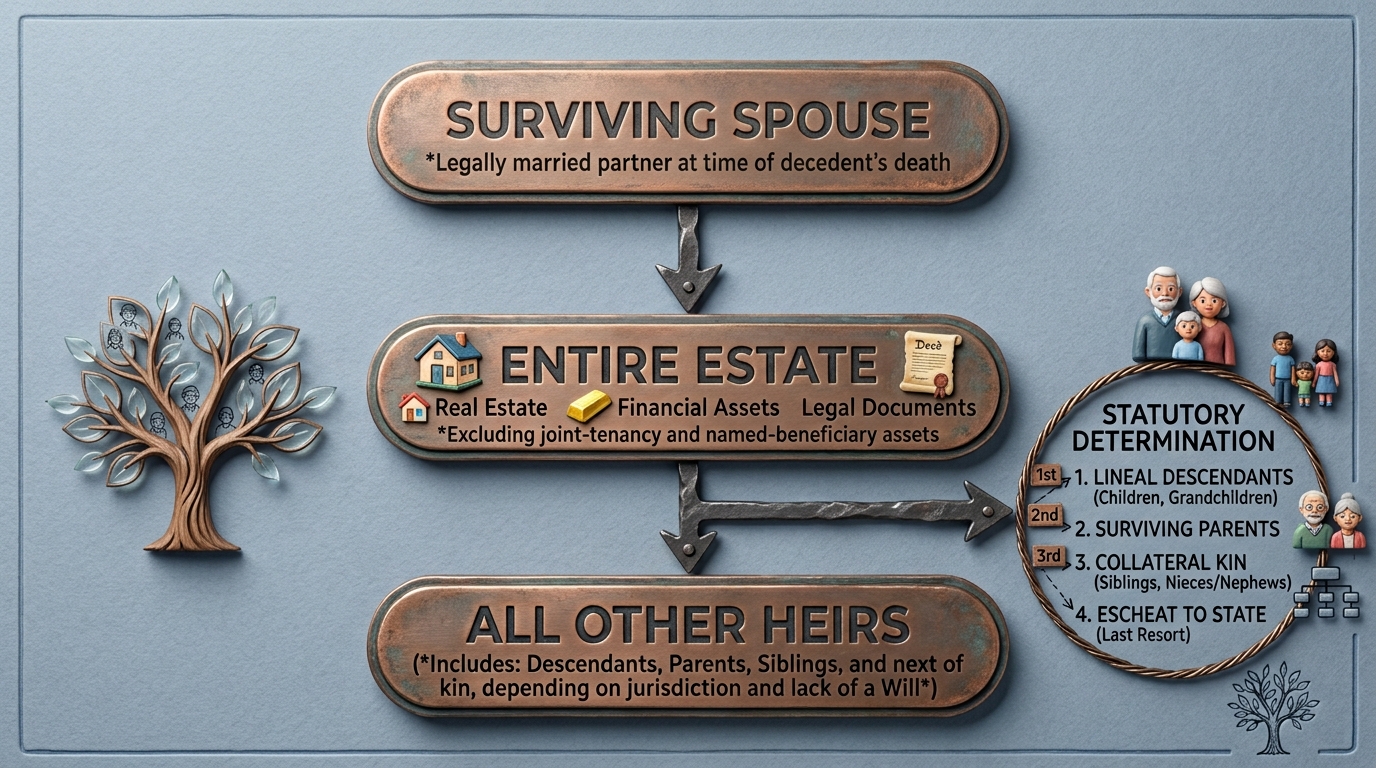
Florida’s rules do not give every relative an inheritance claim. A surviving spouse may receive the entire intestate estate in some families, while the spouse receives one half when certain descendants or blended family circumstances exist. If no spouse inherits the property, Florida law turns to descendants, parents, siblings, and progressively more remote relatives according to the hierarchy in § 732.103.
Florida Intestate Succession Hierarchy Structure
That hierarchy can produce results that surprise families. A half sibling can receive a different share from a whole blood sibling. A child who died before the decedent can leave a branch of descendants who inherit under the per stirpes rule. An alleged heir may have to prove the claimed family relationship before receiving anything. A distant relative may discover that being biologically related to the decedent does not place that person within a statutory class of heirs.
Florida law also treats some property differently from ordinary intestate assets. A jointly owned asset may pass through survivorship rights. A trust can control property outside the probate estate. A beneficiary designation can determine who receives certain financial assets. Florida homestead has its own inheritance rules that can change the analysis when a surviving spouse and descendants are involved.
The result is a legal question with several layers:
Who qualifies as an heir?
What share does that heir receive?
Is the property subject to intestate succession at all?
Those questions become particularly important when a Florida estate involves a blended family, disputed heirship, distant relatives, or a home owned by the decedent.
What Is Intestate Succession in Florida?
Intestate succession is the statutory process used to determine who inherits property that a Florida decedent did not effectively dispose of through a will.
Florida’s principal intestacy rules appear in Part I of Chapter 732 of the Florida Statutes. The provisions address the intestate estate, the surviving spouse’s share, the shares of other heirs, per stirpes inheritance, half blood relatives, afterborn heirs, escheat, adopted persons, children born outside marriage, and termination of parental rights.
The term therefore has a narrower legal meaning than “everything a person owned when they died.”
A person can die without a will while some assets pass through another legal mechanism. The intestacy statutes become relevant to property that remains subject to the statutory inheritance scheme.
Can someone have a will and still have an intestate estate?
Yes.
Florida Statute § 732.101 applies when part of an estate has not been effectively disposed of by will. A person can therefore leave a valid will while some property passes to heirs under intestate succession.
This is known as partial intestacy.
For example, a will might dispose of several assets but fail to provide an effective disposition for a particular piece of property. That property can pass under the intestacy statutes even though the decedent left a will.
That distinction matters throughout probate.
The relevant question is not simply whether a document called a will exists. The question is whether the will effectively disposes of the property at issue.
What Is Intestate Succession in Florida?
Florida intestate succession is the legal system that determines who receives property when a person dies without an effective will. Under Florida Statute § 732.101, property that is not effectively disposed of by a will passes to the decedent’s heirs under the intestacy statutes. The heirs’ rights to that intestate property vest at death.
The absence of a will does not mean that the estate has no legal rules governing inheritance. It means the legislature has supplied those rules.
Florida Statute § 732.102 addresses the surviving spouse. Section 732.103 determines who inherits the remaining estate when there is no surviving spouse or when the spouse does not receive the entire intestate estate. The result depends heavily on the decedent’s family relationships at the time of death.
That distinction matters because intestate succession applies only to property that actually belongs in the intestate estate. A person can die without a will while some assets pass through another legal mechanism. The ownership structure or beneficiary designation attached to an asset may determine what happens to it without applying the intestacy hierarchy.
Which Property Is Subject to Intestate Succession?
The first question in an intestate estate is not simply who the relatives are. It is whether the particular property passes through intestacy at all.
Florida Statute § 732.101 applies to property that was not effectively disposed of by will. This can include property that the decedent owned individually and that does not have another valid method of passing at death.
An asset may therefore fall outside the intestate estate because of the way it was owned or because another legal arrangement controls its transfer. For example, property held with another person in a form that carries a right of survivorship may pass to the surviving owner. Certain accounts and insurance policies may pass according to a valid beneficiary designation.
This distinction becomes particularly important when someone says that a deceased relative had “no will.” The absence of a will does not automatically mean that every asset must be divided under Chapter 732.
It is possible to have an estate with both intestate property and property that passes outside intestacy.
That situation is sometimes called partial intestacy. A will may also create partial intestacy if it fails to dispose effectively of some property. Florida law addresses the property that remains undisposed of through the intestacy statutes.
Who Inherits First Under Florida Intestacy Law?
The surviving spouse receives special treatment under Florida law.
If the decedent leaves no surviving descendants, the surviving spouse receives the entire intestate estate. The same result generally applies when every surviving descendant is also a descendant of the surviving spouse and the spouse has no descendant from another relationship.
The result changes when the family structure is different.
If the decedent has a surviving descendant who is not also a lineal descendant of the surviving spouse, the spouse receives one half of the intestate estate. The other half passes according to the rules governing the decedent’s descendants.
Florida law also addresses a less obvious blended family situation. Even if every surviving child of the decedent is also the spouse’s child, the spouse receives one half when the spouse has a descendant from another relationship who is not a descendant of the decedent.
Example: A Married Person With Children From Another Relationship
Suppose Maria dies without an effective will. She leaves a husband and two children. Both children are also her husband’s children.
If her husband has another child from a previous relationship, the statute treats the family differently from a marriage in which the surviving spouse has no children outside the marriage.
Under § 732.102, Maria’s husband receives one half of the intestate estate. The remaining half passes under the rules for Maria’s descendants.
This is one reason a simple statement such as “the spouse inherits everything” can be legally misleading.
What Happens If There Is No Surviving Spouse?
When there is no surviving spouse, Florida Statute § 732.103 supplies the succession rules.
The estate first passes to the decedent’s descendants. If the decedent has no descendants, the statute moves to the parents.
In some cases if neither parent survives, the statute reaches the decedent’s brothers and sisters and the descendants of deceased siblings.
If those relatives do not exist, the statute moves farther into the family tree. Florida divides this stage between the decedent’s paternal and maternal kindred. Grandparents receive priority within those branches. If the relevant grandparents are not living, the statute addresses aunts and uncles and the descendants of deceased aunts and uncles.
The statute does not continue indefinitely through every person who can establish some biological connection to the decedent.
That limitation became important in a recent Broward County case.
How Far Does Florida Intestacy Law Reach?
In State of Florida, Department of Legal Affairs v. Estate of Kyle William Bruening, the Fourth District Court of Appeal considered an intestate estate involving distant relatives.
Kyle Bruening died without a will. No spouse or children survived him. His parents and grandparents had also died, and there were no surviving siblings or aunts and uncles within the categories recognized by the statute. Several distant relatives claimed the estate because they shared great grandparents with Bruening.
The trial court treated those relatives as heirs. The Fourth District reversed.
The appellate court held that sharing great grandparents with the decedent did not place those relatives within a class of heirs recognized by § 732.103. The court explained that the statute identifies the relatives who inherit through intestacy and does not create a general right of inheritance for every distant blood relative.
The case arose in Broward County, which makes it particularly relevant to probate disputes in Coral Springs and elsewhere in South Florida.
The practical point is straightforward. A family connection is not enough by itself. The relationship must fall within a category recognized by Florida intestacy law.
What Does Per Stirpes Mean in Florida?
Florida Statute § 732.104 provides that intestate descent is per stirpes. The rule applies to descendants and to collateral heirs.
The concept becomes important when an heir who would have inherited directly has already died.
Consider a decedent who has two children. One child survives the decedent. The other child died before the decedent but left two children of their own.
The surviving child does not simply take the entire estate. The deceased child’s branch remains relevant. The descendants of that deceased child can receive the share attributable to that branch under the per stirpes rule.
This can produce a different result from dividing an estate equally among every living descendant. Florida law preserves the deceased heir’s branch when the statute reaches that branch of the family.
A family tree can therefore matter at several generations.
Can One Side of the Family Receive the Entire Estate?
Yes.
People sometimes miss this point because they assume that intestate property must always be divided equally between the maternal and paternal sides of the family.
Section 732.103 does not require that result when one side has no qualifying heirs.
In Faskowitz v. Department of Legal Affairs, the decedent had no surviving descendants. His will had attempted to leave his property to his wife, but she died before him and the will did not provide an alternate beneficiary. Relatives on the paternal side established their status as heirs. The probate court had treated half of the property as potentially belonging to unknown maternal relatives.
The Second District Court of Appeal rejected that approach. Under § 732.103, if there is no qualifying kindred on one side, the surviving kindred on the other side can receive the entire estate.
The case demonstrates why determining heirship requires more than locating one relative and assuming the estate will be divided along a simple family line.
What Happens If Family Members Disagree About Who Is an Heir?
Disputes over family relationships can easily turn an intestate estate contentious.
Florida Statute § 733.105 allows an interested person to ask the probate court to determine who is entitled to receive property or what share a person should receive when there is doubt about the proper beneficiaries.
That proceeding can require evidence about the decedent’s family history.
The Florida Supreme Court addressed this problem in State v. Rudawski, a case involving the estate of Jacob Tim. Tim died intestate in Miami Beach. More than fifty people appeared claiming different degrees of relationship to him. The court ultimately held that the claimants had failed to establish their entitlement to the estate.
The case illustrates a basic probate principle that can become decisive in an intestate estate: a person claiming inheritance must establish the legal basis for that claim.
A surname is not enough. A family story is not enough. The evidence must establish the relationship required by the applicable law.
Do Adopted Children Inherit Under Florida Intestacy Law?
Yes. Florida law generally treats an adopted person as a descendant of the adopting parent for purposes of intestate succession.
Section 732.108 provides that an adopted person becomes a descendant of the adopting parent and a member of that family for intestate succession purposes. The statute also contains specific exceptions involving certain adoptions by a natural parent’s spouse and other family relationships.
The details can matter when an adoption changes the legal relationship between the child and the natural family.
For that reason, a probate court may need to examine the adoption itself rather than relying on a family description used informally during the decedent’s lifetime.
What Happens With a Half Sibling?
Florida has a specific rule for half blood relatives.
When property passes to collateral relatives and some are related to the decedent by whole blood while others are related by half blood, the half blood relatives receive half as much as the whole blood relatives. If all of the relevant collateral relatives are half blood relatives, they receive equal shares.
This rule can matter when an estate reaches the sibling portion of the intestacy hierarchy.
For example, assume an intestate estate reaches the decedent’s siblings. When a surviving full sibling and a surviving half sibling both inherit, the statute does not automatically give them equal shares.
Therefore, you should calculate the shares under § 732.105 rather than treating every sibling as having the same statutory relationship.
Can a Child Born After the Parent’s Death Inherit?
Florida law expressly addresses this situation.
Under § 732.106, an heir who was conceived before the decedent’s death but born afterward inherits intestate property as though the child had been born during the decedent’s lifetime.
The timing of the birth therefore does not by itself eliminate the child’s inheritance rights.
Other legal questions can arise when parentage is disputed. Those questions should be addressed under the statutes governing the particular relationship rather than assumed from the family’s understanding of who the child’s parent was.

What Happens to a Florida Homestead When There Is No Will?
Florida homestead property requires separate attention because constitutional protections and Florida statutes impose special rules.
Section 732.401 provides that homestead generally descends under the intestacy rules when it has not been validly devised. When the decedent leaves a surviving spouse and descendants, however, the surviving spouse receives a life estate with a vested remainder in the descendants who were living at the decedent’s death. The spouse may instead elect an undivided one half interest as a tenant in common, with the remaining half passing to the descendants per stirpes.
This means a family home cannot always be treated like an ordinary asset in an intestate estate.
A surviving spouse may have rights that differ substantially from the result produced by simply dividing the home according to the general intestacy hierarchy.
The homestead rules also make property ownership particularly important. Before assuming that a house must be distributed through intestacy, the probate lawyer must determine how the property was titled and whether Florida’s homestead protections apply.
Can Intestate Succession Create Problems With a Family Home?
Yes.
Suppose a person dies in Coral Springs without a will and leaves a house to several descendants. Those heirs may acquire ownership interests in the property rather than receiving an automatic cash distribution.
The situation can become difficult when one heir wants to sell and another wants to keep the property. The heirs may also disagree about maintenance or the use of the house.
The problem can become larger with later deaths. An heir who receives an interest can later die without a will, causing that interest to pass through another estate. Over time, ownership can become divided among a growing number of relatives.
This is one reason intestate succession can have consequences long after the initial probate administration.
What Happens If No Legal Heir Can Be Found?
Florida law provides for escheat when a person dies without leaving anyone entitled to the estate.
Under § 732.107, property that has no person entitled to receive it can escheat to the State of Florida. The statute provides a procedure for handling the property and permits a person with a valid claim to seek the proceeds within the statutory period.
Escheat is not the first step merely because relatives are difficult to locate.
The question is whether a person legally entitled to inherit exists under the applicable statutes. Bruening demonstrates that a court will not expand the statutory categories simply because a distant relative can establish a biological connection.
Faskowitz demonstrates the other side of the problem. When qualifying heirs exist on one side of the family, the absence of qualifying heirs on the other side does not automatically send half the estate to the State.
Who Handles an Estate When There Is No Will?
An intestate estate still requires administration.
Florida law establishes a preference for appointment as personal representative in an intestate estate. The surviving spouse has the first preference. The statute then addresses selection by the heirs and the heir nearest in degree.
The personal representative is responsible for administering the estate under Florida probate law.
That role does not give the representative ownership of the estate. The representative administers property that belongs to the estate and distributes it according to the law after the required probate process has been completed.
A dispute over who should serve as personal representative can therefore be separate from a dispute over who inherits.
What If Nobody Knows Exactly Who the Heirs Are?
Florida provides a court procedure for this problem.
Under § 733.105, an interested person can petition the probate court to determine the beneficiaries or their respective shares when property passes through intestate succession and there is uncertainty about entitlement.
This can become relevant when relatives have incomplete records or when different family members provide conflicting accounts of the decedent’s family history.
The evidence may include civil records and other documentation establishing the claimed relationship. In a difficult estate, a genealogical investigation may also become necessary.
The objective is not to identify every person who might be related to the decedent. The objective is to establish the relatives who fall within the statutory categories of heirs.
What If the Person Had a Will That Did Not Cover Everything?
A person does not have to die completely intestate for the intestacy statutes to matter.
Section 732.101 applies to any part of an estate that was not effectively disposed of by will.
Imagine a will that leaves a particular bank account to one beneficiary but does not effectively dispose of the remainder of the estate.
The undisposed property can pass under Florida intestacy law.
This distinction matters when reviewing an older will after a death. The question is not simply whether the decedent signed a document called a will. The question is whether that document actually controls the property now at issue.
Why Intestate Succession Can Produce Surprising Results
Florida intestacy law follows statutory categories rather than the family’s idea of what would have been fair.
A decedent may have been especially close to a niece while having little contact with a sibling. That does not allow the niece to inherit simply because the relationship was closer.
A person may have supported one child financially during life while providing little support to another. Intestacy law does not generally adjust the statutory inheritance share because the family considers one relationship stronger.
The statute applies the legal relationships recognized by the Probate Code.
That is why the consequences can feel unexpected when a family has never discussed estate planning.
What Should a Family Do After Someone Dies Without a Will?
The first step is to determine what property actually belongs in the probate estate.
The next question is who may have inheritance rights under Florida law. That inquiry should account for the surviving spouse and the decedent’s descendants before moving farther into the family tree.
The family should also determine whether the decedent owned a Florida homestead. That property can be subject to special rules that change the ordinary intestacy analysis.
If relatives disagree about heirship, the probate court can determine who is entitled to the property and what share each person should receive. Section 733.105 specifically provides a procedure for resolving that uncertainty.
In Coral Springs and elsewhere in Broward County, these questions can arise in estates involving a family home, multiple generations, or relatives who have lived in different states for many years.
Waiting can make the factual investigation harder. Birth records may be difficult to locate. Family members may have incomplete information. Property may remain titled in the decedent’s name while relatives disagree about what should happen next.
A Florida probate attorney can review the ownership records and family relationships against the applicable statutes before the estate is distributed.
Frequently Asked Questions About Florida Intestate Succession
Who inherits if someone dies without a will in Florida?
- The answer depends on the decedent’s surviving relatives and the property involved. A surviving spouse may receive the entire intestate estate or one half, depending on the family structure. If no spouse survives, descendants generally take priority under § 732.103.
Does the oldest child inherit more under Florida intestacy law?
- No. Age does not give the oldest child a larger intestate share. When descendants inherit directly, Florida applies its statutory distribution rules.
Does a surviving spouse always inherit everything?
- No. The surviving spouse receives the entire intestate estate in several situations, but § 732.102 reduces the spouse’s share to one half in specified family structures involving descendants.
Do grandchildren inherit if their parent is alive?
- Generally, the inheritance hierarchy reaches the decedent’s descendants directly before moving to more remote relatives. The per stirpes rule becomes particularly important when a descendant who would have inherited has already died.
Can a niece or nephew inherit from an aunt or uncle who dies without a will?
- A niece or nephew may inherit when the intestacy hierarchy reaches the descendants of a deceased sibling. The exact result depends on which relatives survive the decedent and how the statutory branches apply.
Can a second cousin inherit under Florida intestacy law?
- Usually not merely because the person is a second cousin. In Bruening, the Fourth District held that relatives who shared great grandparents with the decedent did not fall within the statutory class of heirs applicable to that estate.
Do adopted children inherit from their adoptive parents?
- Yes. Florida generally treats an adopted child as a descendant of the adopting parent for intestate succession. The statute contains specific exceptions that can affect relationships with natural family members.
Does a half sibling inherit the same amount as a full sibling?
- Not always. When the relevant collateral heirs include both whole blood and half blood relatives, Florida law gives a half blood relative half the share of a whole blood relative.
What happens to a Florida house when the owner dies without a will?
- The answer depends on the ownership of the property and the circumstances of the family. Florida homestead law contains special inheritance rules when a surviving spouse and descendants exist.
Can the State of Florida inherit an intestate estate?
- Yes, but only when the statutory conditions for escheat are satisfied. If someone legally entitled to the estate exists under Florida law, the property does not simply pass to the State because the family is difficult to identify.
What if family members disagree about who should inherit?
- An interested person can ask the probate court to determine who is entitled to the property or what share each person should receive. Florida Statute § 733.105 provides the procedure for that determination.
Florida Intestate Succession Requires a Property and Family Analysis
Dying without a will does not leave an estate without rules. Florida law supplies a statutory inheritance system that begins with the surviving spouse and descendants before reaching more remote relatives.
The difficult cases arise when the family structure is complicated or the property does not fit neatly into the ordinary probate estate. Homestead property can require a separate analysis. A distant relative may have a biological connection without having a statutory right to inherit. A surviving relative on one side of the family may receive the entire estate when the other side has no qualifying heirs.
For families in Coral Springs and Broward County, an intestate estate should be examined under the current Florida statutes before property is distributed. The right heir may not be the person the family expects, and the property that appears to belong to the estate may not all be subject to intestate succession.