Yes. An online will can be legally valid in Florida, provided it satisfies the state’s requirements for execution and complies with the law governing the type of will being used. A document generated by a website does not become valid simply because it looks official or contains the right language.
The more difficult question is whether the document actually accomplishes what its creator intends. A DIY will may be signed incorrectly, overlook how certain assets transfer at death, or fail to account for a family situation that does not fit the template. Some of these problems may remain invisible until the person who created the will can no longer explain what they meant.
For people in Coral Springs and Broward County, the practical decision is not necessarily whether to use an online service or hire an attorney for every task. It is whether the proposed document fits the person’s circumstances and whether the consequences of a drafting or execution error justify professional review.
Key points to know:
- Florida generally requires a conventional will to be in writing and signed under specific witness formalities.
- Notarization alone does not replace the required witnesses.
- A valid will does not necessarily control every asset or avoid probate.
- Florida recognizes electronic wills, but they must follow a separate statutory framework.
- A will that is legally valid can still be unsuitable for the person’s family or financial circumstances.
Are Online Wills Legal in Florida?
Florida law does not prohibit someone from using an online service to prepare a will. The source of the document is not the decisive issue. The important questions are whether the will meets Florida’s legal requirements and whether its provisions work as intended.
Someone may use a website to prepare a conventional paper will, print it, and sign it in accordance with Florida law. That is different from signing a document electronically and assuming that a saved PDF qualifies as a valid electronic will.
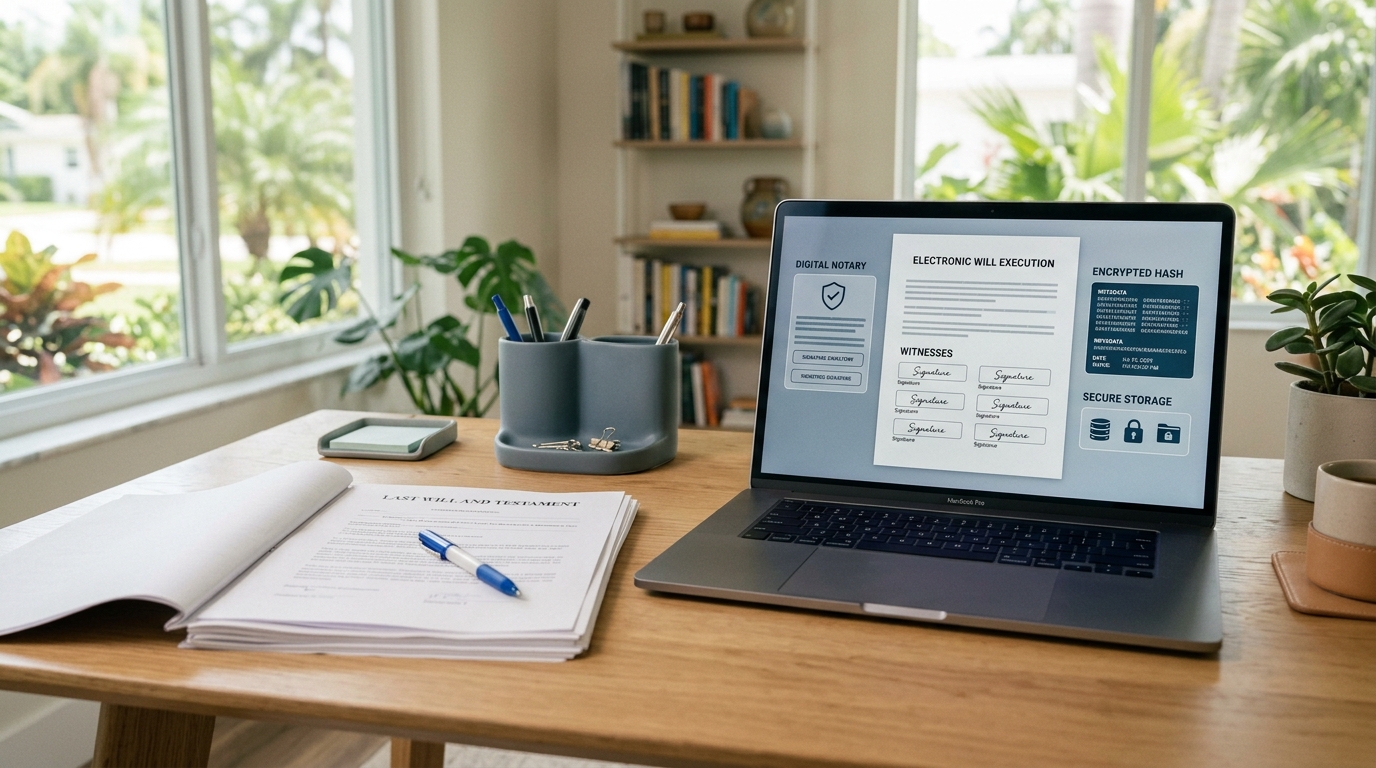
Florida has a separate legal framework for electronic wills under sections 732.521 through 732.525 of the Florida Statutes. That framework addresses electronic signatures and the procedures used to execute and preserve an electronic will. The requirements are more specific than simply typing a name into a document or storing it online.
The distinction matters because an online will service may offer a document that looks complete while leaving the user responsible for the legal steps that make it effective. The user must understand which execution process applies to the document they have prepared.
The American Bar Association’s Section of Real Property, Trust and Estate Law has warned that DIY estate planning can create a false sense of security. Its concern is not that every online will is invalid. The risk is that a person may believe an estate plan is finished without recognizing that an important legal or practical issue remains unresolved.
What Does Florida Require for a Valid Will?
Florida’s conventional will requirements are set out in section 732.502 of the Florida Statutes. The rules are formal because a will is intended to determine how property is handled after its maker has died, when that person can no longer clarify their wishes.
In general, a person making a conventional Florida will must:
- Put the will in writing.
- Sign at the end of the document, subject to the statutory alternative involving another person signing at the testator’s direction and in the testator’s presence.
- Sign the will, or acknowledge the existing signature, in the presence of at least two attesting witnesses.
- Have the witnesses sign in the presence of the testator and each other.
Florida law also generally requires the person making the will to be at least 18 years old or an emancipated minor and to be of sound mind when signing.
These requirements are not decorative formalities. They determine whether the document can function as a will under Florida law. A website can generate suitable wording, but the user must still follow the execution rules that apply to the document.
Does a Florida will have to be notarized?
A conventional Florida will does not become valid simply by being notarized. The required witnessing process remains essential.
Notarization is commonly used as part of the self-proving procedure. Under section 732.503, the testator and witnesses can complete the required acknowledgments and affidavits before an authorized officer. A properly self-proved will can generally be admitted to probate without the additional proof otherwise required from a witness, subject to statutory exceptions.
Self-proving status can make the later probate process easier. It does not replace the normal signing and witnessing requirements.
This is an important distinction for someone following online instructions. Having a notary stamp a document does not automatically correct a failure to execute the will properly.
Can a relative or beneficiary witness a will?
Florida law addresses who may serve as a witness under section 732.504. An interested witness does not automatically invalidate a will merely because that person may benefit from it.
That does not mean choosing a beneficiary as a witness is always a good practical decision. When a family member stands to receive property under a will, the circumstances can invite questions about influence or the testator’s intentions. Independent witnesses may help avoid unnecessary disputes.
A person using a DIY form should not assume that a witness arrangement is safe merely because a website allows the names to be entered.

What Can Go Wrong With a DIY Will?
The most consequential mistakes are often not obvious grammatical errors. They involve the legal effect of the document or a gap between what the person intended and what the document actually accomplishes.
1. The will is never executed correctly
A document may be carefully prepared and still fail because the testator or witnesses did not follow the statutory procedure.
Florida Supreme Court case law illustrates why this matters. In Allen v. Dalk, 877 So. 2d 800 (Fla. 2002), the court considered a will that had not been validly executed. The document expressed the deceased person’s apparent intention, but the court rejected the argument that a constructive trust could be imposed to give effect to the intended disposition.
The case did not concern an online will service. Its relevance is more fundamental: clear evidence of what someone wanted does not automatically cure a will’s failure to meet Florida’s execution requirements.
Imagine a person prepares a will using an online template and leaves most of their estate to a close friend. The friend knows the person intended to sign the document, and other relatives agree that the plan reflected those wishes. If the will was not executed in the manner required by law, those facts may not be enough to make it valid.
The resulting dispute can require court proceedings while the estate remains unresolved. The intended beneficiary may ultimately receive nothing under the defective document.
2. The document does not fit the person’s family
Many templates ask users to select beneficiaries and name a personal representative. Those fields may not adequately address a complicated family situation.
A second marriage can create competing expectations between a surviving spouse and children from an earlier relationship. A person with minor children may also need to consider who should serve as guardian if a court appointment becomes necessary.
Florida law contains specific rules affecting wills after events such as marriage or divorce. Section 732.507 addresses certain effects of these changes, but the result depends on the circumstances. A person should not assume that an old will will operate exactly as originally written after a major family change.
The problem may not be an invalid document. It may be a document that remains legally effective while producing a result the testator no longer wants.
3. The will does not control the assets the person expects
A will generally governs property that forms part of the probate estate. Certain assets may pass under a separate legal arrangement.
For example, life insurance or a retirement account may transfer according to its beneficiary designation. Property held with a valid right of survivorship may pass to the surviving owner. Assets held in a properly funded trust may be governed by the trust rather than by the will.
This creates a practical risk for someone who prepares a will without reviewing how their assets are titled. They may name one person as the beneficiary in the will while an older beneficiary designation directs an account to someone else.
The will may be valid, yet the overall plan may not produce the intended result.
4. The person assumes that a will avoids probate
A will provides instructions for the disposition of property covered by the will. It does not automatically remove that property from probate.
When probate administration is required, the court oversees the applicable process. The personal representative must be appointed and obtain the authority required to administer the estate. A will may help direct that process, but it is not a substitute for it.
Someone whose main goal is to avoid probate should understand which assets are likely to pass through the probate estate. A will alone may not achieve that goal.
5. The person changes the signed document informally
After signing a will, someone might cross out a beneficiary’s name, write in a new one, or add a handwritten instruction in the margin.
The Florida Bar’s consumer guidance warns that writing on an executed will can invalidate part or all of it. Changes generally need to be made through a properly executed new will or codicil, which is a formal amendment to an existing will.
The safer approach is not to assume that a handwritten correction will be honored. The change should be made using a method that complies with Florida law.
6. The will ignores undue influence or other challenges
Florida Statutes section 732.5165 addresses wills or portions of wills procured by fraud, duress, mistake, or undue influence.
A DIY document does not automatically create these problems. However, a will that significantly changes an established estate plan may attract scrutiny if the circumstances surrounding its preparation are questionable.
Consider an older adult who depends on a relative for daily assistance. The relative helps prepare an online will and receives a substantial gift under the new document. If other family members later challenge the will, the circumstances may become relevant to whether the document was procured through improper influence.
The statutory issue is fact specific. A family disagreement by itself does not prove undue influence, and a large gift is not automatically unlawful. The point is that a template cannot resolve the underlying questions that may arise when a will is challenged.
What Do the Statistics Say About Estate Planning?
National survey data helps explain why online wills appeal to people who have not completed an estate plan. It also shows why convenience and completion are separate issues.
According to Caring.com’s 2025 Wills and Estate Planning Survey, conducted with YouGov, 24% of surveyed American adults reported having a will. The survey included more than 2,500 adults and was conducted online from January 3 to 6, 2025. Among respondents without a will, 43% said they simply had not gotten around to making one.
These are national survey findings, not estimates for Florida residents or proof that online wills are less reliable than attorney-prepared wills. They do, however, illustrate a practical obstacle: many people delay estate planning even when they recognize its importance.
Cost and perceived need can also affect the decision. Caring.com’s 2024 survey reported that 40% of respondents without a will cited having insufficient assets as a reason. That figure should be understood in the context of that survey’s sample and questions, rather than treated as a universal explanation.
The assumption that estate planning matters only to wealthy people can be misleading. A person with modest assets may still want to direct the distribution of property or nominate a personal representative. Parents may also want to express their preferences regarding a guardian for minor children.
The more useful question is not whether a person has a large estate. It is whether the consequences of leaving decisions to default legal rules are acceptable to that person.
When Might an Online Will Be Insufficient?
An online will may be a reasonable starting point for someone with a straightforward situation. For example, a person with modest assets who wants to leave probate property to a close relative may have fewer issues to resolve than someone with a blended family or a complex asset structure.
Even then, the document must be executed correctly. Simplicity does not remove Florida’s legal requirements.
Professional review becomes particularly useful when the estate plan must account for circumstances such as:
- Children from different relationships or a recent marriage.
- A beneficiary who is a minor or may need assistance managing an inheritance.
- Property held jointly with another person.
- A business interest or real estate ownership arrangement.
- A significant change to an earlier will.
- Concerns that someone may challenge the document.
These circumstances do not automatically make an online will invalid. They can, however, make a standard template less likely to address the person’s needs fully.
The American Bar Association’s guidance on DIY estate planning recognizes that self-prepared documents may work in limited situations. It also warns that generic forms may overlook state law details or fail to coordinate assets that pass outside a will.
The issue is not that every person needs the most elaborate estate plan available. It is that a document should be judged by how well it fits the person’s circumstances, rather than by how quickly a website can generate it.
Can You Make an Electronic Will in Florida?
Yes. Florida law recognizes electronic wills, but the rules differ from those governing conventional paper wills.
Sections 732.521 through 732.525 of the Florida Statutes address electronic wills and related requirements. The statutory framework includes electronic signatures and the use of a qualified custodian under the circumstances specified by law.
An electronic will should not be confused with a paper will that was drafted online. Printing a website-generated document and signing it as a conventional will invokes the rules for a paper will. Signing electronically invokes the separate electronic-will framework, which must be followed as applicable.
A person considering an electronic will should confirm that the service supports Florida’s legal requirements. They should also understand how the executed document will be preserved and made available after death.
Keeping a PDF in an email account or cloud folder is not, by itself, proof that an electronic will has been validly executed or preserved under Florida law.
What Happens to a Will After the Person Dies?
Preparing a will is only one part of the process. The document must be available when needed, and the estate may still require probate administration.
Florida Statutes section 732.901 addresses the delivery of a will to the appropriate clerk of court. A person who has custody of a will must generally deposit it within 10 days after receiving information that the testator has died. Depositing the will is not the same thing as completing probate or distributing the estate.
The next steps depend on the estate and the applicable procedure. In a formal administration, the court determines whether the will can be admitted to probate and appoints a personal representative. That representative then receives the authority needed to administer the estate.
A self-proved will can generally be admitted without further proof of execution, subject to legal exceptions. If the will is not self-proved, additional proof may be required under the applicable rules.
This is one reason it is important to keep the executed will safe and make sure someone knows where to find it. A document that cannot be located when needed can create avoidable complications for the people left to administer the estate.
How to Check a DIY Will Before Relying on It
Someone who has already prepared an online will can use the following questions as a preliminary review. This checklist cannot certify that a will is valid, but it can help identify issues that deserve attention.
- Execution: Was the document signed in accordance with the rules that apply to a conventional or electronic will?
- Witnesses: For a conventional will, did the required witnesses participate in the manner prescribed by Florida law?
- Beneficiaries: Do the intended recipients match the person’s current wishes?
- Assets: Are there beneficiary designations, survivorship arrangements, or trust assets that may pass outside the will?
- Personal representative: Is the named person eligible and willing to serve?
- Family circumstances: Has a marriage, divorce, birth, adoption, or other major change affected the plan?
- Storage: Can the executed document be found when it is needed?
- Updates: Have any changes been made through a legally appropriate process rather than informal handwritten edits?
If any answer is uncertain, the person should avoid assuming that the document will work as intended. Reviewing the issue before a death occurs is generally more practical than leaving the question for relatives to resolve during probate.
Should You Use an Online Will or Consult an Estate Planning Attorney?
The decision depends on the person’s circumstances and tolerance for risk.
An online service may offer a convenient way to prepare a basic document. It cannot guarantee that the will has been executed properly, that every asset is coordinated with the plan, or that the document addresses an unusual family situation.
A lawyer can review the legal effect of the proposed provisions and identify issues that a generic form may not address. That review may be especially valuable when the person owns real estate, has children from different relationships, or wants to make a significant change to an existing estate plan.
Preparing for a consultation can also help control the time involved. A person can gather information about their assets and liabilities, locate existing estate documents, and think through whom they want to benefit. Having those materials available gives the attorney a clearer starting point.
For residents of Coral Springs and Broward County, the sensible approach is to assess the actual estate plan rather than assume that every online will is defective or that every estate requires a complex legal arrangement.
Frequently Asked Questions
Can I make a will in Florida without hiring a lawyer?
- Yes. Florida law does not generally require a person to hire an attorney to prepare a conventional will. The document must still comply with the applicable legal requirements. Whether a DIY document is suitable depends on the person’s circumstances and the plan’s intended effect.
Is an online will legally binding in Florida?
- It can be. A website-generated will must satisfy the requirements that apply to the type of document being used. A conventional paper will must follow Florida’s signing and witnessing rules. An electronic will must comply with the separate statutory framework for electronic wills.
Does a Florida will have to be notarized?
- Notarization alone is not enough to make a conventional Florida will valid. The will must satisfy the applicable execution requirements, including the witness formalities. Notarization may be part of the additional procedure used to make a will self-proving.
What if I signed my will incorrectly?
- The effect depends on what went wrong and the applicable facts. A defect may prevent the document from being admitted as a valid will. In Allen v. Dalk, the Florida Supreme Court rejected an attempt to use a constructive trust to carry out the intended disposition under an invalidly executed will. A person who suspects an execution problem should have the document reviewed rather than assume the defect can be corrected after death.
Can I change an online will after signing it?
- You can generally change your estate plan while you have the legal capacity to do so, but the change must follow the applicable formalities. Florida’s consumer guidance warns against relying on handwritten edits or crossed-out provisions in an executed will. A new will or properly executed codicil may be appropriate, depending on the situation.
Does having a will let my family avoid probate?
- No. A will generally directs the disposition of property that is part of the probate estate, but it does not automatically eliminate probate. Whether an asset passes through probate depends on how it is owned and whether a separate transfer arrangement applies.
What is the difference between a paper will prepared online and an electronic will?
- A paper will prepared online is printed and executed under the rules for a conventional will. An electronic will is executed electronically under Florida’s specific statutory framework. Saving a document as a PDF does not, by itself, establish that it qualifies as a valid electronic will.
Should I have an attorney review a will I already made online?
- A review can be useful if you are uncertain about the signing procedure or if your circumstances have changed since you prepared the document. It may also help identify assets or family arrangements that the will does not address. The need for review depends on the details of the plan.
Review Your Estate Plan Before Your Family Has to Rely on It
An online will can be a legitimate starting point, but generating a document is not the same as confirming that it will carry out your wishes. Execution errors can undermine an otherwise carefully prepared will. A plan can also leave important questions unresolved even when the document is legally valid.
If you live in Coral Springs or elsewhere in Broward County and want to understand whether your will addresses your circumstances, MyPersonalAttorneys can help you review your estate planning options under Florida law.
Call 954-334-1520 to discuss your situation and determine whether a review of your existing documents may be appropriate.
This article provides general information about Florida law and is not a substitute for legal advice concerning an individual estate plan.