
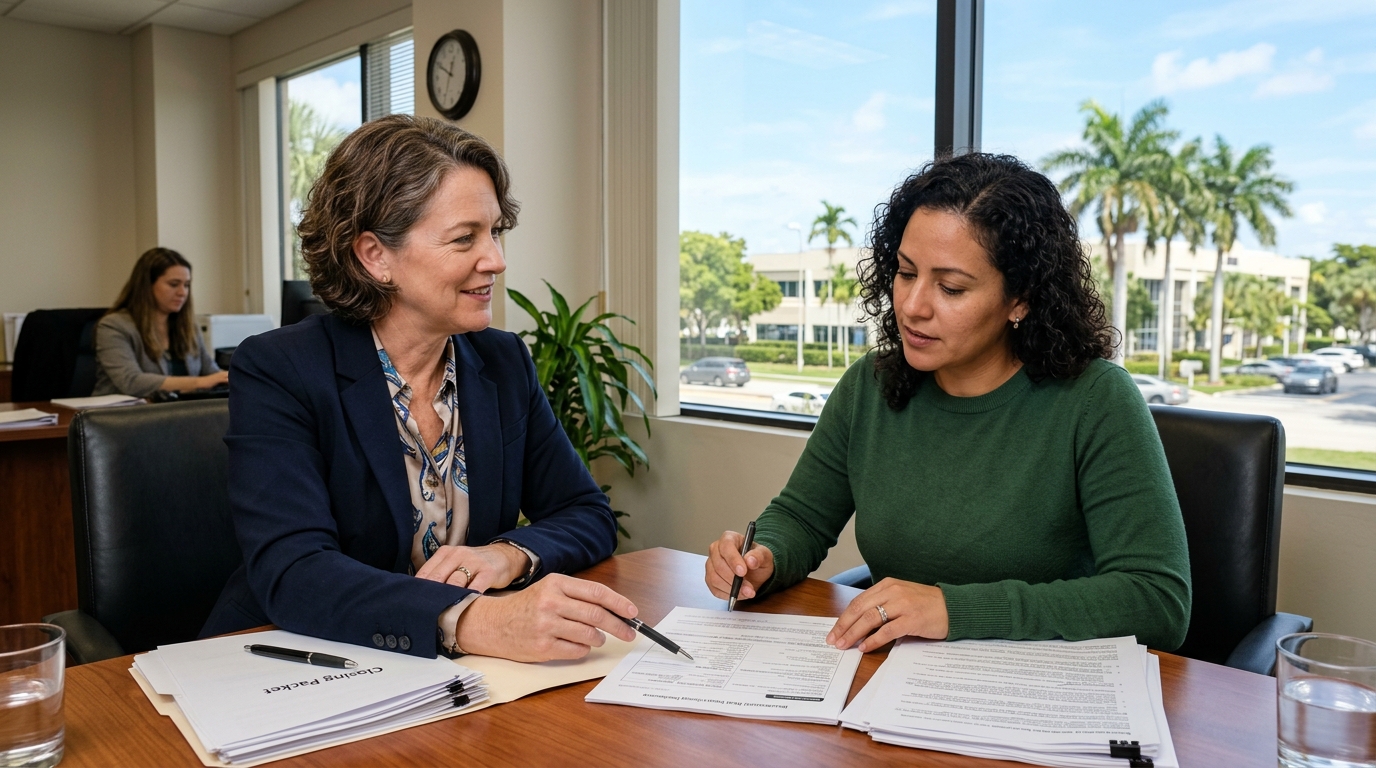
No. Florida does not require an attorney to be present at every real estate closing.
That is the straightforward legal answer. But it does not necessarily answer the more useful question: what can an attorney do for you that the ordinary closing process does not?
Florida law allows licensed title insurers, title agents and agencies, and attorney agents to perform authorized closing services. Those services can include preparing documents, conducting the closing, and handling the disbursement of funds. Title professionals also handle the title work involved in determining insurability and addressing underwriting requirements.
That is the legal baseline. It is not a statement that legal representation is unnecessary.
Perhaps you have been told that the title company will “take care of everything.” Perhaps a title commitment has arrived and you are unsure which parts deserve attention. Or perhaps you have bought property before without an attorney.
For whatever reason brought you here, the useful question is not simply whether Florida requires a lawyer. It is what legal work needs to be done, who is responsible for doing it, and whose interests that person represents.
Does Florida Require a Real Estate Attorney at Closing?
No. Florida does not make independent legal representation a condition of closing a real estate transaction.
A title company or other authorized closing agent can perform substantial work on the transaction. Florida’s title insurance statutes recognize closing services that include preparing necessary documents, conducting the closing, and handling the disbursement of funds. The law also recognizes title services involving title information, underwriting requirements, title commitments, and policies.
That is what the law permits.
The Florida Bar’s consumer guidance, however, recommends consulting an experienced Florida licensed real estate lawyer before signing a purchase contract. It also emphasizes the importance of proper legal representation of a buyer’s or seller’s interests throughout the transaction.
The timing matters. A lawyer who becomes involved before the contract is signed can address issues while they are still negotiable. A lawyer who first sees the transaction at closing is working with a much narrower set of options.
What Does a Real Estate Attorney Do at Closing?
An attorney may represent a buyer or seller independently, or may also act as a title or closing agent. The roles can overlap, but they are not necessarily the same.
When an attorney represents you, the legal work may include:
- Reviewing and negotiating the purchase contract
- Explaining provisions affecting your rights and obligations
- Reviewing the title commitment and title exceptions
- Examining liens, judgments, easements, restrictions, and ownership issues
- Reviewing deeds and other legal documents
- Addressing condominium or homeowners’ association issues
- Coordinating with the title company, lender, broker, surveyor, and other professionals
- Advising you when a legal problem arises before closing
The distinction is important.
A closing agent can be responsible for conducting the transaction correctly. An attorney representing you can also answer a different question:
Is what you are being asked to sign actually in your legal interest?
What Does a Title Company Do?
A title company performs important work. It is not simply an administrative participant.
Florida law defines closing services to include preparing documents necessary to close, conducting the closing, and handling the disbursement of funds. Title services can include determining insurability based on title information, addressing underwriting objections and requirements, and preparing title commitments and policies.
A title search may reveal mortgages, liens, judgments, easements, restrictions, defects in recorded documents, or questions concerning the chain of ownership.
Many title issues can be resolved without litigation. Some cannot.
This is where title services and independent legal representation become different things.
A title professional may identify an issue and determine what is required for the title insurer to proceed. An attorney representing you can advise what the issue means for your rights and what legal options may be available.
Is a Title Company the Same as a Real Estate Attorney?
No.
There can be substantial overlap, particularly because an attorney may also act as a title agent or closing agent. But the fact that a title company can perform important legal and transactional functions does not mean it is automatically acting as your personal legal counsel.
The distinction becomes obvious when a problem appears.
Suppose a title search reveals an old judgment. Or a deed contains an error. Perhaps the seller’s ownership is connected to an estate. Or a former spouse may have an interest in the property.
The title agent can identify the problem and explain what is required for the title insurer to proceed.
But there may be a separate question:
What should you do about it?
That is a legal question.
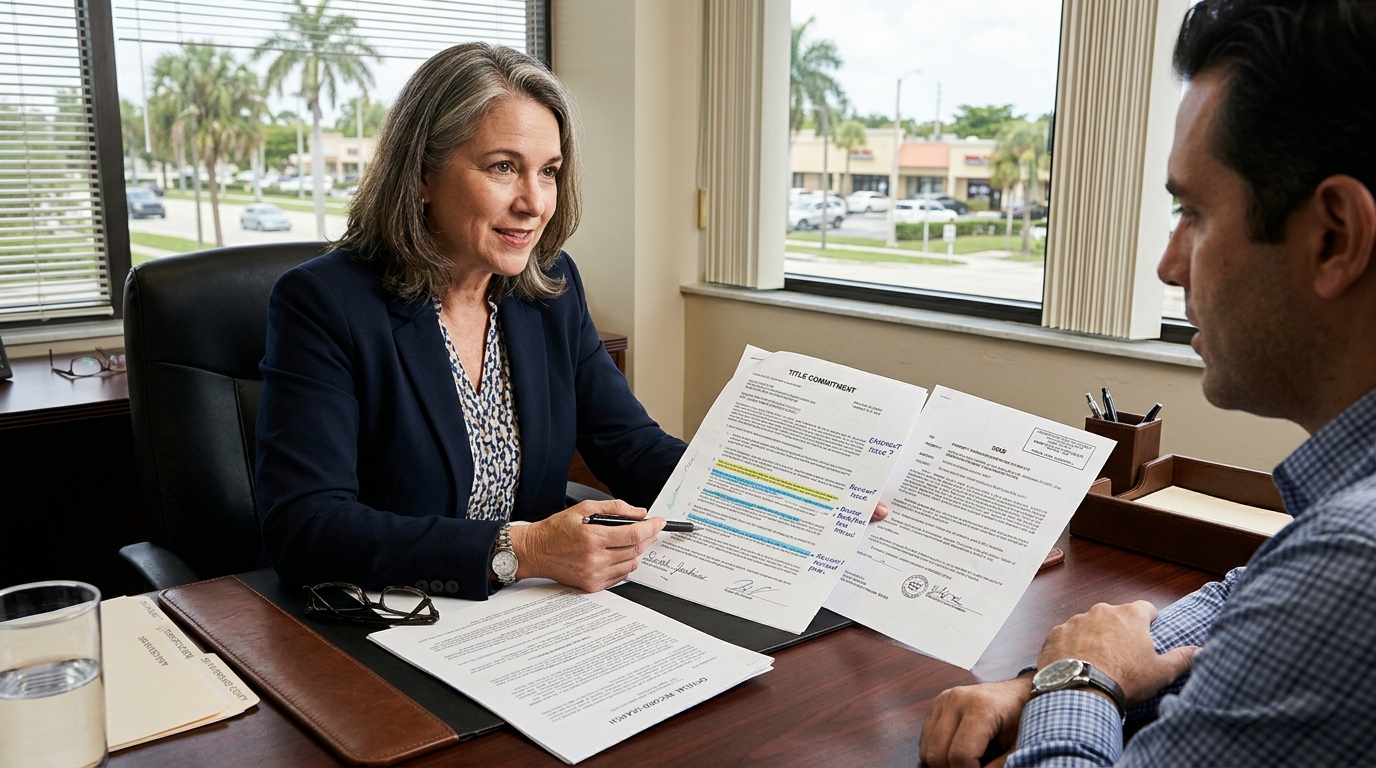
What Happens If the Title Search Finds a Problem?
The phrase “title problem” covers a wide range of circumstances.
An old mortgage that was never properly released is one thing. A dispute over who actually owns the property is another. One may be resolved with documentation. The other could require litigation.
A Florida case illustrates why the distinction matters.
Endruschat v. American Title Insurance Co.
In Endruschat v. American Title Insurance Co., two buyers purchased property intending to convert it into a dental clinic. They did not obtain their own legal counsel and relied on the title company involved in the transaction.
A recorded restriction limiting the property’s use to a single-family residence was not identified in the title materials. The problem was later discovered, construction was halted, and the buyers ultimately had to retain attorneys to resolve the title issue.
The case does not establish that every purchaser must hire an attorney. It illustrates something more specific:
Knowing what appears in the public record and understanding what that information means for your particular transaction are not always the same task.
If you are purchasing property for a particular purpose, a restriction that looks minor on a title document may be anything but minor to you.
What Responsibilities Does a Closing Agent Have?
It would also be inaccurate to portray a title company as a passive participant that simply collects signatures.
In Florida Southern Abstract & Title Co. v. Bjellos, the buyers’ contract required a negative termite inspection. The title company’s closing agent received documentation that did not establish that the contractual condition had been satisfied, yet the transaction proceeded. The buyers later discovered a substantial termite infestation.
The appellate court held that the title company, having undertaken to supervise the closing, was required to perform that role with reasonable care. But the court also drew an important boundary: it did not hold that the title company had to provide a legal opinion about the sufficiency of every document presented at closing.
That distinction is worth remembering.
A closing agent has responsibilities. An attorney representing a client has responsibilities to that client. Those responsibilities can intersect without becoming identical.
What Does a Real Estate Attorney Review Before Closing?
In many transactions, some of the most valuable legal work happens before the closing itself.
The purchase contract
The contract establishes the obligations of the buyer and seller. It can address price, deposits, financing, inspections, repairs, title, possession, default, and other matters.
An attorney can explain what those provisions mean and negotiate changes before they become binding obligations.
The title commitment
The title commitment identifies requirements that must be satisfied and exceptions to the coverage the title insurer proposes to provide.
Some exceptions are routine. Others deserve closer attention.
An attorney can help determine whether a title issue should be accepted, corrected, negotiated, or investigated further.
The deed
The deed conveys the property. Its language, the identity and authority of the grantor, and the circumstances of the transfer can all matter.
The closing statement
Purchase price, deposits, credits, prorations, taxes, mortgage payoffs, title charges, recording fees, and other costs must be accounted for.
When those figures are affected by a contractual dispute, payoff problem, title issue, or other legal question, legal review can become important.
When Is a Real Estate Attorney Particularly Important?
There is no statutory purchase price at which Florida suddenly requires a lawyer. The circumstances are more important than the number.
Legal representation deserves particular consideration when:
- The property has a complicated or disputed title history
- There are liens or judgments
- The property is being transferred through an estate or trust
- Divorce or marital ownership affects the property
- Multiple owners disagree about the transaction
- A business entity owns the property
- The contract contains unusual provisions
- The transaction involves seller financing
- There is a boundary or survey dispute
- A condominium or homeowners’ association issue affects the transaction
- A party is involved in bankruptcy or another legal proceeding
- A significant problem appears shortly before closing
These circumstances do not automatically mean that litigation is coming.
They mean the transaction deserves closer legal attention.
Do I Need an Attorney If I Already Have a Real Estate Agent?
A real estate agent and a real estate attorney perform different functions.
An agent may help locate the property, negotiate the transaction, coordinate inspections, and communicate with the other side.
An attorney can analyze the legal implications of the transaction, advise a client about legal rights and obligations, negotiate legal provisions, and provide legal representation when an issue arises.
The same principle applies to the title company.
Several professionals can be involved in a transaction without performing the same role or representing the same interests.
What Should I Ask Before Hiring a Real Estate Attorney?
If you are considering legal representation, ask what the attorney will actually do.
- Will the attorney review the purchase contract?
- Will the attorney represent only me?
- Will the attorney also act as the closing agent?
- Who handles title objections?
- Will the attorney review the title commitment?
- Will the attorney attend the closing?
- What happens if a legal problem appears shortly before closing?
- Are legal fees separate from title insurance and other closing costs?
- Does the representation include contract negotiation?
These questions prevent a common misunderstanding:
“There is an attorney involved” does not necessarily tell you what that attorney is doing for you.
The scope of the representation matters. So does the timing.
Why Legal Advice Can Matter Before the Closing Table
There is a familiar image of the real estate attorney as the person who appears at the end of the transaction, reviews a stack of documents, and sits beside everyone while the signatures happen.
Sometimes that is exactly what the lawyer does.
But some of the most consequential work may happen weeks earlier.
A contract can be negotiated before it is signed. A title problem can be investigated before the parties are committed to a closing date. An ownership question can be addressed before the moving truck is booked. A questionable provision can be changed before it becomes an obligation.
Once everyone is sitting at the closing table, those options may be considerably narrower.
Florida law does not require an attorney at every real estate closing.
It also does not eliminate the legal questions that arise in a real estate transaction.
That is where independent legal representation can matter.
Frequently Asked Questions
Do I legally need a real estate attorney at closing in Florida?
- No. Florida does not require an attorney to be present at every real estate closing. Authorized title professionals can perform permitted closing services.
Can a title company close a Florida real estate transaction without an attorney?
- Yes. Florida law permits authorized title professionals to perform closing services, including preparing documents, conducting the closing, and handling disbursement of funds.
Is a title company the same as a real estate attorney?
- No. A title company can perform title and closing services, while an attorney representing a client can provide independent legal advice and representation. An attorney may also act as a title or closing agent.
Should I have an attorney review my Florida purchase contract?
- The Florida Bar recommends consulting an experienced Florida licensed real estate lawyer before signing a purchase contract.
What happens if a title problem is found before closing?
- It depends on the problem. Some issues can be corrected through documentation or other routine measures. Others may require negotiation, further investigation, or litigation.
Can an attorney handle both title work and the closing?
- Yes. Florida law recognizes attorneys acting as title agents in connection with closing services.
Real Estate Closings in Coral Springs and Broward County
If you are buying or selling property in Coral Springs, the closing may involve a real estate agent, title company, lender, surveyor, inspector, and other professionals.
That is normal.
What is less obvious is who is responsible for answering which questions.
A title agent may be handling title and closing. A lender has its own requirements. A real estate agent has a different professional role. An attorney representing you is there to address your legal interests.
The distinction matters throughout Broward County and South Florida, particularly when a transaction involves an estate, multiple owners, liens, financing complications, condominium restrictions, or disputed title.
Florida law does not require every buyer or seller to retain an attorney.
But the absence of a legal requirement is not the same thing as the absence of a legal question.
And the best time to ask them is usually before the closing table, not after something has gone wrong.
This article provides general information about Florida real estate law and is not a substitute for legal advice concerning a particular transaction.