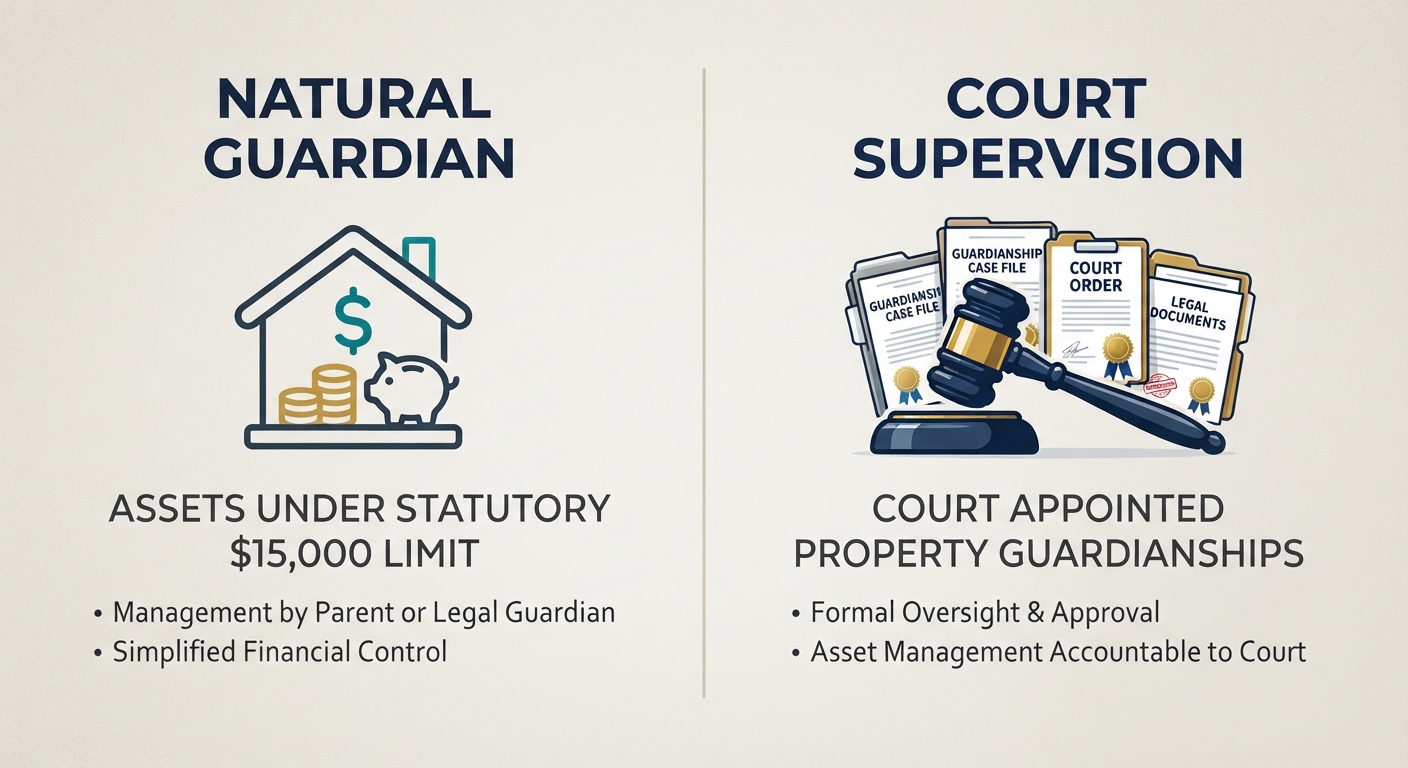
Under Florida law, a minor child cannot legally hold direct title to real estate, financial accounts, or large inheritances.
If a child receives property valued above the $15,000 statutory threshold under Florida Statute § 744.301 without a designated trust or custodial structure, the 17th Judicial Circuit or local probate court will typically require the formal appointment of a Guardian of the Property to oversee and manage the assets until the child turns eighteen.
UTMA Custodial AccountFlexible management without ongoing court oversight. Can extend distribution timing up to age 25.
Revocable Living TrustPrivate trustee control with custom phased distribution rules, completely bypassing public probate and guardianship courts.
Parents often assume that if something happens to them, any money, insurance proceeds, or real estate left behind will simply pass to their children and be managed by the surviving family members seamlessly.
In reality, Florida law draws a sharp legal line between who inherits property and who has the legal capacity to manage it. Because minors lack the legal standing to sign deeds, execute financial transfers, or control significant assets, an unintended inheritance triggers a complex web of probate rules, statutory thresholds, and court oversight.
1. Can a Minor Inherit Money or Property in Florida?
Yes. Legally, a minor child has every right to be named as a beneficiary in a Last Will and Testament, a life insurance policy, a retirement account, or a real estate deed.
However, owning property and controlling property are entirely different matters. While a child can legally own an asset, they cannot manage, sell, or spend it. If an estate distribution results in a minor receiving direct funds or real estate without a pre-arranged legal structure, the probate court steps in to freeze direct access until a qualified adult is formally authorized by a judge.
2. The $15,000 Threshold: Natural Guardianship Limits
Under Florida Statute § 744.301, biological or adoptive parents are recognized as the “natural guardians” of their minor children. As natural guardians, parents have the authority to manage minor property only if the total gross value of the personal property does not exceed $15,000.
If a child inherits an amount exceeding that $15,000 threshold—whether through a bank account, an investment portfolio, or a wrongful death settlement—a natural guardian cannot simply deposit or manage the funds. A formal Guardianship of the Property must be opened through the local probate court.
3. Case Study: Two Young Children Inherit a Large Estate (In re Matter of Castro)
To understand how Florida courts handle management disputes when children inherit major assets, consider the landmark Florida appellate decision in In re Matter of Castro, 344 So. 2d 270 (Fla. 3d DCA 1977).
The Facts: Following a father’s death, two young children ages four and six inherited a substantial estate. The children’s mother petitioned to be appointed as the legal guardian of their property. The trial court initially bypassed the mother and appointed an outside attorney, citing potential conflicts because of surrounding family circumstances.
The Ruling: The Third District Court of Appeal reversed the trial court, holding that Florida law establishes a strong statutory preference for qualified next of kin (such as a parent) to serve as guardian. A potential conflict, without concrete evidence establishing unfitness or disqualification, is not enough to strip a parent of their statutory preference. The court ordered the mother appointed as guardian, subject to posting a proper fiduciary bond.
The Takeaway:Castro demonstrates that inheriting property and deciding who manages that property are distinct legal hurdles. Even when a parent holds a natural preference, stepping into the role of formal property guardian requires navigating strict judicial scrutiny, background checks, and court bonds.
4. What Happens When a Minor Inherits Real Estate?
Real estate introduces some of the most complex hurdles in Florida probate and guardianship law.
If a grandparent leaves a home in Coral Springs or Broward County directly to minor grandchildren, the children cannot sign a listing agreement, execute a deed, or manage the property expenses.
The Guardianship Barrier: To sell, lease, or mortgage minor-owned real estate, a guardian of the property must petition the probate court for explicit authorization. Every major transaction requires judicial approval to ensure the minor’s financial interests are protected.
The Insurance and Tax Burden: Real estate requires continuous funding for property taxes, homeowner insurance, and maintenance. If the estate or guardianship lacks liquid cash to cover these ongoing carrying costs, the court may be forced to order a rush sale of the family property.
5. Case Study: A Minor, a Trust, and Insurance Proceeds (In re Estate of Weymer)
Another layer of complexity arises when insurance proceeds or estate assets flow through secondary legal structures. This dynamic was central toIn re Estate of Weymer, 199 So. 2d 495 (Fla. 4th DCA 1967).
The Facts: A father passed away leaving a residuary trust under his will for the primary benefit of his minor daughter. The father also maintained a life insurance policy payable directly to his estate. The executor collected the insurance funds, prompting the court appointed guardian of the minor’s property to demand those proceeds on behalf of the child.
The Ruling: The Fourth District Court of Appeal analyzed how insurance proceeds passing through an estate interact with testamentary trust provisions and minor beneficiaries, examining how funds must be segregated and accounted for while in the hands of estate fiduciaries.
The Takeaway:Weymer highlights why holding and administering a child’s money is completely separate from determining who inherited it. When insurance and estate assets collide, fiduciaries must carefully untangle whether funds belong directly to a guardianship estate or are funneled through a trust administration framework.
6. Does a Child Automatically Get an Inheritance at 18 in Florida?
A common misconception among parents is that establishing a guardianship or minor account locks up money until a child reaches maturity, at which point they handle it responsibly. In reality, “minor” status ends abruptly at age eighteen in Florida.
The table below illustrates how different legal structures dictate what happens when a child reaches adulthood:
Holding Structure
Management During Minority
What Happens at Age 18
Guardianship of Property
Court supervised, annual accounting, strict bond requirements
Terminates automatically. The 18 year old receives absolute, unrestricted control over the entire balance.
UTMA Custodial Account
Managed by a designated custodian without court supervision
Terminates at age 18, 21, or can be structured up to age 25 if properly designated at inception.
Revocable Living Trust
Managed privately by a trusted trustee according to custom terms
Controlled completely by the trust agreement. Distributions can be delayed, phased (e.g., portions at 25 and 30), or tied to milestones.
7. Frequently Asked Questions
Can a parent use a child’s inheritance to pay for family living expenses?
Generally no. Under Florida law, parents have a legal duty of support. A guardian of the property cannot use a child’s inherited funds to cover basic household rent, food, or clothing without explicit, prior authorization from the probate judge.
What is the difference between a guardian of the person and a guardian of the property?
A guardian of the person makes personal, medical, and educational decisions for the child. A guardian of the property manages financial assets, investments, and real estate. In many cases, these can be separate individuals or corporate fiduciaries.
How does a UTMA account differ from a formal trust?
A Uniform Transfers to Minors Act (UTMA) account is a simplified custodial arrangement ideal for smaller asset amounts. However, unlike a comprehensive Revocable Living Trust, a UTMA offers zero protection against a young adult gaining full access to the funds the moment they reach the statutory cutoff age.
Protect Your Children’s Future in Coral Springs
Leaving minor children unprotected against the rigid mechanics of Florida guardianship and probate courts can jeopardize their financial security.