
A Comprehensive Guide to Florida Statute Section 732.402, Local Courthouse Procedures, Case Law Precedents, Common Misconceptions, and Tactical Protections in Broward County.
Losing a loved one feels like navigating an unexpected emotional storm. The absolute last thing any grieving family needs is a predatory debt collector calling during dinner to ask if Mom’s 2018 Honda Civic is parked in the driveway for immediate repossession, or if someone will be home on Tuesday so credit card liquidators can carry off Dad’s favorite armchair.
That grim mental picture belongs in a Victorian novel, not modern Florida. Florida law takes an aggressive defensive stance against collection tactics following a death. Under Florida Statute Section 732.402, lawmakers built a legal fortress around personal vehicles and everyday household goods. This statutory shield prevents general estate creditors from stripping surviving family members of basic personal belongings.
These statutory protections do not execute themselves. Securing them requires active legal steps inside Broward County’s probate court. If you miss mandatory statutory deadlines or skip required local procedural filings, those rights dissolve, leaving personal effects vulnerable to forced liquidation.
Below is an authoritative, step-by-step breakdown of how Florida exempt property protections function, how local rules operate within the Seventeenth Judicial Circuit Court in Fort Lauderdale, key judicial case law precedents, common mistakes that hand victory to creditors, and what surviving heirs must do to secure clean legal title.
The Macro Reality: Why Creditors Push and Why Florida Law Stops Them
To understand why exempt property laws exist, consider the sheer volume of cases clogging the court system. In Broward County alone, the Seventeenth Judicial Circuit Court processes thousands of probate matters every single year. Each judge in Broward’s probate division handles thousands of active files annually.
Nationally, data from the National Center for State Courts indicates that roughly 2.6 million probate cases are filed across state courts each year. With billions of dollars in unsecured medical debt and credit card balances circulating through those estates, collection agencies rely on automated notices and aggressive demand letters, hoping grieving families will simply hand over cash or car keys out of sheer panic or confusion.
Florida lawmakers recognized decades ago that driving a grieving family onto the street or forcing a widow to walk to work just to satisfy medical bills is fundamentally unjust. Florida Statute Section 732.402(2) establishes specific statutory protections for personal belongings that general creditors cannot touch.
1. What Assets Qualify as Exempt Property Under Florida Law?
Section 732.402(2) breaks down qualifying exempt assets into four primary categories:
A. Personal Motor Vehicles
The statute shields up to two personal motor vehicles held in the decedent’s name. Each vehicle must satisfy two distinct criteria:
- The Weight Cap: Every individual vehicle must have a Gross Vehicle Weight Rating under 15,000 pounds. Your standard family sedan, light pickup truck, minivan, or personal SUV clears this bar easily. Heavy commercial haulers or massive industrial rigs exceed this weight limit.
Statutes & Constitution :View Statutes : Online Sunshine - The Regular Personal Use Standard: The vehicle must have served as regular personal transportation for the decedent or their immediate family. Vehicles maintained purely as corporate fleet units stay outside statutory protection.
Statutes & Constitution :View Statutes : Online Sunshine
B. Household Goods and Furnishings
The law shields household furniture, appliances, and general furnishings located in the decedent’s usual residence up to a net value of $20,000 as of the date of death.
The court measures this $20,000 threshold using realistic thrift store or garage sale market value on the exact date of death. Original retail purchase receipts do not dictate value here. Because used furniture depreciates rapidly, $20,000 in garage sale value almost always encompasses every physical item inside a home.
C. Qualified Tuition Programs
Under Section 732.402(2)(c), all higher education tuition contracts authorized under Section 529 of the Internal Revenue Code receive complete protection from estate creditors. This includes Florida Prepaid College Trust Fund accounts and state sponsored college savings plans.
D. Educator Death Benefits
Section 732.402(2)(d) protects specific teacher death benefits authorized under state law, shielding those funds directly from creditor claims filed against the estate.
2. Who Holds Legal Priority to Claim Exempt Assets?
Statutory rights under Section 732.402 do not distribute randomly across extended family lines. Florida law establishes an absolute priority structure that leaves zero space for informal family squabbles:
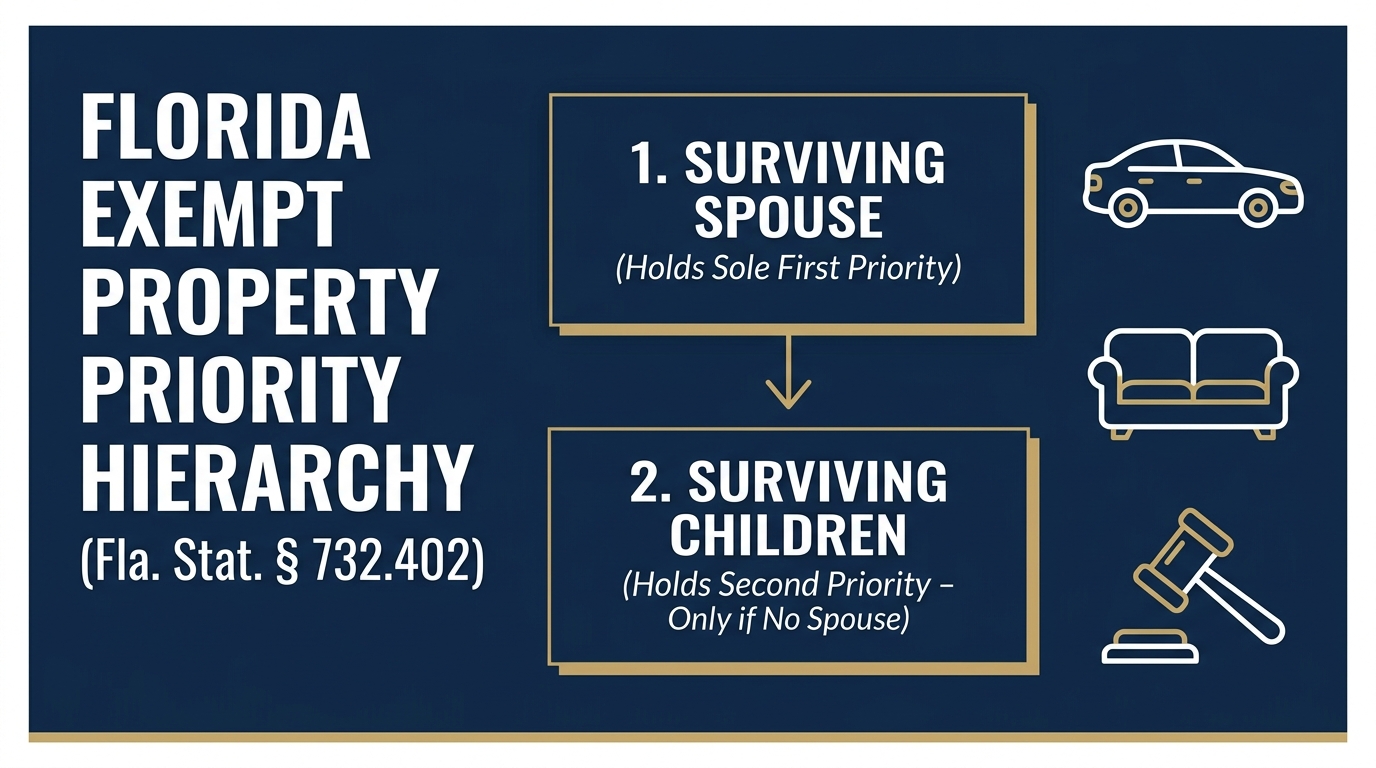
- Sole First Priority (The Surviving Spouse): If the decedent was legally married at death, the surviving spouse holds exclusive legal priority to claim exempt property.
- Second Priority (The Decedent’s Children): The decedent’s surviving children hold rights to claim exempt property only when no surviving spouse exists.
Friction Rules in Blended Families
Blended family structures routinely trigger disputes over personal property. Adult children from a previous marriage often attempt to secure a late parent’s personal vehicle or household effects. Florida law grants the surviving second spouse complete statutory priority over cars and household belongings regardless of emotional claims or informal family arrangements.
3. Deep-Dive Case Law Precedents: How Florida Courts Rule
To truly appreciate how Section 732.402 functions when pushed into litigation, we must examine key Florida appellate decisions that define the boundaries of asset eligibility, statutory deadlines, and usage standards:
In re Estate of Corbin, 603 So. 2d 127 (Fla. 1st DCA 1992)
This foundational decision clarified the operational scope of motor vehicle exemptions under Florida probate law. In Corbin, the court confronted a dispute over whether specialized recreational vehicles, specifically a motor home and travel trailer, qualified as exempt personal motor vehicles under Section 732.402.
The appellate court established that vehicle eligibility hinges strictly on actual, regular personal use by the decedent or immediate family members as standard personal transport. Because motor homes and specialized travel trailers served primarily as recreational housing units rather than day-to-day personal motor vehicles, they failed the statutory test.
The lesson from Corbin is clear: trial courts will examine the physical reality of how a vehicle was routinely operated, rejecting attempts to shield commercial units, recreational rigs, or off-site investment vehicles under the guise of personal transportation.
In re Estate of Liberman, 677 So. 2d 1294 (Fla. 4th DCA 1996)
Originating within the Fourth District Court of Appeal (which directly governs Broward County probate matters), Liberman serves as a stern judicial warning regarding statutory deadlines. The court addressed a situation where a petition claiming exempt property was filed well past the mandatory statutory timeframe established under Section 732.402(6).
The Fourth DCA affirmed that the statutory filing window is a mandatory jurisdictional cutoff. Missing the petition deadline results in an automatic, irreversible waiver of exempt property rights.
The court made it explicitly clear that probate judges possess no equitable authority to grant late exemptions if the petitioner allowed the statutory window to close without filing.
In re Estate of Salathe, 703 So. 2d 1167 (Fla. 2d DCA 1997)
The Salathe ruling examined the statutory interplay between a decedent’s Last Will and Testament and the exempt property rights of a surviving spouse under Section 732.402(5).
The court confirmed that while a general, non-specific bequest in a Will does not defeat exempt property protections, a specific bequest leaving a named item directly to a designated third party overrides general exemption claims unless that specific beneficiary executes a written waiver.
This case highlights why reading the precise text of a Will is essential before assuming an asset can be claimed under the general exemption allowance.
4. Common Mistakes People Make That Facilitate Creditors’ Work
In probate practice, creditors rarely win because the law favors them. They win because grieving heirs inadvertently make critical tactical mistakes that gift the creditor a legal advantage. Here are six major blunders that pave the way for debt collectors:
Mistake 1: Assuming That “Exempt” Means “Automatic”
This is the single most costly misconception in Florida probate. Families frequently assume that because a statute exists, Mom’s car and furniture are automatically shielded the second she passes away. In reality, Florida law requires an affirmative court order signed by a probate judge. Until a verified petition is e-filed and a judicial order is entered, the property remains unverified personal estate property. Sitting back doing nothing hands creditors the legal opening they need to demand liquidation.
Mistake 2: Voluntary Surrender After Believing Creditor Phone Demands
Third-party collection agencies employ aggressive call scripts designed to instill immediate panic. Representatives often tell surviving family members that keeping a deceased parent’s car constitutes fraud or theft, demanding that the family turn over the keys or reveal the vehicle’s location. Grieving relatives routinely comply out of fear.
Voluntarily handing over keys or surrendering physical possession before consulting a probate attorney waives practical leverage and forces the family to fight an uphill battle to recover converted property.
Mistake 3: Confusing Retail Replacement Value with Date-of-Death Liquidation Value
Heirs frequently look around a deceased relative’s home, calculate that the furniture cost $35,000 when purchased ten years ago, and conclude they are far over the $20,000 statutory exemption cap. They mistakenly inform the personal representative or creditors that the household goods exceed the limit. In probate court, retail purchase receipts belong in the trash.
Valuation is calculated strictly using date-of-death garage sale or thrift store liquidation prices. That ten-year-old living room set that cost $5,000 brand new might only fetch $300 at a yard sale today, easily fitting under the statutory cap.
Mistake 4: Missing the Statutory 4-Month Filing Window
Florida Statute Section 732.402(6) mandates that a petition for exempt property must be filed by the later of four months after the service date of the Notice of Administration or 40 days after the conclusion of any will challenge proceedings.
Families preoccupied with personal affairs frequently ignore formal legal notices arriving in the mail. Letting four months slip by legally waives the exemption permanently, handing creditors a free pass to liquidate the assets to satisfy outstanding bills.
Mistake 5: Informally Distributing Belongings Among Relatives Before Filing
When a parent dies, adult siblings often meet at the house over a weekend to divide up furniture, electronics, and vehicles without opening probate or seeking legal advice. Informally distributing assets without a court order creates chaotic titling disputes, exposes the heirs to claims of asset conversion, and prevents the probate court from entering a clean Order Determining Exempt Property. Creditors can exploit these informal transfers to claim that assets were improperly hidden or dissipated.
Mistake 6: Failing to Distinguish Between Secured Liens and Unsecured Debt
Section 732.402 shields assets against unsecured creditors like medical billing groups and credit card companies. It does not erase perfected security interests. Heirs often assume that declaring a financed car “exempt” eliminates the monthly auto loan balance. When the family stops making payments, the bank repossesses the vehicle under its valid security lien. An exempt property order shields the car from credit cards, but the family must maintain loan payments or refinance the balance to keep the vehicle.

5. Direct Commentary: What Authority Figures Say
Legal scholars and seasoned probate practitioners frequently emphasize that Section 732.402 is an affirmative shield designed to maintain household stability, not a mechanism for unjust enrichment.
As prominent Florida probate commentators have noted across appellate rulings, the statutory intent behind Section 732.402 is to preserve the immediate physical environment of the decedent’s home for surviving family members. The court’s primary goal is ensuring that the surviving spouse or minor children do not face sudden physical dislocation or loss of basic personal transportation while the broader estate administration drags on over many months.
6. Critical Exceptions: When Creditors or Wills Prevail
While Section 732.402 blocks general medical bills and credit card accounts, two explicit legal situations limit or bypass exempt property protections:
A. Perfected Security Interests and Auto Loans
Section 732.402(4) shields assets against unsecured general claims only. It does not eliminate perfected security interests.
When a decedent owed money on an active vehicle financing agreement, the lender holds a valid security lien. Declaring the vehicle exempt keeps credit card collectors from forcing a sale, but the surviving family must keep making monthly car payments or surrender the vehicle to the lender.
B. Specific Bequests in a Last Will
Under Section 732.402(5), property specifically devised in a Last Will to a designated individual cannot be claimed as general exempt property by a spouse or child. A specific clause leaving a classic car to a named sibling overrides general statutory exemption rights unless that designated beneficiary signs a formal waiver.
7. Modern Belongings: Consumer Electronics and Digital Assets
Florida probate practice must reconcile traditional statutory definitions written for physical furniture with modern household technology:
- Consumer Electronics & Smart Home Infrastructure: Laptops, desktop computers, high end televisions, home theater systems, and smart appliances located inside the primary residence qualify as household furnishings under Section 732.402(2)(a). Their combined liquidation value counts against the $20,000 date of death cap.
- Tangible Hardware vs. Digital Assets: Physical storage hardware (hard drives, tablets, personal servers) qualifies as tangible personal property. Digital assets, online subscriptions, cloud media libraries, and cryptocurrency holdings fall under Florida Statute Chapter 740 (Florida’s Revised Uniform Fiduciary Access to Digital Assets Act) and are governed by separate fiduciary access frameworks.
8. Procedural Protocol: Claiming Exempt Assets in Broward County
Exempt property status is never automatic. Obtaining marketable legal title and insulating assets from estate claims requires executing formal proceedings inside the Seventeenth Judicial Circuit Court of Florida.
Broward County Judicial Circuit Court Workflow
- Prepare the Verified Petition: Draft a formal Petition for Determination of Exempt Property complying with Florida Probate Rule 5.406. The pleading must list exact Vehicle Identification Numbers, titling records, and itemized property valuations.
- E-File via the Florida Courts Portal: Submit the pleading through the Florida Courts E-Filing Portal directed to the Broward County Clerk of Courts Probate Division at the Central Courthouse in Fort Lauderdale.
- Execute Formal Notice Procedures: Serve copies of the petition upon the court appointed Personal Representative and known creditors. Served parties receive a 30-day window to file formal written objections.
- Obtain Judicial Orders and Re-Title Assets: Once the judge signs the Order Determining Exempt Property, present certified copies to the Florida Department of Highway Safety and Motor Vehicles to issue clean vehicle titles.
9. The Small Estate Shortcut: Disposition Without Administration
When a Broward resident dies leaving behind only exempt property along with non-exempt personal assets that do not exceed funeral expenses and final medical bills, formal probate can be bypassed completely.
Under Florida Statute Section 735.301, qualifying family members can file a streamlined proceeding known as Disposition of Personal Property Without Administration. Family members can request Disposition forms directly at the Broward County Probate Clerk counter on the third floor of the Central Courthouse, Room 03150, located at 201 SE 6th Street in Fort Lauderdale. This short form track authorizes fast asset release without formal administration fees.
10. Tactical Protective Measures and Hidden Legal Pitfalls
To ensure creditors or disgruntled relatives do not unlawfully seize physical property while court filings are pending, surviving family members should execute active protective measures immediately:
- Secure physical access right away: Change residential door locks and store vehicle keys in a safe location immediately following a death. Never permit third party debt collectors or co heirs to enter the premises without formal judicial authorization.
- Refuse informal surrender demands: Debt collectors frequently contact surviving relatives claiming an immediate right to tow vehicles or collect furniture. Never surrender physical custody of any item without a signed order from a Broward probate judge.
- Prohibit informal asset sales: Selling or giving away household items before filing a Petition for Determination of Exempt Property can invalidate statutory protections and expose heirs to claims of asset conversion from estate creditors.
11. Strict Filing Deadlines Under Florida Law
Hesitating to file court paperwork destroys your statutory rights. Under Florida Statute Section 732.402(6), statutory protections are permanently lost if mandatory filing deadlines expire:
Statutory Deadlines Under Section 732.402(6)
A Petition for Determination of Exempt Property must be filed on or before the LATER of these two dates:
- 4 months following the date of service of the Notice of Administration.
- 40 days following the complete conclusion of any court proceedings challenging the Will.
The Cost of Delay: Missing these statutory deadlines waives your rights permanently. Unprotected vehicles and household furnishings drop straight into the general estate, where general creditors can force public sales to satisfy outstanding debts.
12. Action Plan for Broward County Families
Securing physical belongings after a loss requires methodical organization. Taking these immediate steps keeps aggressive creditors at a distance:
- Protect physical possession: Secure car keys and keep residential premises locked to stop third parties from making off with personal belongings.
- Review vehicle registration records: Check if car titles stand in the decedent’s name alone and review records for active bank liens.
- Compile a realistic property inventory: List major furniture pieces alongside garage sale market valuations.
- Monitor court notices in your mail: Note the exact service date of the Notice of Administration to calculate your petition deadlines.
- Retain Broward County probate counsel: Work with a skilled local firm to file your verified petition in the Seventeenth Judicial Circuit Court before statutory windows close.
Need Help Protecting Your Family’s Property in Broward County?
Losing someone close to you brings a heavy emotional burden, and dealing with aggressive debt collectors on top of that grief is entirely unfair. If you are handling estate claims, fighting over vehicle title transfers, or trying to understand how Florida exempt property rules apply to your situation, you do not have to carry that weight by yourself.
At the Law Offices of Reinfeld & Cabrera, we stand beside families across Coral Springs, Fort Lauderdale, and all of Broward County to protect what matters most. We step in to manage the probate filings, handle the creditor pressure, and make sure your family’s statutory rights under Florida law are fully enforced.
Call our Coral Springs office today at (954) 755-1280 or contact us online to schedule a confidential consultation with an experienced Broward County probate attorney. Let us take the legal burden off your shoulders so you can focus on taking care of your family.
Frequently Asked Questions
Can credit card companies seize a deceased person’s car in Florida?
- No. Under Florida Statute Section 732.402, up to two personal motor vehicles weighing under 15,000 pounds Gross Vehicle Weight Rating are shielded from general unsecured creditors. Securing this protection requires an eligible surviving spouse or child to file a formal petition in probate court.
What happens if you miss the deadline to claim exempt property in Florida probate?
- Under Florida Statute Section 732.402(6), missing the filing window waives your exemption rights permanently. Unclaimed assets fall into the general estate pool, where creditors can force public sales to satisfy outstanding claims.
Does Florida exempt property protection apply to adult children?
- Yes, but only when no surviving spouse exists. The surviving spouse holds sole statutory priority. Adult children can step forward only when the decedent left no surviving spouse or when the spouse lawfully waived their rights.
What happens if the deceased person owned three personal cars?
- The surviving spouse or children must select two vehicles to shield under Section 732.402. The third vehicle enters the general probate estate, where general creditors can target it unless another legal exemption applies.
Can a credit card company take furniture out of a deceased person’s home?
- Unsecured creditors cannot seize household furniture if an eligible heir petitions for exemption under Florida law. The statute shields up to $20,000 in garage sale value of household furnishings from estate debts.
Does exempt property reduce a surviving spouse’s inheritance share?
- No. Exempt property determined under Section 732.402 is excluded from net estate calculations. It passes directly to the surviving spouse or children in addition to any statutory elective share or intestate inheritance distribution.
Can an auto lender repossess a vehicle that the court declared exempt?
- Yes. Section 732.402 protects property against unsecured creditors only. It does not erase perfected security liens. A financed car lender retains full legal rights to repossess the vehicle if loan payments lapse.
How do you establish the value of household furniture during Broward probate?
- Courts evaluate household belongings using garage sale or thrift store market value on the date of death. Itemized property lists accompanied by photos and signed under penalty of perjury generally satisfy local judicial standards in the Seventeenth Judicial Circuit Court.