Can You Handle an Eviction Without an Attorney in Florida?

Coral-Springs-Eviction-Attorney


Yes, a landlord or tenant can handle some Florida eviction cases without an attorney. Florida law does not require a lawyer in every eviction proceeding. But an eviction still involves specific notice requirements, court filings, service of process, deadlines, and rules governing defenses and possession. A mistake at any of those stages can affect the outcome of the case.

For landlords, the process generally begins with the legally required notice and can proceed to a county court action if the tenant does not leave. For tenants, receiving an eviction lawsuit creates deadlines for responding and, in some cases, requirements for paying disputed rent into the court registry.

The issue matters in Broward County, where there were 16,666 eviction filings in 2025 and 7,955 more during the first six months of 2026.

So when is an eviction simple enough to handle on your own, and when does the situation call for legal assistance? The answer usually depends on the reason for the eviction, the lease, the notice, and whether the other side contests the case.


Can You Handle an Eviction Without an Attorney?

Yes.

Florida does not require every landlord or tenant to hire an attorney for an eviction. Broward County provides self service information and forms for people handling certain eviction matters themselves. The Clerk also explains that its deputy clerks can provide procedural information, but cannot prepare legal forms or give legal advice.

The complexity of the case matters.

A straightforward dispute involving unpaid rent may be different from a case involving:

  • A disputed lease violation.
  • Questions about whether the required notice was valid.
  • A commercial lease.
  • A disagreement about the amount of rent actually owed.
  • A claim that the landlord failed to maintain the property.
  • A retaliation defense.
  • A security deposit dispute.
  • A lease renewal or termination dispute.
  • A claim for damages in addition to possession.

An eviction can also become more complicated when the parties disagree about basic facts.

That is where legal advice may become useful.


Why Does the Eviction Process Matter?

Florida provides a summary procedure for eviction cases. The purpose is to provide a more direct procedure for resolving possession disputes.

“Summary” does not mean informal.

Florida law still requires the landlord to establish the legal basis for possession and follow the applicable requirements. The Broward County Clerk describes the basic local process as:

  1. Issue the required notice.
  2. Complete and file the required forms.
  3. Properly serve the tenant.
  4. Obtain a judgment and, when appropriate, a writ of possession.

Each stage can raise separate issues.

A defective notice can create a problem before the case even reaches a judge.

A service problem can affect whether the case can proceed.

A tenant who fails to respond properly can lose important defenses.

A landlord who tries to bypass the court process can create a different legal problem altogether.

Eviction law has very little patience for the idea that everyone can simply improvise.


What Notice Does a Landlord Have to Give?

The required notice depends on the reason for ending the tenancy.

For example, Florida law provides specific procedures for nonpayment of rent and for certain lease violations. The notice requirements are contained in section 83.56 of the Florida Statutes and are not simply optional language that the parties can rewrite in a lease.

For nonpayment cases, the applicable notice period and calculation depend on the tenancy and the circumstances. Florida’s statutory framework also specifies how certain periods are calculated.

For other violations, the landlord may need to give the tenant an opportunity to correct the problem when the law provides a cure period.

This distinction matters because an eviction notice is not interchangeable with every other type of demand letter.

The reason for the termination affects what the landlord may need to do next.

A notice can become a legal issue in itself

Consider a tenant who receives a notice claiming that rent was not paid.

The tenant might disagree about:

  • Whether the rent was actually due.
  • How much was owed.
  • Whether payment was made.
  • Whether the notice was properly served.
  • Whether the notice contained the required information.
  • Whether the landlord complied with the applicable statutory requirements.

Those questions can affect what happens after the notice.

The notice is therefore more than a warning. It can become part of the legal record.


What Happens After the Notice?

If the tenant does not leave and the landlord has the legal basis to seek possession, the landlord can file an action for possession.

Florida Statute §83.59 governs actions to recover possession. The landlord must proceed through the court rather than simply taking possession personally.

Broward County’s Clerk describes the next stages as filing the required documents and serving the tenant. The tenant then has to follow the instructions in the summons and respond within the applicable time.

This is one reason an eviction should not be treated like an ordinary argument between a landlord and tenant.

Once a lawsuit has been filed, deadlines and procedural rules become part of the dispute.


What Can a Tenant Do After Receiving an Eviction Lawsuit?

A tenant is not automatically removed simply because a landlord files an eviction case.

Florida law permits tenants to raise certain legal and equitable defenses. Depending on the circumstances, those defenses can involve alleged landlord noncompliance, defective notices, retaliation, payment disputes, or other issues recognized by law.

But there is an important procedural requirement that tenants should understand.

When a tenant raises a defense other than payment in a nonpayment case, section 83.60 generally requires the tenant to pay the accrued rent into the court registry or timely file a motion asking the court to determine the amount that must be deposited.

Failure to comply can result in waiver of defenses other than payment and can allow the landlord to obtain an immediate default judgment for possession.

That is not a minor technicality.

It can change the course of the case.


A Broward County case shows why this matters

In Muscella v. Johnson, a 2024 Fourth District Court of Appeal decision arising from Broward County, the tenants did not pay the rent into the court registry or timely move to determine the amount as required by section 83.60(2).

The Fourth DCA reversed the county court and explained that, under the circumstances, the landlord was entitled to the writ of possession.

The court stated that when the statutory requirement is not met, the landlord can be entitled to possession without another hearing.

That case illustrates the practical importance of understanding procedural requirements.


But the Same Rules Can Protect a Tenant Who Responds Properly

A different Broward County case demonstrates the other side.

In Kaufman v. High Seas, LLC, the landlord sought possession for alleged nonpayment of rent. The tenant disputed the landlord’s allegations, raised defenses, and timely filed a motion asking the court to determine the amount of rent that should be deposited into the court registry.

The trial court entered an eviction judgment without resolving that motion.

The Fourth DCA reversed and remanded, holding that the trial court needed to address the pending motion before entering the eviction judgment.

The case is useful because it shows why neither side should assume that an eviction case is automatic.

The landlord had procedural requirements.

The tenant had procedural requirements.

And the court had to apply the statute to what actually happened in the case.


Landlord vs. Tenant: What Is at Stake?

The obligations are different depending on which side of the dispute you are on.

IssueLandlordTenant
Before filingMust establish the basis for termination and provide the required noticeShould understand what the notice alleges and what deadline applies
LeaseMust establish the contractual or statutory basis for possessionMay dispute the interpretation or enforcement of the lease
Court filingMust file the appropriate action and supporting documentsMust respond according to the summons and applicable rules
Rent disputeMay seek possession and, where legally available, damagesMay have court registry requirements when raising certain defenses
DefensesMust respond to defenses raised by the tenantMay raise legal or equitable defenses recognized by Florida law
PossessionCannot simply bypass the court processHas statutory protections against certain forms of self help
After judgmentMay obtain a writ of possession through the courtMust comply with a valid writ while retaining whatever legal remedies remain available

The table is not a substitute for the statute or legal advice. It simply illustrates why an eviction case involves obligations on both sides.


Can a Landlord Change the Locks Instead?

No.

For residential properties covered by Florida’s landlord tenant law, section 83.67 prohibits a landlord from preventing a tenant from obtaining reasonable access to the dwelling, including by changing the locks or using a bootlock.

The statute also prohibits a landlord from interrupting utility services as a way of dealing with the tenancy.

That means a landlord generally cannot avoid the eviction process by deciding to remove the tenant personally.

The lawful process is different.

After a judgment in the landlord’s favor, Florida law provides for a writ of possession issued to the sheriff. The sheriff then executes the writ after the statutory notice period. Section 83.62 currently provides for 24 hours’ notice posted on the premises before the sheriff puts the landlord in possession.

In other words:

A court judgment and writ of possession are not the same thing as a landlord changing the locks on their own.

That distinction matters.


What If the Dispute Is About More Than Rent?

Not every landlord tenant dispute is really a simple nonpayment eviction.

The underlying disagreement might involve:

  • A commercial lease.
  • An assignment or sublease.
  • A disputed renewal option.
  • Property damage.
  • A security deposit.
  • Alleged nuisance.
  • A claim of constructive eviction.
  • Abandonment of personal property.
  • Lease provisions concerning rent increases.
  • Claims for damages in addition to possession.

Some of these matters may arise alongside an eviction. Others may require separate legal analysis.

A recent Fourth DCA case illustrates the point.

In Destiny Fulfilled Outreach Ministries v. Investments SWK, the dispute involved a commercial tenancy and disagreement over the nature and duration of the parties’ lease arrangement. The Fourth DCA affirmed the eviction judgment after the lower court determined that the parties had not established the claimed lease term.

The lesson is not that every commercial eviction looks like that case.

It is that the right to possession can depend on questions about the lease itself.


What About Attorney’s Fees?

Attorney’s fees can also become part of an eviction dispute when a statute, lease, or other applicable legal authority permits an award.

A 2025 Fourth DCA case arising from Broward County illustrates that even a fee award following an eviction judgment can create a separate appellate issue.

In Gordon v. Pinoargotty, the Fourth DCA reversed an attorney’s fee award because the trial court had not made the required findings concerning reasonable hours and the reasonable hourly rate. The underlying eviction judgment was not what the appeal addressed.

This is another reason to avoid thinking of an eviction as simply:

notice → tenant leaves → finished.

Depending on the case, possession, rent, damages, attorney’s fees, and other issues can all require separate attention.


When Does an Eviction Become More Complicated?

There is no single point at which every eviction suddenly requires an attorney.

Some situations, however, deserve closer attention.

Legal advice may be particularly useful when:

  • The tenant disputes the facts.
  • The landlord is unsure which notice applies.
  • The tenant claims the notice was defective.
  • There are questions about rent payments or the amount owed.
  • The lease contains complicated provisions.
  • The property is commercial.
  • There are counterclaims or substantial damages.
  • A tenant alleges retaliation.
  • The case involves habitability or property condition issues.
  • The landlord and tenant disagree about whether the lease has ended.
  • A prior eviction case or judgment is involved.
  • A party has received court papers and is unsure how to respond.

The more issues that exist beyond straightforward possession, the less useful a generic eviction form becomes.


What About Coral Springs and Broward County?

For someone in Coral Springs, an eviction case does not take place in a legal vacuum.

Coral Springs is part of Broward County and the Seventeenth Judicial Circuit, so local filing and court procedures matter in addition to the statewide landlord tenant statutes.

The Broward County Clerk’s current eviction information identifies the required sequence of notice, filing, service, judgment, and writ of possession. It also directs filers to the applicable Seventeenth Judicial Circuit administrative order for the location where county civil actions are filed.

Broward’s numbers show why this is not an obscure area of law.

The county recorded:

  • 15,588 eviction filings in 2019
  • 17,657 in 2022
  • 18,670 in 2023
  • 18,335 in 2024
  • 16,666 in 2025

The 2023 figure was the highest in that series. The 2025 total represented a decline from the prior year, but still amounted to more than 16,000 filings.

During the first six months of 2026, Broward recorded 7,955 filings, including 1,562 in January and 1,426 in June.

There is no reliable public source in the data reviewed here that isolates eviction filings specifically for Coral Springs. It is therefore more accurate to use Broward County as the local statistical measure rather than assigning a countywide number to Coral Springs.


What If You Cannot Afford an Attorney?

A private attorney is not the only possible source of help.

The Legal Aid Service of Broward County provides civil legal assistance to eligible low income Broward residents and specifically identifies landlord tenant matters and eviction assistance among its housing services. Eligibility requirements apply.

Broward County also provides self service information for people handling certain eviction matters without counsel.

That does not mean every case is appropriate for self representation.

It does mean that someone facing an eviction should not assume the only choices are hiring a private lawyer immediately or doing nothing.


What Should You Do If You Receive an Eviction Notice?

Start by determining exactly what you received.

An eviction notice is different from an eviction lawsuit.

If you have received only a notice from the landlord, review the reason stated and the deadline carefully.

If you have received a court summons or complaint, the situation is more urgent because the court’s procedural deadlines now matter.

Keep copies of:

  • The lease.
  • The eviction notice.
  • Proof of rent payments.
  • Communications with the landlord.
  • Repair requests.
  • Photographs or videos of relevant property conditions.
  • Court documents.
  • Receipts and other supporting records.

Do not assume that an unanswered court document will simply disappear.

It will not.


What Should a Landlord Do Before Filing?

A landlord should similarly organize the underlying record before beginning an eviction case.

That can include:

  • The signed lease.
  • Payment records.
  • The applicable notice.
  • Proof of delivery or service.
  • Communications with the tenant.
  • Records concerning alleged lease violations.
  • Property inspection records.
  • Photographs where relevant.
  • Documentation supporting any claimed damages.

The landlord should also make sure that the legal basis for possession matches the notice and the facts.

An eviction is not improved by filing quickly with the wrong theory.


The Bigger Point: Eviction Is a Process, Not a Threat

The old idea that an eviction is simply a landlord versus tenant argument misses what actually happens in court.

  • Florida law creates a process.
  • The landlord has to establish a basis for possession.
  • The tenant may have defenses.
  • Both sides have procedural obligations.
  • The court applies the governing law.
  • And if the landlord ultimately obtains judgment, possession is transferred through the statutory process rather than by private force.

The recent Broward cases make that clear from opposite directions.

In Muscella, the tenants’ failure to comply with the rent registry requirement had immediate consequences.

In Kaufman, the tenant’s timely motion to determine rent meant that the trial court could not simply enter the eviction judgment without addressing the pending issue.

Neither case establishes that every landlord needs an attorney or that every tenant will successfully defend an eviction.

They demonstrate something more practical:

The details matter.


Frequently Asked Questions

Can I evict a tenant without an attorney in Florida?

  • Mostly. Florida does not require every landlord to hire an attorney for an eviction. However, the landlord must still comply with the applicable statutes, court rules, notice requirements, filing requirements, and service requirements.

Could a tenant fight an eviction without an attorney?

  • Yes. Tenants can represent themselves and may raise defenses permitted by Florida law. But some defenses trigger specific procedural requirements, including requirements concerning rent paid into the court registry.

Can my landlord change the locks instead of evicting me?

  • For residential tenancies governed by Florida’s landlord tenant law, a landlord generally may not prevent a tenant from accessing the dwelling by changing the locks or using similar devices. Florida law also prohibits certain utility shutoffs used to interfere with a tenancy.

How long does an eviction take in Florida?

  • There is no single answer. Timing depends on the type of case, the notice, whether the tenant responds, whether defenses are raised, court scheduling, service, and other circumstances. Florida uses a summary procedure for eviction cases, but summary does not mean automatic.

What happens after a landlord wins an eviction?

  • After a judgment for the landlord, the clerk issues a writ of possession to the sheriff. Florida law provides for 24 hours’ notice to be posted before the sheriff puts the landlord in possession.

Can a tenant raise defenses to an eviction?

  • Yes. Florida law permits certain legal and equitable defenses. In nonpayment cases, however, a tenant raising defenses other than payment generally must comply with the rent registry requirements in section 83.60.

Does an eviction case always involve unpaid rent?

  • No. Eviction disputes can involve alleged lease violations, expiration or termination of a tenancy, possession disputes, and other issues. Commercial cases can also involve questions about lease terms and renewal rights.

Where are eviction cases handled in Broward County?

  • Eviction matters are handled through the county civil system within the Seventeenth Judicial Circuit. The Broward County Clerk provides current filing information and directs filers to the applicable administrative order concerning filing locations.

Is there legal help for tenants in Broward County who cannot afford a lawyer?

  • Legal Aid Service of Broward County provides civil legal services to eligible low income residents and offers housing and eviction assistance subject to its eligibility requirements.

Eviction and Landlord Tenant Disputes in Coral Springs

An eviction can look simple from the outside.

A landlord wants the property back. A tenant wants to remain there. A notice is delivered. A lawsuit may follow.

The actual legal process can be more complicated.

For landlords and tenants in Coral Springs, Broward County, and throughout South Florida, understanding the applicable Florida law is the first step. The next question is whether the particular dispute is straightforward enough to handle without legal assistance or whether the consequences of a procedural mistake make professional advice worthwhile.

Reinfeld & Cabrera represents landlords and tenants in eviction and landlord tenant disputes, including residential and commercial matters, lease disputes, security deposit claims, wrongful or constructive eviction claims, and other related issues.

If you are dealing with an eviction notice, an eviction lawsuit, or a dispute concerning possession of property, the specific documents and facts of the case matter more than a generic checklist ever could.

Facing Bankruptcy?

Bankruptcy-AttorneyAre you facing bankruptcy? Do you have a professional bankruptcy attorney who you can rely on? Do you understand what it means to face bankruptcy? As an experienced bankruptcy attorney, Reinfeld & Cabrera, P.A. will answer all your bankruptcy questions as and when you need. Here are a few questions that you can ponder in order to give you a head start on bankruptcy and bankruptcy attorneys.

What is bankruptcy?
Very basically bankruptcy is a legal status of a person or entity that cannot repay its debts owed to creditors. Bankruptcy is often imposed by a court order initiated by the debtor. Here in Florida the Bankruptcy Code located at Title 11 of the United States Code governs us. There are six types of bankruptcy under the Bankruptcy Code. The most commonly used types of bankruptcy are Chapter 7: basic liquidation for individuals and businesses and Chapter 13: rehabilitation with a payment plan for individuals with a regular source of income. Chapter 7 (also known as straight bankruptcy) is the simplest and quickest type of bankruptcy in existence, while chapter 13 (also known as Wage Earner Bankruptcy) permits individuals with regular income to develop a means of paying off their debt through a repayment plan.

What is a bankruptcy attorney?
A bankruptcy attorney is in charge of helping you through the intricate bankruptcy process. An experienced bankruptcy attorney such as Reinfeld & Cabrera, P.A. will ensure that you make no mistakes in preparing your petition. Experienced bankruptcy attorneys are better prepared to deal with any questions, concerns, or requests from the court than ordinary attorneys. A bankruptcy attorney will also appear with you at your Meeting of Creditors and help you to prepare and submit any additional documentation required until your case is discharged.

What should you do when facing bankruptcy?
As we have mentioned bankruptcy is a complicated and intricate process. With many forms to fill in and file, and potentially problematic procedures to navigate, facing bankruptcy on your own is not advisable. Arguably the wisest move you could make the moment you realise you may be facing bankruptcy is to contact an experienced bankruptcy attorney. Having a bankruptcy attorney such as Reinfeld & Cabrera, P.A. assist you through bankruptcy will ensure that you are in the best of hands when it comes to the complex bankruptcy process. If you are facing bankruptcy please contact at your soonest opportunity to ensure that you have the support you need during the bankruptcy process.

It Makes Sense To Use A Real Estate Attorney When Buying A House

It makes sense to use a real estate attorney when buying a house

Congratulations on the finding the property of your dreams! But before you go any further, let the experienced attorneys at Reinfeld & Cabrera, P.A. tell you why it makes sense to use a real estate attorney when buying a house.

Firstly, there is always a lot of official paperwork that surrounds the selling and purchasing of any property. In order for a sale to be legitimate, there needs to be a well-documented and legally binding contract. From sales contracts and financing agreements to title deeds you will have paperwork coming out of your ears! Often these contracts will be filled with legalese (fancy lawyer speak) and complicated processes and clauses. A real estate attorney will be there to relieve you of this headache and to explain the things you may not understand.

Real estate attorneys such as Reinfeld & Cabrera are experienced in dealing with these contracts and because they are familiar with the procedures they will be able to process everything much faster and more efficiently than an estate agent or you will be able to. They will also make sure that there are no possible glitches or issues for the buyer of the property and that all parts of the transaction follow state law. This includes your real estate attorney doing a title search to ensure that there are no liens or judgements against the perfect little place you plan to make your home. A title search ensures that the property owners have a legal right to sell the house. A real estate attorney will always have your best interests in mind.

Aside from all the paperwork flying around, there are other parts of your transaction that will need to be dealt with. Inspections and negotiations on the sales, repairs or maintenance will undoubtedly come about. You will want to have an experienced real estate attorney on your side to make sure that your property is received in top condition and that you are getting what you pay for and no less. During the negotiations and inspections it often happens that certain issues will occur. For instance you may find some structural damage to the property that makes it unsafe or the electrical system needs to be repaired. You won’t want to have to deal with these extra expenses once you have already purchased the property. A real estate attorney will guarantee that all issues are either compensated for in the price or that the seller is contractually obligated to repair any problems.

Hopefully with a knowledgeable real estate attorney on your side, you will never have to go into the process of litigation. However, if a dispute does arise and the issue is taken to court, you will be eternally thankful that you have a skilled real estate attorney to represent your interests. So don’t let your new home be tainted by any possible problems that may occur during the process, make sure that you start off on a stress-free and happy foot when buying your house – call a real estate attorney from Reinfeld & Cabrera today!

How to Choose an Attorney in Coral Springs: What Should You Look For?

Client asking questions during an attorney consultation in Coral Springs

Finding an attorney in Coral Springs is not particularly difficult. There are law firms, directories, referral services, advertisements, reviews, and search results ready to give you names.

The harder part comes afterward.

You have a legal problem. You may have several attorneys in front of you who appear qualified. Their websites may use similar language. Their credentials may look impressive. Their reviews may all be positive. One office may be five minutes away while another is across Broward County.

So how do you decide?

The useful place to start is not with the attorney. Start with the problem you need to solve.


What Kind of Legal Problem Do You Have?

A lawyer’s practice area is a useful starting point, but it should not be the end of your research.

A probate dispute is different from preparing an estate plan. A personal injury claim is different from a real estate transaction. A divorce raises different legal questions from a business dispute.

Even within a single area of law, experience can vary considerably.

Someone looking for an attorney after a serious automobile accident may want to know whether the lawyer regularly handles personal injury claims involving insurance disputes, serious injuries, contested liability, or litigation. Someone dealing with an estate dispute may need an attorney who regularly handles probate litigation rather than someone whose practice consists primarily of drafting wills.

The first question to ask is therefore fairly simple:


Does this attorney regularly handle problems like mine?

The Florida Bar recommends asking prospective lawyers whether they have handled cases like yours before, how frequently they do so, and how much experience they have with that type of matter.

That is considerably more useful than counting how many different practice areas appear on a firm’s website.


Experience Should Be Specific

“Experienced attorney” is one of those phrases that appears on an enormous number of law firm websites.

By itself, it tells you very little.

A lawyer may have practiced for twenty years without spending much of that time on the particular kind of matter you are facing. Another lawyer may have concentrated heavily on a particular area for a shorter period.

That is why it is worth asking about relevant experience, rather than simply years in practice.

You can ask:

  • How often do you handle cases like mine?
  • Have you handled cases involving circumstances similar to mine?
  • Will my matter probably require litigation?
  • If so, how much experience does the firm have with that type of litigation?
  • Who will actually handle my case?

The last question deserves particular attention.


Who Will Actually Handle Your Case?

You may meet one attorney during your initial consultation and later discover that another lawyer, associate, paralegal, or other member of the firm will be doing much of the work.

That arrangement is not necessarily a problem. A law firm is a team, and different people can have different responsibilities.

You should simply know what you are agreeing to.

The Florida Bar specifically recommends asking what support resources an attorney has available and who will work on the matter. Its consumer guidance also recommends asking about how and how often you will communicate with the attorney.

A reasonable question at the beginning is:

Who will be my primary contact, and who will be doing the legal work on my matter?

There is nothing awkward about asking. You are considering a professional relationship, and you should understand how that relationship will work.


Pay Attention to How the Lawyer Explains Things

Legal problems can be complicated. Your lawyer does not have to make them sound simple when they are not.

But you should be able to leave a consultation with a clearer understanding of what you are dealing with.

A good consultation should give you an opportunity to explain what happened, ask questions, hear the relevant legal issues, and understand what may happen next.

That does not mean the attorney can predict the outcome.

In many legal disputes, important facts are still unknown. The other side may take a position you cannot predict. Evidence may change the analysis. A court may ultimately have to decide an issue.

Be cautious of anyone who seems to know the result before knowing the facts.

A useful attorney can explain the strengths and weaknesses of your position without turning the consultation into either a sales pitch or a lecture you cannot follow.


Communication Is Part of the Representation

You may not need your lawyer to call you every afternoon.

You do need to know how communication will work.

Ask whether communication will generally happen by telephone, email, a client portal, or some combination. Ask who you should contact with routine questions. Ask how frequently you should expect updates.

The Florida Bar specifically recommends discussing both the means and frequency of communication during the initial meeting.

This is one area where client reviews can provide useful information. If numerous clients independently describe a firm as responsive, organized, or difficult to reach, that can tell you something about the client experience.

Reviews still have limits, though.

A collection of five-star reviews cannot tell you whether an attorney has handled your particular legal problem. Likewise, a lawyer with substantial experience in a specialized area may not have hundreds of online reviews.

Reputation and legal experience answer different questions.


Understand the Fee Before You Hire the Lawyer

Money is an uncomfortable subject until you receive a bill you did not expect.

It is better to discuss fees early.

Lawyers may charge fixed or flat fees, hourly fees, contingency fees, or other arrangements depending on the type of legal work. The Florida Bar recommends discussing prospective charges at the first meeting and understanding other costs that may arise.

Ask:

  • How are your fees calculated?
  • Is there a fee for the initial consultation?
  • Are there costs separate from the attorney’s fees?
  • What circumstances could cause the cost to increase?

For litigation and other matters where the amount of work depends heavily on what happens next, an attorney may not be able to give you an exact final number. That does not mean the financial conversation should be vague.

You should understand the basic fee arrangement before deciding whether to proceed.


Do You Need the Lawyer Who Is Closest to You?

If you live in Coral Springs, having an attorney nearby can certainly be convenient.

There may be times when you need to attend a meeting, review documents in person, sign something, or discuss an issue face to face. Local familiarity can also be useful depending on the nature of the legal matter.

But distance should not become a substitute for relevant experience.

Someone searching for a Coral Springs attorney may reasonably want a lawyer who understands the local area and can serve clients in Broward County. At the same time, the best geographical match is not necessarily the attorney whose office happens to be closest to your front door.

If the legal problem is specialized, experience with that problem deserves serious consideration alongside convenience.


What About Lawyer Referral Services?

You do not have to find an attorney entirely on your own.

The Florida Bar operates a statewide Lawyer Referral Service designed to connect consumers with verified attorneys based on their legal needs and location. The service is available online, and eligible referrals can receive an initial 30-minute consultation for no more than $25. Local bar associations also operate referral services in parts of Florida.

Referral services can be particularly useful if you know you have a legal problem but are unsure which type of attorney you need.

They are one starting point.

You should still use the consultation to decide whether the attorney is appropriate for your particular matter.


Check the Basics

There is also nothing wrong with checking the basic professional information available about an attorney.

The Florida Bar’s public resources allow consumers to search for an attorney and review information such as membership status and public disciplinary history.

That is not a substitute for evaluating experience or having a conversation with the lawyer.

It is simply sensible due diligence.


What Should You Bring to the First Meeting?

The quality of an initial consultation depends partly on how much useful information you can give the attorney.

The Florida Bar recommends organizing relevant documents and correspondence before the appointment and preparing a timeline when one would help explain what happened.

Depending on the matter, that might include:

  • Contracts or other agreements
  • Court papers
  • Letters or emails
  • Medical records or bills
  • Insurance correspondence
  • Property records
  • Financial documents
  • A written timeline of important events

You do not need to become your own lawyer before meeting the lawyer.

You simply want to give the attorney enough information to understand what happened.

And tell the truth, including the uncomfortable parts. Your attorney can deal with a fact you disclose. A surprise is harder to deal with after the other side has already found it.


Questions to Ask an Attorney in Coral Springs

If you are comparing several attorneys, you can ask each of them the same basic questions.

  • Have you handled matters like mine before?
  • How frequently do you handle them?
  • Who will actually work on my case?
  • What do you see as the main legal issues?
  • What information or documents do you need from me?
  • How will we communicate?
  • How often should I expect updates?
  • How are your fees calculated?
  • Are there additional costs I should understand?
  • What happens after this consultation?

The answers will not tell you everything. They will, however, give you something considerably more useful than a search-results page full of law firm names.

Coral Springs attorney speaking with a client about a legal matter in Broward County

Finding the Right Attorney Is About Fit, Experience, and the Problem in Front of You

There is no single characteristic that makes an attorney the right choice for every client.

A large firm may be appropriate for one matter and unnecessary for another. A lawyer with decades of experience may be exactly what one case requires. Another client may need someone whose practice is highly concentrated in a particular area.

Location matters. Reviews matter. Professional experience matters. Communication matters. Fees matter.

What matters most is how those factors fit the legal problem you actually have.

If you are looking for an attorney in Coral Springs, start by identifying the type of legal help you need. Then look closely at the lawyers you are considering. Find out whether they regularly handle matters like yours, who will be working on your case, how communication will work, and what the financial arrangement will look like.

You are not expected to know Florida law before you hire a Florida lawyer. That is the lawyer’s job.

Your job is to ask enough questions to understand who you are hiring and what you can reasonably expect from the relationship.


Frequently Asked Questions

How do I choose an attorney in Coral Springs?

  • Start by identifying the type of legal problem you have and looking for attorneys who regularly handle that kind of matter. Then ask about relevant experience, who will handle your case, communication, fees, and the likely next steps.

What should I ask a lawyer before hiring them?

  • Ask whether they have handled matters like yours, how frequently they do so, who will work on your case, how communication will work, how fees are calculated, and what other costs may arise. The Florida Bar recommends discussing these issues during the initial meeting.

How can I find a lawyer in Coral Springs?

  • You can search directly for local attorneys, ask people you trust for recommendations, or use a lawyer referral service. The Florida Bar Lawyer Referral Service can match consumers with attorneys based on their legal needs and location.

Should I choose a lawyer based on online reviews?

  • Reviews can provide useful information about client experience, particularly communication and responsiveness. They should be considered alongside relevant legal experience and the attorney’s ability to handle the specific type of matter you have.

Does the closest attorney make the best choice?

  • Not necessarily. Convenience can matter, particularly when in-person meetings are useful, but relevant experience with your particular legal problem should also be considered.

How much does an attorney in Coral Springs cost?

  • There is no single standard fee. Florida attorneys may use different fee arrangements depending on the type and complexity of the legal matter. Discuss the consultation fee, attorney’s fees, and other anticipated costs before retaining counsel.

Looking for an Attorney in Coral Springs?

Reinfeld & Cabrera, P.A. represents clients in Coral Springs and throughout Broward County in a range of probate legal matters.

If you are dealing with a legal problem and want to understand your options, contact the firm to arrange a consultation and discuss your circumstances with a Florida attorney

Why Use a Real Estate Attorney in Florida? What Legal Counsel Adds to a Transaction

A Florida real estate attorney knows the rules that govern property transactions, from contract requirements and title issues to closing procedures and the remedies available when something goes wrong. A buyer or seller generally does not have that knowledge. There is no reason to expect them to.

You know the property. What you want to pay or receive. You know the circumstances that brought you to the transaction. Your attorney brings something different: a working knowledge of Florida real estate law and the experience to recognize legal problems that may not be obvious from the face of a document.

The Florida Bar recommends consulting an experienced Florida licensed real estate lawyer before signing a purchase contract. That timing gives the attorney an opportunity to examine the agreement while its terms can still be negotiated.

For someone buying or selling property in Coral Springs, Broward County, or elsewhere in South Florida, that is often the most useful place to begin.


Who Represents Your Interests?

A property transaction can involve real estate agents, brokers, lenders, title professionals, inspectors, surveyors, insurance professionals, and attorneys.

Each person has a different responsibility.

A closing agent may coordinate documents, funds, title requirements, and the mechanics of completing the transaction. That person may also be a lawyer. The Florida Bar cautions consumers that a closing agent does not necessarily represent the buyer’s personal legal interests.

Your own attorney has a different assignment. The lawyer is there to advise you about your legal position, explain what you are agreeing to, identify problems, and negotiate or respond when necessary.


Alan Reinfeld puts it this way:

“A closing can look perfectly organized from the outside while still containing terms that deserve a closer legal review. The question is whether someone is specifically looking at the transaction from your legal point of view.”

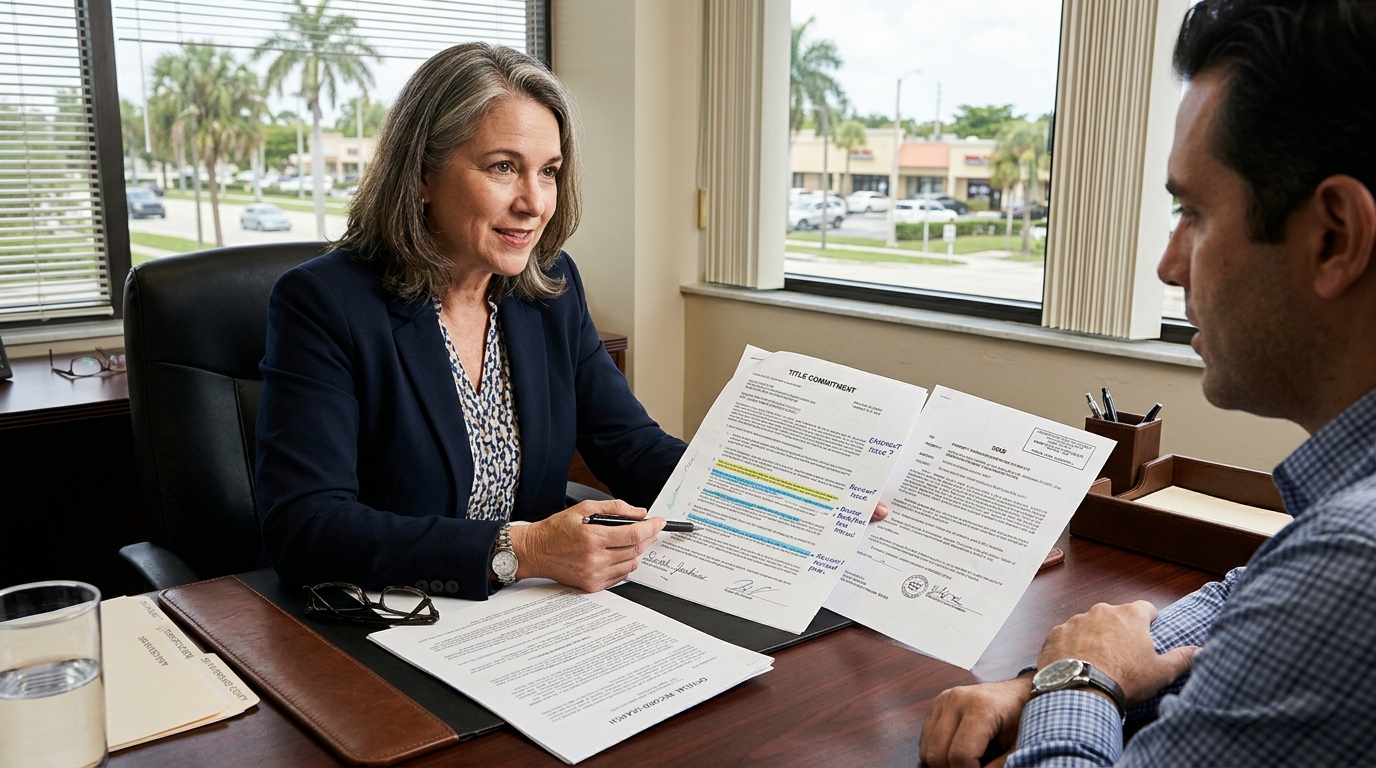
That can matter when a contract contains unusual obligations, a title commitment raises questions, a condominium has complicated restrictions, or the parties disagree about what was promised.


Start With the Contract

The purchase agreement establishes the framework for the transaction.

Price is one provision. Deadlines, deposits, financing, inspections, repairs, default provisions, closing conditions, property disclosures, and special agreements can all affect what happens after the contract is signed.

The Florida Bar advises buyers to have a lawyer review the purchase contract before signing. Its consumer guidance also notes that contractual terms may become difficult to change once the agreement has been executed.

Florida Realtors has likewise advised consumers to read contracts carefully, including the particular version being used and provisions dealing with default and disputes. Familiarity with a standard form does not answer every question raised by an individual transaction.


A lawyer reviewing the agreement may examine

Contract issueQuestions legal review can address
DepositWhere is it held? When can it be released?
InspectionWhat rights exist if defects are discovered?
FinancingWhat deadlines and conditions apply?
Closing dateWhat happens if either side cannot close on time?
RepairsWhich obligations have actually been agreed to?
DefaultWhat remedies may become available?
Special provisionsDo unusual terms create additional obligations?
DisputesWhat procedures or remedies does the agreement provide?

A provision can look harmless when read by itself and have a very different effect when considered alongside the rest of the agreement. An attorney is trained to look for those connections.


Title Problems Can Follow the Property

Title work is another central part of a real estate transaction.

A title examination can involve years of recorded documents, previous transfers, liens, easements, restrictions, and other matters affecting ownership. The title insurance commitment identifies requirements that must be satisfied before the policy is issued as well as exceptions to coverage.

Consider a buyer who discovers an easement affecting part of the property. The existence of an easement does not automatically make the transaction unacceptable. Its location, purpose, language, and effect on the buyer’s intended use of the property are the questions that need attention.

The same applies to liens, restrictions, unresolved ownership questions, and other title matters.

A title commitment may identify an exception. The attorney’s job is to explain what that exception means and whether it creates a legal problem for the client.

Florida’s Department of Financial Services recognizes Florida attorneys in good standing as professionals who may handle real estate closings involving title insurance and escrow.


Negotiating the Terms

Real estate negotiations rarely stop at the number written on the first page.

A buyer may want additional time for financing. A seller may agree to repairs in exchange for a particular closing date. The parties may negotiate responsibility for an existing lien or an issue discovered during inspection. A condominium transaction may involve documents and restrictions that require attention before the buyer proceeds.

The lawyer brings legal knowledge to those negotiations.

That knowledge can be useful when a proposed change sounds reasonable but creates an obligation elsewhere in the contract. It can also help a client understand what is worth negotiating and what may create unnecessary complications.

Florida Realtors has emphasized that contract terms can be negotiated and that parties have a right to seek legal review.

A standard contract form is a starting point. The property, the parties, and the circumstances determine whether its provisions actually work for the transaction at hand.


What Happens at Closing?

Closing is where the contractual decisions, title work, financing, and other requirements come together.

The deed must transfer the property properly. Required documents must be completed. The closing figures must correspond with the transaction. Title requirements must be satisfied or addressed. Funds need to reach the correct destination.

A lawyer handling the transaction understands the legal significance of those documents and requirements. The client does not need to become a temporary expert in Florida property law simply because they are buying a house.

There is also a distinctly modern hazard: wire fraud.

The Florida Bar advises consumers to verify wire instructions independently rather than relying solely on an email or other electronic communication.

That advice deserves serious attention. Real estate transactions can involve hundreds of thousands of dollars moving electronically. A fraudulent change to wiring instructions can turn an ordinary closing into a serious financial problem.

Real estate attorney reviewing a Florida purchase contract and title documents

When a Transaction Starts to Fall Apart

Some legal questions do not appear until the deal is already under pressure.

The inspection may reveal significant damage. Financing may fail. A title defect may appear shortly before closing. The seller may refuse to perform an agreed obligation. The buyer may want to withdraw. The parties may disagree about the deposit.

Once that happens, the contract becomes the starting point for determining what each party is required to do and what remedies may exist.

Florida Realtors notes that a failed closing does not cause the underlying contract to disappear. The circumstances surrounding the failure can determine whether a breach occurred and what consequences follow.

This is where knowing the details of the agreement matters. Deadlines, contingencies, default provisions, notice requirements, and other clauses can determine what a party can do next.

An attorney who has reviewed the transaction from the beginning also has the benefit of knowing how the dispute developed, rather than trying to reconstruct the deal after the parties have reached an impasse.


Florida’s Property Market

Florida’s real estate market gives these transactions considerable financial weight.

Florida Realtors reported 26,036 single-family home closings in June 2026, up 9.3% from June 2025. Condo and townhouse sales totaled 8,900, an increase of 14%. The statewide median price was $432,000 for single-family homes and $305,000 for condos and townhouses.

By August 2026, the statewide median price was $415,000 for single-family homes and $298,000 for condos and townhouses. Inventory stood at 4.3 months for single-family homes and 7.7 months for condos and townhouses.

Florida residential market, August 2026Median priceInventory
Single-family homes$415,0004.3 months
Condos and townhouses$298,0007.7 months

A transaction involving a property worth several hundred thousand dollars can turn on a few sentences in a contract or a title document. Understanding those sentences is part of the attorney’s job.


Do You Need a Real Estate Attorney in Florida?

Florida does not require an attorney for every real estate transaction.

The Florida Bar nevertheless recommends consulting an experienced Florida licensed real estate lawyer before signing a purchase contract.

There is nothing strange about that distinction. People routinely hire professionals for matters that fall within those professionals’ expertise.

You probably would not expect a title examiner to negotiate your purchase agreement or a real estate agent to give you a complete analysis of Florida contract law. An attorney occupies a different place in the transaction.

The lawyer knows the statutes, regulations, contractual principles, title rules, and legal remedies that can affect the deal. The client brings knowledge of the property and their own objectives. Good representation connects the two.


Questions to Ask a Real Estate Attorney

If you are considering legal representation for a Florida property transaction, useful questions include:

  • Will you review the purchase contract before I sign it?
  • Will you review the title commitment and exceptions?
  • Who will represent my interests during closing?
  • Can you negotiate changes to the contract?
  • Will you review condominium or homeowners’ association documents when relevant?
  • What happens if the other party refuses to close?
  • What should I do if a title problem appears?
  • How will you communicate with the title company, lender, broker, or opposing counsel?

The answers can tell you how involved the attorney expects to be and whether the representation fits the transaction.


Why Use a Real Estate Attorney?

You do not need to memorize Florida’s real estate laws to buy a house.

You do need to understand the agreement you are signing and the legal consequences of the transaction. That is where an attorney’s knowledge becomes useful.

A real estate lawyer works with the statutes, contracts, title records, closing requirements, and disputes that surround property transactions. The lawyer can recognize legal issues that an ordinary buyer or seller may never have encountered before.

Florida real estate attorney reviewing a property transaction with clients in Coral Springs

Stuart Reinfeld describes the objective this way:

As he states: “A successful closing depends on documents that accurately reflect the agreement and on careful attention to the client’s legal interests throughout the transaction.”

Reinfeld & Cabrera represents clients in Coral Springs, Broward County, and throughout South Florida in real estate matters, including contract review, transactions, title issues, and real estate disputes.

If you are buying or selling property, refinancing, dealing with a title issue, or facing a disagreement over a real estate contract, contact Reinfeld & Cabrera to discuss your situation.


Frequently Asked Questions

Is a real estate attorney required in Florida?

  • No. Florida does not require an attorney for every real estate transaction. The Florida Bar recommends consulting an experienced Florida licensed real estate lawyer before signing a purchase contract.

When should I hire a real estate attorney?

  • Before signing the purchase contract is generally the most useful time. Early review allows potential contractual problems to be addressed while the terms remain open to negotiation.

What does a Florida real estate attorney do?

  • Depending on the transaction, an attorney may review contracts, investigate title issues, explain closing documents, negotiate terms, advise on property restrictions, and represent a client when a transaction develops into a dispute.

Does the closing agent represent the buyer?

  • Not necessarily. A closing agent can coordinate the transaction without representing the buyer’s individual legal interests.

Can a real estate attorney resolve title problems?

  • An attorney can investigate the legal significance of title defects, liens, easements, restrictions, and other title issues and advise the client about available options.

What happens when a Florida real estate transaction does not close?

  • The answer depends on the contract and the circumstances. The parties may have rights and obligations involving deposits, default, damages, deadlines, or other remedies. The contract and the facts need to be examined before determining what follows.

What Does a Real Estate Attorney Do at a Florida Closing?

Real estate attorney reviewing a property closing with clients in Coral Springs, Florida

A real estate closing can look deceptively simple. The buyer signs documents, the seller signs documents, money changes hands, and the property changes ownership.

The legal work behind that moment is considerably less simple.

A Florida real estate attorney can review the purchase contract, examine title issues, address liens and other encumbrances, review the closing documents, and advise a buyer or seller when the transaction does not proceed exactly as expected. That work may begin weeks before the closing date.

For someone who already has a real estate agent, lender, title company, or closing agent, it is reasonable to ask what a separate attorney actually does. The answer depends on the transaction, but the attorney’s role is generally to provide legal advice to the client whose interests the attorney represents.

The Florida Bar recommends consulting a Florida licensed real estate lawyer before signing a purchase contract. It also points out that the closing agent may be an attorney without representing the individual buyer’s or seller’s interests.


The Lawyer’s Work Often Starts Before the Closing

The closing is the final stage of a transaction that began with a contract.

That contract determines the purchase price, deposit, financing arrangements, inspection rights, title requirements, closing date, possession, closing costs, and the obligations of both parties. It can also establish what happens when one side fails to perform.

Those provisions matter when the transaction develops a problem.

Suppose the seller discovers that an old mortgage was never properly released. Or the buyer learns that a title objection has not been resolved. Perhaps the parties disagree about whether a repair was required under the contract, or whether a closing deadline can be extended.

Those questions cannot be answered by looking only at the documents being signed on closing day. The purchase agreement, amendments, correspondence, title documents, and applicable Florida law may all matter.

That is one reason the Florida Bar recommends having a lawyer review the purchase contract before it is signed. Standard forms contain many provisions, but the parties can negotiate terms and add provisions that change their rights and obligations.


What Does a Real Estate Attorney Review?

The attorney may review the purchase agreement and the documents generated during the transaction. Depending on the property and the circumstances, that can include:

  • The purchase and sale agreement
  • Addenda and amendments
  • Title commitments and title evidence
  • Deeds
  • Mortgages and other recorded instruments
  • Liens and judgments
  • Easements and restrictions
  • Survey issues and possible encroachments
  • Closing statements
  • Tax and other prorations
  • Repair credits and other concessions
  • Financing documents
  • Possession provisions
  • Documents prepared for signing at closing

The attorney is also looking at how these documents fit together.

For example, a closing statement might contain a credit that was negotiated in an amendment to the purchase contract. A title commitment might identify an exception that needs to be addressed before the buyer can receive the title insurance coverage expected under the transaction. A survey might reveal an encroachment that was not apparent when the contract was signed.

The point is not to read every document in isolation. The documents have to be consistent with the transaction the parties actually agreed to.


Why Title Problems Can Delay a Closing

Title is one of the biggest legal issues in a real estate transaction because ownership is not established simply by the seller saying that the property belongs to them.

A title examination can reveal mortgages, tax liens, judgments, easements, restrictions, probate issues, prior conveyances, or other matters affecting the property. The Florida Bar notes that a title examination may involve records going back many years and that problems can originate in areas such as probate, divorce, foreclosure, inheritance, and previous financing.

Some problems are relatively easy to correct. Others require additional documents, negotiations, or legal proceedings.

The purchase contract also matters because it may give the buyer a specific period to examine the title and notify the seller of objections.

Florida courts have enforced those contractual deadlines. In Davis v. Ivey, 984 So. 2d 571 (Fla. 5th DCA 2008), the buyers had 15 days after receiving title evidence to examine the title and notify the seller of defects. The seller provided the title evidence only one day before the scheduled closing. The appellate court held that the contractual examination period still applied.

That kind of dispute illustrates why a closing date does not tell the entire story. The contract may give the parties rights that continue to operate as the closing approaches.


Is the Closing Agent Your Attorney?

Not necessarily.

A title company or settlement agent may handle many of the practical steps required to complete the transaction. That can include preparing or coordinating documents, receiving and disbursing funds, recording documents, satisfying title requirements, and communicating with the parties.

The closing agent’s role does not automatically create an attorney-client relationship with the buyer or seller.

The Florida Bar specifically warns consumers that a closing agent may be a lawyer but may not represent their individual interests.

This distinction becomes important when the parties have competing interests. If the buyer and seller disagree about a contractual provision, for example, the buyer may need independent legal advice rather than assuming that the person conducting the closing is there to advise the buyer.


What Happens When the Closing Statement Changes?

The money being exchanged at closing has to match the transaction.

The settlement statement can include the purchase price, deposit, loan proceeds, taxes, insurance, title charges, recording fees, commissions, credits, prorations, payoff amounts, and other expenses.

Some of these figures are routine. Others may require explanation.

A repair credit negotiated after the original contract was signed should appear consistently in the closing documents. A mortgage payoff should correspond with the amount required to satisfy the seller’s loan. Property taxes may need to be prorated according to the terms of the transaction and the relevant tax period.

A lawyer reviewing the closing documents can compare them with the contract and identify discrepancies that need to be resolved before signing.


Be Careful With Wire Instructions

Wire fraud deserves particular attention during a real estate transaction because large sums of money are commonly transferred shortly before or at closing.

The Florida Bar advises consumers to independently and personally verify wire instructions rather than relying on an email containing payment information.

That advice is worth taking literally. If someone sends new instructions shortly before closing, call the intended recipient using a telephone number you already know to be legitimate. Do not assume that an email is genuine because it contains familiar names, logos, or details from the transaction.


Florida Homestead Law Can Affect the Documents

Florida’s homestead rules create additional legal considerations for qualifying homestead property.

Section 196.031 of the Florida Statutes addresses the homestead exemption for qualifying permanent residences. Florida law also contains specific rules concerning the conveyance and mortgaging of homestead property. Section 689.111 addresses circumstances involving a married owner’s spouse.

These rules can affect the documents required for a transaction and whether a deed or mortgage has been properly executed.

Homestead status can also intersect with estate planning, ownership, and family circumstances. An attorney therefore needs to look at the property and the people involved rather than assuming that every Florida residential closing follows the same set of rules.


What If Something Goes Wrong at Closing?

A closing does not automatically become a lawsuit because a problem appears.

The parties may be able to correct a document, obtain a lien release, resolve a title objection, amend the contract, adjust the closing figures, or agree on another solution. The appropriate response depends on the nature of the problem and the rights established by the contract.

The legal question may become more serious when one party refuses to perform.

If a seller cannot deliver the title required by the agreement, a buyer may have contractual remedies. Maybe a buyer fails to provide required funds or financing, the seller may have rights under the contract. If the parties disagree about whether a condition has been satisfied, the language of the agreement can become central to the dispute.

This is why the purchase contract deserves attention before closing rather than being treated as paperwork that has already served its purpose.

Real estate attorney reviewing a property with clients in Coral Springs, Florida

Do You Need a Real Estate Attorney for a Florida Closing?

There is no single answer for every transaction.

A straightforward residential purchase may involve relatively few legal complications. Other transactions can involve title defects, probate issues, divorces, liens, boundary disputes, unusual financing arrangements, commercial property, seller financing, significant contract amendments, or disagreements between the parties.

Those circumstances can change the legal work required.

The Florida Bar recommends having a qualified Florida real estate lawyer review a purchase contract before it is signed, particularly because standard contracts can be modified and because the consequences of contractual language can be significant.

If you are considering hiring an attorney, ask what the attorney will actually review and what representation includes. You should know whether the lawyer will examine the purchase agreement, communicate with the title company, review title issues, examine the closing documents, and advise you about disputes that arise before closing.


Real Estate Closings in Coral Springs and Broward County

A Coral Springs real estate transaction follows Florida law, but the property itself has its own history.

The relevant records can include prior deeds, mortgages, liens, easements, tax information, surveys, condominium or homeowners’ association documents, and other records affecting the property.

That history matters because two properties in the same neighborhood can have completely different title issues.

For buyers and sellers in Coral Springs and Broward County, a real estate attorney can review the particular property and transaction rather than relying on assumptions about how a typical closing should proceed.


Questions to Ask a Real Estate Attorney

Before hiring a Florida real estate attorney, ask specific questions about the work you need:

  1. Will you review my purchase contract before I sign it?
  2. Will you review the title commitment and identify title problems?
  3. Who will communicate with the title company or closing agent?
  4. Will you review the final closing statement?
  5. What happens if a lien or other title defect appears?
  6. What happens if the other party misses a contractual deadline?
  7. Will you review the documents before I sign them?
  8. Who will handle my matter?
  9. How will the legal fees be calculated?

The answers should give you a clear idea of what the attorney will actually do during the transaction.


Talk With a Coral Springs Real Estate Attorney

Reinfeld & Cabrera, P.A. represents clients in Coral Springs and throughout Broward County in real estate matters.

If you are buying or selling property and want legal advice about the contract, title, closing documents, or another issue affecting the transaction, contact the firm to discuss your circumstances with an attorney.


How to Collect a Business Debt in Florida: From Unpaid Invoice to Judgment

Business debt collection attorney meeting with a Coral Springs business owner

A business does not have to accept an unpaid invoice as the cost of doing business.

When another company, customer, contractor, or client stops paying, the first step is usually figuring out exactly what is owed, why it is owed, and what evidence supports the claim. From there, a creditor may negotiate payment, send a formal demand, pursue a lawsuit, or, if a judgment is obtained, use Florida’s judgment enforcement procedures to pursue available assets.

There is an important difference between winning a debt case and collecting the money.

A judgment establishes a legal obligation. It does not automatically put a check in your company’s bank account.

Florida’s courts handle an enormous civil caseload. The state’s 2023-24 statistical report shows nearly 2.4 million county civil filings statewide, including small claims and other county civil matters. Florida’s trial courts as a whole manage more than two million civil case filings annually.

Business debt collection is only one part of that system, but the basic lesson is useful: a claim for money needs to be treated as a legal claim, not merely as an increasingly irritated series of emails.


What Should You Do When a Business Owes You Money?

Start by establishing the debt.

Look at the contract, invoice, purchase order, delivery records, emails, payment history, account statements, and any other documents showing what was agreed and what happened afterward.

Ask a few straightforward questions:

  • What did the debtor agree to pay?
  • What did your business provide?
  • When was payment due?
  • How much has been paid?
  • What remains outstanding?
  • Has the debtor disputed the amount or the underlying work?
  • Does the contract contain provisions concerning interest, attorney’s fees, venue, or dispute resolution?
  • Did anyone personally guarantee the obligation?

That last question can become important.

If the customer is an LLC or corporation, the company’s debt does not automatically become the owner’s personal debt. A creditor needs a legal basis for pursuing an individual separately, such as a guaranty or another applicable theory of liability.

That is one reason the paperwork deserves attention before anyone starts threatening to sue.


What Evidence Do You Need to Collect a Business Debt?

A creditor’s strongest evidence often consists of ordinary business records.

A signed contract is useful. So are invoices showing the amounts due, records showing that goods were delivered or services were performed, correspondence acknowledging the balance, and payment records showing what happened afterward.

Sometimes there is no single document that tells the whole story.

Florida recognizes an account stated claim in appropriate circumstances. The Florida Supreme Court has explained that an account stated depends on an agreement concerning the amount owed and an obligation to pay that amount.

Florida’s standard jury instructions describe an account stated as involving transactions for which a specific amount is due and note that an account statement is not automatically conclusive if evidence establishes fraud, mistake, or error.

So an unpaid invoice should not be treated as magic evidence.

A debtor can dispute what was billed, whether the work was completed, whether the goods were delivered, whether the amount is correct, or whether the person receiving the invoice had authority to incur the obligation.

The more clearly the business can reconstruct the transaction, the easier it becomes to evaluate the claim.


Should You Send a Demand for Payment Before Suing?

Often, yes.

A demand letter can identify the amount claimed, explain the contractual or factual basis for the debt, establish a deadline for payment, and give the debtor an opportunity to resolve the matter before litigation.

It can also reveal what the actual dispute is.

A company that responds, “We agree that we owe $40,000 but need 90 days” presents one problem.

A company that responds, “Your employees never completed the work and we owe nothing” presents another.

And a company that stops answering altogether presents yet another.

The demand process therefore has a practical purpose beyond giving someone one final chance to pay.

It can help establish what the parties actually disagree about.


Can You Sue a Business for an Unpaid Debt?

Yes, when the facts support a legally recognized claim.

The appropriate cause of action depends on the transaction. A creditor may have a breach of contract claim, an account stated claim, an open account claim, or another theory depending on the circumstances.

The contract itself can also determine what remedies are available.

Florida law generally gives five years to bring a legal or equitable action founded on a written contract or other liability founded on a written instrument. The limitations period is different for various other types of claims, including claims based on unwritten obligations.

That makes one piece of advice particularly important:

Do not assume you have plenty of time because the debtor keeps promising to pay.

A business can spend months or years hearing variations of “the check is coming” while the legal clock continues to run.


A recent Florida case illustrates the problem.

An Unpaid Legal Bill That Stayed Unpaid for Years

In LAD Commercial, LLC v. Eagle Trace at Vero Beach Homeowners’ Association, Inc., the Fourth District Court of Appeal considered a breach of contract claim arising from unpaid legal services.

The invoices totaled $20,179.08. The alleged unpaid work dated back years, and the defendant argued that the claim was barred by the statute of limitations. The litigation ultimately required the appellate court to examine when the cause of action accrued and how the contract’s payment provisions affected that analysis.

The lesson is not that every unpaid invoice becomes a statute of limitations dispute.

It is that waiting can turn a collection problem into a limitations problem.


What If the Debtor Disputes the Debt?

Then the case needs to be analyzed rather than treated as a simple collection matter.

Suppose a contractor invoices a business for $75,000. The business refuses to pay and says the contractor abandoned the project.

Now there are factual questions:

  • Was there a contract?
  • What work was required?
  • What work was actually completed?
  • Were there change orders?
  • Did the customer approve them?
  • Was the work defective?
  • Did the customer terminate the contract?
  • What damages did either side suffer?

The invoice alone cannot answer those questions.

Commercial litigation often turns on reconstructing the transaction from the documents and testimony rather than simply proving that an invoice exists.


Can You Sue the Owner of an LLC Personally?

Not merely because the LLC owes the money.

An LLC is a separate legal entity, and the existence of a business debt does not automatically create personal liability for its members.

A personal guaranty can change that.

So can other circumstances, depending on the facts and applicable law.

This is an area where careless collection advice can create a serious problem. A creditor should identify the actual legal basis for pursuing an individual instead of assuming that the person who owns the company and the company itself are interchangeable.

If the contract says that the company’s owner personally guarantees payment, that provision deserves close examination.

If there is no guaranty, the analysis is different.


What Happens If You File a Business Debt Lawsuit?

The case moves into the ordinary civil litigation process.

Depending on the claim and amount involved, that can include:

  1. Filing the complaint
  2. Serving the defendant
  3. Receiving the defendant’s response
  4. Conducting discovery
  5. Negotiating a settlement
  6. Resolving motions and disputed legal issues
  7. Preparing for trial if necessary
  8. Obtaining a judgment
Commercial litigation attorney reviewing business debt evidence in Broward County

Florida’s civil procedure system was significantly updated beginning January 1, 2025. The changes emphasize active case management, deadlines, initial discovery disclosures, supplementation, and discovery proportional to the needs of the case.

That does not mean every unpaid invoice will turn into a dramatic courtroom battle.

Many cases settle.

Some are resolved through motion practice.

Some proceed to trial.

And some defendants simply fail to respond, creating a different procedural situation.

The important point is that filing a lawsuit starts a legal process. It does not mean the creditor can immediately take the debtor’s property.


What Happens After You Win a Judgment?

This is the part that the old article barely addressed.

A judgment is not the same thing as payment.

Florida law provides several mechanisms for enforcing money judgments.

Under Florida Statute § 77.03, a judgment creditor can seek a writ of garnishment after obtaining a judgment. Garnishment can reach certain money or property held by a third party for the judgment debtor, subject to the requirements and limitations of Florida law.

Florida’s execution statutes also provide for levy and sale of certain property to satisfy a judgment. Section 56.061 identifies categories of property subject to execution, including certain real and personal property and corporate stock.

Florida also permits a judgment creditor to acquire a judgment lien on certain personal property, including property subject to execution and certain payment intangibles and accounts.

Those remedies can matter when a debtor has assets but simply refuses to pay.

They also have limits.

Property may be exempt. Other creditors may have priority. Secured creditors may have existing rights. Bankruptcy can change the situation entirely.

A judgment gives the creditor legal leverage and enforcement tools. It does not create assets that do not exist.


Can You Garnish a Business Bank Account?

Potentially, but garnishment has a specific legal procedure.

Florida Statute § 77.03 provides for issuance of a writ after judgment. Florida law also permits pre-judgment garnishment in certain circumstances, but the requirements are considerably more specific. Section 77.031 requires a verified motion or affidavit containing particular factual allegations, including the nature and amount of the claim and why the plaintiff believes the defendant will not have sufficient property available for execution.

That is a good example of why “just garnish their account” is not legal strategy.

There is a procedure.

There are requirements.

And there may be defenses and exemptions.


What If the Debtor Has Assets but Still Refuses to Pay?

Florida’s judgment enforcement statutes give creditors tools for investigating and reaching certain property.

Chapter 56 includes proceedings supplementary, which can be used in appropriate circumstances after a judgment. Florida law also addresses discovery concerning a judgment debtor’s assets and execution procedures.

A judgment creditor may therefore have options even when the debtor has not voluntarily written the check.

But those options depend heavily on what the debtor actually owns, how the assets are titled, whether other creditors have claims, and whether exemptions or other legal restrictions apply.

That investigation can become particularly important when a business appears to be operating normally while claiming that it has no money to satisfy a judgment.


Can You Recover Attorney’s Fees and Interest?

Sometimes.

Attorney’s fees are not automatically awarded simply because a business wins a lawsuit.

A contract may provide for attorney’s fees. Florida Statute § 57.105(7) provides reciprocity for certain contractual attorney’s fee provisions, allowing the prevailing party to recover reasonable attorney’s fees in an action concerning a contract when the statutory requirements are met.

Florida’s courts have also dealt with the issue in collection cases.

In Ham v. Portfolio Recovery Associates, LLC, the Florida Supreme Court considered whether a contractual attorney’s fee provision could become reciprocal when the creditor pursued an account stated claim rather than suing directly under the underlying credit agreement. The Court held that the statutory reciprocity provision applied because of the relationship between the account stated claim and the underlying contract.

That is a useful warning against treating attorney’s fees as an automatic add-on to every debt.

The contract, the cause of action, and the applicable statute all matter.

Interest also has its own rules. Florida Statute § 55.03 establishes the framework for the interest rate applicable to judgments and provides for quarterly adjustments based on the statutory formula.


What If You Already Have a Judgment but Still Have Not Been Paid?

Then the legal problem has changed.

You are no longer trying to establish that the debtor owes the money. You are trying to enforce an established judgment.

That can involve:

  • Judgment liens
  • Garnishment
  • Execution
  • Discovery concerning assets
  • Proceedings supplementary
  • Negotiated payment arrangements
  • Other enforcement mechanisms permitted by law

Florida Statute § 55.081 provides that a judgment generally cannot remain a lien on Florida real or personal property indefinitely; the statutory period is 20 years from entry of the judgment, subject to the statute’s provisions.

That does not mean a creditor should wait 19 years and see what happens.

It means Florida gives judgments a legal life that can extend well beyond the original lawsuit.


What If the Business Is Closing or Moving Assets?

This is where timing can become particularly important.

A creditor who has reason to believe that a debtor is transferring assets, shutting down operations, or reorganizing its affairs may need legal advice quickly.

Florida law contains procedures governing execution, judgment liens, proceedings supplementary, and other post-judgment remedies. The appropriate response depends on what is actually happening and what assets are involved.

A creditor should also avoid taking matters into its own hands.

Threatening customers, seizing property without legal authority, making false accusations, or attempting to bypass court procedures can create entirely new legal problems.

Collection is supposed to recover a debt.

It should not create another lawsuit.


How Long Do You Have to Collect a Business Debt in Florida?

There is no single limitations period for every business debt.

For example, Florida Statute § 95.11 generally provides a five-year limitations period for an action founded on a written instrument. Other claims can have different periods.

The nature of the obligation matters.

So does the date on which the particular cause of action accrued.

A creditor should identify the legal claim before assuming that an old invoice is still enforceable.

This is one reason an attorney should review an aging account before the business simply writes it off or sends another routine reminder.


A Business Debt Is Still a Business Problem

An unpaid $5,000 invoice can be irritating.

Some unpaid $50,000 invoice can disrupt payroll.

An unpaid $500,000 obligation can change whether a business can continue operating.

That is why debt collection should be approached in proportion to the amount at stake, the strength of the evidence, the debtor’s financial position, and the cost of pursuing the claim.

There is also a relationship question.

A company may want the money without destroying a valuable customer relationship. Another company may have reached the point where continuing to negotiate makes little economic sense.

Those are business decisions.

The legal job is to identify the available remedies and the consequences of using them.


When Should You Hire a Business Debt Collection Attorney?

Legal advice can be particularly useful when:

  • The amount owed is substantial
  • The debtor disputes the debt
  • The contract contains complicated provisions
  • A personal guaranty is involved
  • Several businesses or individuals are connected to the transaction
  • The debtor has stopped responding
  • You suspect assets are being moved
  • The debt is approaching a limitations deadline
  • You need to file a lawsuit
  • You already have a judgment
  • You need to investigate enforcement options
  • Bankruptcy has been threatened or filed

The earlier the legal analysis occurs, the more options may still be available.

That does not mean every $2,000 invoice needs a lawsuit.

Sometimes a well-supported demand gets the check.

There are cases where a payment agreement makes commercial sense.

Sometimes litigation is necessary.

And sometimes the debtor’s financial condition makes collecting the judgment itself the hardest part.

Florida attorney discussing judgment enforcement with a business owner

Frequently Asked Questions

How do I collect a business debt in Florida?

  • Begin by documenting the debt, reviewing the contract and supporting records, and determining whether the debtor disputes the amount or the underlying obligation. Depending on the circumstances, collection may involve a demand for payment, negotiation, litigation, judgment, and post-judgment enforcement.

Can I sue a business for an unpaid invoice?

  • Yes, when the facts support a legally recognized claim. The appropriate claim depends on the transaction, contract, records, and applicable Florida law.

Can I personally sue the owner of an LLC for the company’s debt?

  • Not automatically. An LLC is a separate legal entity. Personal liability generally requires its own legal basis, such as a personal guaranty or another applicable theory.

Could I recover attorney’s fees in a business debt lawsuit?

  • Possibly. A contract, statute, or other legal basis may authorize recovery. Florida Statute § 57.105(7) provides for reciprocal attorney’s fee rights in certain contract actions when the statutory requirements are satisfied.

Can I garnish a debtor’s bank account in Florida?

  • Potentially. Florida law provides procedures for garnishment, including post-judgment garnishment under § 77.03. Exemptions, procedural requirements, and the identity of the account holder can affect whether garnishment is available.

What happens after I win a judgment?

  • The creditor may have several enforcement options, including garnishment, execution, judgment liens, and proceedings supplementary, depending on the debtor’s assets and the circumstances.

How long do I have to sue for an unpaid business debt in Florida?

  • It depends on the legal claim. Florida generally provides five years for actions founded on a written instrument, while other claims can have different limitations periods.

Is a judgment the same as getting paid?

  • No. A judgment establishes the legal obligation, but the creditor may still need to use available enforcement procedures to collect the judgment.

Collecting Business Debts in Coral Springs and Broward County

A business in Coral Springs may sell services to another Broward County company, supply goods to customers across South Florida, or have contracts with companies anywhere in the country.

The location of the debtor, the terms of the contract, the applicable law, and the debtor’s assets can all affect the collection strategy.

For a Coral Springs business dealing with a significant unpaid account, the first useful step may be a review of the transaction itself: the contract, invoices, communications, payment history, and any documents showing what the debtor agreed to pay.

From there, the appropriate path may be a demand, negotiation, lawsuit, judgment enforcement, or some combination of those steps.

The important thing is to know which problem you actually have.

An unpaid invoice is one problem. A disputed contract is another. An unpaid judgment is a third.

Treating all three as “someone hasn’t paid us yet” is how a relatively straightforward collection matter can become unnecessarily expensive.


Talk With a Coral Springs Business Litigation Attorney

If your business is owed money by a customer, contractor, company, or other party, Reinfeld & Cabrera, P.A. can review the underlying transaction and discuss the legal options available for pursuing the debt.

That may mean evaluating the contract and records before a lawsuit is filed. It may mean negotiating payment. It may mean litigating the claim. And if you already have a judgment, the analysis may shift toward enforcement.

The right approach depends on the debt, the evidence, the debtor, and the remedies available under Florida law.

Contact Reinfeld & Cabrera, P.A. in Coral Springs to discuss your business debt collection matter.

This article provides general information about Florida business debt collection and is not a substitute for legal advice concerning a particular debt, contract, lawsuit, or judgm


When Does a Landlord Have to Return a Security Deposit in Florida?


How Long Does a Landlord Have to Return a Security Deposit?

Florida Statute §83.49 creates two different timelines.

If the landlord is not making a claim against the security deposit, the deposit generally must be returned within 15 days after the tenancy ends.

If the landlord intends to keep some or all the deposit, the landlord has 30 days to notify the tenant. He provides a copy in writing of the intention to impose a claim and the reason for it. The notice must be sent as required by the statute. This by certified mail to the tenant’s last known mailing address or, when the parties have properly agreed to electronic notices, by email.

That difference is important. The 15-day rule is about returning a deposit when there is no claim. The 30-day rule gives the landlord time to notify the former tenant about a claim against the deposit.


What If the Landlord Wants to Keep Part of the Deposit?

A landlord cannot simply decide that the security deposit has become a convenient repair fund.

When a landlord intends to impose a claim, the required notice must state the amount claimed and the reason for the claim. The tenant then has 15 days after receiving the notice to object in writing.

If the tenant does not object within that period, things change. The landlord may deduct the claim and must send the remaining balance within the time required by the statute.

A late objection does not necessarily eliminate every possible legal claim by the tenant. Florida law expressly says that failing to object within the 15-day period does not waive the tenant’s right to seek damages in a separate action.


What Can a Landlord Deduct From a Security Deposit in Florida?

A security deposit exists to secure the tenant’s obligations under the rental agreement. A dispute can arise over unpaid rent, damage to the property, or other amounts the landlord claims are owed under the lease.

The recurring fight, however, is usually about damage versus ordinary wear and tear.

A tenant who has lived in an apartment for several years should not expect the property to look exactly as it did on move-in day. Faded paint, ordinary aging, and normal deterioration are different from a broken fixture, a damaged door, or other physical damage caused during the tenancy.

The lease, the property’s condition, and the evidence surrounding the claimed damage all matter.

For that reason, both sides should preserve useful records:

  • The lease and any amendments
  • Move-in and move-out photographs
  • Inspection reports
  • Messages about repairs
  • Photographs of claimed damage
  • Repair invoices or estimates
  • Proof of rent payments
  • The tenant’s forwarding address
  • The landlord’s deposit correspondence

A photograph taken on moving day can be considerably more useful than an argument six months later about what the carpet looked like.


What Happens If the Landlord Misses the 30-Day Deadline?

This is one of the most important Florida security deposit rules.

If a landlord fails to give the required notice within the 30-day period, the landlord forfeits the right to impose a claim against the security deposit. The statute still allows the landlord to bring an action for damages after returning the deposit.

That does not mean every late notice automatically ends every dispute between the parties. It means the landlord cannot use the security deposit itself as a setoff after missing the statutory notice deadline.

For a tenant who has been waiting for a deposit, the date the tenancy ended and the date the landlord sent the notice can therefore become important evidence.


What If the Tenant Disagrees With the Deduction?

A tenant who receives a claim against the deposit has 15 days after receiving the notice to object in writing.

The objection should address the actual dispute. If the landlord claims $2,000 for repairs and the tenant believes the property suffered ordinary wear and tear, the tenant can explain that disagreement and preserve the relevant evidence.

Photographs, inspection records, repair communications, and the condition of the property at move-in can all become useful.

If the dispute cannot be resolved, either party can bring an action to determine who is entitled to the security deposit. Florida law provides that the prevailing party is entitled to court costs and a reasonable attorney fee in an action concerning the deposit.

That can make the size and strength of the claim relevant when deciding how to proceed.


Does a Florida Security Deposit Earn Interest?

It can.

Florida law allows a landlord to hold a security deposit in a separate non-interest-bearing account, a separate interest-bearing account, or under certain circumstances through a surety bond.

When the deposit is held in an interest-bearing account, the tenant must receive interest calculated under the formula in §83.49. The statute also provides a 5% simple-interest requirement when the landlord uses the specified surety-bond option.

The landlord must also give the tenant written information about how the deposit is being held and whether the tenant is entitled to interest, subject to the statutory exceptions.


What If I Paid a Fee Instead of a Security Deposit?

Florida law now recognizes a separate arrangement in which a landlord may offer a tenant the option to pay a fee in lieu of a security deposit.

That fee is legally different from a traditional security deposit. The arrangement has its own disclosure requirements and rules concerning claims for unpaid rent, fees, and property damage. The statute applies to rental agreements entered into or renewed on or after July 1, 2023.

So if the money paid at the beginning of the tenancy was called a “deposit waiver fee,” “deposit alternative,” or something similar, the first step is to determine what agreement the tenant actually signed.

The ordinary security-deposit rules should not automatically be applied to a different arrangement.


What If the Tenant Never Gave a Forwarding Address?

Give the landlord one.

Florida’s statutory security-deposit notice specifically tells tenants to provide a new address after moving out so the landlord can send notices concerning the deposit. Section 83.49 also contains separate rules concerning a tenant who vacates or abandons a property without giving the required notice.

A forwarding address also removes one very unnecessary source of confusion.

If there is a dispute over the deposit, keep proof that the new address was provided and keep copies of the communication.


Security Deposit Disputes in Coral Springs and Broward County

A security deposit dispute in Coral Springs is governed primarily by Florida’s statewide landlord-tenant law. Florida expressly preempts local regulation of matters covered by Part II of Chapter 83, including security deposits and landlord-tenant notice requirements.

The same statutory framework applies across Broward County and South Florida, whether the rental property is in Coral Springs, Tamarac, Fort Lauderdale, Parkland, or another community.

The facts of the dispute will still be local: the rental property, the lease, the inspection records, the communications between the parties, and the evidence supporting the claimed deduction.


Landlord or tenant? Get the deposit dispute reviewed before it gets bigger.

If you are a tenant and your security deposit was withheld, bring the lease, the landlord’s notice, photographs, and your move-out records to an attorney who can evaluate whether the deduction and notice complied with Florida law.

If you are a landlord, have the lease, deposit records, photographs, invoices, and notice reviewed before assuming a deduction is enforceable. A mistake in the notice or timing can affect your ability to claim against the deposit.

Reinfeld & Cabrera, P.A. represents both landlords and tenants in South Florida landlord-tenant disputes, including security deposit claims. Contact the firm in Coral Springs to discuss the circumstances, review the relevant documents, and determine what legal options may be available.


Frequently Asked Questions

How long does a landlord have to return a security deposit in Florida?

  • Generally, 15 days after the tenancy ends if the landlord does not intend to make a claim against the deposit. If the landlord intends to make a claim, the landlord generally has 30 days to provide the required notice.

Can a landlord keep a security deposit for damages in Florida?

  • A landlord may have a claim against a security deposit for amounts the tenant owes under the rental agreement, including qualifying damage. The landlord must follow Florida’s statutory notice procedure when making a claim.

What is the 30-day rule for security deposits in Florida?

  • If a landlord intends to impose a claim against the security deposit, the landlord generally must give the tenant written notice of the claim and its reason within 30 days after the tenancy ends.

How long does a tenant have to dispute a security deposit deduction in Florida?

  • A tenant generally has 15 days after receiving the landlord’s claim notice to object in writing.

What happens if a landlord does not return a security deposit in Florida?

  • The answer depends on whether the landlord made a claim and whether the required statutory notices were provided on time. A landlord who misses the 30-day claim-notice deadline forfeits the right to impose a claim against the deposit itself, although the statute allows a later action for damages after the deposit is returned.

This article provides general information about Florida landlord-tenant law and security deposits. It is not legal advice for a particular landlord or tenant, and the outcome of a dispute depends on the lease, the facts, and the applicable law.

Florida Property Deeds & Titling: Choosing the Right Ownership Structure to Avoid Probate

An illustrative visual guide comparing Florida property deeds including Lady Bird Deeds, Quitclaim Deeds, and Trust Transfer Deeds for probate avoidance.

The primary property deeds used in Florida estate planning are Warranty Deeds, Quitclaim Deeds, and Enhanced Life Estate Deeds (commonly called Lady Bird Deeds).

While a deed physically transfers legal title to real estate, the way ownership is titled determines a lot. For example – whether your home must pass through Broward County probate court or transfer automatically to your loved ones upon your death. Understanding the distinction between legal deeds and property titling structures is one of the most effective ways to protect real estate assets, minimize tax exposure, and prevent costly judicial delays for Florida families.


Deeds vs. Titling: Understanding the Fundamental Difference

To build an effective estate plan, it is critical to separate the transfer instrument from the form of ownership:

  • The Deed (The Vehicle): The legal document signed, executed, and recorded in the county public records to transfer real estate ownership from a grantor to a grantee.
  • The Titling / Ownership Form (The Rules): The specific statutory language. Written directly into the deed that dictates who holds ownership rights today. For example how liabilities are shared, and what happens to the property when an owner passes away.

Even a perfectly drafted Warranty Deed will fail to keep your home out of probate court if the underlying titling structure is misconfigured under Florida real estate law.


Comprehensive Comparison: Florida Property Deeds & Estate Planning Tools

Different real estate deeds serve distinct legal purposes during property transfers and estate planning:

Deed / Structure TypeProbate Avoidance?Owner Retains Lifetime Control?Primary Estate Planning & Legal Use Case
Lady Bird Deed (Enhanced Life Estate)YesYes (Can sell, mortgage, or revoke without consent)Passing a Florida primary homestead directly to named beneficiaries outside probate without sacrificing Medicaid eligibility or lifetime control.
Traditional Life Estate DeedYesNo (Requires remainder beneficiary consent to sell or refinance)Transferring property with irrevocable remainder rights. Rarely used in modern estate planning due to loss of owner flexibility.
Trust Transfer DeedYesYes (Managed seamlessly via Trustee)Conveying real estate into a Revocable Living Trust to coordinate complex, multi-property, or multi-state real estate holdings.
Quitclaim DeedNo (Unless combined with joint titling)YesTransferring property without title warranties, commonly between family members, during divorce settlements, or to clear title defects.
General / Special Warranty DeedNo (Unless combined with joint titling)YesStandard commercial or residential real estate purchases where the grantor guarantees clear title free of encumbrances.

The Power of the Florida Lady Bird Deed (Enhanced Life Estate)

In South Florida, the Enhanced Life Estate Deed—popularly known as a Lady Bird Deed—is one of the most powerful probate-avoidance tools available to homeowners.

Unlike a traditional life estate deed, which restricts the primary owner from selling or mortgaging the home without written permission from the named beneficiaries, a Lady Bird Deed allows you to maintain total lifetime control over the property:

  • Full Unilateral Control: You reserve the right to sell, gift, lease, or mortgage the property during your lifetime. You do not need to notify or obtain consent from the named remainder beneficiaries.
  • Automatic Post-Death Transfer: Upon your passing, full legal ownership automatically transfers to your named beneficiaries. This is done by recording a certified death certificate in the Broward County public records, completely bypassing probate court.
  • Preservation of Homestead Protections: A Lady Bird Deed maintains your Florida Constitutional Homestead tax exemptions (including the Save Our Homes cap). And it also keeps the property protected from general judgment creditors.
  • Medicaid Eligibility Protection: Because reserving an enhanced life estate is not considered an immediate gift or transfer of asset value under current Florida Medicaid rules, it generally does not trigger Medicaid penalty periods.

How Property Titling Controls Probate Under Florida Law

When two or more individuals hold title to Florida real estate, the specific legal language on the recorded deed dictates how ownership passes upon death:

                                 FLORIDA PROPERTY TITLING
                                            │
               ┌────────────────────────────┼────────────────────────────┐
               ▼                            ▼                            ▼
      Tenants in Common         Joint Tenants w/ Survivorship    Tenancy by the Entirety
   (Default for Unmarried)           (Unmarried Co-Owners)             (Married Couples)
               │                            │                            │
               ▼                            ▼                            ▼
       Requires Probate            Bypasses Probate             Bypasses Probate
  (Passes to Deceased's Estate)    (Passes to Surviving Owner)  (Passes to Surviving Spouse)

1. Tenancy by the Entirety (Married Couples)

Under Florida law (F.S. § 689.115), real property jointly acquired by a married couple is legally presumed to be held as Tenancy by the Entirety. Each spouse owns an undivided 100% interest in the entire property. Upon the death of one spouse, full title automatically vests in the surviving spouse outside of probate. Additionally, this form of titling provides strong creditor protection against debt obligations incurred by only one spouse.

2. Joint Tenants with Right of Survivorship (JTWROS)

Frequently used by unmarried co-owners, adult siblings, or parents and children, Joint Tenants with Right of Survivorship explicitly mandates that when one joint owner dies, their ownership share automatically absorbs into the surviving owner’s share. This transfer occurs outside of probate court. However, adding non-spouse co-owners exposes the property to the joint owner’s personal financial liabilities, tax liens, or lawsuits.

3. Tenants in Common (TIC)

Tenants in Common is the default legal ownership structure for unmarried co-owners in Florida unless the deed explicitly specifies otherwise. Each co-owner holds a distinct, separate fractional percentage of the property. When a Tenant in Common dies, their ownership percentage does NOT pass to the surviving co-owner—it becomes part of the deceased person’s probate estate and must be distributed through court according to their Will or Florida’s intestate laws.


Pitfalls of DIY Deed Transfers & Co-Ownership

While deeding real estate directly to family members may seem like a quick alternative to formal estate planning, self-drafted quitclaim deeds frequently cause severe financial and legal consequences:

  1. Title Defects & Clouded Titles: Missing marital status disclosures, incorrect legal descriptions, or improper witness attestations can cloud the title, preventing future sales or requiring costly quiet title lawsuits.
  2. Unintended Tax Consequences: Gifting real estate during your lifetime through a standard quitclaim deed causes the beneficiary to inherit your original tax cost basis. Conversely, inheriting property upon death via a Lady Bird Deed or Trust provides a step-up in cost basis, drastically reducing capital gains taxes when sold.
  3. Creditor & Divorce Exposure: Adding an adult child to your deed gives their creditors, judgment holders, or divorcing spouse a legal claim against your home.
An infographic diagram explaining how property titling structures like Joint Tenants with Right of Survivorship and Tenancy by the Entirety impact probate under Florida law.

Don’t Let an Outdated Deed Dictate Your Family’s Future

A single unreviewed property deed can trigger months of unexpected probate court proceedings, cloud your title, or expose your home to unnecessary tax liabilities. Whether you need to draft an Enhanced Life Estate (Lady Bird) Deed, transfer real estate into a Revocable Living Trust, or audit an existing deed after marriage or divorce, taking action now prevents costly legal disputes later.

Schedule a Property Deed & Titling Audit

Ensure your real estate title is structured to pass seamlessly outside of probate court. Contact Reinfeld Cabrera PA today to review your property deeds with our South Florida legal team.

  • Coral Springs Office: 9625 W. Sample Rd, Coral Springs, FL 33065
  • Direct Line: (954) 866-4878 | Toll-Free: 954-866-HURT
  • Local Practice Coverage: Coral Springs, Fort Lauderdale, Parkland, Tamarac, Margate, and Broward County

Frequently Asked Questions

What is a Florida Lady Bird Deed, and why is it popular in estate planning?

  • An Enhanced Life Estate Deed (Lady Bird Deed) allows a property owner to retain full lifetime control over their property—including the right to sell, mortgage, or revoke the deed—while naming a beneficiary who automatically inherits the real estate upon the owner’s death without probate court involvement.

Does adding my adult child to my deed avoid probate in Florida?

  • Adding an adult child as a Joint Tenant with Right of Survivorship can avoid probate, but it carries significant risk. It subjects your primary residence to your child’s creditors, financial judgments, bankruptcy proceedings, or marital disputes during your lifetime. Utilizing a Revocable Living Trust or Lady Bird Deed is generally a far safer legal alternative.

Do I need to update my deed after getting married or divorced?

  • Yes. Under Florida law, a final decree of divorce automatically converts property held as Tenancy by the Entirety into a Tenants in Common arrangement. Without an updated deed or property settlement agreement, your ex-spouse’s share will no longer pass automatically to you upon death, requiring court probate to settle.

Can I transfer Florida homestead property into a Revocable Living Trust?

  • Yes. Florida homestead real estate can be transferred into a properly drafted Revocable Living Trust without losing homestead tax exemptions or Save Our Homes caps, provided the trust agreement preserves your legal right to reside on the property during your lifetime.

What is the difference between a Quitclaim Deed and a Warranty Deed in Florida?

  • A Warranty Deed provides formal legal guarantees that the grantor holds clear, marketable title free of undisclosed liens or encumbrances. A Quitclaim Deed simply transfers whatever ownership interest the grantor currently holds without any guarantees regarding title quality.

Do You Require Community Association Law Attorneys?

There are more than 60,000 shared ownership communities in Florida and these need to be represented by a community association law attorney. Reinfeld & Cabrera, P.A. can represent a community association as we have the knowledge and experience to help with property law issues, land use and zoning, contract law, commercial and business litigation, foreclosure and even with mediation.

A community association law attorney can help a homeowners or condominium association draft contracts and advise on property rights matters. We can help homeowners or condominium association association members understand their responsibilities and advise on how to enforce community rules.

When Reinfeld & Cabrera, P.A. represent a community association, such as a homeowners association, they help the association understand the parameters for how their power can be executed to enforce the rules of the community. Community association law and the attorney representing the association, makes sure that the board is acting in ways that comply with the governing law.

It is important to remember that a community association law attorney does not represent the members of the homeowners association, or even the board, but rather the attorney represents the corporation itself. We are experienced in many issues impacting homeowners associations, from collections and foreclosures, enforcement of rules and regulations, to mediation, and when necessary, litigation.

The communication association law attorneys at Reinfeld & Cabrera, P.A. will provide affordable and knowledgeable legal advice to your community association so your association can make the best, legal decision on the issues that impact your community.